Why Did the Titans Trade Jeffery Simmons for Two First-Round Picks?

Didn’t the Tennessee Titans just give Jeffery Simmons a massive new contract?
They did. In June 2026, Tennessee gave its star defensive tackle a three-year extension worth about $105.8 million. Then, on October 29, the Titans agreed to send him to the Chicago Bears for a package built around two first-round draft picks. The agreement was announced pending a physical. (Titans · NFL)
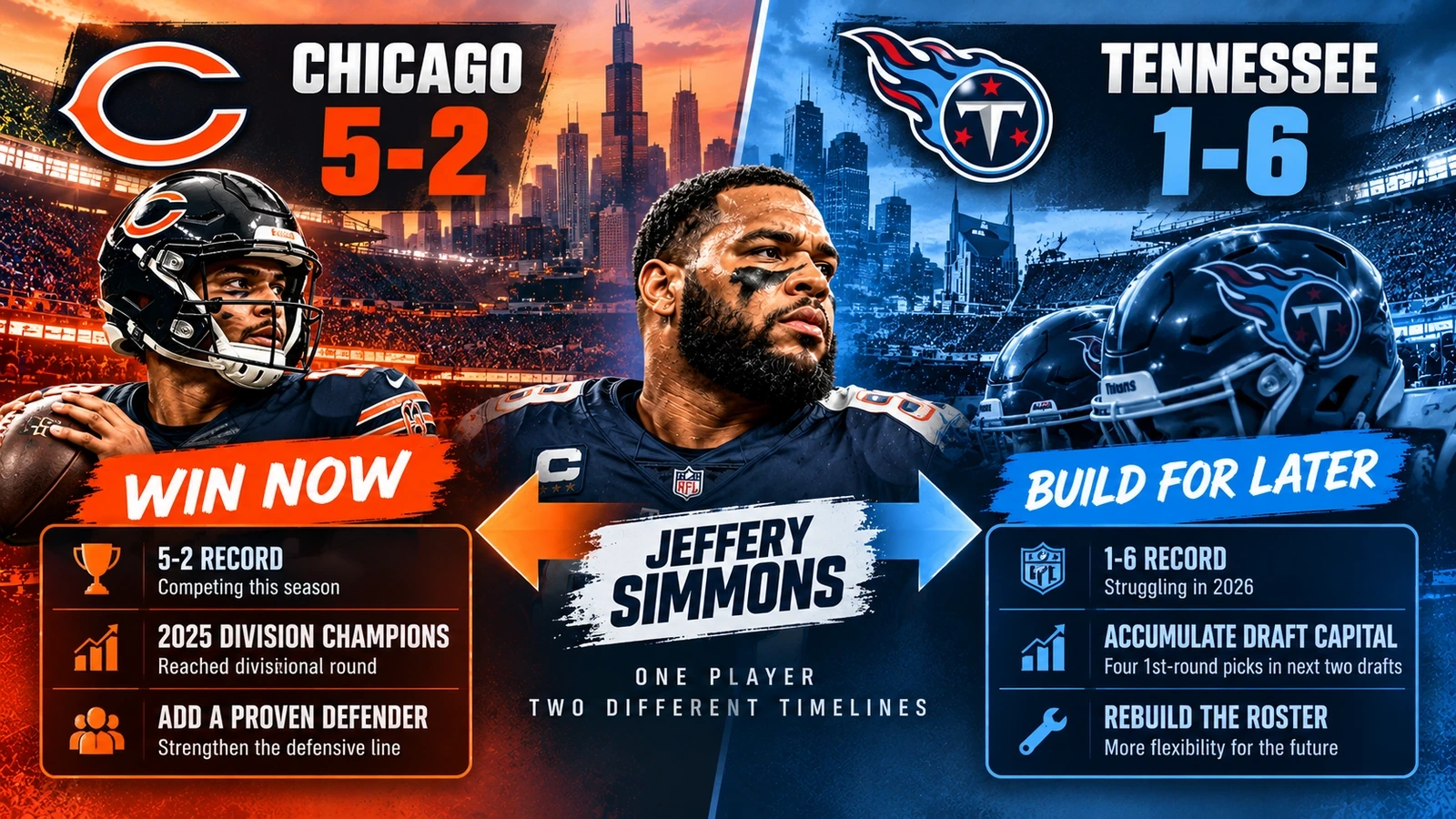
That sounds like a sudden reversal. But the two teams are betting on different things: Chicago wants a proven difference-maker now, while Tennessee wants more chances to build a winner later. Their records help explain the split—the Bears were 5-2 and the Titans were 1-6 when the deal was announced. (Associated Press)
※ Images in this article are AI-generated illustrations created to help explain the story. They are not actual photographs, and depictions of people, places, or events may differ slightly from reality.
The full trade terms—and what happened the night before—make the decision easier to understand.
What Did Chicago Actually Give Up?
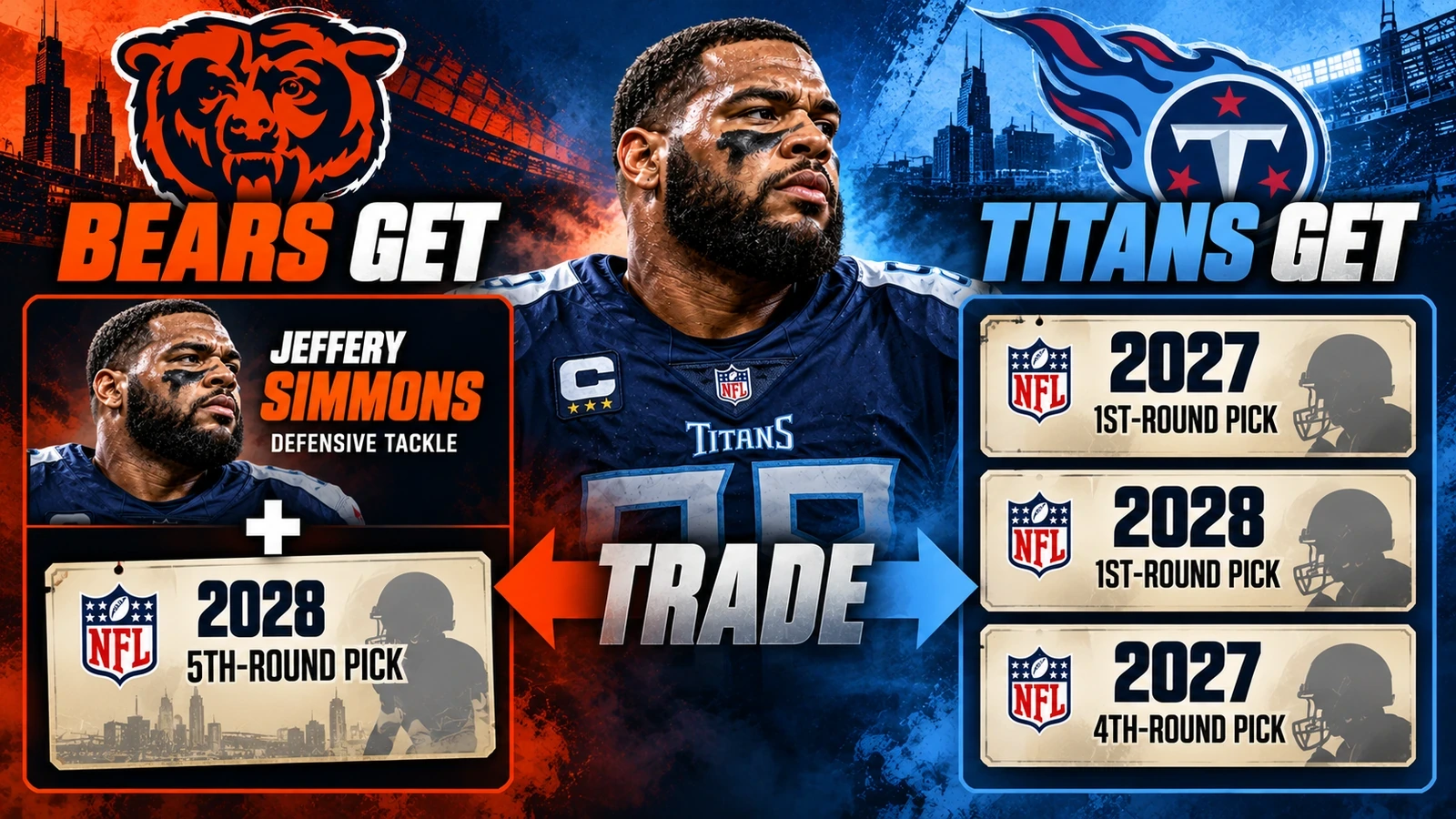
Chicago agreed to give up its 2027 and 2028 first-round picks plus a 2027 fourth-round pick. In return, it gets Simmons and Tennessee’s 2028 fifth-round selection. Both the Titans and the NFL confirmed those terms on October 29. (Titans · NFL)
| Chicago receives | Tennessee receives |
|---|---|
| Jeffery Simmons | Chicago’s 2027 first-round pick |
| 2028 fifth-round pick | Chicago’s 2028 first-round pick |
| — | Chicago’s 2027 fourth-round pick |
Why are the first-rounders such a big deal? A first-round selection gives a team an early opportunity to choose one of the next year’s most sought-after college players. Giving up two means Chicago is sacrificing two future opportunities to add young, relatively inexpensive talent.
The exact positions of those picks are not known yet. They depend on how Chicago finishes in the relevant seasons, so Tennessee is acquiring future opportunities, not two guaranteed stars.
Why Would Tennessee Trade a Player It Just Re-Signed?
Tennessee decided that the draft capital was worth more to its rebuilding effort than keeping one elite defender. That does not mean the Titans suddenly thought Simmons was a bad player.
In fact, general manager Mike Borgonzi said the team had not been trying to trade him. According to the Titans’ account, Bears general manager Ryan Poles called on the night of October 28 with an offer that changed the calculation. Borgonzi discussed the proposal with coach Robert Saleh and controlling owner Amy Adams Strunk before the teams reached an agreement the next morning. (Titans)
The timing was especially jarring. On October 28, Simmons told reporters he had not heard anything from his agent or the organization indicating he would be traded. Less than a day later, the deal was public. (Titans)
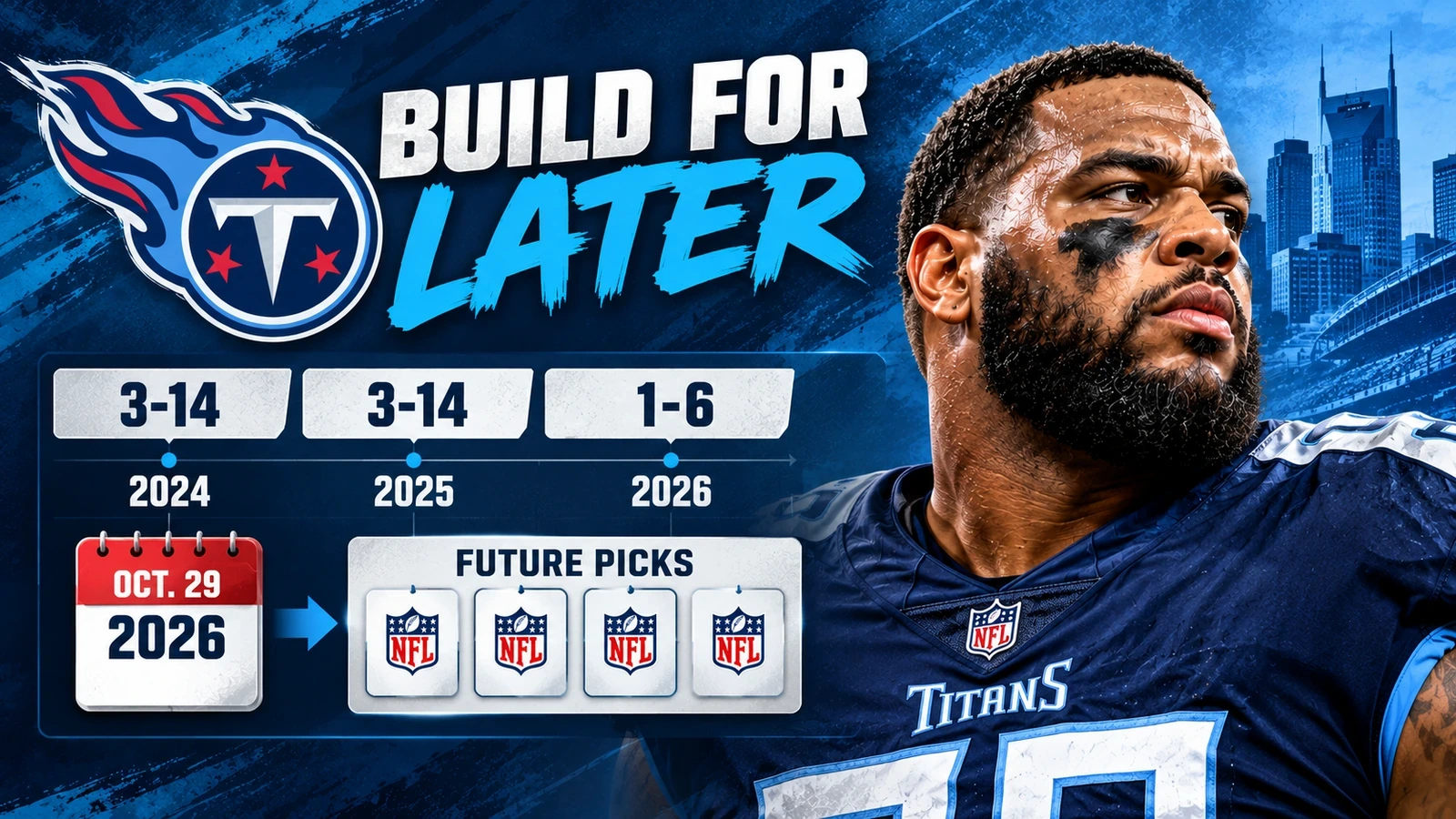
Tennessee had finished 3-14 in each of the previous two seasons and stood at 1-6 in 2026. Borgonzi said the trade would help accelerate a draft-centered rebuild; the team said it was positioned to hold four first-round selections across the next two drafts. (Titans)
That is the uncomfortable arithmetic of a struggling team. An outstanding veteran can help win games, but if the roster needs improvement in several places, the picks acquired for him might be more useful over multiple seasons. Whether that decision works will depend on who Tennessee actually drafts.
Why Is Chicago Willing to Pay So Much Right Now?
Because Chicago sees a chance to compete immediately—and a disruptive defensive tackle could make that chance more realistic.
The Bears entered the trade at 5-2 behind quarterback Caleb Williams and coach Ben Johnson. Chicago won its division in 2025 and reached the divisional round of the playoffs, giving the organization a reason to believe it could push further. But its defensive line remained an area to improve. (Associated Press · Chicago Sun-Times)
A draft pick in 2027 or 2028 might eventually produce an excellent player. It cannot pressure opposing quarterbacks for Chicago this November. Simmons potentially can, once the deal is finalized and he is ready to play.
That is the central trade-off: Chicago is spending future flexibility to strengthen a current contender. The decision raises expectations, but even an All-Pro addition cannot guarantee a championship.
What Makes Jeffery Simmons Worth Such a Price?
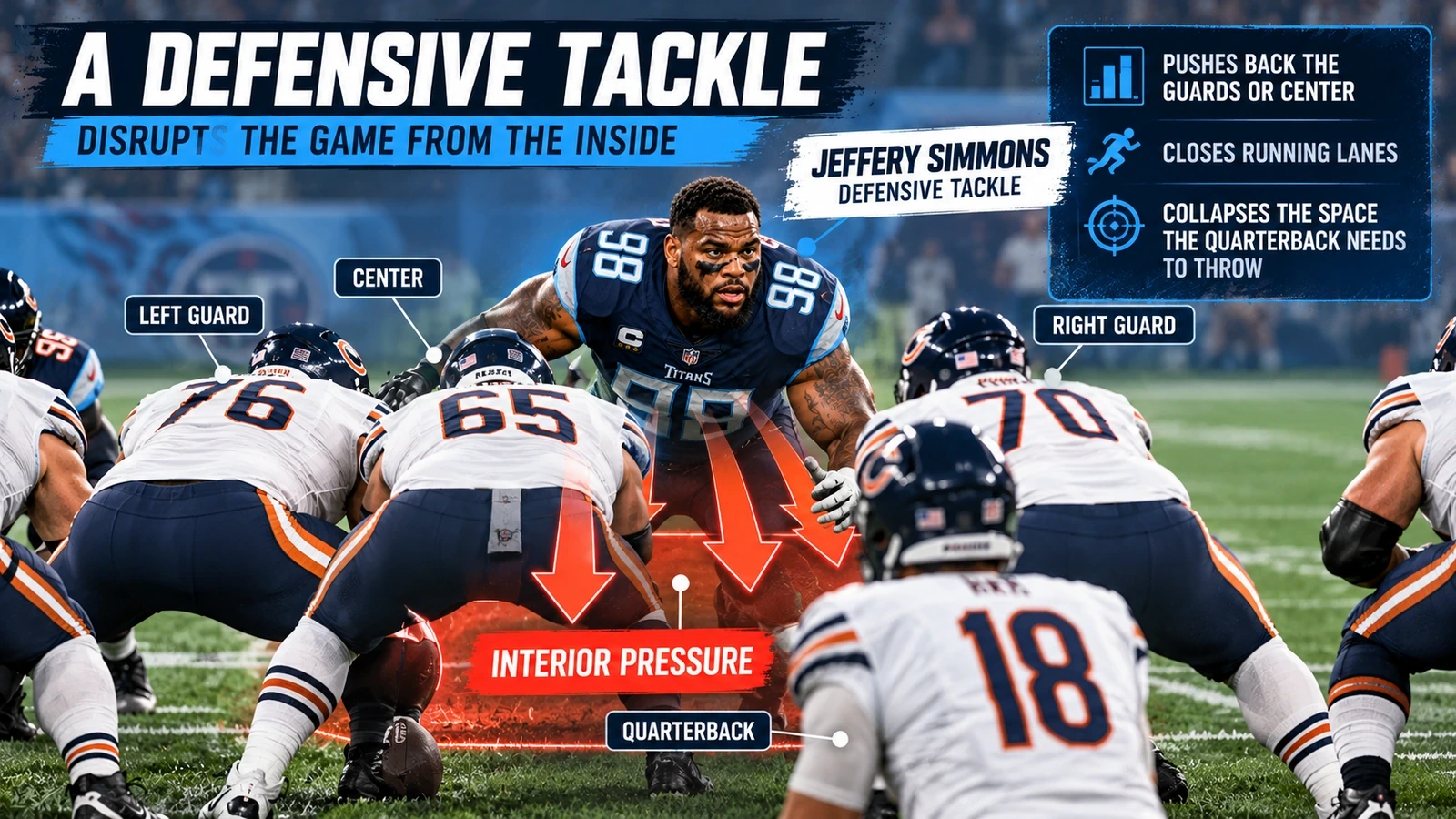
Simmons is not just a recognizable name. He was a first-team All-Pro in 2025, when he recorded a career-high 11 sacks, and he has been selected to four Pro Bowls. Through seven games in 2026, he had four sacks. The Titans originally drafted him 19th overall in 2019. (NFL · Associated Press)
A defensive tackle lines up near the middle of the offensive line. Unlike an edge rusher attacking from the outside, a top interior defender can drive back the guards or center, squeeze the running lanes and collapse the space a quarterback needs to step forward and throw.
That can improve a defense even on plays when the tackle does not record a sack. An offense may have to assign an extra blocker to him, which can create opportunities for teammates elsewhere.
Chicago is paying for the possibility of that kind of impact on every down—not simply for the four sacks already on Simmons’s 2026 stat sheet.
Does Simmons’s $105.8 Million Contract Make This Riskier?
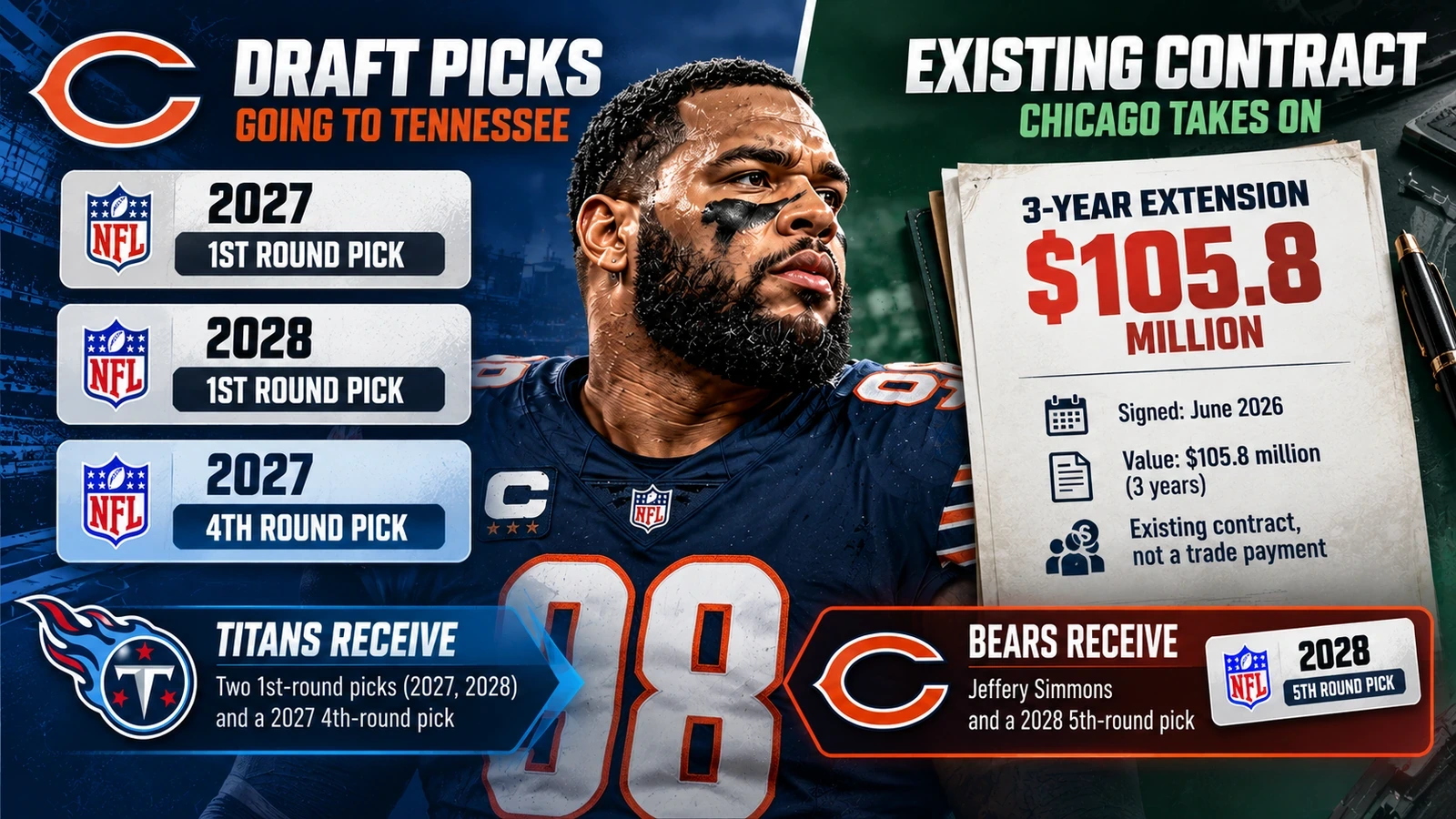
Yes. Chicago is taking on a major financial commitment as well as surrendering valuable draft choices.
Simmons signed a three-year extension worth about $105.8 million in June 2026, before the trade. That is the value of an existing contract extension—not a separate $105.8 million fee paid by Chicago to Tennessee. Under NFL salary-cap rules, compensation and prior bonuses can be accounted for differently when a player changes teams, so the headline total is not the same as an immediate cash payment or a single-year cap charge. (NFL · Over The Cap)
Think of it as two separate costs. Chicago has given up valuable draft slots and is committing roster resources to an established, highly paid veteran. Tennessee gets future picks, but it also loses the player who was supposed to anchor its defense.
If Simmons performs at an All-Pro level through Chicago’s competitive window, the gamble could look worthwhile. If the defense fails to improve or the team needs inexpensive young players later, those missing first-round selections may become much more painful. Both outcomes remain possibilities, not predictions.
What Happens Next for the Bears and Titans?
First, the announced agreement was still subject to Simmons passing a physical as of October 29. The teams had agreed on compensation, but that medical condition should not be mistaken for a meaningless formality or proof that every transaction step was already complete. (Titans)
For Chicago, the next test is how quickly Simmons can be integrated into its defensive front—and whether that leads to better pressure in important games. For Tennessee, the test is much longer: draft position, scouting and development will determine what the two first-rounders ultimately become.
The league’s 2026 trade deadline is November 10 at 4 p.m. Eastern Time, so the move also comes before the final stretch of in-season trading. (NFL)
Bottom Line: What This Story Really Means
The Titans did not trade Jeffery Simmons because he stopped being an elite defensive tackle. They accepted an unusually large package of future picks because their 1-6 start and longer-term rebuilding needs made that offer difficult to reject.
Chicago made the opposite calculation. The Bears believe proven help on defense is worth more to them now than two first-round opportunities later. One team is buying time to rebuild; the other is using its future to compete in the present. The real verdict will come from what Simmons does in Chicago and what Tennessee turns those picks into.
Jeffery Simmons Trade: Key Questions Explained
Q. Which NFL team is Jeffery Simmons joining?
The Chicago Bears agreed to acquire Simmons from the Tennessee Titans on October 29, 2026. The announced agreement was pending a physical.
Q. Which first-round picks are included in the deal?
Tennessee is set to receive Chicago’s first-round selections in the 2027 and 2028 NFL drafts. Their eventual overall pick numbers are not yet known.
Q. Did Chicago receive anything besides Simmons?
Yes. The Bears also receive Tennessee’s fifth-round pick in 2028, while the Titans receive Chicago’s fourth-round pick in 2027.
Q. Was Tennessee actively shopping Simmons?
General manager Mike Borgonzi said the Titans were not trying to trade Simmons. He said Bears GM Ryan Poles made the compelling offer on October 28.
Q. How old is Simmons, and what has he achieved?
Simmons is 29. He has made four Pro Bowls and earned first-team All-Pro honors for his 2025 season, when he recorded 11 sacks.
Q. Does the trade mean Chicago paid Tennessee $105.8 million?
No. That figure refers to the three-year contract extension Simmons signed with the Titans in June. The trade compensation consists of draft picks, while Chicago must account for the player’s existing contract.
Q. Why aren’t two first-round picks a guaranteed win for Tennessee?
Draft picks offer chances to acquire talent, not guaranteed results. Their eventual positions and the success of the players selected will determine how valuable the return becomes.
Q. When is the 2026 NFL trade deadline?
The deadline is November 10, 2026, at 4 p.m. Eastern Time.
Did this help make the story clearer? 🙂 WIN keeps unpacking the “why” behind the news—clearly and simply!
Sources
Official Trade Terms and Tennessee’s Decision
Tennessee Titans — Simmons Trade Announcement, October 29, 2026
Tennessee Titans — GM Mike Borgonzi Explains the Trade
League Confirmation and Chicago’s Competitive Position
NFL — Jeffery Simmons Trade Report
NFL — 2026 Trade Deadline Tracker
Associated Press via CBS Chicago — Bears Agree to Acquire Simmons
Chicago Sun-Times — Bears Trade Reflects Confidence in Caleb Williams