
Saudi Arabia Built a Pipeline to Bypass Hormuz—So Why Is Its Oil Route Still at Risk?
Wasn’t Saudi Arabia’s East-West Pipeline built for exactly this kind of crisis?
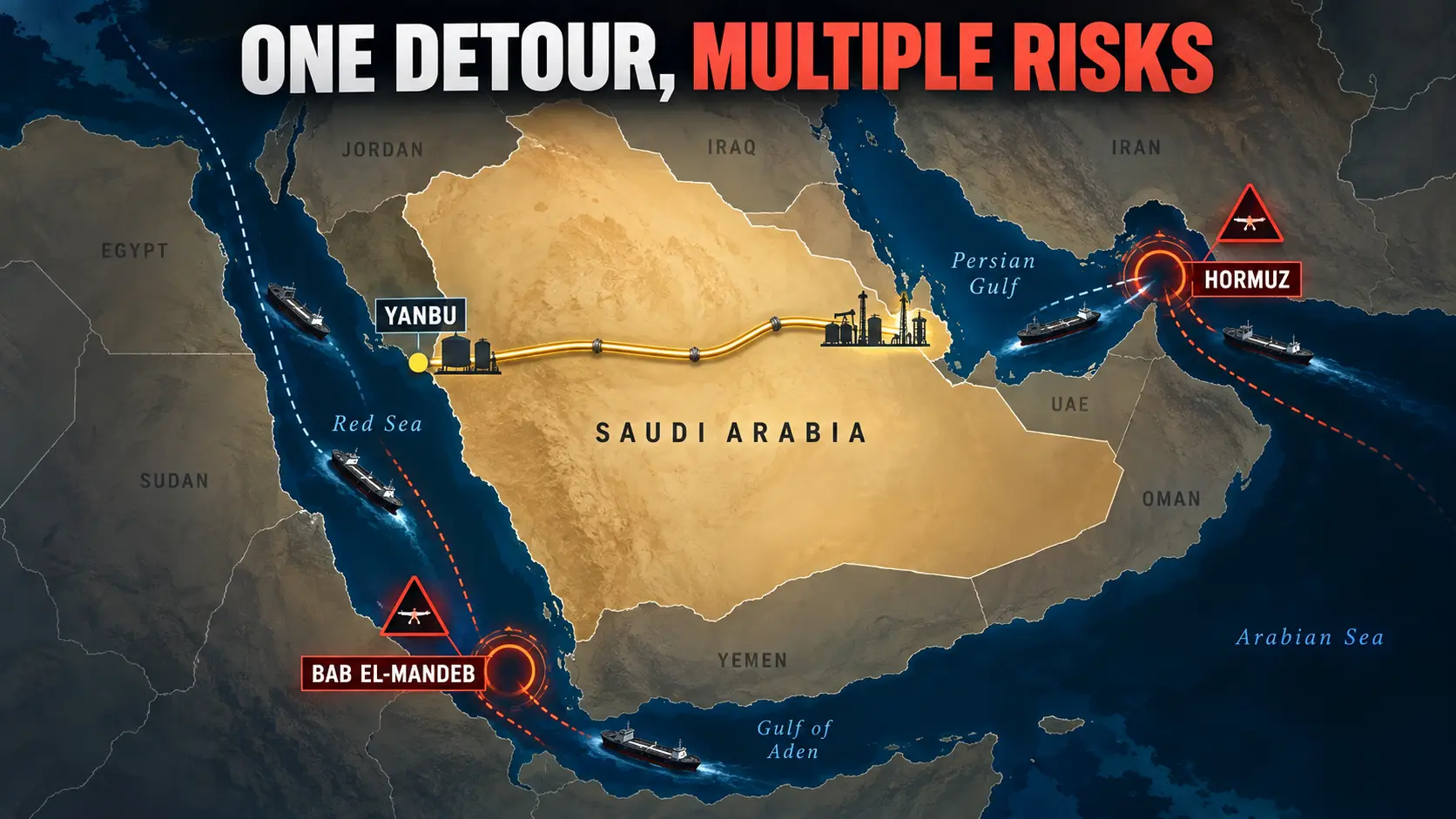
If ships cannot move safely through the Strait of Hormuz, Saudi Arabia can pump crude across the country to the Red Sea instead. That sounds like a ready-made escape route.
The problem is that an escape route can have its own weak points. A drone attack in September damaged key pumping infrastructure on the East-West Pipeline, while Yemen’s Houthis were separately expanding military pressure around Saudi Arabia and the Red Sea. Saudi Arabia said the pipeline attack came from Iran-backed militias in Iraq; that attack should not be conflated with the Houthis’ later missile and drone attacks on Saudi targets.
That distinction matters because the bigger story is not one attack by one group. It is the way several pressure points are stacking up along the same oil-export system.
What Actually Happened to the East-West Pipeline?
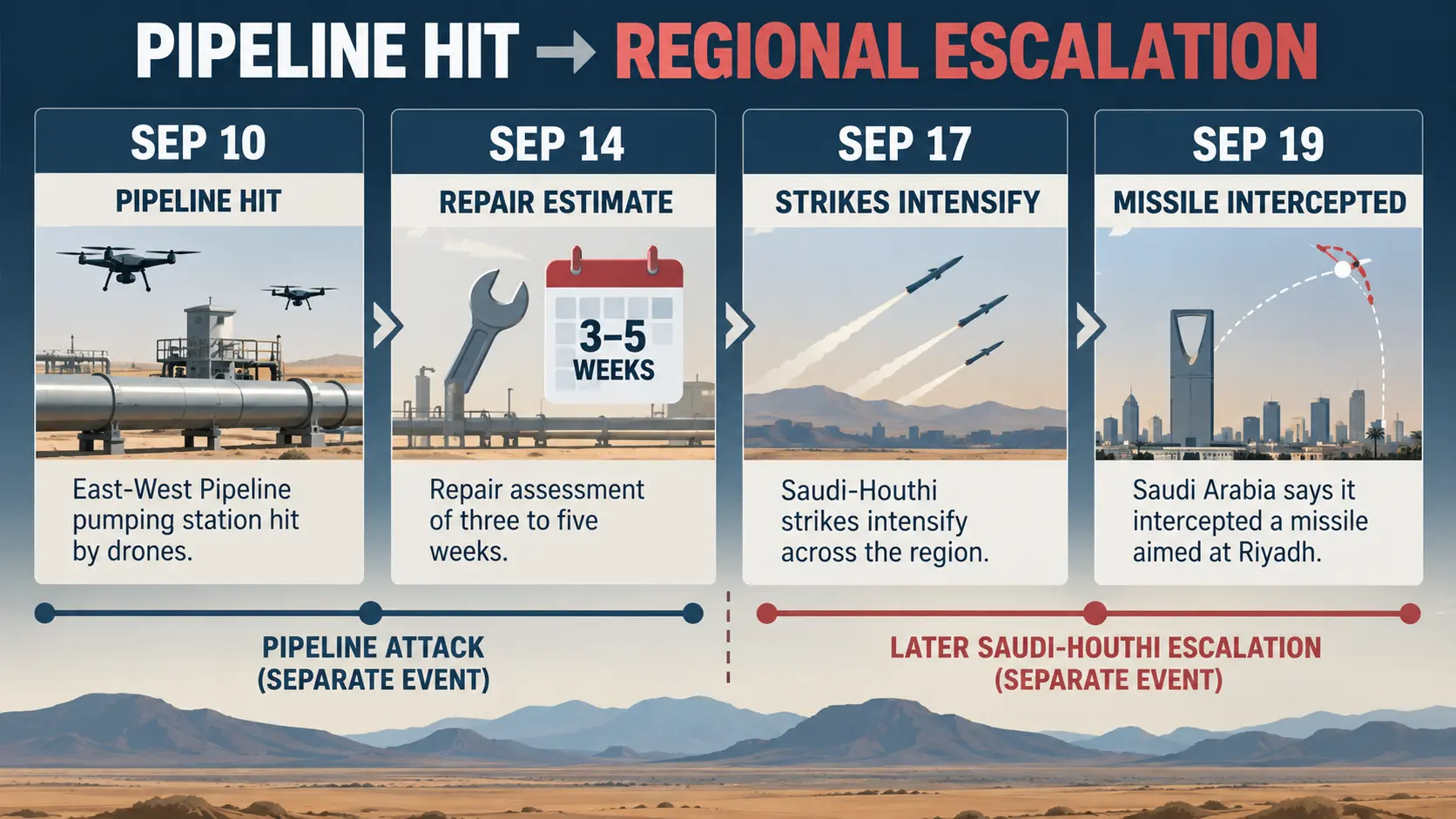
The East-West Pipeline was hit by drones on September 10, according to Saudi authorities and subsequent reporting. AP reported on September 14 that major repairs could take three to five weeks and that the system might operate only partially during that period. The attack damaged important pumping infrastructure on the 745-mile route. (AP)
Reuters later reported that three pumping stations had been damaged and that Saudi Arabia was trying to restore roughly half of the pipeline’s capacity quickly, although estimates for a full return remained uncertain. (Reuters)
At the same time, a separate conflict was worsening. Saudi Arabia and Yemen’s Iran-aligned Houthis exchanged strikes, and on September 19 Saudi Arabia said it had intercepted a Houthi ballistic missile aimed at Riyadh. Saudi authorities also said attempted attacks on Yanbu and other locations were thwarted. The Houthis claimed attacks on Saudi oil facilities, but AP said it could not independently verify those claims. (AP)
So the key sequence is:
| Date | Development | Why it mattered |
|---|---|---|
| September 10 | Drones hit East-West Pipeline infrastructure | Saudi Arabia’s main land bypass around Hormuz was disrupted |
| September 14 | AP reports repairs could take three to five weeks | The disruption looked longer than a brief outage |
| September 17 | Saudi-Houthi strikes intensify | Risk spreads from one pipeline to a wider regional confrontation |
| September 19 | Saudi Arabia says it intercepted a Houthi missile aimed at Riyadh | The conflict reaches the Saudi capital and keeps energy-security fears elevated |
Why Was This Pipeline So Important in the First Place?
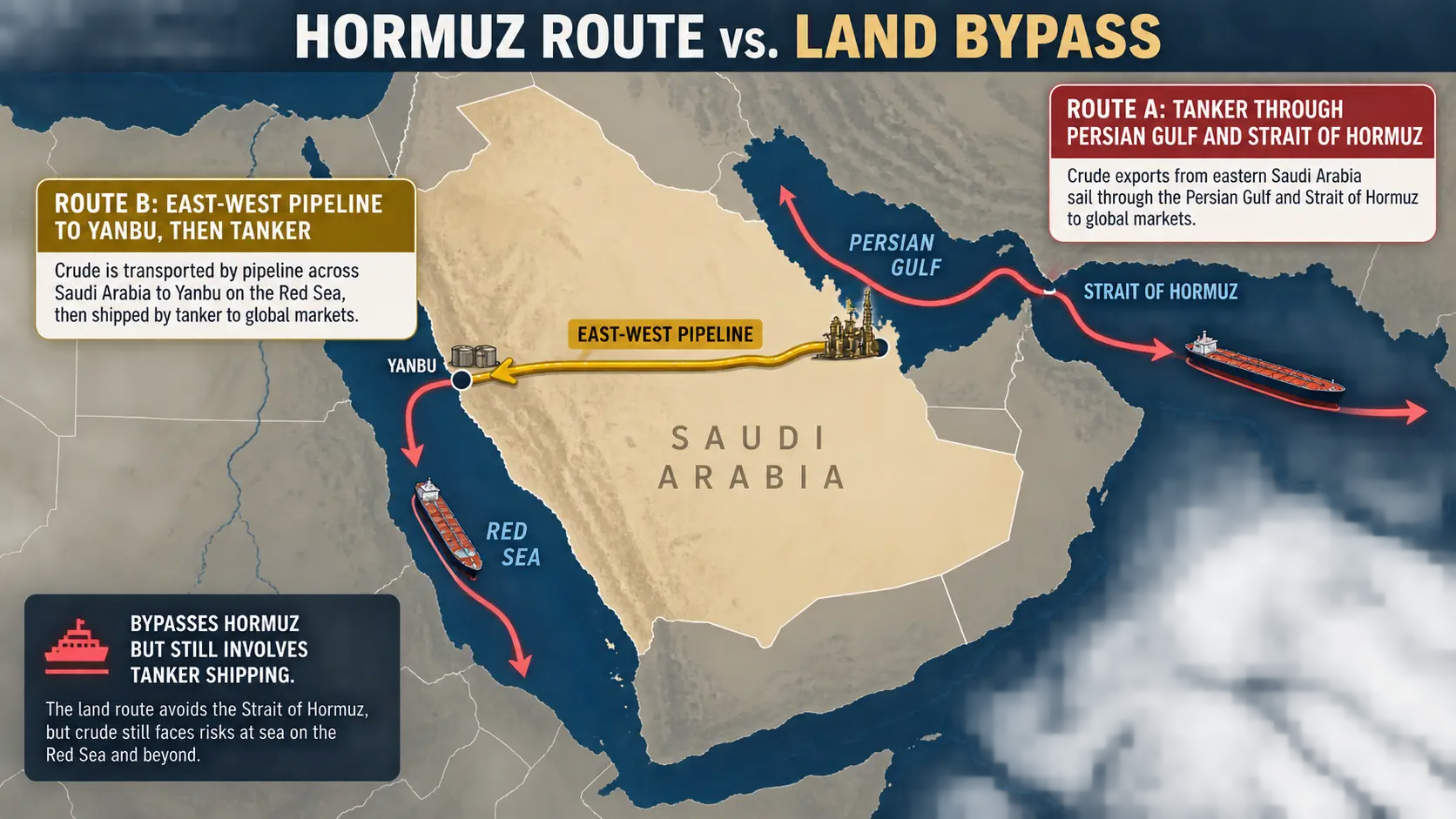
The East-West Pipeline matters because it lets Saudi Arabia move crude from its eastern oil-producing region to Yanbu on the Red Sea without sending that oil through the Strait of Hormuz.
The pipeline’s maximum capacity reached 7 million barrels per day in the first quarter of 2026 as Saudi Arabia sharply increased westbound flows during the broader Middle East energy disruption. (AP)
That capacity does not mean 7 million barrels were always moving through it. AP reported that the pipeline had recently been carrying an average of roughly 2.6 million to 4 million barrels per day. But even that range is enormous: if a large share suddenly disappears from the market, traders have to ask where replacement barrels will come from and how quickly they can arrive. (AP)
A simple way to picture it is this: Hormuz is the Persian Gulf’s front door. The East-West Pipeline is a hallway that lets Saudi oil leave through a different door on the Red Sea.
The hallway helps only if the hallway itself works—and if the ships waiting at the other end can still move safely.
If the Oil Reaches the Red Sea, Why Is the Route Still Vulnerable?
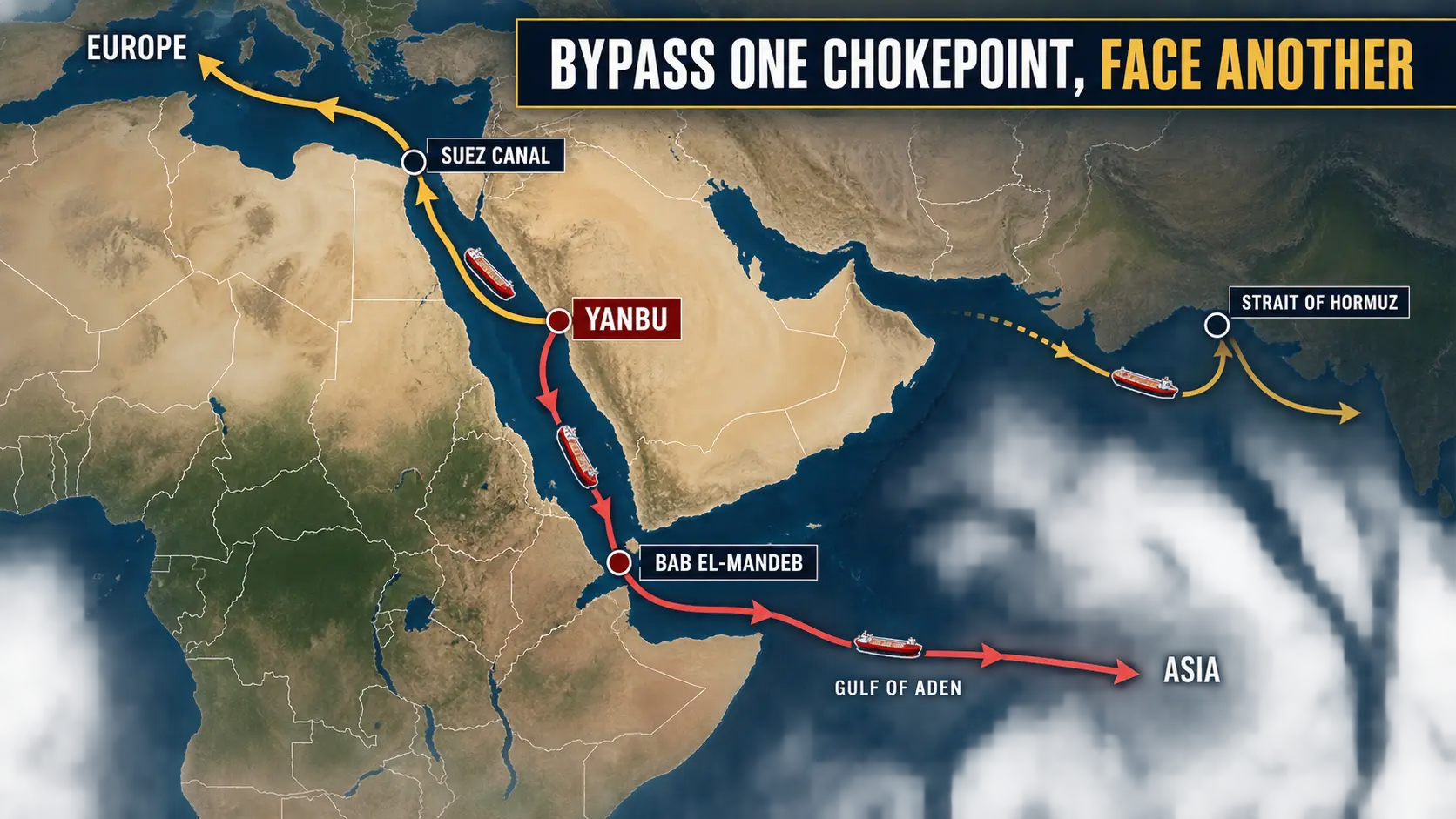
Because reaching Yanbu solves only the first part of the problem.
From Yanbu, tankers can head north through the Red Sea toward the Suez Canal and Europe, or they can head south toward the Bab el-Mandeb Strait and then into the Gulf of Aden and the Indian Ocean. The second route is especially important for reaching Asian markets efficiently.
That is where the Houthi advance matters. AP reported that Houthi forces seized Mokha and strategic Red Sea islands, expanding their positions near Bab el-Mandeb. The group has also targeted Saudi shipping and infrastructure in the Red Sea. (AP)
Saudi exporters can send some tankers north through Suez to avoid Bab el-Mandeb, but that can make deliveries to Asia longer and more expensive. Reuters reported that tanker traffic, insurance costs, shipping availability, and physical fuel markets were all under pressure as the conflict spread. (Reuters)
The route therefore has three separate places where trouble can build:
| Part of the system | What it does | Current risk |
|---|---|---|
| Strait of Hormuz | Main sea exit from the Persian Gulf | Shipping has been heavily disrupted by the broader Iran conflict |
| East-West Pipeline | Moves Saudi crude overland to the Red Sea | Pumping infrastructure was damaged by drones |
| Bab el-Mandeb / Red Sea | Connects Red Sea shipping to the Indian Ocean | Houthi military pressure has increased around the corridor |
That is why calling the East-West Pipeline a “Hormuz bypass” is correct but incomplete. It avoids one chokepoint. It does not make Saudi oil exports immune to attack, shipping disruption, or another chokepoint farther west.
Were the Houthis Behind the Pipeline Attack?
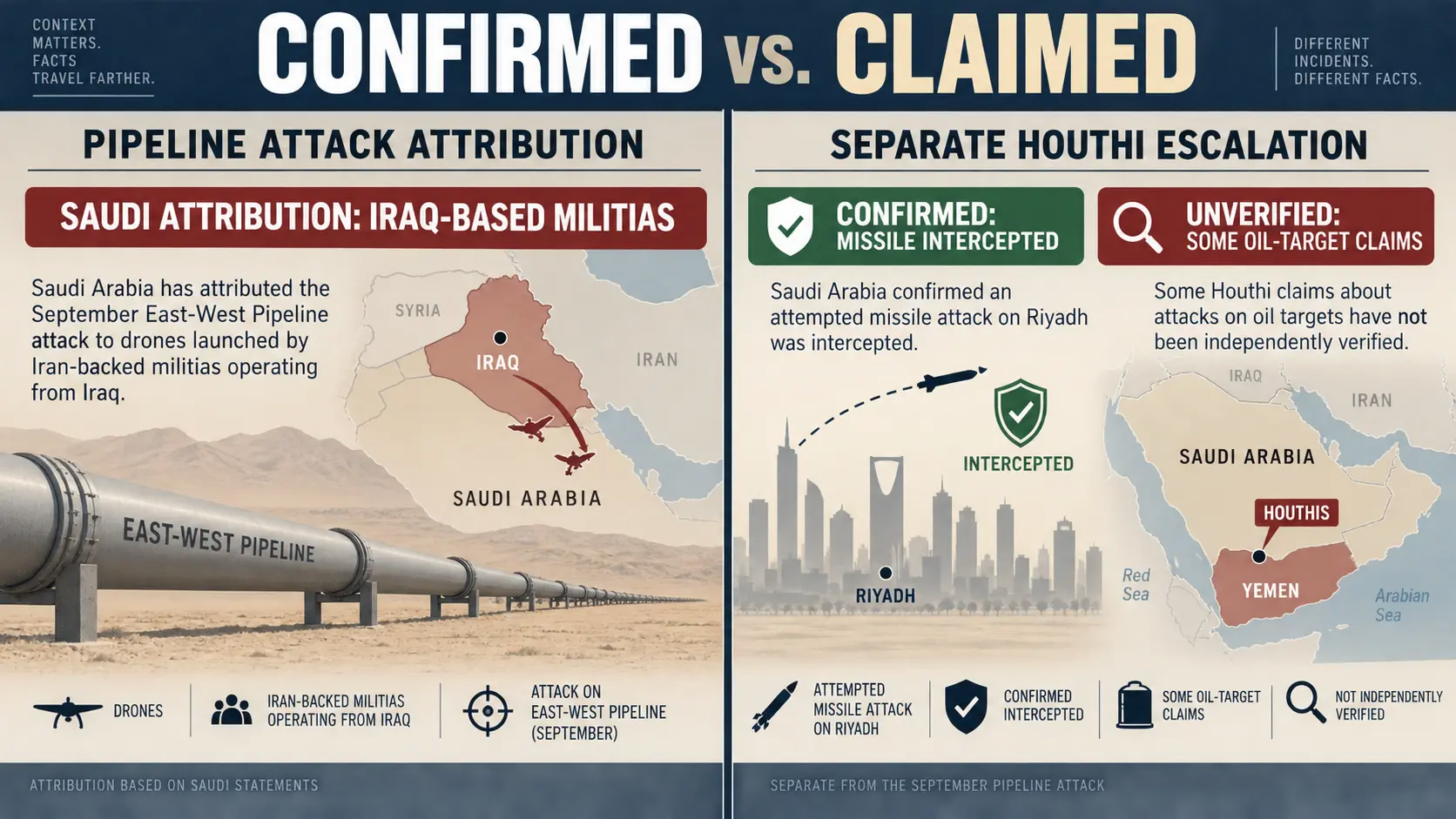
Not based on the public evidence available so far.
Saudi Arabia blamed the East-West Pipeline drone attack on Iran-backed militias operating from Iraq. Reuters likewise described the pipeline strikes as having been launched from Iraq, while AP reported the Saudi attribution. (Reuters · AP)
The Houthis were creating a separate but connected layer of pressure. They exchanged strikes with Saudi Arabia, expanded positions along Yemen’s Red Sea coast, and later claimed attacks on Saudi infrastructure. Saudi Arabia confirmed the attempted missile attack on Riyadh but said it had intercepted it; AP said it could not independently verify some of the Houthis’ claims about oil facilities.
This distinction is easy to lose because both sets of events involve Iran-aligned armed groups and both affect Saudi energy security. But “Iran-aligned” does not mean every attack was conducted by the same force, and it does not by itself prove operational coordination in a specific strike.
How Could This Reach U.S. Gas Pumps?
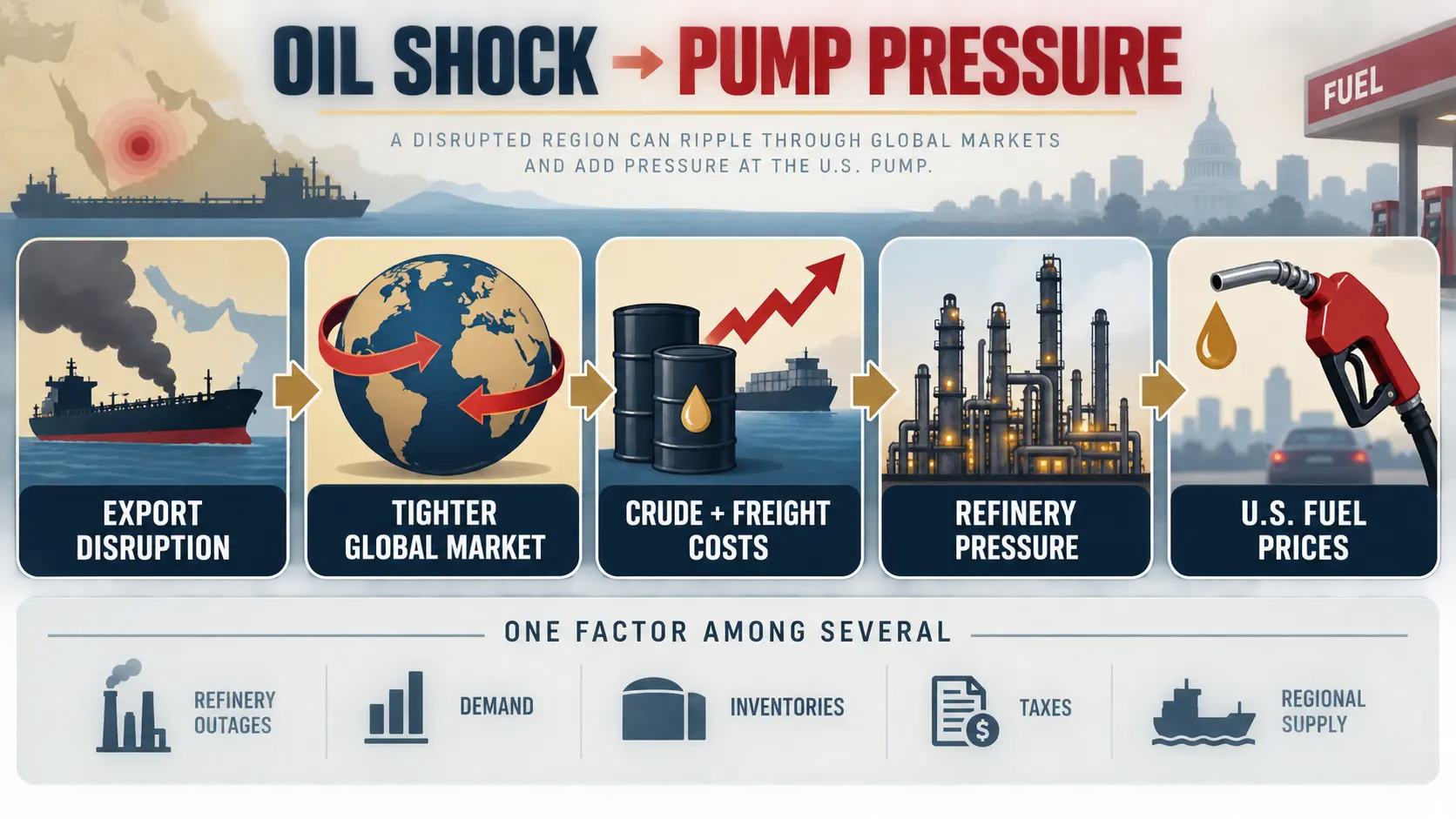
The United States produces a large amount of its own oil, but crude is still priced in a global market. If a major exporter has fewer barrels available—or if those barrels become slower and more expensive to move—the global price of crude can rise.
That feeds into U.S. fuel prices, although not in a simple one-for-one way. Refinery outages, seasonal gasoline demand, inventories, transportation costs, taxes, and regional supply conditions all matter too.
The market was already tight before the latest Saudi escalation. On September 17, AAA said the national average for regular gasoline was about $4.44 a gallon, up 16 cents from the previous week and more than $1 above the same time a year earlier. AAA linked the increase to crude prices around $100 a barrel and continued instability around the Strait of Hormuz. (AAA)
A day later, Reuters reported U.S. gasoline averaging about $4.47 a gallon and diesel at a record $6.45 as oil markets dealt with the Saudi pipeline damage, Houthi attacks, Hormuz disruption, and refinery constraints. (Reuters)
So the pipeline attack did not single-handedly cause expensive gasoline. The more accurate chain is:
Saudi export capacity becomes less reliable → traders price in a greater risk of shortage → crude and shipping costs stay elevated → U.S. refiners pay more for a stressed global supply system → consumers face more pressure at the pump.
What Is Saudi Arabia Doing to Keep Oil Moving?
Saudi Arabia has been trying to create workarounds rather than wait for a full pipeline repair.
Reuters reported that Saudi crude was being offered through ship-to-ship transfers off Oman, which could move additional barrels into global markets despite the East-West Pipeline disruption. Saudi Arabia was also trying to bring roughly half of the pipeline’s capacity back quickly, although sources differed on how long a full recovery would take. (Reuters)
Aramco also has storage and a wider export network that can absorb some short-term disruption. But storage is a buffer, not a permanent substitute for transport capacity. If a pipeline, a loading terminal, a sea lane, and tanker availability all face pressure at the same time, the system becomes progressively harder and more expensive to reroute.
That is why oil prices eased on some days when traders saw possible workarounds, yet remained above $100 per barrel in the Reuters reports from September 17 and 18. The market was reacting not only to how much oil existed, but to whether that oil could actually get where buyers needed it. (Reuters, September 17 · Reuters, September 18)
What Should You Watch Next?
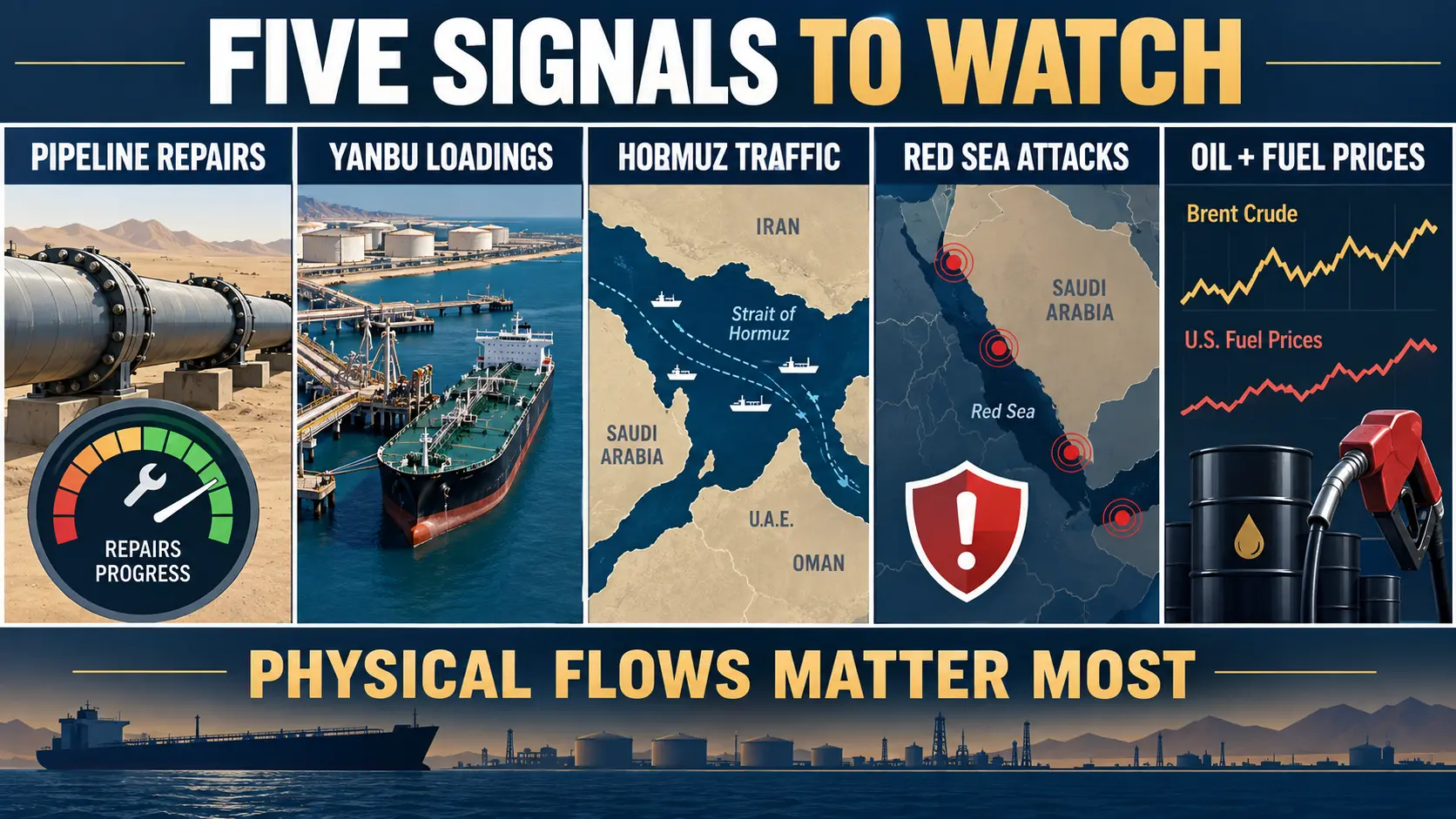
Five indicators will tell you more than any single headline:
- East-West Pipeline repair progress. A partial restart would return some Saudi export flexibility; a prolonged outage would keep the system tight.
- Yanbu loadings. If tankers can load normally again, the Red Sea route becomes more useful even before every repair is complete.
- Strait of Hormuz traffic. More ship transits would reduce pressure on Saudi Arabia’s need to bypass the Gulf route.
- Houthi attacks around Saudi Arabia and the Red Sea. Fewer attacks would lower shipping and insurance risk; more attacks would do the opposite.
- Brent crude, diesel, and U.S. gasoline prices. Those prices show whether physical disruptions are turning into broader economic pressure.
On September 19, Saudi Arabia’s interception of a Houthi missile aimed at Riyadh showed that the confrontation had not yet cooled. The fact that Yanbu was also named among attempted targets keeps the energy-security question directly tied to the military one. (AP)
No single attack guarantees higher gasoline prices. The risk is that Saudi Arabia now has fewer reliable ways to reroute oil just as several regional pressure points are worsening at once.
Why It Matters in One Sentence
Saudi Arabia’s East-West Pipeline was designed to reduce dependence on the Strait of Hormuz, but damage to the pipeline and escalating threats around the Red Sea show that bypassing one chokepoint does not eliminate the global oil market’s vulnerability to another—and that can keep pressure on U.S. fuel prices.
Saudi East-West Pipeline: Key Questions Explained
Q. What is the Saudi East-West Pipeline?
It is a 745-mile crude-oil pipeline that moves oil from eastern Saudi Arabia to Yanbu on the Red Sea, allowing exports to bypass the Strait of Hormuz.
Q. Was the East-West Pipeline attack carried out by the Houthis?
Public reporting does not establish that. Saudi Arabia blamed the pipeline drone attack on Iran-backed militias in Iraq, while the Houthis separately carried out or claimed other attacks against Saudi targets.
Q. How long could repairs take?
AP reported on September 14 that repairs could take three to five weeks, although Reuters later reported efforts to restore roughly half of the capacity sooner. A full timeline remained uncertain.
Q. Why can’t Saudi Arabia simply ship everything from Yanbu?
Because reaching Yanbu solves only part of the journey. Tankers still need safe, affordable routes through the Red Sea, Suez Canal, or Bab el-Mandeb, depending on the destination.
Q. What is the difference between Hormuz and Bab el-Mandeb?
Hormuz is the maritime exit from the Persian Gulf. Bab el-Mandeb is the southern gateway between the Red Sea and the Gulf of Aden. They are different chokepoints serving different parts of the route.
Q. Could the Saudi pipeline disruption raise U.S. gas prices?
Yes, it can add upward pressure by tightening global crude supply and raising transport costs. But U.S. gasoline prices also depend on refinery capacity, inventories, demand, taxes, and regional supply conditions.
Q. Why are traders watching Yanbu so closely?
Yanbu is the Red Sea terminal at the end of the East-West Pipeline. If crude cannot reliably reach or load from Yanbu, Saudi Arabia loses part of the flexibility it uses to bypass problems in the Persian Gulf.
Q. What matters most next?
Pipeline repair progress, tanker loadings at Yanbu, ship traffic through Hormuz, Houthi attacks in and around the Red Sea, and the direction of global crude and fuel prices will show whether the disruption is easing or deepening.
Did this help make the story clearer? 🙂
WIN keeps unpacking the “why” behind the news—clearly and simply!
Sources
Pipeline Damage and Saudi Export Capacity
Associated Press — Saudi Pipeline Hit by Drones Will Be Out of Service for Weeks
Reuters — Three Pumping Stations Along Saudi East-West Pipeline Were Hit
Oil Markets and Workarounds
Reuters — Oil Falls as Investors Watch Middle East Supply Disruptions
Reuters — Oil Slides After China Asks Iran to Limit Houthi Attacks on Saudi Oil Facilities
Houthi Escalation and Saudi Security
Associated Press — Saudi Arabia Confirms Houthis Tried to Attack Riyadh