
Apple Was Hit With a $5.7 Billion Patent Verdict. How Did Taction Win—and Will Apple Actually Have to Pay?
$5.7 billion—for the tiny tap you feel when an iPhone responds to your touch?
And if a jury already awarded that amount, does Apple now have to write a check?
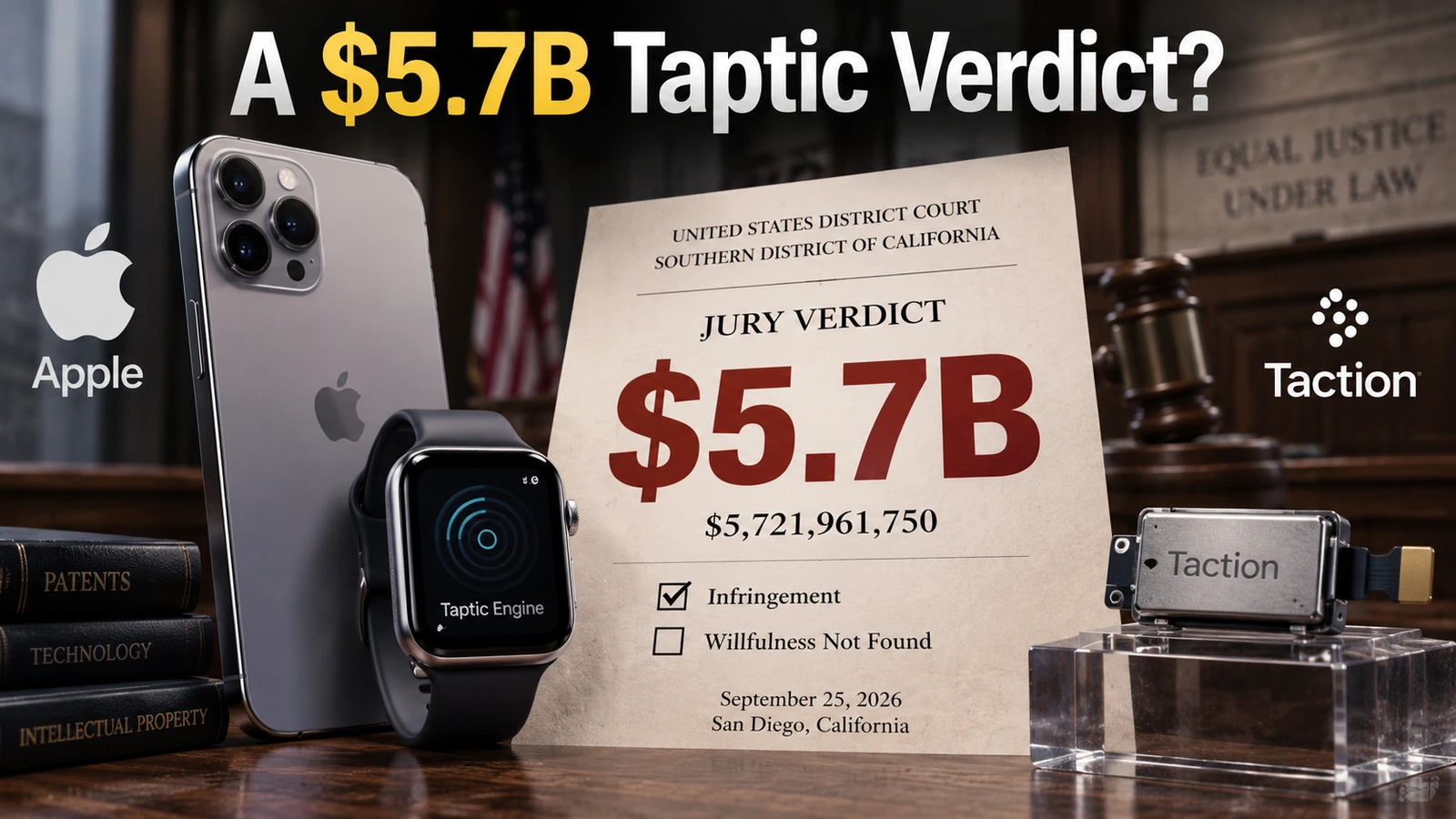
On September 25, 2026, a federal jury in San Diego found that Apple’s Taptic Engine infringed three claims across two patents owned by California-based Taction Technology. The jury awarded $5,721,961,750 in damages, a figure Reuters and Law360 reported as a record-setting U.S. patent verdict. The jury also found that the infringement was not willful. Apple said it strongly disagreed with the verdict and would appeal. (Reuters via CNA · Law360)
That last part matters. A jury verdict is a major legal win, but it is not the same thing as a final, irreversible cash payment. Post-trial motions, entry of judgment, an appeal to the U.S. Court of Appeals for the Federal Circuit, a settlement, or some combination of those steps could still change what Apple ultimately owes. A patent-litigation analysis published after the verdict noted that no final judgment had yet appeared on the docket. (Patent Litigator)
The more interesting story, then, is not simply that Apple “lost $5.7 billion.” It is how a small haptics company reached this point after Apple had already won the case once—and why the headline number may still be only one stage in a much longer fight.
What Did the Jury Actually Decide?

The jury answered several different questions, and they are easy to blur together.
| Question | Jury’s answer |
|---|---|
| Did Apple infringe the asserted patent claims? | Yes—claims 17 and 19 of U.S. Patent No. 10,659,885 and claim 16 of U.S. Patent No. 10,820,117 |
| Was the infringement willful? | No |
| Did Apple prove its invalidity defenses? | The verdict went to Taction on those defenses |
| How much did the jury award? | $5,721,961,750 |
That distinction is important because patent infringement does not automatically mean a jury found deliberate copying. Here, the jury found infringement but did not find willfulness. (Patent Litigator)
Under U.S. patent law, damages are meant to compensate a patent owner for infringement and cannot be less than a reasonable royalty. The statute also gives a court power in appropriate cases to increase damages up to three times the amount found or assessed. The Taction jury’s no-willfulness finding therefore matters when people see the verdict and assume the jury concluded Apple intentionally stole the technology. It did not make that finding. (35 U.S.C. § 284)
What Is the Taptic Engine—and What Did Taction Patent?

“Haptics” is simply technology that communicates through touch. A phone vibration, a simulated click, or a subtle tap on your wrist can all be forms of haptic feedback. The Federal Circuit described haptics in the Taction case as interaction with technology through the sense of touch, including vibrations. (U.S. Court of Appeals for the Federal Circuit)
Apple’s Taptic Engine is the actuator used to create that tactile feedback in products including iPhones and Apple Watches. (Reuters via CNA)
Taction, meanwhile, developed tactile-transducer technology originally aimed at making low-frequency bass something a user could physically feel. Its website says its Transporter technology has been licensed for products including Corsair’s HS60 Haptic gaming headset. (Taction Technology · Taction Technology technical overview)
The two patents at the center of the case—U.S. Patent Nos. 10,659,885 and 10,820,117—share a priority date of September 24, 2014. They describe systems involving components such as coils, magnets, a moving portion, flexures, and damping; certain claims describe the use of ferrofluid in the damping structure. (U.S. Patent No. 10,659,885 · U.S. Patent No. 10,820,117)
But this does not mean the jury found the entire Taptic Engine to be a copy of Taction’s commercial product. Patent infringement is analyzed claim by claim: the question is whether an accused product satisfies the limitations of an asserted patent claim under the court’s claim construction. That is much narrower—and more technical—than saying two products simply “look” or “work” the same. (Federal Circuit opinion)
How Did Apple Go From Winning the Case to a $5.7 Billion Verdict?
This case almost ended very differently.
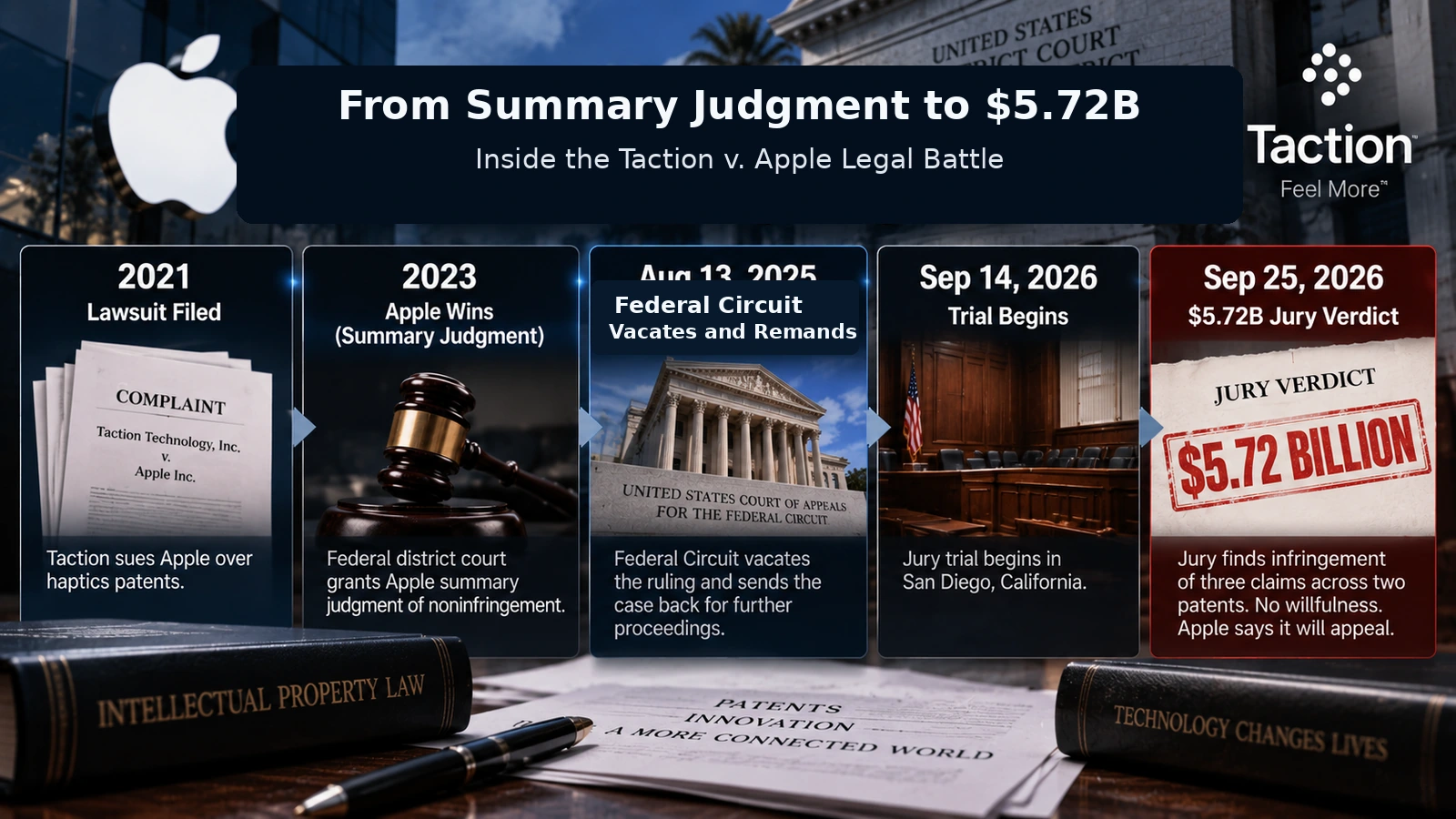
Taction filed its lawsuit in 2021. In 2023, the federal district court granted Apple summary judgment of noninfringement after excluding portions of Taction’s expert infringement opinions and construing a key “highly damped output” limitation in Apple’s favor. That meant Apple won without a jury trial on infringement. (Federal Circuit opinion)
Then the Federal Circuit changed the course of the case. On August 13, 2025, the appeals court vacated the summary judgment and sent the case back. Among other things, it held that the district court had improperly relied on an unwritten requirement when excluding parts of Taction’s expert opinions and had gone too far in narrowing the patent claims to require mechanical damping and a Q-factor below 1.5. The appeals court did not rule that Apple infringed the patents; it reopened the path for Taction to prove its case. (Federal Circuit opinion)
After the case returned to the district court, a jury trial began on September 14, 2026. On September 25, the jury returned the $5.72 billion verdict. (Patent Litigator)
That sequence is one reason the case is so striking: Apple had already won once. The record verdict came only after an appellate court concluded that important parts of the legal and evidentiary framework used in that earlier victory could not stand.
Does Apple Have to Pay $5.7 Billion Now?

Not necessarily—and certainly not yet in the simple sense the headline suggests.
A jury verdict establishes what that jury found and the damages it awarded. The trial judge can still address post-trial motions, enter judgment, and rule on related issues. Apple has already said it will appeal. As of the immediate post-verdict reporting, the docket did not yet show an entered final judgment. (Bloomberg Law · Patent Litigator)
And patent verdicts can change dramatically after the jury leaves the courtroom.
In 2020, Caltech won a roughly $1.1 billion jury verdict against Apple and Broadcom over Wi-Fi patents. An appeals court later overturned the damages award and ordered a retrial on damages; the dispute was eventually settled. In another long-running case, VirnetX once held a $502.8 million verdict against Apple, but that judgment was later overturned after the relevant patent claims were invalidated. (Reuters on Caltech · Reuters on VirnetX)
Those examples do not tell us what will happen in Taction’s case. They show something narrower: a giant patent verdict is not necessarily the final number.
How Can a Small Haptics Company Fight Apple for More Than Five Years?
Patent litigation at this scale can be extraordinarily expensive. That raises an obvious question: how does a much smaller company keep a case going against one of the world’s largest corporations?
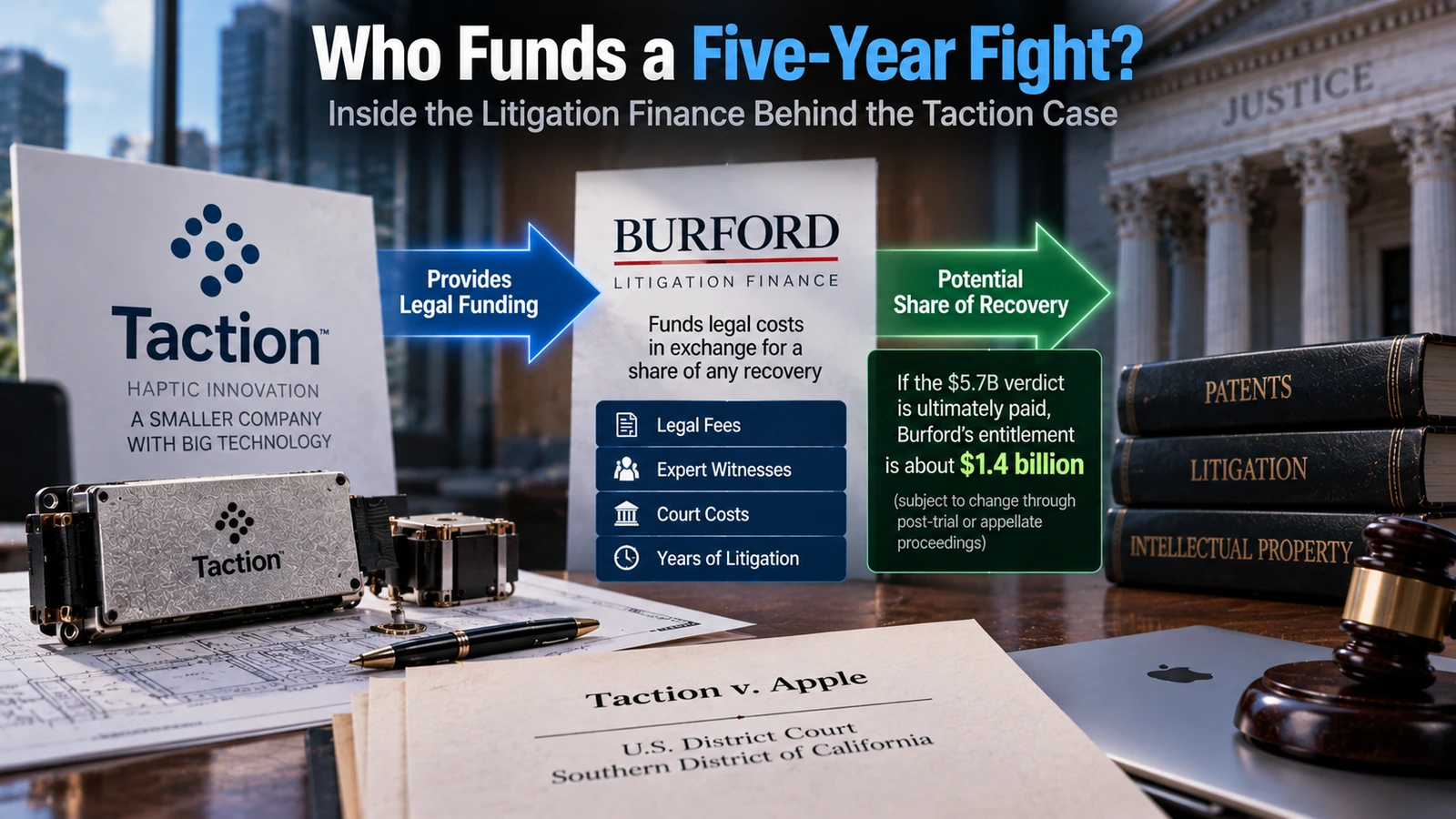
In Taction’s case, part of the answer is litigation finance. Bloomberg Law reported that discovery revealed financing from Gronostaj Investments LLC and Kenosha Investments LP, with Kenosha identified in separate litigation as an indirect subsidiary of Burford Capital. (Bloomberg Law)
Litigation finance generally works like this: an outside funder provides money to support legal costs in exchange for a contractual financial interest in a successful recovery. The arrangement can make years of litigation possible for a plaintiff that does not have a defendant’s resources. In this case, it also means Taction would not necessarily keep the entire recovery.
On September 28, Burford issued a statement saying that if the $5.7 billion verdict were ultimately paid as is, its entitlement would be about $1.4 billion, split roughly between Burford’s balance sheet and investment funds. Burford also emphasized the uncertainty: it said the verdict amount was likely to be altered in post-trial or appellate proceedings and warned that the eventual recovery could be less—or even zero. (Burford statement)
That makes the headline number easier to understand. The $5.72 billion figure is not simply a check moving from Apple to a small startup. It sits inside a much larger legal and financial structure involving years of litigation, outside financing, post-trial proceedings, and an expected appeal.
Does This Verdict Prove Apple Has a Pattern of “Stealing” Smaller Companies’ Technology?
No. The Taction verdict proves what this jury found in this case: Apple infringed specific claims of two Taction patents. It does not automatically prove every broader accusation made about Apple’s dealings with smaller technology companies.
That distinction matters because several famous Apple disputes involve very different legal questions.
| Dispute | Main legal issue | What the record actually shows |
|---|---|---|
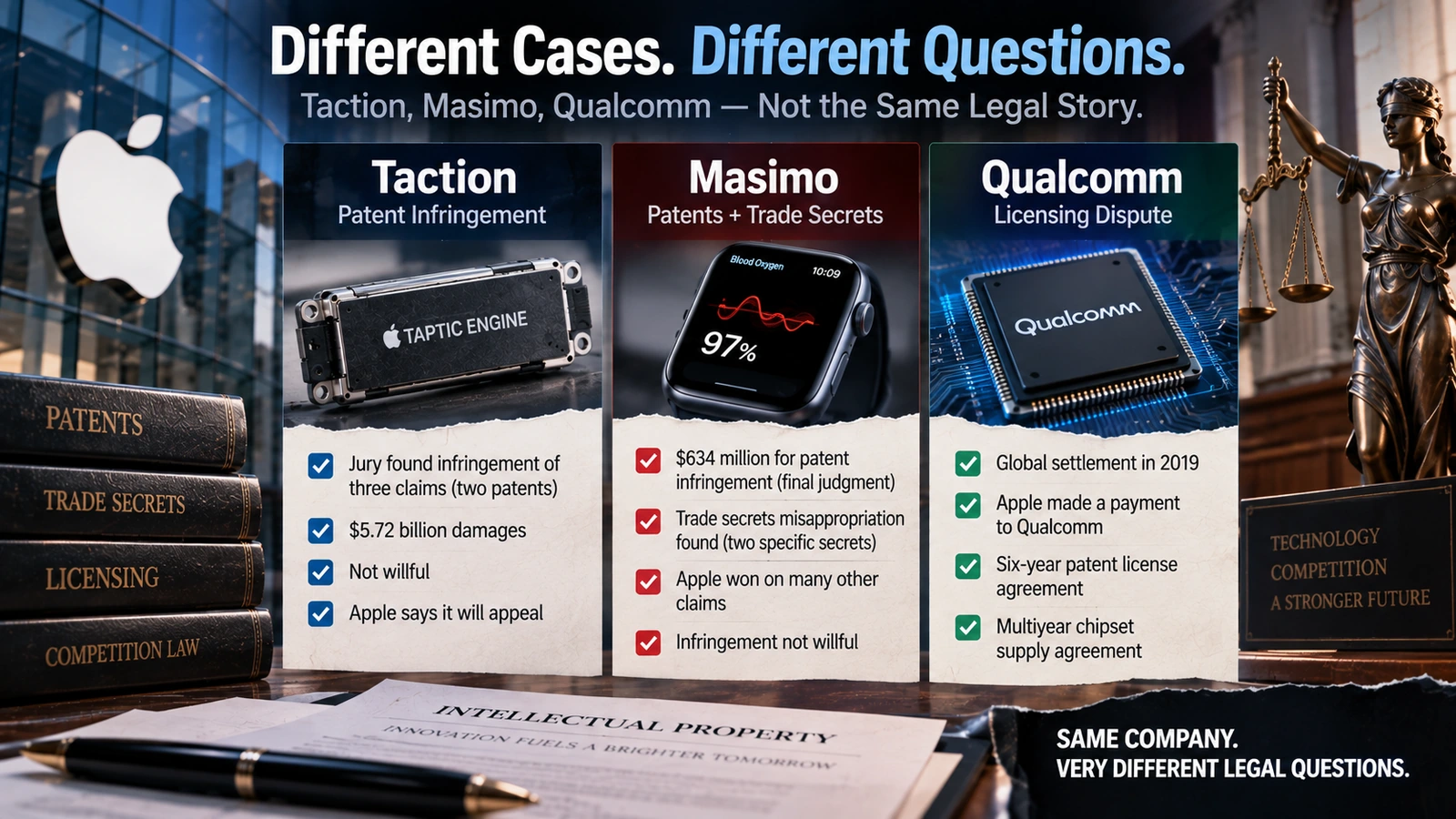
| Taction | Patent infringement involving haptics | September 25, 2026 jury found three claims across two patents infringed; $5.72B damages; no willfulness; Apple says it will appeal |
| Masimo | Patent infringement, trade secrets, and patent ownership/inventorship | July 20, 2026 final judgment awarded $634.3M for infringement of one Masimo patent and found Apple misappropriated two specified trade secrets; Apple prevailed on numerous other trade-secret allegations and on the ownership/inventorship claims |
| Qualcomm | Global patent, licensing, and modem-chip litigation | The companies settled in 2019; Apple agreed to make a payment, and the companies entered a six-year patent license plus a multiyear chipset supply agreement |
The Masimo litigation is a good example of why broad labels can mislead. In July 2026, a federal court entered final judgment awarding Masimo $634,313,913 for patent infringement and finding that Apple misappropriated two identified trade secrets, L4 and L5. But the same judgment also ruled for Apple on numerous other alleged trade secrets and on Masimo’s patent-ownership and inventorship claims. The patent infringement was found not willful. (U.S. District Court final judgment)
The Qualcomm dispute was different again. Apple and Qualcomm announced a global settlement in 2019 that ended all ongoing litigation, included a payment from Apple to Qualcomm, established a six-year patent-license agreement, and created a multiyear chipset-supply agreement. A settlement resolves a dispute; it is not the same as a court finding that one side “stole” technology. (Apple and Qualcomm joint announcement)
So the safer way to understand the recurring headlines is this: Apple is a massive technology company whose products combine thousands of technologies and patents, and it has repeatedly faced high-stakes intellectual-property disputes. Each dispute still has to be judged on its own claims, evidence, and procedural history.
Why Does the Taction Verdict Matter Beyond Apple?
The case shows how a technology that feels tiny to a consumer can carry enormous legal value when it is built into products sold at massive scale.
It also shows why patent cases are so hard to summarize with a single headline. A jury can find infringement without finding willfulness. A plaintiff can lose on summary judgment, win an appeal that merely reopens the case, then win a record verdict at trial. And even after that, the amount can remain contested for years.
For consumers, the verdict does not currently mean iPhones or Apple Watches are about to disappear from stores. The verdict is a damages finding in a district-court patent case. Any future product changes, licensing deal, settlement, injunction request, or final payment would depend on later legal developments. Apple has said it will appeal. (Reuters)
For smaller technology companies, however, the case is already significant. It illustrates that a patent owner can survive an early courtroom defeat, revive a case on appeal, secure outside financing, and still reach a jury against a company with vastly greater resources.
Whether Taction ultimately collects anything close to $5.72 billion is a different question.
Bottom Line: What This Story Really Means
The September 25 verdict is a genuine and extraordinary legal setback for Apple: a federal jury found that its Taptic Engine infringed three claims in two Taction patents and awarded $5,721,961,750 in damages. But the jury did not find the infringement willful, Apple disputes the result, and the company has said it will appeal. (Bloomberg Law · Patent Litigator)
The biggest misconception is treating the headline as though Apple has already paid $5.7 billion. It has not. The verdict still sits inside a legal process that can include post-trial rulings, a final judgment, appellate review, settlement negotiations, and potentially a very different ultimate amount.
And the verdict does not turn every past Apple technology dispute into proof of one single corporate tactic. Taction, Masimo, Qualcomm, and other cases involve different patents, trade secrets, contracts, procedural histories, and outcomes. The useful lesson is not “Apple was finally caught.” It is that intellectual-property disputes can hinge on extremely specific technical claims—and even a record jury verdict may be only the beginning of the final legal fight.
Apple Taction Patent Verdict: Key Questions Explained
Q. Did Apple already pay Taction $5.7 billion?
No. The jury awarded $5,721,961,750, but the immediate post-verdict record did not show a final judgment or a completed payment. Apple has said it will appeal, and post-trial or appellate proceedings could change the result.
Q. What exactly did the jury find Apple infringed?
The jury found infringement of claims 17 and 19 of U.S. Patent No. 10,659,885 and claim 16 of U.S. Patent No. 10,820,117, both involving Taction’s haptics technology.
Q. Did the jury find that Apple deliberately copied Taction’s technology?
No. The jury specifically found that the infringement was not willful. That does not erase the infringement finding, but it is different from a finding of deliberate or willful infringement.
Q. What is Taction Technology?
Taction Technology is a California-based haptics company focused on tactile transducers that let users physically feel low-frequency vibrations. Its Transporter technology has been used in products including Corsair’s HS60 Haptic gaming headset.
Q. Why did this case go to trial if Apple had already won in 2023?
The Federal Circuit vacated Apple’s 2023 summary-judgment victory in August 2025 and sent the case back for further proceedings. The appeals court found errors in how parts of Taction’s expert evidence and patent-claim limitations had been handled; it did not itself find Apple liable for infringement.
Q. Can the $5.7 billion damages figure still change?
Yes. Post-trial rulings, appellate review, or a settlement could reduce, eliminate, modify, or leave the award intact. Past Apple patent cases have produced large jury awards that later changed substantially on appeal.
Q. Who financed Taction’s long-running lawsuit?
Bloomberg Law reported that Taction received litigation financing involving entities connected to Burford Capital. Burford later said that if the verdict were ultimately paid as entered by the jury, its entitlement would be about $1.4 billion, while warning that the amount is likely to change and that no final recovery is guaranteed.
Q. Does this verdict prove every accusation that Apple “steals” technology from smaller companies?
No. It establishes a specific patent-infringement verdict in the Taction case. Other Apple disputes—including Masimo and Qualcomm—have involved different legal theories, evidence, rulings, and settlements and should not be treated as interchangeable proof of one claim.
Did this help make the story clearer? 🙂
WIN keeps unpacking the “why” behind the news—clearly and simply!
Sources
Taction Verdict and Court History
Reuters via CNA — U.S. jury says Apple owes record $5.7 billion in haptic technology patent case
Law360 — Apple Hit With Historic $5.7B Patent Verdict
Bloomberg Law — Apple Owes $5.7 Billion for Infringement of Haptics Patents
Patents and Haptics Technology
U.S. Patent No. 10,659,885 — Google Patents
U.S. Patent No. 10,820,117 — Google Patents
Taction Technology — Technology Overview
35 U.S.C. § 284 — Patent Damages
Litigation Finance and Post-Verdict Risk
Burford Capital — Statement Regarding Jury Verdict in Patent Matter
Reuters — Microsoft settles Caltech lawsuit over Wi-Fi technology
Reuters — U.S. Supreme Court won’t review Apple’s win against $503 million patent verdict
Other Apple Intellectual-Property Disputes
U.S. District Court — Masimo Corporation v. Apple Inc., Final Judgment, July 20, 2026
Apple — Qualcomm and Apple agree to drop all litigation, April 16, 2019