
NEOM in 2026: What Was Cut, What Was Delayed, and What Is Still Being Built?
Wasn’t Saudi Arabia supposed to build a 106-mile-long mirrored city in the desert?
Wasn’t The Line supposed to become a place where millions of people lived without cars, roads or conventional urban sprawl?
Then why is Saudi Arabia’s own sovereign wealth fund now saying The Line does not need to be completed by 2030?
That is where the NEOM story becomes much more interesting.
The project has not disappeared. But the version of NEOM that captured the world’s attention a few years ago is increasingly different from what Saudi Arabia is prioritizing today.
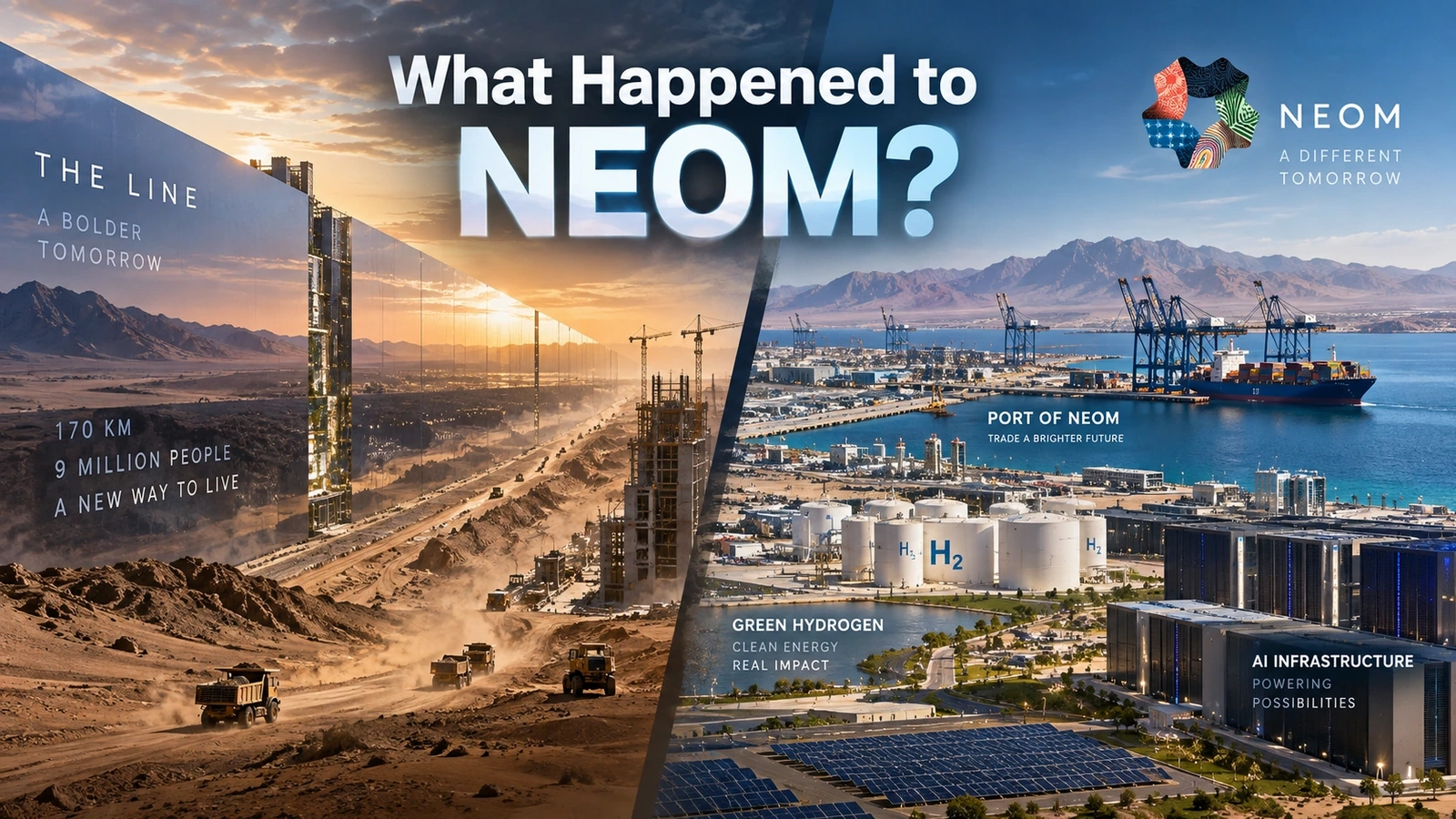
The Line has been deprioritized. Major construction contracts have been terminated. A luxury island promoted as an early showcase ran into serious problems. The mountain resort once tied to the 2029 Asian Winter Games has also lost major contracts.
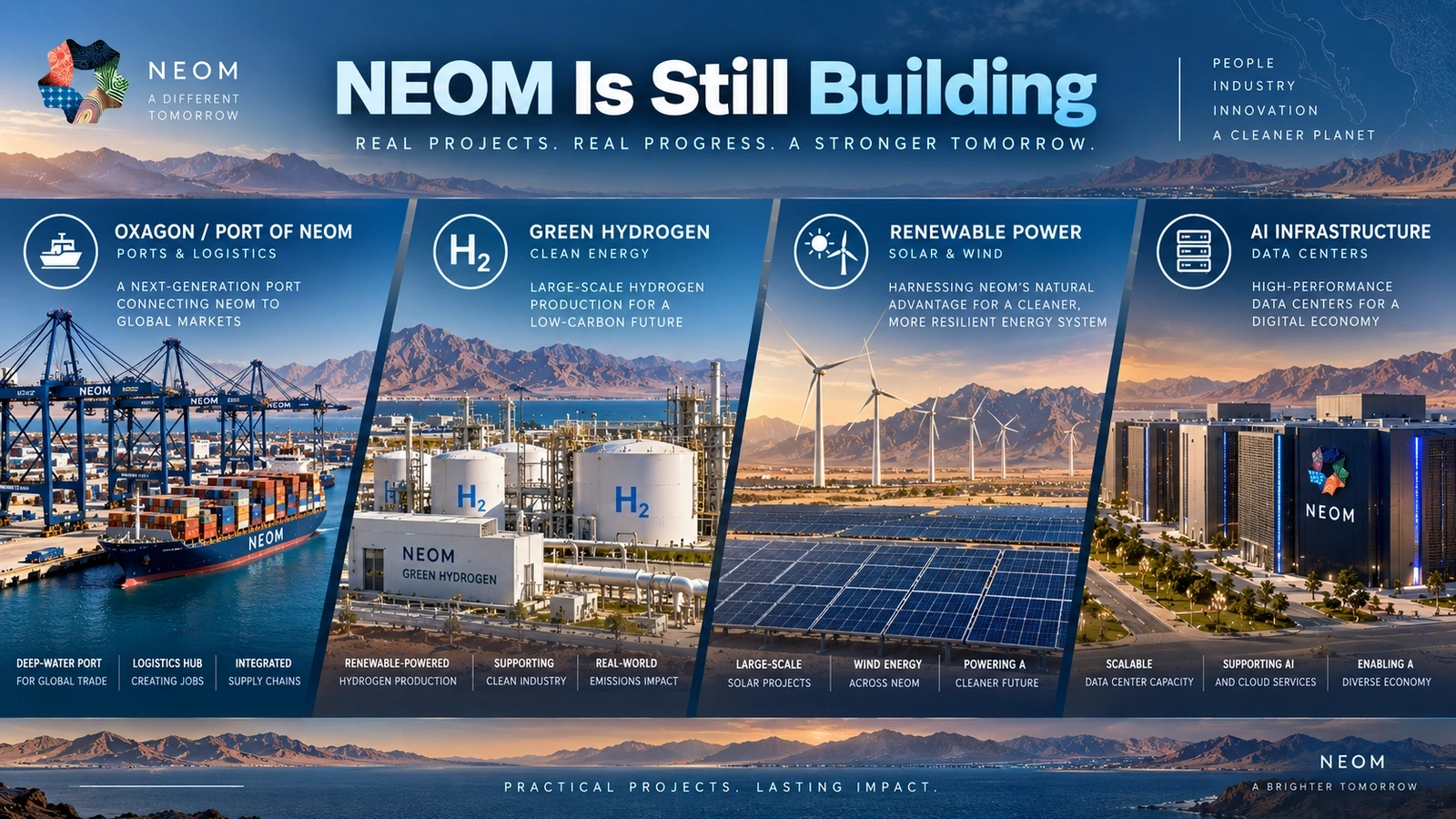
At the same time, Saudi Arabia is still spending money inside NEOM—on a port, green hydrogen and AI infrastructure.
So the useful question is not simply, “Did NEOM fail?”
It is: What happened to the original plan, and what kind of NEOM is Saudi Arabia actually trying to build now?
Wasn’t The Line Supposed to Be Enormous?

Yes. The original vision really was that ambitious.
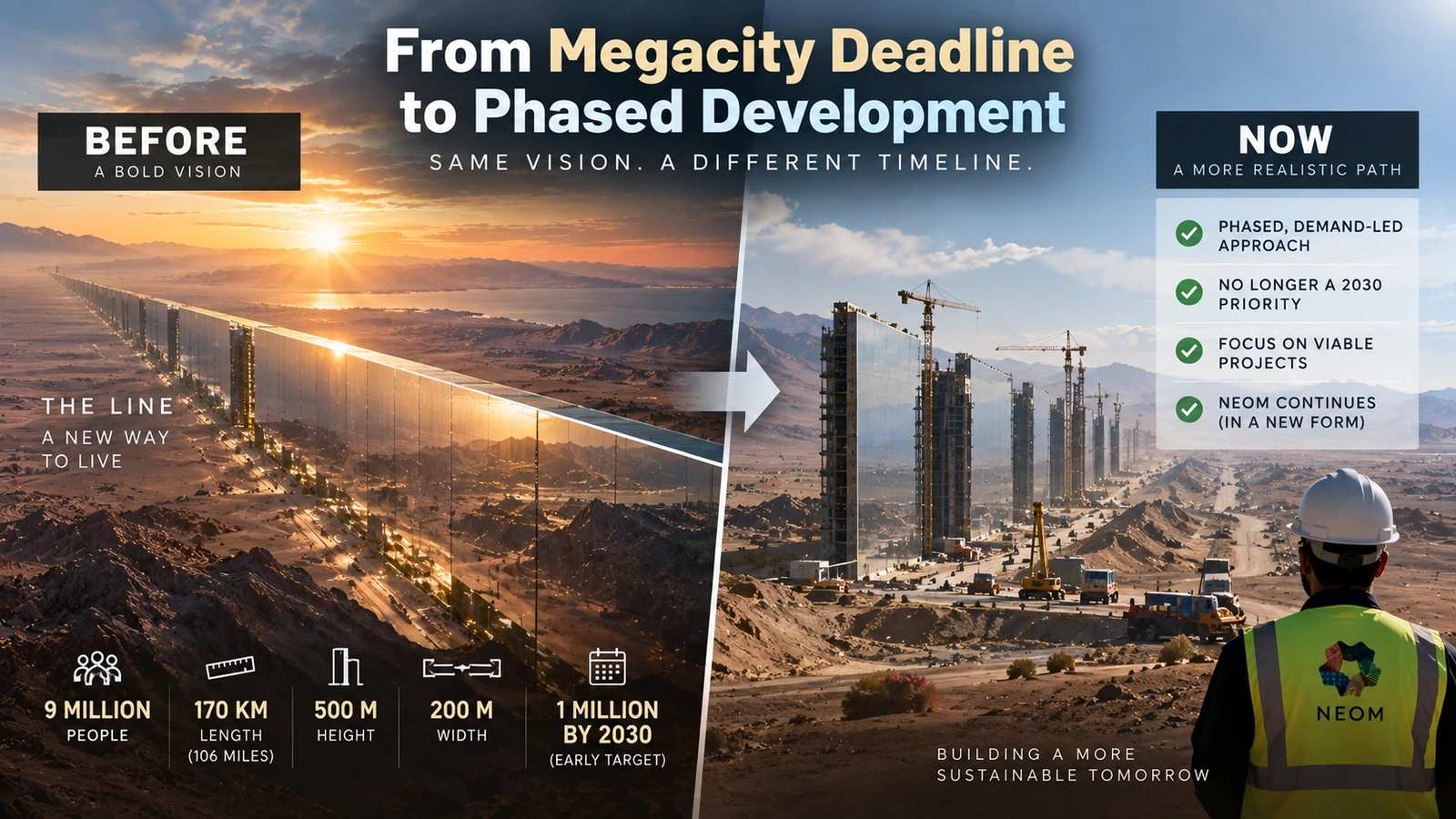
In 2022, Saudi Arabia’s Public Investment Fund described The Line as a 170-kilometer—or roughly 106-mile—linear city, only about 656 feet (200 meters) wide but about 1,640 feet (500 meters) high. It was ultimately intended to accommodate 9 million people on a footprint of just 34 square kilometers. The plan included no conventional roads or cars and envisioned high-speed transportation running from one end to the other. (pif.gov.sa)
An earlier Saudi government investment publication listed an interim target of 1 million residents by 2030 for The Line. That early target helps show how far the near-term delivery expectations have shifted since the project’s launch. (Invest Saudi)
That matters because many people now hear that NEOM is merely being developed “in phases” and assume that was always the story.
Phasing was always part of the long-term plan. But the scale, timing and priority attached to The Line have changed substantially.
What Changed With The Line in 2026?
The clearest change came on April 15, 2026.
Public Investment Fund Governor Yasir Al-Rumayyan said publicly that The Line was no longer a priority. He also said completing it by 2030 was not necessary, while emphasizing that no NEOM project had formally been canceled. Reuters reported the remarks after PIF approved its new 2026–2030 strategy. (Reuters)
That distinction is important.
The Line still exists as a long-term project. Its previous urgency does not.
NEOM’s current official page now describes The Line as advancing through a “phased, demand-led approach.” The current page emphasizes livability, sustainability and multi-phase development rather than presenting the project primarily through the dramatic 170-kilometer and 9-million-resident numbers that dominated earlier promotional material. (neom.com)
Then came a more concrete sign of retrenchment.
In May, Italian construction group Webuild announced that NEOM had terminated its contract for the Connector High-Speed Line near Sharma. The project had already been suspended, was about 20% complete, and had roughly €1 billion in remaining contracted work. Webuild said the termination ended all of its NEOM activities. (webuildgroup.com)
Semafor separately reported, citing people familiar with the plans, that additional work on The Line had been pushed beyond 2030 and that NEOM’s broader 2030 population target had been reduced to up to 100,000 people. NEOM did not publicly confirm that population figure in the report. (semafor.com)
The change can be summarized this way:
| Earlier vision | 2026 reality |
|---|---|
| The Line presented as NEOM’s defining centerpiece | PIF says The Line is no longer a priority |
| Major 2030 population ambitions | Officials say The Line does not need to be ready by 2030 |
| High-speed transport integrated into the wider project | A major Connector rail contract was terminated at about 20% completion |
| Giant futuristic city used as the main public image | Current messaging emphasizes phased, demand-led development |
That does not mean every original feature has been formally abandoned.
It does mean the delivery plan investors and the public are looking at in 2026 is materially different from the earlier vision.
Why Is Saudi Arabia Reprioritizing NEOM?
Because Saudi Arabia is changing the way it allocates capital.
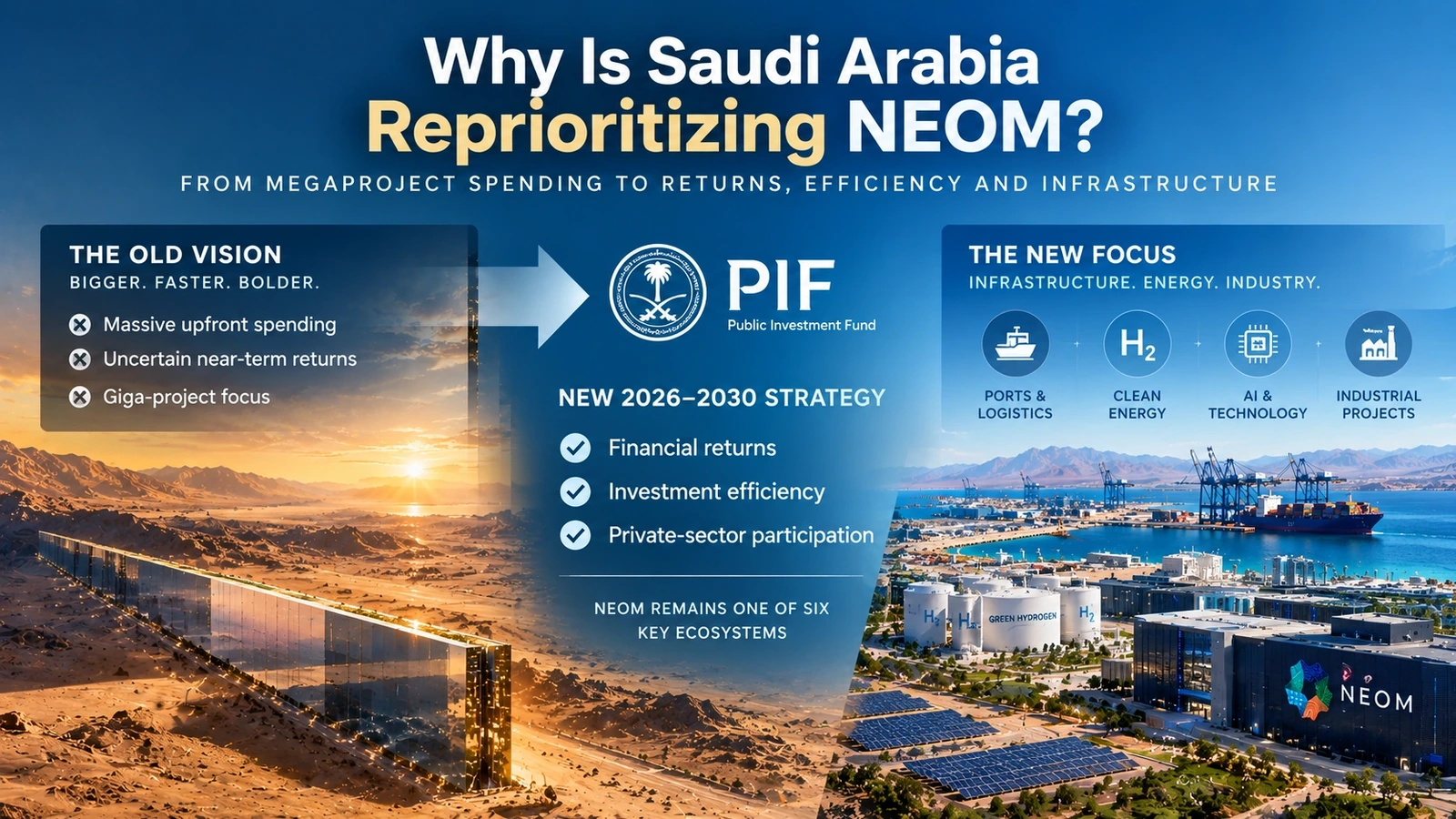
PIF’s official 2026–2030 strategy says the fund will put greater emphasis on financial returns, investment efficiency and private-sector participation. NEOM remains one of six domestic ecosystems in that strategy, which confirms that the Saudi government has not simply removed NEOM from its economic plans. (PIF)
But Reuters reported that Saudi officials have increasingly moved away from expensive giga-projects with unclear near-term returns and toward investments that can generate revenue or strengthen the economy more directly. The shift has come amid budget deficits, years of lower oil-price pressure and more recent regional security costs. (Reuters)
There is another expensive complication: stopping megaprojects costs money too.
Semafor reported in June, citing people familiar with NEOM’s budget, that authorities expected about 60 billion Saudi riyals—roughly $16 billion—of payments related to terminating long-term agreements between 2026 and 2030. The final amount could change depending on negotiations, and the figure has not been publicly confirmed by NEOM or PIF. (Semafor)
Think of it like building an enormous house after already signing contracts for the foundation, elevators, glass, power systems and landscaping.
Deciding to make the house smaller does not erase those contracts.
Sometimes scaling back the plan creates its own multibillion-dollar bill.
Trojena Was Supposed to Host the Asian Winter Games—What Happened?

Trojena provides another clear example of changing timelines.
The mountain destination had been associated with Saudi Arabia’s plan to host the 2029 Asian Winter Games.
That is no longer happening in 2029.
The Saudi Olympic and Paralympic Committee and the Olympic Council of Asia confirmed that Saudi Arabia’s 2029 edition would be postponed to a later date. (OCA)
Then, on February 5, 2026, the OCA signed the Host City Contract with Kazakhstan’s national Olympic committee for Almaty, Kazakhstan, to stage the 2029 Games. (OCA)
Construction changes followed as well.
In March, Webuild said NEOM terminated its contract for three dams and the architectural structure known as The Bow at Trojena. Webuild said the contracted works were about 30% complete, with approximately €2.8 billion in remaining backlog. It also said NEOM had terminated other contracts with other contractors in the area. (Webuild)
Saudi Arabia has not abandoned the idea of developing winter sports. The agreement with the OCA says the kingdom intends to host smaller winter-sports events and prepare for a future Asian Winter Games at a later date.
But the original sequence—build Trojena and host the 2029 Games there—has changed.
And What Happened to Sindalah?
Sindalah was supposed to demonstrate that NEOM could move from spectacular renderings to a finished luxury destination.
Instead, it became one of the project’s most visible delivery problems.
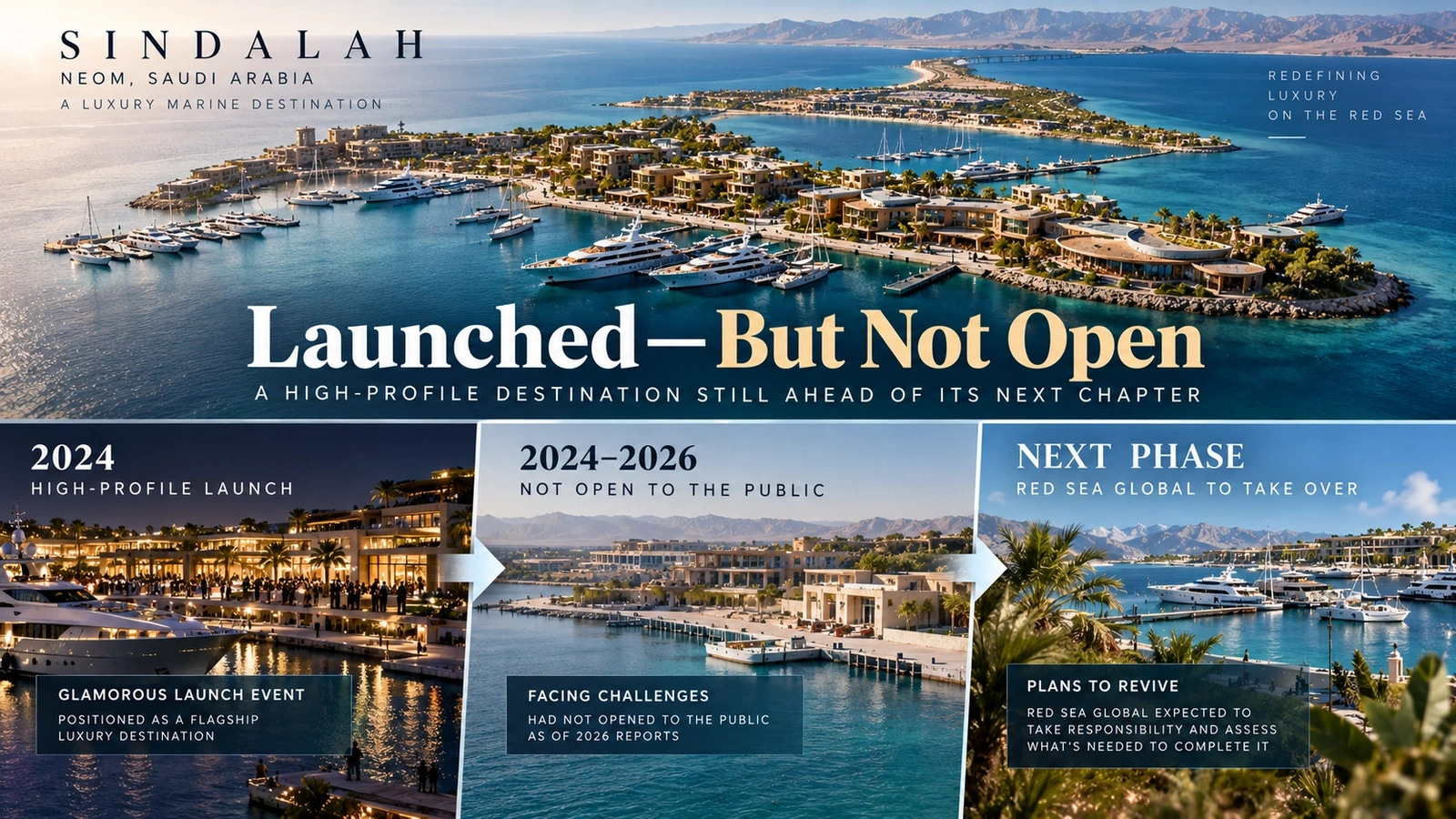
Reuters reported in June that the island had never opened to the public, despite a high-profile 2024 launch event attended by celebrities and yacht owners. Red Sea Global CEO John Pagano said his company was expected to take responsibility for the project, assess what still needed to be done and “bring it back to life.” (Reuters)
Reuters also reported, citing people familiar with the project, problems including poor finishing, a marina exposed to waves and wind conditions that had not been adequately addressed during planning. Pagano attributed the broader issue to unrealistic delivery timelines. (Reuters)
That makes Sindalah significant for more than tourism.
The island illustrates what can happen when a megaproject has a politically important deadline but the engineering, construction and operating details are not yet ready.
So Is Anything at NEOM Actually Moving Forward?
Yes—and this is the part that makes the simple “NEOM is dead” description misleading.
The clearest progress is around Oxagon, NEOM’s industrial and logistics area.
NEOM currently describes the Port of NEOM as “open for business,” while Oxagon is presented as an industrial hub centered on logistics, renewable energy and AI-driven industries. (Port of NEOM · Oxagon)
The NEOM Green Hydrogen Company announced in March that its giant hydrogen project had reached 90% overall construction completion, with renewable power assets about 95% complete. It said commissioning would follow and the first green-ammonia product was planned for 2027. (NGHC)
By June, NGHC said construction was in final completion and commissioning had started with energization. (NGHC)
Then another revealing development arrived in August.
HUMAIN and DataVolt announced that construction had begun on 100 megawatts of a planned 360-megawatt first phase of an AI-ready data-center campus at Oxagon. The first 100 MW is expected to become available in 2028. (NEOM)
These are very different projects from a 106-mile mirrored city.
They are tied more directly to logistics services, energy production and computing infrastructure.
That difference helps explain what NEOM increasingly looks like in 2026: less of a single giant futuristic city project and more of a portfolio in which industrial, energy and digital infrastructure are receiving greater emphasis.
Does That Mean NEOM Has Failed?
There is no single factual yes-or-no answer because “NEOM” is not one construction project.
It is a collection of projects with different schedules, contracts and purposes.
If the question is whether the original near-term vision of The Line is being delivered on the timetable once promoted, the public record shows substantial retrenchment. The Line is no longer a 2030 priority, major related contracts have been terminated, and current official language emphasizes phased development. (Reuters)
If the question is whether all of NEOM has been abandoned, the answer is different. PIF still includes NEOM in its 2026–2030 strategy, while hydrogen, port and AI infrastructure continue to move forward. (PIF)
A more useful way to track NEOM is to separate its pieces:
| Part of NEOM | What the 2026 record shows |
|---|---|
| The Line | Lower priority; current official approach described as phased and demand-led |
| Connector high-speed rail | Webuild contract terminated at about 20% completion |
| Trojena | Major Webuild contract terminated; 2029 Asian Winter Games moved to Almaty |
| Sindalah | Did not open publicly after its launch; planned transfer to Red Sea Global |
| Oxagon / Port of NEOM | Industrial and logistics activity continues |
| Green hydrogen | 90% construction completion reported in March; commissioning later began |
| AI infrastructure | New Oxagon data-center construction announced in August |
That distinction matters because “failed megaproject” and “unchanged megaproject” are both too simple.
The NEOM being built now is increasingly different from the NEOM that originally made headlines.
What Should You Watch Next?
Four developments will show whether this strategic reset is working.
First, watch whether Saudi Arabia announces a new concrete design, construction segment or delivery date for The Line. “Phased development” can mean many things until the next physical phase is defined.
Second, watch Sindalah. A public reopening under Red Sea Global would show that Saudi Arabia can recover one of NEOM’s most visible troubled assets.
Third, watch the green hydrogen project. Its planned 2027 production start is one of the clearest near-term tests of whether NEOM’s industrial projects can move from construction into commercial operation. (NGHC)
Finally, watch Oxagon’s AI infrastructure. If the first 100 MW of the new data-center project enters service as planned in 2028, it would strengthen the case that NEOM’s future is becoming more closely tied to industrial infrastructure, energy and computing than to one enormous architectural landmark. (NEOM)
Why It Matters in One Sentence
NEOM has not disappeared, but Saudi Arabia has moved away from treating The Line as an urgent 2030 centerpiece and is increasingly concentrating on projects—ports, energy and AI infrastructure—that can be built in stages and tied more directly to economic activity.
NEOM: Key Questions Explained
Q. Has Saudi Arabia canceled NEOM?
No. PIF still lists NEOM as one of the six domestic ecosystems in its 2026–2030 strategy, and several projects inside NEOM remain active. (PIF)
Q. Has The Line been canceled?
Saudi officials have not announced a formal cancellation. PIF Governor Yasir Al-Rumayyan said in April that The Line was no longer a priority and did not need to be completed by 2030. (Reuters)
Q. How big was The Line originally supposed to be?
The publicly announced long-term design called for a 106-mile (170-kilometer) city about 1,640 feet (500 meters) high and 656 feet (200 meters) wide, eventually housing 9 million people. (pif.gov.sa)
Q. Is construction on The Line still happening?
NEOM’s current official position describes The Line as a phased, demand-led project. Semafor reported in May that additional major work was being delayed beyond 2030, while Webuild separately confirmed termination of its Connector High-Speed Line contract. (NEOM · Semafor · Webuild)
Q. What happened to the 2029 Asian Winter Games at Trojena?
Saudi Arabia’s edition was postponed, and the Olympic Council of Asia later signed the 2029 Host City Contract with Almaty, Kazakhstan. (OCA postponement · OCA Almaty contract)
Q. What happened to Sindalah?
The luxury island held a high-profile launch in 2024 but had not opened to the public as of Reuters’ June 2026 report. Red Sea Global was preparing to take over the project and assess what would be required to complete it. (Reuters)
Q. Which parts of NEOM are still progressing?
Projects tied to Oxagon are among the clearest examples. The green hydrogen plant reported 90% construction completion in March, and HUMAIN and DataVolt announced in August that construction was underway on the first 100 MW of an AI-ready data-center project. (NGHC · NEOM)
Q. Why is Saudi Arabia changing the plan?
PIF’s new strategy emphasizes investment efficiency, financial returns and private-sector participation. Reuters has also reported that Saudi officials are shifting away from some costly giga-project commitments as budget deficits, lower oil-price pressure and regional security strains reshape priorities. (PIF · Reuters)
Q. What is the biggest change to understand about NEOM?
The biggest change is priority. The futuristic city concept remains part of the long-term vision, but Saudi Arabia is putting more immediate emphasis on infrastructure and projects with clearer economic uses.
Did this help make the story clearer? 🙂
WIN keeps unpacking the “why” behind the news—clearly and simply!
Sources
The Line and Saudi Arabia’s 2026 Investment Strategy
Reuters — PIF Strategy and The Line Reprioritization
NEOM — Current The Line Overview
PIF — Original The Line Specifications
Invest Saudi — Early The Line 2030 Target
Construction Reductions and Contract Changes
Webuild — Connector High-Speed Line Contract Termination
Webuild — Trojena Contract Termination
Semafor — The Line Work Delayed Beyond 2030
Semafor — Estimated NEOM Contract-Termination Costs
Trojena and Sindalah
Olympic Council of Asia — Saudi 2029 Edition Postponed
Olympic Council of Asia — Almaty 2029 Host City Contract
Reuters — Red Sea Global and Sindalah
Projects Still Moving Forward
Port of NEOM — Current Operations and Expansion
Oxagon — Industrial and Logistics Development
NEOM Green Hydrogen Company — 90% Construction Milestone
NEOM Green Hydrogen Company — Final Construction and Commissioning Update