Why Is Netflix Laying Off 1,000 Workers While Making Billions?

Wasn’t Netflix supposed to be the winner of the streaming wars?
After years of outspending and outmaneuvering traditional television companies, Netflix has become a hugely profitable subscription business. Yet it has just announced about 1,000 job cuts, replaced the executive responsible for its global programming, and lost another senior film leader. Its shares were also down more than 40% over the preceding 12 months in mid-October 2026. (Reuters · Financial Times)
That sounds like a company running out of money. But on October 20, Netflix reported $4.46 billion in third-quarter operating income. The problem is different: Netflix can keep growing its revenue while struggling to win a larger share of the time people spend watching video. (Netflix SEC Filing)
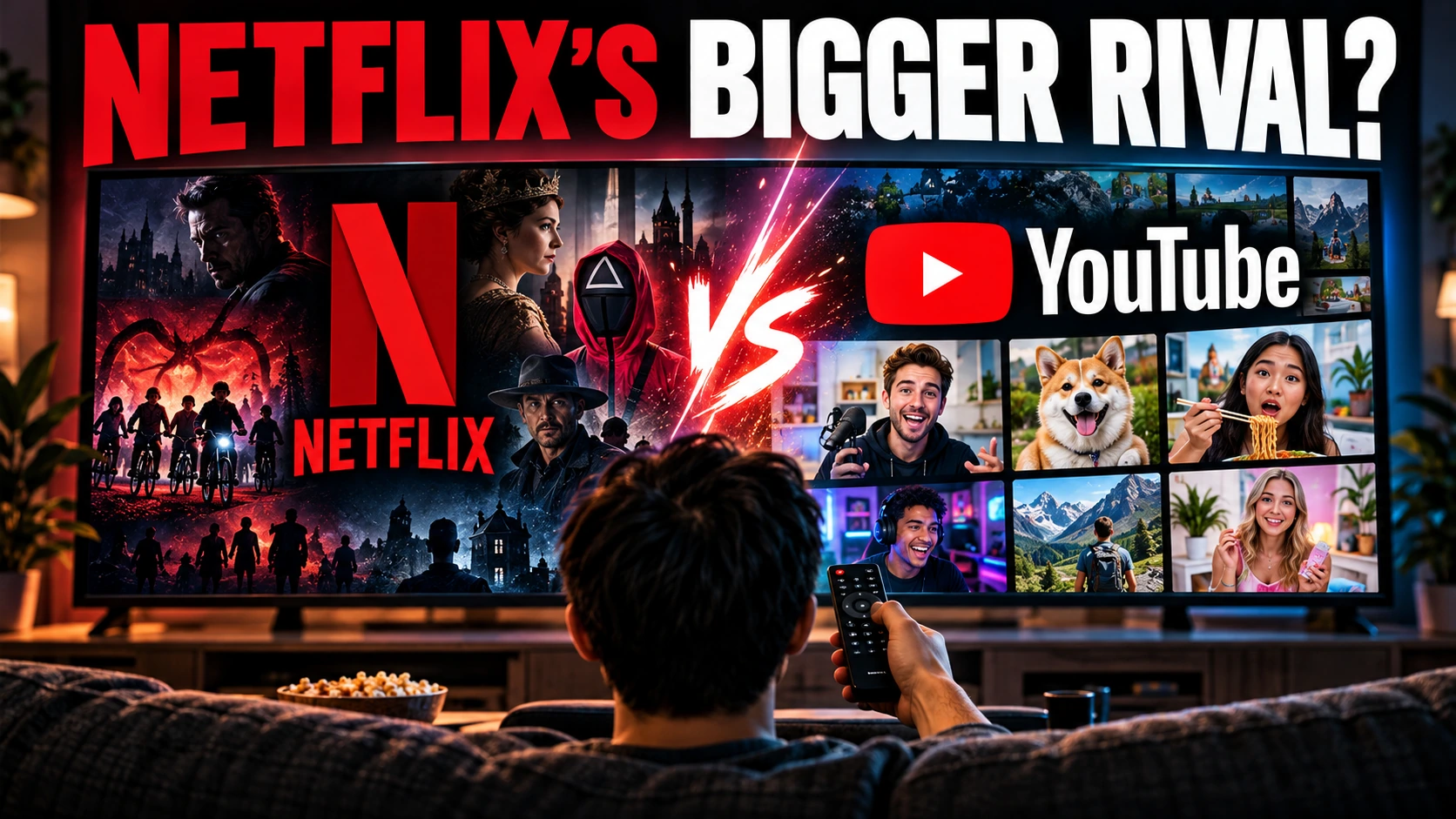
※ Images in this article are AI-generated illustrations created to help explain the story. They are not actual photographs, and depictions of people, places, or events may differ slightly from reality.
The uncomfortable question for Netflix isn’t whether people will still pay for great shows. It’s whether that business alone can keep delivering the growth investors once expected—especially when YouTube offers an almost endless alternative on the very same TV screen.
What Actually Happened at Netflix in October?
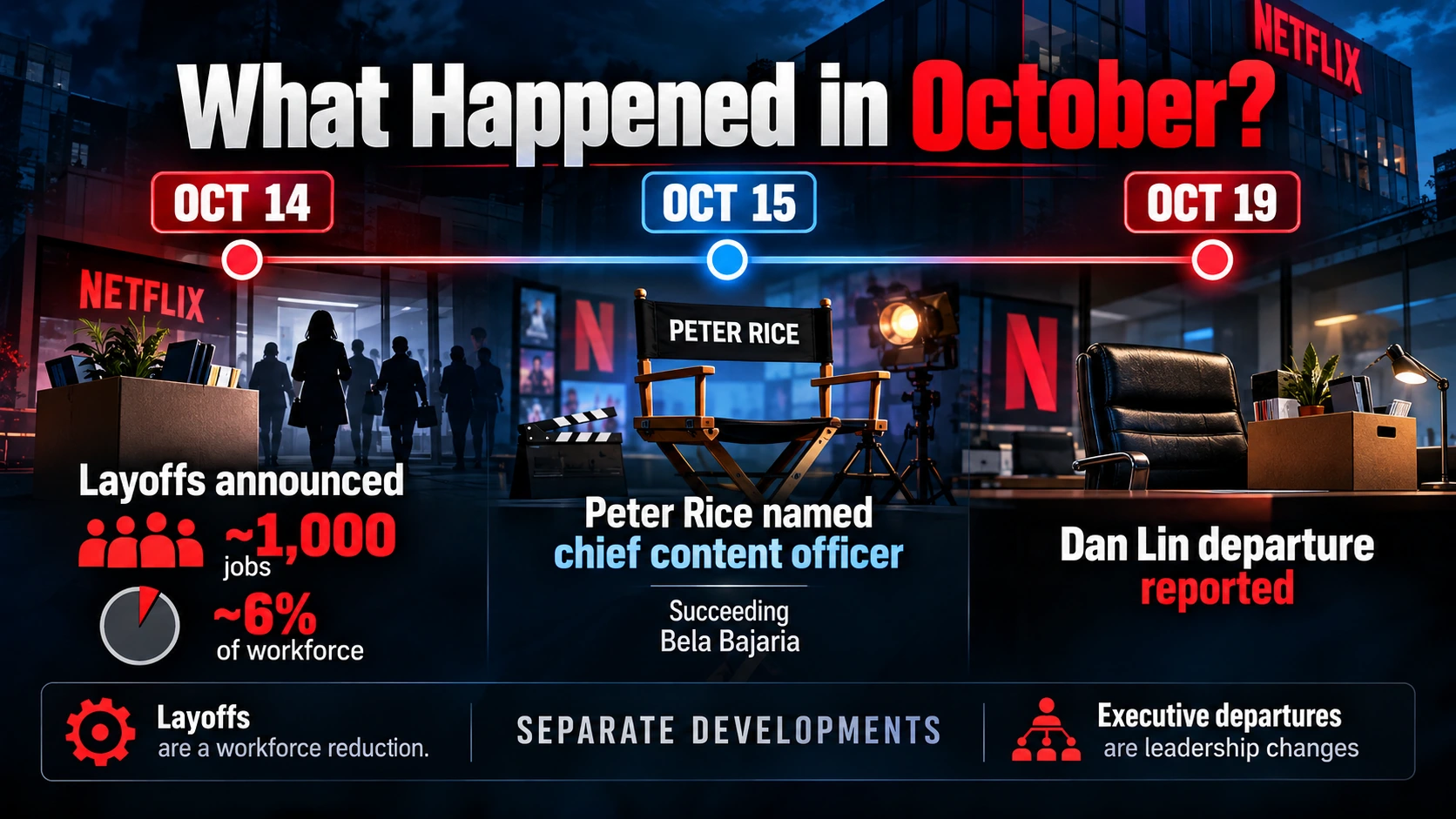
Netflix announced on October 14 that it would eliminate roughly 1,000 jobs, or about 6% of its workforce. Product, technology, legal, and human-resources teams were expected to bear the brunt of the reductions. Reuters described it as the company’s largest round of cuts since 2022. (Reuters)
A day later, Netflix said Peter Rice, a former senior Disney and Fox executive, would become chief content officer on October 26. He was named to succeed Bela Bajaria, who had led global content and helped oversee an era that included hits such as Squid Game and Bridgerton. Netflix publicly thanked her for her work; the announcement did not establish that she was one of the employees affected by the broader layoff program. (Netflix · Reuters)
On October 19, Reuters reported that film division head Dan Lin would also depart. The timing made the shake-up harder to dismiss as a routine staff reduction. Netflix was changing both its cost structure and the people making big programming decisions. (Reuters)
But the co-CEOs, Ted Sarandos and Greg Peters, told staff that the underlying business remained strong and that Netflix was on track to meet its full-year forecast. That is why the next question is about performance, not survival. (AP)
How Can Netflix Be So Profitable and Still Face Pressure?
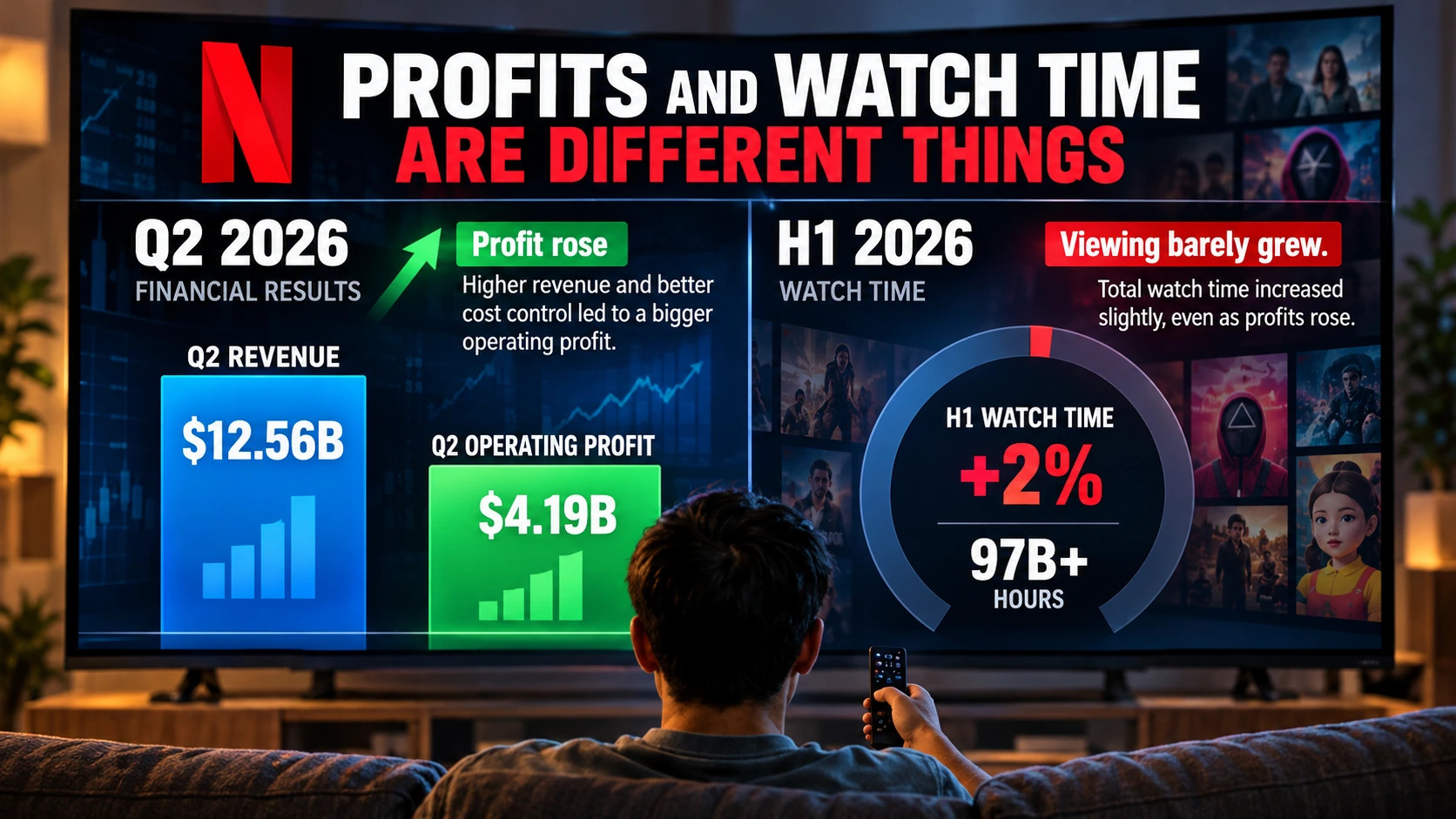
Netflix’s second-quarter 2026 results already offered a strong answer. Revenue reached $12.56 billion, up 13.4% from a year earlier. Operating income reached $4.19 billion, with a 33.4% operating margin. That means the company generated about 33 cents of operating profit for every dollar of revenue, before interest and taxes. (Netflix SEC Filing)
Netflix’s October 20 report provided a newer snapshot: third-quarter revenue was $12.87 billion, up 11.8% year over year, while operating income reached $4.46 billion, with a 34.6% operating margin. These are results for the third quarter, not the second-quarter numbers illustrated above. (Netflix SEC Filing)
The company now forecasts $51.1 billion in full-year 2026 revenue and a 31.5% operating margin. It also reduced its advertising revenue outlook from roughly $3.0 billion to $2.7 billion, citing a slower-than-expected rollout of some advertising capabilities. These remain forecasts, not completed full-year results. Operating profit is also different from free cash flow: Netflix reported $1.53 billion in free cash flow for the second quarter and $2.88 billion in the third. (Netflix SEC Filing)
So why the stock-market anxiety? Investors are looking beyond today’s profits to how fast the business can expand from here. Netflix shares fell more than 5% in after-hours trading following the October 20 results, as the fourth-quarter outlook disappointed investors. A company priced for rapid growth can see its shares fall even while revenue and profit rise. (Reuters)
Netflix has also been able to increase revenue through membership growth, higher subscription prices and advertising. Those are valuable levers, but they raise a harder question: if customers pay more while the amount they watch barely changes, how much additional growth remains available? (Netflix SEC Filing)
What Does Netflix’s 2% Viewing Growth Really Mean?
The company’s own numbers show a slower-moving part of the story. Netflix said members watched more than 97 billion hours in the first half of 2026, up 2% from the first half of 2025. For perspective, Netflix said viewing hours rose 1.5% during 2025. So the latest figure is not evidence that total viewing has collapsed; it is evidence of modest growth in a very large business. (Netflix SEC Filing)
Viewing hours, revenue and subscribers measure different things. A price increase can raise revenue without adding a single viewing hour. An expensive new series can attract subscribers but may only be watched once. A smaller show that people revisit can generate substantial viewing time without becoming a cultural event.
Netflix also argues that not all viewing hours have equal value. In its shareholder letter, the company explained that live events can account for a relatively small share of total watch time while producing unusually strong subscription sign-up days. A useful show is not necessarily the show with the most minutes. (Netflix SEC Filing)
That nuance matters. Netflix’s challenge is to keep people subscribing and engaged enough to justify their monthly bill—not to maximize an hours counter at any cost.
Is YouTube Actually Beating Netflix on American TVs?
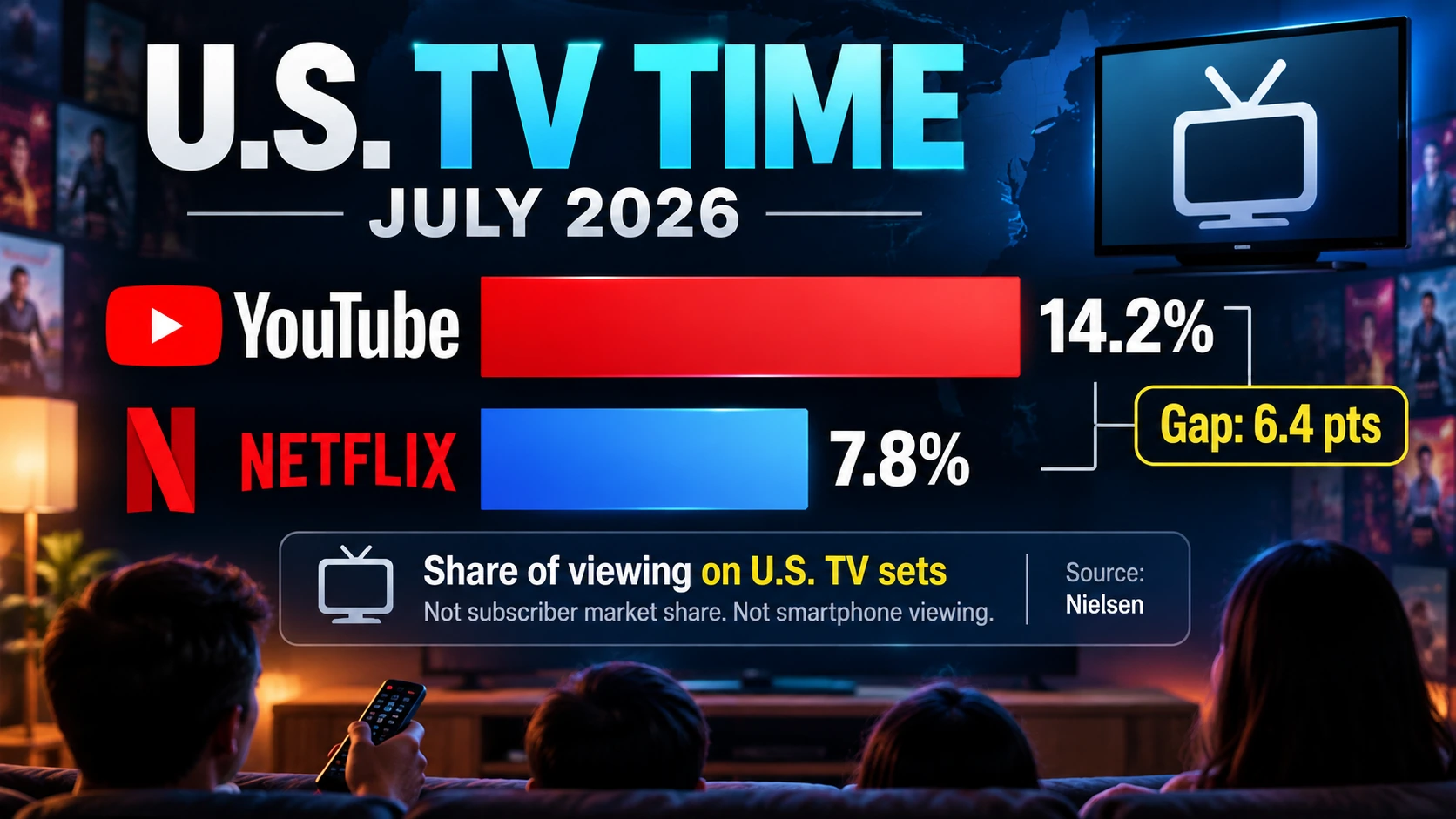
Yes—when the measure is time spent watching on U.S. television sets. Nielsen reported that YouTube captured a record 14.2% of U.S. TV viewing in July 2026. Netflix accounted for about 7.8% in the same month, according to Nielsen’s media-distributor figures. (Nielsen · TheWrap)
That is a gap of 6.4 percentage points. A year earlier, the July comparison was 13.4% for YouTube and 8.8% for Netflix. The year-over-year comparison suggests YouTube has strengthened its hold on the living-room screen even though Netflix remains a leading paid streaming service. (Nielsen · TheWrap)
| U.S. TV viewing measure | YouTube | Netflix |
|---|---|---|
| July 2025 | 13.4% | 8.8% |
| July 2026 | 14.2% | 7.8% |
| Change | +0.8 percentage points | −1.0 percentage point |
These numbers are shares of all viewing on TV sets, not shares of paid subscriptions, company revenue or viewing across every device. They do not by themselves establish that Netflix is losing paying customers. They reveal how Americans are dividing their time on the biggest screen at home.
Why Is YouTube So Much Harder to Compete With Than Disney+?
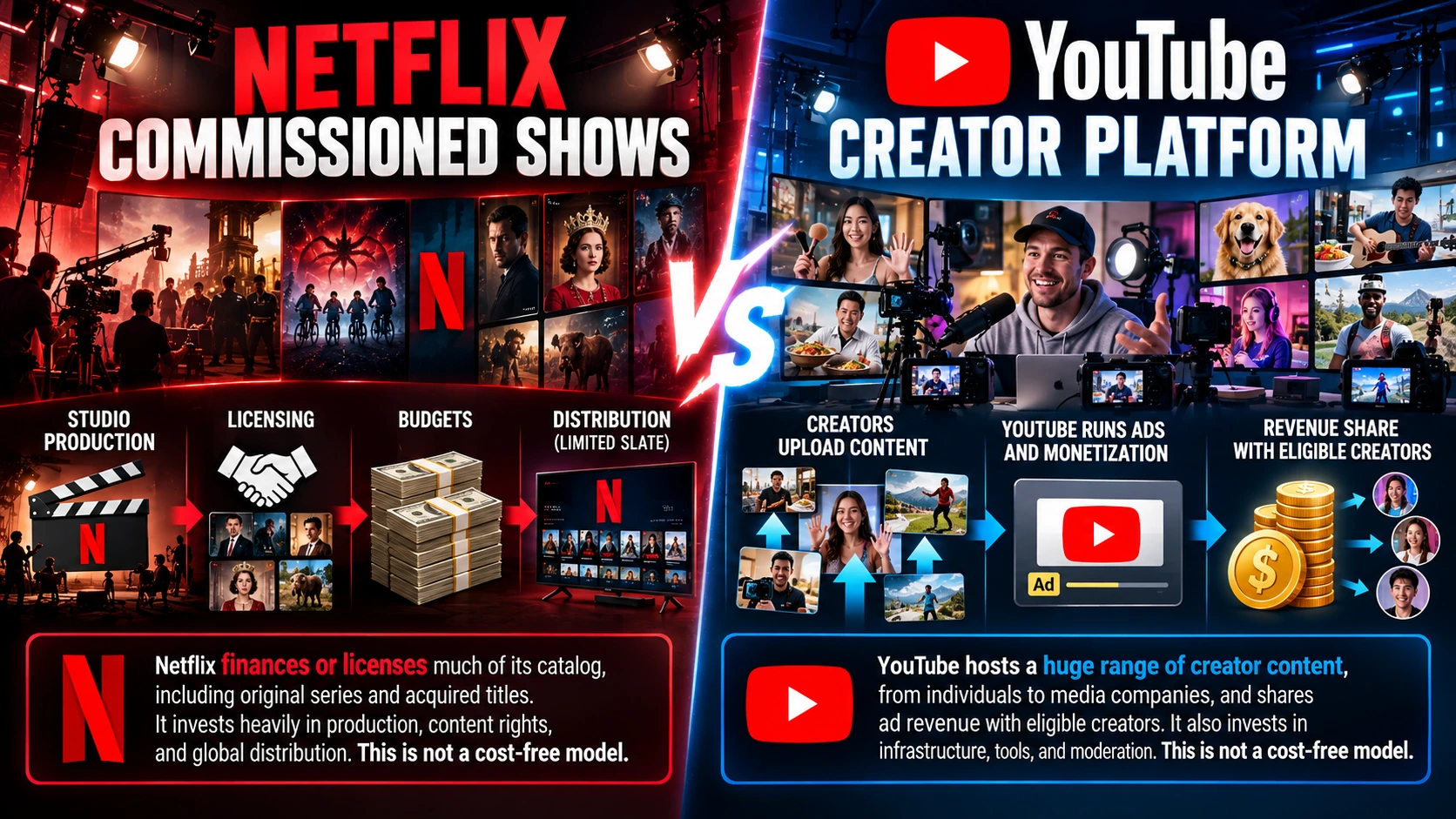
Disney+, HBO Max and Netflix largely compete by offering professionally made entertainment, distinctive franchises and subscription bundles. YouTube competes in a different way: it offers viewers a huge library of video made by independent creators, broadcasters, podcasters, businesses and media companies.
The economics differ, too. Netflix pays to commission, acquire or license programming, often committing money well before it knows whether a title will become a hit. YouTube generally does not need to finance each creator’s production up front. Eligible creators can earn a share of ad revenue or other platform earnings if their videos attract an audience.
| Business question | Netflix | YouTube |
|---|---|---|
| Who supplies much of the video? | Studios, production partners and licensed rights holders | Independent creators and media publishers |
| Who takes production risk? | Netflix and its production or licensing partners | Largely creators and their production partners |
| How does the platform make money? | Subscriptions and advertising | Advertising, subscriptions and other services |
| What brings people back? | Shows, films, live events and recommendations | An enormous range of creators, topics and recommendations |
YouTube is not free to operate: infrastructure, content moderation, licensing and creator payments all cost money. And Netflix does not bear every creative risk alone. But YouTube can host everything from a 30-second cooking tip to a three-hour interview without ordering each video as a studio production.
Imagine two restaurants competing for dinner guests. One must hire the chefs, develop most of the menu and pay for every dish it puts on display. The other runs a giant food hall where thousands of vendors bring their own offerings and share part of the proceeds. Both models have costs and advantages, but they scale very differently.
For Netflix, another season of a major drama might be a huge success. On YouTube, the alternative could be a game walkthrough, a neighborhood news update or a video podcast that costs a fraction as much to produce. The competition is ultimately for the same hour of leisure time.
Didn’t Squid Game and KPop Demon Hunters Prove Netflix Can Still Win?
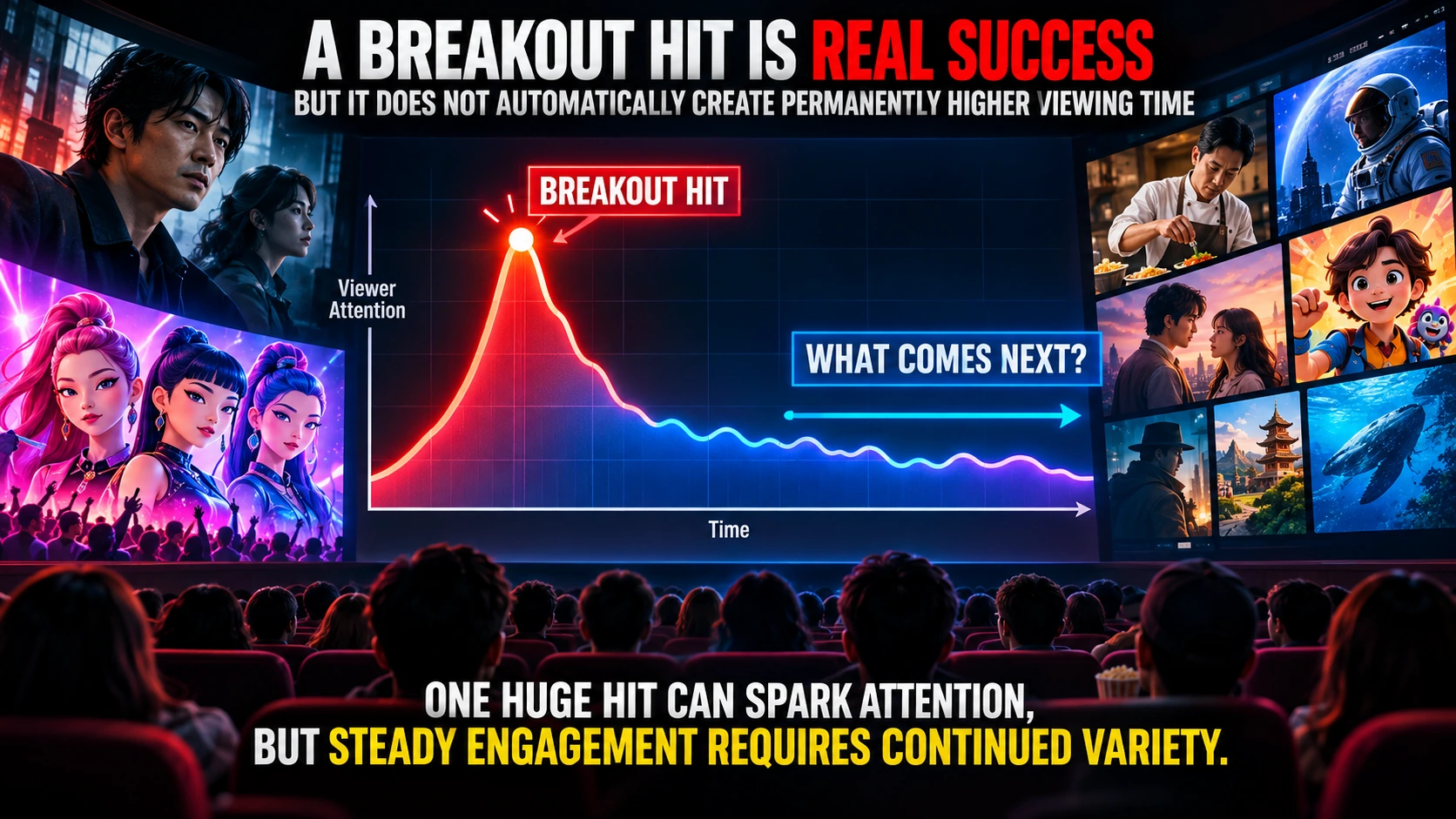
They proved that Netflix can still produce—or bring audiences—enormous cultural events. Squid Game demonstrated that a Korean-language drama could become a worldwide sensation. The 2025 animated movie KPop Demon Hunters later became Netflix’s most popular film in its standardized first-91-days rankings, with roughly 325 million views on its all-time chart. (Netflix Top 10)
A relevant distinction: KPop Demon Hunters draws deeply on Korean culture, but it was produced in partnership with Sony Pictures Animation. It should not be described as simply a Korean television production that Netflix financed in South Korea. (Sony Pictures Animation)
Global storytelling remains one of Netflix’s strengths. Its July shareholder letter said non-English content represented more than a third of viewing hours in the first half of 2026, with notable programming from Korea, Japan, Spain and India. Netflix continues to make the case that its international scale gives individual local shows an unusually large audience. (Netflix SEC Filing)
The difficulty is turning occasional blockbuster moments into steady habits. A family might join Netflix for a hit series, finish it over a weekend and then spend its evenings watching familiar creators elsewhere. Another family may stay subscribed for Netflix’s entire catalog. Those very different behaviors are why one global hit does not settle the engagement debate.
Did Netflix’s Push Into Video Games Fail?
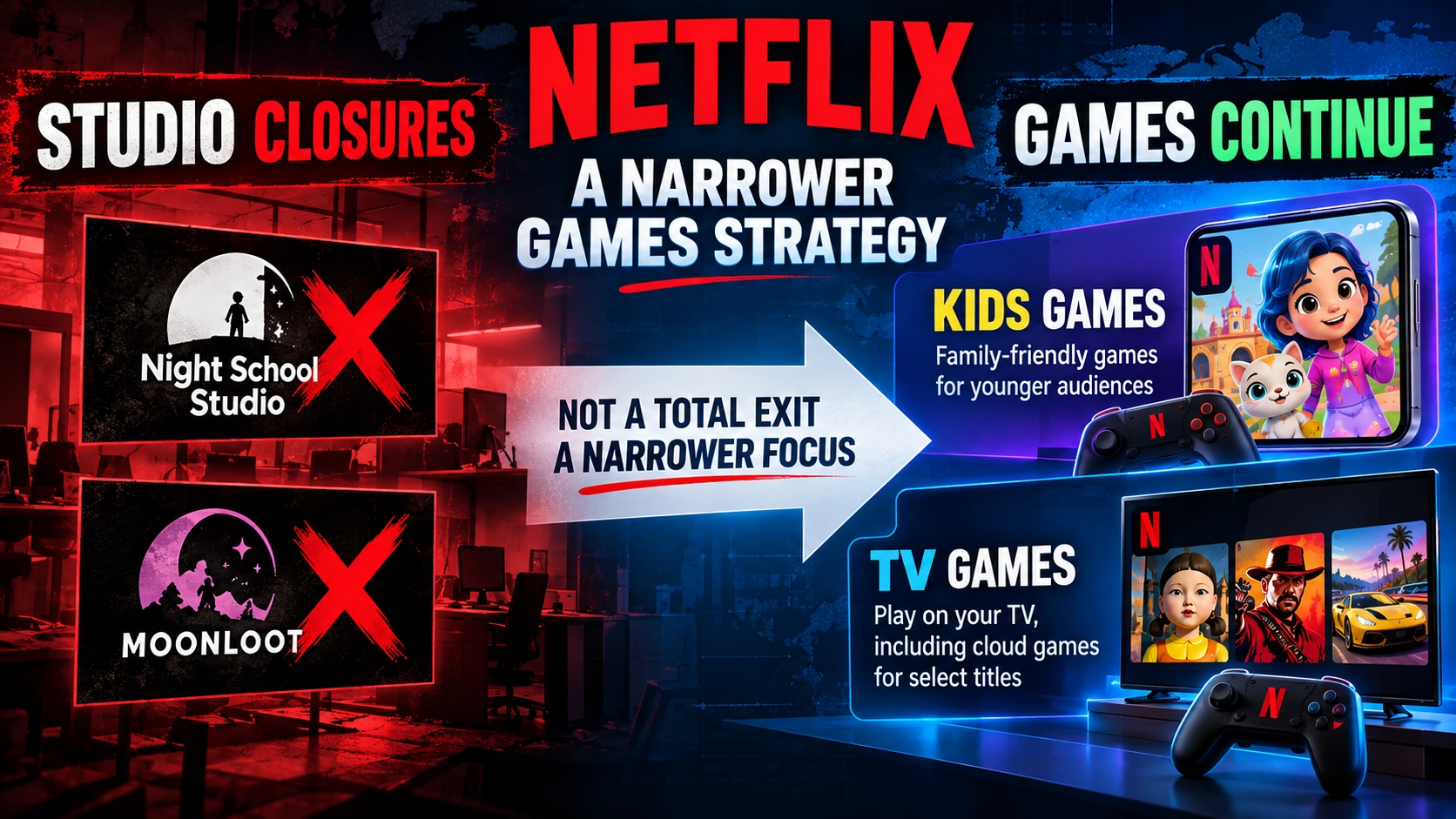
Netflix’s gaming expansion has clearly faced setbacks, but saying the company has abandoned games would go too far. In August 2026, Netflix confirmed that it was closing Night School Studio, known for Oxenfree, and Helsinki-based Moonloot, while reducing additional games roles. The changes followed earlier efforts to build in-house development teams. (Game Developer)
Yet Netflix’s July shareholder letter highlighted growth in its kids games and early progress with cloud-based games played on televisions. It noted that those businesses were growing from a small base. That is very different from announcing that the gaming experiment is over. (Netflix SEC Filing)
There is also an important technical distinction. Some Netflix games are downloaded and run on phones or tablets; cloud games send gameplay from a remote server to a television or other device. They should not be treated as one identical product with the same performance limitations.
For now, the defensible conclusion is narrower: Netflix has yet to establish gaming as a second business on the scale of its video subscriptions, and it is concentrating its bets. Claims about an exact multibillion-dollar total spent on gaming or a precise percentage of users playing each day need publicly verifiable evidence; they should not be treated as established figures.
Why Did Netflix Walk Away From a Warner Bros. Deal?
Buying major studio assets might have given Netflix a larger library of famous franchises. But the company withdrew from its bidding contest for Warner Bros. in February 2026 after Warner Bros. Discovery determined that Paramount Skydance had made a superior proposal. Netflix said matching the higher price would no longer be financially attractive. (Netflix)
That decision illustrates a second tension. More content and famous intellectual property can help a subscription service stand out, but paying too much to acquire them can hurt the financial returns investors expect.
There is no automatic contradiction between walking away from an expensive acquisition and laying off staff months later. Both can fit a strategy of allocating money more selectively. Neither, on its own, proves Netflix has lost the streaming business.
What Would Actually Show That Netflix Is Back on Track?
Netflix does not need to beat YouTube in every minute of viewing to have a successful business. It needs to give enough people a compelling reason to keep paying—and to turn that loyalty into sustainable revenue and profit.
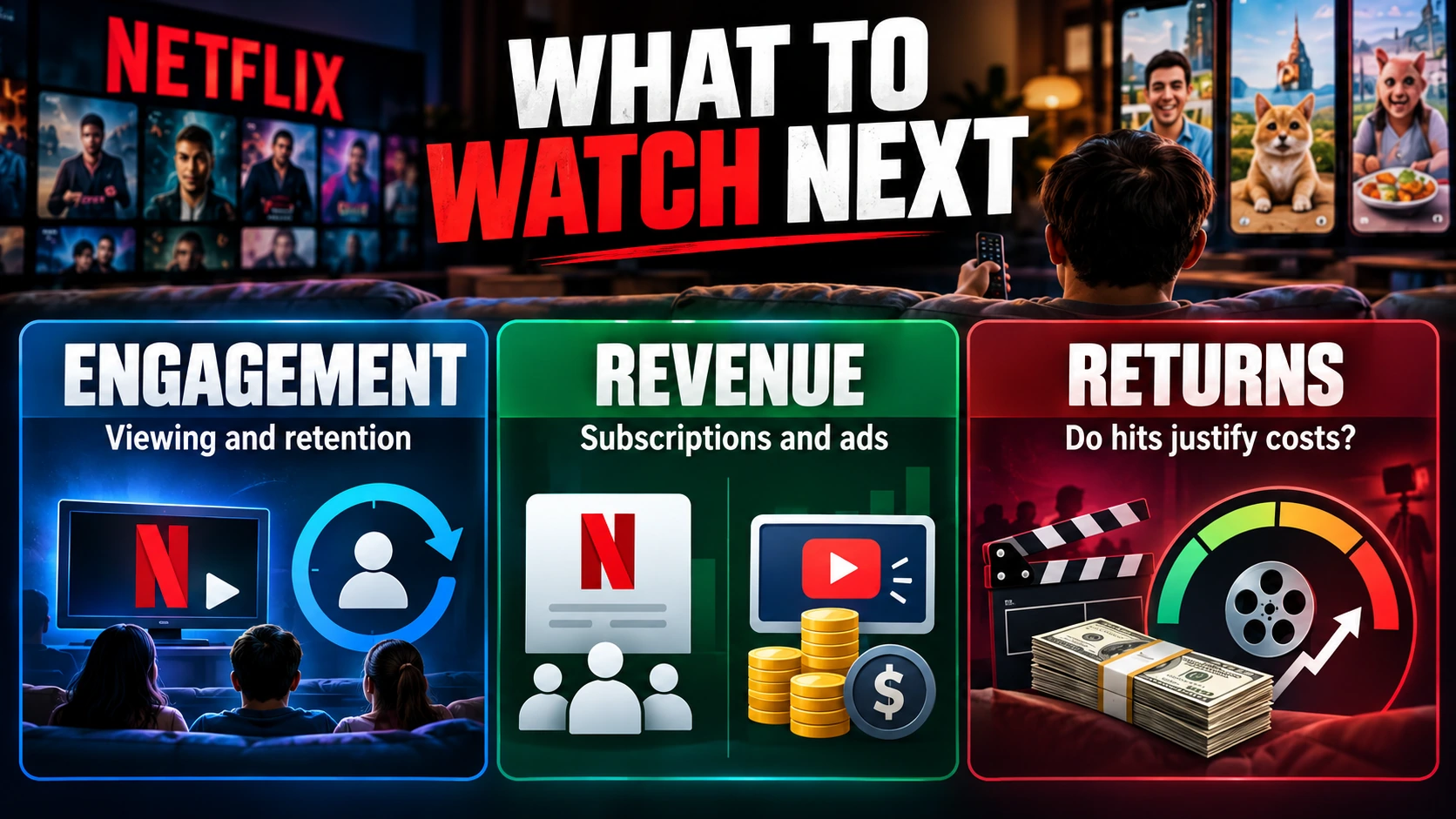
Three indicators will help tell whether the October shake-up is working:
- Engagement and retention: Do viewing habits stabilize or improve, and do subscribers still see enough value to stay after a hit show’s finale?
- Revenue quality: Can Netflix keep growing through subscriptions and advertising without relying indefinitely on price increases?
- Returns on content: Do its films, series, live events and new formats attract or retain enough viewers to justify their costs?
The October 20, 2026, third-quarter results made that test more immediate: profits continued to rise, but slower revenue growth and a reduced advertising outlook worried investors. One quarterly report cannot settle a long-term contest for attention. Investors will also be watching how incoming content chief Peter Rice balances hits, variety and spending. (Netflix SEC Filing · Reuters · Netflix)
For viewers, the outcome may look less dramatic than the headlines suggest. Netflix could continue making major series while experimenting with live sports, podcasts, advertising plans and games. The question is whether those additions make Netflix a service people regularly use, not merely one they open when the next blockbuster arrives.
Bottom Line: What This Story Really Means
Netflix is not facing a straightforward financial collapse. It is making billions in operating profit, forecasting further revenue growth and still producing major global hits. Its recent layoffs and leadership changes reflect pressure to make those strengths translate into lasting audience engagement and a convincing growth strategy.
YouTube has exposed a different competitive threat from the one Netflix spent years fighting. Netflix helped replace cable television with on-demand streaming. Now it must compete with a creator-driven video universe that can occupy viewers for hours without looking anything like a traditional movie studio.
Netflix won a major battle over how people watch television. It has not won a permanent claim on their attention.
Netflix Layoffs: Key Questions Explained
Q. How many employees is Netflix cutting in October 2026?
Netflix announced plans to cut roughly 1,000 jobs, or about 6% of its workforce, with product, technology, legal and human-resources teams among the hardest hit.
Q. Was Netflix losing money when it announced the layoffs?
No. In the third quarter of 2026, Netflix reported approximately $4.46 billion in operating income on $12.87 billion in revenue.
Q. How much did Netflix viewing grow in early 2026?
Netflix said members watched more than 97 billion hours during the first six months of 2026, a 2% increase from a year earlier.
Q. Does YouTube have more U.S. television viewing time than Netflix?
Yes. Nielsen’s July 2026 figures showed YouTube with 14.2% of total U.S. TV viewing versus about 7.8% for Netflix. That is TV viewing share, not subscriber market share.
Q. Who is replacing Netflix content chief Bela Bajaria?
Peter Rice, a former Disney and Fox executive, was named to take over as chief content officer effective October 26, 2026.
Q. Did Netflix stop making video games?
No. The company closed internal development studios and narrowed its priorities, while continuing to develop and promote selected kids and cloud-based TV games.
Q. Is KPop Demon Hunters a South Korean Netflix-produced series?
No. It is a 2025 animated film produced in partnership with Sony Pictures Animation, featuring a story rooted in Korean pop culture. It became a major global Netflix hit.
Q. Does a decline in Netflix’s share of TV time mean subscribers are leaving?
Not necessarily. Nielsen’s TV-share figures track how viewing time is divided among services. They do not directly measure Netflix subscription cancellations or total worldwide revenue.
Did this help make the story clearer? 🙂 WIN keeps unpacking the “why” behind the news—clearly and simply!
Sources
Netflix’s Financial Performance and Engagement
Netflix Third-Quarter 2026 Shareholder Letter, Filed With the SEC
Netflix Second-Quarter 2026 Shareholder Letter, Filed With the SEC
Reuters: Netflix Shares Fall on Fourth-Quarter Outlook, October 20, 2026
Layoffs and Management Changes
Reuters: Netflix Cuts About 6% of Its Workforce, October 14, 2026
Netflix: Peter Rice Named Chief Content Officer, October 15, 2026
Reuters: Netflix Film Chief Dan Lin to Depart, October 19, 2026
The Battle for Viewing Time and Global Hits
Nielsen: July 2026 U.S. Television Viewing Report
TheWrap: YouTube and Netflix’s July 2026 TV Viewing Shares
Netflix: Most Popular Movies of All Time
Sony Pictures Animation: KPop Demon Hunters
Games and Corporate Strategy
Game Developer: Netflix Closes Night School Studio and Moonloot Games
Netflix: Decision Not to Increase Warner Bros. Offer, February 26, 2026