Why Is Barclays Cutting 5,000 Jobs While Its Profits Are Rising?

A bank makes billions in profit. Its earnings are improving. And then it announces thousands of job cuts.
That sounds like something is wrong.
But Barclays, one of Britain’s largest banks and a major player in international finance, is doing exactly that.
On October 22, 2026, Barclays revealed plans to reduce its workforce by approximately 5,000 positions this year. The announcement came alongside third-quarter results showing that its pretax profit had actually increased.
And artificial intelligence is part of the explanation.
So why would a profitable bank need fewer people? Has AI really become capable of replacing thousands of banking employees? And could this signal what is coming for office jobs in the United States?
The answer is that Barclays is trying to make its existing business more profitable by permanently reducing the cost of running it. AI is helping make that possible, but it is not the whole story.

※ Images in this article are AI-generated illustrations created to help explain the story. They are not actual photographs, and depictions of people, places, or events may differ slightly from reality.
Why Would Barclays Cut Jobs When It Is Already Making Money?

Because a company can be profitable today and still decide that its future operations should require fewer employees.
For Barclays, the decision is part of a longer effort to simplify its organization, invest in technology and improve returns for shareholders.
Consider a simple example.
Imagine a company earns $10 million in revenue and spends $7 million running its business. Its operating profit is $3 million.
If new software allows the company to perform the same work while reducing annual expenses to $6 million, operating profit could rise to $4 million, assuming revenue and other costs stay unchanged.
The company was already profitable. It simply became more profitable by spending less.
That is the economic logic behind much of Barclays’ restructuring.
The bank is not announcing these cuts because it has suddenly run out of money. Instead, it believes investments in technology and changes to how employees work can support a smaller workforce.
Barclays reported that its group cost-to-income ratio improved from 63% to 62% in the third quarter.
That ratio measures how much a bank spends to generate its income. A lower ratio generally signals greater operating efficiency.
The company also announced further restructuring measures designed to produce savings in future years. (Barclays PLC)
There is an important distinction here.
A profitable business does not necessarily need to expand its workforce. If management believes the same amount of work can be completed with fewer people, job cuts can become part of its growth strategy.
Whether those cuts ultimately improve long-term performance is a separate question.
How Many Barclays Jobs Are Actually Being Cut?
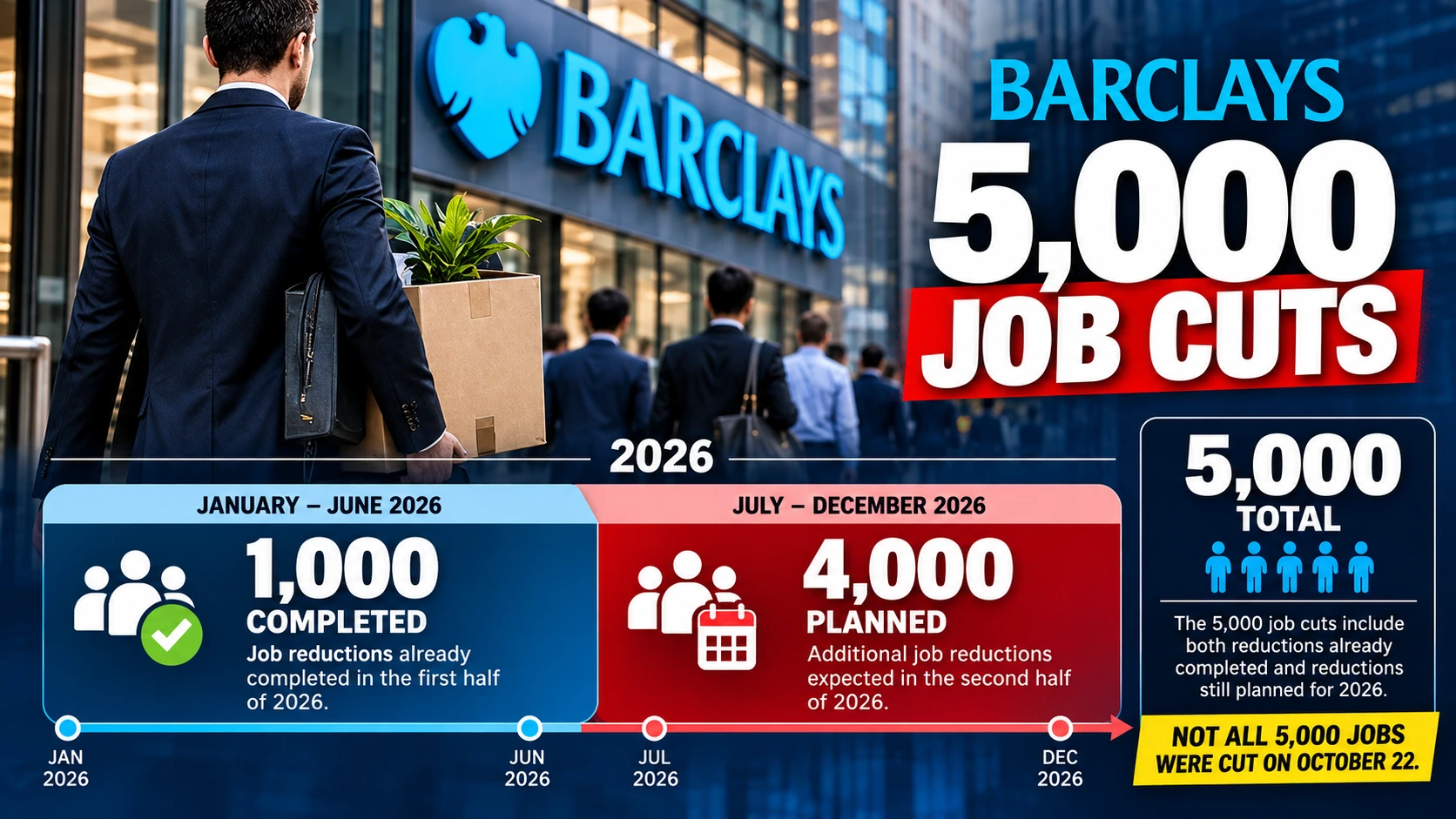
Barclays expects approximately 5,000 positions to be eliminated during 2026, representing roughly 5% of its global workforce.
But those 5,000 jobs were not all cut on the day of the announcement.
Chief Financial Officer Anna Cross told reporters that around 1,000 reductions had already taken place during the first half of the year. The bank planned to complete the remaining roughly 4,000 reductions by the end of December. (Reuters)
Here is the difference:
| Period | Job reductions | Status as reported October 22 |
|---|---|---|
| First half of 2026 | About 1,000 | Already completed |
| Second half of 2026 | About 4,000 | Planned for completion by year-end |
| Full-year 2026 total | About 5,000 | Expected total reduction |
Barclays had approximately 93,000 employees globally at the end of 2025, making the planned reduction substantial but not equivalent to eliminating an entire major business division. (AFP)
The cuts are spread across the banking group rather than being described as the closure of one specific office or department.
They are also part of a restructuring program already in progress, not an entirely new initiative launched on October 22.
That matters because the headline describes a full-year workforce reduction, not 5,000 new layoffs announced for immediate implementation.
The precise number of employees affected in individual countries and departments has not been fully established in the public reports reviewed for this article.
Is Artificial Intelligence Really Replacing Barclays Employees?
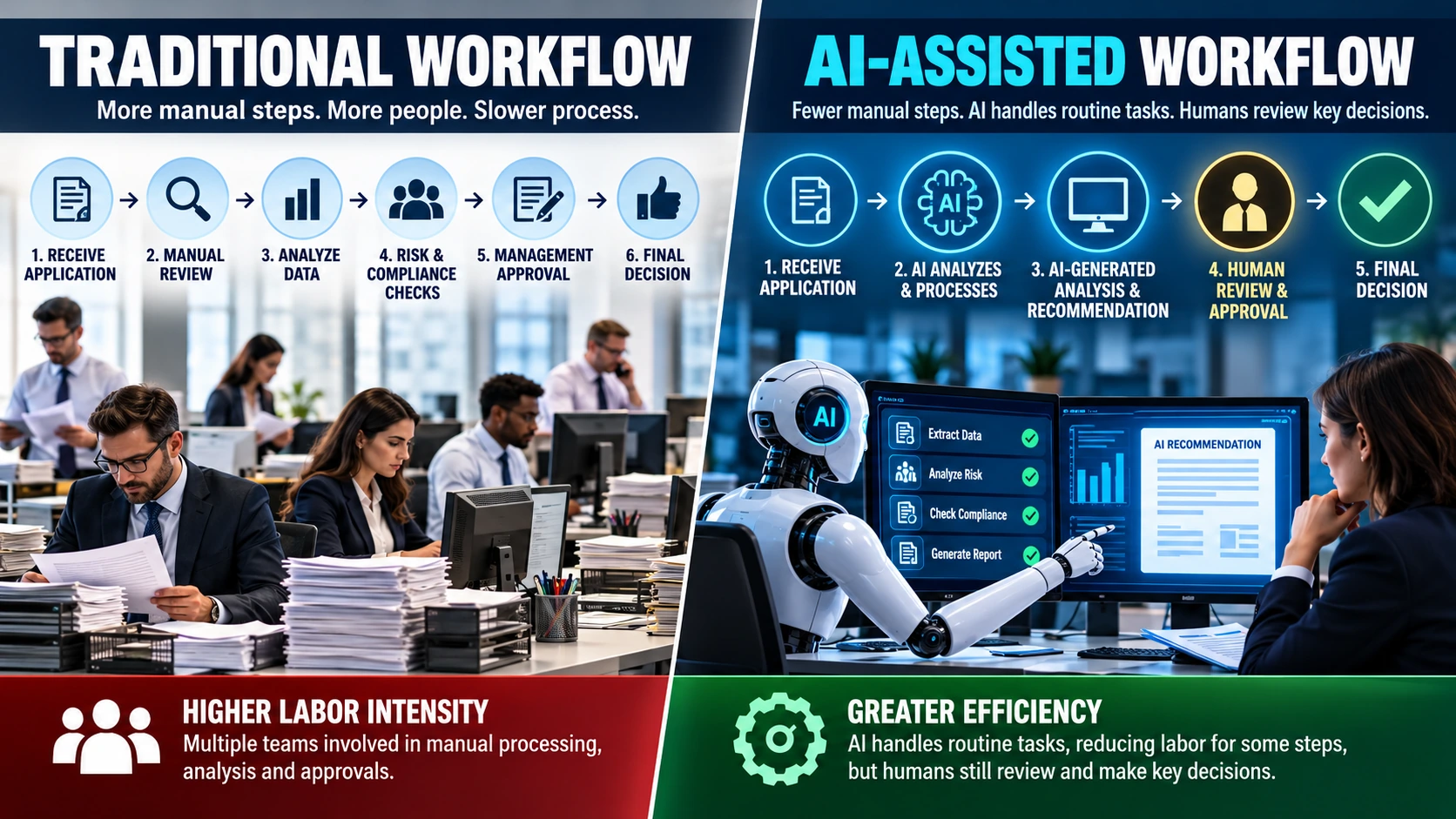
AI is contributing to the reductions, but Barclays has not demonstrated that AI alone has directly replaced every one of the 5,000 positions.
That distinction is essential.
Barclays has invested in technology for years. Its current restructuring combines organizational simplification, improved digital systems, automation and greater use of artificial intelligence.
During the October 22 earnings discussions, CEO C. S. Venkatakrishnan described AI as the “icing on the cake” of the bank’s broader technology investments.
His point was that AI works best when the underlying systems, data and business processes have already been modernized. (The Guardian)
Think about how work moves through a large bank.
A single customer request might previously require one employee to collect information, another to review documents, another to enter data and someone else to verify the result.
Newer systems can combine or accelerate parts of that process.
AI may help employees find information, prepare documents or write software. Traditional automation can handle repetitive routing, calculations and standardized transactions.
Together, these technologies can reduce the number of working hours required for some activities.
But a reduction in labor requirements does not automatically mean that an AI system has independently assumed every responsibility previously held by a human employee.
Banks still need people to handle exceptions, supervise important decisions, manage operational risks and meet legal and regulatory requirements.
There is also a difference between what a company expects AI to achieve and what it has independently demonstrated.
Barclays’ announcement establishes that management sees technology as a major source of efficiency. It does not provide a verified task-by-task accounting showing exactly how many jobs were eliminated solely because of generative AI.
Why Are Software Developers and Support Staff Among the Most Affected?
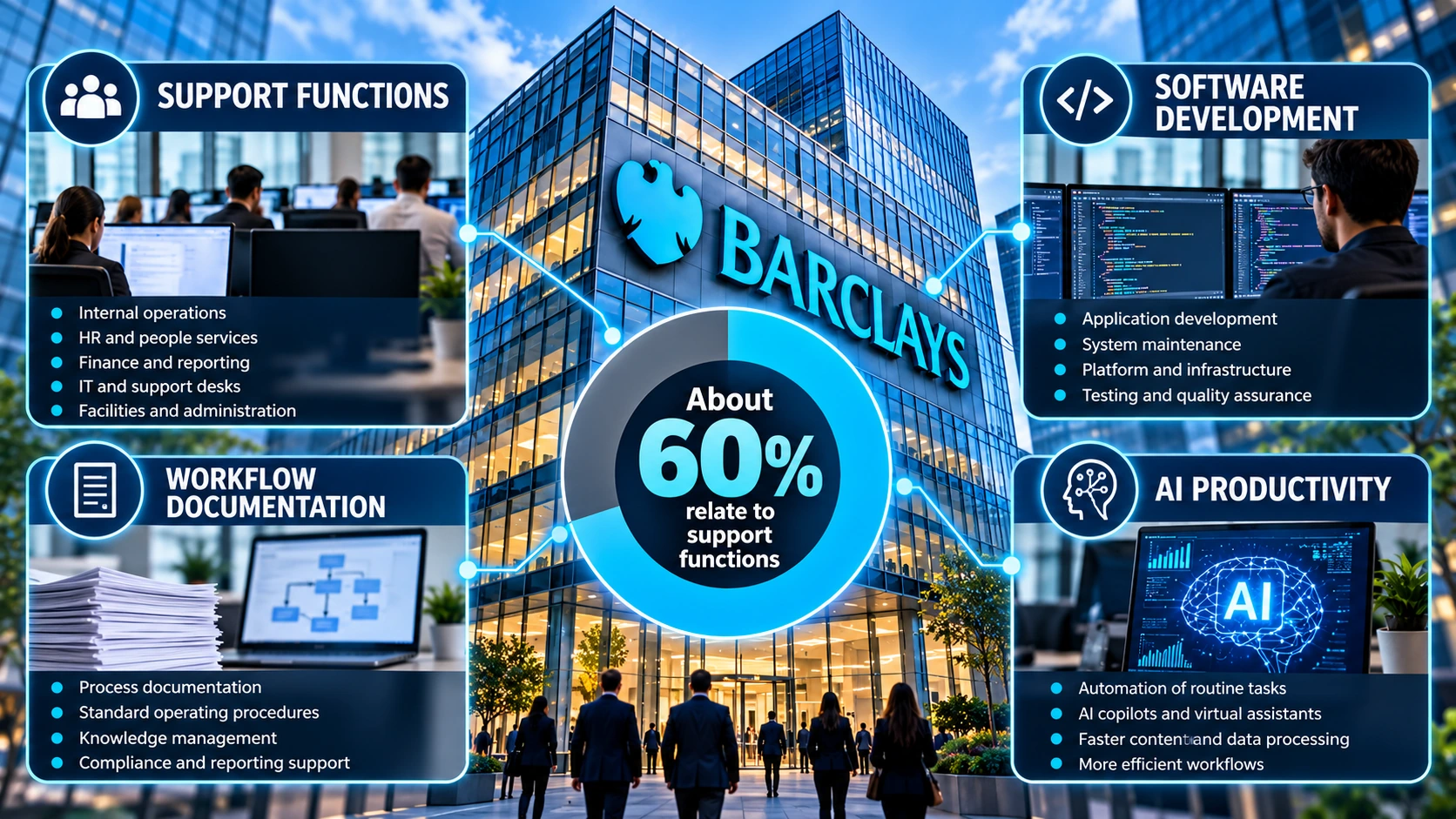
Barclays says roughly 60% of its workforce reductions relate to support functions, including areas such as software development.
That does not mean 60% of the eliminated positions are software developers.
It means support functions as a broader category account for approximately three-fifths of the reductions.
Anna Cross specifically identified fewer developers as an example of how AI can help existing employees become more productive. (Reuters)
Why would a bank need fewer developers?
For decades, large banks have depended on extensive technology teams to build applications, maintain internal systems, process information and support digital services.
AI-powered coding assistants can now help with some of that work.
For example, developers may use AI tools to produce initial code drafts, explain unfamiliar software, suggest tests or identify possible errors.
Human developers still need to review the output, assess security implications and ensure that the software behaves correctly.
But if an existing team can complete more development work in the same period, management may decide it needs fewer additional employees—or a smaller team—to deliver a particular workload.
That is the productivity argument Barclays is making.
Does this mean traditional banking jobs are disappearing too?
Some operational and administrative work may also require fewer people as processes become more automated.
At Barclays, improvements to customer-facing technology and internal operations have been part of the broader cost-reduction strategy.
A bank can reduce staffing needs without replacing the entire customer service or operations function.
The distinction is between eliminating certain tasks and eliminating all the people who perform those tasks.
For employees, though, that distinction offers limited comfort when a company concludes that fewer positions are necessary.
The concern is no longer confined to the traditional image of automation replacing repetitive factory work. It increasingly extends to routine components of professional, technical and administrative jobs.
How Strong Are Barclays’ Profits—and Why Is It Buying Back Shares?

Barclays is profitable, and its third-quarter pretax earnings rose from a year earlier. But its financial results were not uniformly strong.
For the July–September 2026 quarter, Barclays reported the following:
| Financial measure | Third-quarter result |
|---|---|
| Pretax profit | £2.3 billion |
| Pretax profit growth | Up 12% year over year |
| Total income | About £7.4 billion |
| Equities trading income | Up 47% year over year |
| Fixed-income trading income | Down 19% year over year |
| Newly announced share buyback | Up to £500 million |
These figures come from the bank’s October 22 results announcement. (Barclays PLC)
The contrast between equities and fixed-income trading is revealing.
Equities trading involves products connected to stocks, while fixed-income trading deals with products such as bonds and related financial instruments.
Barclays performed particularly well in equities. Its fixed-income business, however, experienced weaker activity and disappointing results.
Although overall pretax profit grew, the bank’s earnings were slightly below analysts’ expectations. (Reuters)
In other words, higher profits did not mean every part of Barclays was performing as well as management or investors wanted.
Why announce a share buyback during job cuts?
A share buyback occurs when a company purchases its own outstanding shares.
If those shares are canceled, fewer shares remain in circulation. That can increase earnings per remaining share, assuming total earnings stay the same, although it does not guarantee a higher stock price.
Barclays announced its intention to buy back up to £500 million in shares while pursuing workforce reductions.
These are different financial decisions, but they highlight a tension in how companies allocate resources.
Management may argue that returning capital to shareholders and making the business more efficient are both parts of its strategy.
Employees and labor representatives may question whether some of those resources should instead be directed toward retaining workers or retraining them.
Britain’s Unite union criticized Barclays’ approach and argued for greater efforts to retrain and support employees rather than eliminate positions as technology changes. (The Guardian)
Neither the profit figure nor the share buyback, by itself, tells us whether a particular job was economically necessary.
What the combination does show is that Barclays is prioritizing a leaner operating structure while continuing to reward shareholders.
Why Should Americans Care About Job Cuts at a British Bank?
Because the forces behind Barclays’ decision are not unique to Britain.
Barclays is a global financial institution with a U.S. consumer banking business and international investment banking operations.
Its own results describe activity in American consumer finance, including credit products, deposits and lending. (Barclays PLC)
The announcement does not, however, establish how many of the planned 5,000 reductions will affect U.S.-based employees.
There is no basis for treating the entire worldwide reduction as an American layoff event.
The broader significance lies in the business model.
U.S. banks, insurers, financial technology companies and other large employers face similar questions about whether AI and digital systems can reduce routine administrative and technical work.
Barclays offers a concrete example of what happens when a large employer connects that productivity argument to an explicit staffing reduction.
Could it mean fewer banking jobs in America?
It could signal pressure on certain types of work, but Barclays’ decision alone cannot establish how many U.S. jobs will disappear.
A company may respond to higher productivity in several ways.
It could expand services without hiring as many additional employees, redeploy workers to new responsibilities, invest in retraining or reduce its existing headcount.
Barclays is taking the workforce-reduction route in parts of its business.
Other institutions may make different decisions depending on demand, their existing technology, regulation and financial priorities.
For an American employee, an important question is not just whether AI can perform part of their job.
It is whether their employer plans to use the time saved by AI to expand the business—or to reduce the number of employees required.
What about banking customers?
For customers, automation can potentially bring faster service and more convenient digital tools.
But those gains depend on whether new systems work reliably and whether adequate human support remains available when problems are complicated.
A smaller workforce does not automatically produce worse customer service. It does not guarantee better service, either.
Barclays’ job-cut announcement is not itself evidence that customers will receive lower fees, higher deposit rates or better borrowing terms.
Those outcomes would require separate evidence.
What Happens Next for Barclays—and What Is Still Unclear?
The next major milestone is the completion of the planned workforce reductions by the end of 2026.
Barclays expects its restructuring and technology investments to contribute to further efficiency gains in 2027 and beyond.
Management has indicated that it expects more than £1.1 billion in efficiency savings during 2027.
Those are forward-looking expectations, not savings that have already been fully realized. (The Guardian)
Several developments will help determine whether the strategy is successful.
First, the actual workforce reduction. The company will need to complete its planned staffing changes. The final composition of those reductions will matter as much as the headline total.
Second, measurable cost savings. Barclays disclosed £201 million in third-quarter structural cost actions—expenses associated with restructuring and changing its cost base. Those costs should not be confused with money already saved.
Third, operating performance. A smaller workforce only improves the business over the long run if the bank can maintain essential services, controls and productivity.
Fourth, evidence of AI’s contribution. Investors, employees and customers may want to know how much of the improvement comes specifically from AI and how much results from traditional automation, organizational changes and other investments.
Barclays has also scheduled its full-year 2026 results for February 9, 2027, according to its published financial calendar.
That reporting will provide a clearer picture of its annual financial performance and may offer further information about the restructuring. (Barclays PLC)
There is no need to assume the bank’s projections will all be achieved.
The test will be whether its future results demonstrate lasting efficiency gains without offsetting damage to operations or customer service.
Bottom Line: What This Story Really Means
Barclays is cutting approximately 5,000 positions in 2026 even as its profits rise because it believes technology and organizational changes can allow it to operate with fewer employees.
About 1,000 of those reductions had already happened in the first half of 2026, while roughly 4,000 more were targeted for completion by year-end.
Artificial intelligence is part of the strategy, particularly in support functions and software development. But it would be misleading to claim that AI has independently replaced all 5,000 workers.
The story illustrates a shift in how companies think about employment.
For many years, rising profits were often associated with business expansion and new hiring. Today, some employers are also pursuing stronger profits by reducing the labor needed for existing work.
That does not mean every company will follow Barclays or that every office job is in danger.
It does mean that profitability is no longer a reliable indicator of job security, particularly when management believes new technology can change how work gets done.
The question extending well beyond Barclays is how companies will share the benefits of improved productivity among employees, customers and shareholders.
Barclays Job Cuts: Key Questions Explained
Q. How many jobs is Barclays cutting in 2026?
Barclays expects to eliminate approximately 5,000 positions, equivalent to about 5% of its global workforce.
Q. Have all 5,000 Barclays employees already lost their jobs?
No. Approximately 1,000 reductions had been completed during the first half of 2026, with roughly 4,000 additional reductions planned for completion by year-end.
Q. Are the Barclays job cuts happening because the bank is losing money?
No. Barclays reported £2.3 billion in third-quarter 2026 pretax profit, up 12% from a year earlier. The restructuring is intended to reduce ongoing costs and improve future returns.
Q. Is AI responsible for all 5,000 Barclays job cuts?
That has not been established. Barclays identifies AI and technology-enabled efficiencies as important contributors, alongside broader organizational simplification and restructuring.
Q. Which Barclays employees are most affected by the reductions?
Approximately 60% of the reductions relate to support functions, including some software development roles. Barclays has not publicly established a complete role-by-role breakdown in the sources reviewed here.
Q. Why are software development jobs affected by AI?
AI-assisted coding and related tools can help developers complete certain tasks faster. Employers may therefore decide that some projects require fewer people, although human oversight, testing and security work remain necessary.
Q. Why is Barclays buying back shares while reducing its workforce?
Barclays is pursuing two separate financial objectives: returning capital to shareholders and lowering its operating costs. The simultaneous decisions have drawn criticism from labor representatives.
Q. Will American Barclays employees lose jobs?
The 5,000 figure applies to Barclays’ global workforce. The public announcements reviewed for this article do not establish a specific number of U.S.-based positions affected.
Q. Does Barclays’ decision mean AI will replace most banking employees?
No such conclusion follows from this announcement. It demonstrates that technology can contribute to substantial staffing reductions at one bank, not that most banking jobs can be fully automated.
Q. When will the results of Barclays’ restructuring become clearer?
The bank plans to complete its 2026 reductions by year-end. Its full-year results, scheduled for February 9, 2027, should provide additional financial context, although they may not resolve every question about the impact of AI.
Did this help make the story clearer? 🙂
WIN keeps unpacking the “why” behind the news—clearly and simply!
Sources
Barclays’ Official Financial Results and Strategy
Barclays PLC — Third Quarter 2026 Results Announcement, October 22, 2026
Workforce Reductions and AI Adoption
Reuters — Barclays to Cut 5,000 Jobs This Year, October 22, 2026
Reuters — Barclays to Slash 5,000 Jobs in AI-Powered Cost-Cutting Drive, October 22, 2026
AFP — Barclays Bank to Cut About 5,000 Jobs Amid AI Drive, October 22, 2026
Labor Response and Wider Implications
Keep Reading
Why Are Other Profitable Companies Cutting Jobs, Too?
Barclays is not the only company reducing staff while reporting strong earnings. Netflix’s October layoffs provide another example of why healthy profits and a shrinking workforce can coexist—even when the role of AI differs.
Netflix Layoffs: Why Cut Nearly 1,000 Jobs When Profits Are Strong?