Why Would Amazon Sell $8 Billion of Nvidia AI Chips—Then Lease Them Back?

Why would Amazon sell billions of dollars’ worth of AI chips that it still needs?
And if the company plans to keep those chips running inside its data centers, what exactly has been “sold”?
That is the unusual part of a financing plan reported by the Financial Times on October 2. According to people familiar with the talks, Amazon has been exploring a structure that could move roughly $8 billion of Nvidia Grace Blackwell chips into a separate investment vehicle and then lease the hardware back.
So the computers would not necessarily go anywhere.
What changes is who owns the expensive hardware and who provides the money to finance it.
There is also an important qualification: this is a reported proposal, not a completed Amazon transaction. Reuters, citing the FT report, said Amazon and Nvidia had not provided immediate comment on the plan. (Financial Times · Reuters)
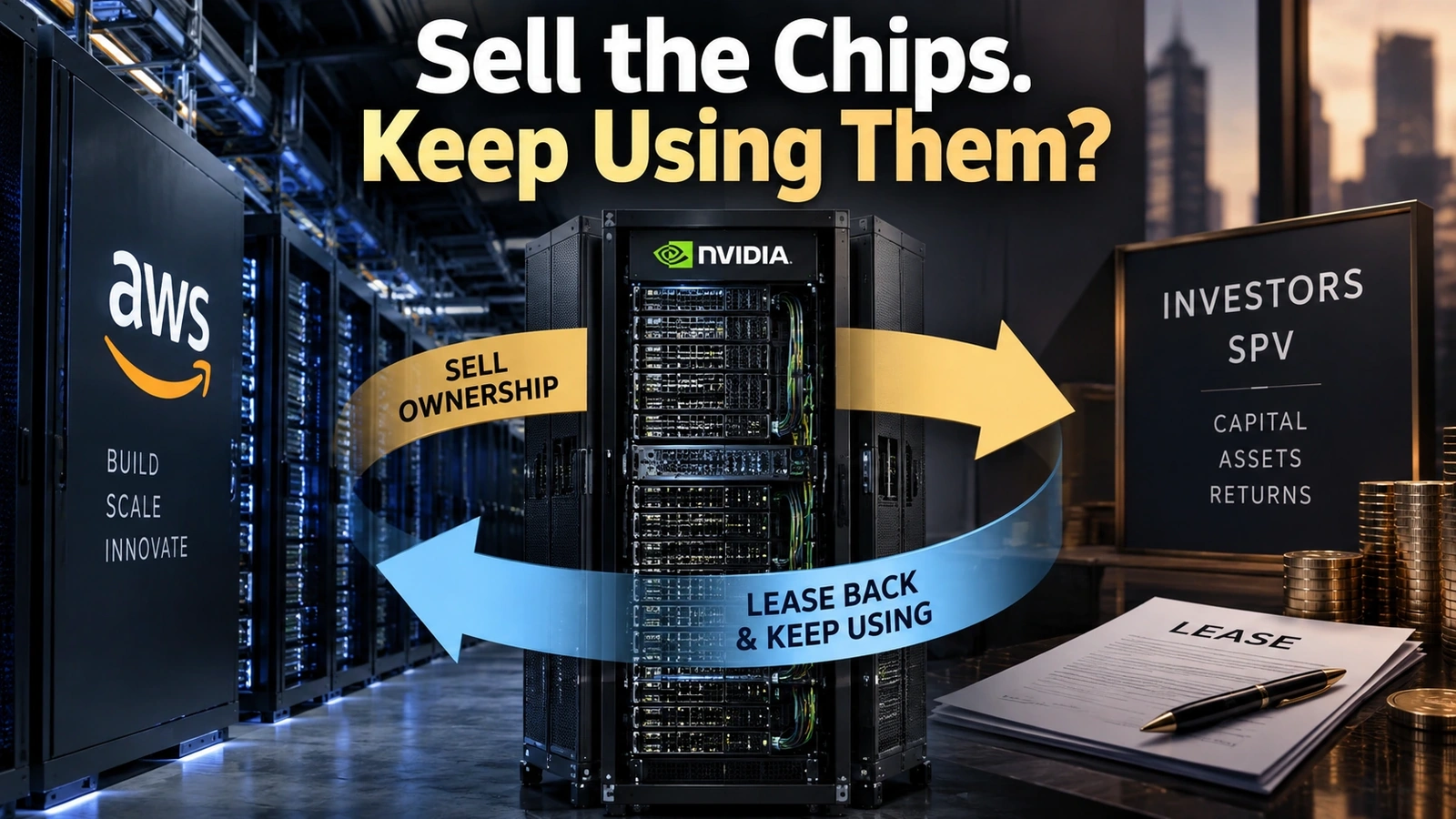
※ Images in this article are AI-generated illustrations created to help explain the story. They are not actual photographs, and depictions of people, places, or events may differ slightly from reality.
The simplest way to understand the proposal is to separate two things that normally come together: ownership of a chip and the right to use it.
Amazon could potentially give up the first while keeping the second.
What Is Amazon Actually Considering?
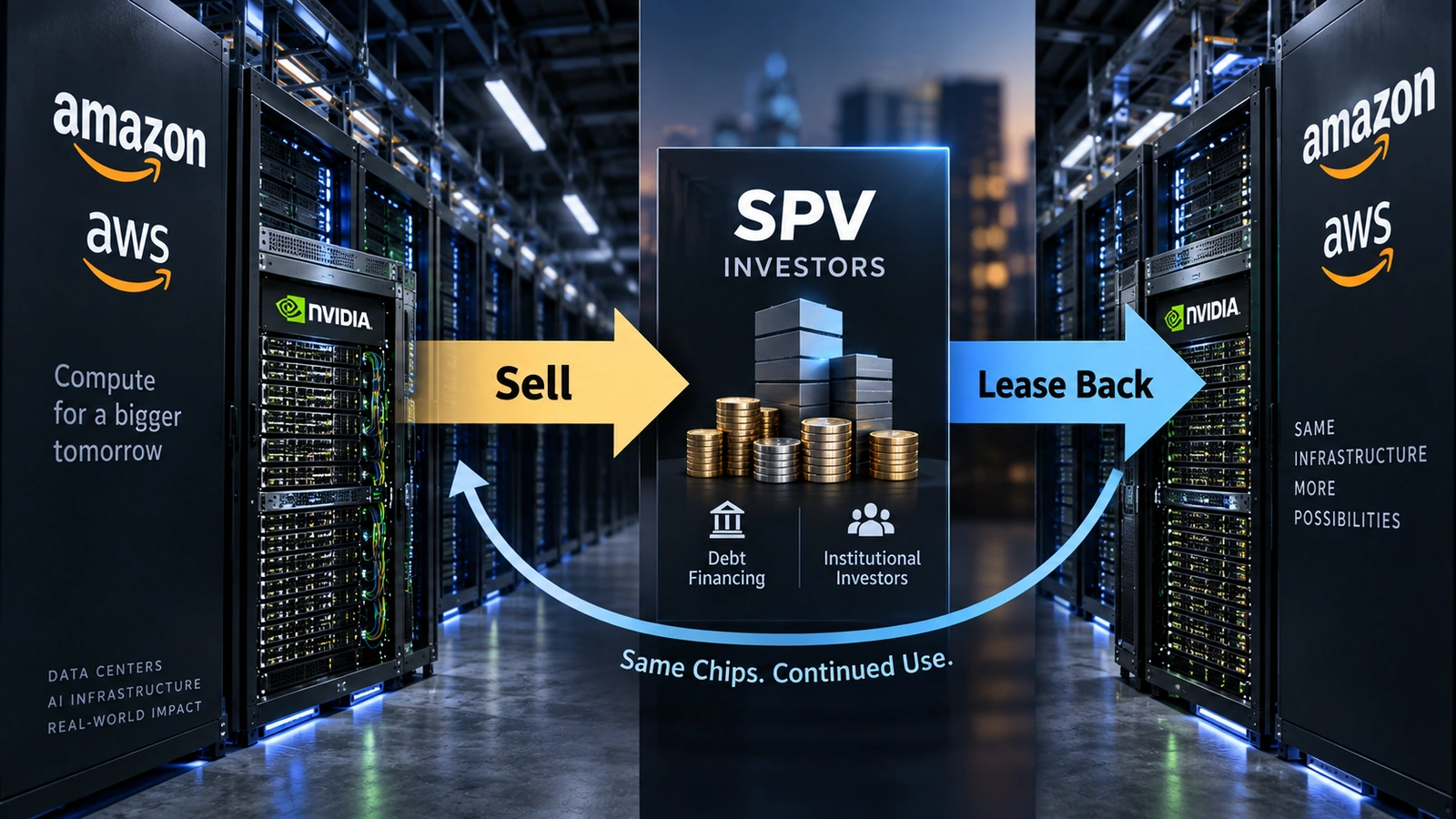
The reported structure uses a special-purpose vehicle, or SPV.
An SPV is a separate legal entity created for a specific transaction or pool of assets. In this case, the vehicle would hold the AI hardware and raise money from outside investors, including through debt. Amazon would then make lease payments in exchange for continuing to use the chips.
The FT reported that the hardware includes thousands of Grace Blackwell chips deployed across more than a dozen U.S. data centers in five states, including Nevada and Virginia. (Financial Times · Reuters)
Here is the basic idea:
| Step | What happens | What Amazon gets |
|---|---|---|
| 1 | AI chips are transferred into a separate financing vehicle | Cash or financing capacity |
| 2 | Outside investors fund the SPV | Investors gain exposure to the assets and lease payments |
| 3 | Amazon leases the chips back | Continued use of the same computing hardware |
| 4 | Amazon makes lease payments over time | Less need to fund the entire hardware cost upfront |
That last point is the reason the transaction can make economic sense even though it initially sounds circular.
Amazon is not trying to stop using the chips.
It is potentially trying to change the way those chips are financed.
Why Sell Something You Still Need?
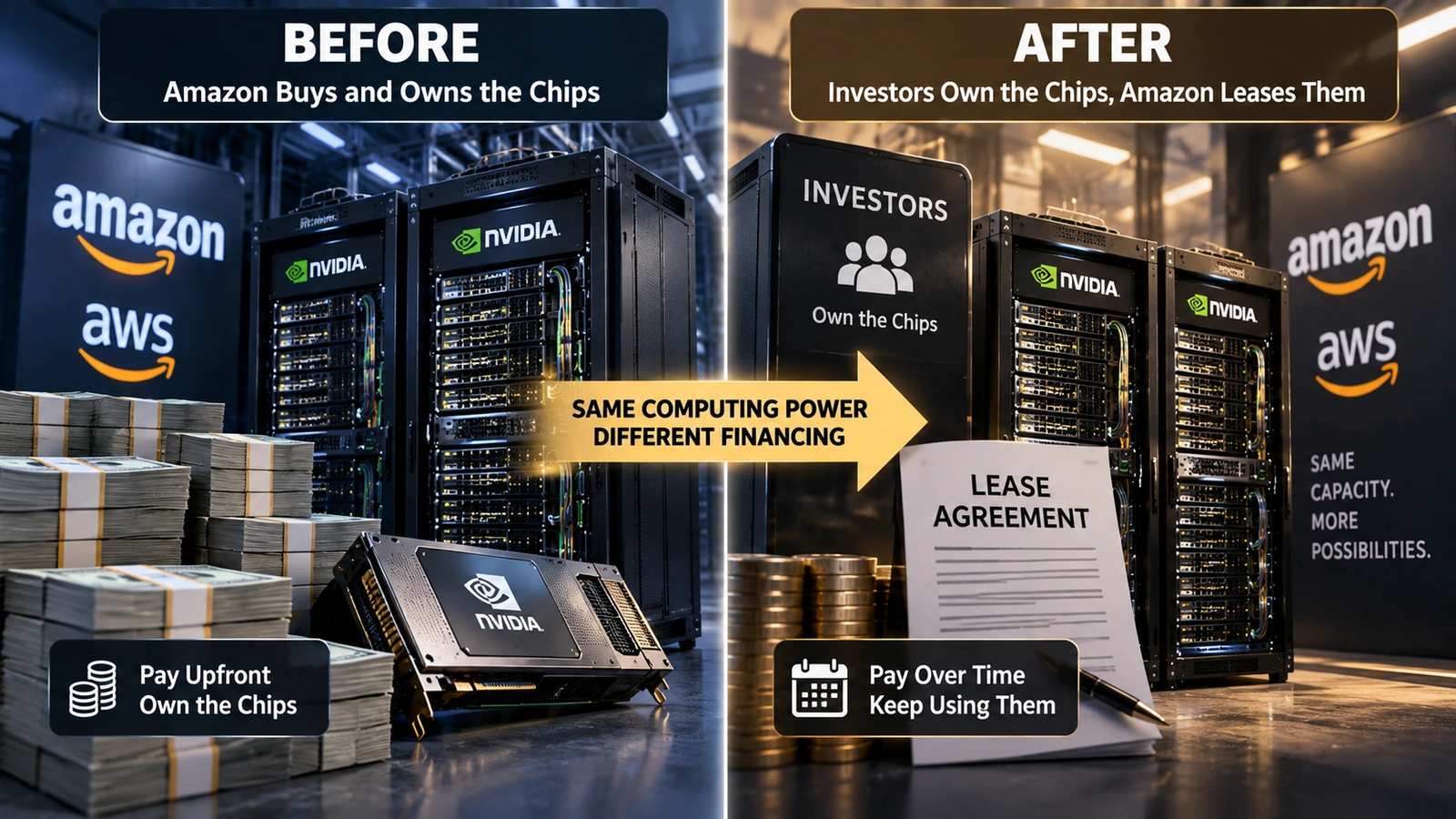
Because owning an asset and using an asset are not the same thing.
Airlines often lease aircraft. Companies lease warehouses, vehicles and industrial equipment. They can control the equipment for business purposes without paying the entire purchase price upfront or keeping legal ownership for its full life.
A sale-and-leaseback applies that idea to something the company already controls.
Imagine a company owns $100 million of machinery. It sells the machinery to a financing company for $100 million, then signs a lease allowing it to keep operating the machines.
Operationally, very little may change on Monday morning.
Financially, a lot has changed.
The company has converted an owned asset into cash and replaced ownership with a stream of future lease payments.
For Amazon, that matters because the cost of building AI capacity is arriving before much of the revenue that the new infrastructure is expected to produce.
CEO Andy Jassy described that timing problem in his 2025 shareholder letter: AWS must spend money in advance on land, power, buildings, chips, servers and networking, often months before the resulting capacity starts generating customer revenue. (Amazon)
A leaseback can therefore act as a bridge between a huge upfront investment and the years of usage expected from the equipment.
Is Amazon Trying to Make $8 Billion of Debt Disappear?
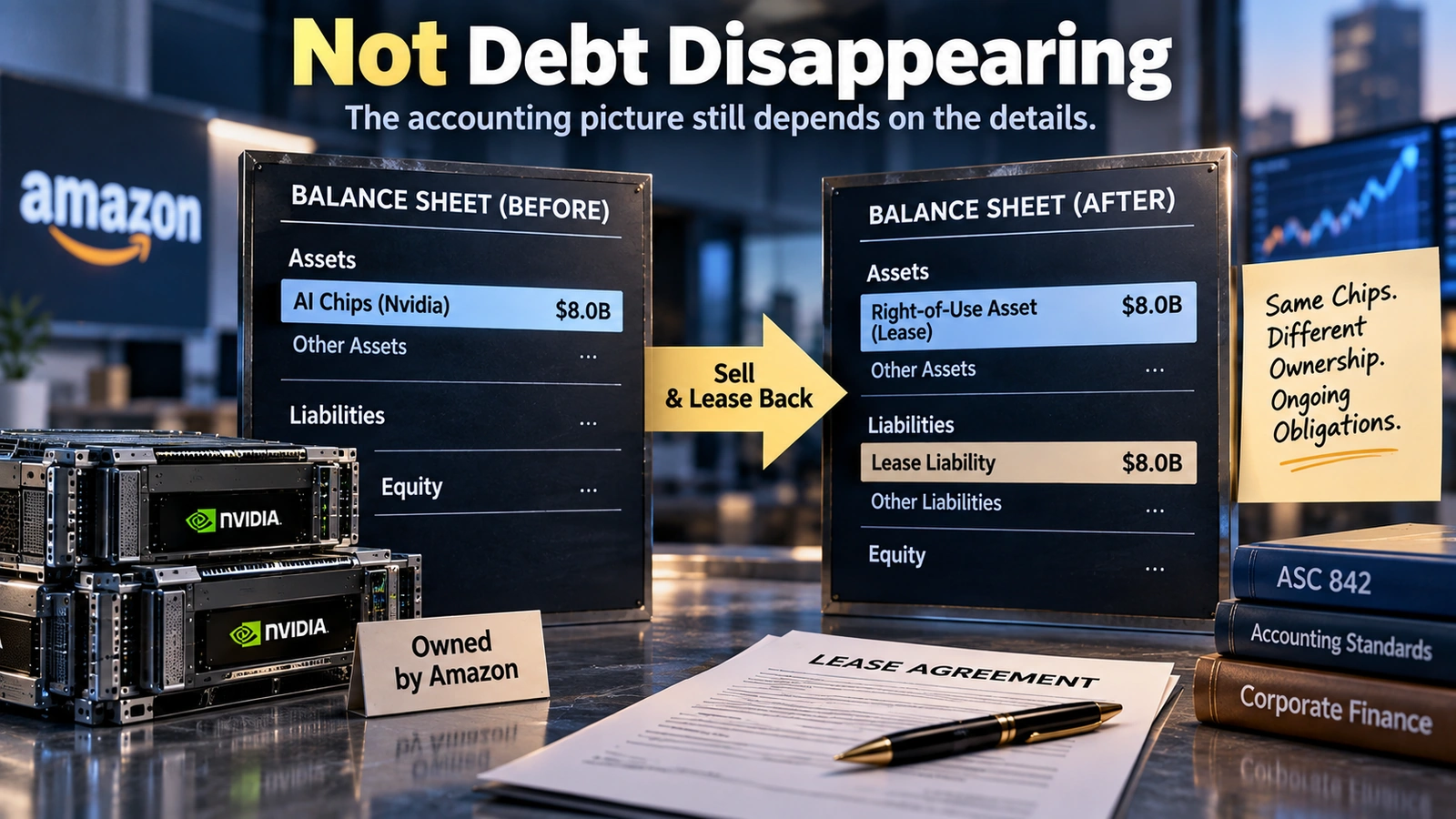
Not necessarily—and this is one of the most important distinctions in the story.
Calling a transaction “asset-light” does not mean all of its financial obligations vanish.
Under U.S. lease accounting rules, companies generally recognize lease obligations and corresponding right-of-use assets for leases. A true sale-and-leaseback can allow the original asset to be removed from the seller-lessee’s books, but the lease itself still has to be accounted for.
And if the transaction does not qualify as a true sale under the accounting rules, it can instead be treated as a financing arrangement. Deloitte’s ASC 842 guidance makes that distinction explicit. (Deloitte)
That means headlines suggesting Amazon would simply move $8 billion “off the books” can be misleading if taken too literally.
The exact accounting treatment will depend on the final contract—including who controls the assets, the lease classification and other terms that have not been publicly disclosed.
So the more useful question is not:
“Does $8 billion disappear?”
It is:
“How much capital can Amazon free up today, and what obligations does it take on in return?”
Why Is Amazon Looking at Financing Like This Now?
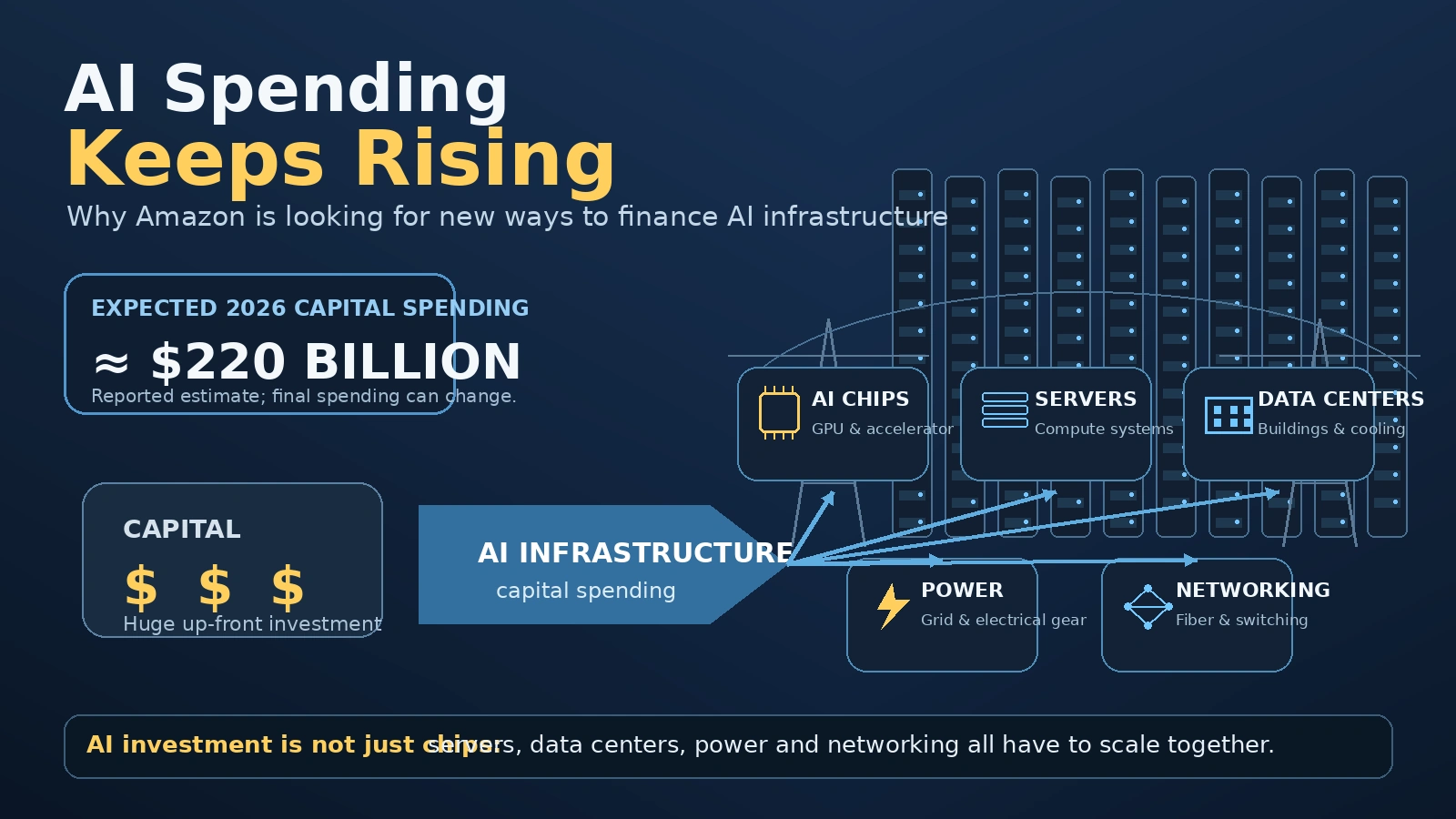
Because AI has turned cloud computing into an extraordinarily capital-intensive business.
In his shareholder letter earlier in 2026, Jassy said Amazon expected to spend approximately $200 billion in capital expenditures during 2026 and argued that much of the AWS spending was backed by customer commitments. The FT now reports that Amazon’s expected 2026 capital spending is around $220 billion, with a large share going toward AWS chips and AI data centers. (Amazon · Financial Times)
Amazon’s own financial results show what that spending can do to cash flow.
For the 12 months through June 30, Amazon reported $7.6 billion of negative free cash flow, compared with positive free cash flow a year earlier. The company said the deterioration was driven primarily by a $66.1 billion year-over-year increase in purchases of property and equipment, largely reflecting AI investment. (Amazon Investor Relations)
That does not mean the underlying AWS business is shrinking.
Quite the opposite.
AWS revenue grew 37% year over year in the second quarter to $42.2 billion, and Amazon said AWS had reached a $169 billion annualized revenue run rate. Its AI business had also surpassed a $25 billion annualized revenue run rate. (Amazon Investor Relations)
The tension is therefore unusual:
Demand is strong, but meeting that demand requires enormous amounts of cash before the new infrastructure fully pays for itself.
That is exactly the kind of environment where companies start looking for more ways to finance physical assets.
Why Not Just Issue More Amazon Bonds?
An SPV offers a different funding channel.
Instead of Amazon financing every GPU directly with corporate cash or ordinary unsecured debt, a separate vehicle can be built around a specific pool of assets and the cash flows associated with leasing them.
That can potentially attract investors who are interested in asset-backed or investment-grade income rather than simply buying more Amazon corporate bonds.
The FT reported that the proposed SPV would raise outside money through debt issuance. The broader goal is an “asset-light” structure in which outside capital finances hardware that Amazon continues to operate. (Financial Times)
This does not automatically mean the SPV financing is cheaper.
The final cost depends on interest rates, lease terms, investor appetite, the value of the chips and how the contracts divide risk.
But it gives Amazon another option.
Think of it as adding another faucet to a very large funding system rather than replacing the existing ones.
Amazon can still use operating cash flow, corporate debt and traditional leases while also bringing outside investors directly into certain infrastructure assets.
Why Nvidia Chips If Amazon Is Building Its Own Trainium Chips?
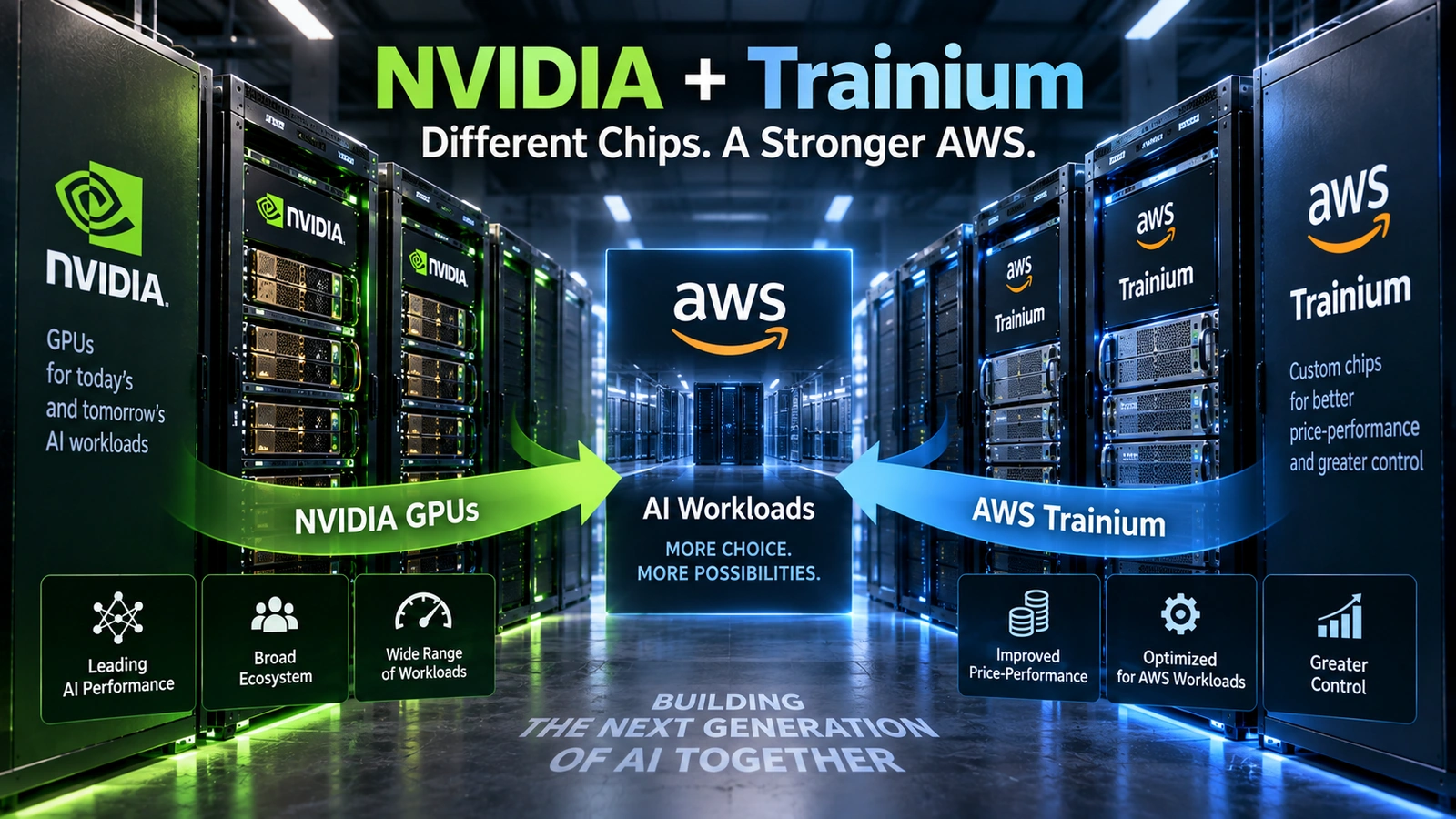
Because AWS is pursuing both.
Amazon has invested heavily in Trainium, its own AI accelerator, because custom silicon can lower costs and improve AWS economics for workloads that fit it.
But Jassy has also said explicitly that Amazon intends to maintain a strong Nvidia partnership and continue offering Nvidia hardware to customers who want it. (Amazon)
AWS and Nvidia announced an expanded collaboration in March, including plans to deploy more than one million Nvidia GPUs across AWS regions starting in 2026. (AWS)
So the reported leaseback should not be read as evidence that Amazon no longer wants Nvidia hardware.
It is a financing story, not necessarily a technology exit.
| Nvidia GPUs | Amazon Trainium |
|---|---|
| Major industry-standard AI accelerator platform | AWS-designed AI accelerator |
| Important for customers already building on Nvidia’s ecosystem | Designed to improve AWS price-performance and economics |
| Amazon plans large-scale continued deployment | Amazon is rapidly expanding its own chip business |
| Could be financed through purchases, leases or other structures | Gives Amazon another route to reduce dependence on external accelerators |
The bigger strategy is diversification.
AWS wants customers to be able to choose Nvidia hardware while also giving Amazon more control over the economics of its own infrastructure.
Who Takes the Risk When Investors Own the Chips?
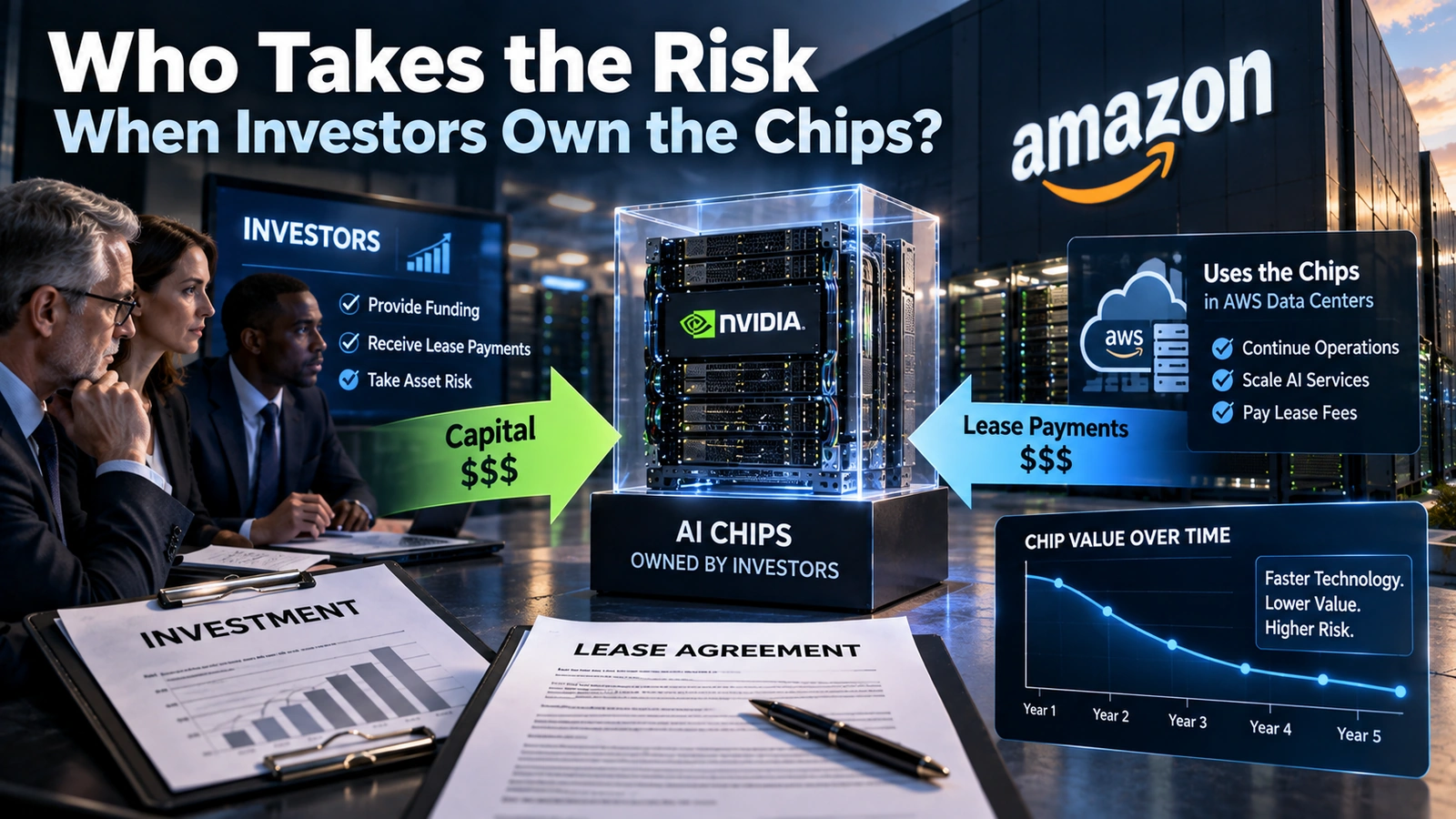
This is where the transaction becomes more interesting than a simple loan.
AI chips are expensive, but they are not buildings.
A data center can remain useful for decades. High-end computing hardware has a much shorter economic life because new generations continually improve performance and efficiency.
That creates something financiers call residual-value risk: what will the asset still be worth after the lease has run for several years?
If outside investors own the chips, they may bear some of that risk.
But the actual allocation could change substantially depending on the contract. Amazon could agree to minimum lease periods, renewal terms, guarantees or other protections that shift some economic risk back toward the company.
Those details have not been publicly disclosed.
The same uncertainty applies to other major questions:
| Question | Why it matters |
|---|---|
| How long is the lease? | Longer leases give investors more predictable payments |
| What interest rate will the SPV pay? | Determines how expensive the financing becomes |
| Who bears the chips’ decline in value? | Affects investor returns and Amazon’s economic risk |
| Can Amazon replace or upgrade hardware? | AI chips can become technologically outdated quickly |
| Does the deal qualify as a sale for accounting purposes? | Determines how the transaction appears in financial statements |
| How large will the final transaction be? | The reported $8 billion figure remains part of an evolving proposal |
That is why the finished contract matters more than the headline structure.
Does This Mean the AI Boom Is Running Out of Money?
No.
A company searching for new financing methods is not, by itself, evidence that its business is failing.
Amazon is simultaneously reporting rapid AWS growth, large AI demand and enormous infrastructure spending.
What the reported deal does show is that the AI boom has become large enough to create a financing problem of its own.
The first phase of generative AI was mostly discussed in terms of models: which system was smarter, faster or cheaper?
The infrastructure phase is different.
Now the industry needs extraordinary amounts of chips, servers, land, electricity, cooling equipment, fiber and data-center construction.
And once spending reaches hundreds of billions of dollars per year, financing becomes part of the technology story.
The question is no longer simply:
“Who can build the best AI?”
It is also:
“Who can finance enough computing infrastructure to keep building it?”
What Should We Watch Next?
The first thing to watch is whether Amazon actually completes the transaction.
The FT described investor discussions, not a signed final deal. Amazon had not publicly confirmed the reported plan as of October 2. (Financial Times · Reuters)
If a transaction is completed, the most revealing details will be its size, lease duration, borrowing cost, investor participation and accounting treatment.
There is also a larger industry question.
Amazon is not the only company confronting the enormous cost of AI infrastructure. Reuters reported on October 1 that Broadcom had agreed to provide up to $42 billion of financing connected with Anthropic’s future chip-computing commitments. (Reuters)
Different transactions use different structures, so they should not be treated as identical.
But the direction is clear: AI finance is becoming a distinct business alongside AI technology itself.
Bottom Line: What This Story Really Means
Amazon is reportedly considering selling roughly $8 billion of Nvidia AI chips to an investor-backed vehicle and then leasing the same hardware back.
That sounds contradictory only if ownership and use are assumed to be the same thing.
They are not.
A sale-and-leaseback can let Amazon recover capital tied up in expensive hardware while continuing to use that hardware inside AWS data centers. In return, Amazon would take on lease obligations and potentially give outside investors exposure to the value and risks of the chips.
The plan does not mean $8 billion simply disappears from Amazon’s financial obligations, and the final accounting treatment cannot be known until the actual terms are disclosed.
The bigger story is what pushed Amazon to consider the structure in the first place: AI infrastructure has become so expensive that the world’s largest technology companies are increasingly treating servers, chips and data centers not just as technology—but as assets that need sophisticated financing.
Amazon Leaseback: Key Questions Explained
Q. Is Amazon definitely selling $8 billion of Nvidia chips?
No. The Financial Times reported that Amazon has been discussing a transaction of roughly that size with investors. As of October 2, Amazon had not publicly confirmed a completed deal.
Q. Would Amazon stop using the Nvidia chips after selling them?
No, not under the reported structure. Amazon would lease the chips back from the investment vehicle and continue using them in its data centers.
Q. What is an SPV?
An SPV, or special-purpose vehicle, is a separate legal entity created for a specific transaction or group of assets. In this case, it would potentially own the chips and raise outside financing.
Q. Why would Amazon sell hardware and then pay rent to use it?
The structure could convert money tied up in owned hardware into cash while allowing Amazon to keep using the computing capacity. The tradeoff is that Amazon would make lease payments over time.
Q. Does a sale-and-leaseback remove the entire obligation from Amazon’s balance sheet?
Not automatically. U.S. accounting rules generally require lease assets and liabilities to be recognized, and a transaction that does not qualify as a true sale may be treated as financing instead.
Q. Why does Amazon need so much money for AI infrastructure?
AI capacity requires far more than chips. Amazon must invest in data centers, servers, networking, power infrastructure and other equipment before much of that capacity starts producing revenue.
Q. Is Amazon moving away from Nvidia and replacing it with Trainium?
No. Amazon is expanding Trainium while also continuing a major Nvidia partnership. AWS says it plans to deploy more than one million Nvidia GPUs across its regions starting in 2026.
Q. What is the biggest risk for investors buying the chips?
One potential risk is how quickly the hardware loses economic value as newer AI chips arrive. The final allocation of that risk would depend on the lease and financing contracts.
Q. What happens next?
The most important next step is whether Amazon reaches a final agreement with investors. If it does, the lease terms, financing cost, accounting treatment and final transaction size will show how valuable the structure actually is.
Did this help make the story clearer? 🙂 WIN keeps unpacking the “why” behind the news—clearly and simply!
Sources
Reported Amazon Nvidia Chip Transaction
Financial Times — Amazon seeks to offload $8bn of Nvidia chips to investors
Reuters — Amazon seeks to offload $8 billion of Nvidia chips to investors, FT reports
Amazon AI Spending and AWS Growth
Amazon Investor Relations — Amazon.com Announces Second Quarter Results
Amazon — CEO Andy Jassy’s 2025 Letter to Shareholders
AWS — AWS and NVIDIA deepen strategic collaboration
Sale-and-Leaseback Accounting and AI Financing
Deloitte — Lease Accounting Guide and Sale-and-Leaseback Guidance
Reuters — Broadcom to lend Anthropic up to $42 billion to lease its chips
Keep Reading
What other costs make AI infrastructure so expensive besides the chips?
Amazon’s financing problem does not end with GPUs. This WIN explainer shows how new data centers can also require major spending on electricity, transmission, substations, water systems and other infrastructure—and why regulators are increasingly asking who should pay for those upgrades.
Why Are Texas and California Putting New Limits on Data Centers—and Who Pays for the Power?
Why do investors care so much about whether AI spending keeps accelerating?
The value of chips, data centers and the financing built around them depends partly on expectations for continued computing demand. This earlier WIN explainer shows how even the possibility of slower frontier-AI development quickly changed investor assumptions about Nvidia, chips and data-center spending.