Why Are Texas and California Putting New Limits on Data Centers—and Who Pays for the Power?
If AI is supposed to make computing faster and more efficient, why are Texas and California suddenly putting tighter conditions on data-center growth?
And if these giant computing facilities are privately owned, why are governors talking about household electric bills and local water supplies?
On September 21, 2026, Texas Gov. Greg Abbott directed the Texas Commission on Environmental Quality to stop issuing permits sought by data centers until state agencies complete an audit of their power and water demands. On the same day, California Gov. Gavin Newsom signed seven data-center bills covering electricity costs, water use, reporting, and land-use rules. (Texas Governor’s Office · California Governor’s Office)
Neither state banned data centers.
The much bigger question is who should pay when a new AI or cloud-computing campus needs new substations, transmission lines, power generation, water infrastructure, and other upgrades.

Texas Hit Pause. California Changed the Rules. What Actually Happened?
Texas and California are responding to the same basic problem in very different ways.
Texas ordered TCEQ to halt permits sought by data centers and directed state agencies not to move forward with related regulatory approvals until required audit information is available.
California instead enacted seven new laws intended to increase disclosure and make data-center developers bear more of the infrastructure costs created by their projects. (Texas Governor’s Office · California Governor’s Office)

| Question | Texas | California |
|---|---|---|
| Main action | Temporarily halt state permits while audits are completed | Seven data-center bills signed into law |
| Electricity focus | Verify grid impact and require projects to cover infrastructure costs | Create tariffs and cost-allocation rules for large data-center loads |
| Water focus | Audit usage and enforce existing reporting requirements | Require water disclosures, planning, and developer-funded infrastructure |
| Basic approach | Pause and verify | Regulate and allocate costs |
Texas had already begun tightening the grid-connection process before the September 21 order. In June, ERCOT said it was tracking more than 438,000 megawatts of large-load connection requests, with nearly 89% associated with data centers. ERCOT also warned that not every request becomes a completed project. (ERCOT)
That distinction matters.
A request to connect a 500-megawatt project to the grid is not the same thing as a 500-megawatt facility actually being built. Utilities still have to plan for credible future demand, however, and bad forecasts can become very expensive.
Why Are Power Bills at the Center of the Fight?
A data center does not automatically make residential electricity more expensive.
The concern is what happens when a utility must build expensive infrastructure to serve that new customer—and how those costs are divided.

Suppose a utility expects a massive computing campus to arrive. It may need to build a new substation, strengthen transmission lines, purchase additional electricity, or sign long-term contracts for new generation.
Then imagine the data-center project is delayed, downsized, or canceled.
The infrastructure may already have been built.
That creates what regulators call a stranded-cost risk: the system spent money for demand that did not fully materialize. If the large customer does not cover enough of that cost, other customers may be left paying part of the bill.
Lawrence Berkeley National Laboratory identifies fair cost allocation and the risk of underused infrastructure as two of the central issues regulators face when designing electricity rates for data centers and other very large customers. (Berkeley Lab)
California’s new AB 2383 addresses that problem directly. It requires the California Public Utilities Commission to require investor-owned utilities to file specified transmission, distribution, and generation tariffs for participating data centers, with mechanisms such as upfront collateral, early-termination charges, and minimum payments tied to projected demand so other customers are protected from certain costs created to serve a large project. (California Legislature — AB 2383)
So when politicians say data centers should “pay their own way,” this is the practical question they are talking about.
Not who pays the monthly server-room electricity bill.
Who pays for the grid that had to be expanded to make that electricity available in the first place?
How Much Electricity Could Data Centers Really Use?
Enough that utilities can no longer treat them like ordinary commercial customers.
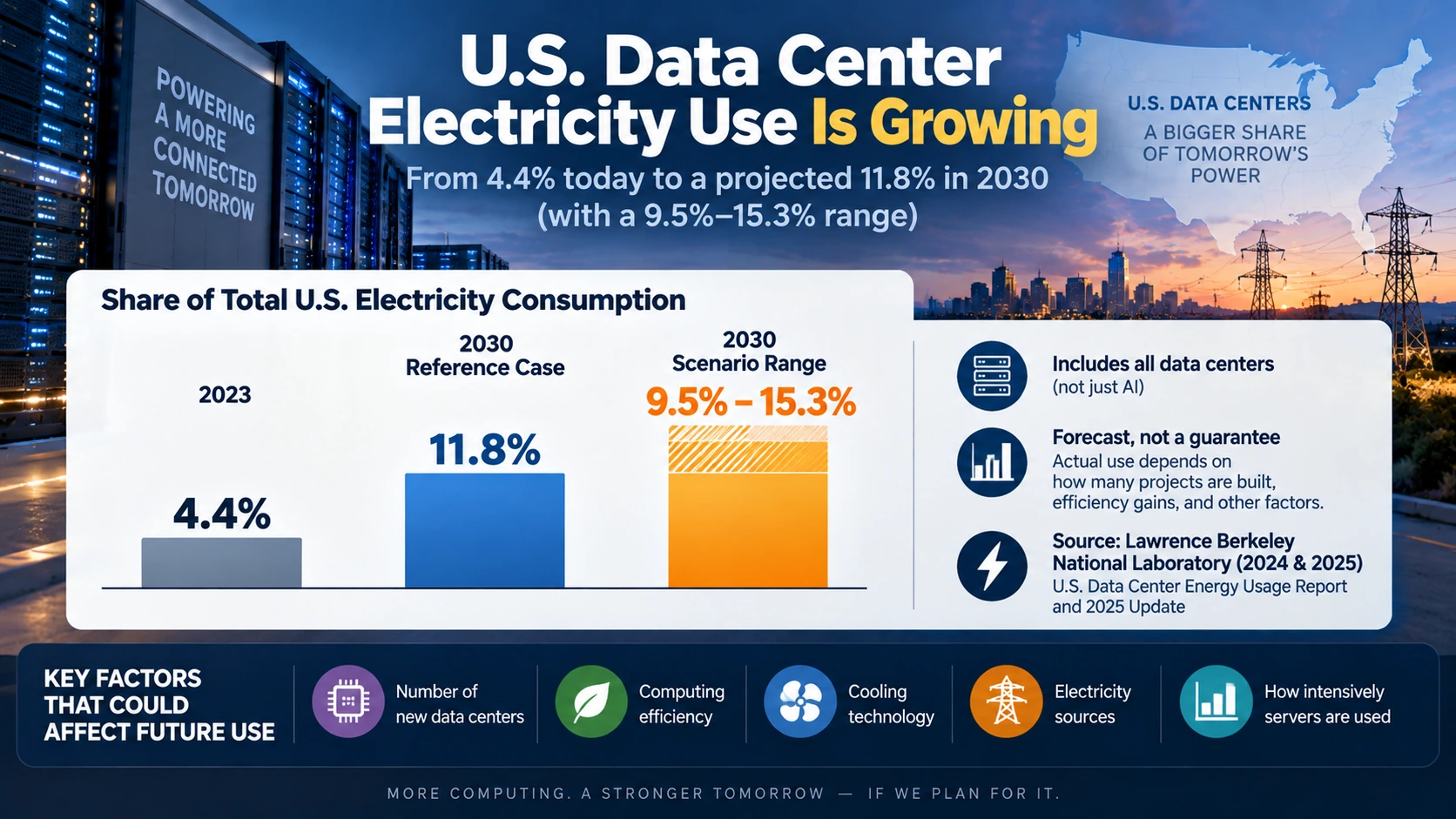
Berkeley Lab’s June 2026 update estimates that U.S. data centers could account for about 11.8% of total national electricity consumption in 2030 under its reference case. Its broader scenario range runs from 9.5% to 15.3%. (Lawrence Berkeley National Laboratory)
| U.S. data-center electricity use | Share of total U.S. electricity |
|---|---|
| 2023 estimate | 4.4% |
| 2030 reference case | 11.8% |
| 2030 scenario range | 9.5%–15.3% |
The 4.4% figure is Berkeley Lab’s estimate for 2023, while the 2030 figures come from its June 2026 update. (Lawrence Berkeley National Laboratory — 2024 Report · Lawrence Berkeley National Laboratory — 2025 Update)
Those numbers include data centers broadly, not just generative-AI systems.
They are also forecasts, not guarantees. Future consumption depends on how many projects actually get built, how intensively servers are used, improvements in computing efficiency, cooling technology, and several other variables.
But the direction is why state regulators are moving now rather than waiting until the facilities are already connected.
Large AI facilities are unusual because their power demand can be enormous, highly concentrated in one location, and expected to operate around the clock.
A city adding thousands of homes creates new electricity demand gradually.
A single hyperscale computing campus can arrive as one enormous block of demand.
Why Is Texas Auditing Projects Before Letting More of Them Move Forward?
Texas has two problems to solve at the same time: grid capacity and uncertainty about which proposed projects are real.
ERCOT’s large-load connection queue became so large that the grid operator created a new “Batch Zero” system to study qualified projects of 75 megawatts or more together instead of examining each request in isolation. In June, ERCOT said the queue contained more than 438,000 megawatts of large-load requests, almost 89% associated with data centers. (ERCOT)
That does not mean Texas is about to add 438 gigawatts of actual electricity consumption.
ERCOT itself notes that not every interconnection request becomes a completed project.
That is exactly why verification matters.
Texas’s audit is focused on information the state says it needs before projects move forward, including projected electricity demand, onsite generation plans, water use and supply, cooling technology, public financial assistance, ownership, and community impacts. (Texas Governor’s Office — August 3 Audit Directive)
Abbott’s September 21 directive therefore went beyond the grid-connection review. It instructed the Texas Commission on Environmental Quality to stop permits sought by data centers until the relevant audits are completed. (Texas Governor’s Office)
The agency is due to provide the governor’s office an update on compliance with the directive by October 19, 2026.
This is a pause tied to information gathering—not a permanent statewide prohibition on data centers.
What Exactly Did California Change?
California did not impose a statewide moratorium.
Instead, it built a more detailed regulatory framework around the question: If a data center creates a new cost, how much of that cost should the project itself absorb?
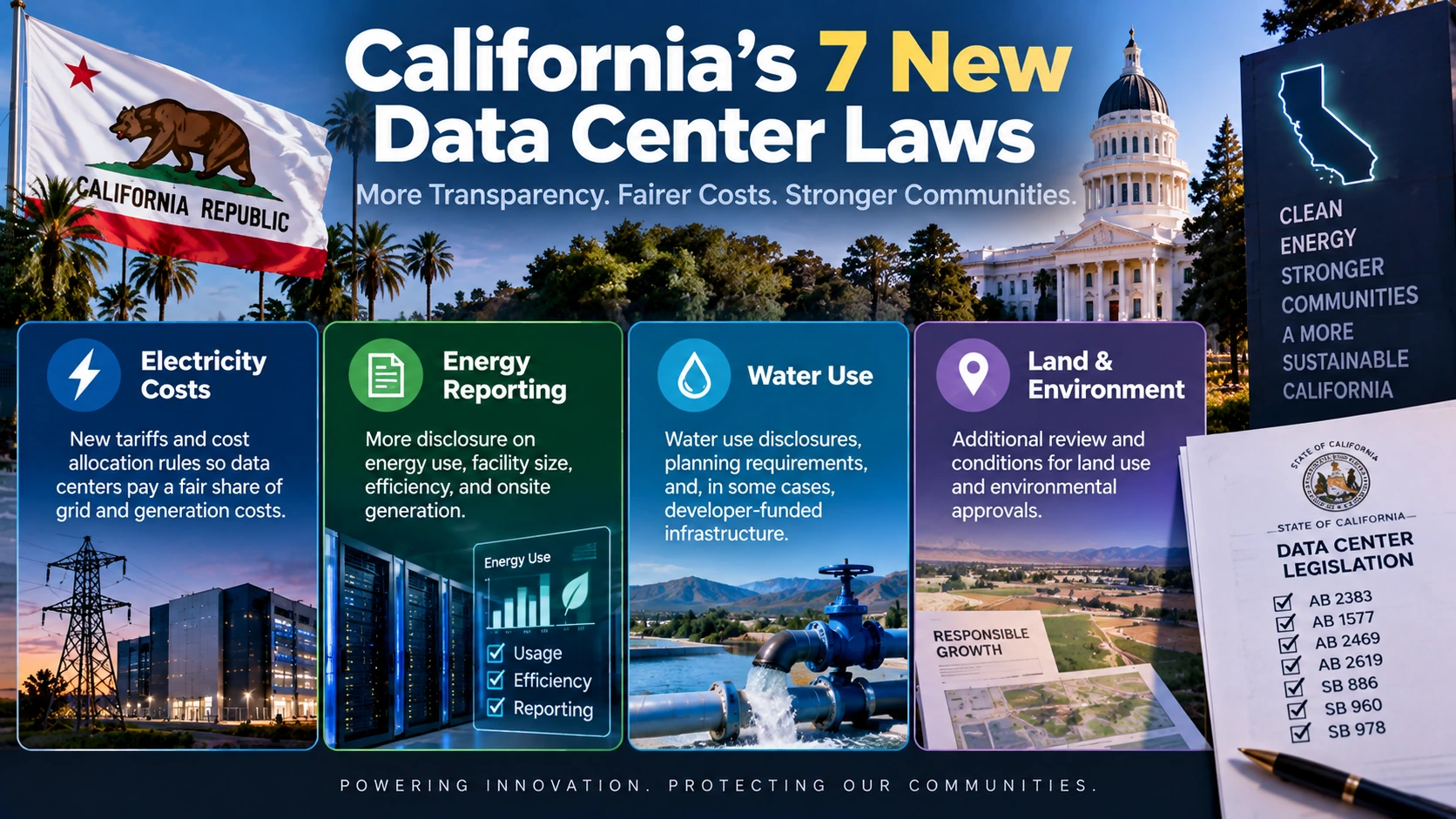
Several of the laws overlap, but the seven-bill package can be understood in four main groups. (California Governor’s Office)
| Area | Key bills | What changes |
|---|---|---|
| Electricity rates and interconnection | AB 2383, SB 886, SB 1168 | Tariffs and cost-allocation rules are intended to keep certain data-center grid and generation costs from shifting to other ratepayers |
| Energy reporting | AB 1577 | Covered data centers must provide information about energy use, facility size, efficiency, and onsite generation |
| Water | AB 2469, AB 2619 | Developers and operators face new water-use disclosure and planning requirements, including responsibility for specified infrastructure costs |
| Land and environmental review | SB 887 | Data centers face additional CEQA requirements and conditions for certain streamlined review |
AB 2383 is especially important for electric bills. It requires specified tariffs and cost-recovery mechanisms intended to prevent other customers from being left with incremental generation costs if a project does not connect, leaves early, or uses less electricity than projected. It also requires community choice aggregators and electric service providers to adopt qualifying generation-service tariffs by January 1, 2028. SB 886 separately requires the California Public Utilities Commission, by January 1, 2028, to establish new tariffs or update existing electric rules for covered large-load customers. (California Legislature — AB 2383 · California Legislature — SB 886)
AB 1577 creates a statewide reporting process for covered data centers, generally facilities with at least 10 megawatts of electrical capacity, covering information such as facility size, energy efficiency and onsite fuel use. It also requires additional information when operators seek certain local permits, and the California Energy Commission is directed to begin including data-center load assessments in its integrated energy policy reporting beginning in 2029. (California Legislature — AB 1577)
The package therefore does more than regulate electricity consumption.
It tries to make the costs and resource demands of a proposed project visible before communities commit to serving it.
Why Does Water Keep Coming Up in a Story About Computers?
Because servers generate heat.
Cooling that equipment can require water directly at the data center, depending on the cooling technology being used. Electricity production can also have an indirect water footprint depending on how the power is generated.
And there is no reliable universal number for “how much water one AI query uses.”
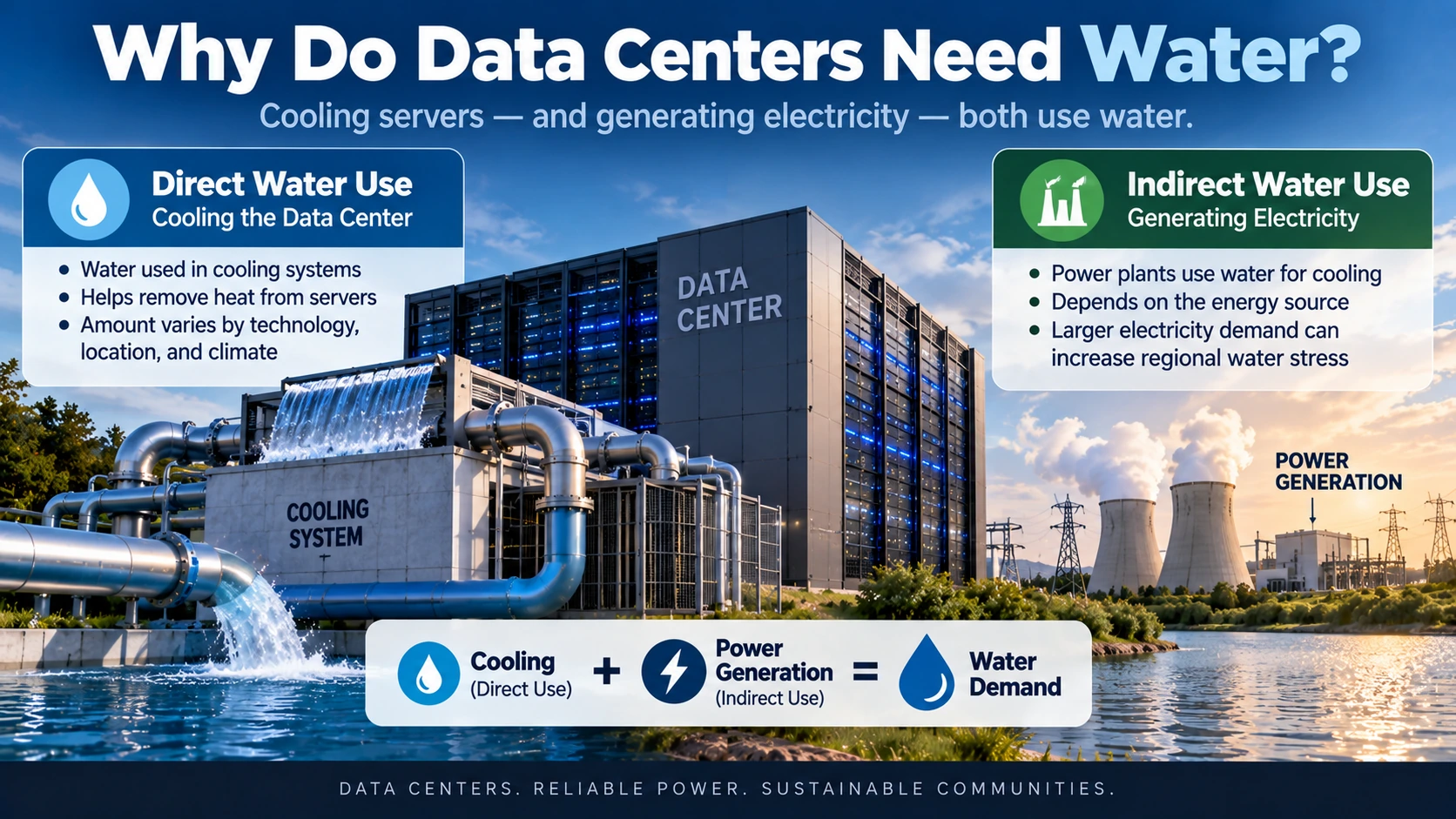
Berkeley Lab researchers found enormous variation in workload-level water consumption depending on server efficiency, the electricity source, cooling design, utilization, climate, and other factors. (Lawrence Berkeley National Laboratory)
That variability is one reason both states are demanding better information.
California’s AB 2469 says local governments cannot approve qualifying construction or expansions unless developers provide specified water information. Beginning January 1, 2028, that includes a water-scarcity plan, and developers must assume responsibility for the full cost of water infrastructure improvements required to serve the project. (California Legislature — AB 2469)
AB 2619 separately requires data-center operators to report projected water use when seeking initial local business approvals and actual annual water use when renewing them. (California Legislature — AB 2619)
Texas has taken a different path. Abbott directed the Texas Water Development Board on September 14 to enforce existing water-use survey requirements against major users, including data centers, and linked that information to the broader audit. (Texas Governor’s Office)
So the water issue is not really “computers versus drinking water.”
It is whether communities know how much water a major industrial-scale facility will require before approving it—and who pays if new treatment, storage, or distribution infrastructure is necessary.
Does a New Data Center Always Mean Higher Household Electric Bills?
No.
A large new customer can bring revenue to a utility system, and a well-designed rate can make that customer pay for the infrastructure and generation needed to serve it.
The problem appears when costs and risks are allocated badly.
If a utility spends heavily to serve a data center and the facility never opens, consumes much less electricity than projected, or receives a rate that does not recover enough of the new system cost, part of that expense can fall elsewhere.
That is why regulators increasingly use tools such as minimum billing commitments, upfront deposits, long-term contracts, exit fees, and special large-load tariffs. Berkeley Lab’s 2026 review of large-load rate design describes these mechanisms as ways of managing risks that can otherwise affect other customers. (Berkeley Lab)
So the real question is not:
“Do data centers raise rates?”
It is:
“Does the rate structure make the company creating the new demand pay an appropriate share of the costs and risks created by that demand?”
That is a much more useful question for understanding both the Texas and California actions.
Why Are Texas and California Moving in the Same Direction?
Texas and California have different electricity systems, different political leadership, and different regulatory traditions.
Yet both are focusing on the same infrastructure question: how to plan for very large new loads without shifting project-specific risks and costs onto other customers.
The challenge is that utilities and local governments may have to plan power, transmission, substations, and water infrastructure before they know which proposed projects will ultimately be built at the size first requested.
Texas is responding by slowing approvals until it can verify the projects and their resource requirements.
California is responding by requiring more disclosure and writing cost-allocation rules into law.
Neither approach means the states have turned against artificial intelligence or cloud computing.
Both states are trying to separate two questions that were often treated as one:
Should data centers be allowed to grow?
And if they do grow, who should absorb the cost of making the electric and water systems big enough to serve them?
The second question is now becoming just as important as the first.
What Happens Next?
The most important changes will now happen in utility proceedings, interconnection reviews, permit decisions, and agency implementation—not in another dramatic announcement.
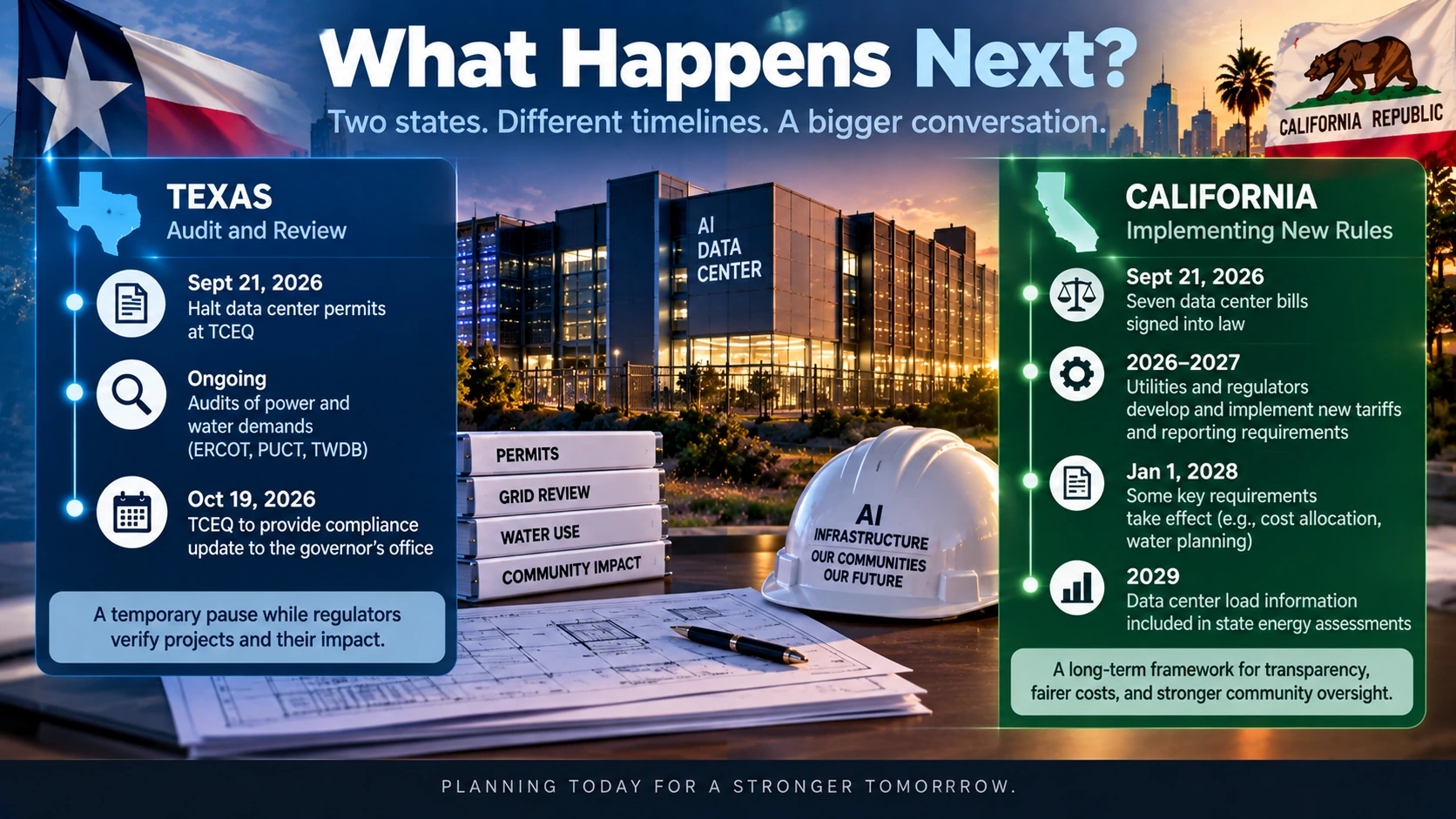
| What to watch | Timing |
|---|---|
| Texas TWDB enforcement progress update | October 14, 2026 |
| Texas TCEQ compliance update | October 19, 2026 |
| Texas ERCOT and water audits | Completion date not yet fixed |
| California implementation of new utility tariffs | Agency and utility proceedings continue; some statutory deadlines extend into 2028 |
| California data-center load reporting | State energy assessments begin appearing in later reporting cycles, including 2029 requirements under AB 1577 |
Texas also says the governor intends to work with lawmakers in the next legislative session on eliminating financial incentives for data centers. That is a future legislative proposal, not a change that took effect with the September 21 permit directive. (Texas Governor’s Office)
For households, the number to watch may not be how many data centers get announced.
It may be how utility regulators write the contracts.
A 500-megawatt project that pays upfront for the infrastructure it needs is a very different proposition from a 500-megawatt proposal whose risks are spread across millions of other customers.
Why It Matters in One Sentence
The AI and data-center boom is forcing states to decide whether households or the companies building massive computing facilities should bear the cost and risk of the power, grid, and water infrastructure those facilities require.
Data Center Electricity Costs: Key Questions Explained
Q. Did Texas ban new data centers?
No. Texas temporarily halted state permits sought by data centers while ERCOT, the Public Utility Commission of Texas, and the Texas Water Development Board conduct audits and gather information. It is a permitting pause, not a permanent statewide ban.
Q. Did California ban new data centers?
No. California enacted seven laws covering electricity costs, resource reporting, water planning, and environmental review. Data centers can still be developed, but developers face additional requirements.
Q. Can a data center raise my electric bill?
It can contribute to higher costs if utilities build new infrastructure or generation to serve the project and those expenses are spread to other customers. Whether that actually happens depends heavily on the utility’s rate design and how costs are allocated.
Q. Why do AI data centers need so much electricity?
AI systems use large numbers of high-performance processors, and the servers and cooling equipment can operate continuously. Large facilities can therefore behave more like major industrial loads than ordinary office buildings.
Q. Are Texas data centers really requesting hundreds of gigawatts of power?
ERCOT reported more than 438,000 megawatts of large-load connection requests in June 2026, with nearly 89% associated with data centers. Those are requests in the connection process, however, and ERCOT specifically notes that not every proposed project will ultimately be built.
Q. Why are states worried about projects that might never be built?
Utilities sometimes must plan or construct expensive infrastructure years in advance. If a large customer cancels or uses much less electricity than promised, regulators must determine who is responsible for the costs already incurred.
Q. Why do data centers need water?
Many facilities use water in cooling systems, while electricity generation can create additional indirect water demand. Actual water consumption varies widely depending on cooling design, climate, server efficiency, and the source of electricity.
Q. Who will pay for California’s new data-center infrastructure?
California’s new laws are designed to shift more project-specific electricity and water costs toward data-center customers themselves. The exact impact will depend on the tariffs, utility proceedings, and project agreements created under the new laws.
Q. What happens next in Texas?
Texas agencies will continue auditing data-center projects and their power and water requirements. TCEQ is scheduled to report to the governor’s office on its compliance with the permit directive by October 19, 2026.
Did this help make the story clearer? 🙂
WIN keeps unpacking the “why” behind the news—clearly and simply!
Sources
Texas Permit Pause and Grid Review
Texas Governor’s Office — Governor Abbott Directs TCEQ To Halt Data Center Permits
Texas Governor’s Office — Comprehensive Data Center Audit
Texas Governor’s Office — Data Center Infrastructure Cost Directive
Texas Governor’s Office — Governor Abbott Directs TWDB To Penalize Data Center Reporting Failures
ERCOT — PUCT Approves ERCOT’s Batch Zero Process for Connecting Large Electricity Users
Texas Tribune — Texas Pauses Environmental Permit Approval for Data Centers
California Electricity and Water Rules
California Governor’s Office — Governor Newsom Signs Seven Data Center Laws
California Legislature — AB 2383: Electricity: Data Centers
California Legislature — AB 1577: Data Centers: Reporting
California Legislature — AB 2469: Data Centers: Water Use Disclosures
California Legislature — AB 2619: Water Resources: Data Centers
California Legislature — SB 886: California Technology Innovation and Ratepayer Protection Act
California Legislature — SB 887: CEQA and Data Centers
National Electricity Demand and Rate Design
Lawrence Berkeley National Laboratory — 2024 United States Data Center Energy Usage Report
Lawrence Berkeley National Laboratory — United States Data Center Energy Usage Report: 2025 Update
Lawrence Berkeley National Laboratory — Electricity Rate Designs for Large Loads: 2026 Update
Lawrence Berkeley National Laboratory — The Water Use of Data Center Workloads