Why Does Trump Say His Giant D.C. Arch Should House Drones and Snipers?

Wasn’t this supposed to be a monument?
That is what makes the latest turn in President Donald Trump’s planned Washington triumphal arch so unusual.
The 250-foot structure at Memorial Circle was presented during months of federal review as a monumental gateway, visitor destination and observation point near Arlington National Cemetery. Then, on September 20, Trump said it should also become what he called a “top grade Military Complex,” capable of housing drones, snipers and ammunition. (AP · Reuters)
That immediately raises a more important question: Is this now an actual Pentagon plan, or is it still a proposal described by the president?
Publicly, the change is still described through Trump’s announcement rather than a separate Pentagon operational plan. Trump said the military had made a “strong request,” but the Pentagon told AP and Reuters that it had nothing to add beyond the president’s statement. No separate Defense Department document detailing the mission, staffing, drone operations or ammunition storage has been publicly released. (AP · Reuters)
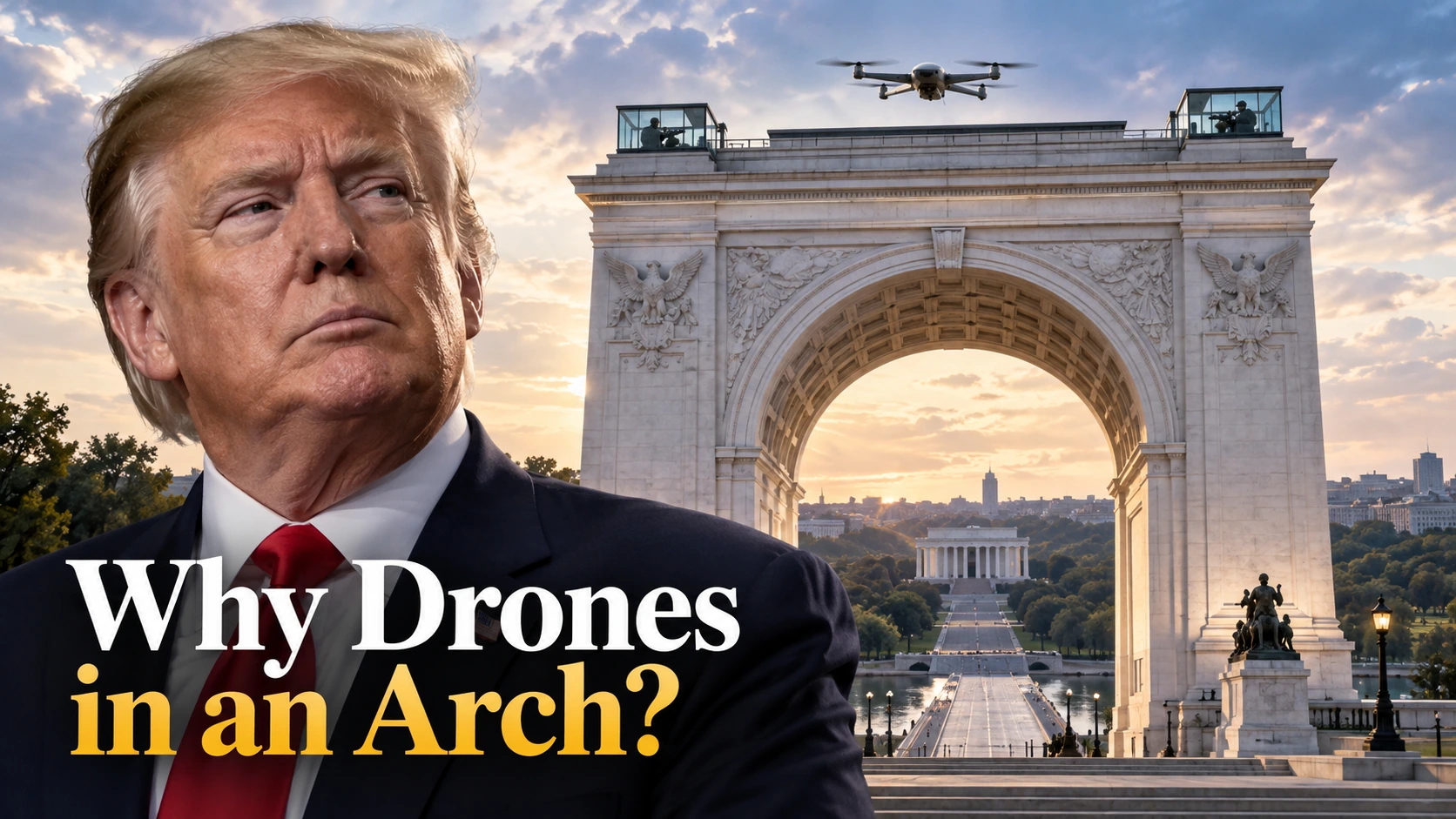
※ Images in this article are AI-generated illustrations created to help explain the story. They are not actual photographs, and depictions of people, places, or events may differ slightly from reality.
And that matters because the arch was already moving through a complicated federal approval process before its proposed purpose changed.
What Exactly Did Trump Say Would Change?
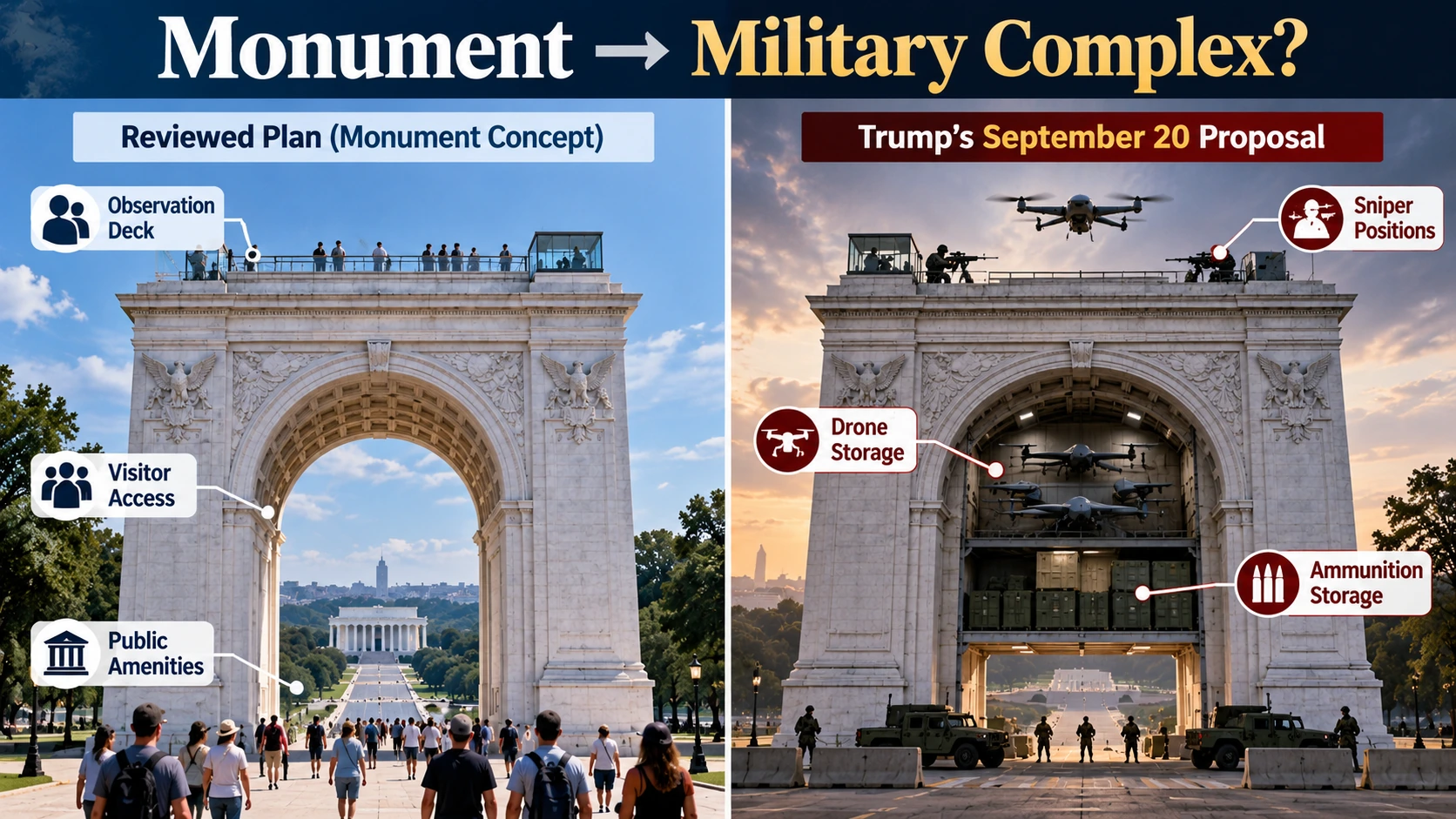
Trump did not merely say the arch should have more security around it. He described a substantial new operational role.
According to his September 20 statement, the structure would be able to house and rapidly deploy “large numbers” of drones, position snipers on the roof and plaza areas, and store sniper ammunition. Trump said the change was for national security and came at the military’s request. (CBS News · Reuters)
That is different from the program federal commissions had been reviewing.
Earlier architectural plans described a permanent stone-clad monument with visitor amenities, interior program space and an observation deck. The Commission of Fine Arts records show that planners spent months debating pedestrian access, security barriers, traffic circulation, materials and the structure’s visual relationship with Arlington National Cemetery and the Lincoln Memorial. (Commission of Fine Arts)
A simple way to see the shift is this:
| Earlier reviewed concept | Trump’s September 20 description |
|---|---|
| Ceremonial monument | Ceremonial monument plus military complex |
| Visitor access | Security and operational functions |
| Observation deck | Roof and plaza sniper positions |
| Public-oriented interior space | Drone and ammunition storage |
| Architectural security features | Rapid military response capability |
The important distinction is that Trump has announced a change in purpose. That does not automatically mean every agency reviewing the project has approved that new purpose.
Was This Arch Always Supposed to Be a Military Facility?
No. The military role is new.
There is, however, a much older story behind the location.
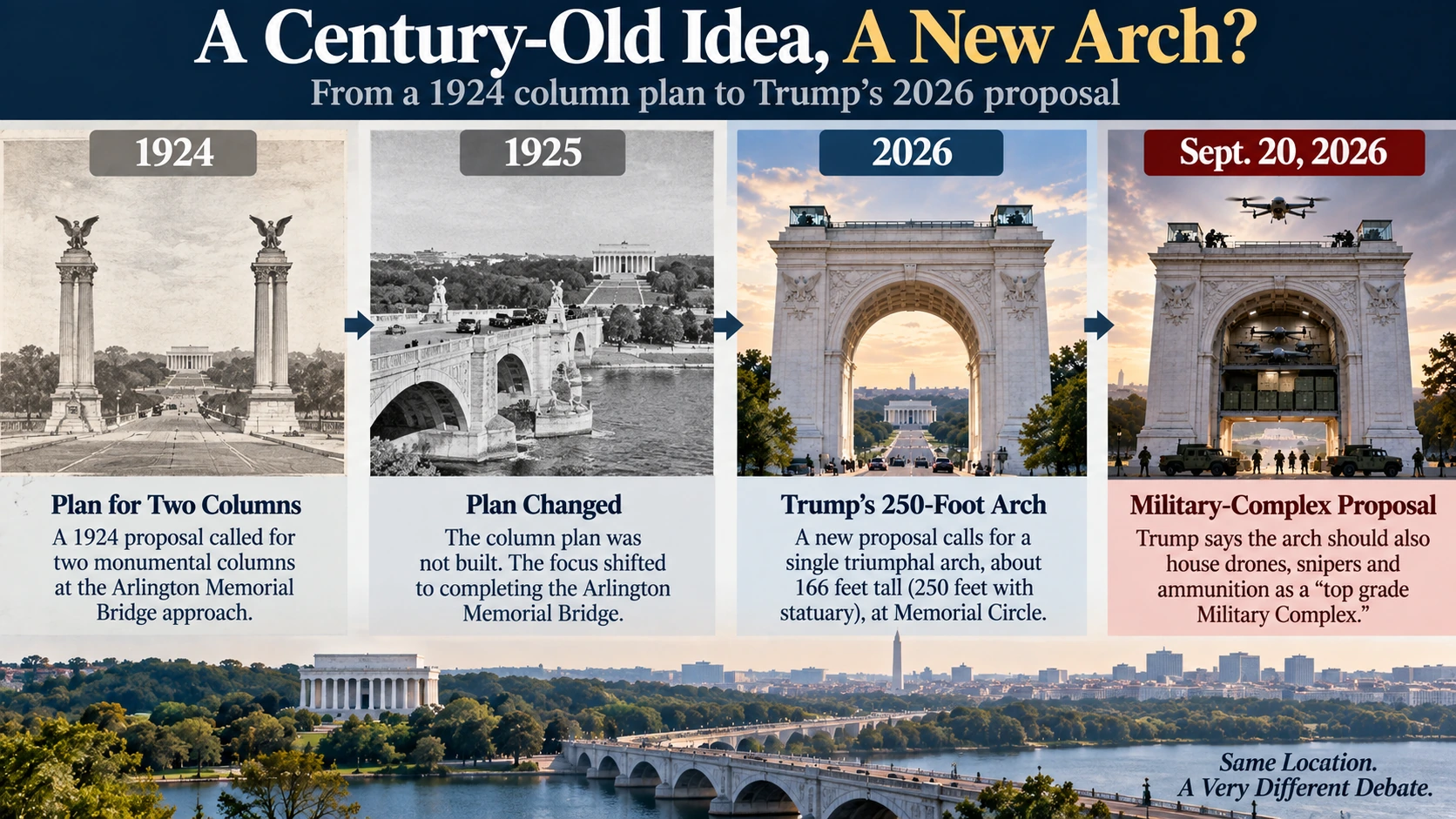
The administration has pointed to planning from the 1920s for the Arlington Memorial Bridge corridor. A 1924 proposal included two monumental columns on Columbia Island near what is now Memorial Circle. Interior Secretary Doug Burgum has argued that Trump’s arch builds on that unfinished vision. (Commission of Fine Arts)
But the old design and the current proposal are not the same structure. The earlier vision involved two separate columns, while Trump’s current plan is a single triumphal arch whose main architectural mass rises about 166 feet and reaches 250 feet with statuary. (Commission of Fine Arts)
The military-complex concept appeared much later—on September 20, 2026.
That distinction is central to the legal fight because the administration argues that Congress’s actions in 1925 already provided authority connected to the old Arlington Memorial Bridge plan. Opponents argue that the century-old authorization cannot be stretched to cover this substantially different arch. A federal court has not yet resolved that dispute on the merits. (Washington Post · Public Citizen)
Did the Pentagon Actually Request a Drone-and-Sniper Complex?
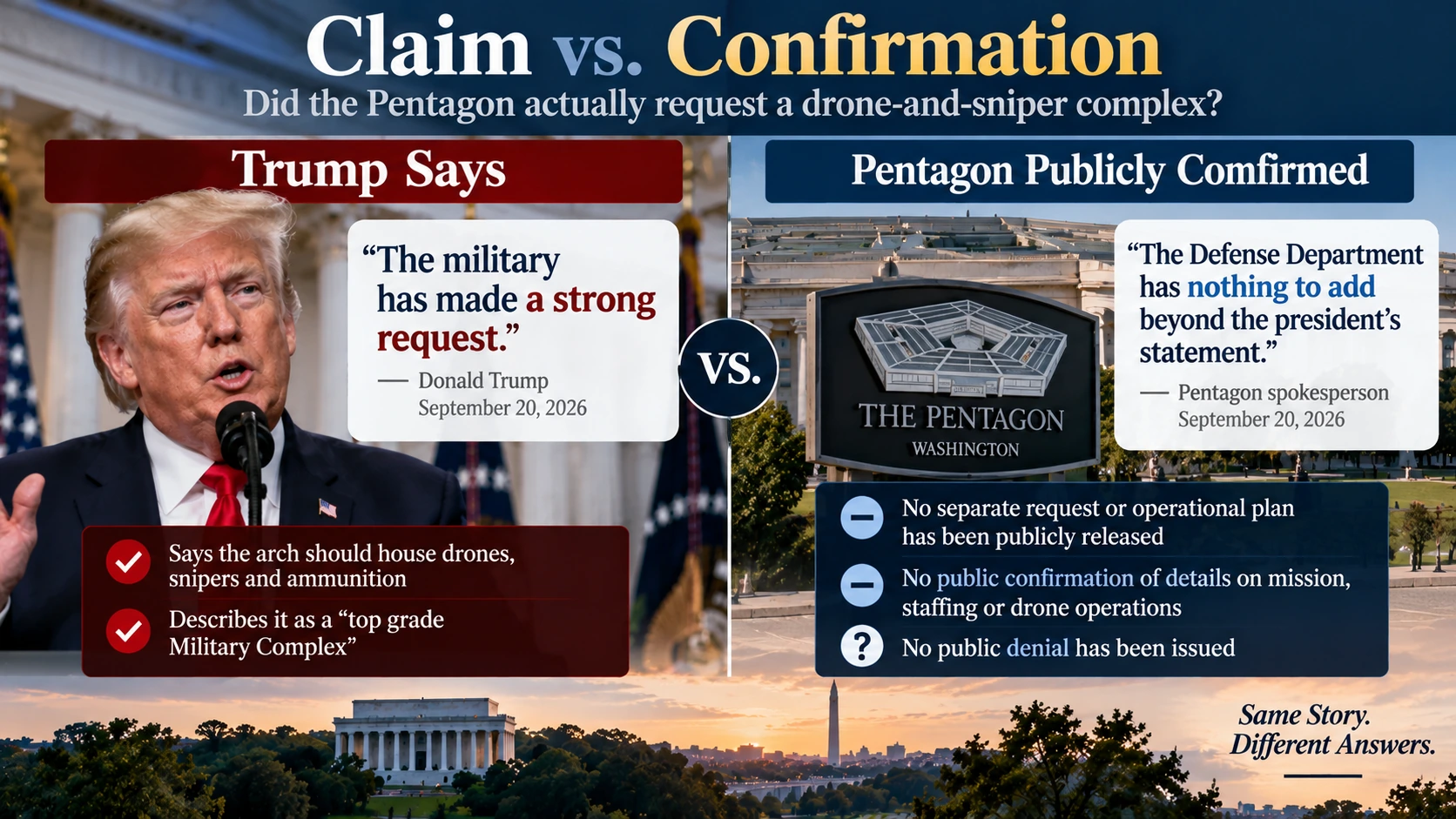
Trump says yes. The Pentagon has not independently provided details confirming that request.
That does not mean the Pentagon has denied Trump’s statement. It has not.
It means the public record is incomplete.
| Question | What is publicly known |
|---|---|
| Did Trump say the military requested the change? | Yes |
| Has the Pentagon publicly released a request or operational plan? | Not as of September 21 |
| Has the Pentagon denied that a request occurred? | No public denial has been reported |
| Do we know what threat the facility is meant to address? | Trump did not identify a specific threat |
| Do we know which military branch would operate it? | No public details have been released |
AP reported that the Pentagon said it had no information beyond Trump’s statement. Reuters separately quoted a U.S. military official saying the Defense Department had nothing to add. (AP · Reuters)
So the most accurate wording right now is not “the Pentagon is building a drone base.”
It is: Trump says the military requested that the planned arch also function as a military complex.
Can Drones Really Operate There So Close to Reagan National Airport?
Possibly—but not simply because the arch itself has cleared an FAA aviation review.
This is one of the easiest parts of the story to misunderstand.
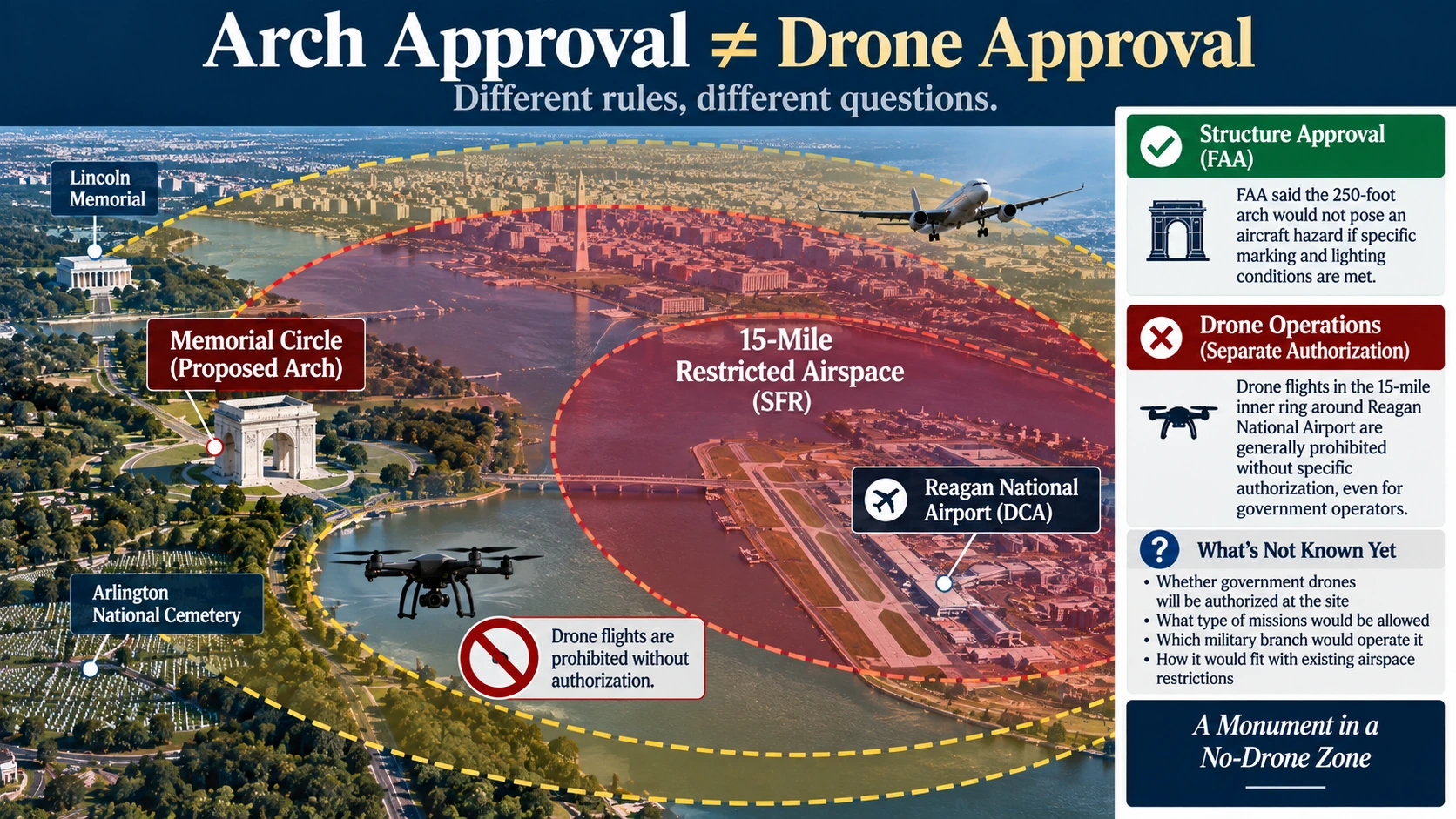
On September 18, the Federal Aviation Administration said the proposed 250-foot structure would not pose a hazard to aircraft if required visibility measures were used, including an “eternal flame” marking and floodlighting. That determination concerns the physical structure. (FAA · Reuters)
Operating drones is a different question.
Washington has some of the most restrictive airspace in the country. The FAA says unmanned aircraft flights inside the 15-mile inner ring around Reagan National Airport are prohibited without specific authorization. Government or other qualifying operators can seek special permission, but ordinary drone rules do not provide a free pass. (FAA)
So these are two separate issues:
| FAA question | Current answer |
|---|---|
| Can the 250-foot arch physically exist without creating an aviation hazard? | FAA says yes, subject to specified marking and lighting conditions |
| Does that automatically authorize drones to operate from the site? | No |
| Could government drones potentially receive authorization? | Yes, through applicable government and FAA procedures |
| Has a detailed drone-operation authorization for this arch been publicly released? | Not yet |
That is why saying “the FAA approved the drone base” would go beyond what the agency has actually said.
Does the Arch Already Have All the Approvals It Needs?
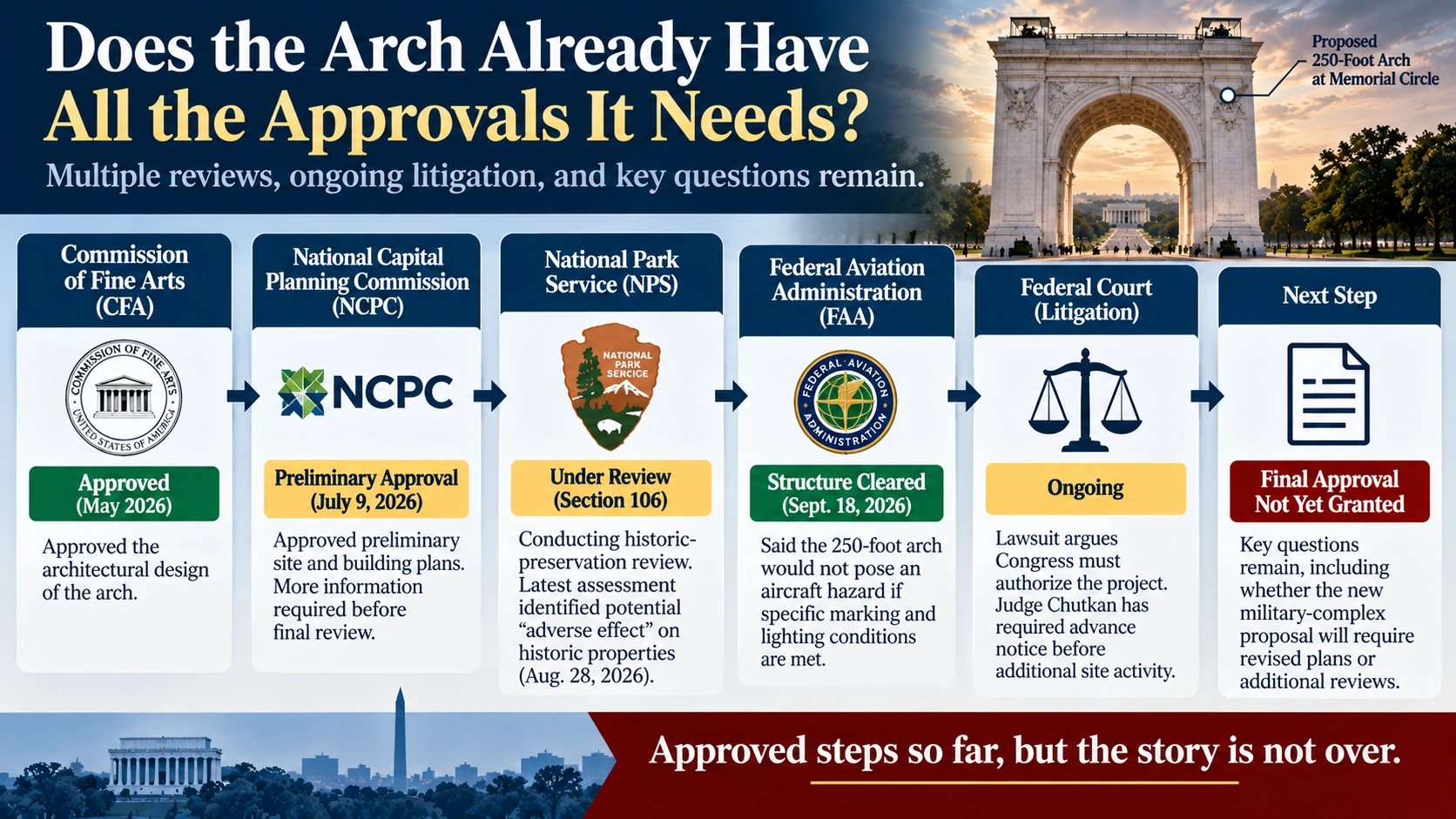
No. Several important steps have occurred, but the project has not reached a simple “fully approved and ready to build” status.
The Commission of Fine Arts approved the architectural design in May. The National Capital Planning Commission then approved preliminary site and building plans on July 9—but specifically said issues remained to be addressed before final review. (Commission of Fine Arts · NCPC)
NCPC’s own record says the commission still expected additional information on matters including transportation effects, aviation lighting and the justification for the project’s height before final action. (NCPC)
The National Park Service has also conducted historic-preservation review under Section 106 of the National Historic Preservation Act. In its revised August 28 Assessment of Effects, NPS found that the undertaking would have an adverse effect on one or more historic properties. (National Park Service)
Then there is the lawsuit.
Three Vietnam veterans and an architectural historian are challenging the project in federal court. Their lawyers argue that Congress must specifically authorize a new commemorative work at Memorial Circle. The administration disputes that theory and relies in part on the 1925 Arlington Memorial Bridge authorization. (Public Citizen · Washington Post)
U.S. District Judge Tanya Chutkan has not issued a final merits ruling deciding whether the project is lawful. After Interior officials announced excavation activity in September, the court required at least 48 hours’ notice before activity at Memorial Circle other than the limited archaeological work described by the Park Service; the government had also committed to at least 14 days’ notice before starting construction. (Public Citizen · Reuters)
The new military-complex announcement creates an additional question: whether a substantial change in the arch’s intended use would require agencies to revisit parts of the designs or reviews they previously considered.
As of September 21, federal agencies have not publicly explained in detail whether the new military use would trigger revised reviews. The Washington Post reported that the White House and Interior Department did not respond to its questions about Trump’s announcement, while a Pentagon spokesperson said the department had nothing to add beyond the president’s post. (Washington Post)
Why Does Congress Matter If the Arch Is on Federal Land?
Because federal land does not automatically mean the president can build any permanent monument there without another branch of government.
This is the core legal dispute.
The plaintiffs rely in part on the Commemorative Works Act and other federal restrictions on constructing permanent structures on federal parkland in Washington. They argue Memorial Circle falls within an area where congressional authorization is required. (Public Citizen)
The administration’s position is different.
Justice Department lawyers have argued that Congress already provided authority when it approved the Arlington Memorial Bridge Commission’s plan in 1925. The administration says the current arch can be understood as carrying out or revising that long-unfinished monumental concept. (Washington Post)
Here is the disagreement in its simplest form:
| Administration’s position | Challengers’ position |
|---|---|
| Congress already authorized the broader Memorial Bridge project in 1925 | The 1925 project was completed long ago |
| The historic design contemplated monumental features at Columbia Island | The historic proposal involved different structures |
| The current arch can build on that earlier authority | A new 250-foot arch requires new congressional authorization |
| Existing federal review can move the project forward | Construction cannot lawfully begin without Congress |
Neither column in that table is a final court ruling.
That is exactly what the pending litigation is supposed to resolve.
Why Does the Location Make the Military Proposal More Complicated?
Memorial Circle is not an isolated military compound.
It sits on Columbia Island at the western end of Arlington Memorial Bridge, on the ceremonial axis linking the Lincoln Memorial with Arlington National Cemetery. It is also part of an active road network between Washington and Northern Virginia. (NCPC)
That creates several overlapping questions.
First, the site was being planned for public visitors. Earlier designs included pedestrian access and an observation deck.
Second, it lies in highly restricted Washington airspace near Reagan National Airport.
Third, existing military facilities are already nearby. Reuters noted that Joint Base Myer-Henderson Hall is roughly a mile from the site and the Pentagon is about two miles away. A retired Marine colonel interviewed by Reuters questioned what operational gap the new facility would fill. That is an expert assessment, not an official Pentagon conclusion. (Reuters)
Fourth, the National Park Service’s preservation review is based on the arch’s effects on a historic ceremonial landscape. Adding permanent military operations, ammunition storage or new hardened security infrastructure could raise practical questions that are different from those posed by an observation deck and visitor plaza.
That does not prove the military concept cannot be implemented.
It means the September 20 announcement potentially changes more than the building’s label.
What Happens Next?
The clearest thing to watch is whether the Trump administration turns the September 20 announcement into formal agency documents.
A social-media statement can establish the president’s preferred direction. It does not by itself reveal engineering requirements, military command responsibility, drone authorizations or how public access would work around an operational security facility.
Several developments would show that the proposal has moved to the next stage:
- A Pentagon or military branch publicly confirms and explains the requested mission.
- Interior or the National Park Service submits revised plans showing military functions.
- NCPC considers whether the new use changes the project before final approval.
- The FAA or other security agencies disclose operational requirements for drones at the site.
- The federal court rules on whether existing law allows construction without a new act of Congress.
- The administration provides the required notice before any construction activity covered by the court’s orders.
Until those steps become clearer, there is an important difference between a proposed military role and an approved, operational military facility.
That difference is the center of this story.
Why It Matters in One Sentence
Trump has transformed the public description of his proposed 250-foot Washington arch from a ceremonial visitor monument into a potential military facility, but the Pentagon’s role, drone permissions, final planning approval and underlying legal authority are still unresolved.
Trump Triumphal Arch Military Complex: Key Questions Explained
Q. What did Trump announce about the Washington triumphal arch?
On September 20, 2026, Trump said the planned 250-foot arch at Memorial Circle should also operate as a military complex able to house drones, snipers and sniper ammunition. (AP)
Q. Did the Pentagon confirm that it requested the military conversion?
Trump said the change came at the military’s strong request, but the Pentagon has not publicly released a separate request or operational plan. It told news organizations it had nothing to add beyond Trump’s statement. (Reuters)
Q. Was the arch originally designed as a military facility?
No. The plans reviewed earlier in 2026 focused on a monumental gateway with public-access features, visitor amenities and an observation deck. (Commission of Fine Arts)
Q. Has the FAA approved drone operations from the arch?
No public FAA approval for drone operations from the arch has been identified. The FAA separately determined that the physical structure itself would not pose an aviation hazard if specified visibility conditions were met. (FAA)
Q. Why are drone operations around Washington unusually complicated?
The inner portion of Washington’s Special Flight Rules Area generally prohibits unmanned aircraft operations without specific authorization. Government operators can obtain specialized permission, but they still operate under a tightly controlled aviation and security framework. (FAA)
Q. Has the National Capital Planning Commission fully approved the arch?
Not yet. NCPC approved preliminary site and building plans in July but identified issues that needed to be addressed before final review. (NCPC)
Q. Why are opponents saying Congress must approve the arch?
The plaintiffs challenging the project argue that federal law requires specific congressional authorization for a new commemorative structure on this federally managed land in Washington. The administration disputes that interpretation. (Public Citizen)
Q. Why does the Trump administration cite a law from 1925?
The administration argues that Congress’s 1925 approval of the Arlington Memorial Bridge project already provided authority for monumental construction associated with the corridor. Critics argue that the authorization concerned a different project and cannot serve as open-ended authority for the current arch. (Washington Post)
Q. Has a federal court ruled that the arch is legal or illegal?
No final merits ruling has been issued in the pending case. Judge Tanya Chutkan has, however, imposed notice requirements governing additional activity at Memorial Circle while the litigation continues. (Public Citizen)
Q. What is the biggest unanswered question now?
The biggest question is whether Trump’s military-complex announcement becomes a formal government plan—with revised designs, military responsibility and regulatory approvals—or remains an announced concept layered onto the existing monument proposal.
Did this help make the story clearer? 🙂
WIN keeps unpacking the “why” behind the news—clearly and simply!
Sources
September 20 Military-Complex Announcement
AP — Trump Says His Planned Arch Would Become a Military Complex
Reuters — Trump Wants to Use Washington Arch as Military Complex for Drones and Snipers
CBS News — Trump Says He Agreed to Convert Triumphal Arch Into Military Complex
Federal Design and Historic-Preservation Review
National Capital Planning Commission — New Monumental Arch Project Record
Commission of Fine Arts — May 2026 Monumental Arch Review
National Park Service — Revised August 28 Triumphal Arch Assessment of Effects
Aviation and Drone Rules
FAA — September 18, 2026 Triumphal Arch Determination
FAA — Washington, D.C. Prohibited and Restricted Drone Airspace
Litigation and Congressional-Authority Dispute
Public Citizen — Lemmon v. Trump Case Record
Reuters — Judge Reinforces Advance-Notice Order for Memorial Circle Work
Washington Post — Administration’s Argument for Using the 1925 Authorization