Why Did Vivek Ramaswamy Use Amy Acton’s Estranged Mother in an Attack Ad?

What would make a political candidate put his opponent’s own mother in a campaign advertisement?
That is the question now surrounding Vivek Ramaswamy, the Republican nominee for Ohio governor.
His campaign produced a video featuring Donna Arthur, the estranged mother of Democratic opponent Amy Acton. In the video, Arthur accuses her daughter of dishonesty and urges Ohio voters not to elect her.
At first glance, a family member criticizing a political candidate might seem like a powerful endorsement of an opponent’s argument.
But there is a troubling detail the advertisement leaves out.
Acton says she has not seen her mother since childhood, following sexual abuse allegations against her stepfather and a family separation dating back nearly five decades.
The video triggered criticism from Democrats and Republicans alike. Yet Ramaswamy acknowledged that his campaign produced it and committed $4 million to promoting it.
The controversy has transformed an already competitive governor’s race into a debate about family trauma, political judgment, and the limits of negative campaigning. (AP · Axios)
※ Images in this article are AI-generated illustrations created to help explain the story. They are not actual photographs, and depictions of people, places, or events may differ slightly from reality.
The question is no longer simply whether a candidate’s family member can appear in a political advertisement.
It is why Ramaswamy’s campaign chose this particular family member—and whether the decision could ultimately hurt him more than it helps.
What Happened With the Ramaswamy Campaign Ad?
Ramaswamy’s campaign acknowledged producing the advertisement on October 20, 2026, after the video began circulating online without clearly identifying who was behind it.
The roughly one-minute video features Donna Arthur criticizing her daughter, Amy Acton, and questioning her personal history.
Arthur calls Acton a liar, disputes parts of her account of growing up in difficult circumstances, and warns voters against electing her governor.
The presentation is unusually personal. Instead of challenging Acton’s proposed policies or performance as a public official, it uses a close family relationship to question her credibility.

How the controversy developed
| Date | What happened | Why it mattered |
|---|---|---|
| October 19 | The video began circulating online without an identified sponsor. | Its origin was initially unclear. |
| October 20 | Ramaswamy publicly acknowledged that his campaign produced it. | Responsibility for the video was established. |
| October 20 | Acton’s campaign responded and released an ad featuring her brother. | The dispute broadened into a public account of the family’s history. |
| October 21 | Republican figures publicly disagreed about the advertisement. | The controversy became an internal GOP dispute as well as a campaign fight. |
The timeline is based on reporting from local news outlets, AP, and the subsequent statements of the candidates and their allies. (FOX19 · AP)
The initial lack of a visible sponsor prompted questions about where the video came from. That detail alone, however, does not establish that the campaign violated election law.
Ramaswamy later made his campaign’s involvement explicit.
Speaking to reporters on October 20, he confirmed the video came from his team. He also said he had never met Arthur and that she had not been compensated for participating.
His broader response was that the campaign should focus on substantive issues, but that Acton was avoiding debates and questions about her record.
His campaign maintained that questions about Acton’s credibility were relevant to voters deciding who should lead Ohio. (FOX19)
That defense raises another issue.
Why did using Acton’s mother produce such a strong backlash?
The answer lies in a family history that began long before either candidate entered the 2026 race.
Why Has Amy Acton Been Estranged From Her Mother for Nearly 50 Years?
Amy Acton says her relationship with her mother ended when she was approximately 12 years old, after sexual abuse by her stepfather and the legal proceedings that followed.
Acton, a physician and former director of the Ohio Department of Health, has discussed her difficult childhood publicly for years.
In a 2019 interview with The Vindicator, a newspaper in Youngstown, Ohio, she described an unstable upbringing marked by poverty, neglect, and abuse.
She said her stepfather sexually abused her when she was a child.
Historical newspaper reporting and court records reviewed by journalists show that her stepfather was arrested in 1978 and subsequently indicted on a rape charge involving a 12-year-old girl.
He pleaded not guilty and did not face a completed criminal trial. He died in 2004.
An indictment is a criminal accusation, not a conviction. The historical records establish that criminal proceedings were initiated; they do not constitute a jury verdict finding him guilty. (PolitiFact · CBS News)
What happened to Acton and her brother?
Acton and her brother, Philip Stearns, say they were removed from their mother’s care following the allegations.
Acton has said she last saw her mother during the court proceedings in 1978.
According to Acton and her brother, Donna Arthur remained married to Acton’s stepfather after the accusations arose, and the children did not reestablish a relationship with their mother.
That estrangement is central to the current controversy.
The advertisement presents Arthur as someone with intimate knowledge of Acton’s character. But Acton says their relationship ended when she was a child.
The person voters see criticizing a candidate as her mother is therefore not necessarily someone who knows the candidate’s adult life or political career.
What does her brother say?
Philip Stearns has publicly supported his sister’s account of their childhood.
In an October 20 statement issued by the Acton campaign, Stearns described the abuse both siblings experienced and criticized Ramaswamy for turning that history into a campaign argument.
Acton’s campaign also released a response advertisement featuring Stearns.
The contrast is striking: one advertisement features the estranged mother questioning Acton’s credibility, while the response features her brother defending her account.
Both are campaign communications, but they draw on very different relationships with Acton and different interpretations of the family’s past.
Acton’s campaign says the advertisement exploits childhood trauma rather than providing voters with useful information about her fitness for office. (PolitiFact · CBS News)
What Did the Advertisement Claim—and What Does the Evidence Actually Show?
The advertisement attacks Acton’s honesty, but a family member’s accusation is not the same as independently verified evidence of dishonesty.
This distinction matters because the video’s emotional force comes largely from the identity of the speaker.
Arthur is Acton’s mother, which could make her claims seem especially persuasive to viewers unfamiliar with the family history.
But the credibility of a statement depends on its evidence, context, and accuracy—not simply the speaker’s family relationship to the person being criticized.
Arthur had also disputed Acton’s childhood account publicly in 2020, while Acton was serving as Ohio’s health director.
The 2026 video therefore did not introduce a wholly new family disagreement. It brought an existing dispute into a high-profile election campaign. (PolitiFact)
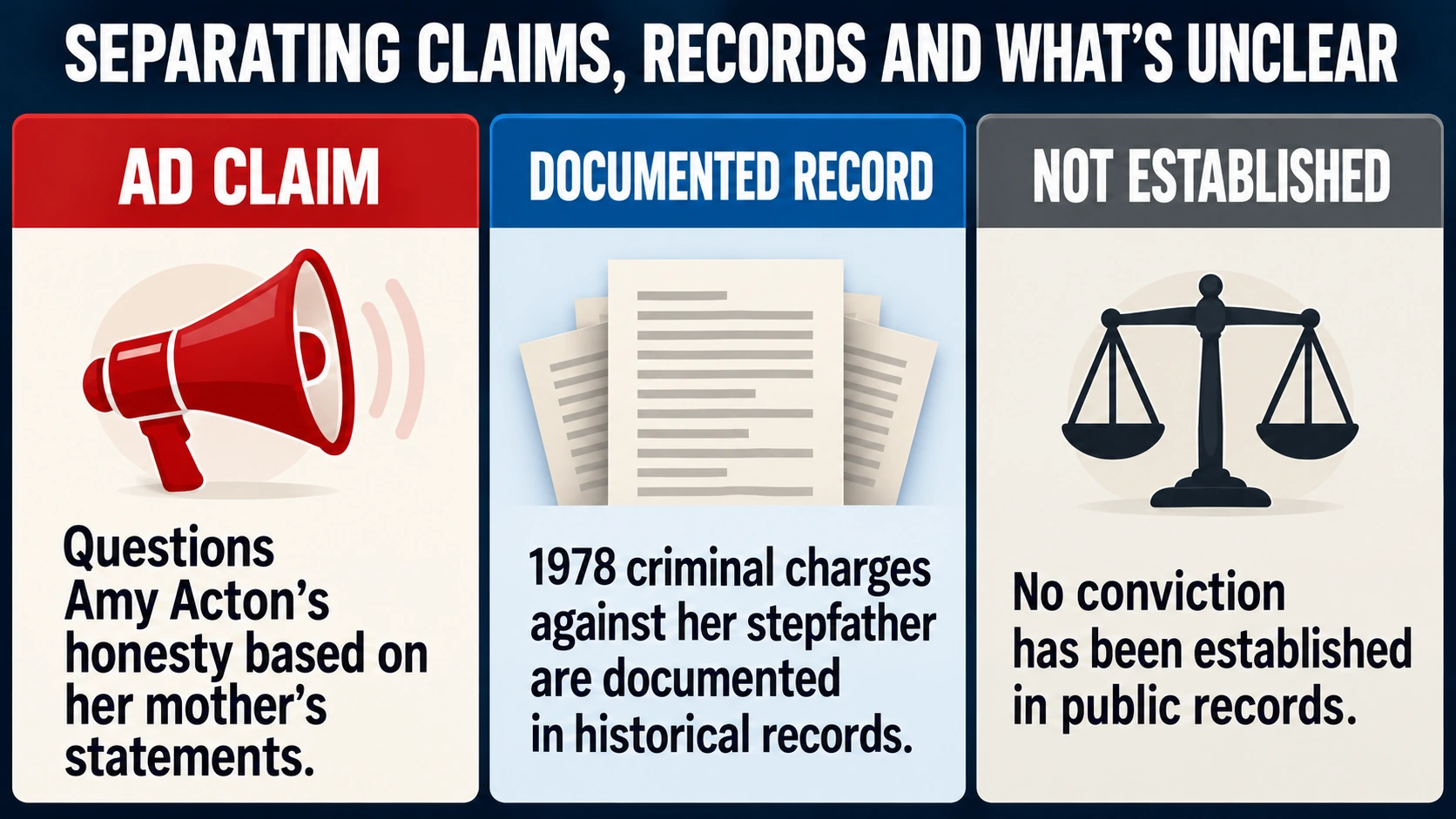
What is documented, and what remains disputed?
| Question | What is documented | What is not established |
|---|---|---|
| Did Arthur publicly criticize Acton? | Yes. She appears in the campaign video and disputes her daughter’s account. | That her accusations are accurate. |
| Did Acton previously discuss childhood abuse? | Yes. Her account appeared in a 2019 newspaper interview. | That every detail of a decades-old childhood account can be independently reconstructed. |
| Were criminal charges brought against Acton’s stepfather? | Yes. Historical reporting and court records describe his arrest and indictment in 1978. | A criminal conviction; no completed trial established guilt. |
| Did Acton and her mother become estranged? | Acton has consistently described a separation dating back to childhood, and her brother supports that account. | That Arthur has firsthand knowledge of Acton’s adult personal life or political career. |
| Did the Ramaswamy campaign produce the advertisement? | Yes. Ramaswamy acknowledged his campaign’s involvement on October 20. | That its allegations have been independently proven by the advertisement itself. |
These distinctions reflect contemporary reporting, historical documentation, and the campaign statements reviewed by PolitiFact and other news organizations. (PolitiFact · AP)
Some of the records supporting Acton’s account were provided by her campaign, and certain details from the 1970s are difficult to verify independently.
That is an important limitation.
But it is also incorrect to treat the absence of a completed criminal trial as proof that Acton fabricated her experience.
The two conclusions are not interchangeable.
The most careful reading is that Acton has long described abuse and estrangement, historical records document serious criminal proceedings involving her stepfather, and Arthur disputes parts of her daughter’s account.
The advertisement does not resolve those competing claims.
Why Would Ramaswamy’s Campaign Take Such a Personal Risk?
The campaign appears to be trying to persuade voters that Acton’s personal credibility is relevant to whether she should become governor.
Rather than argue only about taxes, jobs, or public health policy, the advertisement encourages voters to question the person making those policy promises.
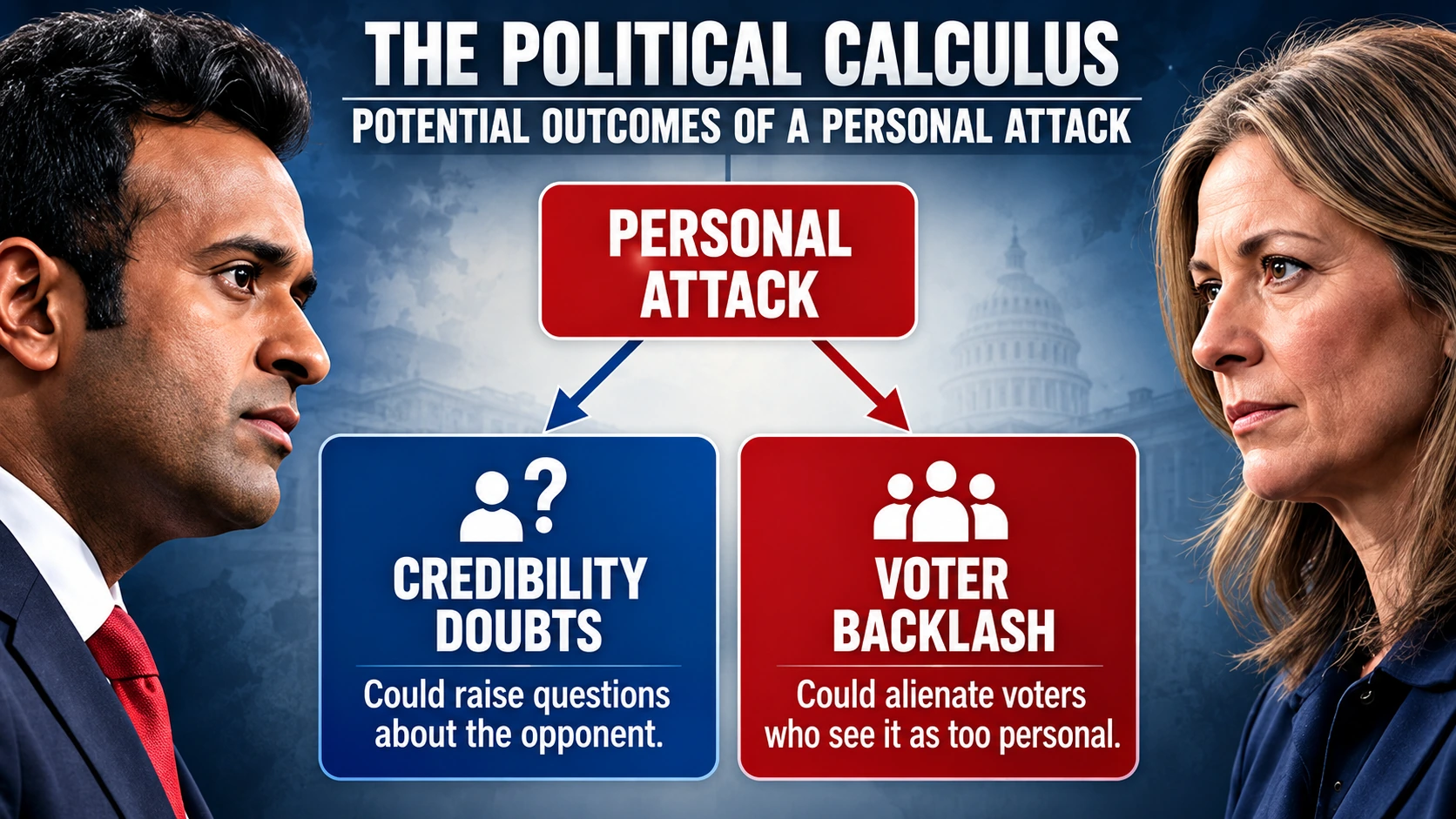
This is a familiar approach in negative campaigning: challenge a candidate’s honesty or judgment so voters become less willing to trust the candidate’s broader message.
The extraordinary part is the messenger.
Ramaswamy’s team chose the opponent’s estranged mother, making the attack more emotionally forceful—and potentially more controversial.
Why spend $4 million on the advertisement?
Ramaswamy’s campaign committed $4 million to promoting the video, according to reporting on October 20 and 21.
Sources close to the campaign told Axios that the message had tested favorably with voters who could still be persuaded.
That helps explain why the campaign might continue using it despite criticism.
But reported campaign testing is not the same as proof that the advertisement will improve the candidate’s election result. (Axios)
The distinction is worth understanding.
A campaign might find that an advertisement changes some voters’ opinions when they see it in a controlled setting.
Once released publicly, however, the same message can also generate negative headlines, criticism from influential political figures, and sympathy for the opponent.
A campaign advertisement has two audiences: the voters it is designed to persuade and the much larger public that may react to the campaign’s choice of tactics.
Could the strategy backfire?
Yes, although there is not yet enough evidence to conclude that it has changed the election’s outcome.
The advertisement could convince some voters that Acton’s personal history deserves closer examination.
Other voters might decide that using an estranged parent in a campaign attack reveals more about Ramaswamy’s judgment than about Acton’s honesty.
That possibility is especially relevant when the subject involves childhood abuse.
Voters can reasonably disagree about how much personal history should matter in choosing a governor.
But there is a difference between examining a candidate’s public record and suggesting that a deeply contested childhood family relationship settles questions about that candidate’s present-day fitness for office.
The advertisement has pushed that distinction into the center of Ohio politics.
Why Are Republicans Themselves Divided Over the Advertisement?
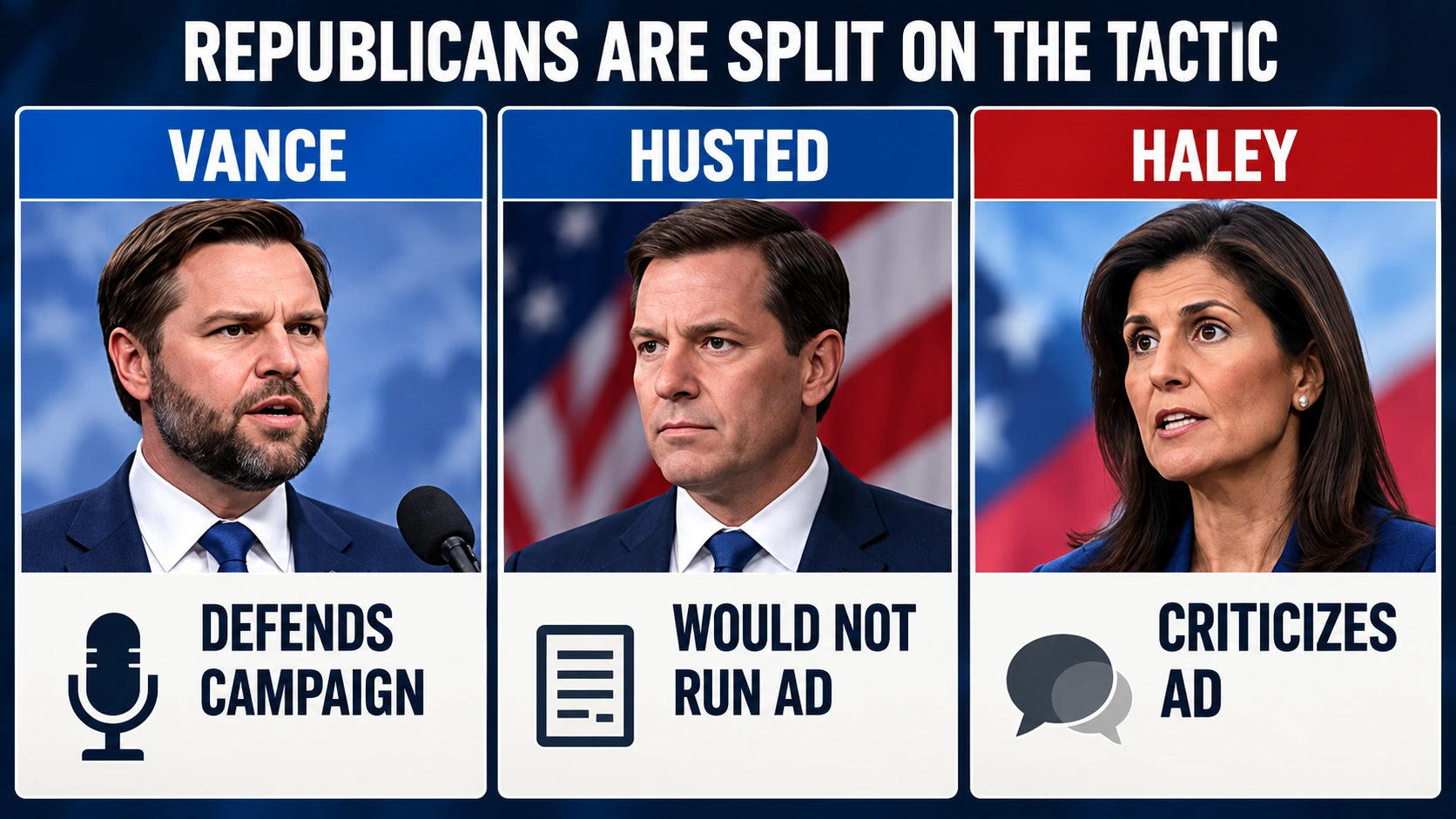
Some prominent Republicans consider the advertisement inappropriate or politically damaging, while Vice President JD Vance and other allies have defended Ramaswamy’s decision to keep using it.
The disagreement became especially visible on October 21.
Republican U.S. Senator Jon Husted, who is also campaigning in Ohio, said he would not have run the advertisement.
Former Republican presidential candidate Nikki Haley and several conservative commentators also criticized the tactic.
Their objections reflected both ethical concerns and the possibility that such a personal attack could alienate voters.
Vance took a different position.
During a campaign visit to Ohio, the vice president criticized Republicans who were publicly objecting to the advertisement. He argued that the party should concentrate on winning elections and opposing Democratic policies rather than focusing on whether the commercial was appropriate.
The dispute illustrates two competing priorities within the same party: concern about the political and moral boundaries of campaigning, and concern about maintaining party unity during a competitive election. (AP · Reuters)
Why does Republican criticism matter?
Ramaswamy is not simply trying to persuade committed Republican voters.
He must also appeal to voters who are undecided, independent, or willing to support candidates from different parties.
A personal attack that satisfies enthusiastic supporters may be less effective with people who dislike negative political advertising.
And when members of the same party object, the controversy becomes harder to describe as ordinary opposition-party criticism.
That does not mean a divided response guarantees a political defeat.
It means the campaign must now manage an additional problem: explaining why this particular advertisement deserves a place in the election.
Why Has Ohio’s Governor’s Race Become So Competitive?
The controversy matters because Ramaswamy and Acton are competing in a race that polling showed was closely contested politically even before the advertisement emerged.
The two candidates also come from notably different backgrounds.
Who are the candidates?
Vivek Ramaswamy is a biotechnology entrepreneur and former Republican presidential candidate. His political identity emphasizes his business background, conservative ideas, and opposition to established political practices.
Amy Acton is a physician who served as Ohio’s health director during the early COVID-19 pandemic under Republican Governor Mike DeWine.
Acton’s public profile is closely associated with her work in public health. Her pandemic-era decisions have also remained a focus of political disagreement.
Both candidates are seeking elected office without previously having held one. (AP · Statehouse News Bureau)
Their contrasting backgrounds create different arguments for voters.
Ramaswamy can emphasize business experience, political change, and criticism of Acton’s government record.
Acton can emphasize public service, health policy experience, and her priorities for Ohio families.
The dispute over her mother risks shifting attention away from those competing records and proposals.
What do the polls actually say?
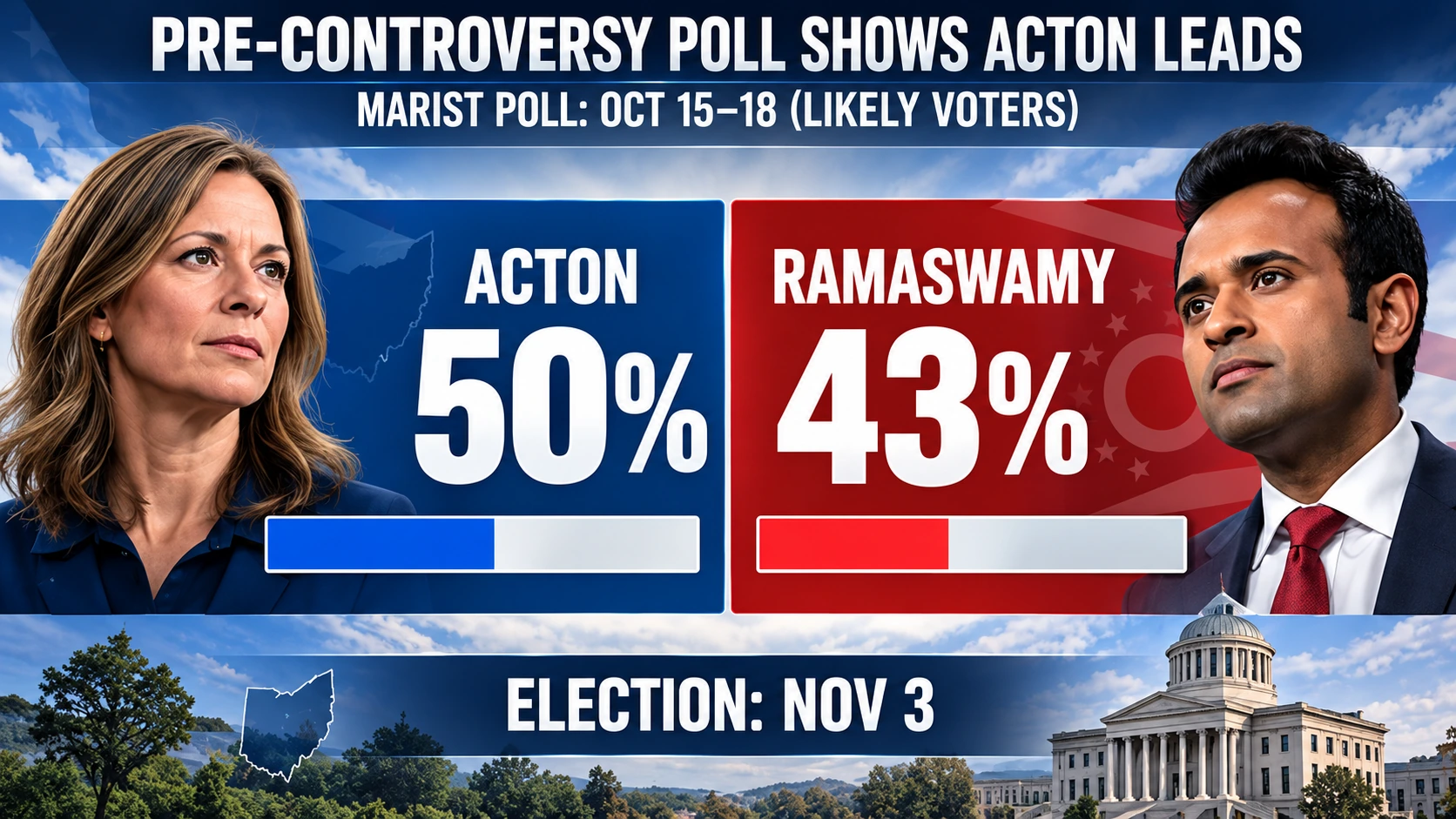
A Marist Poll conducted October 15–18, 2026, found Acton ahead among likely Ohio voters.
| Candidate | Likely voter support |
|---|---|
| Amy Acton (Democrat) | 50% |
| Vivek Ramaswamy (Republican) | 43% |
| Difference | 7 percentage points |
The poll surveyed Ohio registered voters between October 15 and October 18. The reported margin of error for likely voters was approximately 4.5 percentage points. (Marist Poll)
There are two important cautions.
First, the survey was conducted before the advertisement became a major public controversy. It cannot tell us whether the advertisement helped or hurt either candidate.
Second, a seven-point polling lead is not an election result. Polling has sampling uncertainty, and actual turnout can produce a different outcome.
The poll nevertheless shows why a campaign would be looking for ways to change voters’ perceptions in the final weeks.
That political pressure helps explain the willingness to take risks, even when the tactics create controversy.
Could the Advertisement Change the November Election?
It could influence some voters, but there is no reliable basis yet for claiming that this particular advertisement will decide Ohio’s governor’s race.
The general election is scheduled for November 3, 2026, and early voting was already underway when the controversy erupted. (Ohio Secretary of State)
For the two campaigns, the immediate question is whether attention returns to policy differences or continues to center on the disputed family account.
Three developments are worth watching.
Whether Ramaswamy continues investing in the message
The campaign has committed substantial resources to promoting the advertisement.
If it continues running widely, the controversy may remain prominent through the final stretch of the election.
But continued spending should not be mistaken for evidence that the message is succeeding.
Whether Acton can turn criticism into a broader argument about leadership
Acton’s campaign has already responded by highlighting her brother’s account and criticizing Ramaswamy’s judgment.
She may try to connect the episode to questions about empathy, credibility, and the temperament expected of a governor.
That would be a political argument, not proof that voters agree with her.
Whether voters focus on the controversy or return to policy
Ohio voters also have questions about jobs, taxes, public services, health care, and the state’s economic direction.
The advertisement may affect how some people see the candidates, but voters will still decide which candidate they prefer to govern.
The eventual election result will show who won.
It will not, by itself, establish exactly how many votes this particular advertisement changed.
That distinction would require more specific evidence than a final vote total.
Bottom Line: What This Story Really Means
Vivek Ramaswamy’s campaign chose to feature Amy Acton’s estranged mother in an attack advertisement because it wanted voters to question the Democratic candidate’s credibility.
But the family history behind the video is central to understanding the backlash.
Acton says she has been estranged from her mother since childhood after abuse involving her stepfather. Historical records document criminal charges against the stepfather, although no conviction resulted.
Her brother supports her account. Her mother disputes aspects of her personal history.
Those competing statements should not be treated as equally established facts simply because they appear in campaign materials.
Ramaswamy’s team believes questions about Acton’s honesty belong in the election. Critics from both political parties argue that the advertisement exploits a painful family history and crosses an ethical boundary.
The larger issue is whether attacking an opponent’s personal credibility through a long-estranged family member gives voters meaningful information—or simply creates a more emotionally charged campaign.
Ohio voters will make their decision on November 3.
Until then, the advertisement remains both a campaign tactic and a test of how voters respond when deeply personal history enters an election.
Ramaswamy–Acton Campaign Ad: Key Questions Explained
Q. Did Vivek Ramaswamy admit that his campaign made the advertisement?
Yes. On October 20, 2026, Ramaswamy acknowledged that the advertisement featuring Amy Acton’s estranged mother came from his campaign.
Q. Who is Donna Arthur?
Donna Arthur is Amy Acton’s biological mother. Acton says the two have been estranged since she was approximately 12 years old.
Q. Why did Acton stop speaking to her mother?
Acton has said the estrangement followed childhood abuse involving her stepfather and her mother’s failure to protect her. Acton’s brother supports that account.
Q. Was Acton’s stepfather convicted of rape?
No conviction resulted. Historical records show that he was arrested and indicted in 1978, but he pleaded not guilty and did not face a completed criminal trial.
Q. Did Ramaswamy pay Acton’s mother to appear in the video?
Ramaswamy said Arthur was not compensated. That was his public account; the reporting cited here does not independently establish any payment arrangement.
Q. How much money is the Ramaswamy campaign spending on the ad?
The campaign committed $4 million to promoting it, according to reports published on October 20 and 21, 2026.
Q. Why did some Republicans criticize the advertisement?
Critics argued that using an estranged mother to attack a candidate over a traumatic childhood was inappropriate and could create sympathy for Acton. Other Republicans, including Vice President JD Vance, defended the campaign or criticized the backlash.
Q. Was Amy Acton leading before the controversy?
Yes. A Marist Poll conducted October 15–18 showed Acton leading Ramaswamy 50% to 43% among likely voters. That survey preceded the major publicity surrounding the advertisement.
Q. Does Ohio’s governor election take place on November 3, 2026?
Yes. The Ohio general election is scheduled for November 3, 2026. The governor’s race is one of the statewide contests.
Q. Has the advertisement been proven to help or hurt Ramaswamy?
No. The controversy has produced significant public criticism and political debate, but its effect on actual voting behavior has not been established.
Did this help make the story clearer? 🙂 WIN keeps unpacking the “why” behind the news—clearly and simply!
Sources
Advertisement Origins and Campaign Statements
FOX19 — Ramaswamy Confirms Ad Came From His Campaign, October 20, 2026
Axios — Ramaswamy Doubles Down on Advertisement and $4 Million Campaign, October 21, 2026
Family Background and Historical Evidence
PolitiFact — Abuse, Estrangement, and What the Advertisement Omitted, October 21, 2026
CBS News — Ohio Governor’s Race Attack Ad and Amy Acton’s Family History, October 20, 2026
WOUB Public Media — Statehouse News Bureau Report on Ramaswamy’s Admission, October 21, 2026
Amy Acton for Governor — Brother’s Statement on the Advertisement, October 20, 2026
Amy Acton for Governor — Response Advertisement Featuring Philip Stearns, October 20, 2026
Republican Reactions and Election Context
Associated Press — JD Vance Responds to Republican Criticism of the Advertisement, October 21, 2026
Reuters — Vance Defends Ramaswamy’s Attack Advertisement, October 21, 2026