Why Is the Justice Department Trying to Block Ballots From 20,000 California Voters?

Twenty thousand voters. A federal lawsuit. And an election less than three weeks away.
The first reaction is understandable: Did California really send ballots to 20,000 people who aren’t allowed to vote?
That is what federal officials suspect. But suspicion and proof are two very different things.
On October 15, 2026, the Justice Department sued California, asking a federal judge to stop the state from counting mail ballots associated with more than 20,000 registered voters whom federal officials identify as likely noncitizens.
California disputes the reliability of that information and says the federal government has not supplied adequate evidence to justify such an extraordinary step. (U.S. Department of Justice · AP)
Here is the important distinction: The government has identified approximately 20,000 disputed voter records. It has not established that 20,000 noncitizens cast illegal votes.
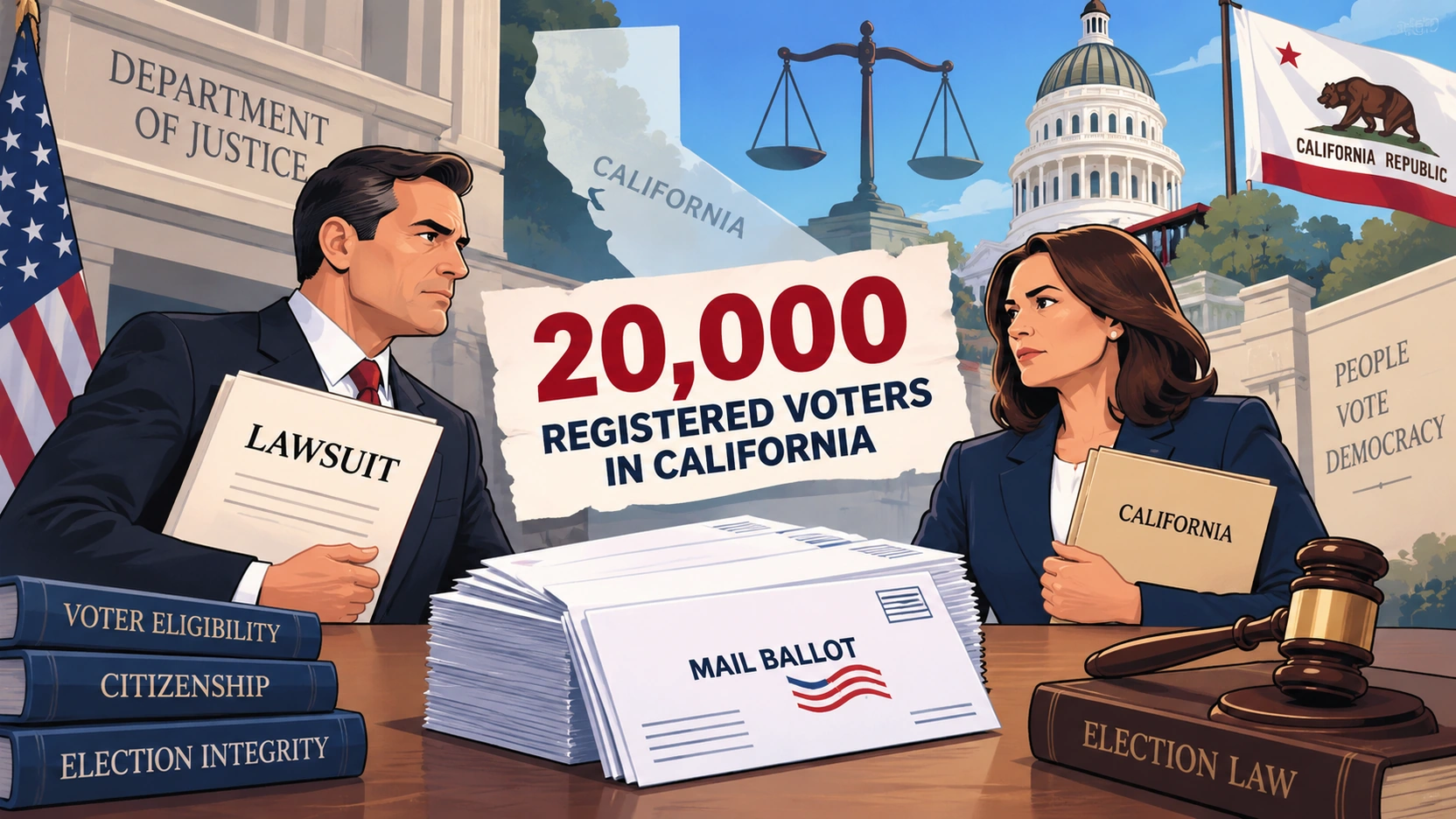
※ Images in this article are AI-generated illustrations created to help explain the story. They are not actual photographs, and depictions of people, places, or events may differ slightly from reality.
That difference is at the center of the lawsuit.
The federal government wants to prevent potentially ineligible votes from affecting an election. California argues that acting on disputed records could instead prevent eligible American citizens from having their votes counted.
To understand how those two concerns collided, start with what the lawsuit actually requests.
What Does the Justice Department Want the Court to Do?
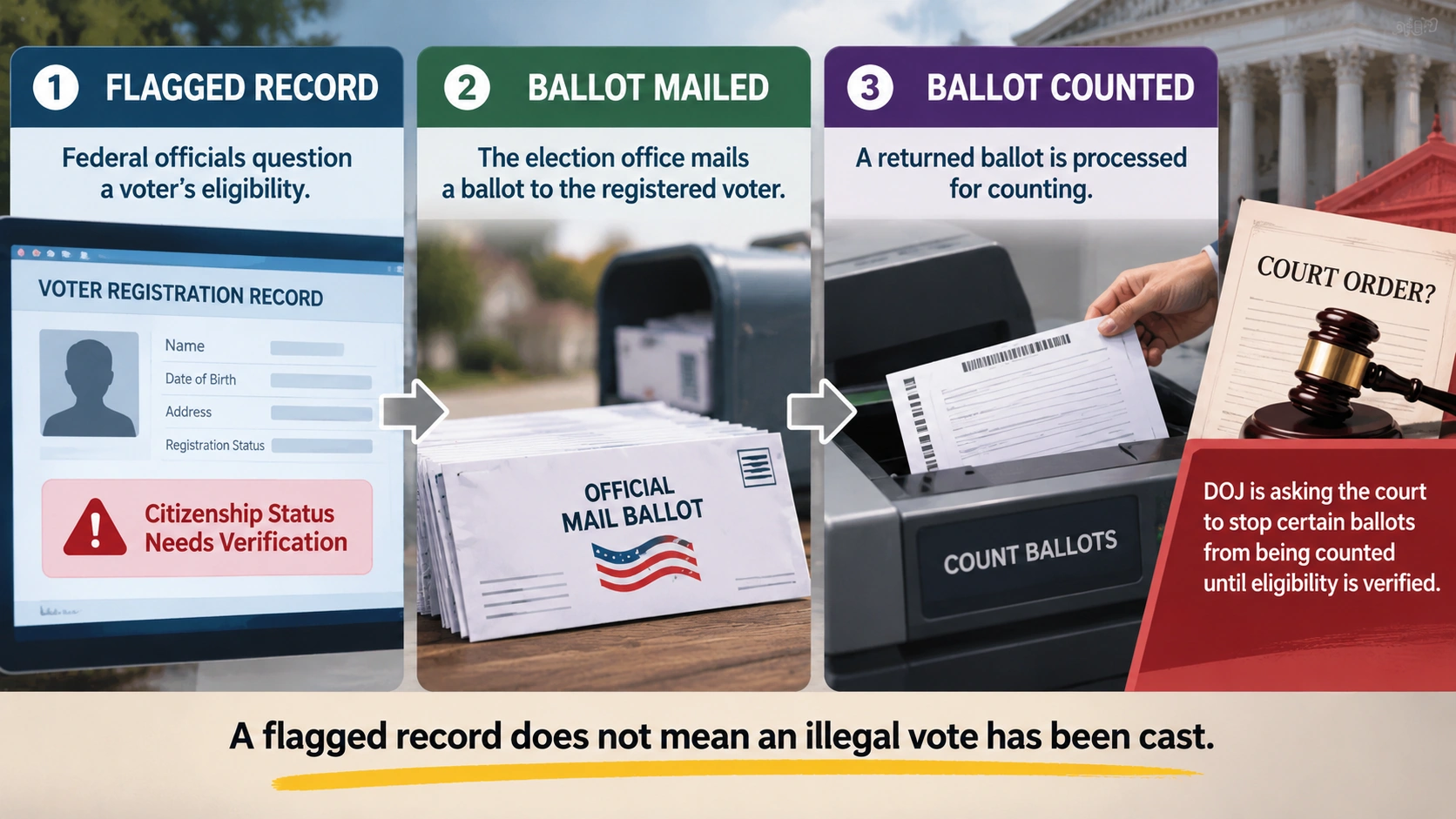
The Justice Department is asking the court to temporarily prevent certain mail ballots from being counted until the voters’ citizenship status can be verified.
It is not requesting that California cancel every mail ballot or suspend the entire November 3 election.
The lawsuit specifically targets people identified through a federal review as likely noncitizens. The government wants California to set aside their mail ballots and verify eligibility before those votes are included in election totals. (U.S. Department of Justice)
The distinction between the three stages is essential.
| Stage | What it establishes | What it does not establish |
|---|---|---|
| Voter record flagged | Federal officials question a person’s eligibility | That the person is legally ineligible |
| Mail ballot sent | An election office mailed a ballot to a registered voter | That the recipient completed or returned it |
| Ballot returned | A ballot was submitted for processing | That it was accepted, counted, or cast illegally |
In California, active registered voters are automatically mailed ballots for the November 3 general election. That is the state’s normal election system, not evidence that a particular voter has broken the law. (California Secretary of State)
The federal government argues that mailing ballots to suspected noncitizens creates a risk of illegal voting.
But a ballot being mailed is not the same as a ballot being returned, and neither automatically proves an illegal vote.
This is why the lawsuit is about much more than a large number.
It is about what kind of evidence should be required before election officials restrict the counting of a person’s ballot.
Where Did the List of 20,000 Voters Come From?
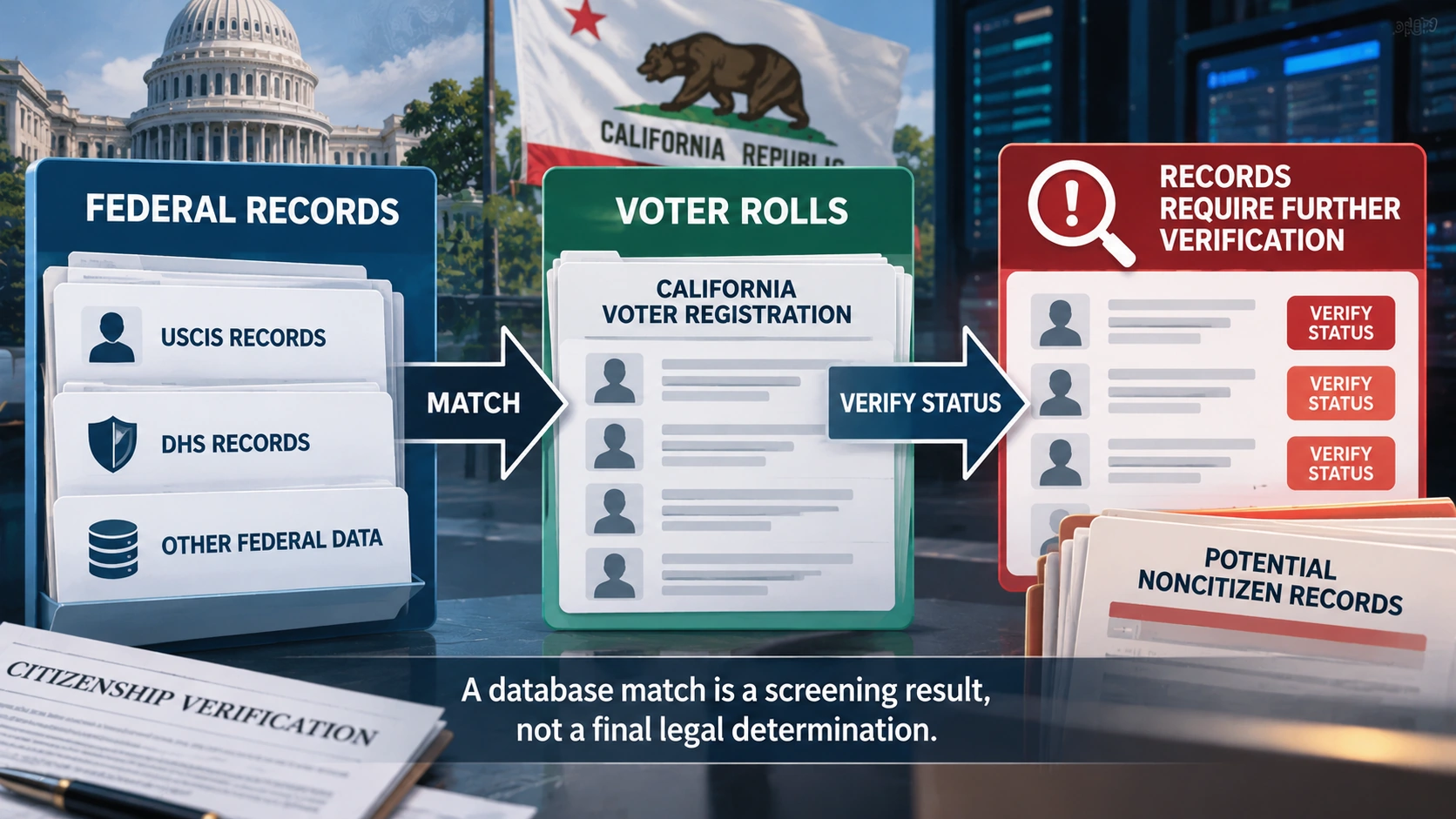
The list came from a federal review involving U.S. Citizenship and Immigration Services (USCIS) and Homeland Security Investigations (HSI).
According to the Justice Department, federal agencies used registration information, government records, and additional verification methods to identify individuals they believed were likely noncitizens.
Federal officials say their review was sufficiently reliable to justify immediate action. (U.S. Department of Justice)
But what does likely noncitizen actually mean?
It means the government suspects the person’s citizenship status does not meet the requirements for voting in federal elections. It does not, by itself, establish that the person has been legally determined to be a noncitizen.
That distinction becomes particularly important when government databases contain outdated information.
Consider a person who originally entered the United States as a lawful permanent resident, received a Social Security number, and later became a naturalized U.S. citizen.
If an older federal record has not been updated to reflect that naturalization, a citizenship check could raise questions even though the person is now an American citizen.
This is a recognized concern in litigation involving federal citizenship-verification systems. It does not prove that the California list contains such errors, but it explains why California officials want to examine the underlying evidence before taking action. (Reuters)
In other words, a computer system can identify a case that needs checking.
It cannot automatically resolve every legal question raised by that case.
That is why the accuracy and transparency of the federal government’s review are central to the dispute.
Why Did California Refuse the Federal Government’s Demand?
California’s central objection is that the federal government demanded urgent action without supplying enough verifiable information to justify restricting registered voters.
The dispute escalated quickly.
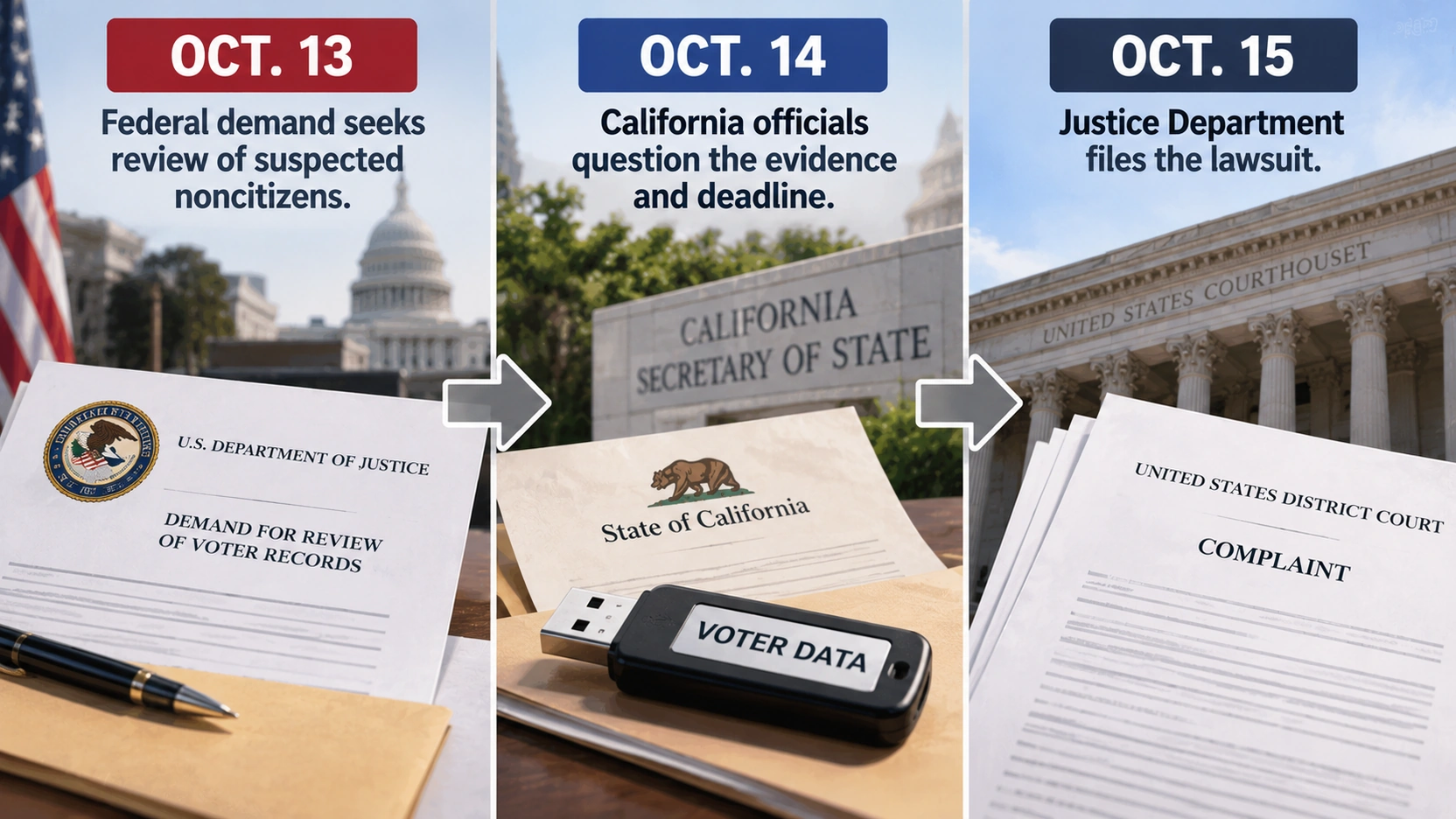
On October 13, Acting Deputy Attorney General Trent McCotter sent demands to California election officials, including Secretary of State Shirley Weber and Los Angeles County Registrar-Recorder/County Clerk Dean Logan.
Federal officials wanted the state to review the disputed names and prevent questionable ballots from being counted until eligibility could be confirmed.
The deadline was approximately 48 hours.
On October 14, Weber publicly criticized the demand, saying the Justice Department had not provided the list to her office and had not adequately explained its evidence or methods.
Los Angeles County had received a password-protected thumb drive, but county officials raised concerns about how the information was delivered and whether it met their security requirements.
On October 15, Weber’s office published its written response to the federal demand, and the Justice Department filed its lawsuit. (California Secretary of State · AP)
On October 16, the Justice Department escalated its position in a warning letter, saying election officials who count ballots from people the government believes are noncitizens could face federal prosecution. The warning was the department’s legal position—not a court finding that the people on its list were ineligible. (AP)
The difference between the state and county offices is worth emphasizing.
The California Secretary of State’s office said it had not received the list directly. Los Angeles County officials acknowledged receiving a thumb drive but objected to the security and verification issues.
Those are different circumstances, not necessarily contradictory accounts.
There was also an earlier numerical dispute.
Why Did an Earlier Claim Mention 190,000 People?
In July 2026, federal officials had raised the possibility that approximately 190,000 noncitizens were registered to vote in California.
The October lawsuit focused on roughly 20,000 individuals.
The newer filing did not publicly resolve why the figures were so different, and California officials challenged the reliability of the earlier allegation as well. (Los Angeles Times)
That does not automatically mean the federal government discovered 170,000 errors. The two figures may reflect different reviews, criteria, or data, but the available reporting does not establish the explanation.
Here is the sequence of the dispute:
| Date | Development | Why it matters |
|---|---|---|
| July 2026 | Federal officials raise an allegation involving roughly 190,000 registrations | Establishes an earlier, disputed estimate |
| October 13 | Federal demand seeks review of suspected noncitizens | Starts the immediate 48-hour confrontation |
| October 14 | Weber disputes the evidence and deadline | Explains California’s refusal |
| October 15 | Justice Department files the lawsuit | Moves the dispute into federal court |
| October 16 | Justice Department issues a further warning to election officials | Adds potential prosecution concerns to the legal dispute |
| November 3 | Scheduled general election | Makes the timing especially consequential |
The timeline reveals why this became an urgent legal dispute.
Federal authorities say waiting could allow unlawful ballots to be counted.
California officials argue that the government is trying to impose a major restriction at the last minute without providing sufficient evidence.
Who Has the Authority: The Federal Government or California?
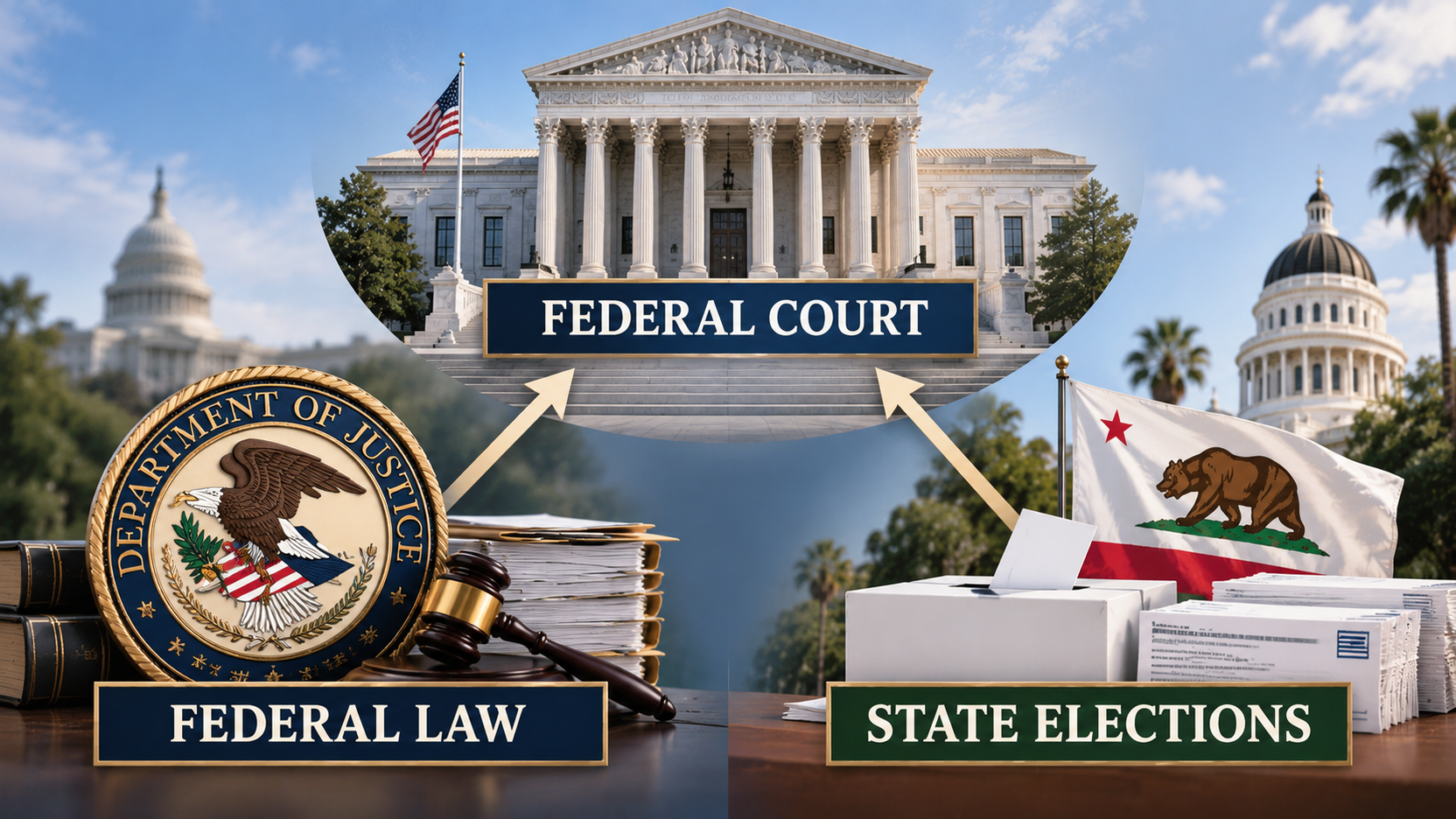
States administer elections, but federal law sets important requirements that states must follow. Federal courts can resolve disputes over those requirements.
That shared system helps explain how the Justice Department and California can both invoke legal authority while disagreeing about what should happen.
California officials are responsible for administering elections, maintaining registration records, and carrying out lawful ballot processing.
The federal government, meanwhile, has authority to enforce federal election laws.
And one rule is not in dispute: people who are not U.S. citizens generally cannot legally vote in federal elections.
The disagreement concerns whether the federal government has demonstrated that the individuals on its list are ineligible and whether the relief it requests is legally justified.
| Institution | Principal role in this dispute |
|---|---|
| Justice Department | Enforces federal law and seeks judicial relief |
| DHS, USCIS, and HSI | Supply and analyze federal citizenship-related information |
| California election officials | Administer elections and make eligibility decisions under applicable law |
| Federal district court | Determines whether the requested legal relief is justified |
The Justice Department cannot transform an allegation into a binding order simply by filing a lawsuit.
But California also cannot disregard a lawful federal court order if one is issued.
The court must examine the government’s legal basis and evidence while considering the state’s objections.
That brings us to a particularly important question about the election calendar.
Doesn’t Federal Law Restrict Voter Roll Changes Within 90 Days of an Election?
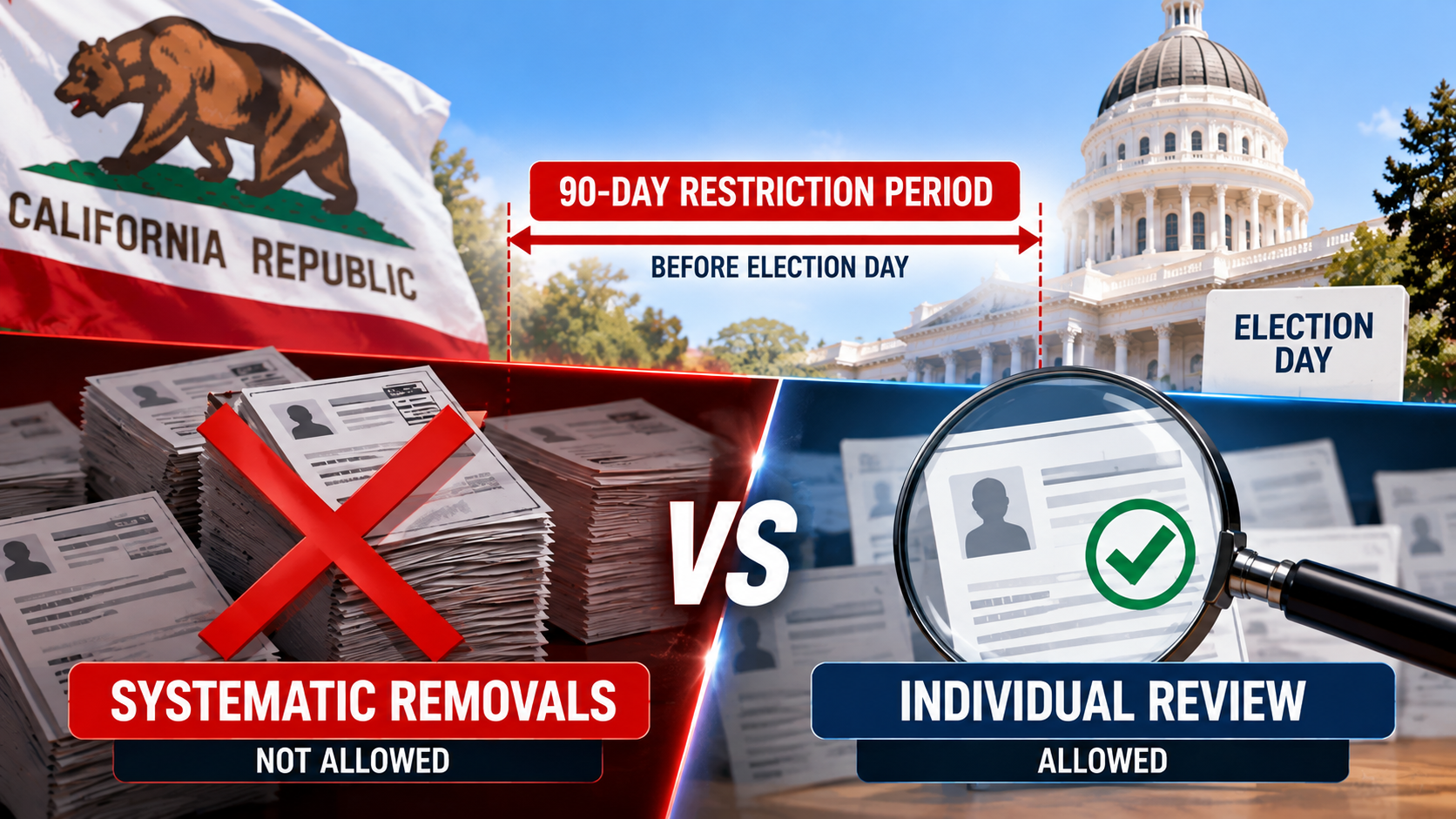
Yes, but the rule is more specific than it may sound.
The National Voter Registration Act contains a provision commonly called the 90-day rule.
Under 52 U.S.C. § 20507(c)(2), states generally must complete programs designed to systematically remove ineligible voters from federal-election registration lists at least 90 days before a federal election.
The law includes specified exceptions and does not prohibit every individualized registration inquiry during that period. (U.S. Code, 52 U.S.C. § 20507)
This distinction matters because the federal government’s request involves both voter eligibility questions and the handling of ballots associated with specific records.
Systematic Removal Versus Individual Review
A systematic removal program uses a broad process to identify and remove groups of registrations.
An individualized inquiry examines the eligibility of a particular person using relevant evidence and applicable procedures.
Those are not legally identical.
| Question | General legal distinction |
|---|---|
| Can a state run a broad systematic voter-removal program immediately before a federal election? | The NVRA generally restricts such programs within 90 days |
| Does that rule prohibit every individualized eligibility inquiry? | No; the statute does not impose a universal ban on all individual reviews |
| Does the 90-day rule automatically decide whether these ballots can be held? | No; the requested ballot-related relief raises additional legal questions |
The November 3 election falls within that restricted period.
California officials argue that the federal government’s last-minute demand threatens lawful voting rights and conflicts with applicable election protections.
The federal government argues that it is seeking to prevent unlawful votes from being counted, not to conduct an unjustified purge of eligible voters.
A federal judge will have to consider how the relevant laws apply to the specific relief requested.
The existence of the 90-day rule alone does not establish the outcome of this lawsuit.
That is why the precise form of any court order matters as much as the general arguments about election integrity.
Could a Federal Judge Really Stop These Ballots From Being Counted?
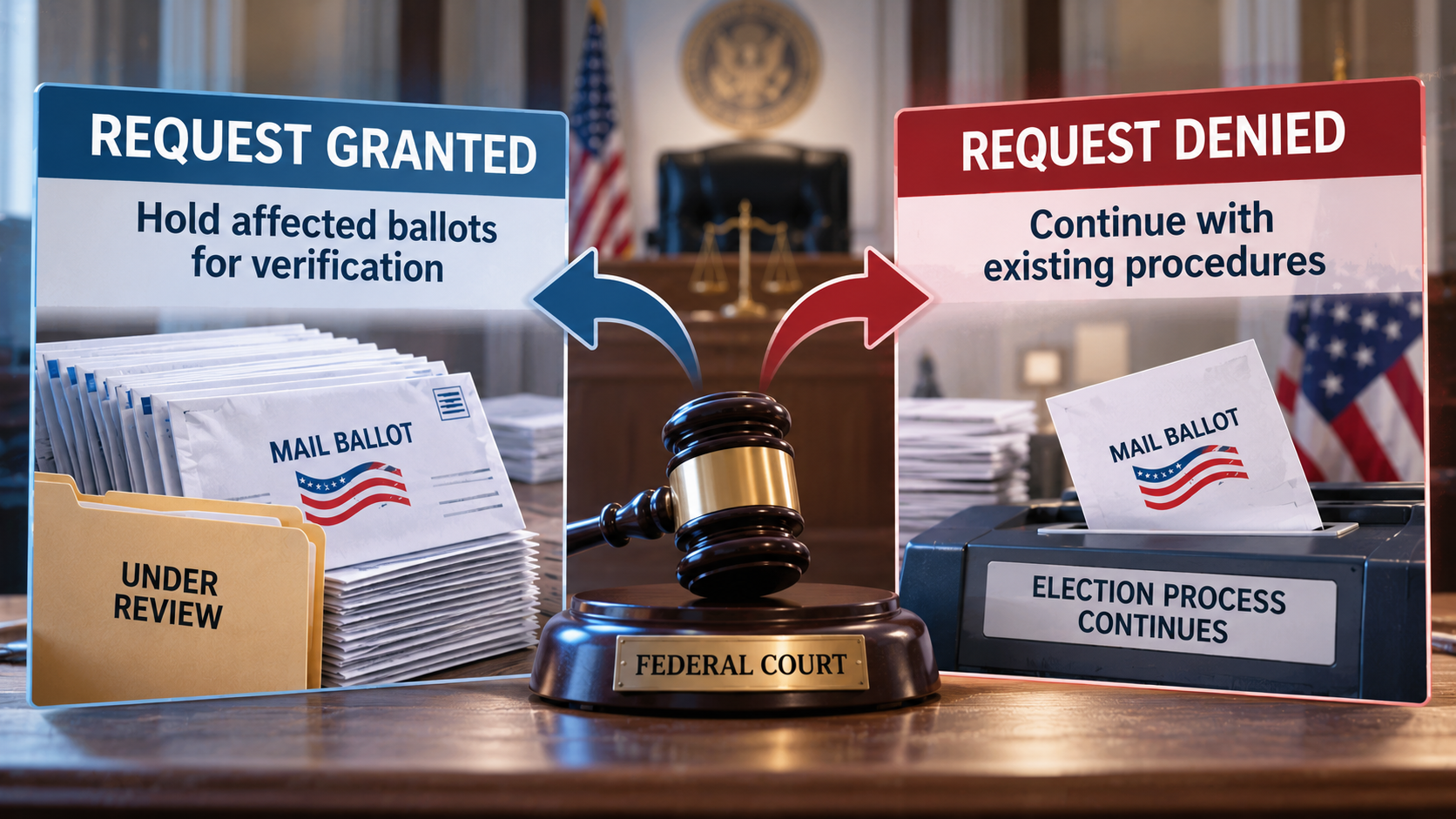
A federal judge can order election officials to take or refrain from certain actions when the legal requirements for judicial relief are met.
But the Justice Department must persuade the court that its requested order is justified.
The October 15 lawsuit itself does not automatically invalidate any ballot or establish that a particular registered voter is ineligible.
Consider two simplified possibilities.
If the Court Grants the Requested Relief
California could be required to set aside or temporarily refrain from counting ballots associated with the disputed list, subject to whatever conditions the court actually orders.
That could involve additional citizenship verification before affected ballots are included in election totals.
A temporary restriction would not necessarily mean every affected ballot is permanently rejected.
The details would depend on the court’s ruling.
If the Court Rejects the Request
California would not be required to implement the specific federal restrictions requested in the lawsuit merely because the Justice Department filed it.
State election officials would continue operating under existing election laws and any other applicable court orders.
Individual eligibility questions could still be examined through lawful procedures.
The judge could also issue narrower relief than either side initially requested, depending on the legal record.
What matters is the actual court order, not either side’s description of what the court should do.
Why Does This Matter Beyond California?
The immediate dispute concerns California, but the underlying questions reach far beyond one state.
Election administrators across the country face the challenge of ensuring that only eligible voters participate while protecting eligible citizens from being mistakenly excluded.
Those goals are not inherently contradictory.
The difficulty comes when a disputed database result is treated as grounds for immediate action, especially shortly before an election.
A federal review might correctly identify someone who is ineligible. It might also flag an American citizen whose information is outdated or incomplete.
The consequences depend on what happens after that initial flag.
This California lawsuit raises three broader questions:
- How reliable must government citizenship data be before it can justify restricting a ballot?
- What verification procedures are legally required to protect eligible voters?
- How far can the federal government go when it disagrees with a state’s administration of an election?
The answers matter because the same kind of dispute could arise wherever federal citizenship records are used in election-related decisions.
There is also a practical concern about timing.
California’s November 3 election was already underway through mail voting when the lawsuit was filed. Officials were being asked to resolve potentially complex eligibility questions while the election calendar continued moving forward. (California Secretary of State)
That creates pressure on both sides.
Federal officials argue that waiting too long may allow ineligible votes to enter the final count.
California officials argue that acting too quickly on uncertain records may put eligible voters’ ballots at risk.
Neither concern eliminates the need for evidence and lawful procedures.
What Should You Watch Next?
The first development to watch is whether the federal district court grants, denies, or modifies the Justice Department’s request for immediate relief.
Next comes the evidence.
Does the government provide enough information to establish that the disputed individuals are not U.S. citizens? Can California independently verify the records? And what safeguards would apply to any ballots held for additional review?
The difference between a broad restriction and a carefully defined, evidence-based process could prove central.
A further question is whether the case produces additional appeals or orders as the November 3 election approaches.
No particular outcome should be assumed from the filing itself.
The decisive developments will be the court’s actual rulings, the supporting evidence, and how election officials implement any binding directions.
Bottom Line: What This Story Really Means
The Justice Department’s California lawsuit is not proof that 20,000 noncitizens voted illegally.
It is a federal legal challenge involving approximately 20,000 registered voters whom government agencies suspect may be ineligible.
The Justice Department argues that ballots tied to those records should not be counted until citizenship is confirmed.
California argues that the federal government’s information is insufficiently verified and that restricting ballots on that basis could interfere with eligible citizens’ voting rights.
The conflict involves two obligations: enforcing voter eligibility requirements and protecting lawful votes.
The question a federal judge must confront is whether the evidence and the law justify restricting these ballots before their owners’ eligibility has been established.
That is why a dispute that began with a list of names has become an important test of election administration, federal authority, and legal protections for voters.
DOJ California Ballot Lawsuit: Key Questions Explained
Q. Did the Justice Department prove that 20,000 noncitizens voted in California?
No. The lawsuit alleges that federal agencies identified roughly 20,000 registered voters who are likely noncitizens. It does not establish that all of those individuals are ineligible or that they cast illegal votes.
Q. Is the DOJ asking California to cancel 20,000 ballots?
The Justice Department is asking a federal court to prevent mail ballots associated with the disputed individuals from being counted until citizenship eligibility is verified. The exact effect would depend on any court order.
Q. Why were ballots mailed to people whose citizenship status is being questioned?
California automatically mails ballots to active registered voters. The disputed individuals appeared on voter registration records, but the federal government and California disagree about whether their eligibility has been adequately established.
Q. Which federal agencies identified the disputed voter records?
The Justice Department says U.S. Citizenship and Immigration Services and Homeland Security Investigations participated in reviewing the information used to identify likely noncitizens.
Q. Did California receive the federal government’s list?
California’s Secretary of State said her office had not received the list directly when it responded to the federal demand. Los Angeles County officials received a password-protected thumb drive but raised concerns about the way the data were delivered.
Q. Why did earlier federal allegations mention 190,000 voters instead of 20,000?
The earlier figure was a separate, disputed federal allegation. The October lawsuit focused on about 20,000 people, but the public record reviewed here does not establish why the numbers differ.
Q. Does federal law prohibit voter roll removals within 90 days of an election?
Federal law generally restricts systematic voter-removal programs during that period, subject to statutory exceptions. It does not automatically prohibit every individualized inquiry, and the rule does not by itself settle the ballot-counting dispute.
Q. Has a court already ruled that the 20,000 ballots cannot be counted?
The October 15 filing is a request for judicial relief, not itself a court order blocking those ballots. Whether any restriction is imposed depends on subsequent judicial action.
Q. What happens if the court orders California to set aside the ballots?
The effect would depend on the terms of the order, including what verification is required and when the affected ballots may be counted. A temporary hold is not necessarily permanent rejection.
Q. Why could this lawsuit matter to voters outside California?
The case raises broader questions about citizenship-record accuracy, federal election-law enforcement, state election administration, and the safeguards required before eligible voters’ ballots can be restricted.
Did this help make the story clearer? 🙂
WIN keeps unpacking the “why” behind the news—clearly and simply!
Sources
Federal Lawsuit and Government Allegations
Reuters — DOJ Sues California to Block Votes From Alleged Noncitizens, October 15, 2026
California’s Response and Disputed Evidence
California Secretary of State — Response to Justice Department Demands, October 15, 2026
AP — Trump Administration Sues California over Alleged Noncitizen Mail Ballots
AP — Justice Department Warns California Election Officials over Disputed Ballots, October 16, 2026
Los Angeles Times — Justice Department Seeks to Stop California From Counting Disputed Ballots
Election Law and Ballot Administration
U.S. Code — 52 U.S.C. § 20507, National Voter Registration Act Requirements
California Secretary of State — Ways to Vote in the November 3, 2026 General Election
Keep Reading
Can a Federal Citizenship Database Mistakenly Flag an Eligible Voter?
The California ballot lawsuit concerns a disputed federal voter list; the separate SAVE case does not establish whether anyone on that list is ineligible. The earlier WIN explainer examines why citizenship-verification records can be outdated and what the Supreme Court’s temporary SAVE ruling did—and did not—settle.
What Is the SAVE Voter Database—and What Did the Supreme Court Actually Allow?