Why Did Trump’s New Press Secretary Leave After Just Five Days?

Five days? For one of the most visible jobs in American politics?
Katie Zacharia arrived as President Donald Trump’s new White House press secretary, held one televised briefing, and was out of the role before the workweek ended. That much is clear. Exactly how the decision was made is less straightforward. Officials described her as leaving the post, while several news organizations reported that she had been fired. (Reuters · AP)
What happened in between? A short first briefing drew criticism, questions about her legal credentials intensified, and Trump publicly suggested she reconsider whether the job was worth it. But the controversy is easy to misunderstand: the press secretary does not need to be a licensed attorney. The legal questions were about how Zacharia had described her earlier career, not a licensing requirement for the White House job.
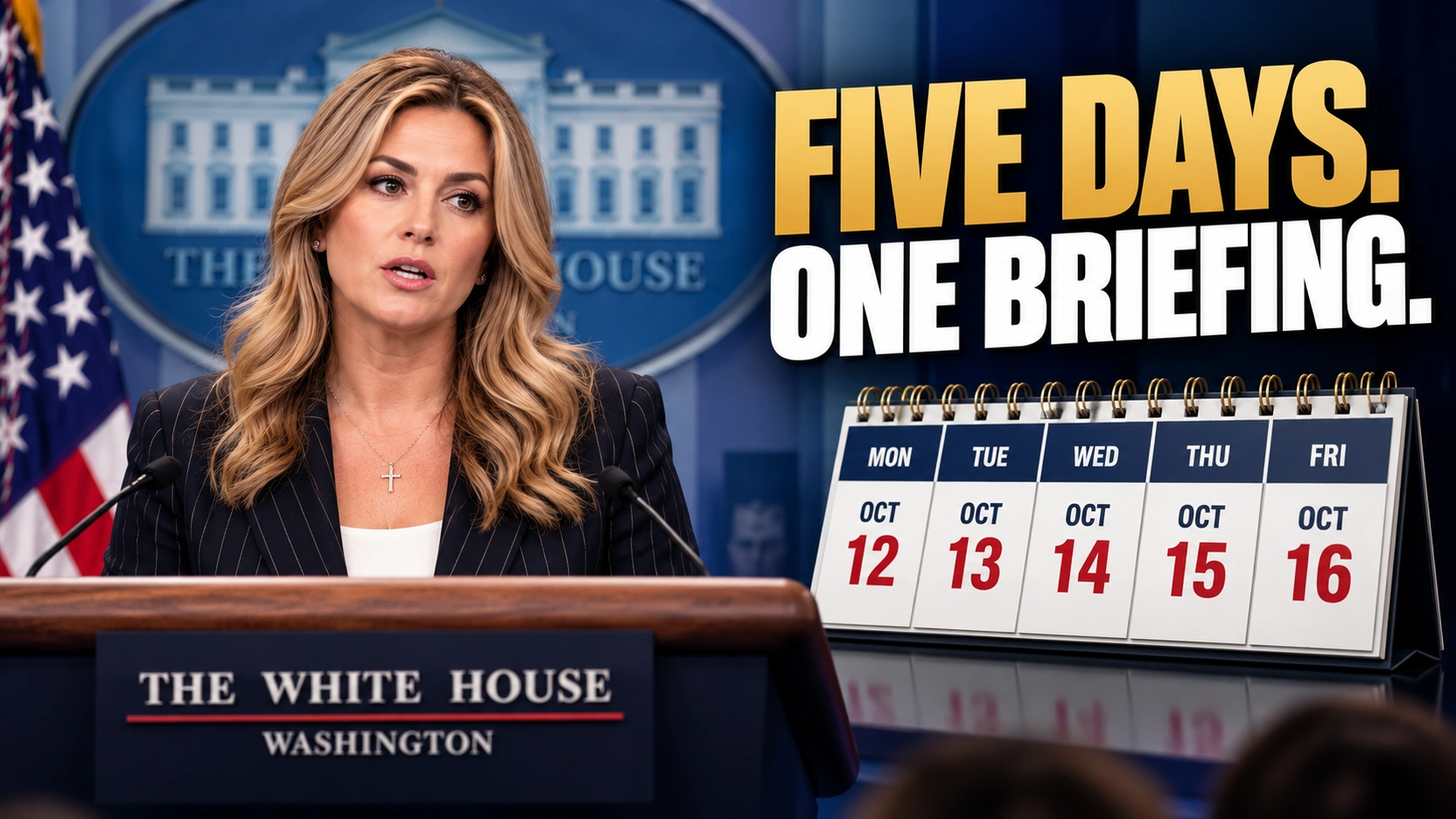
※ Images in this article are AI-generated illustrations created to help explain the story. They are not actual photographs, and depictions of people, places, or events may differ slightly from reality.
The dates explain why the story escalated so quickly—and why the phrase “five days” needs a little context.
How Did Katie Zacharia Go From Appointment to Exit in One Week?
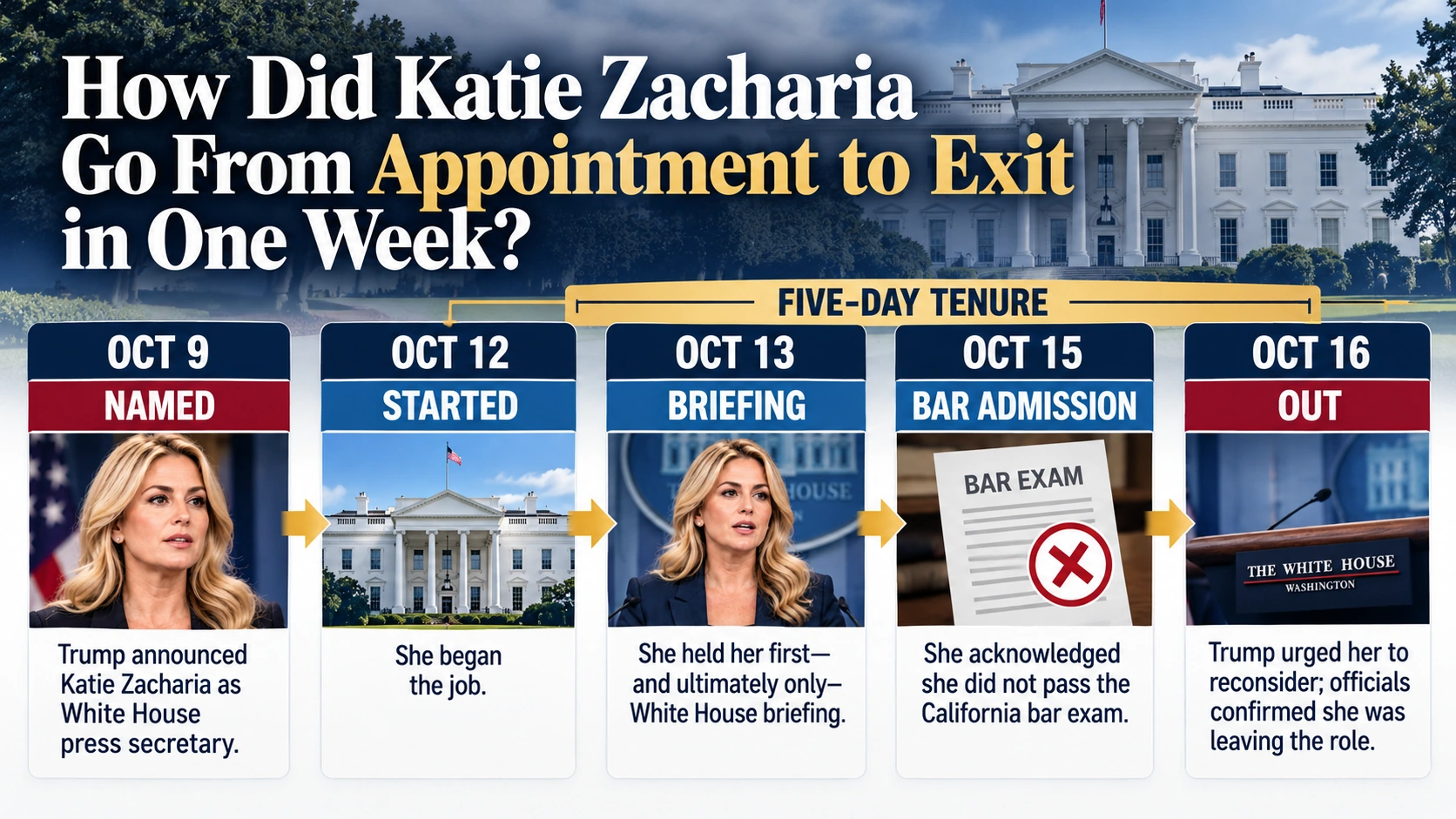
Trump announced Zacharia’s appointment on Friday, October 9, 2026. She officially started on Monday, October 12, and her departure was reported on Friday, October 16. That is the five-day tenure in the headlines; the announcement itself came a week before the departure. (AP · Axios)
| Date | What happened | Why it mattered |
|---|---|---|
| Oct. 9 | Trump announced Zacharia as press secretary. | A highly visible new appointment. |
| Oct. 12 | She began the job. | The start of the five-day count. |
| Oct. 13 | She held her first—and ultimately only—White House briefing. | Her performance became an immediate story. |
| Oct. 14–15 | A watchdog sought a review of her legal claims; Zacharia acknowledged not passing the bar exam. | Questions shifted from presentation to professional credibility. |
| Oct. 16 | Trump urged her to reconsider; officials confirmed she was leaving the role. | Her brief tenure ended without a clearly documented single cause. |
The sequence matters because it was not one embarrassing moment followed instantly by a dismissal. Several distinct controversies built up over a few days, and the White House’s own early praise stood in sharp contrast to the outcome. (Campaign for Accountability · Reuters · AP)
Why Did a 14-Minute Press Briefing Draw So Much Attention?
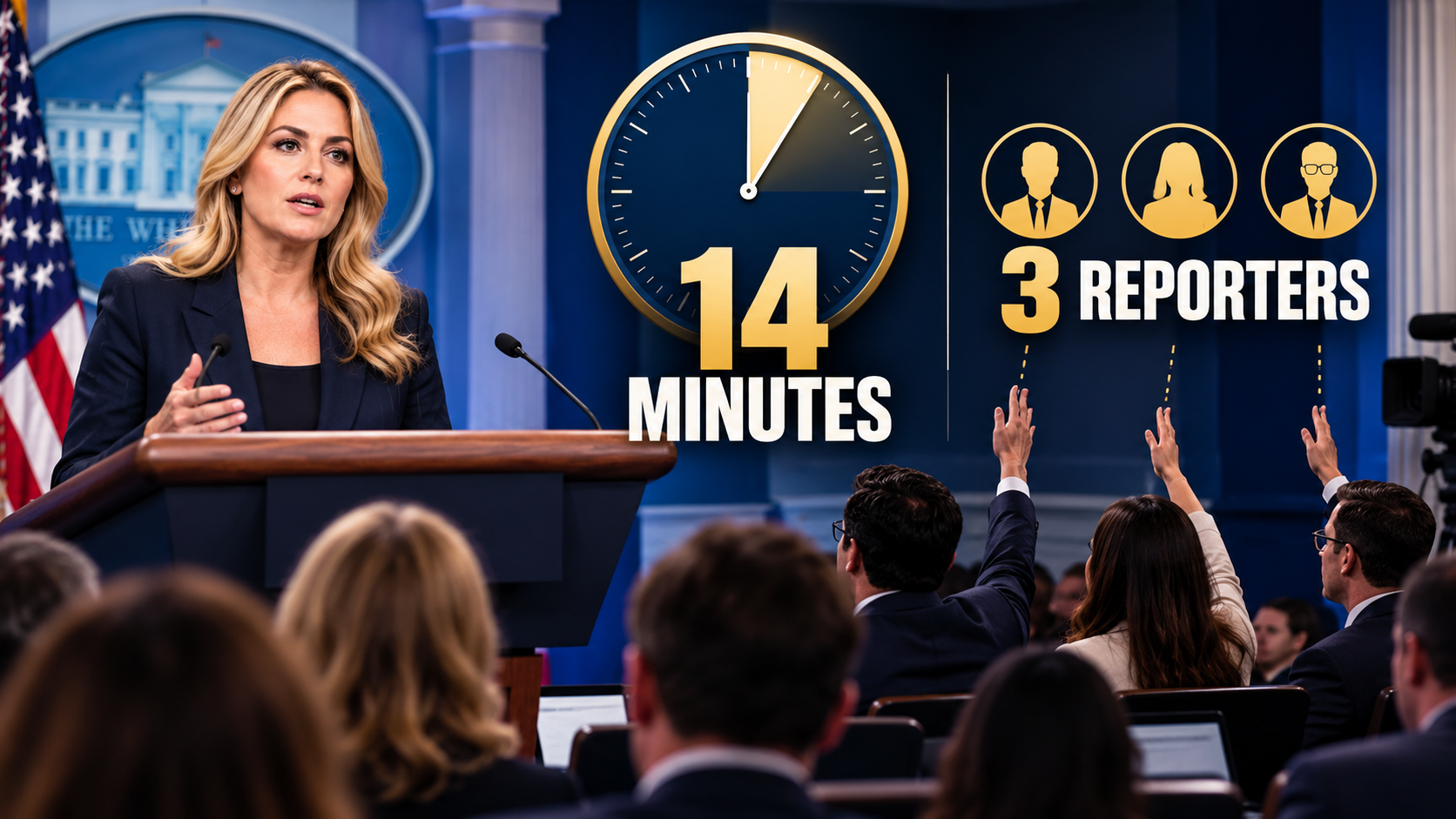
Zacharia’s October 13 briefing lasted about 14 minutes, and she took questions from reporters at just three outlets: Breitbart News, Fox News and the Daily Mail. For a job built around explaining presidential decisions and fielding questions, the limited exchange stood out. (AP)
Much of the appearance consisted of prepared remarks about Trump’s agenda and political activities. Some observers criticized the halting delivery and narrow question period. Others, including Trump, publicly praised her debut. In fact, an official White House statement celebrated the appearance, a notably different assessment from the critical coverage that followed. (AP)
Zacharia offered a practical explanation: she said she had little preparation time and wanted to leave an opportunity for reporters to question Trump when he departed later that morning. The briefing’s length alone does not establish that she was incapable of doing the job. But it became the first public test of a spokesperson whose central responsibility is to handle exactly that pressure. (Reuters · AP)
There was another twist: critical questions also came from conservative media personalities usually viewed as sympathetic to the administration. That made the controversy harder to characterize solely as a fight between Trump and hostile news outlets.
What Was the Bar Exam Controversy Really About?
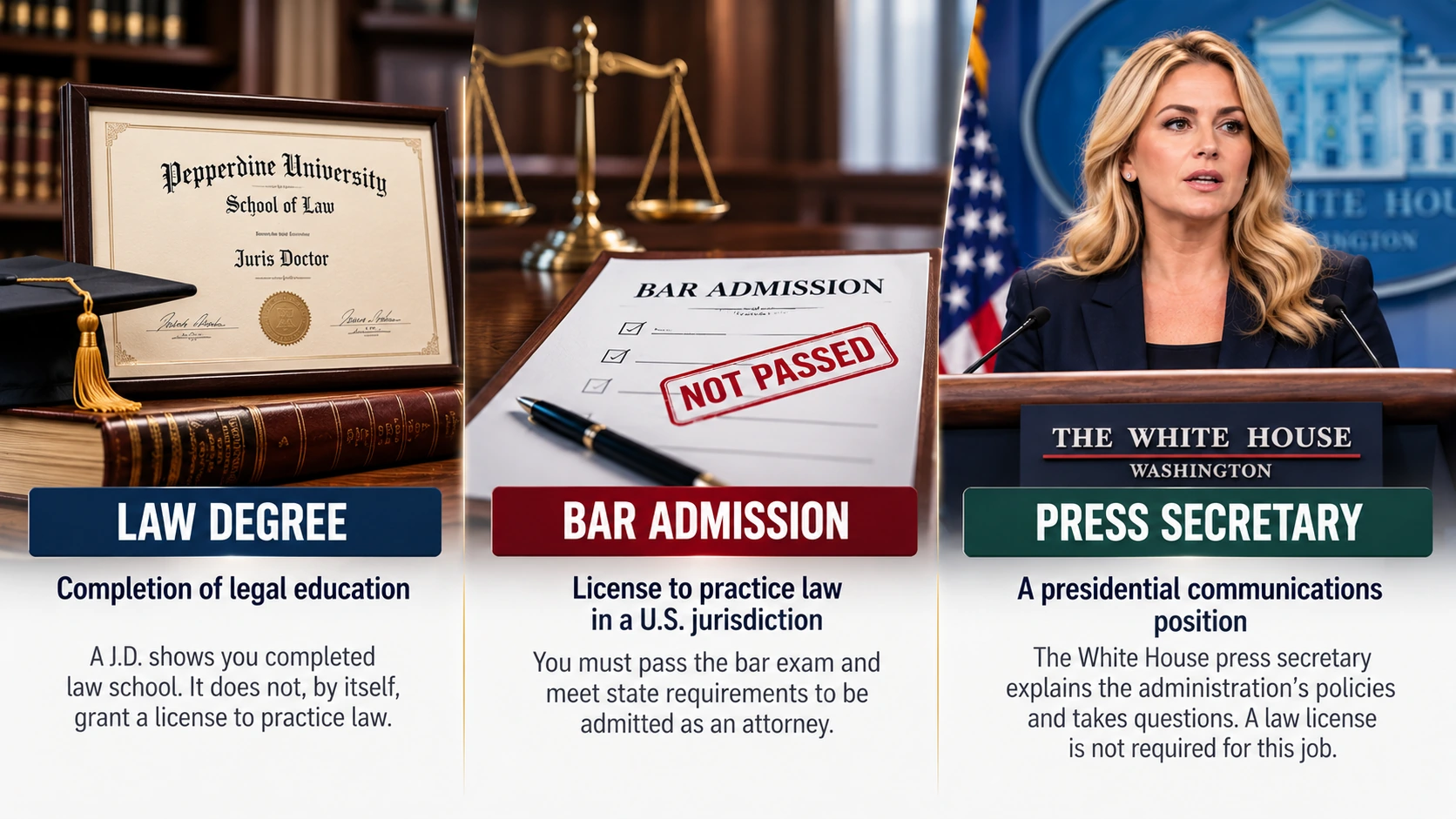
The controversy was not that Zacharia lacked a qualification required for her White House post. It was that she had been described—and had described herself—as a lawyer despite not being admitted to practice law in the United States. Trump had called her an attorney when announcing the appointment. (Reuters · AP)
Zacharia graduated from Pepperdine University’s law school in 2011. When asked about bar admission during her first briefing, she referred to her work in China rather than identifying a U.S. jurisdiction. In an October 15 interview with Fox News host Sean Hannity, she acknowledged that she did not pass the California bar exam and had not taken it a second time. Reuters reported finding no registration showing that she was admitted as an attorney in any U.S. state or Washington, D.C. (The Washington Post · Reuters)
Here are the three concepts people were mixing together:
| Credential or role | What it actually means |
|---|---|
| Law degree (J.D.) | Completion of legal education; it does not, by itself, grant a U.S. license to practice law. |
| Bar admission | Formal authorization to practice law in a particular U.S. jurisdiction after meeting its requirements. |
| White House press secretary | A presidential communications position; it does not require the holder to be an attorney. |
The State Bar of California’s admission requirements make clear that legal education and licensure are separate steps. A person can have a genuine law degree without being authorized to practice law as an attorney. That distinction says nothing, by itself, about someone’s ability to work in communications.
Zacharia said she had worked on international transactions in China and maintained that her description of her work was appropriate. She also said she had provided legal analysis rather than legal advice. Those were her explanations, not findings that a licensing authority had endorsed her use of the title. (AP)
On October 14, Campaign for Accountability filed a complaint asking the State Bar of California to examine her public claims. A complaint is a request for review, not proof of unlawful practice or a finding of misconduct. The available reporting does not establish that she had been convicted or formally found to have violated professional rules. (Campaign for Accountability · AP)
Why Had Trump Chosen Katie Zacharia in the First Place?
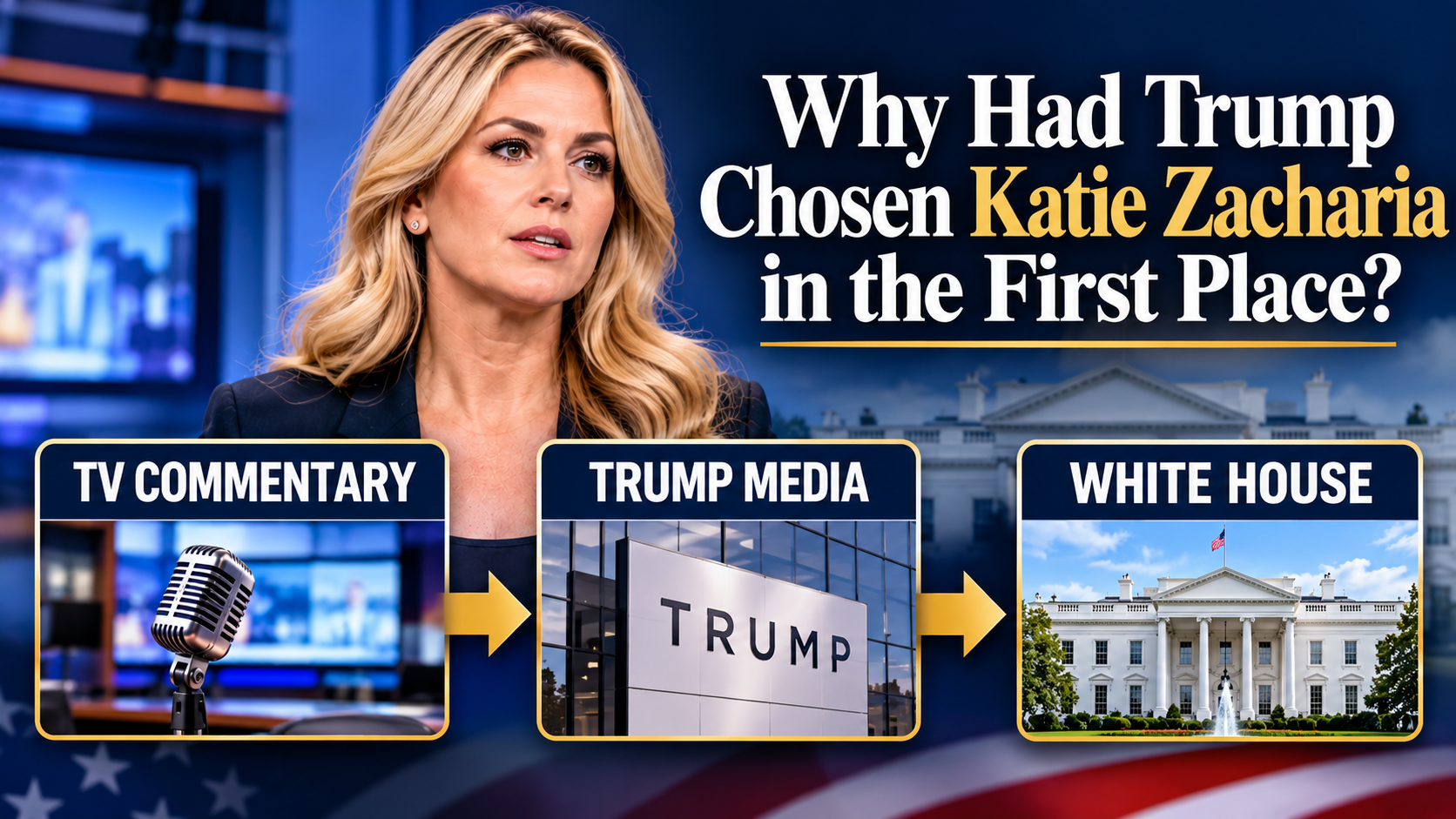
Trump selected Zacharia primarily for a communications job, not a legal one. Before arriving at the White House, she had worked with Trump Media & Technology Group, appeared as a conservative commentator on Fox News and Newsmax, and briefly served in a communications role at the Department of Homeland Security. (AP)
In announcing her appointment, Trump emphasized her loyalty and public support. Reuters later reported, citing people familiar with discussions, that he wanted someone who could better convey the administration’s accomplishments amid his concerns about news coverage. Those accounts help explain the selection, but they do not establish precisely who made each hiring decision or whether a particular credential was checked beforehand. (Reuters)
That background made Zacharia a recognizable advocate for Trump’s agenda. But advocating for a president on television and answering unpredictable questions on behalf of the government are not identical jobs. A press secretary must defend decisions, explain policies, correct the record when necessary and respond under sustained questioning—not simply deliver a supportive message.
Did Zacharia Resign, or Was She Fired?
Her departure is confirmed; the precise private conversation that ended her tenure is not fully public. Reuters reported, citing two U.S. officials, that Zacharia had been fired or let go. Axios also reported that she had been ousted. Other officials used the phrase “transitioning out.” Those descriptions are not identical. (Reuters · Axios)
Earlier on October 16, Trump told reporters he had urged her to reconsider staying in the role. He argued that she had been treated unfairly by the press and suggested that the job’s relentless scrutiny might not be worth it for her. He presented the advice as concern for her well-being, not as an explicit public statement that she had failed a performance test. (AP)
Zacharia, for her part, did not use her public farewell to attack the president. In a post later Friday, she praised Trump and described serving him as an honor. That confirmed her warm public message after the departure, but it did not provide a detailed account of who initiated the decision or settle every question about why it happened. (AP)
The most evidence-based reading is that a troubled public debut, mounting credibility questions and the demands of the role converged during an extraordinarily short week. Treating any single factor as the proven sole cause would go beyond what the public record establishes.
Why Does a White House Press Secretary Matter So Much?
The press secretary is one of the most recognizable links between the president’s administration and the public. The role involves explaining White House positions and taking questions from journalists who may be skeptical, friendly or somewhere in between.
That makes the job different from a campaign spokesperson or political commentator. Support for the president may help someone get hired, but credibility in the briefing room also depends on handling difficult questions accurately and consistently. And the role is separate from that of White House communications director—so comparisons to Anthony Scaramucci’s brief 2017 tenure as communications director are comparisons across different positions, not identical records. (Reuters)
The stakes are particularly visible ahead of the November 2026 midterm elections, when White House policy explanations and political messaging receive intense attention. Zacharia’s departure means the administration must find another person to perform that public-facing job. It does not, by itself, mean an administration policy has changed. (Reuters)
What Happens Next?
The immediate question is who will become Trump’s next press secretary and how the White House will handle briefings in the meantime. In the reporting available through October 16, Trump had not named a replacement and indicated he was not rushing to do so. (Reuters)
Separate from the staffing decision is the bar-related complaint. Whether California licensing authorities take any action is a different process with different standards. The existence of a complaint should not be mistaken for a finding, and Zacharia’s departure from a communications post does not itself resolve that issue.
The next meaningful developments will be a confirmed successor, clearer public information about the departure if the parties provide it, and any independently verifiable action on the credential complaint.
Bottom Line: What This Story Really Means
Katie Zacharia lasted five working days as White House press secretary, from October 12 through October 16, 2026. Her only briefing was short and criticized, while her admission that she had not passed the bar exam raised a separate credibility controversy over earlier descriptions of her career. Trump publicly urged her to reconsider the position; reporting from officials described her as having been removed or as transitioning out.
The distinction that matters most is this: Zacharia did not need a law license to speak for the White House, but the accuracy of her professional claims became part of the story about whether she could credibly do so. Her abrupt departure also shows how different the demands of a White House press briefing can be from political advocacy on television.
Katie Zacharia Press Secretary: Key Questions Explained
Q. Was Katie Zacharia really White House press secretary for only five days?
Yes. She officially started on October 12, 2026, and her departure was reported on October 16. Trump had announced her appointment on October 9.
Q. How many White House briefings did Katie Zacharia hold?
One. Her October 13 briefing lasted about 14 minutes, with questions from reporters at three outlets.
Q. Did Katie Zacharia pass the bar exam?
She said she did not pass the California bar exam and did not retake it. She earned a law degree from Pepperdine University, which is not the same as a license to practice law.
Q. Does the White House press secretary have to be a lawyer?
No. The press secretary is a communications position, not an attorney position. The controversy concerned Zacharia’s descriptions of her past legal work and credentials.
Q. Was Katie Zacharia charged with a crime over her legal credentials?
No criminal charge was reported in the sources reviewed. They document a watchdog complaint requesting a review, which does not establish misconduct or unlawful practice.
Q. Did Trump publicly say he fired her?
Trump publicly said he had advised her to reconsider the job and criticized the treatment she received from the press. Reuters and Axios separately reported, citing officials, that she had been let go or ousted.
Q. Who did Katie Zacharia replace?
She succeeded Karoline Leavitt, who had left the White House press secretary position in August 2026.
Q. Who is replacing Katie Zacharia?
A successor had not been named in the cited October 16 reporting. Trump indicated there was no immediate rush to announce one.
Did this help make the story clearer? 🙂 WIN keeps unpacking the “why” behind the news—clearly and simply!
Sources
Departure, White House Response and Timeline
Reuters — White House Press Secretary Zacharia Fired in Less Than a Week After Facing Criticism
AP — Embattled White House Press Secretary Katie Zacharia Is Leaving the Job After Less Than a Week
Axios — Katie Zacharia Out as White House Press Secretary
First Briefing and Appointment Background
AP — Katie Zacharia Makes a Brief Appearance Before Reporters
The White House — Katie Zacharia Delivers Inaugural Briefing
Legal Credentials and Bar Admission
Reuters — Katie Zacharia Says She Did Not Pass Bar Exam
The State Bar of California — Admission Requirements
Campaign for Accountability — Request for California State Bar Investigation
Keep Reading
Can the White House Decide Which News Organizations Get Access?
Zacharia’s abbreviated briefing put attention on who gets to ask the president’s spokesperson questions. A separate White House dispute concerns which news organizations can enter the building at all—and what constitutional limits apply.
Can the White House Ban Entire News Organizations—and What Happens If They Sue?