Why Is the Supreme Court Taking Up Elon Musk’s DOGE Records Case?

How can a group help reshape the federal government while arguing that its own records are beyond the reach of a major government transparency law?
That is the question behind the legal fight over Elon Musk’s Department of Government Efficiency, better known as DOGE.
When DOGE became a central part of President Donald Trump’s second administration, it was associated with sweeping changes to federal jobs, contracts, technology systems, and government spending. But what was DOGE, legally speaking?
Was it an actual federal agency exercising government authority? Or was it a group of advisers working for the president?
On October 13, 2026, the U.S. Supreme Court agreed to hear a case arising from that disagreement. A government watchdog wants access to DOGE records, while the Trump administration argues that courts have gone too far in ordering the government to produce information. (AP · Reuters)
The Supreme Court has not ordered DOGE to release all its records. Nor has it finally decided whether DOGE is covered by the Freedom of Information Act. The immediate dispute concerns how much evidence a court may require while determining whether a White House-related organization is subject to public-records law.

※ Images in this article are AI-generated illustrations created to help explain the story. They are not actual photographs, and depictions of people, places, or events may differ slightly from reality.
The answer could matter well beyond DOGE. It may help determine how much scrutiny courts can apply when a president creates an influential organization but maintains that it is principally an advisory body.
What Exactly Was DOGE—and Why Are Its Records Important?
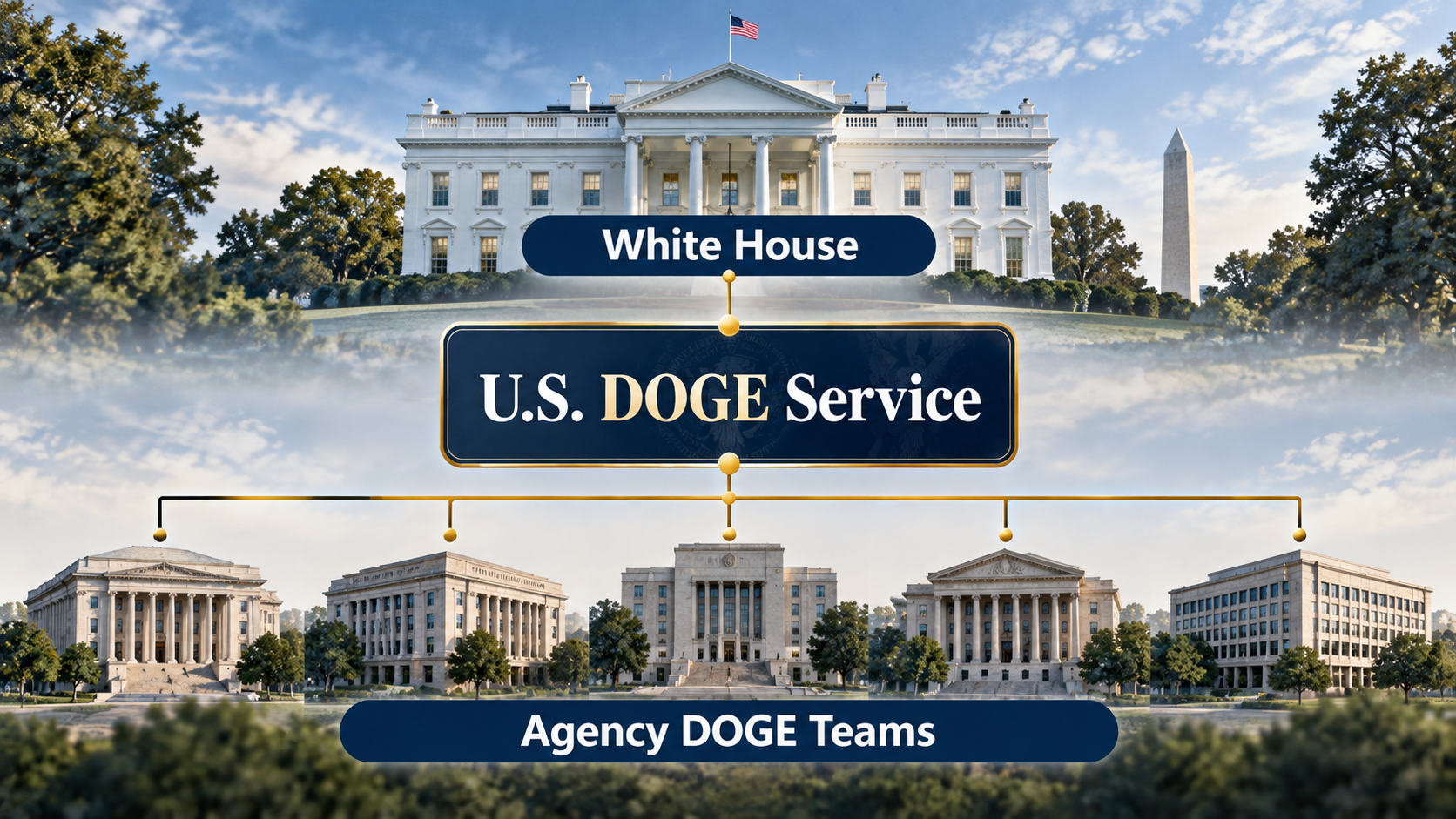
Despite its name, DOGE was not a new Cabinet department created by Congress.
On January 20, 2025, President Trump signed Executive Order 14158. The order renamed the existing United States Digital Service as the United States DOGE Service, or USDS, and placed it within the Executive Office of the President. It also established a temporary organization within USDS and called for DOGE teams to be created inside federal agencies. (Federal Register)
That arrangement created a distinction central to the lawsuit: a DOGE organization within the president’s executive office was not necessarily the same legal entity as DOGE teams working inside existing federal agencies.
DOGE became associated with efforts to cut spending, reduce the federal workforce, cancel contracts, and alter agency operations. Supporters described the work as necessary efficiency reform. Critics questioned the legality, accountability, and consequences of particular actions.
The requested records could help clarify what DOGE personnel were authorized to do, how they communicated with agencies, and what role they played in government decisions.
A presidential adviser can strongly influence a decision without necessarily possessing the legal authority to make that decision. Whether USDS exercised substantial independent authority is central to the underlying FOIA dispute.
Why Does It Matter Whether DOGE Was an Agency or an Adviser?

Because the Freedom of Information Act, usually called FOIA, does not apply to every organization connected to the federal government.
FOIA generally gives people the right to request existing records from federal agencies, including relevant emails, contracts, reports, and policy documents. But the president’s immediate personal staff and offices whose sole function is to advise and assist the president generally fall outside FOIA’s definition of an agency. Other Executive Office of the President components can be covered if their functions and authority meet the legal test. (U.S. Department of Justice)
This makes DOGE’s actual role more important than its name.
| Question | Federal agency | Presidential advisory office |
|---|---|---|
| Primary function | Carries out governmental responsibilities | Advises and assists the president |
| Independent authority | May possess powers delegated by law | Generally lacks substantial independent authority |
| FOIA coverage | Generally covered | Generally excluded when limited to advising and assisting |
| Public records requests | Must process applicable FOIA requests, subject to exemptions | Not independently required to respond under FOIA if outside its scope |
The table explains the legal distinction; it does not establish DOGE’s status.
Imagine a mayor hiring a consultant to recommend budget cuts. The consultant might influence which programs the mayor reduces. But recommending cuts is different from having the legal authority to cancel those programs directly.
The federal case is more complicated because DOGE personnel worked in and around federal agencies while pursuing the president’s agenda.
The administration argues that USDS operated as a presidential advisory component. Citizens for Responsibility and Ethics in Washington, or CREW, argues that its activities went beyond merely advising the president.
The legal question is not simply how influential DOGE was. It is whether DOGE exercised the kind of independent governmental authority that can make an organization subject to FOIA.
What Records Is the Watchdog Group Trying to Obtain?
CREW wants records that could help explain DOGE’s organization, communications, and role in government decisions.
The watchdog filed its lawsuit on February 20, 2025. Its requests included organizational information, communications involving the Office of Management and Budget, information about changes to the former U.S. Digital Service, financial disclosures, and communications between DOGE and federal agencies. (CREW)
An organizational chart could identify who reported to whom. Communications with federal agencies could help establish the nature of DOGE’s involvement in their decisions. Financial disclosures and administrative records could shed light on personnel and organizational arrangements.
CREW also raised questions about preserving records under the Federal Records Act, which is distinct from the public-disclosure requirements of FOIA.
But if DOGE maintains it is not a covered agency, how can CREW obtain the evidence necessary to challenge that position?
That leads to the less familiar legal concept at the heart of the Supreme Court dispute: discovery.
Discovery is a court-supervised process through which litigants seek relevant evidence. It can include documents, written answers, and depositions—formal questioning under oath.
Here, discovery could help a court decide whether USDS is covered by FOIA in the first place. Discovery in litigation is not the same as a final FOIA order releasing records to the public. The administration argues the process itself threatens confidential presidential communications.
How Did the DOGE Records Fight Reach the Supreme Court Twice?
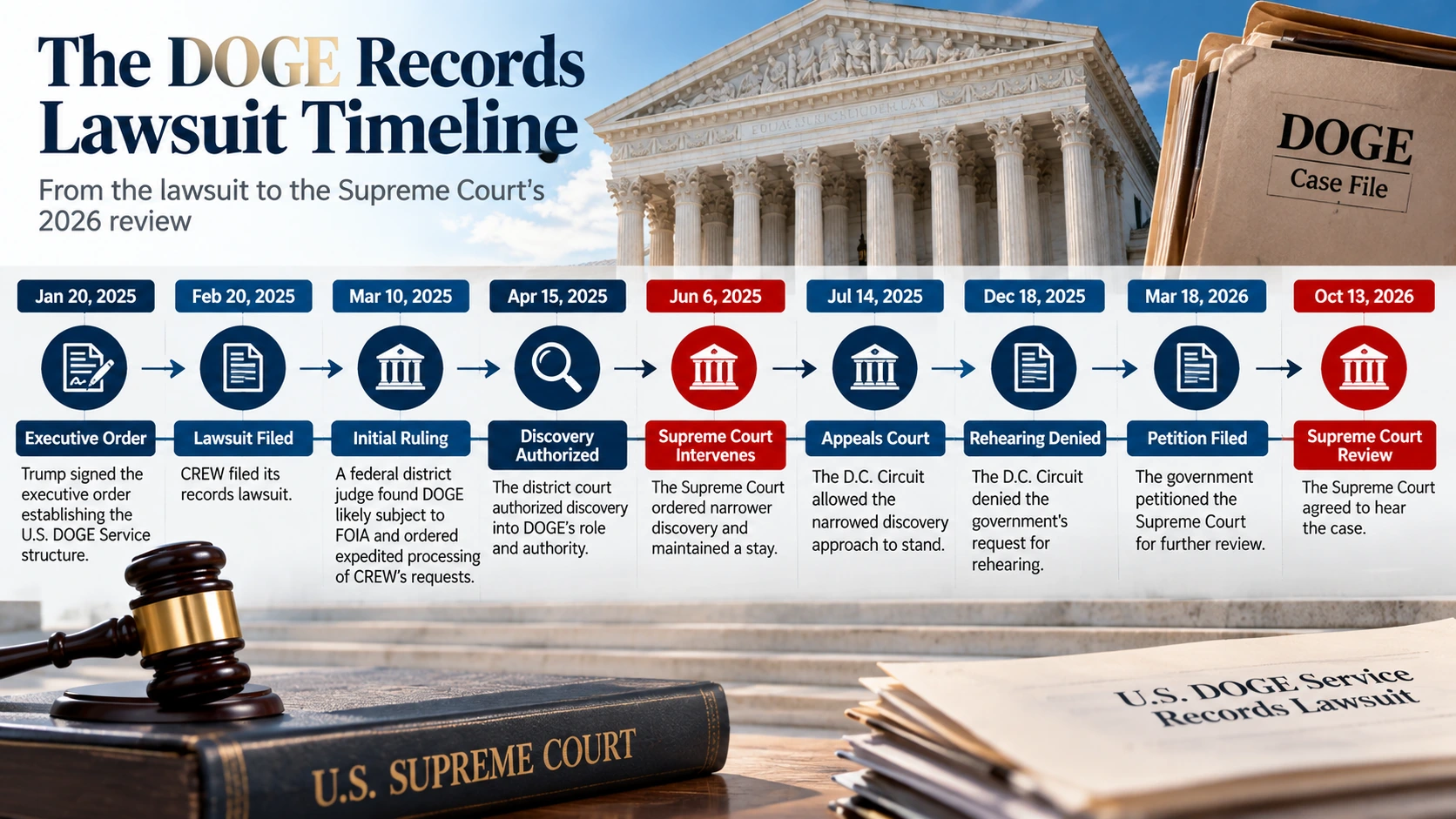
The Supreme Court had already intervened once in this lawsuit. Its earlier order helps explain why this is more complicated than an ordinary public-records dispute.
| Date | What happened |
|---|---|
| January 20, 2025 | Trump signed the order creating the U.S. DOGE Service structure |
| February 20, 2025 | CREW filed its records lawsuit |
| March 10, 2025 | A district judge found USDS likely subject to FOIA and ordered expedited processing |
| April 15, 2025 | The district court authorized discovery into DOGE’s role and authority |
| June 6, 2025 | The Supreme Court ordered narrower discovery and stayed lower-court orders |
| July 14, 2025 | The D.C. Circuit permitted CREW’s narrowed discovery approach |
| December 18, 2025 | The D.C. Circuit denied the government’s request for rehearing |
| March 18, 2026 | The government filed a new Supreme Court petition |
| October 13, 2026 | The Supreme Court agreed to hear the case |
The most important earlier development occurred on June 6, 2025. The Supreme Court concluded that portions of the lower court’s discovery order went too far, particularly demands about the content of DOGE’s recommendations to other executive branch officials and whether those recommendations had been followed.
The justices explained that FOIA agency status cannot turn merely on an organization’s ability to persuade other officials. They also emphasized judicial restraint concerning internal executive branch communications. Justices Sonia Sotomayor, Elena Kagan, and Ketanji Brown Jackson would have denied the government’s request for a stay. (U.S. Supreme Court)
CREW subsequently withdrew certain discovery requests. The D.C. Circuit declined to grant the government’s requested extraordinary relief from the remaining discovery. The government continued to object and petitioned the Supreme Court again in March 2026.
The Court’s October 2026 decision to hear the case is a new stage of review, not the end of the lawsuit.
What Will the Supreme Court Actually Decide?
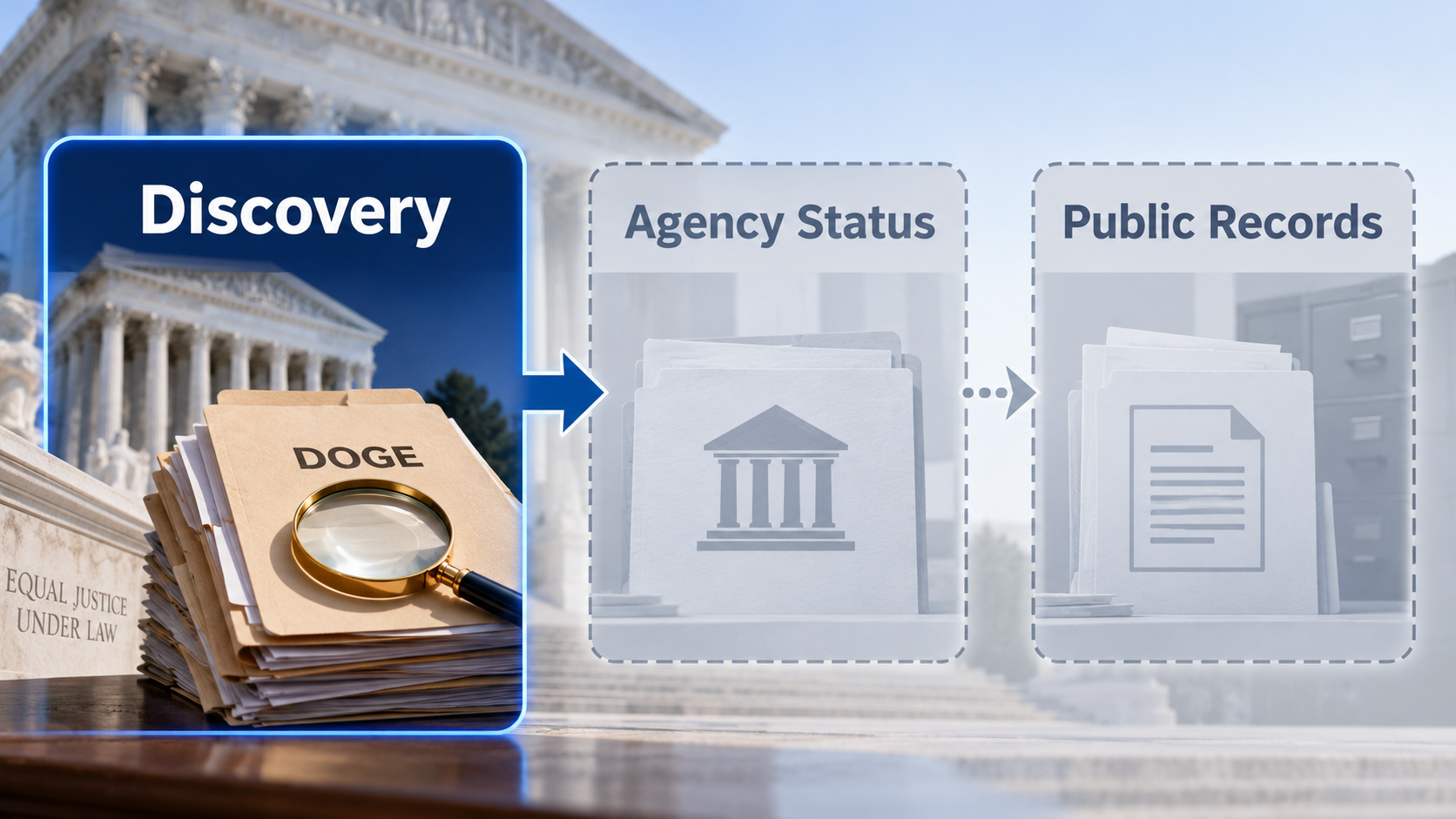
The immediate question is how much evidence a lower court can demand while determining DOGE’s legal status—not which records the public is ultimately entitled to see.
The government’s petition presents two related issues. First, did the appeals court fail to follow the Supreme Court’s 2025 instructions requiring respect for separation-of-powers concerns? Second, can courts order broad discovery from an Executive Office advisory body to decide whether FOIA applies to it? (U.S. Supreme Court)
A useful way to understand the lawsuit is to separate three legal questions.
| Legal question | What it means | Current significance |
|---|---|---|
| May the court demand evidence about DOGE’s operations? | Determines permissible discovery | Central to Supreme Court review |
| Is DOGE an agency subject to FOIA? | Determines whether USDS has its own FOIA duties | Underlying legal dispute |
| Which requested records must be released? | Considers specific records and exemptions | Depends on further proceedings |
A watchdog may need information about an organization’s real activities to establish whether FOIA covers it. But if obtaining that information involves internal presidential communications, the government argues that discovery may undermine confidentiality protections.
The Court’s eventual decision could set limits on how aggressively lower courts may investigate that threshold question. It could resolve discovery without deciding DOGE’s ultimate FOIA status or requiring immediate disclosure of records.
What Are the Trump Administration and CREW Arguing?
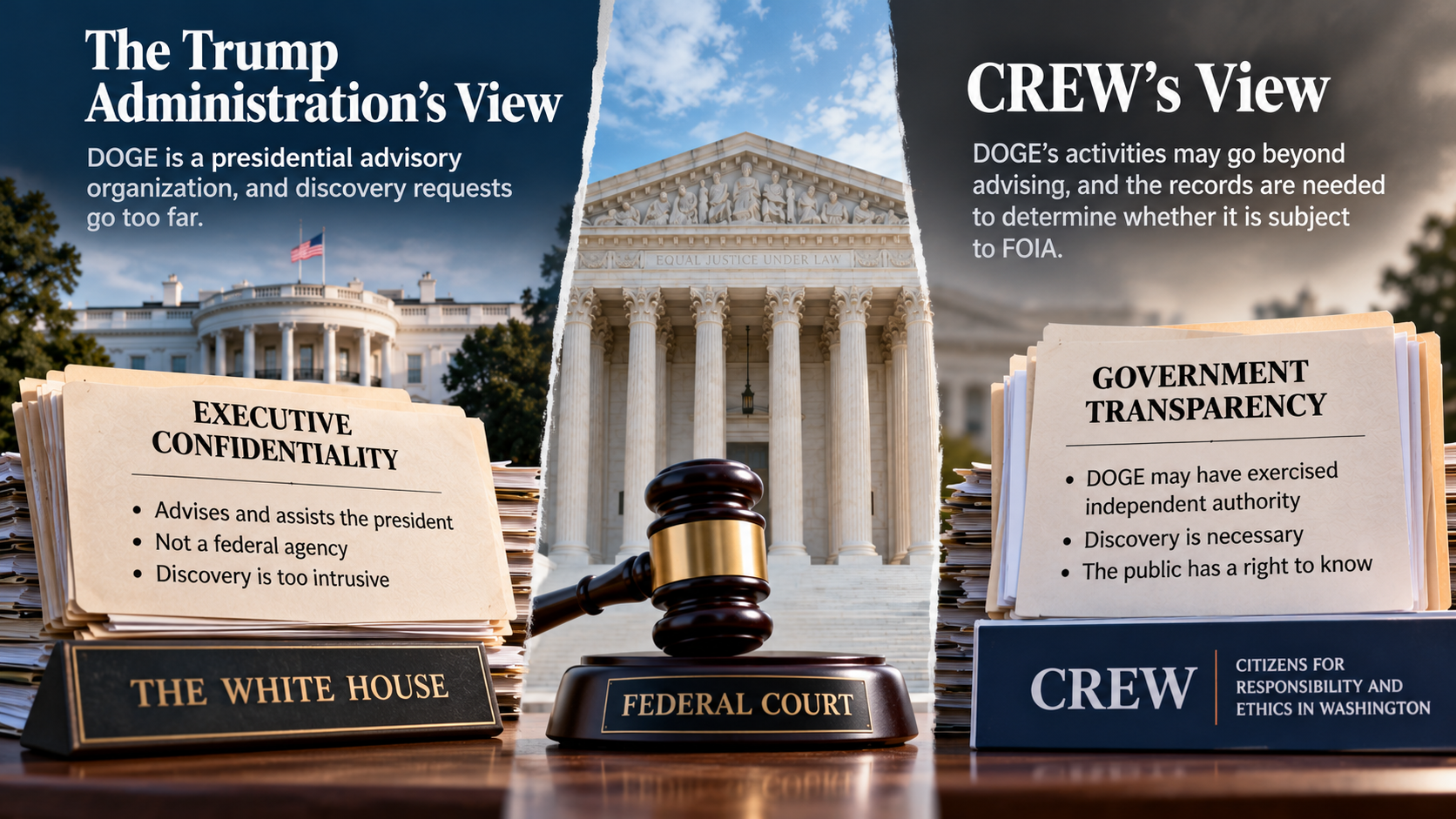
The administration and CREW disagree about DOGE’s legal status and what discovery is appropriate to determine it.
The Trump administration’s position
The administration argues that DOGE was designed to advise and assist the president, and that the lower courts permitted discovery too intrusive into internal executive branch discussions. It argues the courts did not adequately honor the Supreme Court’s earlier directions and must respect the separation of powers.
The government contends that sensitive presidential communications should not be disclosed through litigation before it is established that FOIA applies to the organization.
CREW’s position
CREW argues that DOGE’s actual governmental role cannot be determined solely from the administration’s description of its organization. Some discovery, it says, is necessary to assess whether DOGE exercised substantial independent authority.
The watchdog also argues that it narrowed its requests following the Supreme Court’s 2025 ruling. Without the remaining evidence, CREW says, courts may be unable to determine whether influential presidential organizations must comply with FOIA. (CREW Supreme Court Brief)
| Issue | Administration’s argument | CREW’s argument |
|---|---|---|
| DOGE’s role | Presidential advisory body | Potentially exercised independent governmental authority |
| Discovery | Intrusive into executive operations | Necessary to establish actual functions |
| Supreme Court’s 2025 order | Lower courts did not adequately follow it | Challenged requests were narrowed |
| Broader concern | Presidential confidentiality | Government accountability |
Both sides are making legal arguments. Neither description is a final Supreme Court finding about DOGE’s status.
If DOGE Is Covered by FOIA, Would Every Document Become Public?
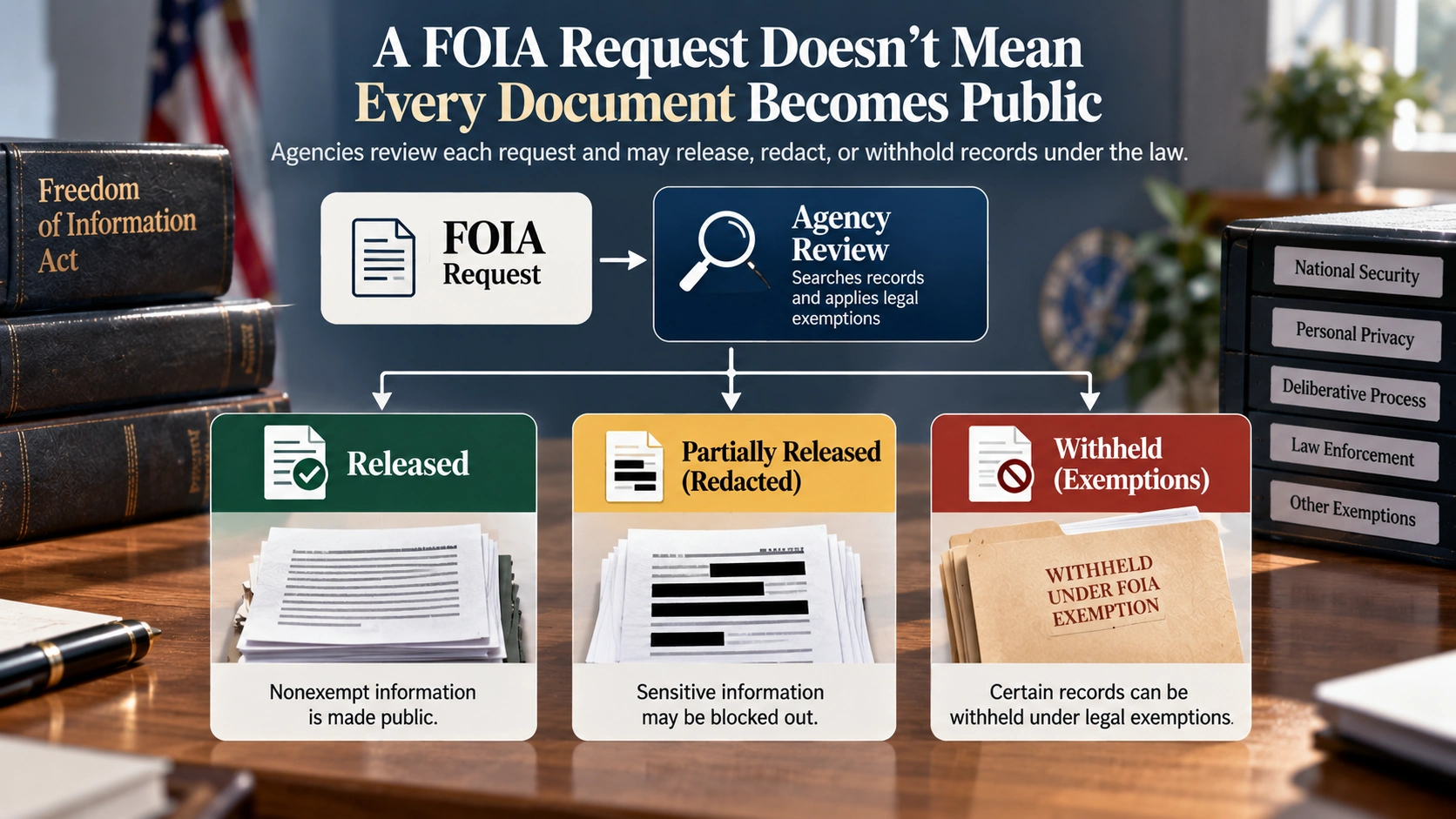
No. Even if DOGE were ultimately found subject to FOIA, not every internal record would automatically become public.
FOIA requires covered agencies to process qualifying requests and disclose responsive agency records unless a legal basis for withholding applies. Exemptions protect certain classified information, personal privacy interests, and other legally protected matters. Nonexempt portions may still have to be released with protected information redacted. (FOIA.gov)
For example, an agency may release a document with identifying personal information blacked out. A different record may qualify for a statutory exemption, subject to the applicable legal requirements and possible court review.
The accurate sequence is FOIA coverage → records search and review → release of nonexempt information, with lawful withholding where appropriate.
And the DOGE lawsuit is still fighting over an earlier question: what evidence courts may obtain to decide whether the organization is covered at all.
Why Could This Case Matter Beyond Elon Musk?
Because the underlying issue is not unique to DOGE.
Presidents rely on advisers, task forces, White House offices, and temporary organizations to develop policy and coordinate action. Some government offices possess independent legal authority. Advisers may strongly influence decisions without possessing that authority themselves.
Federal courts have addressed similar questions for decades. The Justice Department’s FOIA guidance recognizes that some Executive Office of the President components are covered, while advisory-only components are generally excluded. (U.S. Department of Justice)
DOGE puts the distinction under unusual scrutiny because of its prominent role in the administration’s efforts to reshape federal operations.
Consider an agency that cancels a contract after a recommendation from a White House-related task force. Records of the agency’s final decision may be accessible under FOIA. But what about documents explaining who developed the recommendation and whether the task force had any authority beyond advising?
Some documents might be held by the agency. Others might be held by the White House-related organization itself. Those differences matter to which records law applies and what information can be obtained.
The Supreme Court may influence how future courts investigate advisory organizations and determine whether they exercise independent authority. Its decision will not necessarily settle every disclosure dispute involving a future White House office.
What Happens Next?
The Supreme Court agreed to hear U.S. DOGE Service v. United States District Court for the District of Columbia, No. 25-1103. That decision to review the case is not a final ruling on the disputed records.
Next will come further briefs, an oral argument, and a decision. As of October 13, 2026, the Court had not announced an argument date. Argument is expected in early 2027 and a decision could follow by that summer. (CBS News · Reuters)
Watch whether the justices allow, narrow, or block the remaining discovery; how they treat executive confidentiality; and what proceedings follow on USDS’s underlying FOIA status.
The January 2025 executive order specified that the U.S. DOGE Service Temporary Organization would terminate on July 4, 2026. It also stated that the expiration would not automatically terminate or modify the order’s other provisions. (Federal Register)
That provision does not establish that every DOGE-related organizational function ended that day. Nor does the passage of time automatically end litigation about earlier records and operations.
Bottom Line: What This Story Really Means
The Supreme Court’s decision to take up the DOGE case is not an order making Elon Musk or the Trump administration disclose every internal record. It concerns how courts may investigate whether a White House-related organization is covered by federal public-records law.
The administration maintains that USDS was an advisory body whose internal communications deserve special protection. CREW argues that DOGE’s actual powers and activities must be examined before its legal status can be decided.
The central problem is that determining whether an organization must disclose its records may itself require access to information the organization says is protected.
The eventual ruling could clarify the relationship between presidential confidentiality, judicial oversight, and public access to government information.
Supreme Court DOGE Records Case: Key Questions Explained
Q. Did the Supreme Court order Elon Musk’s DOGE to release its records?
No. On October 13, 2026, the Court agreed to review a discovery dispute related to DOGE’s possible public-records obligations. It did not order all DOGE documents to be released.
Q. What is the Freedom of Information Act?
FOIA is a federal law that allows people to request records from covered federal agencies. Agencies process qualifying requests, but some information can lawfully be withheld or redacted.
Q. Why does the Trump administration say DOGE is exempt from FOIA?
The administration argues that USDS advised and assisted the president rather than exercising substantial independent governmental authority.
Q. What is CREW trying to find out about DOGE?
CREW seeks records concerning DOGE’s structure, communications, personnel, and activities, as well as evidence relevant to whether USDS is legally covered by FOIA.
Q. Is Elon Musk personally facing criminal charges in this case?
No. This is civil litigation over federal records and court-ordered discovery, not a criminal prosecution. Musk was included as a party in his official capacity in the underlying proceedings.
Q. What does discovery mean in this lawsuit?
Discovery is a court-supervised process used by litigants to obtain relevant evidence. The disagreement concerns what discovery is permissible before courts decide whether DOGE is covered by FOIA.
Q. Did DOGE automatically disappear on July 4, 2026?
Not necessarily. The executive order specified that date for the temporary organization but expressly distinguished its expiration from other provisions. The lawsuit also concerns earlier activities.
Q. Could the Supreme Court limit discovery without finally exempting DOGE from FOIA?
Yes. The Court could resolve the challenged discovery procedures without finally ruling on every aspect of DOGE’s FOIA status.
Q. When is the Supreme Court expected to decide the DOGE records case?
Arguments are expected in 2027, potentially followed by a decision that summer. The exact schedule and outcome were not set as of October 13, 2026.
Did this help make the story clearer? 🙂 WIN keeps unpacking the “why” behind the news—clearly and simply!
Sources
Supreme Court Review and the Parties’ Legal Arguments
U.S. Supreme Court — Case No. 25-1103, Docket and Filings
U.S. Supreme Court — Government Petition for Review, March 2026
U.S. Supreme Court — CREW Brief in Opposition, June 2026
Associated Press — Supreme Court Agrees to Hear DOGE Records Lawsuit, October 13, 2026
Reuters — Supreme Court to Hear the DOGE Records Fight, October 13, 2026
DOGE’s Creation and the Records Law
Federal Register — Executive Order 14158, January 2025
FOIA.gov — Freedom of Information Act Statute
U.S. Department of Justice — FOIA Guide: Entities Subject to FOIA
Previous Court Proceedings and the Litigation History
U.S. Supreme Court — June 6, 2025 Discovery Order
CREW — DOGE Records Lawsuit and Litigation Timeline
CBS News — Supreme Court Takes Up DOGE Records Dispute
Keep Reading
Can government information be hard to access even when the underlying records exist?
The DOGE dispute concerns whether an organization must respond to records requests. A separate controversy involving America.gov shows a different way access to government information can depend on the rules governing the public-facing system.
Why Did America.gov Stop Answering Political Questions Moments After Its AI Launch?