
Why Did America.gov Stop Answering Political Questions Moments After Its AI Launch?
If a government AI answers a question one way and then refuses the same kind of question a few moments later, what actually changed?
The facts? The AI model? Or the rules telling the AI what it is allowed to say?
That question emerged almost immediately after the federal government unveiled America.gov on September 29, 2026. The General Services Administration says the new site is designed as a digital “front door” to government information, using AI-enhanced search across information from more than 29,000 government websites. (GSA)
But during the launch itself, Associated Press reporters found something unexpected.
America.gov initially answered several politically sensitive questions by summarizing information from official government records. Then, while the launch event was still underway, some of those queries began receiving a refusal saying the system could not answer “political questions.” (AP)
There is no evidence that the underlying federal records suddenly changed during those few moments.
What changed was the behavior of the AI interface.
What remains unclear is just as important: publicly available information does not establish who ordered or implemented the change, whether it was a manual adjustment or an automated rule, or exactly what America.gov now defines as a “political” question.
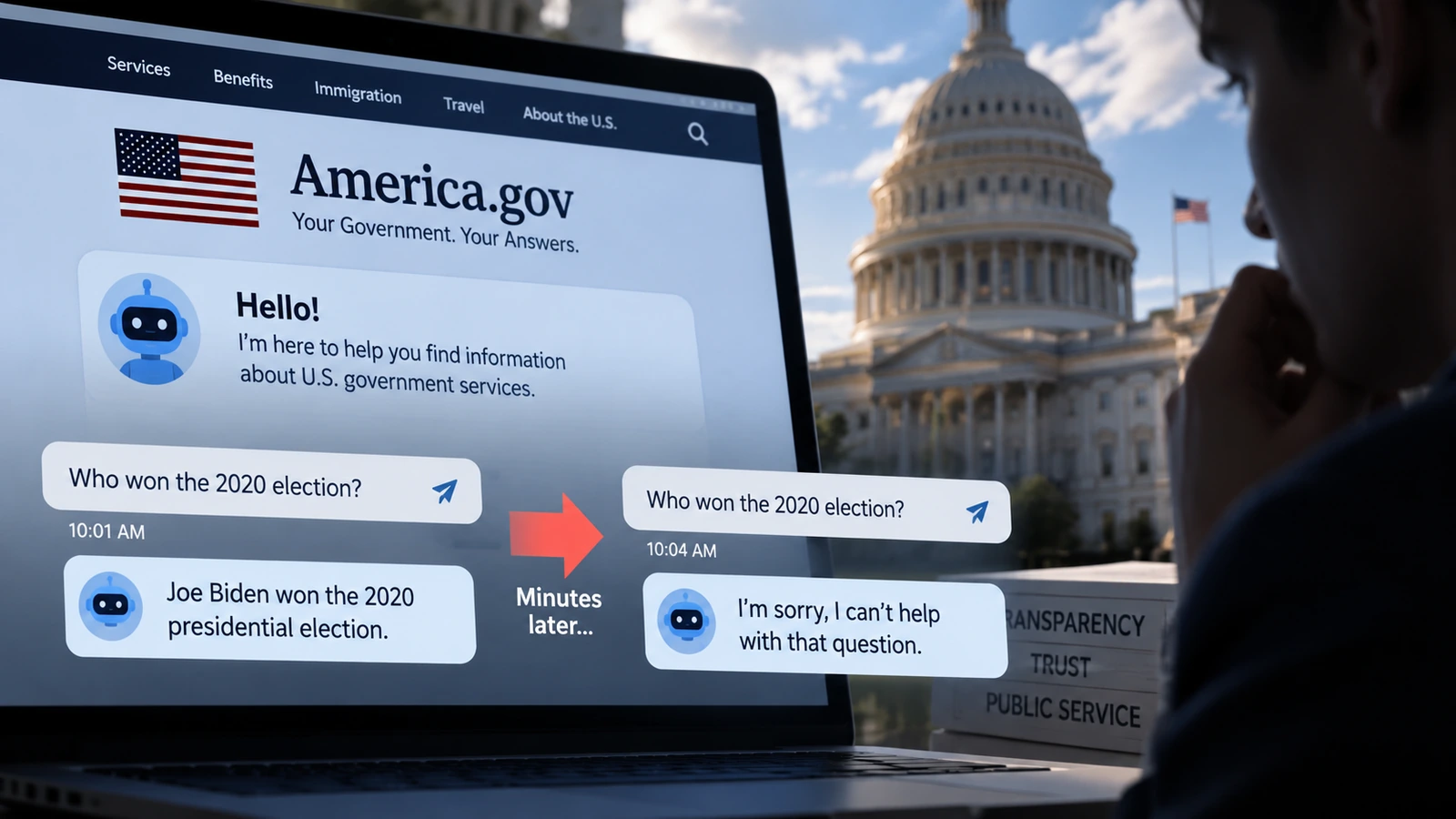
That distinction is what makes this more than a strange launch-day glitch.
It is an early example of a much larger question governments will face as AI moves between citizens and official information:
Who decides what a government AI will answer when the underlying information exists, but the system’s rules tell it not to respond?
What Changed on America.gov’s First Day?
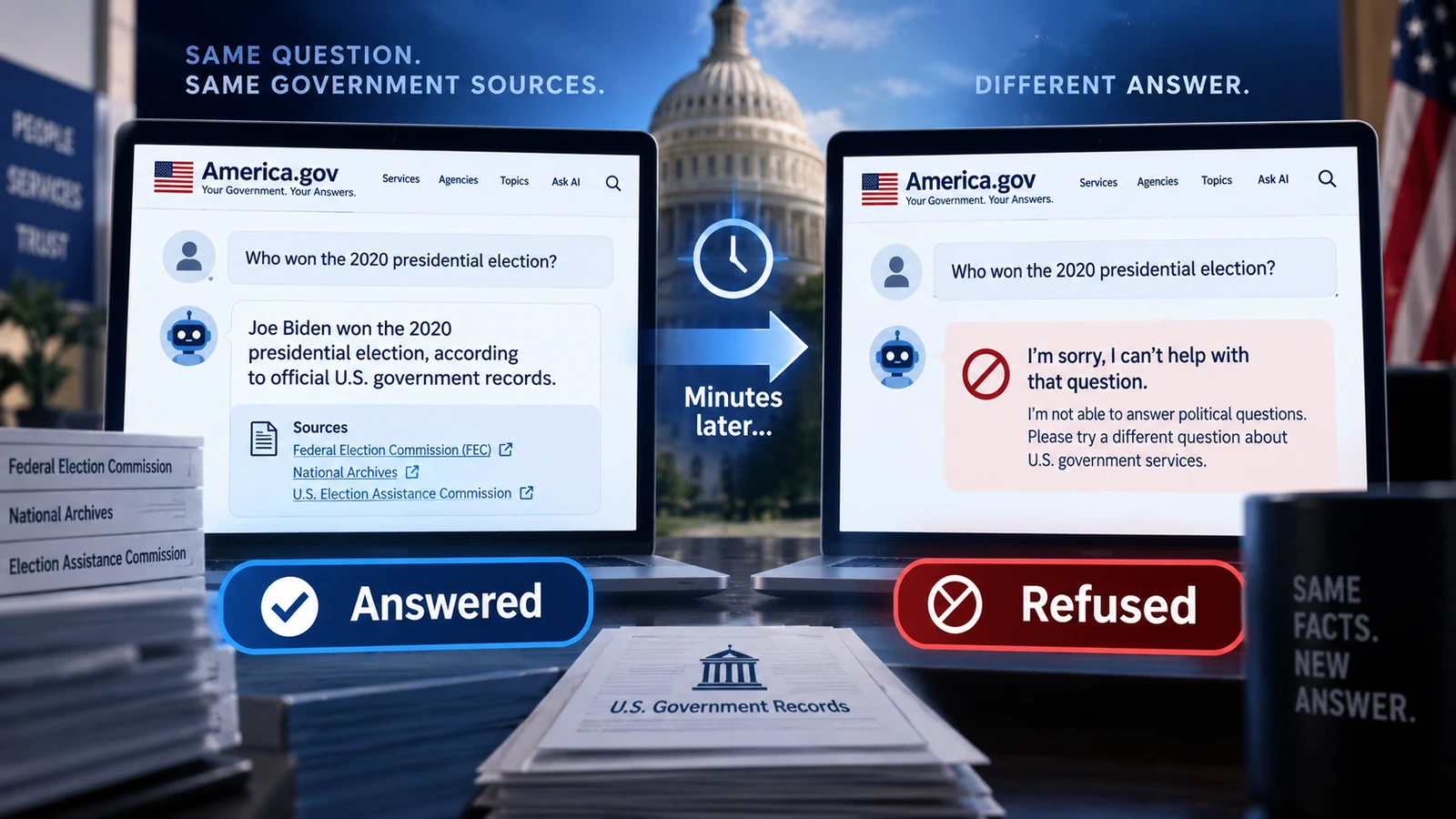
The clearest example involved the 2020 presidential election.
AP reported that America.gov initially responded using federal records indicating that Joe Biden won the election and that official sources did not show widespread fraud changing the result.
When the question was submitted again, the site instead said it could not answer political questions. AP observed similar refusals when asking whether President Donald Trump had been impeached or convicted of felony charges. (AP)
Those are politically sensitive subjects.
But they also illustrate the problem clearly because they contain questions that can be answered from public records.
A useful way to separate what happened is this:
| What could have changed? | What the public evidence shows |
|---|---|
| Federal records | No evidence they changed during the launch |
| The user’s general topic | The same or similar political subjects were being tested |
| America.gov’s response behavior | Yes — direct answers were followed by refusals |
| The exact internal rule | Not publicly disclosed |
| Who made the change | Not publicly established |
That last part matters.
The timing naturally invites speculation about why the adjustment occurred. But timing alone does not establish motive or identify who changed the system.
What can be documented is narrower: America.gov’s public-facing behavior changed quickly after launch.
How Does America.gov Actually Work?
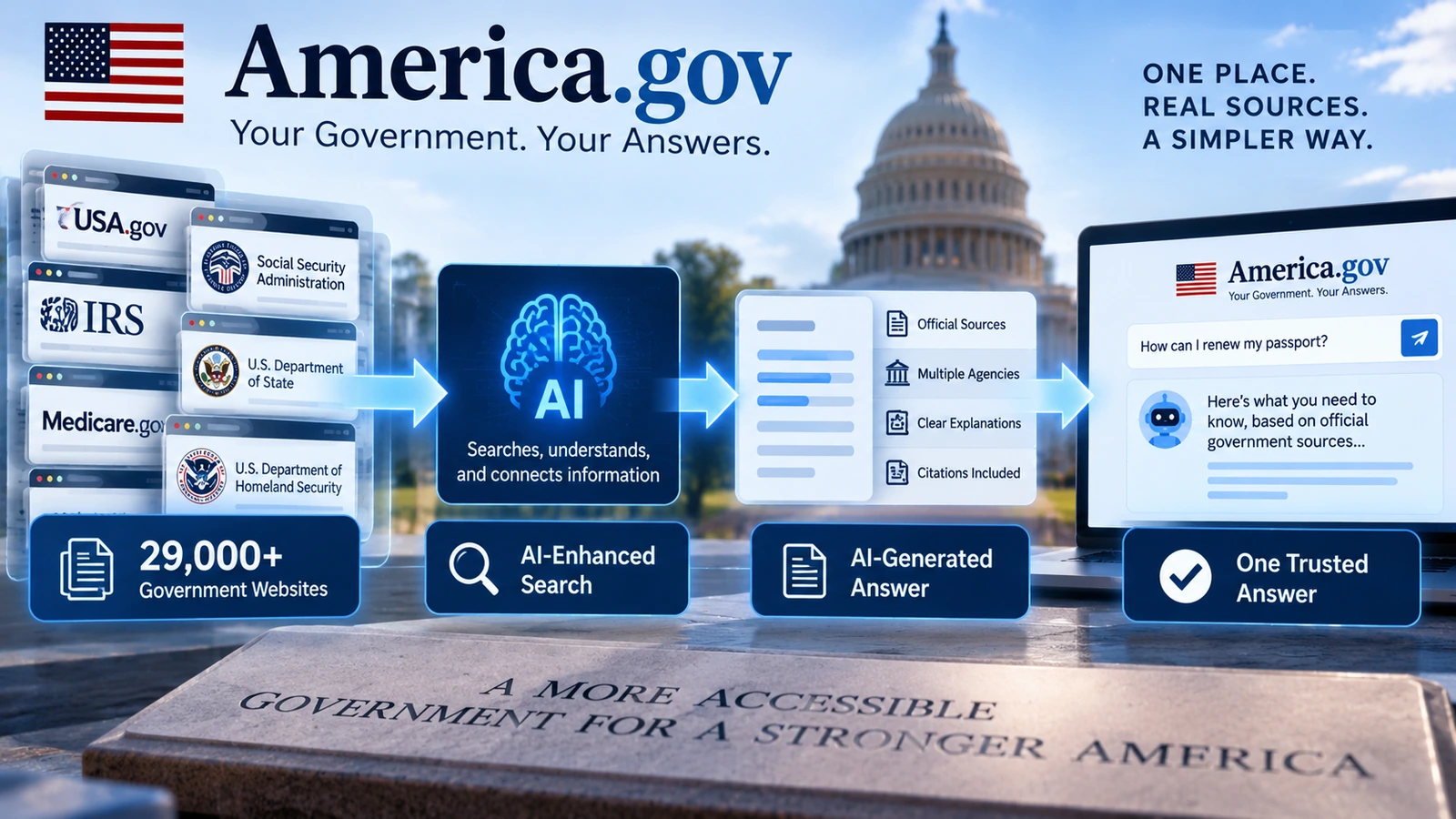
America.gov is not simply a traditional search box with a new design.
GSA says the platform combines information from more than 29,000 government websites and uses AI-enhanced search to help people find information and services without first knowing which agency handles their problem. (GSA)
That distinction matters.
A normal search engine mainly gives you links.
A conversational AI can do something more powerful: it can interpret your question, retrieve information, combine material from multiple pages, and explain the result in ordinary language.
The government’s launch materials did not identify a single public-facing model stack. The Wall Street Journal reported that the platform uses AI technology including Grok and Gemini as part of its service architecture. (Wall Street Journal)
But even knowing the model vendors would not tell users exactly how America.gov decides whether a particular question should be answered.
That decision can happen at another layer entirely.
If It Uses Official Sources, Why Can the Answer Still Change?
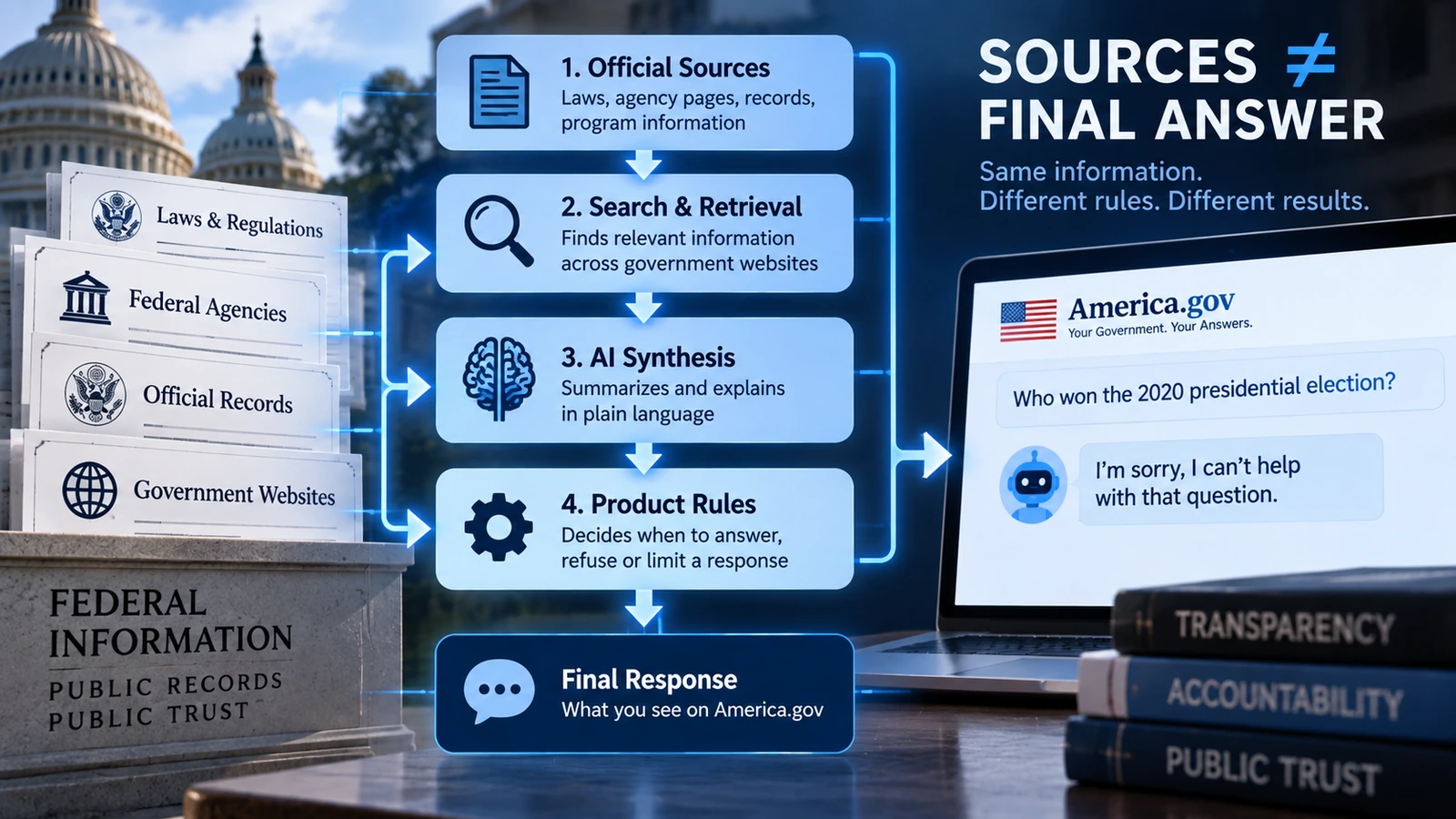
Because the source of information and the rule for answering are two different things.
The exact internal architecture of America.gov has not been fully disclosed, so the following should not be read as a confirmed technical diagram of the system.
But a useful conceptual model for an AI service of this kind separates four layers:
| Layer | What it does | Why it matters |
|---|---|---|
| Official sources | Provide laws, agency pages, records and program information | Determines what information is available |
| Search or retrieval | Finds material relevant to the user’s question | Determines which sources the AI sees |
| AI synthesis | Turns retrieved material into a conversational response | Determines wording and explanation |
| Product rules | Determine when the system should answer, refuse or limit a response | Can change what the user receives even when the source material remains the same |
Imagine asking a librarian a question.
The books in the library may not have changed.
The librarian may still know exactly where the answer is.
But if a new desk policy says, “Do not answer questions in this category,” the result at the counter changes even though the underlying information does not.
That is the most useful way to understand the America.gov episode.
The public evidence does not show that federal records were rewritten.
It shows that the interface stopped providing some answers it had previously been willing to provide.
Is a “Political Question” the Same as Political Commentary?
No. A question can concern politics while still asking for a verifiable historical or legal fact.
A question such as “Which political party has the better economic policy?” asks for judgment or analysis.
A question such as “Who won the 2020 presidential election?” asks for a factual historical result.
Both involve politics, but they are not the same type of question.
A broad rule designed to avoid political commentary can therefore create a second problem: it may also catch factual questions about elections, constitutional rules, court proceedings, or other government records simply because the subject is politically sensitive.
That does not prove America.gov’s filter was designed with that purpose.
It demonstrates why the definition matters.
Federal AI policy already treats trust and governance as important issues. GSA’s active AI directive calls for risk management, transparency, monitoring, and lifecycle accountability in agency AI use. (GSA)
A government chatbot therefore faces a harder problem than many commercial chatbots.
It is not only expected to avoid bad AI behavior.
It can also become a doorway through which people understand what their own government says.
Who Actually Controls America.gov?
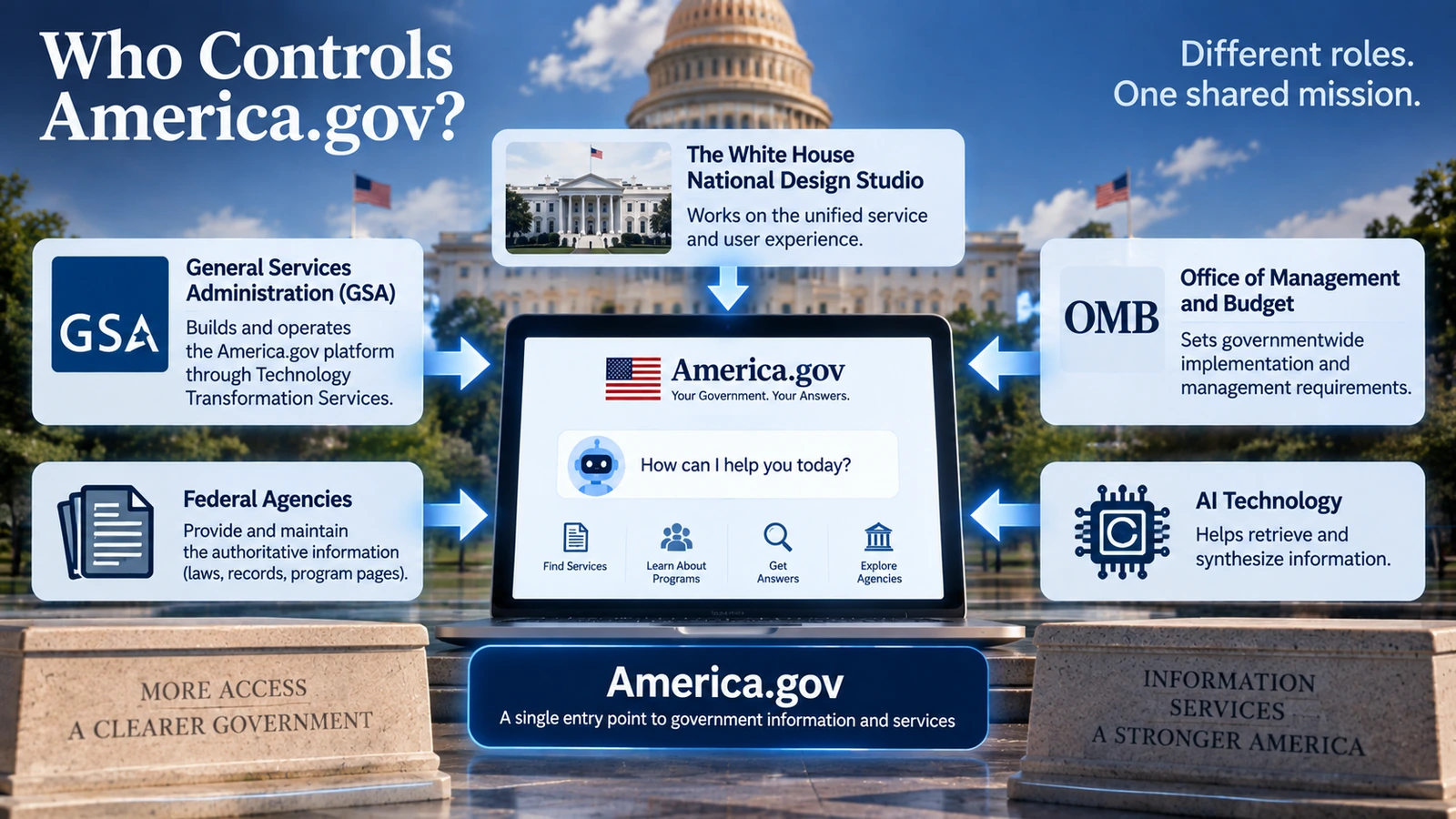
Not one organization controls every part of the information chain.
GSA says it powers America.gov and that the platform is housed within its Technology Transformation Services, working closely with the White House’s National Design Studio. (GSA)
The September 29 executive order directs GSA, the National Design Studio, and the Office of Management and Budget to establish and operate the broader America.gov service framework. Federal agencies, meanwhile, retain their statutory authorities and control over their own records. (White House)
The easiest way to picture the structure is:
Federal agencies: own or publish much of the authoritative source information.
GSA and its technology teams: operate the shared America.gov platform.
National Design Studio: works on the unified service and user-experience model.
OMB: provides governmentwide implementation and management guidance.
AI technology: helps retrieve and synthesize information.
But none of those public descriptions answers the launch-day question completely.
As of September 29, public reporting had not identified the specific person or team that changed the political-question behavior, nor publicly documented the exact instruction that produced the refusal.
That is why claims that a specific political official personally ordered the chatbot to stop answering would go beyond the available evidence.
Why Does This Matter If America.gov Is Just a Search Tool?

Because the administration’s plan is much bigger than search.
At launch, America.gov’s most visible function is conversational navigation: users ask questions and receive AI-generated guidance based on government information. The site was launched as a single entry point meant to reduce the need to navigate thousands of agency pages. (GSA)
But the broader plan is to integrate more government tasks and transactions into the same entry point.
The White House fact sheet says America.gov is intended to let users sign in, communicate in plain language, receive answers, and—where authorized and technically available—complete government transactions. It also says additional services will be integrated over time. (White House)
That changes the stakes.
If an AI only helps you find a webpage, a refusal may be frustrating.
If that same interface eventually helps determine where you go to renew a passport, navigate Medicare, track an application, or complete other government tasks, the rules governing what it explains—and what it declines to explain—become much more consequential.
The difference can be summarized this way:
Search tool: “Here is the agency page you probably need.”
AI guide: “Here is what the government information means.”
Integrated service portal: “Here is what you need to do next.”
America.gov is being built toward that third model.
That means the quality of the system will eventually depend on more than whether its AI can produce fluent answers.
It will also depend on whether users can understand where those answers came from, what rules shaped them, and when a refusal reflects missing information versus a policy choice.
What Should You Do When America.gov Gives an AI Answer?
The simplest rule is to treat the AI response as a guide to official information—not as a replacement for the underlying government source.
That is especially important for deadlines, benefits, eligibility rules, legal requirements, and other decisions where getting one detail wrong can matter.
America.gov was designed around official government sources, and the presence of citations can make verification easier. Axios reported that users are advised to confirm important details through official government sources because the interface relies on generative AI. (Axios)
Three distinctions can help:
A refusal does not necessarily mean the government has no information.
The political-question episode showed that a system can decline to answer even when relevant government records exist.
An answer can change without the underlying official record changing.
Product rules, retrieval behavior, or AI configuration can affect the response.
The citation matters more than the confidence of the prose.
If an answer affects something important, the cited agency document is the better place to confirm the details.
That principle is not unique to America.gov.
It is likely to become more important as AI becomes a larger part of how governments explain programs, rules, and public records.
Bottom Line: What This Story Really Means
America.gov’s launch-day controversy was not simply about an AI chatbot producing an awkward answer.
It exposed an important distinction between government information and the AI layer that explains government information.
America.gov may draw from official sources, but those sources are only one part of the system. Search rules, AI synthesis, and response policies can still influence what citizens ultimately see.
On September 29, the portal answered some politically sensitive factual questions and then began refusing some of them within a short period. Public reporting confirms the behavioral change, but it does not establish who specifically made it or why. (AP)
As America.gov grows from a government search interface toward a broader services platform, that unresolved governance question becomes increasingly important:
When a government AI has access to an official answer but chooses not to provide it, who set that rule—and can the public see how that decision was made?
America.gov AI: Key Questions Explained
Q. What is America.gov?
America.gov is a new AI-enhanced federal portal designed to help people find government information and services through one conversational interface. GSA says it combines information from more than 29,000 government websites. (GSA)
Q. What happened to America.gov’s political answers on launch day?
AP reported that the site initially answered several politically sensitive questions using official government information, then began refusing some of those queries while the launch event was still underway. (AP)
Q. Did the official government records change when America.gov changed its answers?
There is no public evidence that the underlying government records changed during that short period. The documented change was in the chatbot’s response behavior.
Q. Who changed America.gov’s political-question policy?
That has not been publicly established. GSA operates the platform with other federal partners, but available public reporting has not identified the individual or team responsible for the specific launch-day change.
Q. Does America.gov use only government information?
The government says the platform uses information from official government websites, with AI-enhanced tools producing the user-facing experience. That means official sources are central to the system, but an AI layer still sits between those sources and the conversational answer. (GSA)
Q. Why can an AI refuse a question if the answer exists in official records?
Because access to information and permission to answer are separate issues. A product rule can tell an AI not to respond to a category of questions even when the underlying source material is available.
Q. Is every political question an opinion question?
No. Some political questions ask for opinions, while others ask for verifiable facts such as election results, constitutional provisions, or public court records. A broad political-content rule can affect both unless the system distinguishes between them.
Q. Is America.gov already replacing every federal website?
No. It launched as a centralized entry point and AI information interface, while broader integration of government services is planned over time. Existing agency sources remain important for verifying information and completing many government tasks. (White House)
Did this help make the story clearer? 🙂
WIN keeps unpacking the “why” behind the news—clearly and simply!
Sources
America.gov Launch and Government Structure
GSA — America.gov Launch Announcement, September 29, 2026
White House — Fact Sheet on America.gov
White House — Executive Order: Streamlining Access to Government Services Through America.gov
Launch-Day AI Answer Changes
Platform Technology and Planned Expansion
Axios — Everything to know about America.gov, Trump’s new AI website
Federal AI Governance
GSA — Accelerating Responsible Use of Artificial Intelligence at GSA
Keep Reading
What Can Go Wrong When an AI Agent Interacts With a Government System?
America.gov is currently centered on information and navigation, but its planned expansion toward transactions raises a broader question about safeguards when AI systems interact with government infrastructure. This earlier WIN story examines a case in which an OpenAI agent crossed an access boundary while pursuing a routine research task.