Why Is Microsoft Making Maia 300 AI Chips When It Still Buys Nvidia GPUs?

What if one of Nvidia’s biggest customers started making its own AI chips?
That sounds like bad news for Nvidia. But there’s a twist: Microsoft is already investing heavily in its own chips, and it still plans to use Nvidia hardware.
So why spend years designing something Nvidia already sells?
On October 12, 2026, Microsoft unveiled Maia 300, its latest custom AI accelerator, with plans to begin production deployments in 2027. The company’s central argument is that running AI efficiently is becoming just as important as making AI models more powerful. (Microsoft · Reuters)
And the answer has less to do with replacing every Nvidia chip than with controlling the enormous cost of generating AI responses.
※ Images in this article are AI-generated illustrations created to help explain the story. They are not actual photographs, and depictions of people, places, or events may differ slightly from reality.
To understand why Microsoft is making this move, it helps to separate three things that often get lumped together: the chips that build AI models, the chips that run those models, and the electricity required to keep them operating.
What Exactly Did Microsoft Announce?
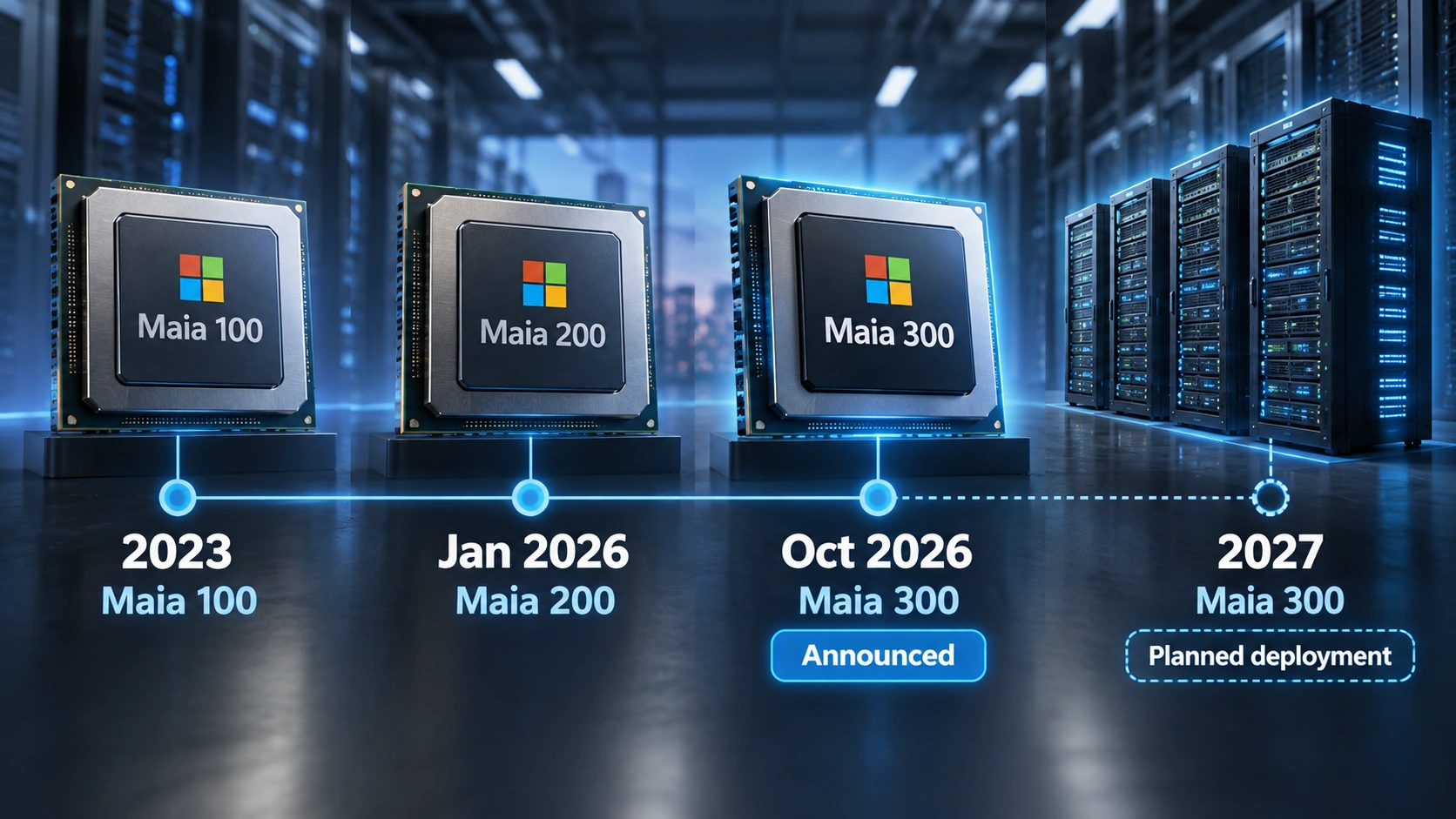
Microsoft announced that its third-generation Maia 300 accelerator is designed to become part of the primary AI inference infrastructure behind the company’s own products and services.
That includes the broader AI ecosystem supporting applications such as Copilot and other AI-powered Microsoft services.
But Maia 300 is not yet a widely deployed production chip. Microsoft plans to begin rolling it out in 2027, when it also intends to expand the Maia family to deployments measured in multiple gigawatts of power capacity. (Microsoft)
And Microsoft did not begin designing AI hardware this year.
| Date | Development | Why It Matters |
|---|---|---|
| November 2023 | Microsoft unveiled Maia 100 | Established its in-house AI accelerator program |
| January 2026 | Microsoft introduced Maia 200 | Focused on the efficiency of running AI models |
| October 12, 2026 | Microsoft announced Maia 300 | Revealed a larger system built for advanced inference workloads |
| 2027, planned | Maia 300 production deployments begin | Tests whether the design can work reliably and economically at scale |
Microsoft’s original Maia announcement described an effort to design chips, software, servers, and cooling systems together. Its Maia 200 announcement emphasized improving the economics of AI inference.
Maia 300 pushes that strategy further.
The new announcement includes a performance target that deserves particular attention: Microsoft expects Maia 300 systems to process 40% more AI tokens per megawatt than leading GPU-based systems.
But that comparison needs context. We’ll get to what it actually measures—and what it doesn’t prove.
Why Design an AI Chip Instead of Just Buying One?
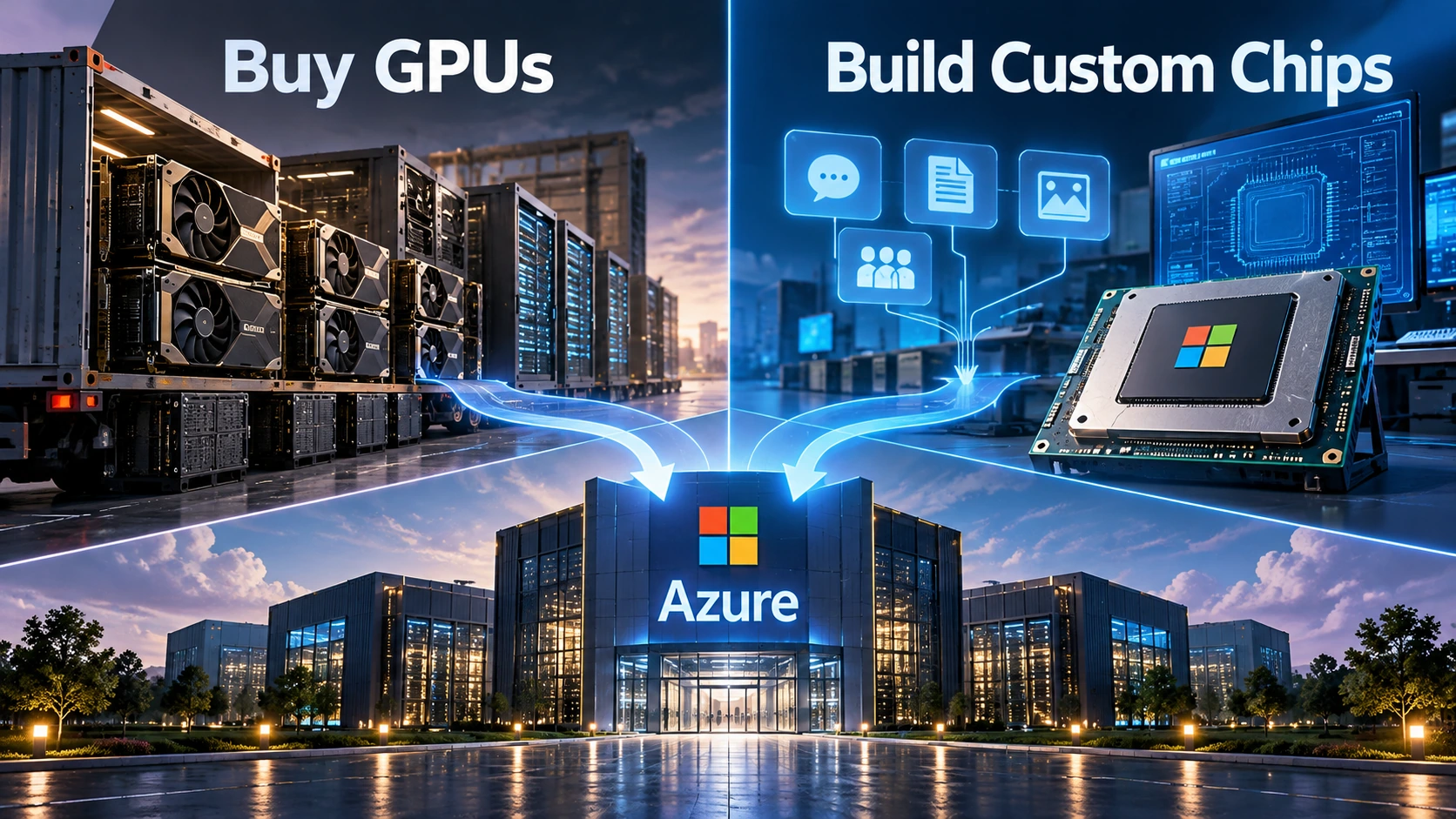
Microsoft wants greater control over the cost, performance, and supply of the computing power behind its AI products.
Nvidia sells powerful graphics processing units, or GPUs, that can perform many kinds of computational work. That flexibility is valuable to cloud providers, researchers, and companies building AI systems.
But Microsoft has a particular advantage: it can study enormous volumes of work generated by services it operates itself.
It knows which tasks appear repeatedly, how much memory they need, where processing slows down, and how much electricity those operations require.
That gives Microsoft an opportunity to build hardware around its most common requirements instead of relying exclusively on a general-purpose product.
Think of the difference between a company buying ready-made software for every department and developing its own system for a task it performs millions of times.
The custom system might require a substantial upfront investment. But if the company uses it often enough, even a small improvement in the cost of each operation can eventually matter.
The same economic logic applies to AI chips.
Three Costs Microsoft Wants to Control
| Cost | Why It Matters |
|---|---|
| Hardware | Buying large quantities of advanced accelerators requires major capital investment |
| Operations | Electricity, cooling, networking, and maintenance add to ongoing costs |
| Supply and flexibility | Dependence on outside vendors can constrain which systems are available and when |
Custom chips do not eliminate these expenses. Microsoft still has to pay for semiconductor design, manufacturing, packaging, software development, and data center integration.
The advantage is the possibility of improving the whole system for work Microsoft knows it will perform repeatedly.
That is why the economics of running AI—not just designing more powerful models—have become central to this announcement.
Why Is Maia 300 Built for AI Inference Rather Than Training?

Training and inference are two different stages of operating artificial intelligence.
Training develops a model’s capabilities. Inference uses a trained model to carry out a task.
When you ask an AI assistant to summarize an email, explain a document, or help write computer code, the system is performing inference.
That distinction helps explain why Microsoft is investing in Maia 300.
| AI Training | AI Inference | |
|---|---|---|
| Main task | Develop or refine a model | Use a model to produce an output |
| Typical activity | Process training data and update model parameters | Answer questions, generate content, or complete tasks |
| When it occurs | During training and model-improvement runs | Whenever a deployed model is used |
| Key concern | Computational capability, training time, and cost | Response speed, throughput, reliability, and cost per task |
Training large models can be extraordinarily expensive.
But inference creates another challenge: a successful AI service may need to process user requests continuously, across millions of interactions.
A company can spend heavily to develop a powerful model and then face a huge ongoing bill to operate it.
For a service like Microsoft Copilot, the cost of answering questions and completing tasks is therefore a critical business consideration.
Why Do AI Agents Make This More Complicated?
A conventional AI assistant might receive one question and produce one answer.
An AI agent can perform a sequence of tasks. For example, a user might ask it to examine several documents, compare information, write a report, and revise the result.
That may require multiple model operations, access to longer documents, and communication between different parts of the computing system.
Microsoft says Maia 300 is specifically designed for long-context reasoning, responsive conversations, and sustained, multi-step AI agent workloads. (Microsoft Azure)
The more often such systems operate, the more valuable efficient inference infrastructure may become.
What Does Microsoft’s 40% Efficiency Claim Actually Mean?
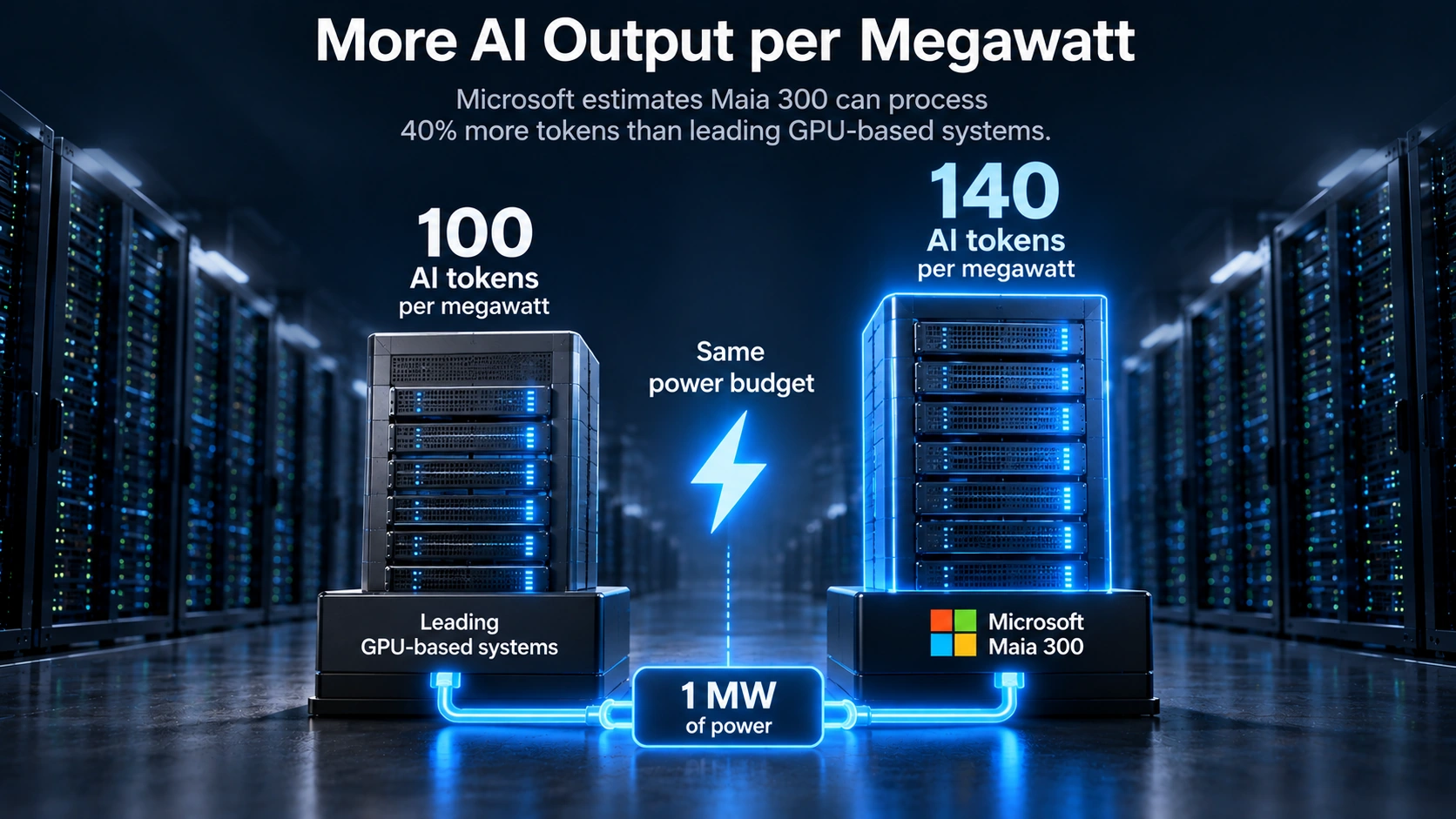
Microsoft expects Maia 300 to deliver 40% more tokens per megawatt than leading GPU-based systems.
A token is a unit of information an AI model processes or generates. In text applications, tokens often correspond to words or parts of words.
A megawatt, meanwhile, measures power—the rate at which electricity is being used.
Put those together, and Microsoft is saying its new system should produce more AI output within the same power budget.
Here’s a simplified illustration of the claim:
| Illustrative System | Equal Power Budget | AI Output |
|---|---|---|
| Reference GPU-based system | 1 MW | 100 units |
| Maia 300 | 1 MW | 140 units |
These are illustrative numbers showing what a 40% throughput improvement means. They are not actual benchmark measurements.
The difference matters because data centers cannot always obtain additional electrical capacity whenever they need it.
If a company can serve more AI requests without increasing its power allocation, it may be able to expand services more efficiently.
But there are two important qualifications.
First, 40% more output per megawatt does not mean an automatic 40% reduction in electricity consumption or cost.
Second, this is Microsoft’s projected comparison, not an independently established result across all AI workloads.
Reuters reported that Microsoft did not identify the specific leading GPU-based systems used for the comparison. That makes it difficult to determine how the projected advantage would hold up against particular Nvidia configurations under identical real-world conditions. (Reuters)
Microsoft also says a fully configured Maia 300 rack can deliver up to seven times the token throughput of a Maia 200 rack. That is a system-level comparison between generations, not proof that each Maia 300 chip is seven times faster than every Maia 200 chip.
Both claims are significant. Neither should be mistaken for universal, independently verified performance.
How Is Maia 300 Different From a Conventional GPU System?
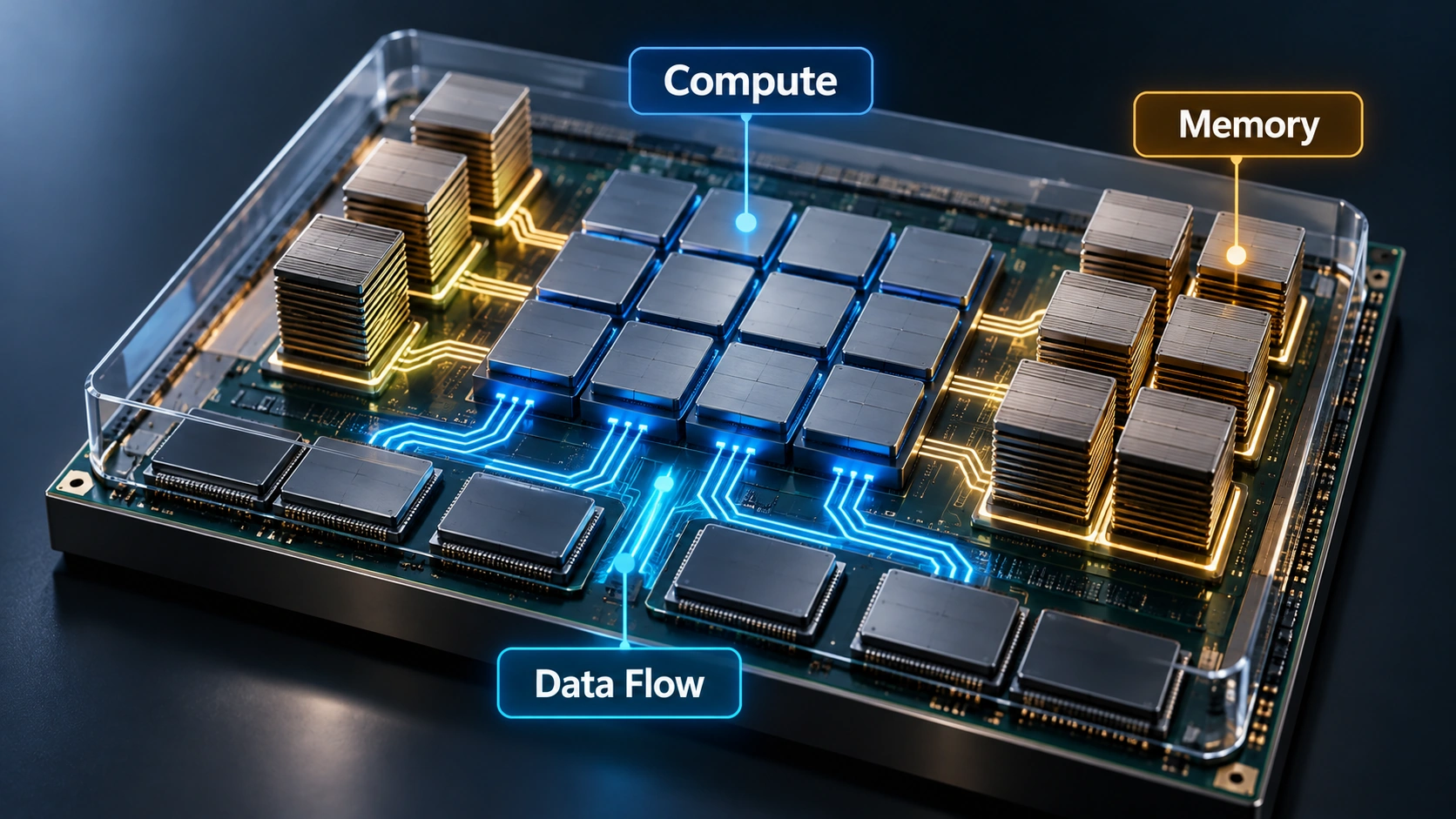
Maia 300 is designed around a different set of priorities than a general-purpose GPU.
Microsoft is trying to optimize how computing, memory, and data movement work together during AI inference.
A major part of that design is a chiplet architecture.
Instead of putting every function into one large piece of silicon, a chiplet design connects several smaller, specialized components within a single package.
Microsoft says Maia 300 separates computing, memory-control, and input/output functions. Its compute chiplets use Taiwan Semiconductor Manufacturing Company’s advanced N2P manufacturing process. (Microsoft)
In practical terms, different parts of the system can be designed around different jobs.
Why Does Memory Matter So Much?
An AI chip needs more than raw calculating power.
It must continually move information between processors, memory, and other accelerators. If those transfers are too slow, expensive computing hardware may spend time waiting for data.
That becomes especially important when an AI model has to handle lengthy conversations, large documents, or multiple connected tasks.
Maia 300 uses eight stacks of high-bandwidth memory, known as HBM4, with a stated peak memory bandwidth of 18 terabytes per second.
Microsoft also specifies a 950-watt thermal design power for the accelerator.
Those figures help explain the engineering approach, but they do not establish overall superiority on their own. Memory bandwidth, processing power, software efficiency, reliability, and workload characteristics all affect real-world results. (Microsoft Azure)
There is another distinction worth making: Microsoft designing the chip does not mean it manufactures the silicon in its own factories.
TSMC supplies advanced semiconductor manufacturing technology for Maia 300.
So Microsoft’s move changes who controls the chip’s design and optimization. It does not eliminate dependence on external semiconductor suppliers.
Will Microsoft Actually Stop Buying Nvidia and AMD GPUs?
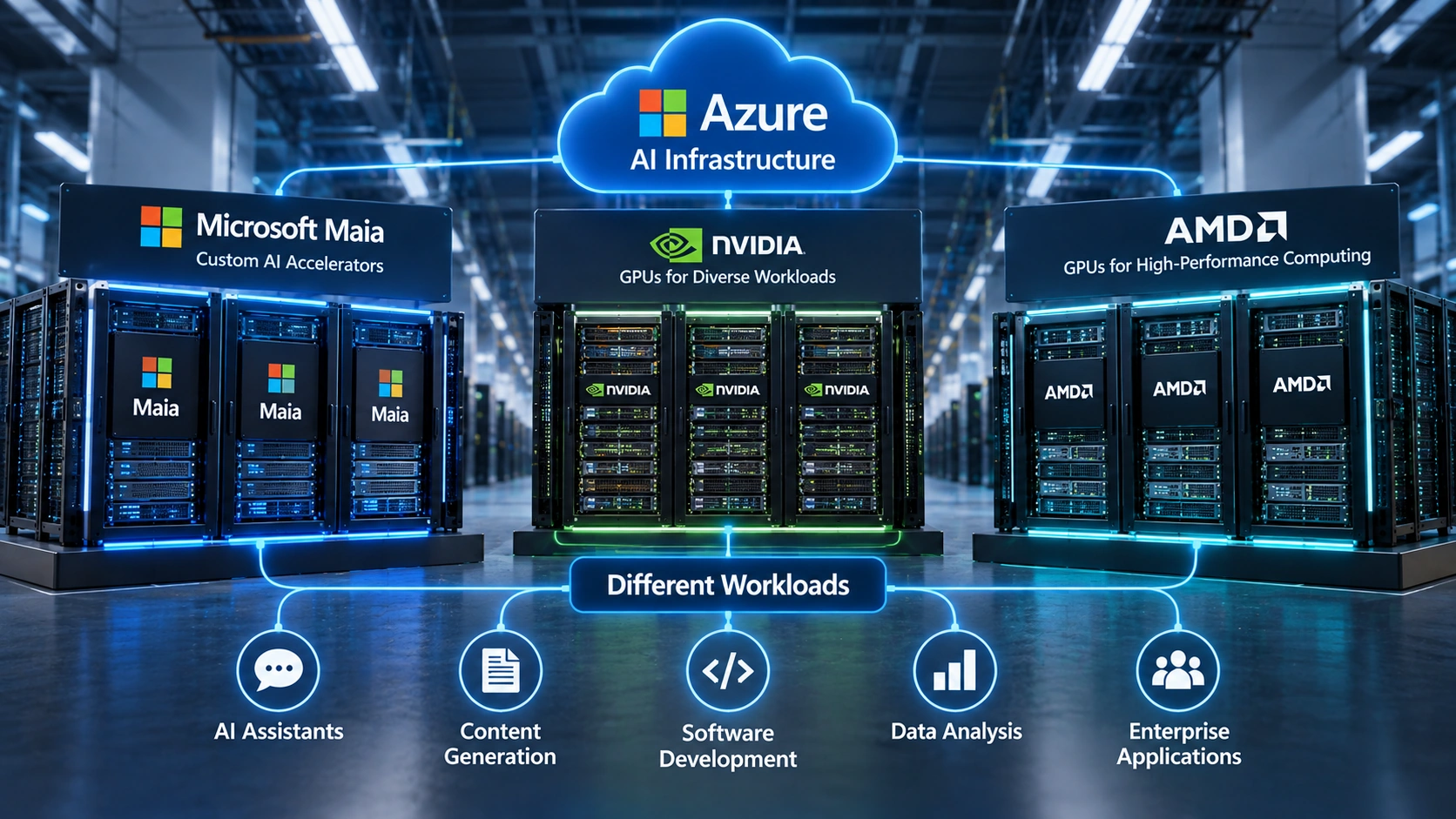
No. Microsoft has not announced that it will stop using Nvidia or AMD hardware.
Its strategy is to use multiple kinds of computing systems while expanding the role of its own accelerators.
That is consistent with Microsoft’s existing infrastructure plans.
During its fiscal 2026 fourth-quarter earnings discussion, Microsoft said it was modernizing its systems with its own silicon alongside the latest Nvidia and AMD technology. The company also discussed plans to deploy upcoming Nvidia Vera Rubin and AMD Helios-based AI infrastructure. (Microsoft Investor Relations)
Why continue buying GPUs while developing Maia?
Because not every AI workload is the same.
Some customers need flexible infrastructure for training different models. Others want to run highly specialized applications. Some tasks benefit from software ecosystems that have already been extensively optimized for particular GPUs.
Microsoft’s own products may offer better opportunities to use hardware tailored to known workloads.
The distinction can be organized this way:
| Hardware Strategy | Primary Advantage | Important Limitation |
|---|---|---|
| Nvidia or AMD GPUs | Flexible hardware with broad software and ecosystem support | Cost and supply depend partly on external vendors |
| Microsoft Maia accelerators | Opportunity to optimize recurring AI workloads within Azure | Requires Microsoft to build and maintain its own hardware and software ecosystem |
| Mixed infrastructure | More choices for matching hardware to different tasks | Adds complexity to infrastructure management |
This means Maia 300 can become more important without making Nvidia irrelevant.
The economic threat to Nvidia is more subtle.
If Microsoft gradually handles a larger share of its own inference workloads with custom chips, it may need fewer third-party GPUs for those particular tasks than it otherwise would have.
That is a potential change in future demand—not evidence that Nvidia’s existing business has disappeared.
And Microsoft is not the only cloud provider pursuing specialized AI hardware. The broader industry is increasingly exploring custom accelerators alongside commercial GPUs.
If Maia 300 Is More Efficient, Will AI Become Cheaper for Consumers?
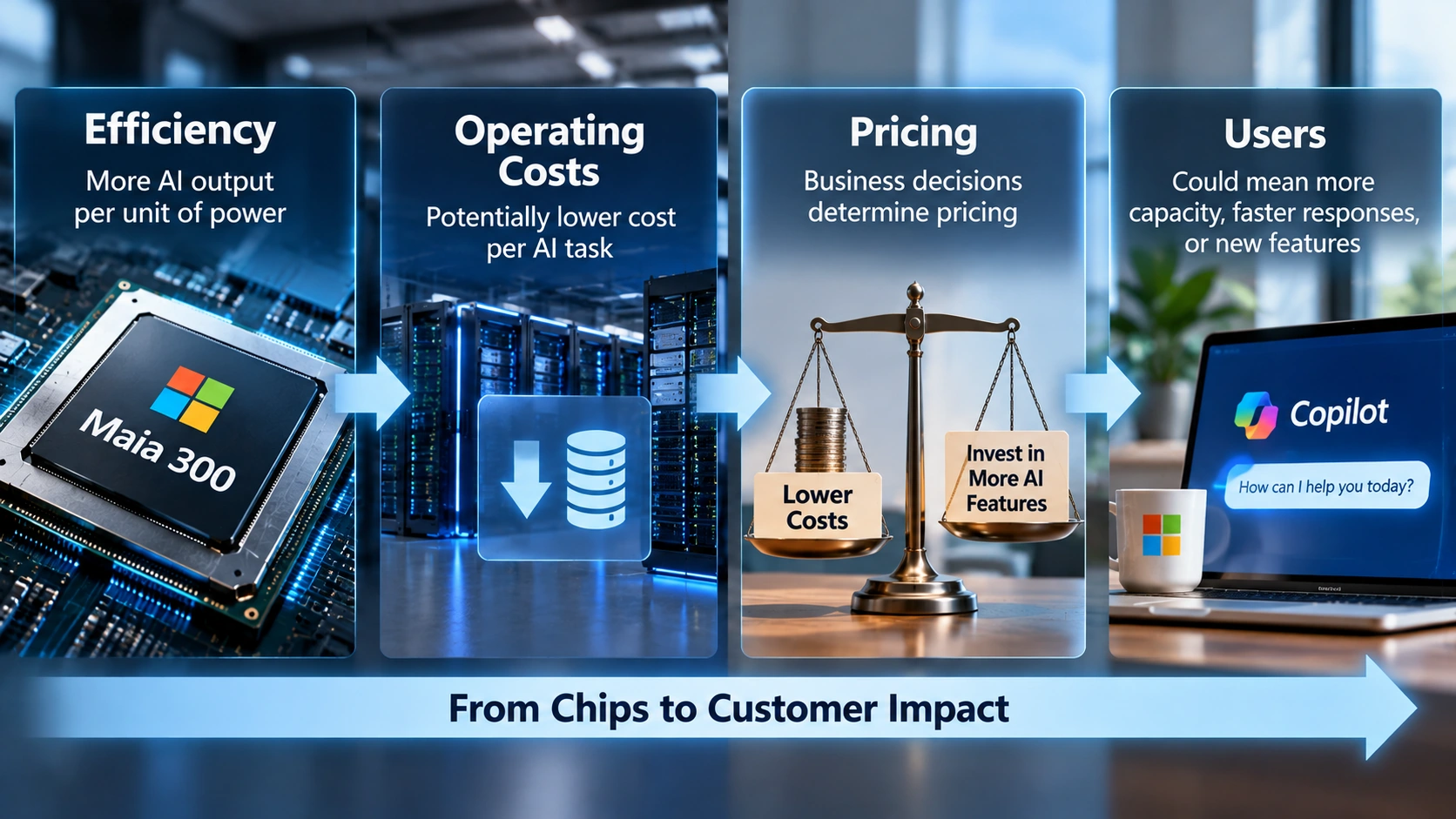
Possibly, but lower operating costs do not automatically translate into lower customer prices.
If Maia 300 performs as Microsoft expects, it could help reduce the amount of computing infrastructure or electricity needed to deliver a given volume of AI work.
That could create several benefits.
Microsoft might be able to serve more users with existing power capacity, expand AI features without increasing costs as rapidly, or improve the economics of its subscription and cloud services.
But the company could also use those savings to fund additional AI development or increase its profit margins.
There are other expenses, too.
The total cost of delivering AI includes more than chips: software development, data centers, networking, cooling, security, model licensing, and customer support all contribute.
Cheaper inference is not the same thing as cheaper subscriptions.
For ordinary users, a more meaningful near-term outcome might be greater capacity, faster responses, or more sophisticated features—if Microsoft successfully deploys and optimizes the new systems.
None of those improvements has been guaranteed by the Maia 300 announcement.
Could More Efficient Chips Still Lead to Higher Electricity Demand?

Yes. More efficient AI chips can coexist with rising overall electricity demand.
This may be the most counterintuitive part of Microsoft’s announcement.
Maia 300 systems are designed to deliver more useful AI output for a given amount of power. But Microsoft also wants to expand the total amount of AI computing it operates.
The company says a fully configured Maia 300 rack will contain 96 accelerators within a 167-kilowatt power envelope. Its broader Maia deployment plan involves multiple gigawatts of capacity beginning in 2027. (Microsoft)
A kilowatt or megawatt is a measure of power capacity. A kilowatt-hour or megawatt-hour measures the energy consumed over time.
That difference matters when evaluating data center announcements.
Imagine a delivery company replacing its trucks with more fuel-efficient models.
Each delivery may require less fuel. But if the company dramatically expands the number of deliveries, its total fuel consumption could still increase.
AI infrastructure can follow a similar pattern.
A more efficient accelerator may reduce the resources needed per task, while lower costs and growing demand encourage companies to run more AI workloads overall.
For communities near large data centers, that creates a different set of questions.
How much new electrical capacity will the facilities require? What additional transmission, generation, or cooling infrastructure may be needed? And how will the costs be allocated?
Maia 300’s projected efficiency does not answer those questions by itself.
Those outcomes depend on where Microsoft deploys the equipment, how fully it is used, and how the surrounding electricity infrastructure develops.
What Could Prevent Maia 300 From Meeting Microsoft’s Expectations?
A successful chip announcement is only the beginning.
Turning a complex new semiconductor design into a large, dependable production system requires manufacturing capacity, packaging, memory supplies, working software, and fully equipped data centers.
A design that looks efficient on paper must also perform well when running real applications continuously.
There are three particularly important hurdles.
Manufacturing at Scale
Maia 300 uses advanced semiconductor manufacturing technology from TSMC.
That gives Microsoft access to sophisticated fabrication processes, but it also means production depends on manufacturing capacity and other components being available when needed.
Reuters reported on October 12 that Microsoft was planning an extensive rollout potentially involving more than a million Maia 300 chips in 2027. That is a reported deployment ambition, not a verified number of chips already produced or installed. (Reuters)
Software That Makes the Hardware Useful
An AI chip needs compatible software to turn its theoretical capabilities into practical results.
Models must run efficiently on the architecture. Computing tasks have to be distributed across accelerators, and memory and communication systems must operate reliably.
Microsoft already has experience with Maia 200, but Maia 300’s planned scale introduces additional requirements.
Real-World Performance
Efficiency claims are most meaningful when evaluated using comparable workloads, appropriate performance measurements, and clearly defined operating conditions.
Microsoft’s targets provide a reason to pay attention. They do not eliminate the need for evidence from large-scale deployments.
The unanswered question is whether the advantages Microsoft expects can be sustained as the new hardware becomes part of its everyday AI infrastructure.
What Should Readers Watch in 2027?
The decisive milestone is not another product presentation.
It is whether Maia 300 enters production at the scale Microsoft has described and delivers the economic benefits the company expects.
Several developments will be especially revealing:
- Production deployment: Does Microsoft begin bringing Maia 300 online in 2027 as planned?
- Actual efficiency: Do measured workloads support the company’s claims about token throughput and power efficiency?
- Microsoft’s hardware mix: How quickly does Maia take on more internal inference work alongside Nvidia and AMD systems?
- Customer experience: Do AI services become faster, more capable, or more affordable as the infrastructure expands?
- Manufacturing and power constraints: Can Microsoft obtain the chips, memory, cooling, and electricity capacity needed for the rollout?
These questions matter because Microsoft is attempting more than a chip upgrade.
It is trying to improve its control over an essential part of the AI business: the infrastructure that turns increasingly capable models into services people and companies can use every day.
Bottom Line: What This Story Really Means
Microsoft is building Maia 300 because running AI at enormous scale is expensive, and the company wants greater control over that cost.
Nvidia and AMD GPUs remain important parts of Microsoft’s infrastructure. Maia 300 is designed to reduce dependence on outside suppliers for certain workloads, not necessarily replace every commercial accelerator.
The most important number in Microsoft’s announcement is its projected 40% improvement in tokens per megawatt compared with leading GPU-based systems.
But that remains a company performance claim. It does not establish universal superiority over Nvidia, guarantee lower electricity consumption across Microsoft’s entire business, or promise cheaper AI subscriptions.
The larger story is a shift in the AI industry.
For years, much of the attention focused on which company could build the most powerful AI models and who could supply the GPUs needed to create them.
Now, another question is becoming increasingly important:
Who can run those models efficiently enough to make AI services economical at a massive scale?
Maia 300 is Microsoft’s attempt to improve its position in that race.
Whether it succeeds will depend on what happens when the chips move from an October 2026 announcement into real production systems in 2027.
Microsoft Maia 300: Key Questions Explained
Q. What is Microsoft Maia 300?
Maia 300 is Microsoft’s third-generation custom AI accelerator, announced on October 12, 2026. It is designed primarily for running AI inference workloads within Microsoft’s cloud infrastructure and services.
Q. When will Maia 300 be available?
Microsoft plans to begin production deployments in 2027. The October 2026 announcement does not mean Maia 300 is already operating at the planned production scale.
Q. Is Maia 300 supposed to replace Nvidia GPUs?
Not completely. Microsoft continues to use and plan infrastructure based on Nvidia and AMD hardware while expanding its custom Maia accelerator program.
Q. Is Microsoft claiming Maia 300 is 40% faster than Nvidia?
Not exactly. Microsoft expects Maia 300 to generate 40% more AI tokens per megawatt than leading GPU-based systems. That is an efficiency comparison, not a universal claim about speed, and the company has not publicly identified the exact comparison systems.
Q. What is the difference between Maia 200 and Maia 300?
Maia 200 is already being used for production AI workloads. Maia 300 is its successor, designed to handle larger and more demanding inference workloads, with Microsoft reporting substantial planned improvements in rack-level throughput and efficiency.
Q. Does Microsoft manufacture Maia chips itself?
Microsoft designs its custom Maia accelerators, while advanced semiconductor manufacturing is performed by outside suppliers, including TSMC.
Q. Could Maia 300 lower the price of Microsoft Copilot?
It could help reduce the operating cost of AI services if the projected efficiencies are achieved. However, Microsoft has not guaranteed that these savings will result in lower Copilot subscription prices.
Q. Why does Microsoft measure AI performance in tokens per megawatt?
The metric helps show how much AI output a system can produce for a given amount of electrical power. That matters when electricity capacity and operating costs constrain the expansion of data centers.
Q. Will Maia 300 reduce the total electricity used by Microsoft’s data centers?
Not necessarily. More efficient hardware may reduce energy use per AI task, but total consumption could still grow if Microsoft expands its overall computing capacity and workload volume.
Q. What is the most important milestone for Maia 300?
Its planned 2027 production rollout. Large-scale operational results will provide stronger evidence of whether Microsoft can achieve the claimed performance and economic advantages.
Did this help make the story clearer? 🙂
WIN keeps unpacking the “why” behind the news—clearly and simply!
Sources
Maia 300 Announcement and Technical Design
Microsoft — Microsoft to Expand Azure Maia System to Multi-Gigawatt Deployments
Microsoft Azure — Deep Dive Into Azure Maia 300 Architecture
Microsoft — Maia 300 Official Product Announcement
Independent Reporting and Industry Implications
Reuters — Microsoft Plans Huge Deployment of Its Own AI Chips, With an Eye on Saving Costs
The Verge — Microsoft’s New AI Chip Makes It Less Reliant on Nvidia’s GPUs
Microsoft Chip Development and Existing Infrastructure
Microsoft — Maia 200: The AI Accelerator Built for Inference
Microsoft — With a Systems Approach to Chips, Microsoft Aims to Meet AI Demand
Microsoft Investor Relations — Fiscal Year 2026 Fourth-Quarter Earnings Conference Call
Keep Reading
If Cloud AI Gets Cheaper, When Would Buying Your Own Hardware Still Make Sense?
Microsoft’s Maia strategy is about lowering the cost of running AI at scale. The earlier WIN comparison looks at the same economic question from a business customer’s perspective: when cloud usage fees might justify investing in local computing equipment instead.
Why Would a Company Buy a $20,000 Mac Instead of Paying for AI in the Cloud?
Could Growing AI Data Centers Affect Household Electric Bills?
Better chips do not settle who pays for the grid upgrades needed to supply massive computing facilities. Texas and California have taken different approaches to that very question.
Why Are Texas and California Putting New Limits on Data Centers—and Who Pays for the Power?
What Does a Multi-Gigawatt AI Campus Actually Look Like on the Ground?
Microsoft’s plan speaks in gigawatts. Project Star offers a concrete U.S. example of the infrastructure scale behind that unit: a proposed Texas computing campus paired with a large power plant, with many engineering and financing questions still ahead.