
Why Would a Company Buy a $20,000 Mac Instead of Paying for AI in the Cloud?
Why would a company spend thousands—or, in a heavily configured system, roughly $20,000—on a Mac just to run AI?
Wouldn’t it be easier to send every request to OpenAI, Anthropic, Microsoft, or another cloud provider and pay only for what gets used?
For many companies, yes. But Apple is betting that the answer changes once AI becomes something a business runs all day, every day.
Apple’s new M6 Mac mini and M5 Max and M5 Ultra Mac Studio began reaching customers and stores on September 22. The unusual part is not simply that they are faster Macs. Apple is explicitly pitching them as machines that can keep substantial AI workloads on a desk instead of sending every prompt to a remote data center. (Apple · Reuters)

That creates a surprisingly simple business question: Is AI becoming more like software you rent, or equipment you buy?
What Actually Changed on September 22?
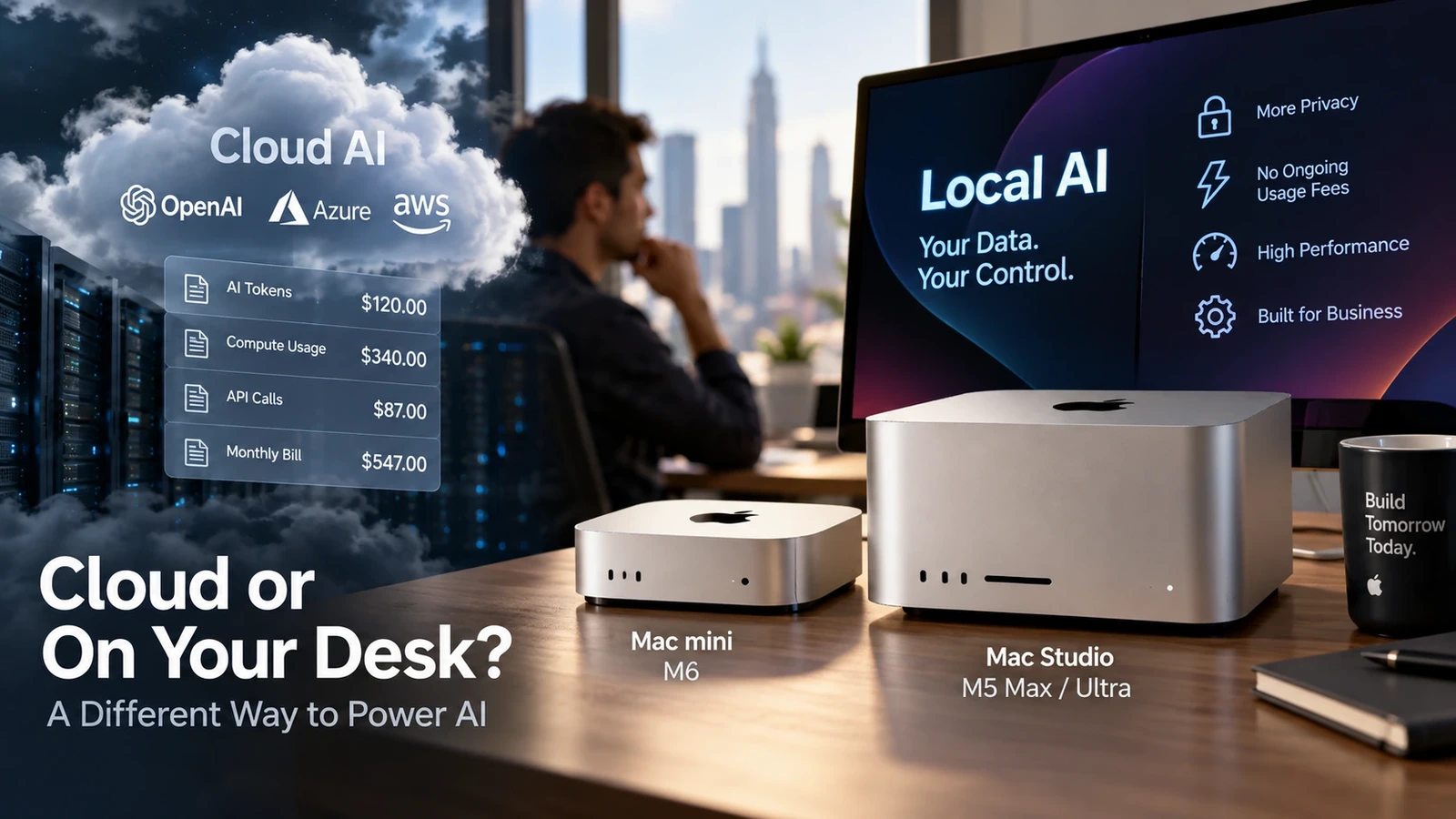
Apple announced the machines on August 25, but September 22 was the date they began arriving to customers and appearing in stores.
The entry point is much lower than the headline-grabbing $20,000 figure. The M6 Mac mini starts at $899, while the M5 Pro version starts at $1,699. Mac Studio starts at $2,499 with M5 Max and $5,499 with M5 Ultra. (Apple Mac mini · Apple Mac Studio)
The eye-catching prices come from heavily configured Mac Studio systems. Reuters reported that top-end configurations can reach roughly $20,000. Apple also says the M5 Ultra version can be configured with as much as 512GB of unified memory and 16TB of storage, although the 512GB memory option is not scheduled to arrive until late October. (Reuters · Apple)
| Desktop | Starting U.S. price | Why it matters for local AI |
|---|---|---|
| Mac mini with M6 | $899 | Entry-level local and agentic AI workloads |
| Mac mini with M5 Pro | $1,699 | More memory and heavier local models |
| Mac Studio with M5 Max | $2,499 | Higher-end AI development and inference |
| Mac Studio with M5 Ultra | $5,499 | Very large local models and clustered inference |
So the real story is not “Apple released a $20,000 computer.”
It is that Apple now has a ladder of machines designed to make local AI practical at several different scales.
What Does “Local AI” Actually Mean?
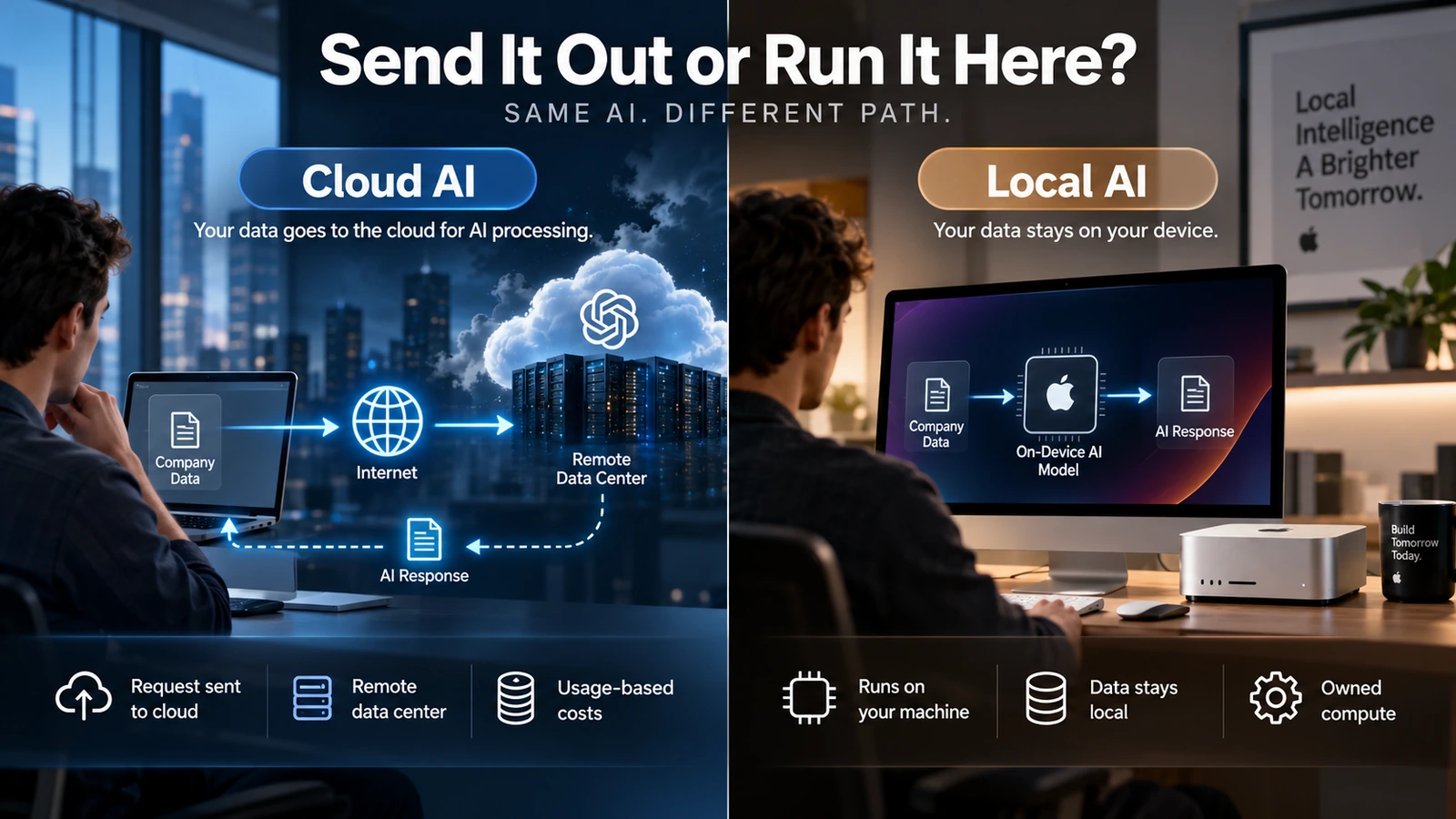
Local AI means the model is actually running on hardware controlled by the user or company instead of sending every request to a provider’s remote servers.
That distinction matters because most people experience generative AI as a service. You type something into an app, the request travels to a data center, powerful servers run the model, and the answer comes back.
For a company using an API, those requests can be metered. OpenAI, for example, currently lists text-model API pricing according to the number of input and output tokens processed. A token is a small unit of text, not the same thing as a message. (OpenAI)
That means the cost structure can look roughly like this:
| Cloud AI | Local AI |
|---|---|
| Little or no major hardware purchase | Large upfront hardware purchase |
| Cost rises with usage | Hardware cost is mostly paid upfront |
| Provider maintains infrastructure | Company maintains its own system |
| Easy access to proprietary frontier models | Usually relies on models that can legally run locally |
| Easy to scale up or down | Capacity is limited by owned hardware |
| Data leaves the device for processing | Processing can remain on the local system |
There is another distinction that is easy to miss.
Buying a Mac does not somehow let a company download every cloud AI model it already uses. Many leading proprietary models remain services operated by their vendors. Local systems are most useful with open-weight models, company-owned models, or software specifically designed for on-device execution.
So this is not a direct choice between “the exact same AI in the cloud” and “the exact same AI on a Mac.”
The model itself may be different.
Why Does 512GB of Unified Memory Matter So Much?

Large AI models do not just need fast processors. Their model weights and working data need somewhere to fit.
That is why memory has become such an important selling point in AI hardware.
The M5 Ultra Mac Studio can be configured with up to 512GB of unified memory and 1.2TB per second of memory bandwidth. In Apple silicon, the CPU, GPU, and other computing components can work from a shared memory architecture rather than relying only on a separate pool of graphics memory. (Apple)
For AI, that can make it possible to load models that would not fit into the memory of a conventional consumer graphics card.
It does not mean that a “512-billion-parameter model needs exactly 512GB.” AI memory requirements vary enormously depending on numerical precision, quantization, context size, software overhead, and how the model is divided.
But the basic relationship is straightforward: more usable high-speed memory gives developers room to run larger models locally.
Apple is taking that idea one step further. Mac Studio systems can be linked through Thunderbolt 5 with remote direct memory access, or RDMA. Apple says four Mac Studios can deliver up to three times the AI inference performance of one system. (Apple)
Reuters reported that Apple demonstrated a trillion-parameter model operating across four Mac Studios powered from a single wall outlet. (Reuters)
That sounds less like a traditional personal computer and more like a miniature AI computing cluster sitting beside a desk.
Where Does the $20,000 Question Come From?
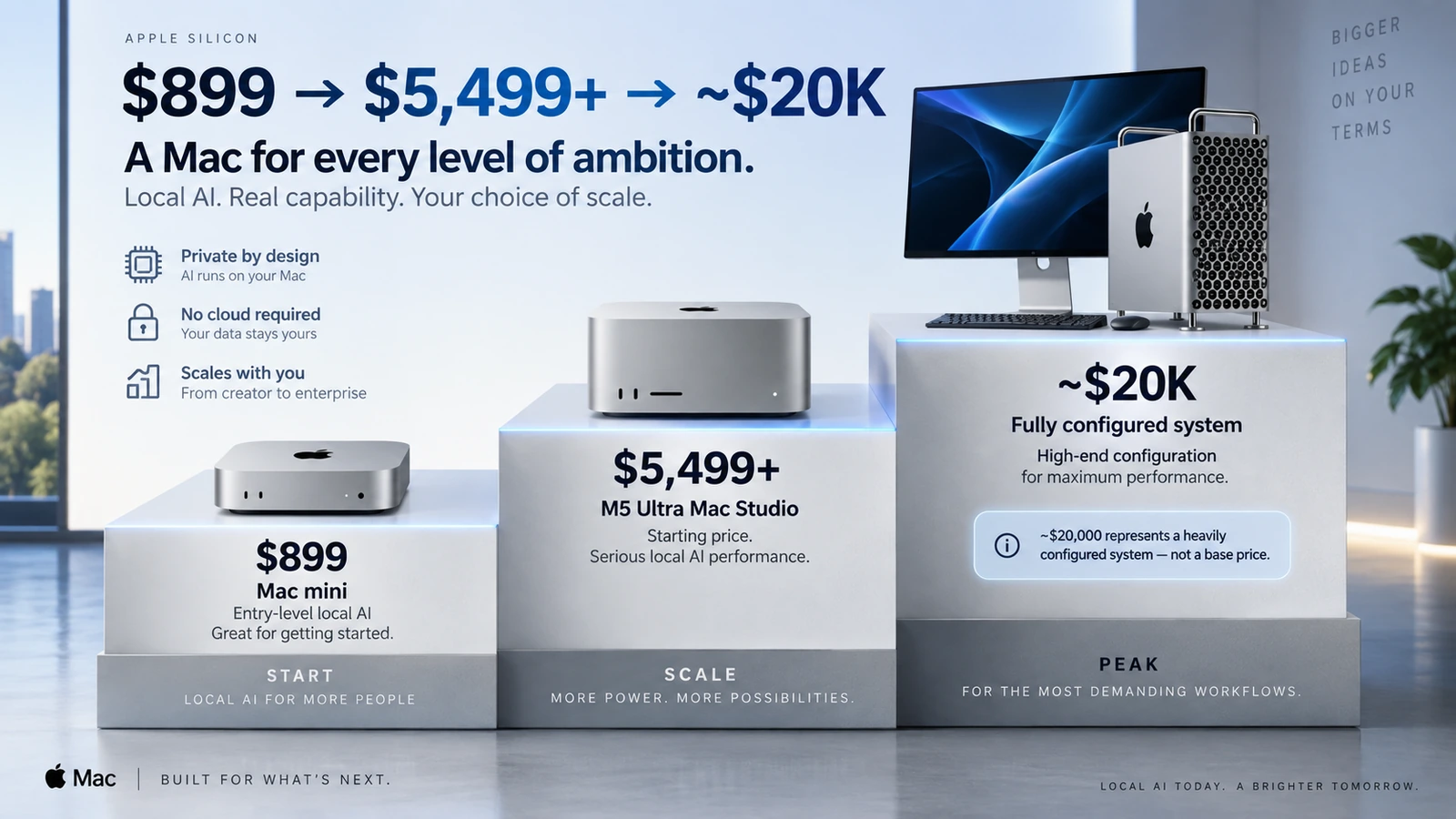
Because Apple is not really comparing a $20,000 computer with a $20 monthly chatbot subscription.
The business calculation is closer to buying a machine versus paying repeatedly for large volumes of API inference.
A company might have thousands of employees, automated coding agents, document-processing systems, internal search tools, customer-service models, or software that sends requests continuously.
Cloud pricing has a major advantage when usage is small or unpredictable: a company does not have to buy expensive equipment that may sit idle.
But as usage becomes steady, the economics change. The company may start asking whether it wants to keep paying for every additional unit of processing or buy a fixed amount of computing capacity.
That is the bet behind Apple’s pitch.
When Can Buying Hardware Beat Paying by the Token?

There is no universal break-even point.
The answer depends on at least five things: how much AI a company uses, which cloud model it would otherwise buy, which local model can do the job, how often the hardware stays busy, and what it costs to operate and manage that hardware.
A local machine becomes more attractive when the workload is repetitive and heavy. If the same workstation can spend most of the day summarizing internal documents, processing code, running a company-specific agent, or answering requests with a suitable local model, its cost can be spread across a large amount of work.
Cloud AI becomes more attractive when demand is occasional, rapidly changing, or requires capabilities that the available local model cannot match.
A more realistic comparison looks like this:
| Question | Local hardware tends to look better when… | Cloud AI tends to look better when… |
|---|---|---|
| Usage | Workloads run continuously | Usage is occasional or unpredictable |
| Model | A suitable local model exists | A proprietary frontier model is required |
| Scaling | Demand is relatively stable | Capacity may suddenly need to expand |
| Data | Keeping processing on-site has value | Managed cloud controls are sufficient |
| IT burden | The company can manage its own systems | The company wants the provider to handle infrastructure |
| Hardware life | The system can stay useful for years | The workload may change quickly |
This is also why comparing the purchase price directly with a single AI subscription is misleading.
Enterprise AI can be infrastructure, not just a chatbot.
Does Local AI Automatically Mean Better Privacy?
A local model can reduce how much sensitive data must leave a company’s own equipment, which can be valuable for source code, internal documents, research data, or other sensitive information.
Apple explicitly promotes on-device processing as a privacy advantage. (Apple)
But “local” does not automatically mean “secure.”
A poorly managed workstation can still be compromised. Employees can still copy sensitive information. Local models can still be connected to external tools. Software supply chains, access controls, device management, backups, logging, and network security still matter.
The safer way to think about it is this: local AI can reduce one category of data movement, but it does not replace normal enterprise security.
Why Would a Company Still Use the Cloud?
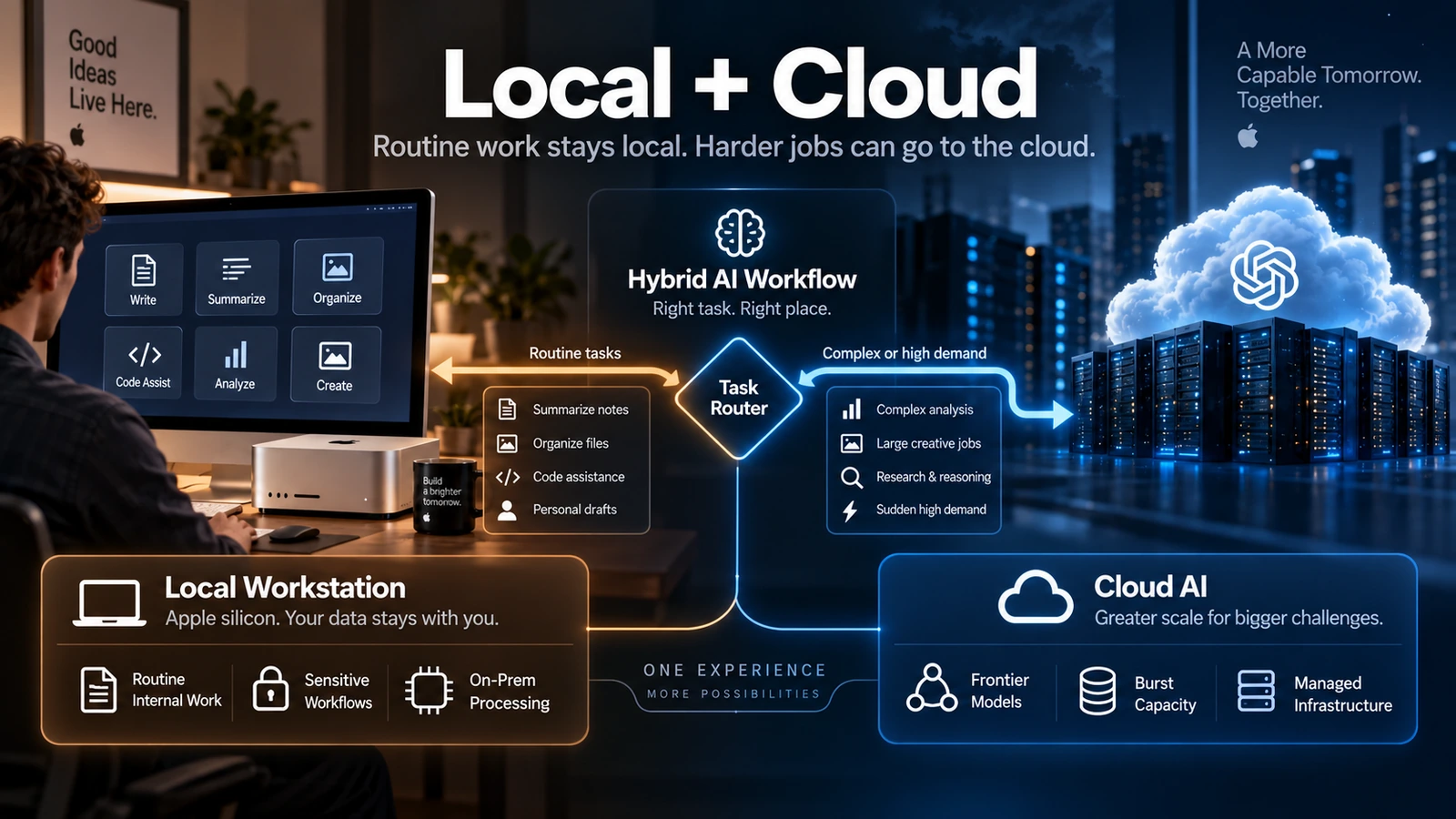
Because the cloud solves several problems that buying a computer does not.
First, cloud providers can give customers access to models that would be impossible or impractical to run on a single workstation.
Second, capacity can expand quickly. If usage jumps tenfold for a few hours, a cloud platform can potentially absorb that surge. A company-owned workstation cannot suddenly grow another GPU or hundreds of gigabytes of memory.
Third, somebody else handles much of the infrastructure.
That can be worth paying for.
The likely outcome for many organizations is therefore not “local or cloud.” It is hybrid AI.
Routine internal work could run on local machines. Sensitive workflows could remain on premises when appropriate. Harder jobs, sudden spikes, or requests requiring a particular proprietary model could still go to cloud services.
Microsoft is making a similar argument around hybrid on-device and cloud AI in its Copilot+ PC strategy. (Microsoft)
Is Apple Really Competing With Nvidia and Microsoft?

Yes, but not because Apple invented local AI.
Nvidia already promotes workstation and DGX hardware specifically as a way to run AI locally and reduce reliance on cloud-generated tokens. Its DGX Spark includes 128GB of unified system memory and is designed to run models of up to 200 billion parameters locally. Multiple systems can also be linked together. (Nvidia)
Microsoft has been pushing AI processing onto Windows PCs through Copilot+ hardware while still emphasizing a hybrid relationship between local processing and cloud services. (Microsoft)
Apple’s challenge is that Microsoft’s Windows ecosystem is already deeply embedded in corporate computing, while Nvidia owns a formidable position in AI development and accelerator software.
Reuters reported that Apple holds only about 4.6% of the enterprise desktop market, compared with more than 90% for Windows. (Reuters)
That makes Apple’s strategy easier to understand.
It does not need every office PC to become a Mac. It can try to establish the Mac as a specialized AI appliance that sits beside developers, researchers, designers, or internal AI teams.
In that role, the question is no longer “Can Mac replace Windows?”
It becomes “Can this box perform enough AI work locally to justify buying it?”
What Should Companies Watch Next?
The first thing to watch is whether companies actually deploy these Macs as always-on AI systems rather than buying them mainly for traditional creative work.
The second is software.
Hardware capacity matters, but enterprise adoption depends on whether AI frameworks, model runtimes, agent platforms, management tools, and security systems work reliably enough for business use. Apple is pushing its MLX framework and a new Core AI framework, while Nvidia has a mature AI software ecosystem and Microsoft has the advantage of Windows integration. (Apple · Nvidia)
The third is model economics.
Cloud AI prices have fallen repeatedly as providers compete, while local hardware is becoming more capable. That means the financial line between renting AI and owning AI will keep moving in both directions.
And that may be the most important part of Apple’s September 22 launch.
The Mac is no longer being pitched only as the computer where an employee uses AI.
Apple wants some businesses to see the Mac as the computer where the AI itself lives.
Why It Matters in One Sentence
Apple’s new desktop Macs turn AI spending into a different kind of decision: instead of automatically paying a cloud provider every time a model runs, businesses can increasingly choose to own some of the computing power themselves—but only when the workload, model, security needs, and utilization make that trade worthwhile.
Mac Studio Local AI: Key Questions Explained
Q. Did Apple release the new Mac Studio on September 22, 2026?
Yes. Apple announced the M5 Max and M5 Ultra Mac Studio on August 25, but customer deliveries and in-store availability began September 22.
Q. Does the new Mac Studio really cost $20,000?
Not at the starting price. The M5 Max Mac Studio starts at $2,499 and the M5 Ultra version at $5,499, while heavily configured systems can reach roughly $20,000.
Q. Is the 512GB M5 Ultra Mac Studio available now?
Apple says the M5 Ultra Mac Studio can be configured with 512GB of unified memory, but that configuration is scheduled for late October rather than the initial September 22 launch.
Q. What does local AI mean?
Local AI means the model performs its computation on a user-controlled computer or workstation rather than sending every request to a remote cloud data center.
Q. Does buying a Mac eliminate AI token fees?
Only for workloads actually moved to a local model. A company would still pay cloud usage fees whenever it uses cloud-hosted APIs or proprietary models.
Q. Is local AI always cheaper than cloud AI?
No. Local AI is more attractive when hardware stays busy with predictable workloads, while cloud AI can be cheaper and easier when usage is low, highly variable, or requires a model that cannot run locally.
Q. Why is unified memory important for AI?
Large AI models require substantial memory to hold their weights and working data. Apple’s large unified memory pool allows the CPU and GPU to work with the same high-capacity memory architecture, making unusually large local models possible.
Q. Can several Mac Studios work together?
Yes. Apple says Mac Studios can be clustered through Thunderbolt 5 and RDMA, and a four-system cluster can deliver up to three times the AI inference performance of a single Mac Studio.
Q. Does local AI automatically make company data secure?
No. Keeping AI processing local can reduce data sent to external servers, but organizations still need access controls, endpoint security, network protection, software management, and other normal security measures.
Q. Will local Macs replace cloud AI?
Probably not for most organizations. The more likely model is hybrid: local hardware handles suitable routine or sensitive workloads while cloud services remain available for frontier models, sudden demand spikes, and tasks that require managed infrastructure.
Did this help make the story clearer? 🙂
WIN keeps unpacking the “why” behind the news—clearly and simply!
Sources
September 22 Launch and Hardware Details
Apple — Mac Studio with M5 Max and M5 Ultra
Apple — Mac mini with M6 and M5 Pro
Apple — Mac Studio Technical Specifications
Local AI Economics and Enterprise Competition
Reuters — With new Macs, Apple aims to take on Microsoft, Nvidia in a rush to lower AI costs
Microsoft — Copilot+ PCs for Business