Is Japan Really Abandoning the iPhone? Why One Survey Put Android at 54.1%—and What That Number Misses

Japan is supposed to be one of Apple’s strongest smartphone markets. So why did a Japanese survey put Android at 54.1% and the iPhone at 45.6%?
Are Japanese consumers finally abandoning Apple?
Not quite. The shift is worth paying attention to, but the headline is easier to misunderstand than it looks. The 54.1% figure comes from an August 2026 consumer survey of people’s main phones—not from nationwide sales data—and that survey covered people ages 18 to 79. At the same time, separate shipment data for Japan’s 2025 fiscal year still put Apple above half of new smartphone shipments. (MMD Research Institute · MM Research Institute)
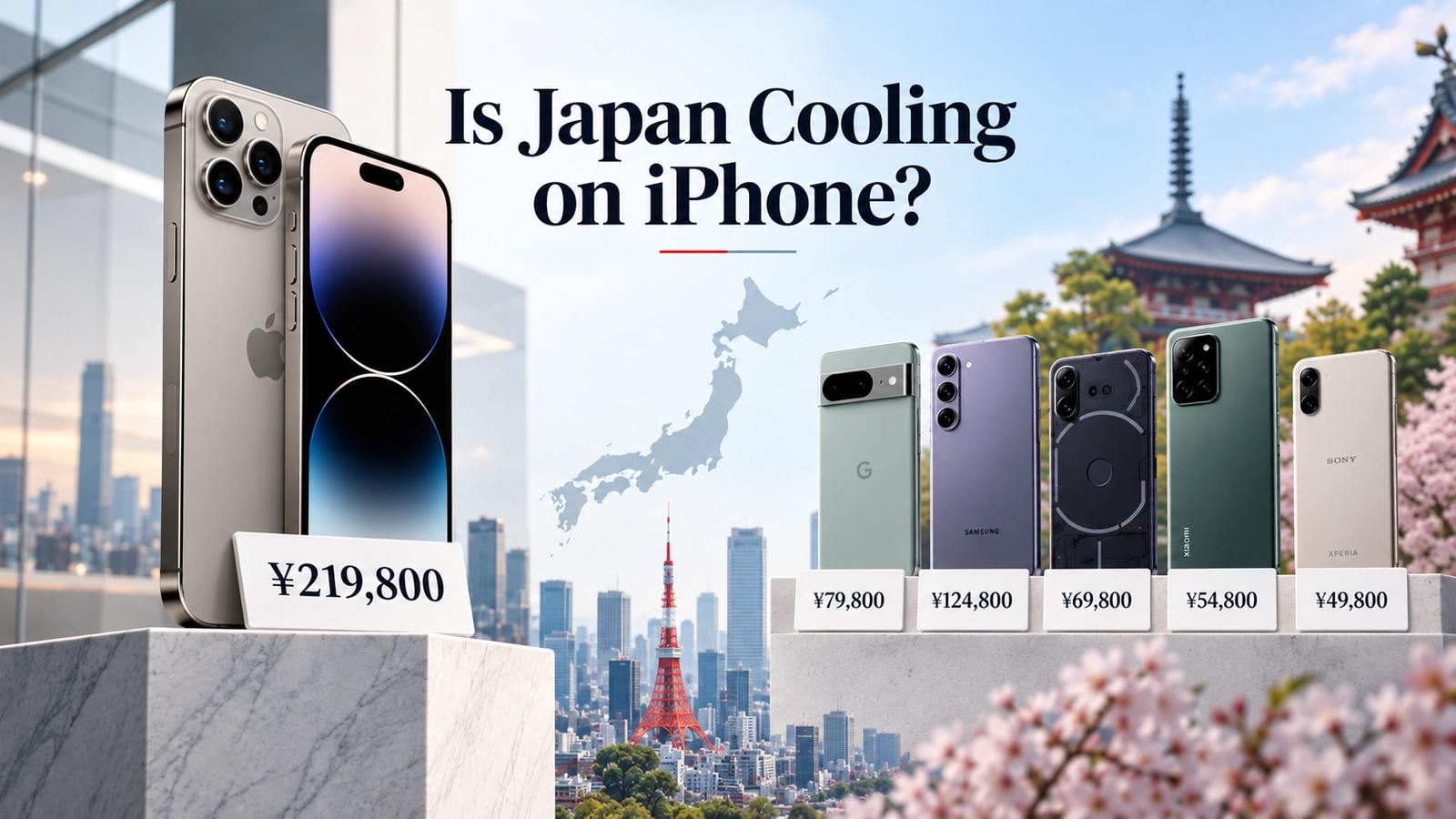
※ Images in this article are AI-generated illustrations created to help explain the story. They are not actual photographs, and depictions of people, places, or events may differ slightly from reality.
The more interesting story is not “Japan suddenly quit the iPhone.” It is that Apple’s unusually strong position in Japan is being tested by higher prices, a weak yen, a growing used-phone market, and Android alternatives that are much more credible than they used to be.
Did Android Really Overtake the iPhone in Japan?
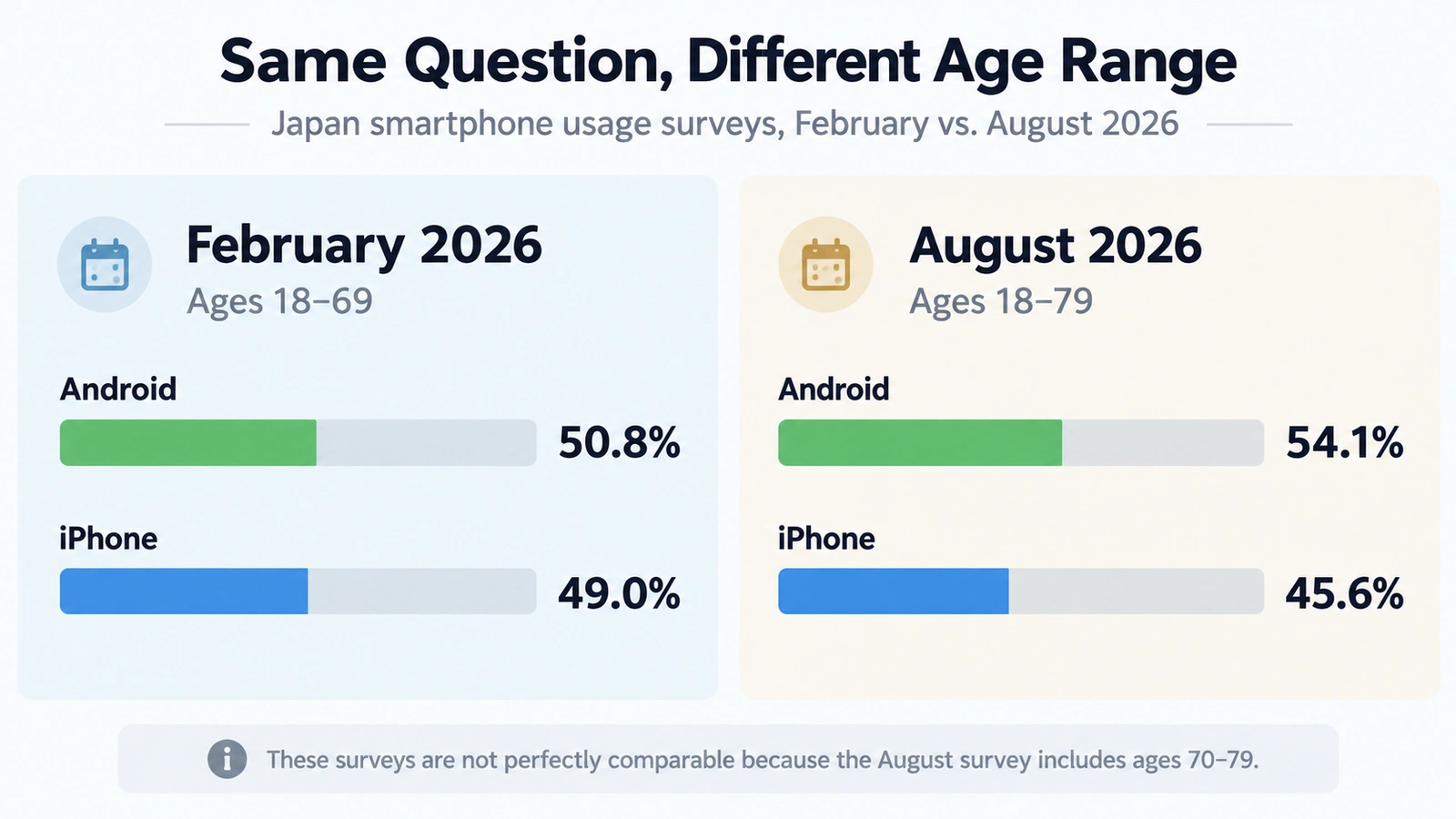
In MMD Research Institute’s August 2026 survey, Android was ahead. Among 34,838 respondents who knew the model of their main smartphone, 54.1% used Android and 45.6% used an iPhone. (MMD Research Institute)
Six months earlier, MMD’s February survey showed Android at 50.8% and iPhone at 49.0%. That makes the new result look like a sharp six-month swing. But there is an important methodological difference: the February survey covered people ages 18 to 69, while the August survey expanded the range to ages 18 to 79. Both surveys were weighted to reflect population composition. (MMD Research Institute — February 2026 · MMD Research Institute — August 2026)
| MMD survey | Age range | Android | iPhone |
|---|---|---|---|
| February 2026 | 18–69 | 50.8% | 49.0% |
| August 2026 | 18–79 | 54.1% | 45.6% |
That matters because the two surveys are not perfectly apples-to-apples. The August result clearly says Android users outnumbered iPhone users in that survey, but it does not prove that 3.4 percentage points of Japanese iPhone users switched platforms in six months.
There is another reason to be careful with the word “overtake.” Android was already slightly ahead in MMD’s February survey. So the real development is that the gap widened—not that Android suddenly crossed from second place to first.
Why Are iPhones Getting So Expensive in Japan?
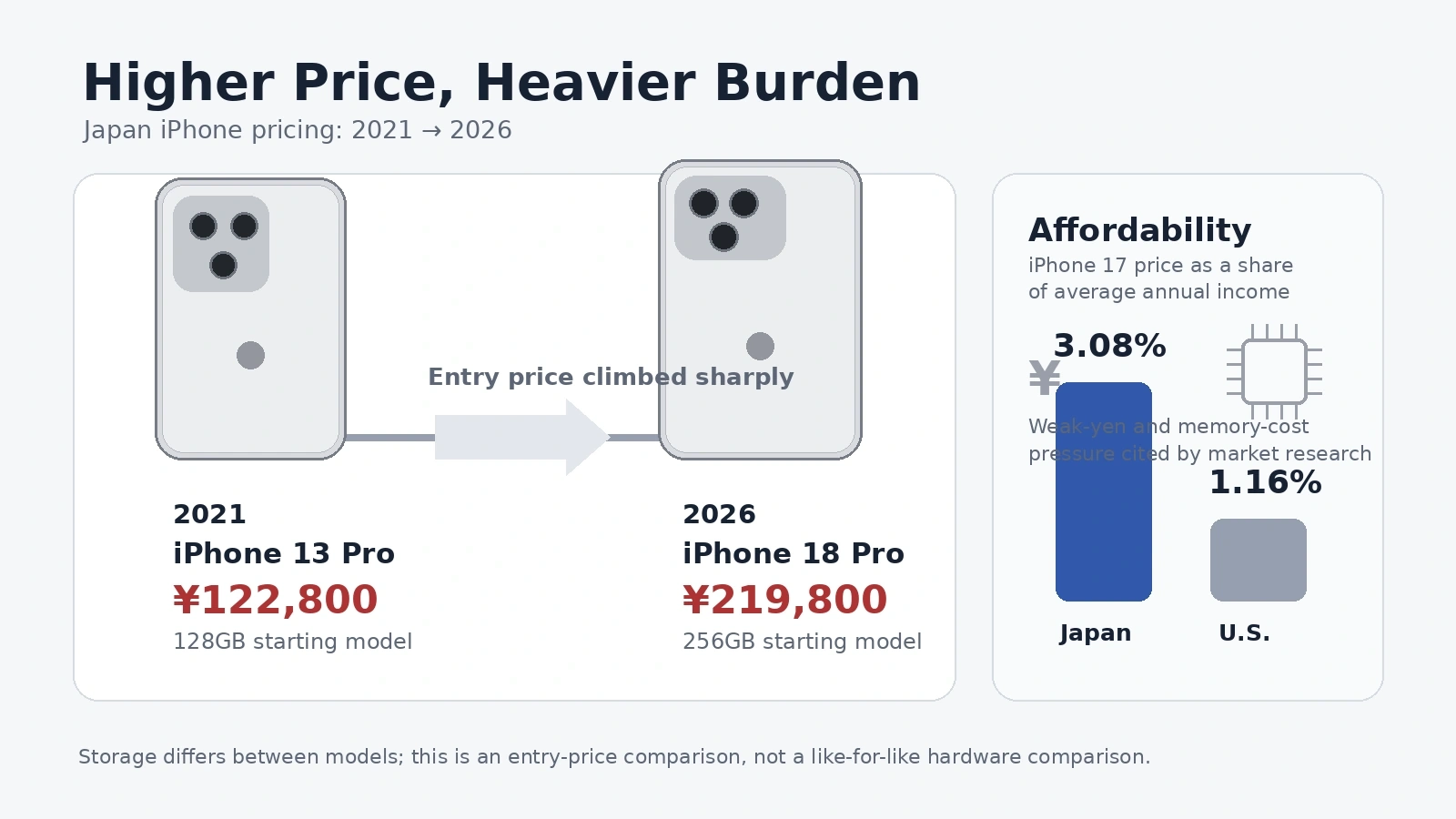
The short answer is that Japanese buyers are facing a much higher entry price for premium iPhones than they did a few years ago, while income has not risen at the same pace.
When Apple launched the iPhone 13 Pro in Japan in 2021, it started at ¥122,800 for 128GB. The iPhone 18 Pro starts at ¥219,800 for 256GB. Apple also announced a starting price of ¥364,800 for the foldable iPhone Duo. The storage capacities differ, so the iPhone 13 Pro and iPhone 18 Pro are not like-for-like hardware comparisons, but the figures still show how much the entry price for a Pro iPhone has moved. (Apple — iPhone 13 Pro · Apple — iPhone 18 Pro · MM Research Institute)
The increases are not limited to brand-new flagship models. MM Research Institute reported that the iPhone 17 rose from ¥129,800 at launch to ¥159,800 by September 2026—a 24% increase. The iPhone 17e rose from ¥99,800 at launch in March to ¥124,800 in September, a 25% increase. The firm linked recent pricing pressure to factors including the weak yen and rising memory costs. (MM Research Institute)
But here is the part that makes the Japanese story more interesting: iPhones are not unusually expensive in Japan when sticker prices are compared across countries.
MM Research Institute found that Japan’s iPhone 18 Pro price was the sixth-lowest among 40 countries and regions it studied. The problem is affordability. The firm created an “iPhone index” by comparing the phone’s price with average annual income. For the iPhone 17, the index was 3.08% in Japan versus 1.16% in the United States. In other words, the phone can rank relatively low on global sticker price while still taking a much larger share of average income in Japan. (MM Research Institute)
| Affordability measure | Japan | United States |
|---|---|---|
| iPhone 17 price as a share of average annual income | 3.08% | 1.16% |
| Relative burden | Higher | Lower |
That distinction explains why a simple currency-converted price comparison can miss the consumer experience. A phone does not feel affordable because it is “cheap for an iPhone.” It feels affordable when the price fits the buyer’s income.
Is Price Really Pushing People Toward Android?
Price is likely part of the story, but the MMD survey itself does not establish that price caused the Android lead. It measured what phones respondents use and what devices they want next; it was not designed to isolate the reason people chose one operating system over another. Separate MM Research Institute analysis, however, says rising iPhone prices could encourage some users to delay upgrades, buy older or used devices, or move to Android. (MMD Research Institute · MM Research Institute)
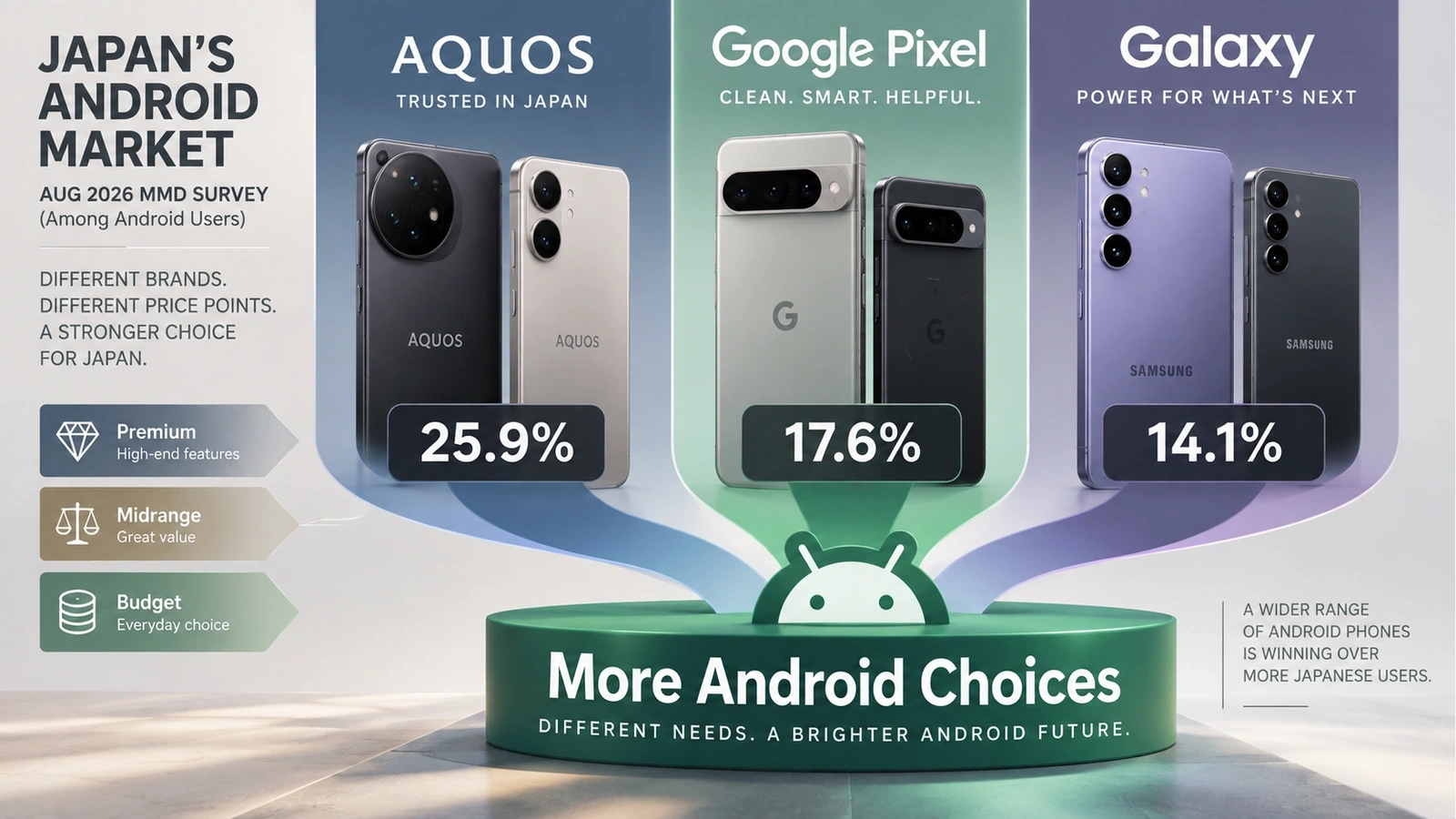
What MMD’s survey does show is that Android has several strong choices in Japan. Among Android users in the August survey, AQUOS accounted for 25.9% of main devices, Google Pixel 17.6%, and Galaxy 14.1%. (MMD Research Institute)
Because Android represented 54.1% of main phones in the survey, Pixel’s 17.6% share within Android works out to roughly 9.5% of the surveyed main-phone base. That is a simple calculation from MMD’s published percentages, not a separate Pixel market-share figure reported by MMD.
The age pattern is also revealing, but it needs to be described precisely. MMD found that the most common phone series, not necessarily the most common operating system, was the iPhone 17 among teens and people in their 20s, the iPhone 16 among people in their 30s, and AQUOS among people in their 40s through 70s. (MMD Research Institute)
And Apple loyalty has not disappeared. Among iPhone users in the August survey who had already decided what series they wanted next, 66.5% chose the iPhone 17. Among Android users with a choice in mind, AQUOS led at 26.3%, followed by Google Pixel at 21.4% and Xperia at 17.5%. (MMD Research Institute)
So the market is not simply “iPhone users fleeing to Android.” A better description is that Android gives price-sensitive consumers more credible places to go when a new iPhone feels too expensive.
Why the 45.6% Number Does Not Mean Apple Has Lost Japan
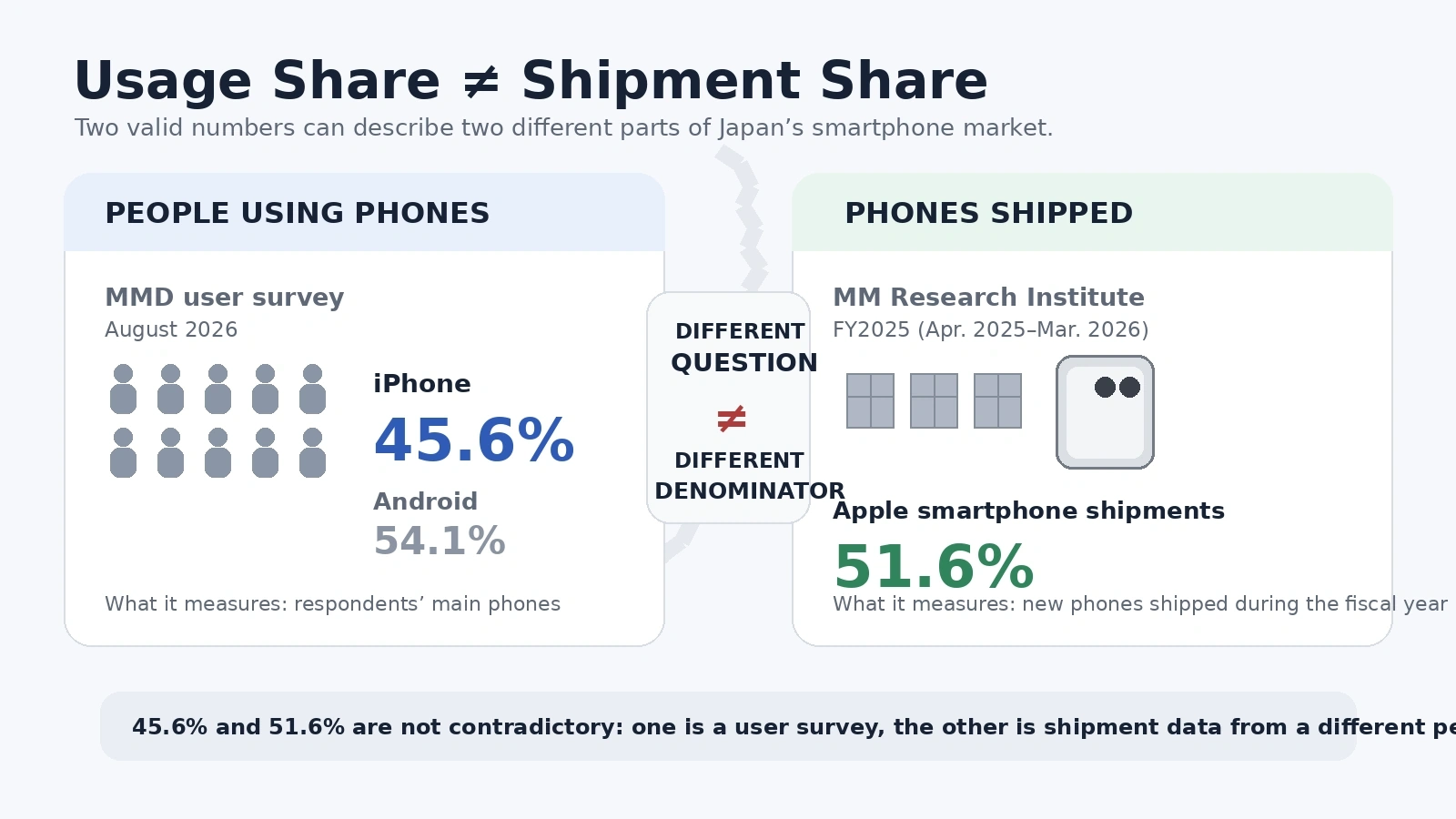
This is the most important distinction in the entire story: usage share and shipment share are not the same thing.
MMD’s 45.6% figure measures the operating system on respondents’ main smartphones. It is a survey-based snapshot of phones in use. Shipment data, by contrast, measures how many new devices manufacturers shipped into the Japanese market during a period.
In Japan’s 2025 fiscal year, which ran from April 2025 through March 2026, Apple accounted for 51.6% of smartphone shipments, according to MM Research Institute. Apple also ranked first in total mobile-phone shipments for the 15th consecutive year. (MM Research Institute)
| Metric | Period | Apple/iPhone result | What it measures |
|---|---|---|---|
| MMD usage survey | August 2026 | 45.6% | Main phones used by survey respondents |
| MMRI smartphone shipments | FY2025 | 51.6% | New smartphones shipped in Japan |
Both numbers can be true at the same time.
A company can lead new-device shipments while accounting for a smaller share of the total installed user base. People also keep phones for different lengths of time, buy used devices, switch at different rates, and appear differently in surveys depending on the population sampled.
That is why “Apple has fallen below 50% in one usage survey” is very different from “Apple no longer leads Japan’s smartphone shipments.”
Why Is Japan’s Used-Phone Market Growing So Fast?
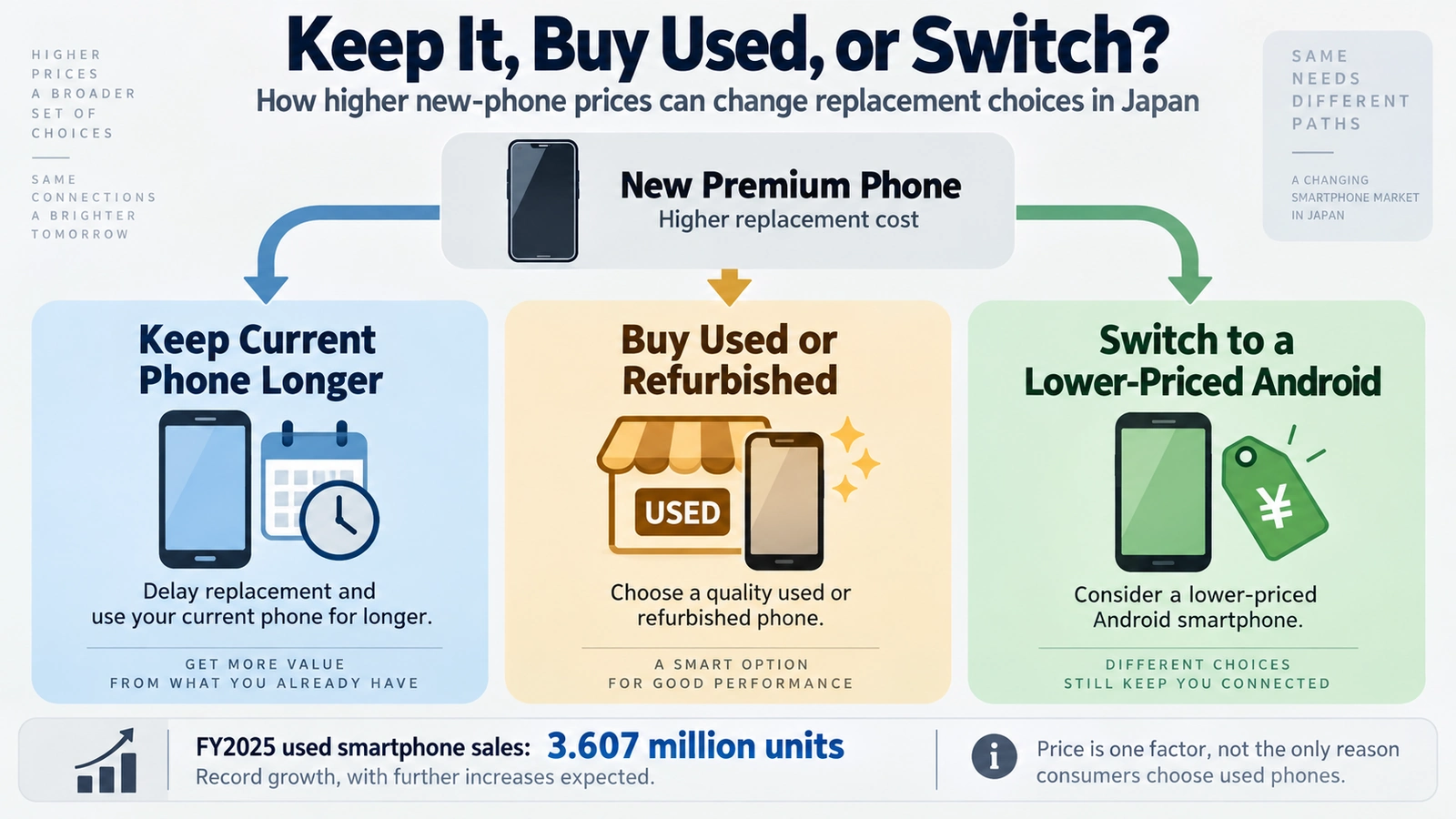
Because replacing a smartphone has become more expensive, keeping an older phone longer or buying a used one is becoming a more mainstream option in Japan.
MM Research Institute estimated that 3.607 million used smartphones were sold in Japan in fiscal 2025, up 12.4% from the previous year and a record for the seventh consecutive year. It projects 3.96 million units in fiscal 2026 and more than 5 million by fiscal 2029. (MM Research Institute)
The firm cited the weak yen and broader inflation as factors supporting demand for cheaper used devices. It also pointed to growth in carrier-certified used phones and manufacturer-backed refurbished programs. (MM Research Institute)
That creates an important middle ground in the iPhone-versus-Android debate.
A Japanese consumer who decides a new iPhone is too expensive does not have only two choices—“buy it” or “switch to Android.” The buyer can also keep an existing iPhone longer, trade it in, buy an older model, or buy a used or refurbished phone.
MM Research Institute expects a mix of those behaviors as prices rise: longer replacement cycles, more interest in older or lower-priced iPhones, more Android switching, more trade-ins, and more used-device purchases. (MM Research Institute)
What Does Japan’s Smartphone Shift Mean for Apple?
Japan is a useful test case because Apple remains unusually strong there. That means even a modest change in consumer behavior matters.
The strongest interpretation is not that Japanese buyers have suddenly rejected the iPhone. It is that the premium Apple habit now has a more visible price limit.
Apple still has a large installed base, more than half of recent annual smartphone shipments, and strong stated loyalty among many existing iPhone users. But Android makers have more room to compete when the latest iPhone moves farther out of reach for ordinary households. In MMD’s August survey, AQUOS, Google Pixel, and Galaxy were the three largest Android device series among Android users. (MMD Research Institute · MM Research Institute)
For American consumers, the Japan story does not mean the same shift is about to happen in the United States. Japan has its own currency, income, carrier, resale, and device-market dynamics.
But it does highlight a broader question that matters well beyond Japan: How high can premium smartphone prices go before even loyal users start stretching replacement cycles, buying used, or choosing another platform?
That is the number worth watching next—not just Android’s 54.1%.
Bottom Line: What This Story Really Means
Japan’s August 2026 smartphone survey does show Android ahead of the iPhone, 54.1% to 45.6%. But it does not prove that Japan has suddenly turned against Apple. (MMD Research Institute)
The survey measures respondents’ main phones, not nationwide sales, and its age range differs from the February survey. Meanwhile, separate shipment data still shows Apple above 50% of Japan’s smartphone shipments in fiscal 2025, and the August MMD survey shows strong next-purchase loyalty among many iPhone users. (MMD Research Institute — February 2026 · MM Research Institute)
What has changed is the pressure around price. The iPhone 18 Pro starts at ¥219,800 in Japan, older iPhone models have been repriced upward, and MM Research Institute’s income-based index suggests an iPhone consumes a larger share of average income in Japan than in the United States. At the same time, Android offers more credible alternatives and Japan’s used-phone market is setting records. (Apple · MM Research Institute — Pricing · MM Research Institute — Used Phones)
So the real story is not “Japan abandoned the iPhone.”
It is that Apple’s advantages—brand loyalty, ecosystem ties, resale value, and carrier support—are being tested by affordability in a way they were not a few years ago.
Japan’s iPhone Market: Key Questions Explained
Q. Did Android overtake the iPhone in Japan?
In MMD Research Institute’s August 2026 user survey, yes. Android accounted for 54.1% of respondents’ main smartphones, while iPhone accounted for 45.6%. That is a usage survey, not nationwide sales data. (MMD Research Institute)
Q. Did iPhone usage really fall 3.4 percentage points in six months?
The reported survey share fell from 49.0% in February to 45.6% in August, but the comparison has an important limitation. The February survey covered ages 18–69, while the August survey covered ages 18–79, so the change cannot be treated as a clean measure of switching. (MMD Research Institute — February 2026 · MMD Research Institute — August 2026)
Q. Why are iPhones becoming more expensive in Japan?
Market researchers point to factors including yen weakness and higher memory costs. MM Research Institute reported that the iPhone 17’s Japanese price rose 24% from its launch price by September 2026. (MM Research Institute)
Q. Is the iPhone unusually expensive in Japan compared with other countries?
Not by sticker price alone. MM Research Institute ranked Japan’s iPhone 18 Pro as the sixth-cheapest among 40 markets studied, but its income-based affordability measure showed a much heavier burden in Japan than in the United States. (MM Research Institute)
Q. Which Android brands are strongest in Japan?
Among Android users in MMD’s August survey, AQUOS accounted for 25.9% of main devices, followed by Google Pixel at 17.6% and Galaxy at 14.1%. (MMD Research Institute)
Q. Is Google Pixel really close to 10% of the surveyed main-phone base?
Roughly, as a derived estimate. Pixel represented 17.6% of Android users, while Android represented 54.1% of main phones in the survey; multiplying those shares gives about 9.5%. MMD did not publish 9.5% as a separate Pixel market-share figure.
Q. Has Apple lost its leadership in Japan?
Not in the latest full-year shipment data cited here. MM Research Institute said Apple accounted for 51.6% of Japan’s smartphone shipments in fiscal 2025. (MM Research Institute)
Q. What should we watch next?
The most useful next signals will be a future MMD survey with a comparable age range, post-iPhone 18 shipment data, replacement-cycle trends, and continued growth in used or refurbished phone sales. Those indicators will help show whether current affordability pressure becomes a lasting platform shift or mainly changes how and when people buy phones.
Did this help make the story clearer? 🙂
WIN keeps unpacking the “why” behind the news—clearly and simply!
Sources
Smartphone Usage and Device Preferences
MMD Research Institute — August 2026 Smartphone OS Share Survey
MMD Research Institute — February 2026 Smartphone OS Share Survey
iPhone Pricing and Affordability
Apple Japan — iPhone 18 Pro and iPhone 18 Pro Max Announcement
Apple Japan — 2021 iPhone 13 Pro and iPhone 13 Pro Max Announcement
MM Research Institute — September 2026 Global iPhone Pricing and Affordability Study
Smartphone Shipments and the Used-Phone Market
MM Research Institute — FY2025 Japan Mobile Phone Shipment Survey
MM Research Institute — FY2025 Used Smartphone Market Survey