Why Is South Korea Warning of “Additional Measures” Against Ukraine Over Two North Korean POWs?

Why would South Korea be warning Ukraine about “additional measures” when both governments have opposed North Korea’s military support for Russia?
And why would a transfer that Seoul and Kyiv had already worked out turn into a diplomatic fight only after the two soldiers reached South Korea?
The short answer is that the dispute is not mainly about whether the two North Korean prisoners of war were transferred. Both sides acknowledge that they were. The fight is over whether the transfer was supposed to remain confidential—and what Ukraine did after making it public.
On October 2, South Korean President Lee Jae Myung said Seoul could take unspecified additional measures unless Ukraine acknowledges what South Korea says was a confidentiality agreement and issues an official apology. Ukraine has disputed Seoul’s account of such an agreement, while its foreign minister has described the episode as a diplomatic misunderstanding that Kyiv wants to resolve quickly. (Reuters · Yonhap)
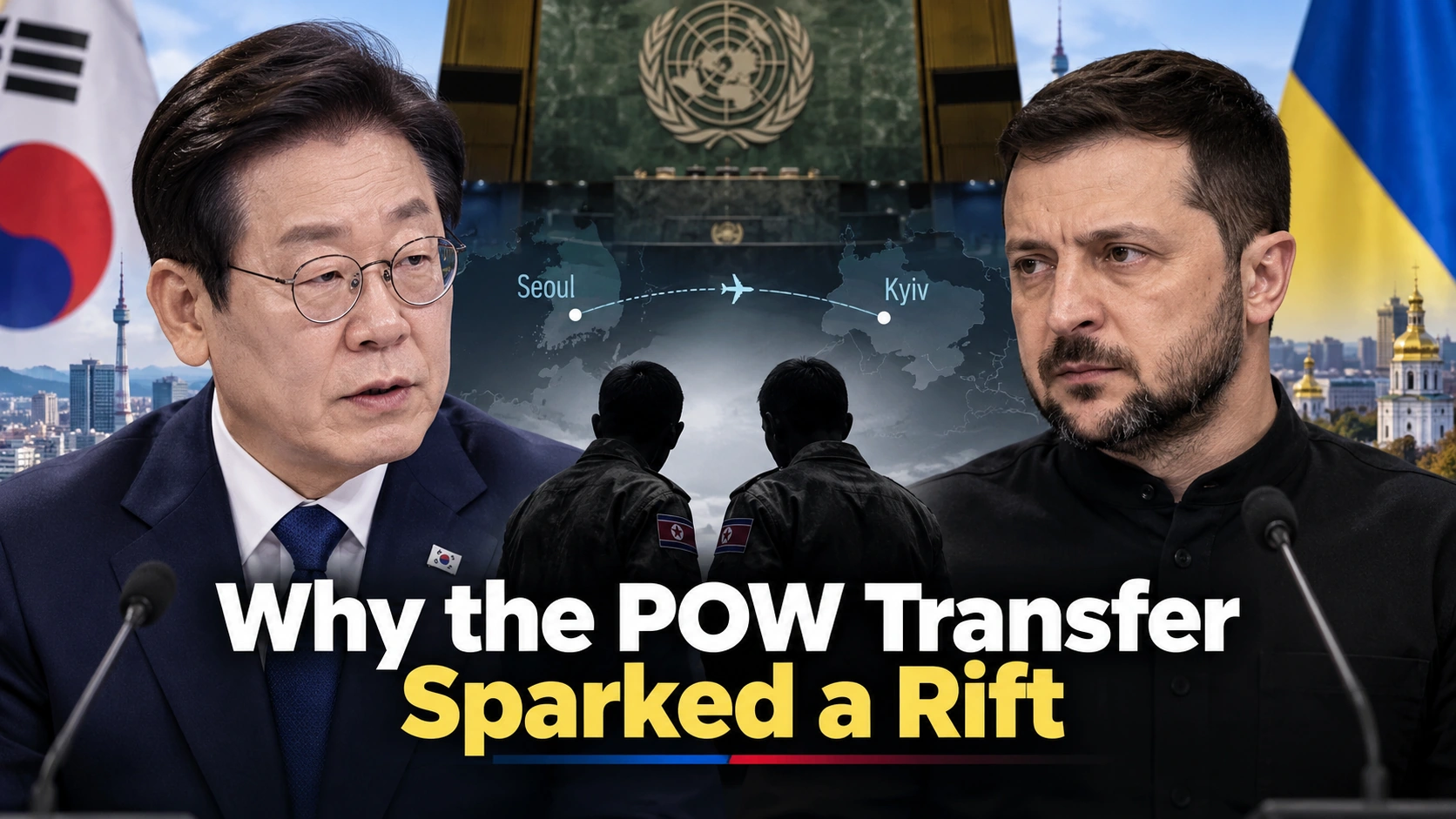
※ Images in this article are AI-generated illustrations created to help explain the story. They are not actual photographs, and depictions of people, places, or events may differ slightly from reality.
The argument sounds narrow—a disagreement over secrecy—but it touches much bigger questions: the fate of North Korean troops fighting for Russia, the safety of defectors and their families, the rules surrounding prisoners of war, and the relationship between two countries that still have reasons to cooperate.
What Actually Happened?
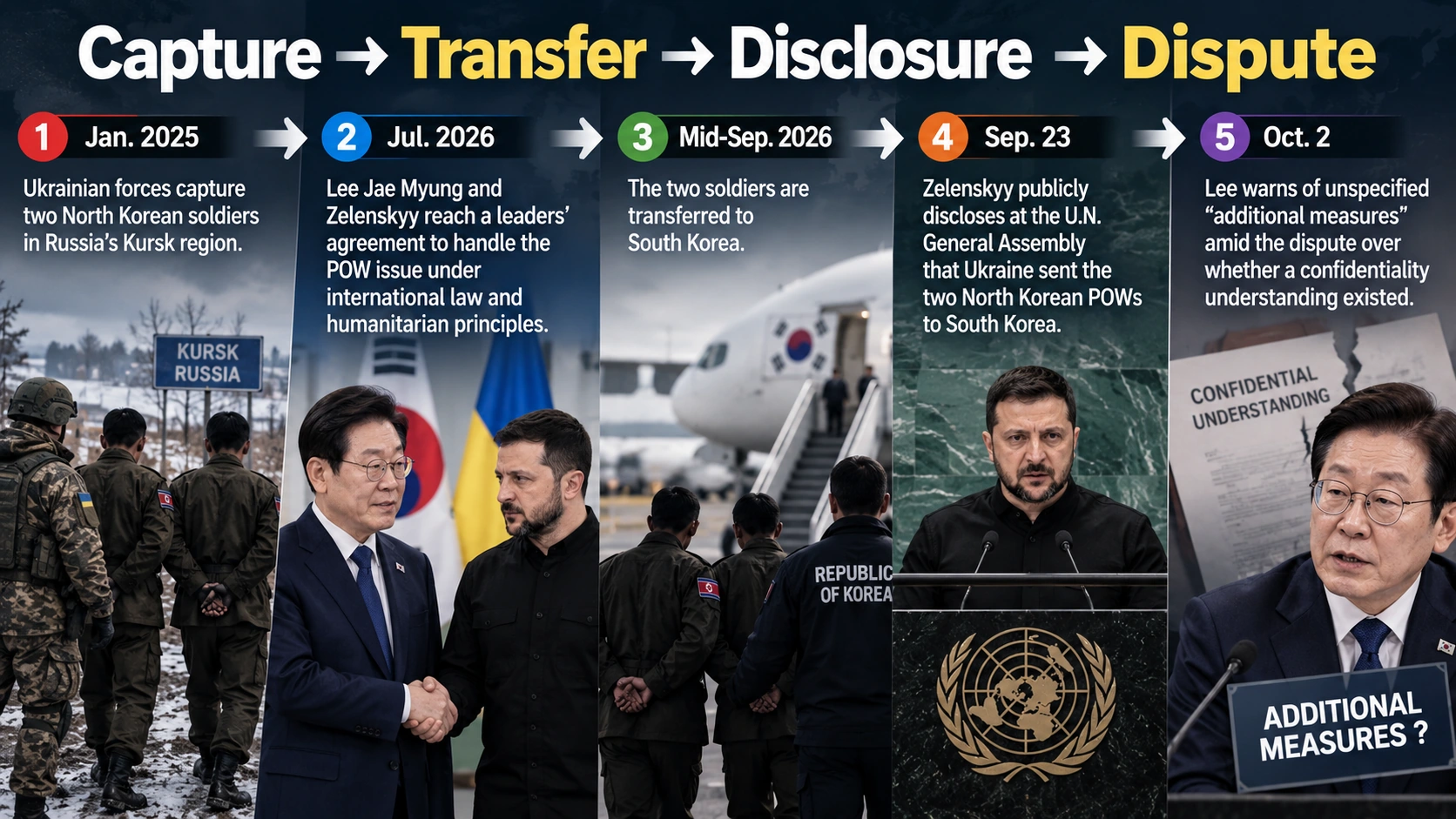
The easiest way to understand the dispute is to separate the transfer itself from the later fight over disclosure.
| Date | What happened | Why it matters |
|---|---|---|
| January 9, 2025 | Ukrainian forces captured two North Korean soldiers in Russia’s Kursk region. | They were among the first known North Korean soldiers captured alive while fighting alongside Russian forces. |
| July 8, 2026 | Lee and Zelenskyy agreed that the POW issue should be handled according to international law and humanitarian principles while respecting the soldiers’ wishes. | This established a leader-level framework for resolving their fate. |
| Mid-September 2026 | The two soldiers arrived in South Korea. | The transfer itself was completed before the public dispute began. |
| September 23, 2026 | Zelenskyy told the U.N. General Assembly that Ukraine had recently sent two North Korean POWs to South Korea. | Seoul says this disclosure violated a prior confidentiality understanding. |
| September 27–30, 2026 | Seoul demanded an explanation and apology; South Korea’s intelligence service told lawmakers that Ukraine had initially requested secrecy. | The disagreement shifted from the POWs’ destination to diplomatic trust. |
| October 2, 2026 | Lee warned of “additional measures” if Ukraine continued to deny the agreement and refused to apologize. | The dispute moved from protest to the possibility of an unspecified policy response. |
The capture date and Seoul’s account of the negotiations were reported after a closed-door briefing by South Korea’s National Intelligence Service. Zelenskyy’s September 23 disclosure is also recorded in the official U.N. transcript and on the Ukrainian president’s website. (Yonhap · U.N. transcript · President of Ukraine)
Why Were the Two North Korean Soldiers Sent to South Korea?
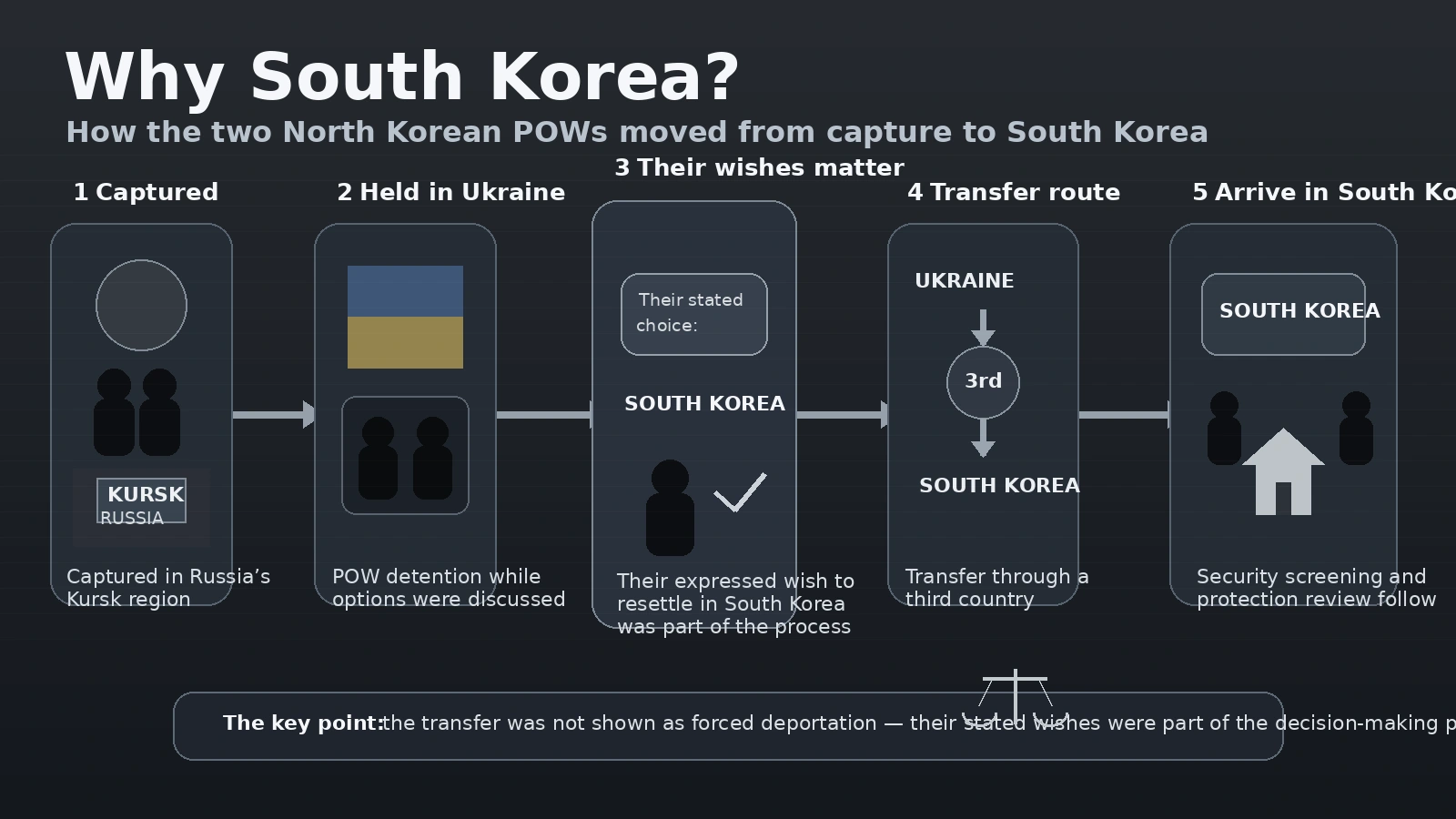
Because both soldiers had expressed a desire to go to South Korea, Seoul and Kyiv had been discussing a solution that would take their wishes into account. At their July 8 summit in Ankara, Lee and Zelenskyy agreed to address the issue in line with international law and humanitarian principles while respecting the POWs’ wishes. (Yonhap)
That does not mean the legal question was simple. The Third Geneva Convention says POWs must be released and repatriated without delay after the cessation of active hostilities, but the current war has not reached that point. The International Committee of the Red Cross’s commentary also recognizes that POWs may refuse repatriation, especially when they fear punishment for capture, desertion, or defection, and says such cases require individual assessment. (ICRC)
Reuters reported that the precise legal basis for this mid-war transfer has not been publicly clarified. What is clearer is that the soldiers had asked to go to South Korea and that Seoul now plans to process them under its system for North Korean escapees, including security screening and a decision on protection and settlement. (Reuters · Korean Law Information Center)
Was There Really a Confidentiality Agreement?
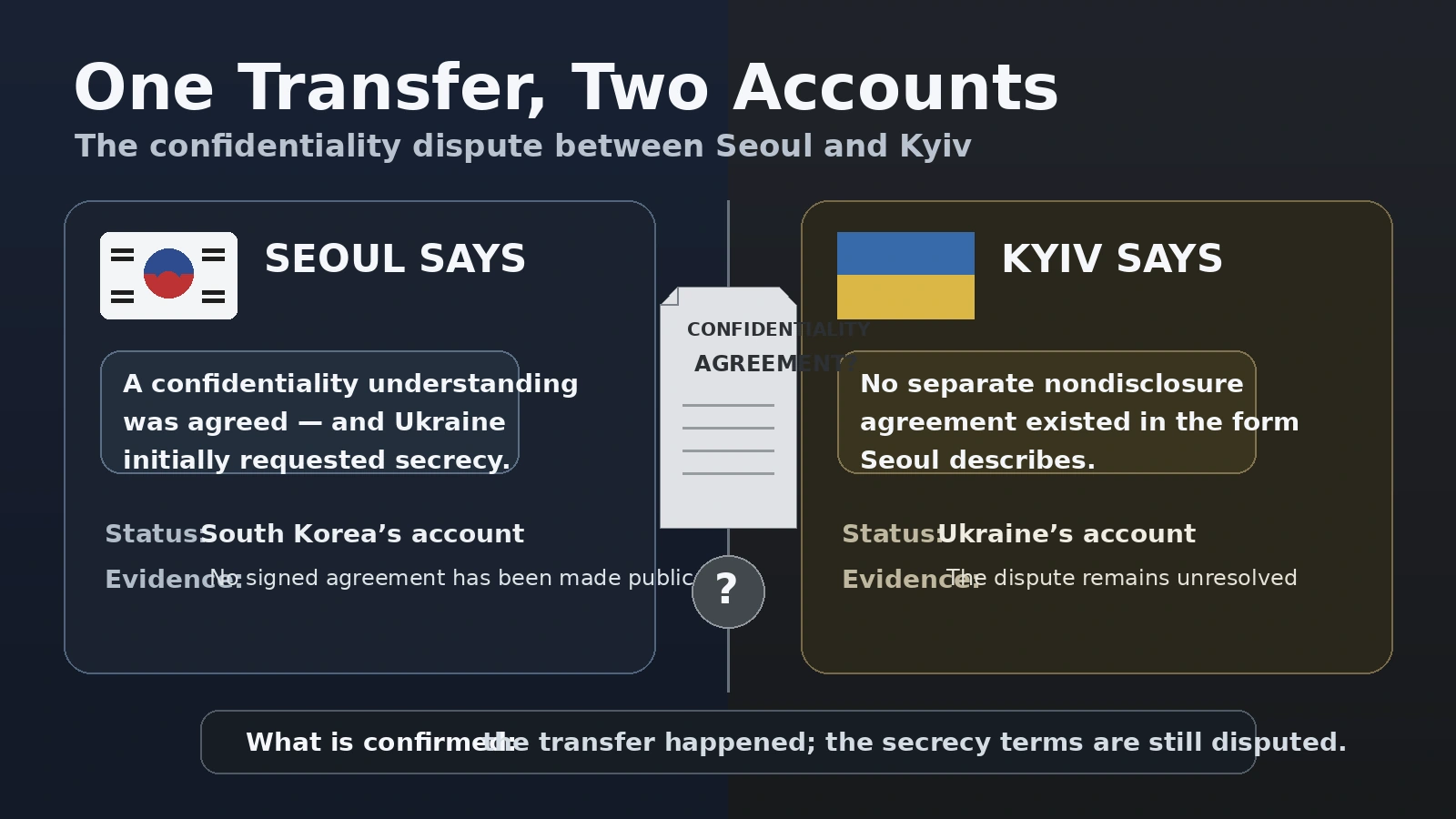
This is the central unresolved factual dispute. South Korea says there was a clear understanding from the beginning that the transfer would remain confidential. Ukraine has denied that there was a separate nondisclosure agreement.
Seoul’s account became more detailed after the dispute erupted. South Korea’s Foreign Ministry said the two governments had a “clear understanding” on confidentiality. The National Intelligence Service later told lawmakers that Ukraine had been the first side to request strict secrecy, citing concerns that publicity could complicate future POW-exchange negotiations. (Yonhap · Yonhap)
Ukrainian officials, however, disputed the existence of the agreement as Seoul described it. That is why the argument is not resolved simply by confirming that talks happened: the two governments disagree over what, exactly, those talks committed them to. (AP · Reuters)
No publicly released signed agreement has settled that dispute. It is therefore safer to describe the secrecy arrangement as Seoul’s claimed confidentiality agreement or understanding unless and until both governments publish matching evidence of its form and terms.
Why Did Secrecy Matter So Much to Seoul?
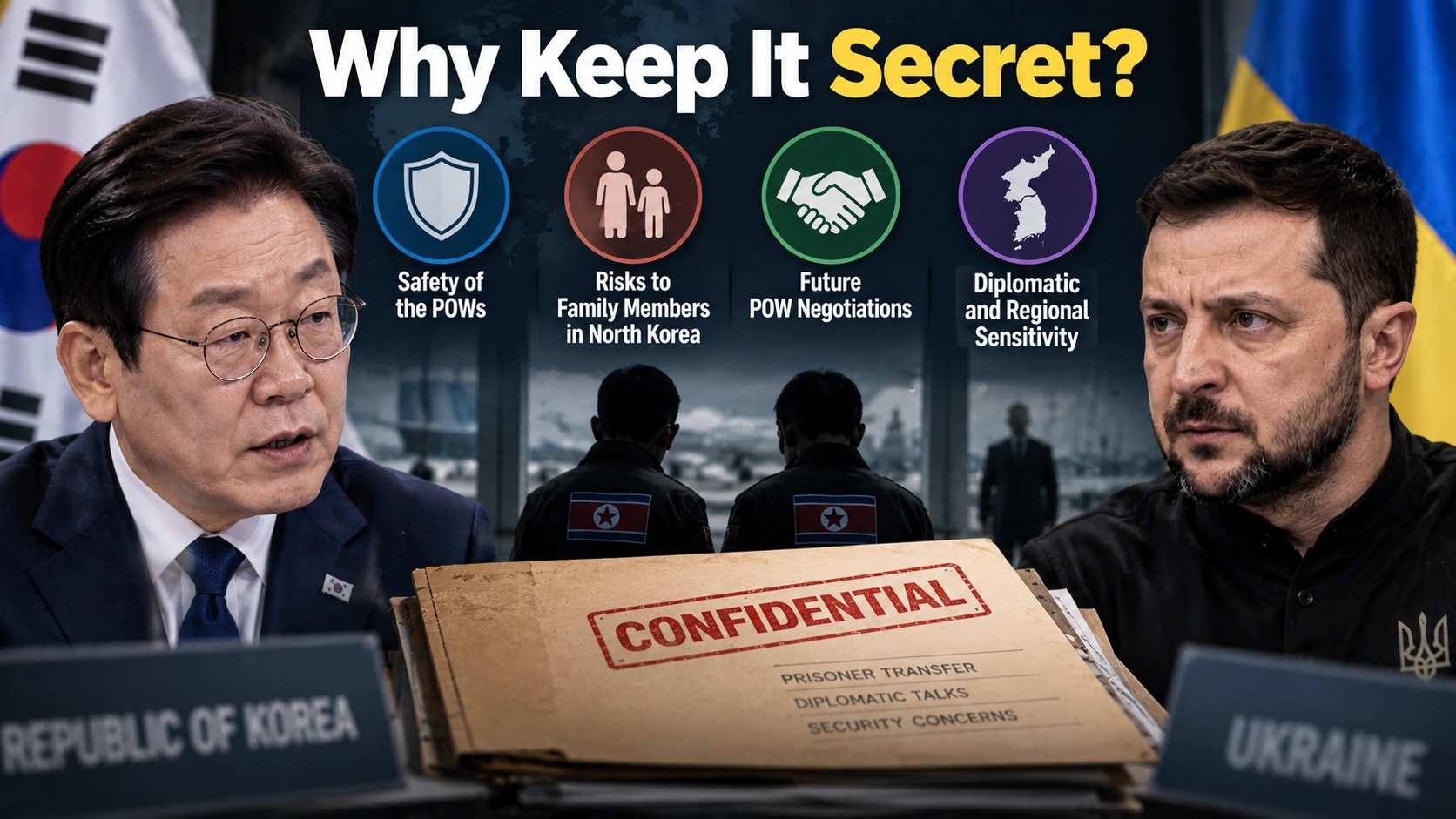
South Korea says secrecy was intended to protect more than the logistics of the transfer. Seoul has cited the safety of the two soldiers, risks to family members who may still be in North Korea, diplomatic consequences, and the sensitivity of future prisoner negotiations. (Reuters · AP)
That makes this different from an ordinary disagreement over who announced a diplomatic success first. For Seoul, the government’s argument is that publicity itself could create risk—especially when the people involved are North Korean soldiers who chose not to return to the North.
The NIS also told lawmakers that Ukraine had originally cited the possible effect on future POW exchanges as a reason for confidentiality. That assertion comes from South Korea’s intelligence briefing; Ukraine has not publicly adopted Seoul’s version of the confidentiality arrangement. (Yonhap)
Why Did Zelenskyy Make the Transfer Public at the U.N.?
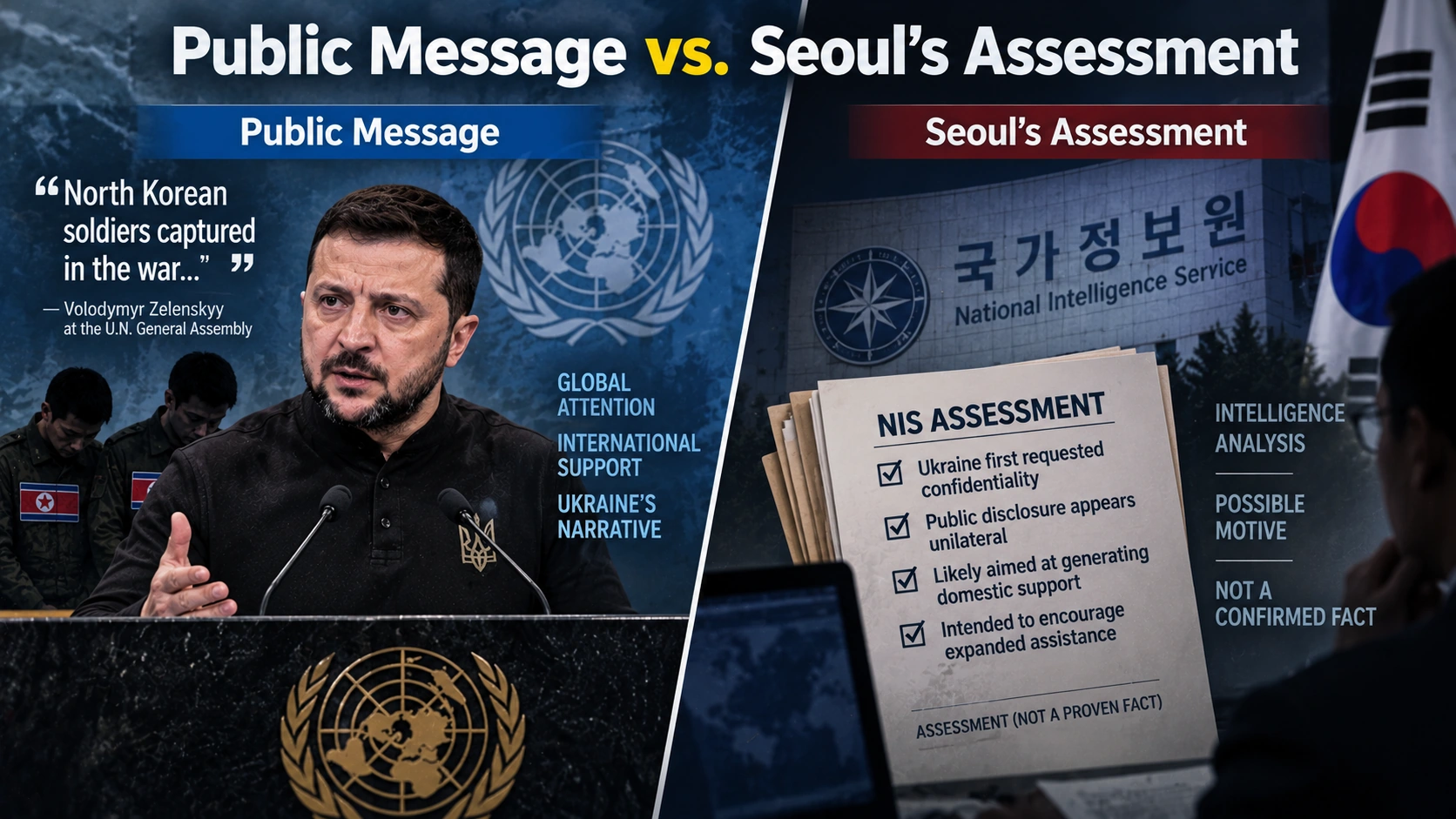
There is no publicly established answer proving Zelenskyy’s private motive.
What is documented is how he used the transfer in his September 23 U.N. speech. Zelenskyy placed the two soldiers inside a broader argument that Russia’s war is drawing North Korea deeper into combat, giving Pyongyang battlefield experience, and spreading the war’s security consequences beyond Europe. He told the General Assembly that Ukraine had “recently” sent two North Korean POWs to South Korea. (U.N. transcript · President of Ukraine)
South Korea’s intelligence service offered a different layer of interpretation. According to lawmakers briefed by the NIS, the agency assessed that Ukraine may have disclosed the transfer to influence South Korean public opinion and encourage greater support for Kyiv. That is an intelligence assessment, not a confirmed statement of Ukrainian intent. (AP · Reuters)
The same NIS briefing said South Korea made no military-aid pledge in exchange for the POW transfer. That matters because it separates the confirmed transfer arrangement from speculation that the soldiers were traded for weapons or other military support. (Reuters)
Why Did the Argument Expand Into Talk About a Korean Military Clash?
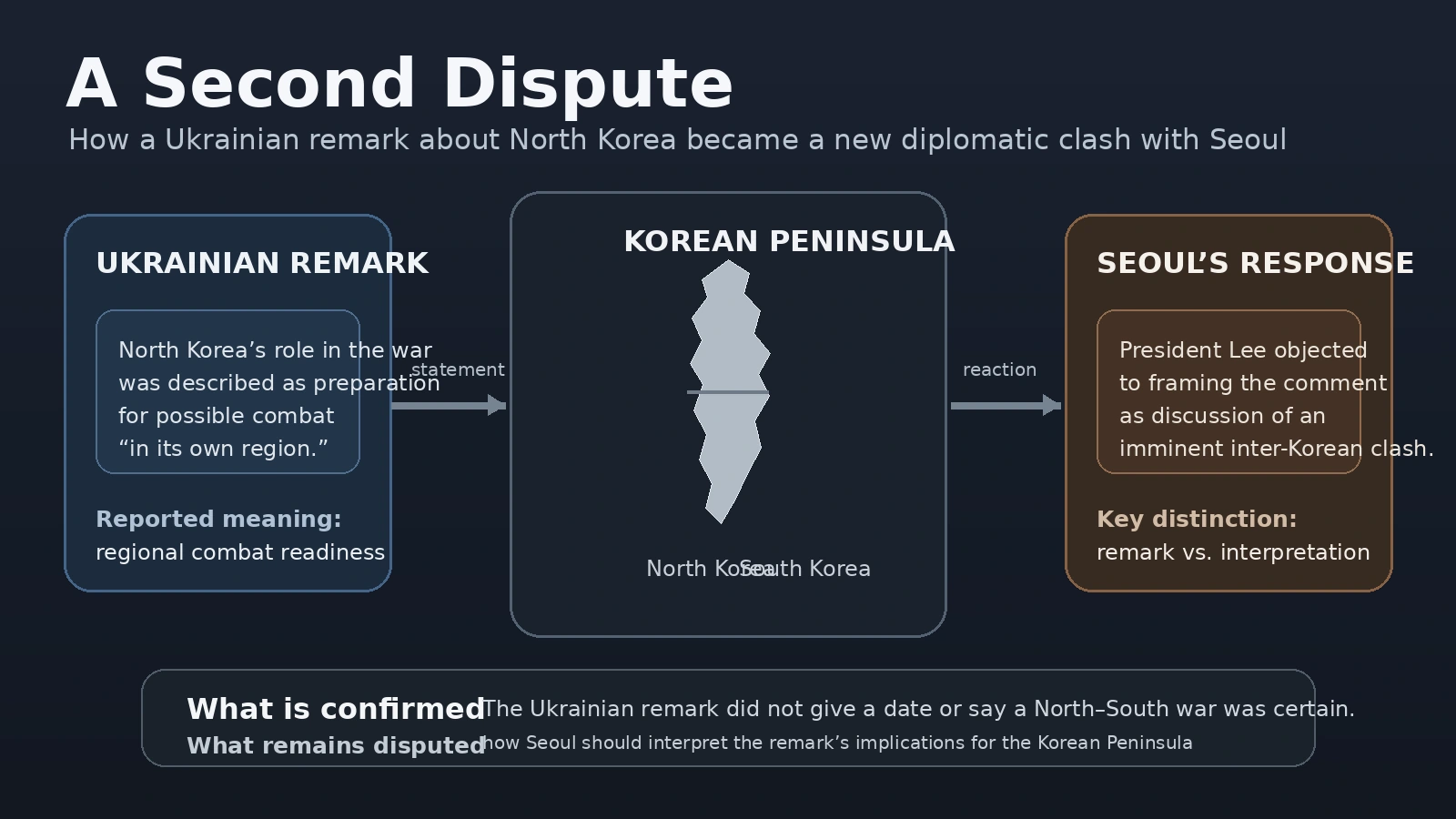
The POW dispute became more heated when Lee objected to comments from Kyrylo Budanov, head of Ukraine’s presidential office, about what North Korea may be learning from the war.
According to Yonhap, Budanov said North Korea’s involvement was “first and foremost, to be ready for active combat operations in its own region.” Lee then accused Ukraine of talking about the possibility of an imminent inter-Korean military clash and expressed serious regret, saying such rhetoric appeared to encourage war on the Korean Peninsula. (Yonhap · Reuters)
There is an important distinction here. The reported Ukrainian remark did not specify a date or say that a North–South Korean war was certain to occur. It framed North Korea’s participation in Ukraine as preparation for possible combat closer to home. Lee’s public response shows how Seoul interpreted that message—and why the diplomatic dispute grew beyond the original confidentiality question.
What Happens to the Two Soldiers Now?
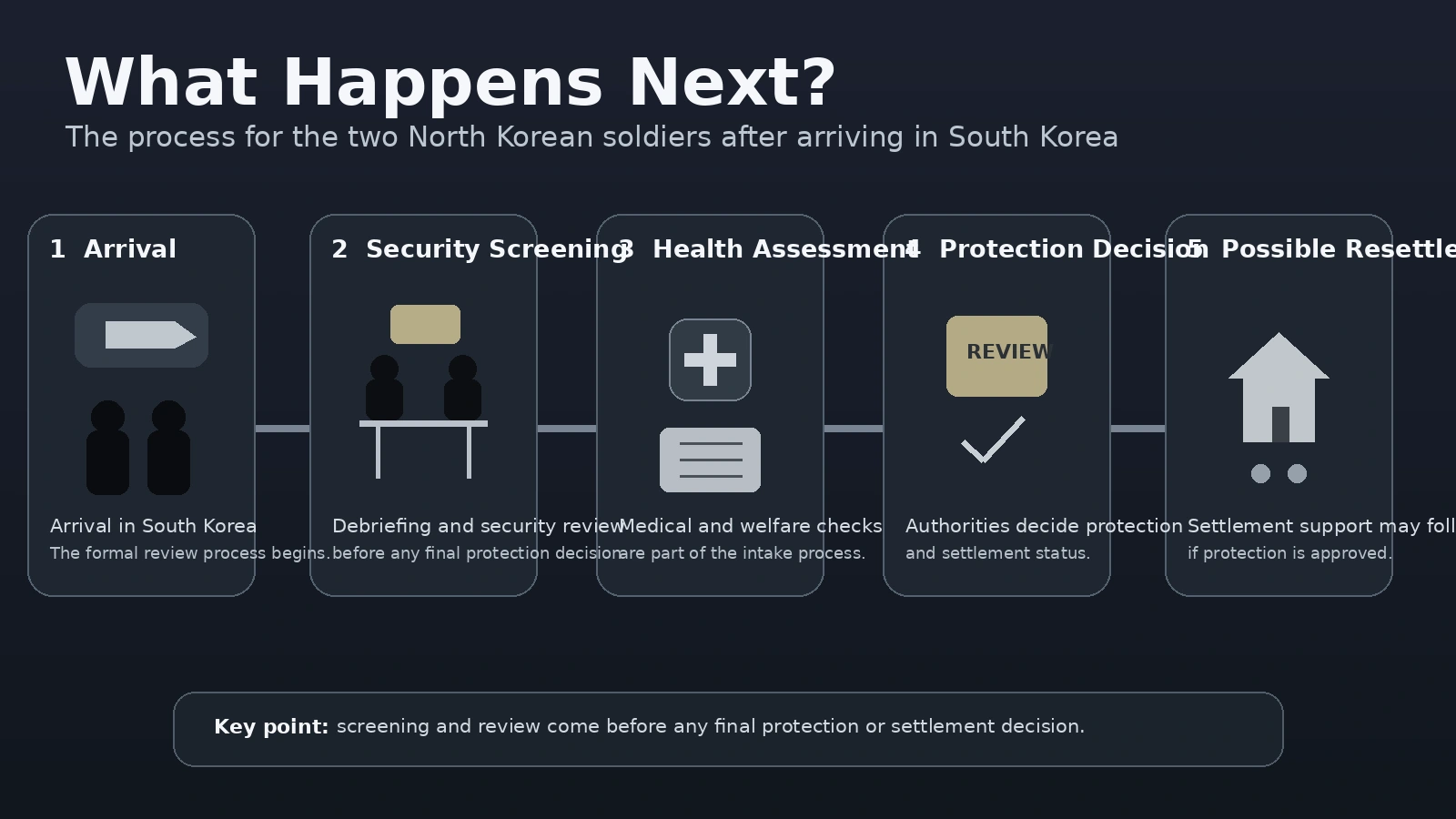
Their arrival in South Korea did not instantly end the process.
Reuters reported that South Korean authorities are expected to question and screen the soldiers under the country’s North Korean defector system, with the security-review and debriefing process potentially lasting up to 90 days. The government will then determine their protection and settlement status. (Reuters)
South Korea’s NIS told lawmakers that the two men arrived in mid-September and had no major health problems. Under South Korean law, the NIS investigates people held in temporary protective custody by checking their identities, reasons for leaving North Korea, and security-related concerns before a protection decision is made. (Yonhap · Reuters)
The relevant South Korean law defines a North Korean escapee as a person who left North Korea and has not acquired another nationality, and it provides a framework for deciding protection and settlement support. That framework also allows protection to be denied in specified cases, including certain serious crimes or security concerns. (Korean Law Information Center · Korean Law Information Center)
Why Does This Matter Beyond Two Soldiers?
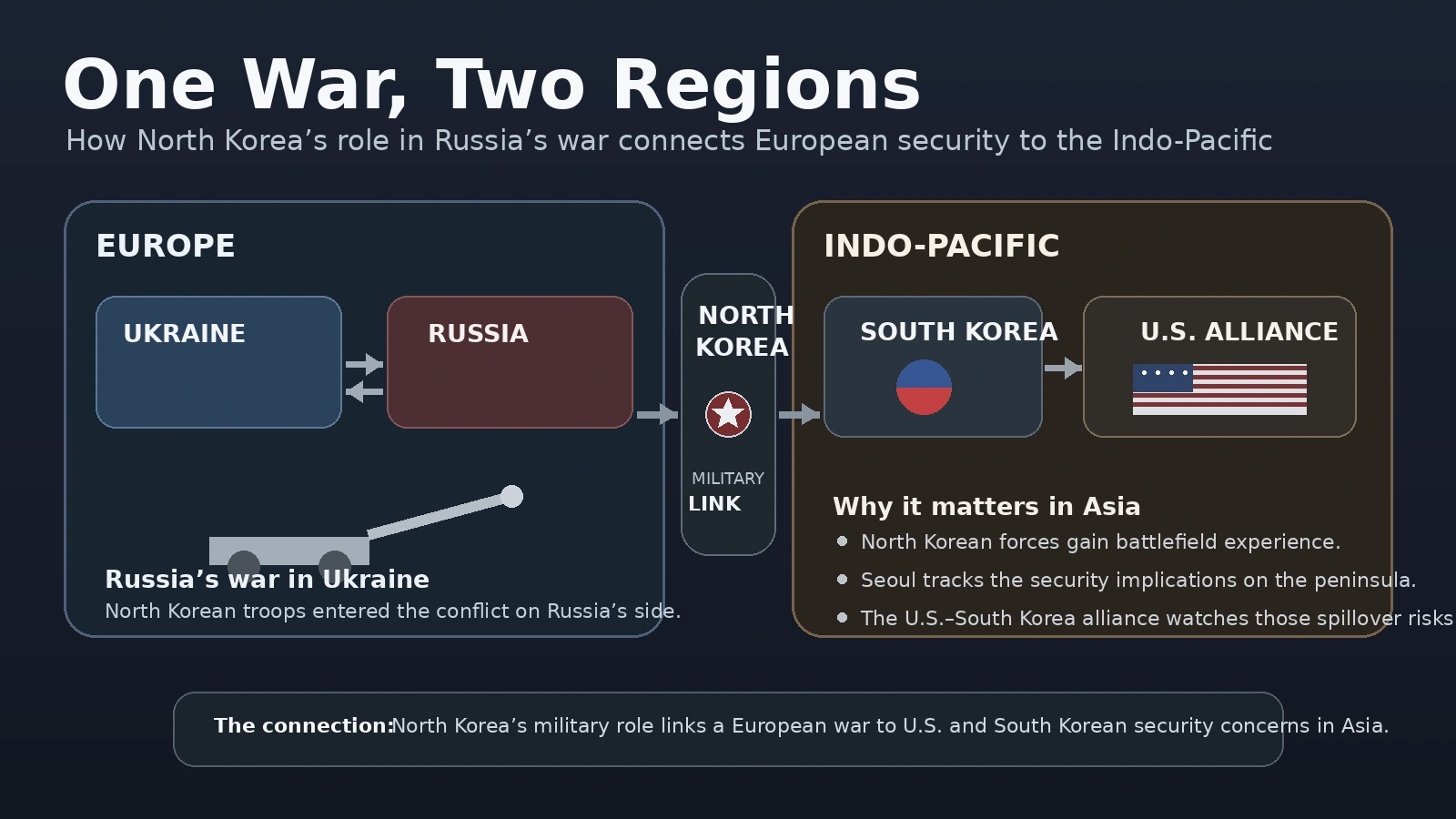
For an American reader, the larger story is how directly the war in Ukraine now connects to security in Northeast Asia.
North Korean troops have fought alongside Russia. Two of those troops were captured, chose South Korea rather than a return to the North, and are now at the center of a dispute between Kyiv and Seoul. That chain of events ties together Russia’s war, North Korea’s military development, South Korea’s security choices, and the interests of the United States, which has a treaty alliance with South Korea.
It also matters because Seoul and Kyiv still have practical reasons to cooperate. South Korea has provided Ukraine with humanitarian and other non-lethal support, and Lee announced a $100 million comprehensive support package during his July meeting with Zelenskyy. At the same time, Kyiv has information about North Korean forces gained directly from the battlefield. (Yonhap · Reuters)
That is why a complete rupture would carry costs for both sides. But as of October 2, South Korea has not publicly specified what Lee’s “additional measures” would be, and it would be premature to assume that aid cuts, sanctions, or another concrete step are already decided. (Reuters)
What Happens Next in the South Korea–Ukraine Dispute?
The immediate question is whether Kyiv will issue language that Seoul can accept as an acknowledgment and apology.
On October 2, a senior South Korean official said Foreign Minister Cho Hyun and Ukrainian Foreign Minister Andrii Sybiha were discussing the “proper message” Ukraine should deliver. Sybiha had already described the episode as a diplomatic misunderstanding and said Ukraine wanted it resolved quickly. (Yonhap · Reuters)
Four things are worth watching:
- Whether Ukraine acknowledges any confidentiality understanding, even if it continues to reject Seoul’s description of a formal agreement.
- Whether Kyiv issues an apology that South Korea considers sufficient.
- Whether Lee defines the “additional measures” he has threatened if the dispute continues.
- Whether the disagreement affects broader cooperation, including aid, reconstruction, intelligence sharing, or diplomatic coordination on North Korea and Russia.
For now, the two governments are still talking. That matters because the public rhetoric has become much sharper than the underlying diplomatic channel.
Bottom Line: What This Story Really Means
South Korea and Ukraine are not fighting over whether two North Korean POWs were transferred to Seoul. They are fighting over whether that transfer was supposed to stay secret, whether Ukraine broke that understanding, and whether Kyiv then wrongly denied that an agreement existed.
The transfer itself grew out of the soldiers’ stated wish to go to South Korea and a July agreement between Lee and Zelenskyy to handle their case according to humanitarian principles. The diplomatic crisis came later, when Zelenskyy publicly revealed the transfer at the U.N.
The next turning point is not on the battlefield. It is diplomatic: whether Ukraine gives Seoul an acknowledgment or apology that both sides can live with—and whether Lee turns his warning of “additional measures” into an actual policy change.
North Korean POWs: Key Questions Explained
Q. Why is South Korea angry with Ukraine over the two North Korean POWs?
South Korea says Ukraine violated a confidentiality understanding by publicly revealing the transfer and then denied that the agreement existed. Ukraine disputes Seoul’s description and has called the episode a diplomatic misunderstanding.
Q. Did Ukraine really transfer two captured North Korean soldiers to South Korea?
Yes. The two soldiers were captured by Ukrainian forces in Russia’s Kursk region in January 2025 and arrived in South Korea in mid-September 2026.
Q. Did the two soldiers want to go to South Korea?
According to South Korean and international reporting, yes. Their stated desire to go to South Korea was a central part of the negotiations, and Lee and Zelenskyy agreed in July to respect the POWs’ wishes while following international law and humanitarian principles.
Q. Was there a signed secrecy agreement between South Korea and Ukraine?
No signed document has been made public. Seoul says there was a clear confidentiality agreement or understanding and says Ukraine initially requested secrecy; Ukraine has denied that a separate nondisclosure agreement existed.
Q. Why were the soldiers not simply sent back to North Korea?
Their own wishes matter, and international humanitarian law does not make forced repatriation a simple automatic rule in a case like this. ICRC commentary recognizes situations in which POWs refuse repatriation because they fear punishment or persecution, although the exact legal basis for this mid-war transfer has not been fully disclosed.
Q. What happens to the soldiers in South Korea now?
They are expected to undergo security screening, debriefing, and a protection review before any final settlement decision. Reuters reported that this process could take up to 90 days.
Q. Did South Korea promise weapons or military aid in exchange for the transfer?
No such deal has been established. South Korea’s NIS told lawmakers that there was no military-aid pledge tied to accepting the two soldiers.
Q. Why did Zelenskyy reveal the transfer at the United Nations?
Zelenskyy used the transfer as part of a broader argument about North Korea’s military involvement in Russia’s war. South Korea’s intelligence service assessed that the disclosure may also have been intended to build support in South Korea for greater assistance to Ukraine, but that remains an assessment rather than a proven Ukrainian motive.
Q. What are Lee Jae Myung’s “additional measures” against Ukraine?
As of October 2, Lee has not publicly specified them. No particular aid cut, sanction, or diplomatic step should be treated as decided until Seoul announces one.
Did this help make the story clearer? 🙂
WIN keeps unpacking the “why” behind the news—clearly and simply!
Sources
Transfer, Disclosure, and the Diplomatic Dispute
Reuters — South Korea’s Lee threatens action against Ukraine over transfer of North Korean soldiers
Reuters — Ukrainian minister hopes to heal “misunderstanding” with South Korea
AP — Seoul demands an apology after Zelenskyy reveals North Korean POWs were sent to South Korea
Yonhap — South Korea and Ukraine’s foreign ministers discuss a response to the POW transfer dispute
Reuters — South Korea made no military aid pledge to Ukraine over the POW transfer
U.N. Disclosure and Confidentiality Claims
United Nations — Transcript of Zelenskyy’s General Assembly address
President of Ukraine — Address at the General Debate of the U.N. General Assembly
Yonhap — NIS says Ukraine first requested confidentiality over the transfer
AP — South Korean intelligence assessment of why the transfer may have been disclosed
POW Status, Repatriation, and Resettlement
Reuters — What comes next for the North Korean soldiers transferred to South Korea
ICRC — Commentary on Article 118 of the Third Geneva Convention
Korean Law Information Center — North Korean Defectors Protection and Settlement Support Act
Korean Law Information Center — Article 9 protection decision criteria
Earlier South Korea–Ukraine Agreement on the POWs
Yonhap — Lee and Zelenskyy agree to handle the North Korean POW issue on humanitarian grounds