U.S.-China Deal: What the $30 Billion Tariff Plan and New AI Incident Channel Actually Change
Thirty billion dollars in tariff relief sounds like a major breakthrough.
So did the United States and China just start ending their trade war?
Not exactly.
And there is another part of the agreement that may sound even stranger: Washington and Beijing, two governments competing intensely over artificial intelligence, agreed to create a channel for communicating about AI-related incidents.
That does not mean either side is preparing to share its most advanced technology with the other.
What emerged from Chinese President Xi Jinping’s September visit to Washington is better understood as something narrower: the two countries are trying to separate areas where they can reduce friction from areas where they still consider each other strategic competitors.

The distinction matters because some of the biggest U.S.-China disputes—advanced technology, rare-earth supply chains and broader national-security competition—remain unresolved. (White House · Chinese government)
What Actually Came Out of the Trump-Xi Summit?
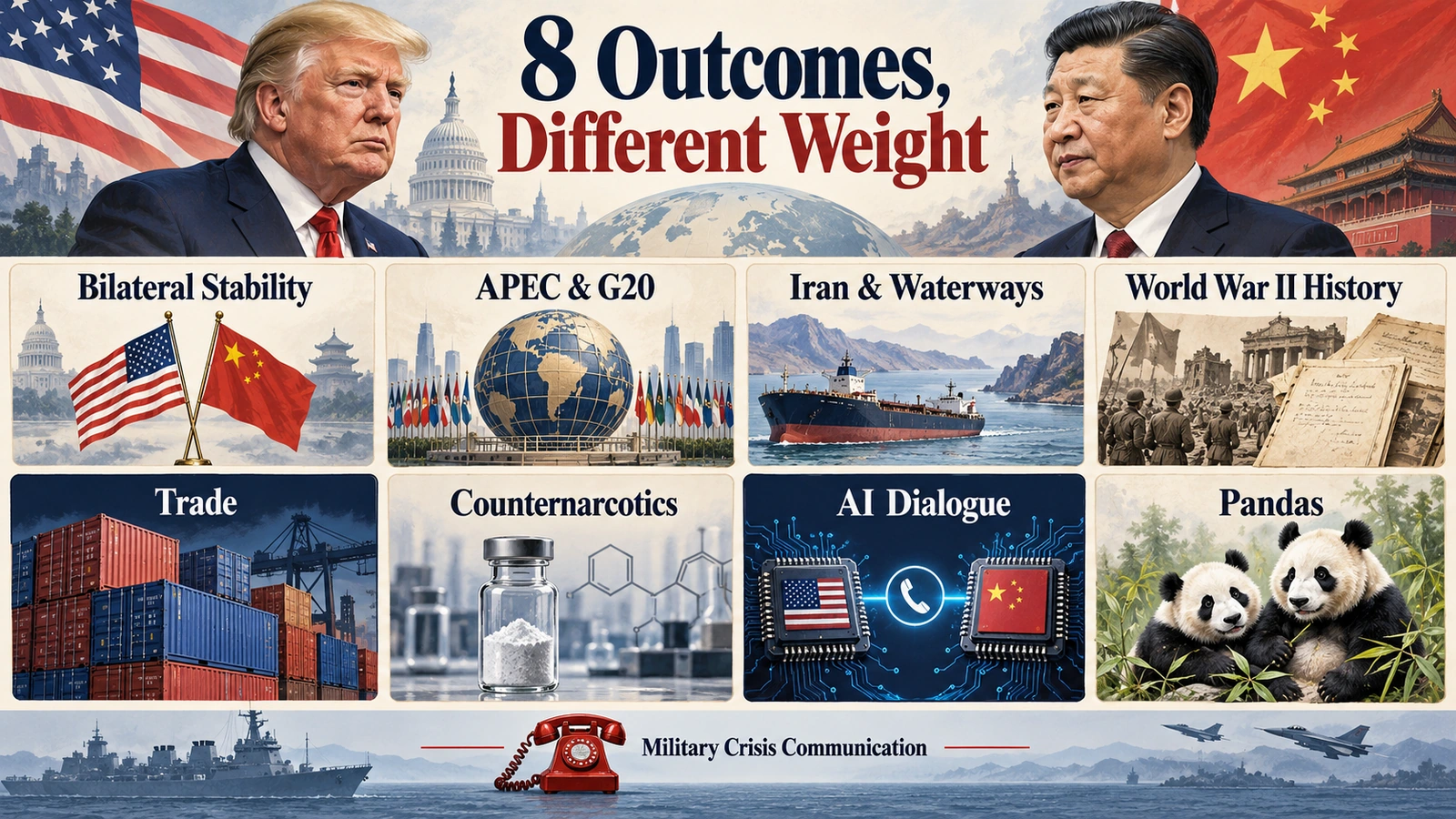
Beijing described the visit as producing eight “deliverables and understandings.” The White House released its own fact sheet rather than presenting the outcome in exactly the same eight-point format.
That difference in wording is worth noticing. Calling something an “eight-point deal” can make the summit sound more comprehensive than the underlying documents actually show.
Here is the clearest way to organize what was announced:
| Area | What was announced |
|---|---|
| Bilateral relationship | Both sides endorsed language about maintaining a constructive relationship with strategic stability |
| APEC and G20 | The leaders signaled support for each other’s upcoming major summits |
| Iran and waterways | Both said Iran should not develop a nuclear weapon and opposed tolls being imposed on international waterways |
| Historical symbolism | Both governments highlighted U.S.-China cooperation during World War II |
| Trade | The countries moved forward with the Board of Trade and tariff relief involving about $30 billion of non-sensitive goods in each direction |
| Counternarcotics | Both highlighted recent cooperation involving synthetic-drug precursors and law enforcement |
| AI | They agreed to continue an AI-focused dialogue and establish a channel for AI-related incidents |
| Pandas | The United States welcomed two pandas being leased to Zoo Atlanta |
The Chinese readout also said the two militaries would work toward a memorandum on crisis communication and prevention.
So the summit was not one giant trade agreement.
It was a collection of economic, technological, law-enforcement and crisis-management measures designed to keep parts of an increasingly competitive relationship functioning. (Chinese government · CBS/AP)
Does the $30 Billion Figure Mean $30 Billion in Tariffs Disappeared?
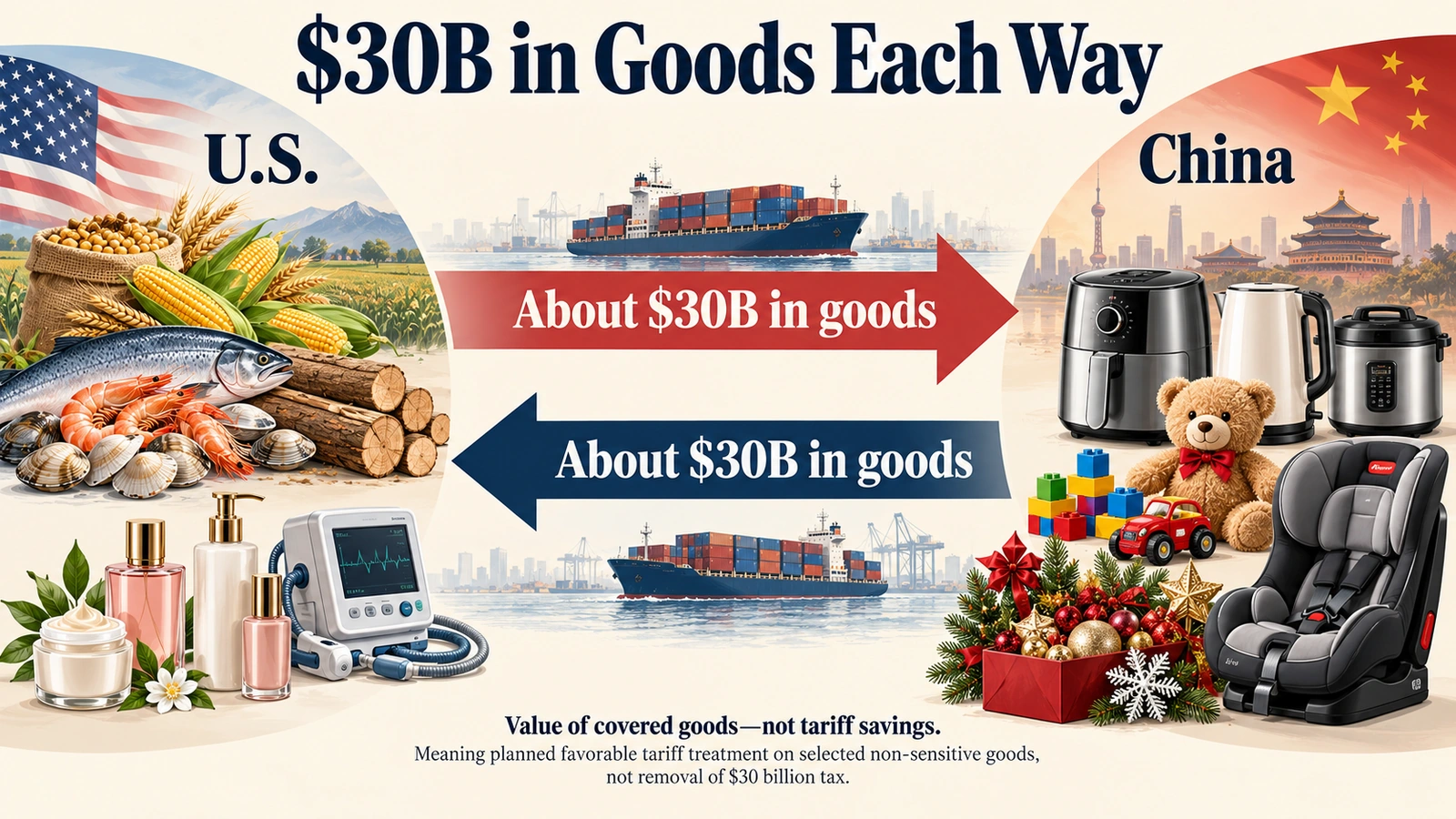
No. The $30 billion figure refers to the value of goods covered by the planned favorable tariff treatment—not $30 billion in tariff payments being erased.
The White House said the two countries reached consensus on recommendations for more favorable tariff treatment covering about $30 billion of non-sensitive goods in each direction.
For U.S. exports to China, the White House listed products including:
- agricultural goods
- fish and seafood
- logs and wood products
- cosmetics
- medical devices
For Chinese exports entering the United States, examples included:
- small appliances
- toys
- holiday decorations
- children’s car seats
That means roughly $30 billion of U.S. exports and roughly $30 billion of imports from China could receive better tariff treatment under the mechanism.
But the White House fact sheet did not publish a complete product-by-product schedule showing every new tariff rate and implementation date. (White House)
That is why “the two countries cut $30 billion in tariffs” would be misleading.
The more accurate description is: they agreed to provide more favorable tariff treatment to a selected pool of trade worth about $30 billion in each direction.
Why Are They Lowering Tariffs on Toys and Farm Goods but Still Fighting Over Technology?

Because the new approach is built around a distinction between “non-sensitive” trade and strategically sensitive sectors.
That distinction was already part of the U.S.-China Board of Trade concept months before the summit.
In June, the Office of the U.S. Trade Representative asked for public input on goods that could receive tariff modifications while saying the United States would continue using tariffs where officials believe economic or national-security interests require them. (USTR)
Think of the strategy as two lanes.
| Lower-friction lane | Strategic-competition lane |
|---|---|
| Agricultural products | Advanced technology |
| Seafood | Sensitive semiconductor-related issues |
| Cosmetics | Critical minerals |
| Toys | National-security restrictions |
| Small appliances | Supply-chain leverage |
The summit widened the first lane.
It did not eliminate the second.
The White House specifically said Washington and Beijing are still working on U.S. concerns involving rare earths and other critical minerals. That is a direct sign that some of the most strategically important trade disputes remain open. (White House)
This is why the agreement can contain real tariff relief without representing a return to the much more integrated U.S.-China economic relationship of earlier decades.
Why Would Two AI Rivals Want an Emergency Communication Channel?

Because a race can become dangerous even when neither side wants to stop racing.
Before the summit, U.S. and Chinese officials were already discussing whether the two governments needed a way to communicate when a serious AI event created national-security concerns.
The issues being discussed included risks such as cyberattacks, misuse of powerful systems and incidents affecting critical infrastructure. (AP · Reuters)
After the summit, the idea became more concrete.
The White House said the two countries established what it calls the U.S.-China Super Intelligence Dialogue, with another exchange expected by November 2026, and agreed to establish a bilateral channel for incidents involving those technologies.
Beijing’s readout uses the more familiar term AI Dialogue. (White House · Chinese government)
What the channel does not appear to mean is just as important.
There has been no announcement that the United States and China will share advanced models, chips, training methods or proprietary technology.
Nor does the incident channel mean Washington has abandoned its goal of maintaining a technological advantage over China.
It is closer to a crisis-management mechanism: keep competing, but create a way to communicate if something goes badly wrong.
The unresolved questions now concern how an “AI incident” will be defined, who will activate the channel and what information each government will actually be willing to disclose.
Those details have not yet been fully published.
Could Americans Actually Notice the Tariff Changes?

Possibly—but not necessarily in a dramatic way.
For American exporters, lower Chinese tariffs on selected products could make some U.S. goods more competitive in China.
That could matter to industries such as agriculture, seafood, forestry, cosmetics and medical devices.
For American consumers, more favorable U.S. tariff treatment for selected Chinese products could reduce import costs for businesses bringing in items such as toys or small appliances.
But a lower tariff does not automatically mean an identical reduction on a store shelf.
The effect depends on several steps:
tariff rate → importer cost → wholesale pricing → retailer pricing → consumer price
Businesses can absorb some of a tariff change, pass it through to customers or divide the difference across the supply chain.
And because the announced arrangement focuses on selected non-sensitive goods rather than most U.S.-China trade, it would be a mistake to assume that the deal will broadly reverse the price effects of years of tariff conflict.
The agreement is economically meaningful.
It is simply much narrower than the phrase “U.S.-China tariff deal” can make it sound.
So Is the U.S.-China Trade War Ending?
No.
The latest agreements look more like an attempt to manage the rivalry than to end it.
The two governments are making it easier to trade selected goods, creating mechanisms for investment discussions, talking about AI risks, coordinating in limited areas of law enforcement and working on military crisis communication.
At the same time, Washington still has unresolved concerns about rare-earth supplies and strategic technology.
China still objects to U.S. restrictions that it views as attempts to constrain its development.
And competition over technological power and geopolitical influence has not disappeared.
This pattern may be the most important part of the summit.
For years, discussion of U.S.-China relations often sounded binary: cooperation or confrontation, engagement or decoupling.
The structure emerging now is more complicated.
The two governments can reduce tariffs on toys while continuing to compete over advanced technology. They can disagree over global power while still deciding that an AI crisis requires a phone line.
That is not reconciliation.
It is an effort to keep competition from turning every dispute into a full-scale confrontation.
What Should We Watch Next?
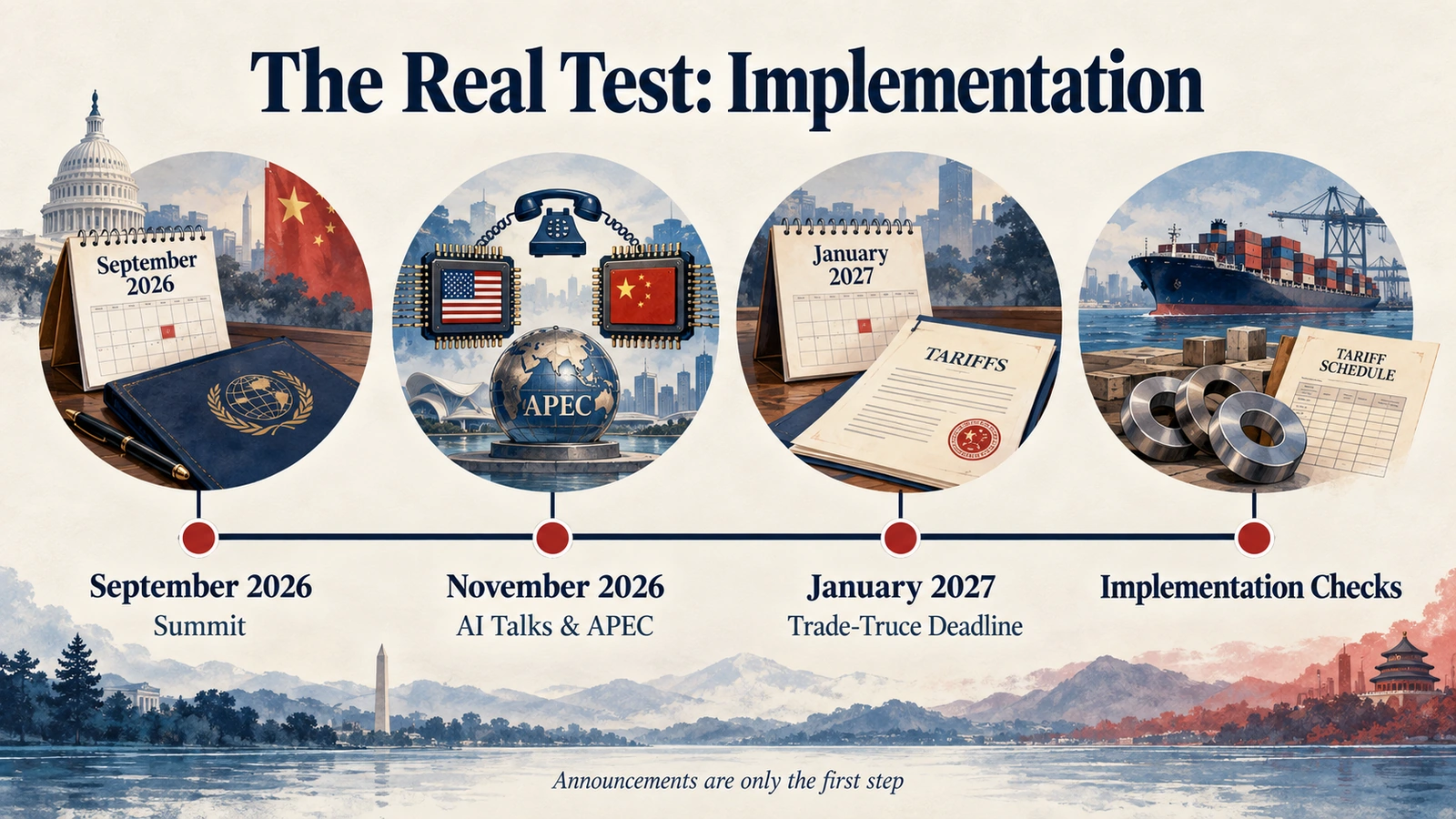
The next stage is much less dramatic than a presidential summit—and probably more important.
Watch whether the announced mechanisms actually begin operating.
The key checkpoints include:
- Tariff schedules: Which products receive lower rates, by how much and when?
- Trade volumes: Do U.S. exports covered by the arrangement actually increase?
- Rare earths: Do U.S. officials report more reliable access to critical-mineral supplies?
- AI dialogue: Does the planned November exchange establish practical rules for the incident channel?
- Military communication: Do the two militaries complete the planned crisis-management memorandum?
- The broader trade truce: Does the current pause lead to a larger agreement or another temporary extension?
The U.S. and China had already been developing the Board of Trade before Xi’s visit, meaning the September summit is not the beginning of this process. It is another step in trying to turn earlier political promises into working mechanisms. (USTR · White House)
A summit announcement tells us what leaders want to do.
Cargo movements, tariff schedules, rare-earth shipments and an AI incident channel that actually works will tell us what changed.
Bottom Line: What This Story Really Means
The United States and China have not ended their trade or technology rivalry.
What they have done is identify a limited group of areas where both governments believe cooperation—or at least lower friction—is useful.
Selected non-sensitive goods worth about $30 billion in each direction are expected to receive more favorable tariff treatment. A new U.S.-China AI dialogue and incident communication channel is intended to give the two governments a way to discuss risks even while they continue competing for technological leadership.
The easiest way to understand the summit is this:
Washington and Beijing are not trying to become strategic partners. They are trying to build guardrails around a strategic rivalry.
U.S.-China Deal: Key Questions Explained
Q. Did the United States and China remove $30 billion in tariffs?
No. The announced figure refers to roughly $30 billion worth of goods in each direction that are expected to receive more favorable tariff treatment. It does not mean the governments eliminated $30 billion in tariff revenue.
Q. Which U.S. products are included in the tariff arrangement?
The White House listed agricultural goods, fish and seafood, logs and wood products, cosmetics and medical devices among the U.S. exports covered by the planned favorable treatment.
Q. Which Chinese goods could receive lower U.S. tariffs?
The White House listed consumer products including small appliances, toys, holiday decorations and children’s car seats.
Q. Does the tariff agreement cover semiconductors and other sensitive technology?
The announced arrangement is specifically focused on non-sensitive goods. Broader strategic disputes involving advanced technology and critical supply chains remain separate.
Q. Did the United States and China create an AI hotline?
They agreed to establish a bilateral communication channel for AI-related incidents and to continue a formal dialogue on AI risks and benefits. The detailed operating rules for that channel have not yet been fully published.
Q. Why would the United States cooperate with China on AI safety?
Because competition and crisis management are different issues. The two countries can continue competing for technological leadership while still deciding that serious AI-related incidents may require direct communication.
Q. Are U.S.-China rare-earth disputes resolved?
No. The White House said the countries are still working on U.S. concerns involving rare earths and other critical minerals.
Q. Does this mean imported goods in the United States will become cheaper?
Not necessarily. Lower tariffs can reduce an importer’s cost, but the final retail price also depends on wholesalers, retailers, exchange rates and other costs.
Q. Is the U.S.-China trade war over?
No. The latest agreements reduce friction in selected areas but leave major economic, technological and geopolitical disputes unresolved.
Q. What matters most after the summit?
Implementation. The important evidence will be actual tariff schedules, trade flows, rare-earth shipments, operation of the AI incident channel and continued crisis-management talks.
Did this help make the story clearer? 🙂
WIN keeps unpacking the “why” behind the news—clearly and simply!
Sources
Summit Outcomes and Official Agreements
White House — Fact Sheet on Xi Jinping’s September 2026 State Visit
Chinese Government — China and the United States Reach Eight Deliverables and Understandings
CBS/AP — Trump and Xi Agree to Set Up AI Safety Channel as Trade and Military Talks Continue
Trade Mechanism and Tariff Background
USTR — Public Comment Process for the U.S.-China Board of Trade
Reuters — Beijing Seeks Input on Planned U.S.-China Tariff Cuts
AI Competition and Crisis Communication
AP — Why the U.S. and China Can Compete on AI While Sharing Safety Concerns
Reuters — U.S. and China Plan Further Talks on AI Safety and Incident Communication
Keep Reading
What Was Trump and Xi’s Washington Summit Supposed to Accomplish?
Before the agreements were announced, the biggest question was whether earlier promises on trade, rare earths, agriculture and AI would turn into concrete action. The pre-summit picture makes it easier to see what actually changed during Xi’s visit.
Trump and Xi Meet in Washington—What Is Actually on the Table?