Why Did U.N. Delegates Walk Out on Netanyahu—and What Did the Protest Actually Mean?
Why were so many diplomats getting up before Benjamin Netanyahu had even started speaking?
Was this simply an unusually rude reception for Israel’s prime minister—or had governments actually planned the scene in advance?
The answer is important: the September 24 walkout was not merely a spontaneous reaction inside the room. The Palestinian Mission to the United Nations had urged representatives from other member states to participate in a collective walkout when Netanyahu was announced. Dozens of delegates then left the General Assembly hall as he approached the podium. (Associated Press)
Netanyahu still delivered his speech. Supporters in the chamber responded with cheers, while he called those who had left “moral cowards.” The walkout did not cancel his address or remove Israel’s place in the General Debate. (The Guardian)

That distinction is what makes the scene easier to understand.
Walking out was a diplomatic message—not a U.N. punishment.
Was the Netanyahu Walkout Spontaneous?
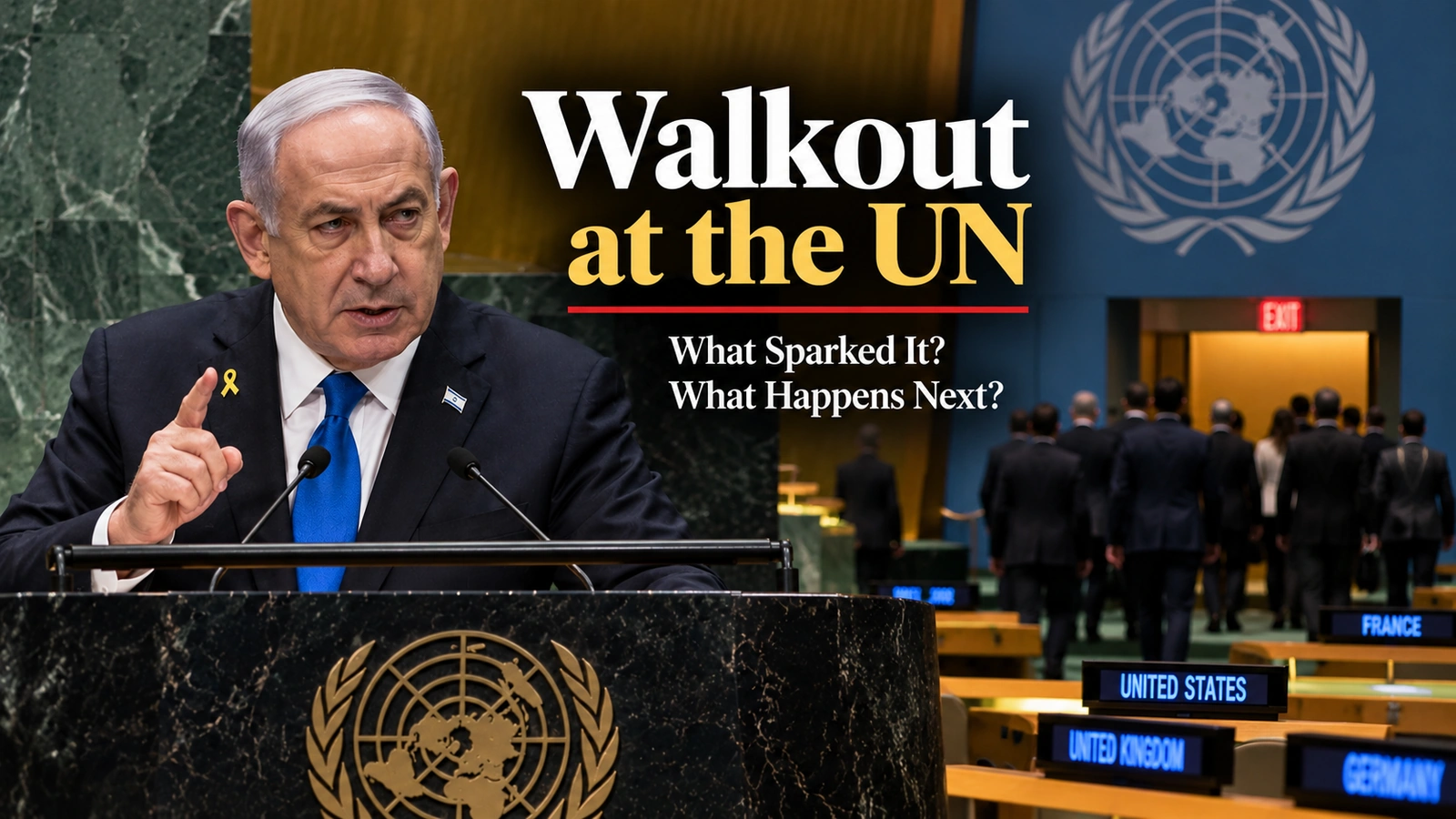
No. At least part of it was deliberately coordinated.
According to Associated Press reporting, the Palestinian Mission contacted many of the U.N.’s 193 member states and encouraged them to bring representatives into the chamber and then “collectively walk out” when Netanyahu was announced. (Associated Press)
That does not mean the United Nations as an institution organized the protest.
The General Assembly presidency, U.N. Secretariat and Palestinian Mission are different actors. The invitation came from the Palestinian diplomatic mission, while individual national delegations decided whether to participate.
Reuters reported that dozens left when Netanyahu began his address, while others remained and some supporters applauded him. (Reuters)
So the simplest description is:
It was a coordinated diplomatic protest carried out by participating delegations, not an official U.N. action against Israel.
What Was Netanyahu Saying as Diplomats Left?
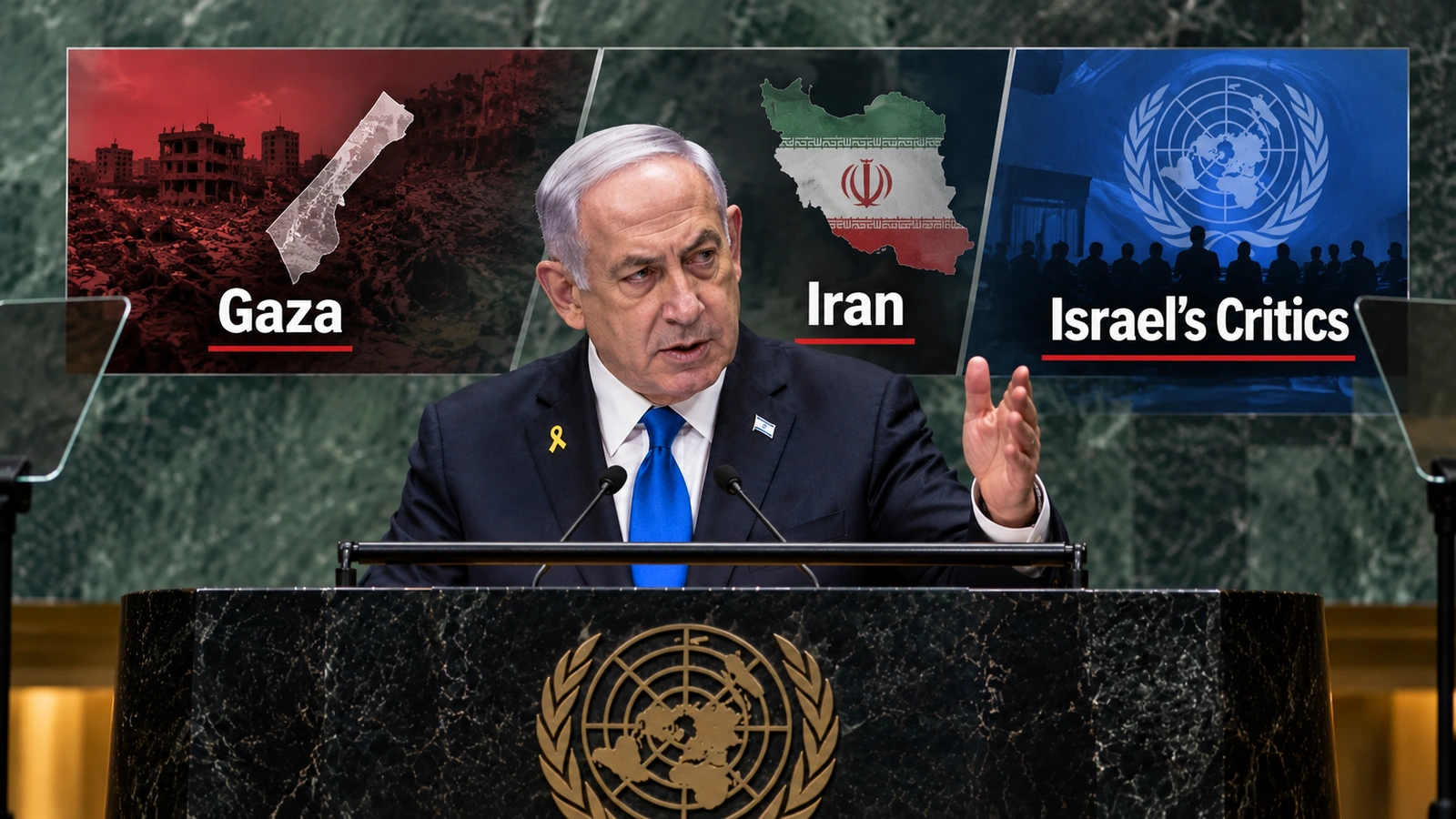
The walkout and the speech were connected—but not in exactly the way a short video clip might suggest.
Netanyahu used the address to defend Israel’s military actions in the region. He rejected accusations that Israel had committed genocide in Gaza, defended the decision to attack Iran and praised U.S. President Donald Trump’s support for Israel. Reuters described the address as a forceful defense of Israel amid mounting international criticism. (Reuters)
The Palestinian Mission framed the organized walkout around Gaza, Palestinian rights and opposition to Israel’s conduct in Palestinian territories. Its appeal cited allegations of genocide, war crimes and occupation. Israel rejects allegations that it has committed genocide or war crimes in Gaza. (Associated Press)
That is an important distinction.
Iran was central to what Netanyahu chose to emphasize.
The Palestinian Mission framed the walkout around Gaza, alleged war crimes and occupation.
Why Has Gaza Turned Netanyahu’s U.N. Appearances Into Such a Flashpoint?
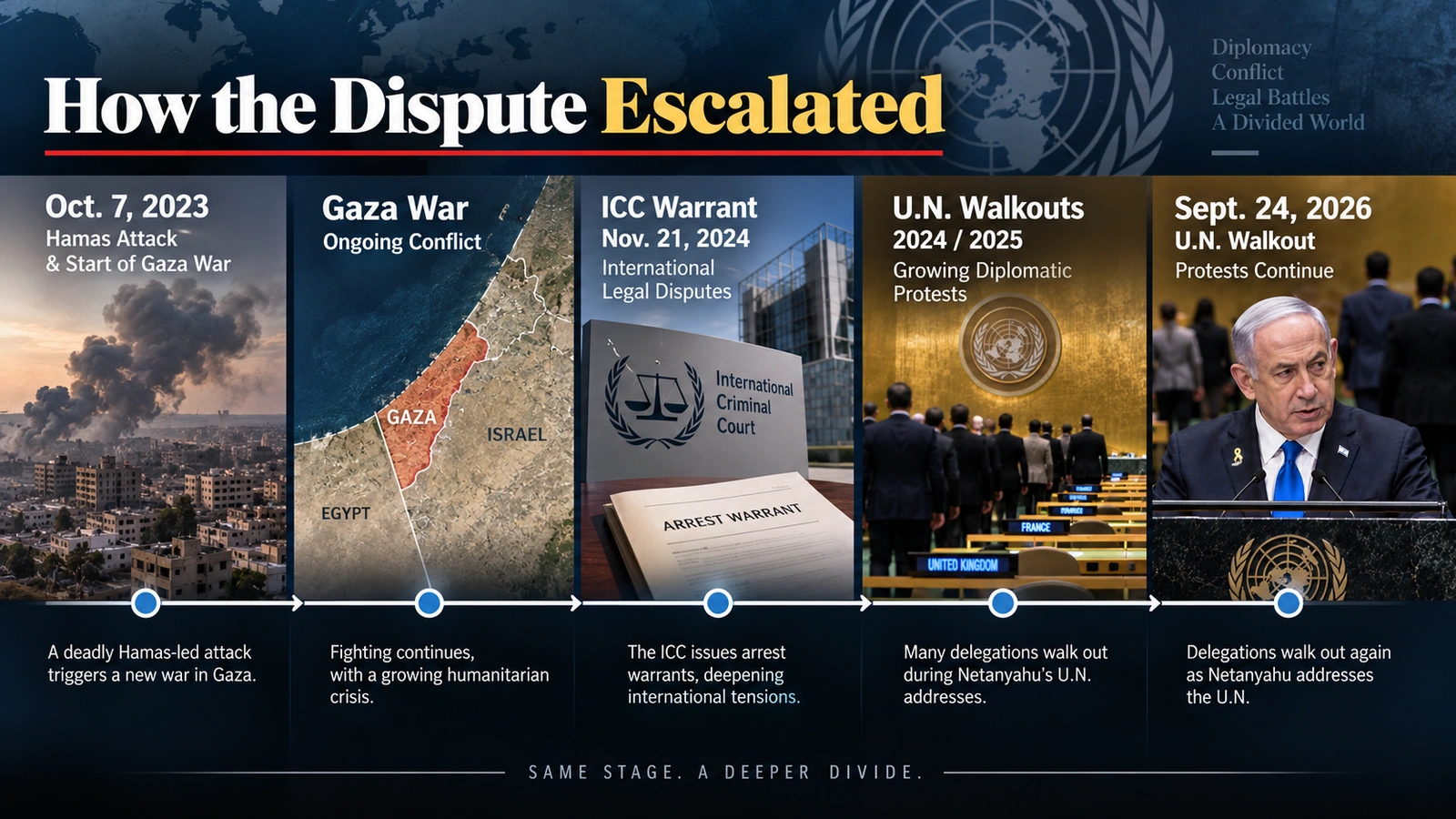
Because the argument is no longer only about the original attack that triggered the war.
The Hamas-led October 7, 2023 attack killed about 1,200 people in Israel and resulted in 251 people being taken hostage, according to Israeli figures cited by Reuters. Israel then launched a major military campaign in Gaza. By September 2026, Gaza health authorities reported more than 73,000 Palestinian deaths; Israel has disputed accusations that its campaign constitutes genocide and says it targets Hamas. (Reuters)
Over time, the dispute expanded into several different arenas: ceasefire negotiations, humanitarian access, Palestinian statehood, arms policy, sanctions, U.N. debates and international court proceedings.
One of those legal proceedings directly involves Netanyahu.
The International Criminal Court issued an arrest warrant for him on November 21, 2024. The ICC says Netanyahu is alleged to bear responsibility for war crimes and crimes against humanity connected with the Gaza conflict. The court currently lists him as “at large.” An arrest warrant is not a conviction. (ICC)
That legal background helps explain why a Netanyahu appearance now carries meaning far beyond an ordinary national speech at the U.N.
Does Walking Out of a U.N. Speech Actually Do Anything?
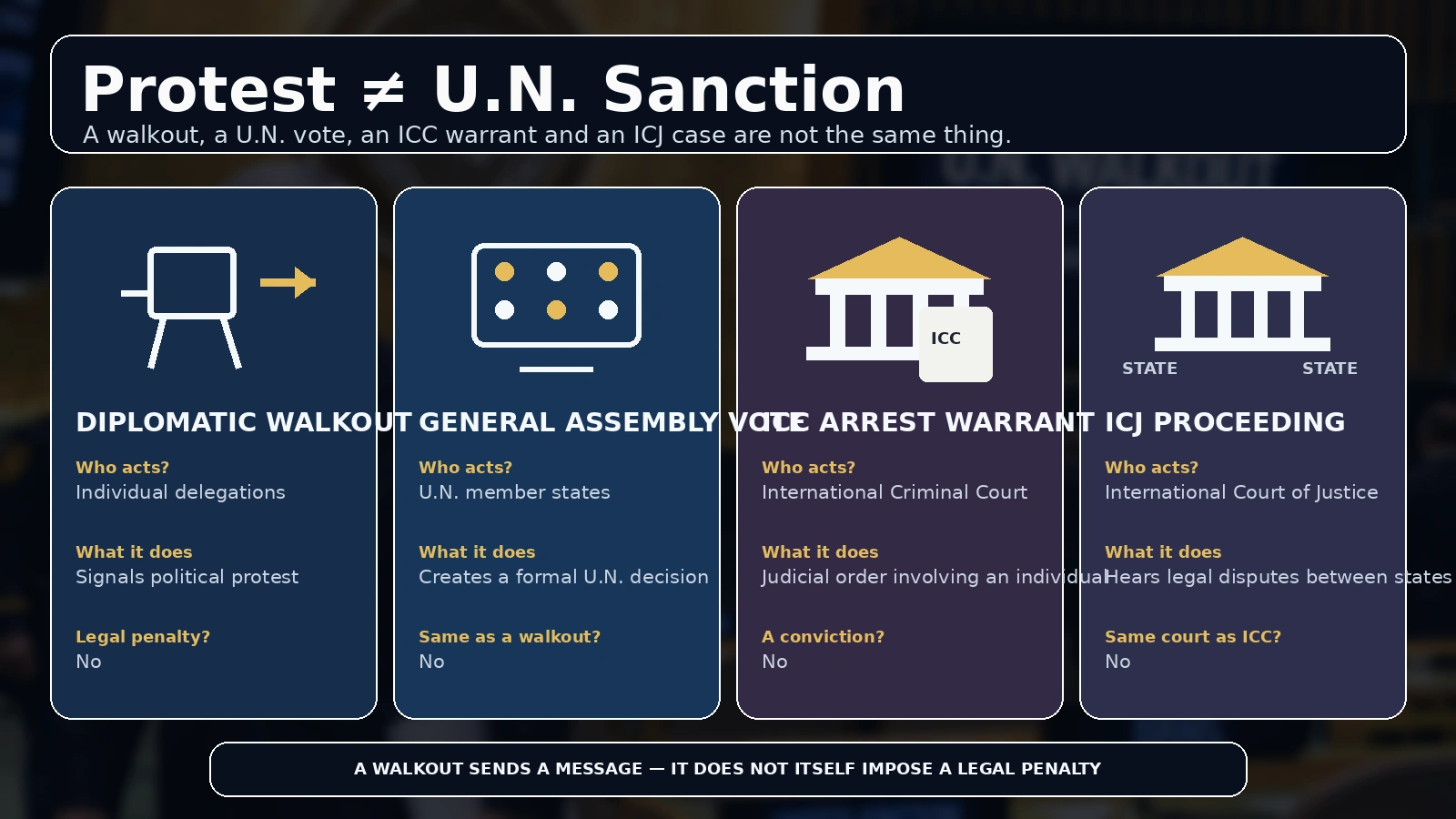
Politically, yes. Procedurally, much less.
A walkout makes a visible statement: we do not want our delegation sitting in the room while this leader speaks.
But leaving the chamber is not itself a General Assembly vote, resolution, sanction or court ruling.
The U.N. General Debate is a forum in which heads of state, heads of government and other high-level representatives present their governments’ positions. U.N. rules separately govern speeches, quorum, motions and voting. Netanyahu therefore continued speaking after the delegates left. (United Nations)
Here is the distinction:
| Action | Who does it? | What it means |
|---|---|---|
| Diplomatic walkout | Individual national delegations | A visible political protest; it does not itself impose a legal penalty |
| General Assembly decision or vote | U.N. member states acting through Assembly procedures | A formal institutional decision under U.N. rules |
| ICC arrest warrant | International Criminal Court | A judicial order concerning an individual accused of crimes within the court’s jurisdiction |
| ICJ proceeding | International Court of Justice | A legal dispute primarily between states, including disputes over treaty obligations |
The images of empty seats were therefore powerful precisely because the action was symbolic rather than procedural.
The delegations could not prevent Netanyahu from speaking simply by leaving.
What they could do was make the empty chamber part of the story.
Is the ICC Warrant the Same as the Gaza Genocide Case?

No. They are two different courts dealing with different legal questions.
The International Criminal Court, or ICC, prosecutes individuals. Its warrant for Netanyahu concerns alleged war crimes and crimes against humanity. (ICC)
The International Court of Justice, or ICJ, hears disputes between states. South Africa brought a case accusing Israel of violating the Genocide Convention in Gaza. The ICJ issued provisional measures in 2024 requiring Israel to take specified steps under the convention while the litigation proceeded. Those provisional orders were not a final judgment that Netanyahu personally was guilty of genocide. (ICJ)
That difference matters whenever the word “genocide” appears in discussions of Netanyahu.
A diplomatic accusation, an ICC arrest warrant and an ICJ proceeding are not three versions of the same legal decision.
They involve different institutions, different defendants and different legal standards.
Was This the First Time Diplomats Walked Out on Netanyahu?
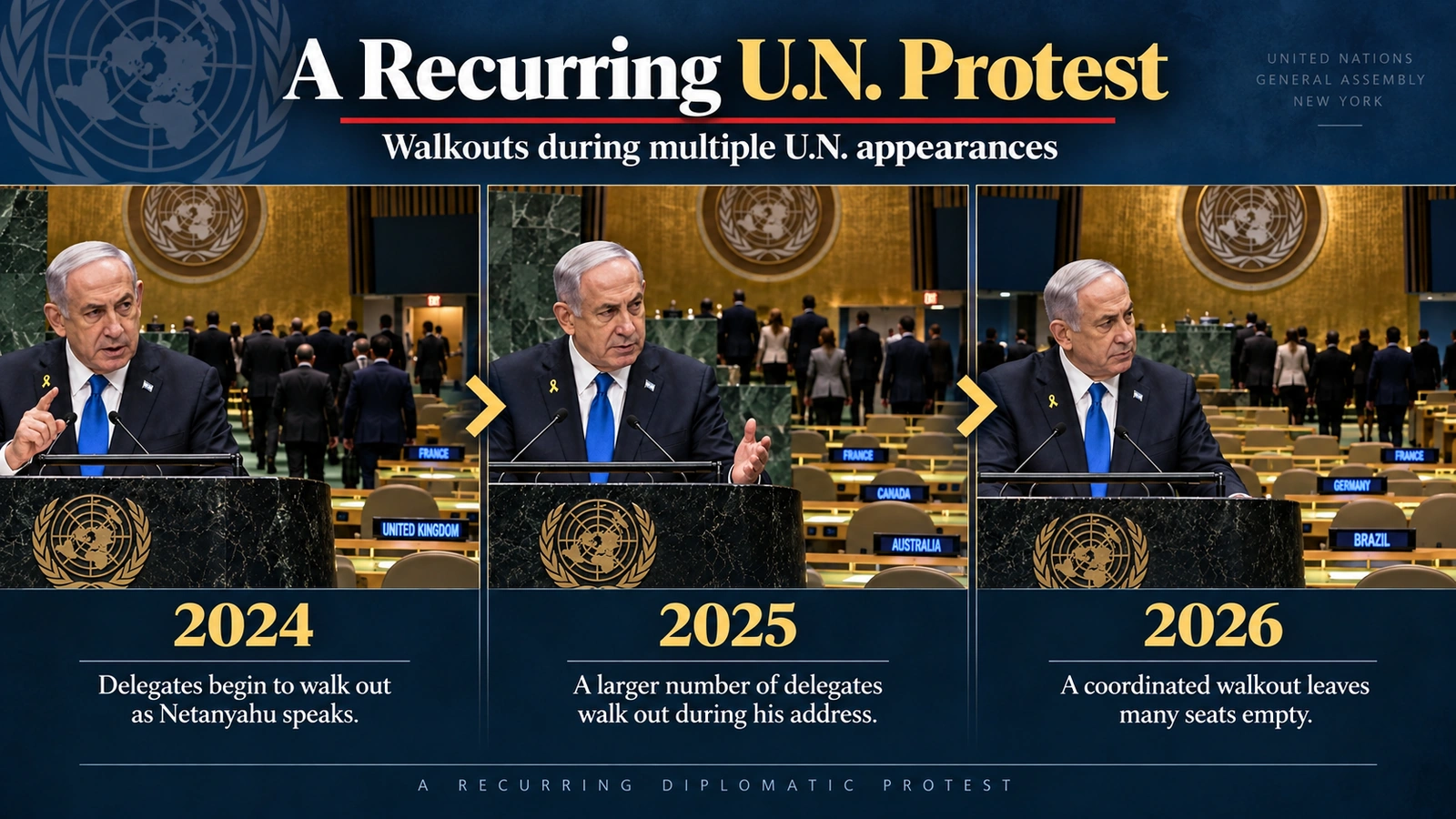
No.
Delegates also walked out during Netanyahu’s September 2024 U.N. address as he defended Israel’s military campaign and confronted criticism over Gaza and Lebanon. (Reuters)
Another walkout occurred during his September 2025 General Assembly speech. U.N. coverage described delegations leaving as Netanyahu took the podium, while Reuters reported similar scenes amid disputes over Gaza and Palestinian statehood. (United Nations)
The repeated scenes matter because they show that the September 2026 protest did not suddenly emerge from one controversial sentence Netanyahu delivered that day.
It reflects a diplomatic confrontation that has been building across successive General Assembly meetings.
What was especially clear in 2026 was the organized effort to make the act of leaving itself part of the political message.
Why Should Americans Care About Empty Seats at the U.N.?
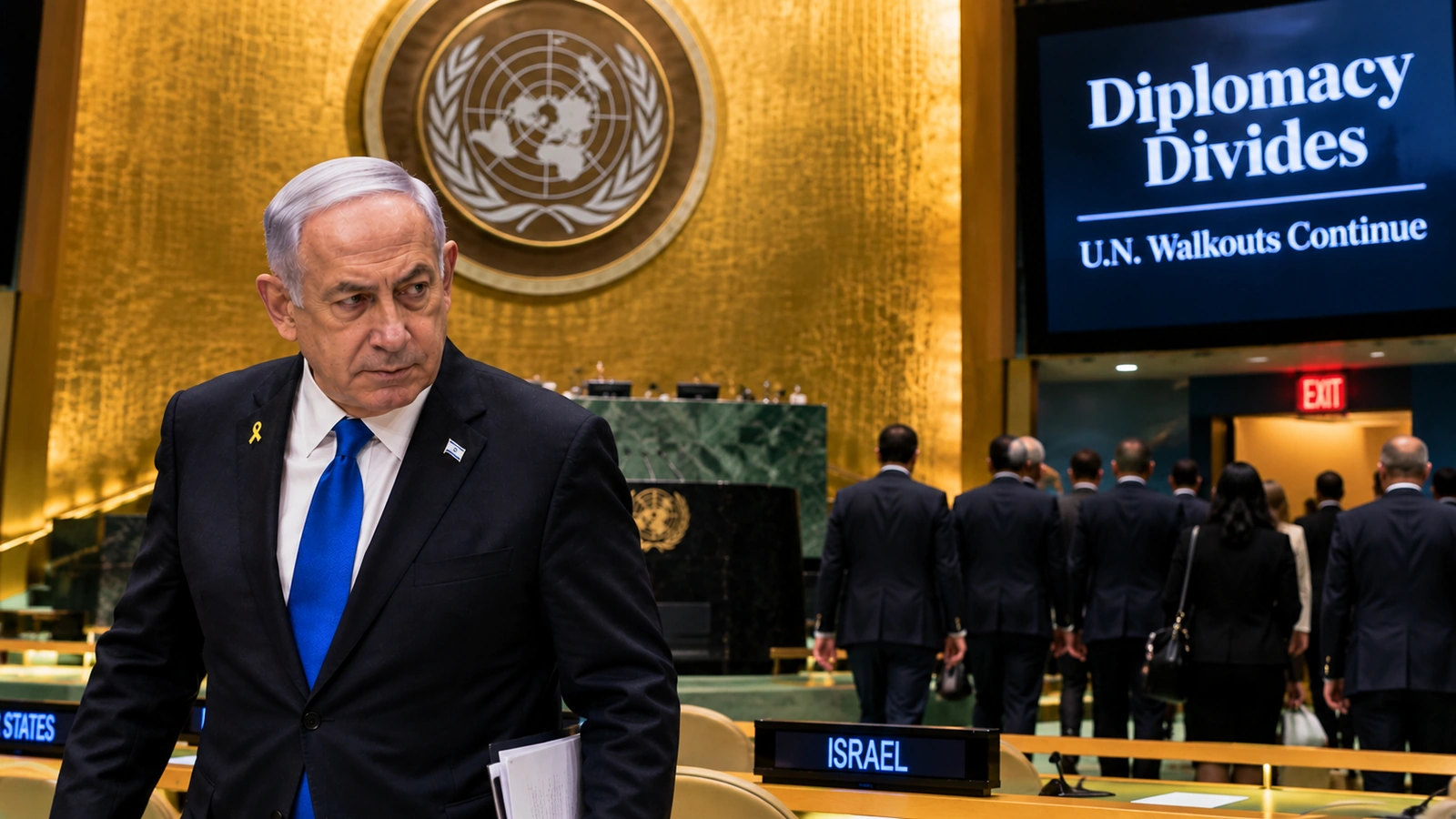
Because the United States is deeply involved in almost every major issue behind the confrontation.
Netanyahu used the September 24 speech to praise President Trump and defend Israeli and U.S. military action against Iran. His visit also came amid mounting international criticism over Gaza and continuing international legal proceedings. (Reuters)
For Americans, the more useful question is not whether a nearly empty U.N. chamber looked embarrassing for Netanyahu.
It is whether the diplomatic anger represented by those empty seats turns into actual government decisions.
That could include U.N. votes, sanctions, changes in diplomatic recognition, arms policies, negotiations over Gaza, responses to West Bank settlements or future international court action.
A walkout cannot answer those questions.
It tells us that the political divide is there.
The next decisions tell us how consequential that divide becomes.
Why It Matters in One Sentence
The mass walkout during Benjamin Netanyahu’s September 24 U.N. speech was a coordinated diplomatic protest centered largely on Gaza—not a formal U.N. sanction—and its real significance depends on whether the governments that left the room turn that symbolism into concrete policy.
Netanyahu UN Walkout: Key Questions Explained
Q. When did delegates walk out of Netanyahu’s U.N. speech?
The walkout occurred on September 24, 2026, in New York as Benjamin Netanyahu began addressing the 81st session of the U.N. General Assembly. (Reuters)
Q. How many delegates walked out?
Reports described dozens of delegates leaving the chamber. Available reporting does not establish that every country opposed to Israel participated, so the scene should not be described as a walkout by the entire United Nations. (Reuters)
Q. Was the walkout organized?
Yes, at least partly. The Palestinian Mission to the U.N. encouraged representatives from other member states to enter the hall and collectively leave when Netanyahu was announced. (Associated Press)
Q. Did the United Nations itself order the walkout?
No. The Palestinian Mission encouraged the protest. Participating national delegations made their own decisions to leave; the U.N. General Debate continued. (Associated Press)
Q. Did the walkout stop Netanyahu from speaking?
No. Netanyahu continued his address after delegates left, and the General Assembly meeting continued. (Reuters)
Q. Why were delegates protesting Netanyahu?
The organized protest was primarily connected to opposition to Israel’s conduct in Gaza and Palestinian territories. Netanyahu rejects accusations of genocide and war crimes and defended Israel’s military actions during the speech. (Associated Press)
Q. Has the ICC convicted Netanyahu?
No. The ICC issued an arrest warrant alleging war crimes and crimes against humanity. A warrant is not a conviction, and the ICC currently lists Netanyahu as at large. (ICC)
Q. Is the ICC warrant the same as the ICJ genocide case?
No. The ICC deals with individual criminal responsibility. The ICJ case brought by South Africa concerns Israel’s obligations as a state under the Genocide Convention. (ICC · ICJ)
Q. Was this Netanyahu’s first U.N. walkout?
No. Delegates also walked out during previous Netanyahu General Assembly appearances, including in 2024 and 2025. (Reuters 2024 · Reuters 2025)
Q. What should people watch next?
The more consequential developments will be formal government and institutional actions: U.N. votes, Gaza diplomacy, national sanctions or arms-policy changes, and further proceedings before international courts. A walkout shows political opposition, but it does not determine those outcomes.
Did this help make the story clearer? 🙂
WIN keeps unpacking the “why” behind the news—clearly and simply!
Sources
September 24 Walkout and Netanyahu’s Speech
Reuters — At UN, Netanyahu Defends Israel as Delegates Walk Out
Associated Press — Netanyahu’s U.N. Address and the Coordinated Walkout
U.N. Procedure and General Debate
United Nations — General Debate of the 81st General Assembly
United Nations — General Assembly Plenary Rules of Procedure
International Court Proceedings
International Criminal Court — Benjamin Netanyahu Case Page
International Court of Justice — South Africa v. Israel
Earlier U.N. Walkouts and Conflict Background
Reuters — Netanyahu’s 2025 U.N. Address and Delegate Walkout
Reuters — Netanyahu’s 2024 U.N. Address
Reuters — Background Before Netanyahu’s 2026 U.N. Address
Keep Reading
How Were Other Leaders Using the Same U.N. Stage to Argue About Power and International Rules?
Netanyahu’s walkout was one expression of the wider argument unfolding at this year’s General Assembly. Trump, Emmanuel Macron and Luiz Inácio Lula da Silva used the same U.N. gathering to present sharply different views of sovereignty, military power and international rules.
Did Trump Threaten Macron and Lula? What Their U.N. Speeches Actually Said