Why Is Russia Threatening Nuclear Use Over Kaliningrad—and What Would “Cutting It Off” Actually Mean?

Why would Russia start talking about nuclear weapons over a small piece of territory wedged between Poland and Lithuania?
And when Moscow says NATO could “cut off” Kaliningrad, does that mean the alliance has actually announced a blockade?
No public NATO decision to blockade Kaliningrad has been announced. On September 30, Russia warned NATO in a diplomatic note that it could use its full arsenal, including nuclear weapons, if NATO tried to isolate Kaliningrad. Russian embassies in Europe also said Moscow had intelligence suggesting NATO was preparing an air and naval blockade. NATO rejected that characterization, said its activities are defensive, and told Russia to stop making nuclear threats. (Reuters · AP)
Then the story escalated again.
On October 1, Russian President Vladimir Putin said that if Kaliningrad or other Russian territory came under direct attack, the use of the full range of weapons available to Russia would immediately become an issue for Moscow, including its nuclear capabilities. (Reuters · AP)
That sounds like a story about nuclear weapons.
But the geography comes first.
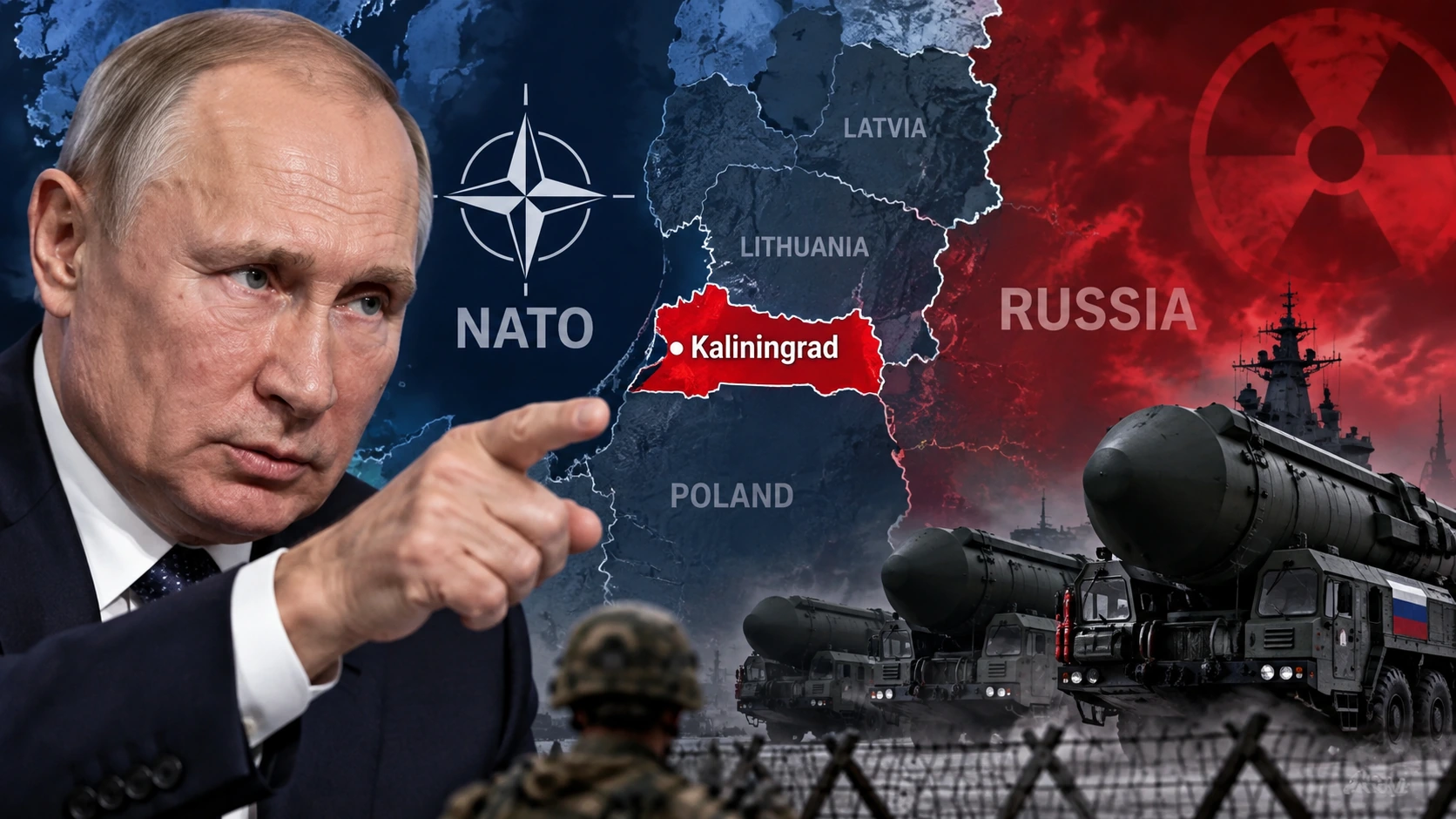
※ Images in this article are AI-generated illustrations created to help explain the story. They are not actual photographs, and depictions of people, places, or events may differ slightly from reality.
Kaliningrad is Russian territory, but it does not touch the rest of Russia. NATO countries surround it on land, while the Baltic Sea lies to the west.
That unusual map explains why the same region can look like a forward military position for Russia and a geographic vulnerability at the same time. (Reuters)
What Exactly Did Russia Threaten?
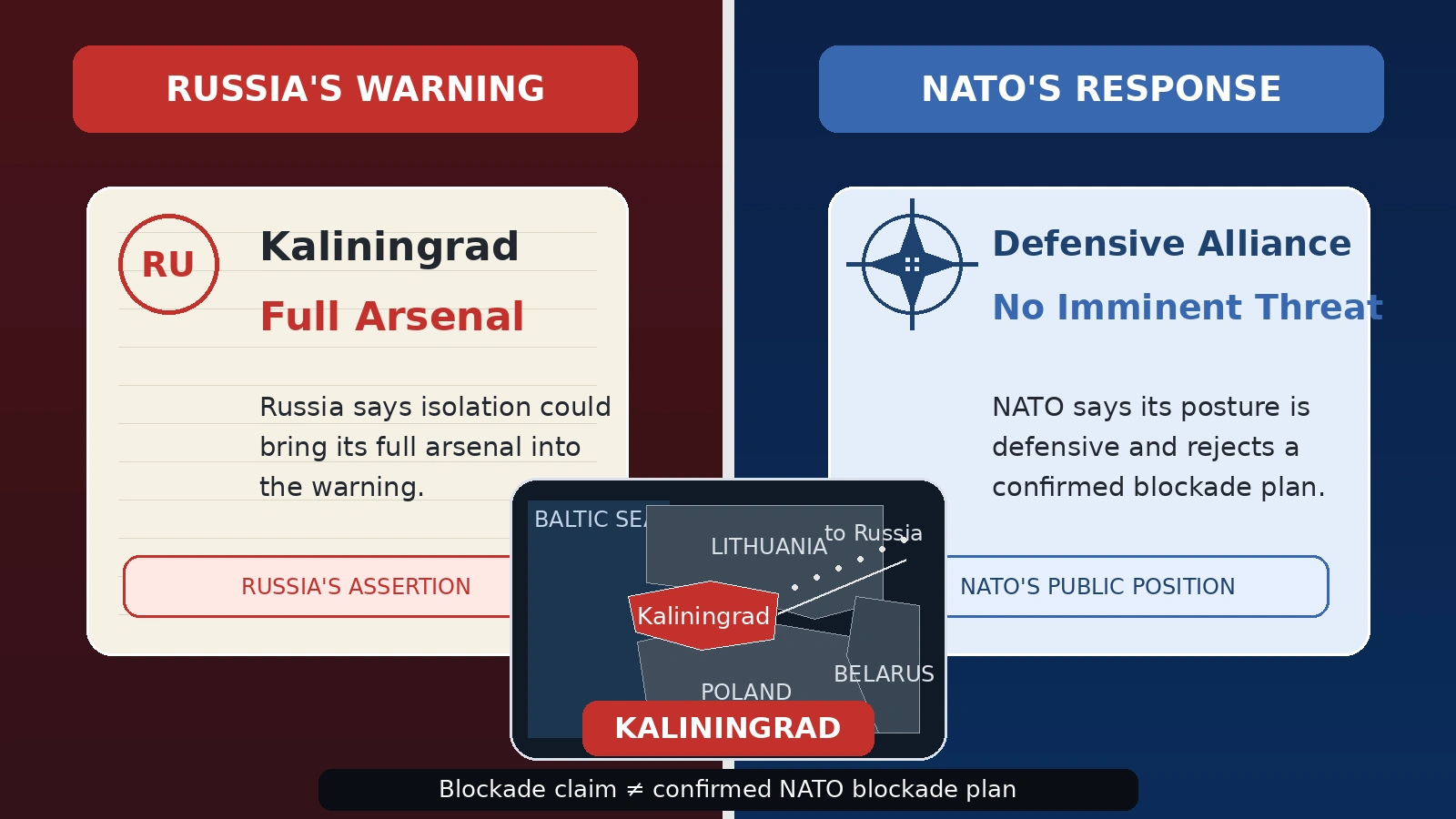
Russia’s September 30 message was more specific than a general reminder that Russia possesses nuclear weapons.
According to Reuters, Moscow said it would be prepared to use “the entire arsenal of forces and capabilities at its disposal, including nuclear weapons” if NATO countries attempted to isolate Kaliningrad from the rest of Russia. AP reported that Russian embassies in Europe also claimed to have intelligence suggesting NATO was planning an air and naval blockade. (Reuters · AP)
NATO did not accept that premise.
Secretary General Mark Rutte said NATO had responded by emphasizing that it is a defensive alliance and by telling Russia to stop making nuclear threats. Asked whether the situation meant a real, imminent nuclear danger to the Baltic states, he said it did not. (NATO · Reuters)
That distinction is essential.
Russia made the warning. It has not publicly established that NATO has decided to blockade Kaliningrad. NATO says its exercises and activities pose no threat to Russian territory. (Reuters)
Putin’s October 1 remarks then reinforced the signal by tying the issue to a direct attack on Russian territory, including Kaliningrad. (Reuters)
What Would “Cutting Off” Kaliningrad Actually Mean?
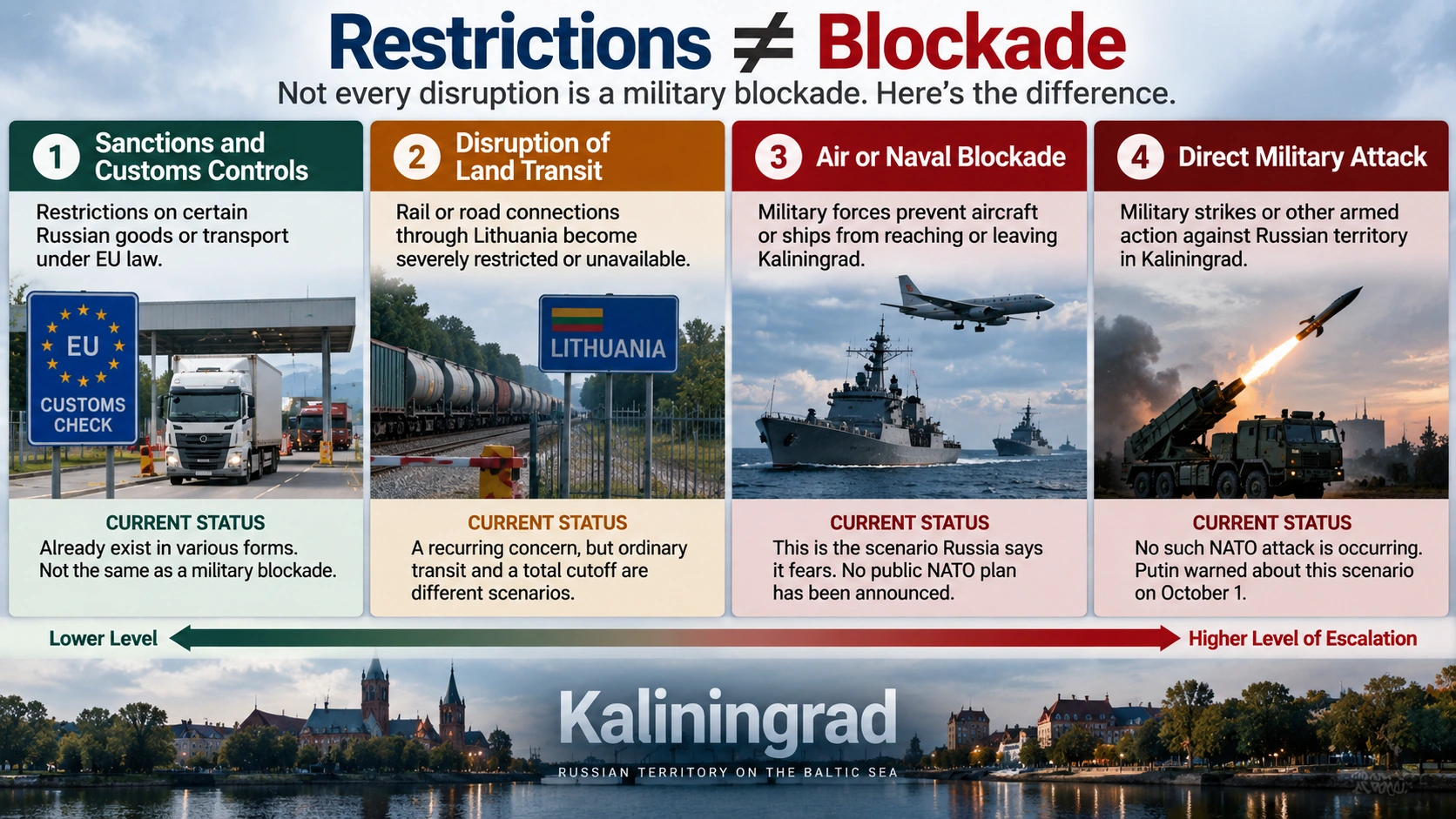
This is where the language becomes confusing, because several very different actions can all be described loosely as “isolation.”
| Scenario | What it actually means | Current status |
|---|---|---|
| Sanctions and customs controls | Restrictions on certain Russian goods or transport under EU law | Already exist in various forms; this is not the same as a military blockade. (European Commission) |
| Disruption of land transit | Rail or road connections through Lithuania become severely restricted or unavailable | Russia has worried about this before, but ordinary transit and a total wartime cutoff are very different scenarios. (European Commission) |
| Air or naval blockade | Military forces prevent aircraft or ships from reaching or leaving Kaliningrad | This is the scenario Russia says it fears; NATO has not publicly announced such a plan. (Reuters) |
| Direct attack | Military strikes or other armed action against Russian territory in Kaliningrad | No such NATO attack is occurring; Putin specifically warned about this scenario on October 1. (Reuters) |
The difference matters because there is already a history of arguments over transit.
After Russia’s full-scale invasion of Ukraine, EU sanctions affected certain goods moving through Lithuania. European Commission guidance distinguished road transport from rail transit and required controls designed to prevent sanctions evasion. Sanctioned goods that are prohibited under EU rules cannot simply use Kaliningrad transit as a way around those restrictions. (European Commission)
That is a sanctions regime.
A naval or air blockade would be something far more serious: military coercion designed to stop access to the territory.
So when Moscow uses the word “blockade,” it is describing a much higher level of confrontation than the customs and transit disputes Europe has already experienced.
Why Is Kaliningrad Part of Russia if It Is Surrounded by NATO Countries?
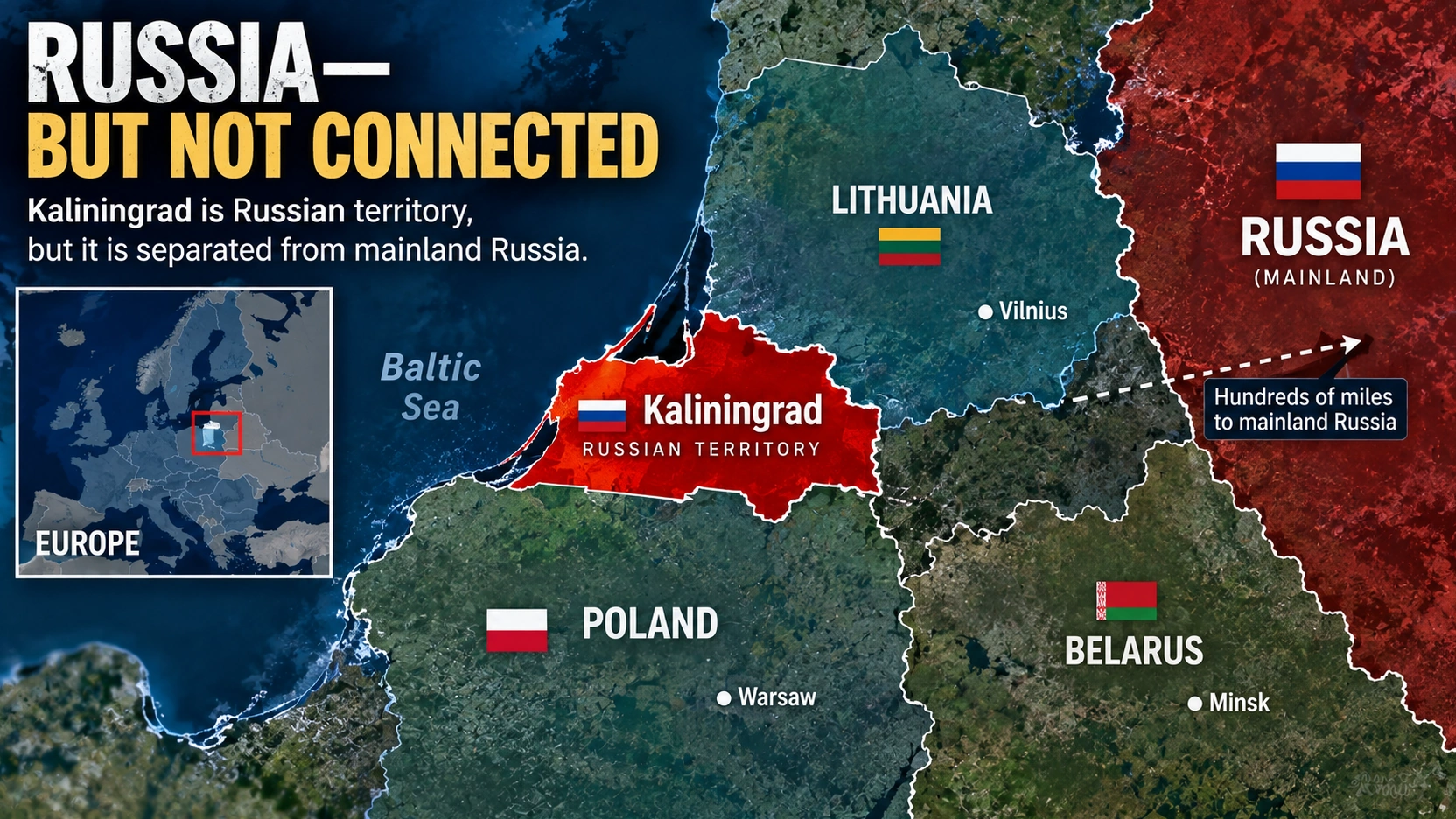
Kaliningrad was once the northern part of Germany’s East Prussia, centered on the city of Königsberg.
The Soviet Union took control of the area after World War II, and it became part of the Russian Soviet republic. When the Soviet Union dissolved, Lithuania became an independent state, leaving Kaliningrad physically separated from the rest of the Russian Federation. (Reuters)
Today it sits between Poland and Lithuania—both NATO and European Union members—with the Baltic Sea on its western side.
That makes Kaliningrad an exclave: part of one country that is geographically separated from that country’s main territory.
The location gives Russia military reach into the Baltic region, but it also means civilian and military logistics are more exposed to what happens in surrounding NATO territory and waters.
Why Is Kaliningrad So Militarily Important?
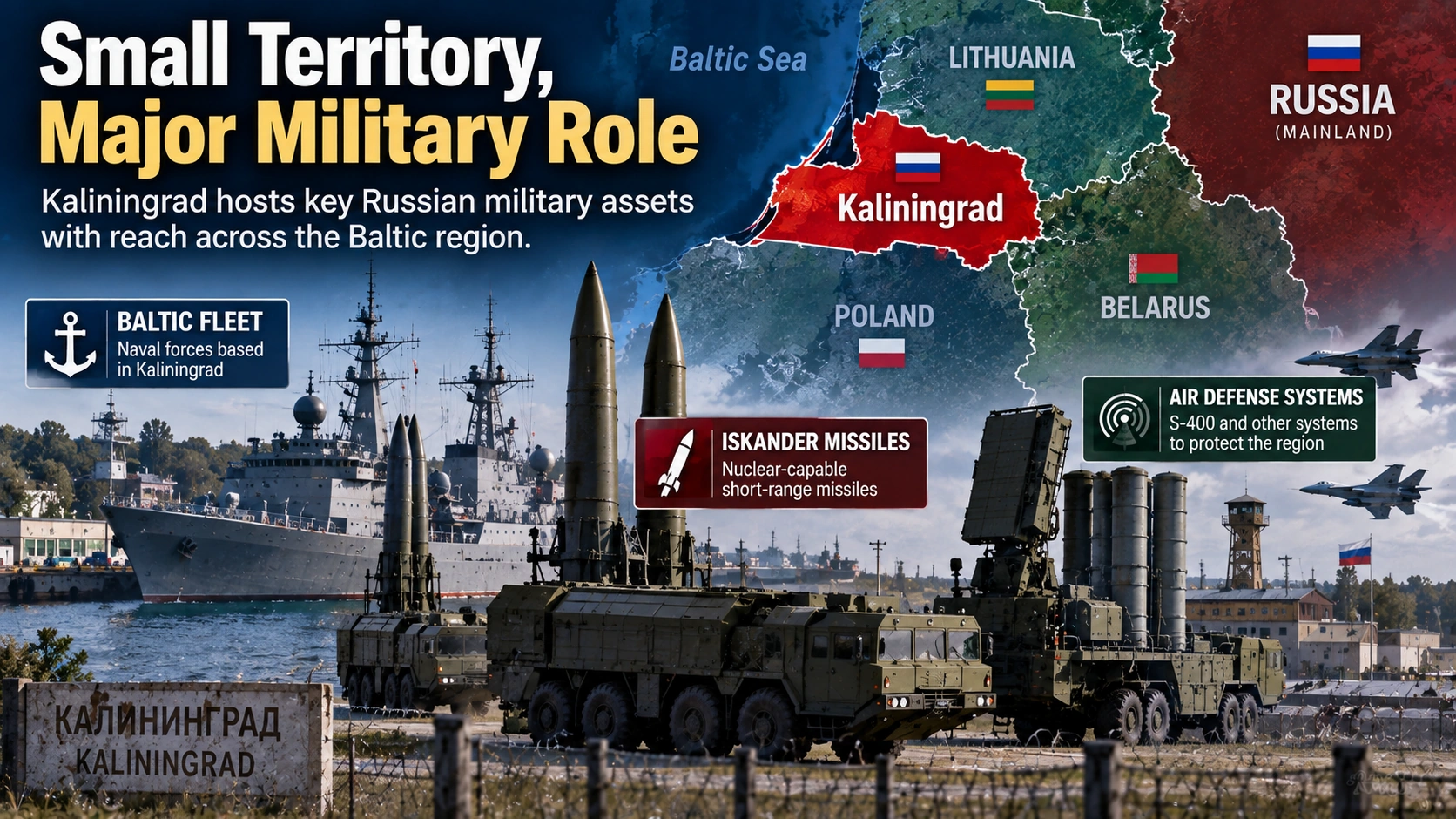
Kaliningrad is much more than a detached Russian province.
It hosts major Russian military assets, including facilities tied to the Baltic Fleet as well as missile and air-defense systems. Reuters and AP report that Russia deploys nuclear-capable Iskander missiles in the region. (Reuters · AP)
“Nuclear-capable” needs careful wording.
It means a weapon system can carry a nuclear payload. It does not, by itself, prove that a particular launcher is carrying a nuclear warhead at a particular moment.
That military concentration gives Russia the ability to monitor, deter and potentially threaten activity across parts of the Baltic region.
But the same map creates a vulnerability.
In a major NATO-Russia conflict, Kaliningrad would be surrounded on land by alliance territory and located in a Baltic Sea where NATO has increased its military presence and surveillance.
That is why the territory can function as both a Russian military outpost and a potential pressure point against Russia.
Why Does the Suwałki Gap Keep Appearing in This Story?
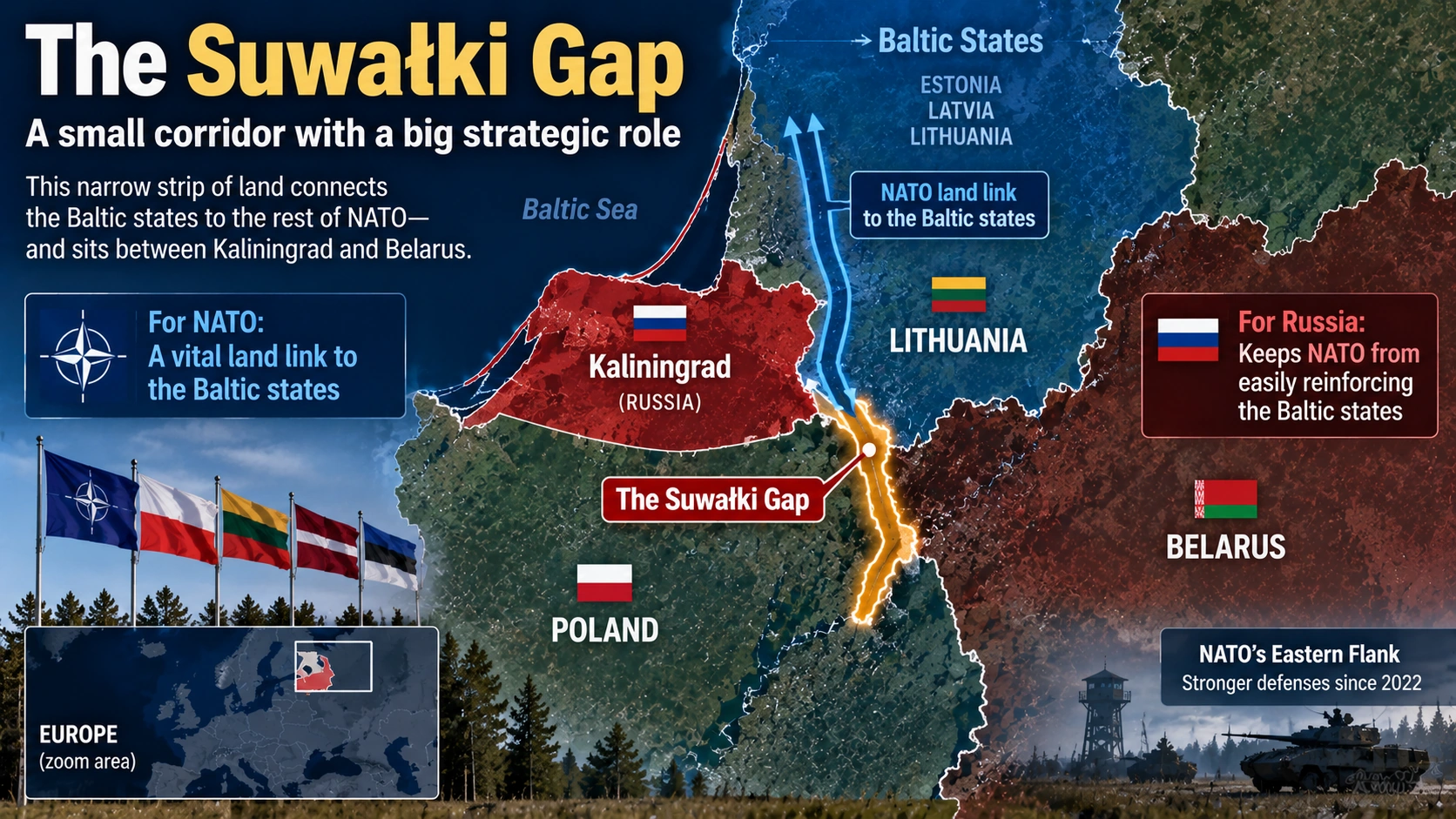
The Suwałki Gap is the other half of the geography.
It is the stretch of Polish-Lithuanian territory lying between Kaliningrad and Belarus. NATO describes it as a strategic land connection linking Estonia, Latvia and Lithuania with the rest of allied territory. (NATO)
Look at the map from both directions.
For NATO, losing access through this corridor in a conflict could make reinforcing the Baltic states by land much harder.
For Russia, Kaliningrad sits on the opposite side of that same geographic squeeze, separated from mainland Russia by NATO and EU territory.
That creates an unusual mirror image:
NATO worries that Kaliningrad and Belarus could help isolate the Baltic states. Russia worries NATO could isolate Kaliningrad.
Neither outcome is happening now.
But military planners on both sides have reasons to think seriously about the geography, which is why exercises, troop deployments and maritime patrols around the region attract so much attention. NATO has expanded forces along its eastern flank and says those measures are defensive and proportionate. (NATO)
Is NATO Actually Preparing a Blockade?
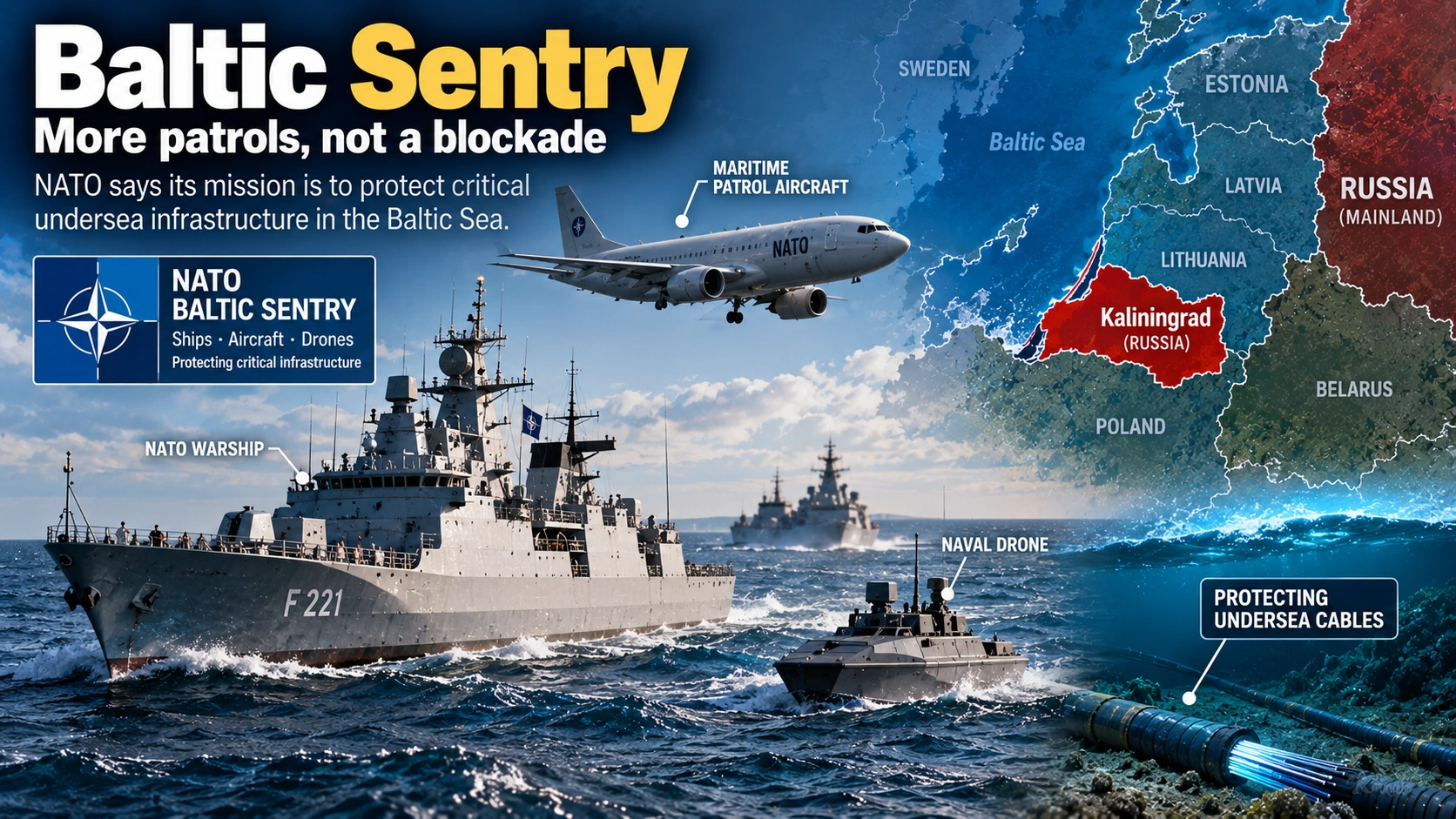
There is no publicly confirmed NATO decision to blockade Kaliningrad.
What does exist is a much larger NATO military presence in the Baltic region than before Russia’s 2022 invasion of Ukraine.
One prominent example is Baltic Sentry, which NATO launched in January 2025 after damage to critical undersea infrastructure. NATO says the activity uses ships, maritime patrol aircraft, surveillance capabilities and naval drones to protect cables and other infrastructure in the Baltic Sea. (NATO)
NATO has also strengthened its eastern flank more broadly, including air, land and maritime capabilities. The alliance describes those measures as defensive, proportionate and consistent with international commitments. (NATO)
Russia views some of those same activities very differently.
Moscow’s September 30 message presented NATO exercises and military activity as part of the threat it says Kaliningrad faces. NATO rejected that interpretation. (Reuters)
So there are two separate facts to keep straight:
NATO military activity in the Baltic is real. A publicly confirmed NATO plan to blockade Kaliningrad is not.
Would a Blockade Automatically Mean Russia Uses Nuclear Weapons?
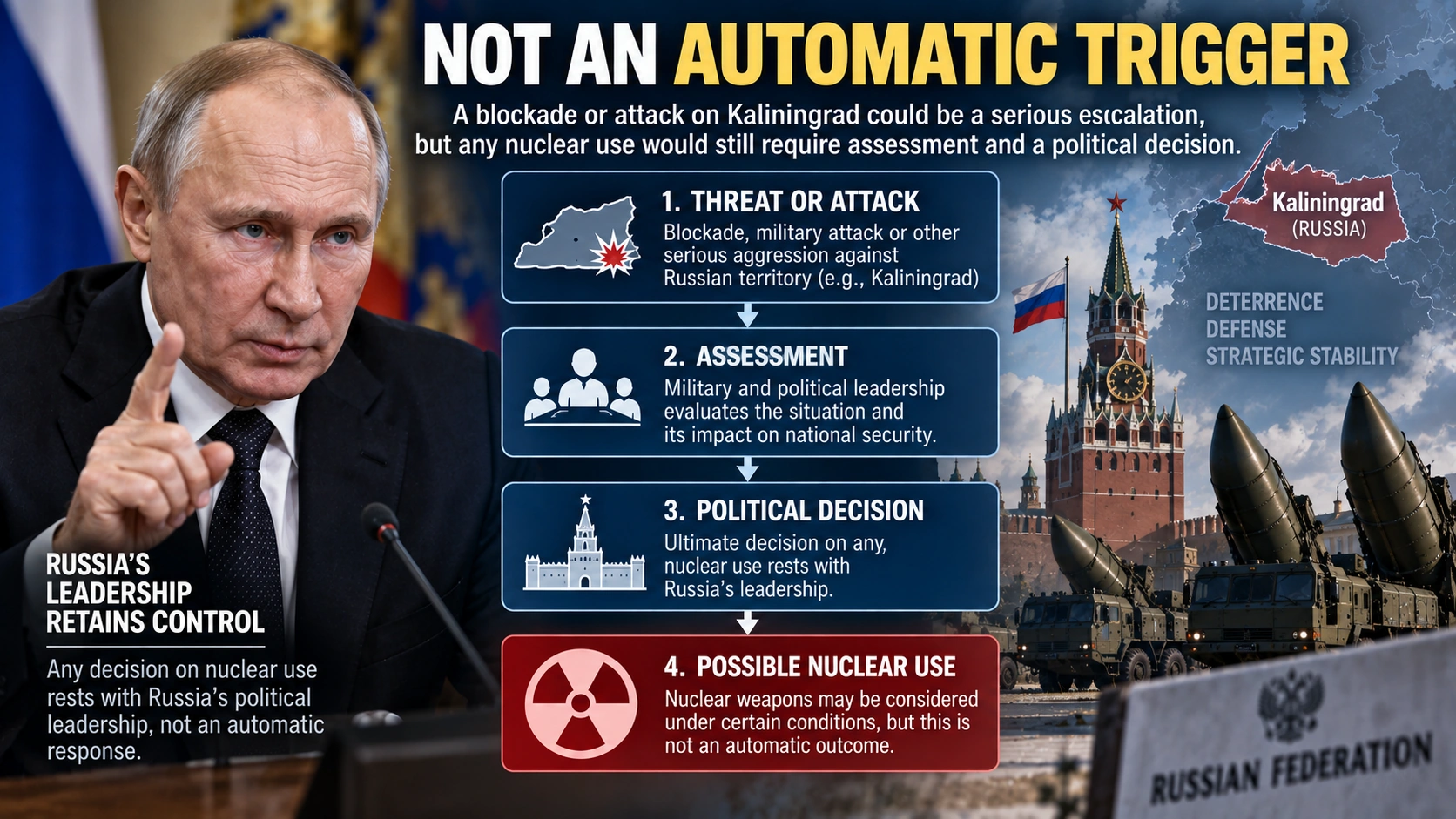
No. Russia’s doctrine does not say that every interruption of access to Kaliningrad automatically launches a nuclear response.
Russia revised its public nuclear-deterrence doctrine in November 2024. The updated framework says nuclear use may be considered when conventional aggression against Russia or Belarus creates a critical threat to their sovereignty or territorial integrity, among several other listed conditions. (Kremlin)
That wording is broader than Russia’s previous public formulation, which referred to conventional aggression threatening the existence of the state. Arms-control analysts have therefore described the revision as expanding or loosening the stated conditions surrounding possible nuclear use. (Arms Control Association · Carnegie Endowment)
But “may be considered” is different from “must happen.”
A political and military judgment would still have to be made about what had occurred, how serious it was and how Russia chose to respond.
That makes the September 30 message notable.
Instead of speaking only in abstract doctrinal language, Moscow attached the warning to a specific geographic scenario: Kaliningrad being isolated.
Putin’s October 1 remarks reinforced that signal by saying a direct attack on the territory would bring the full range of Russian weapons onto the agenda. (Reuters)
The warning is therefore important.
It is not an automatic countdown.
What Happens if Fighting Spills Into Poland or Lithuania?
An armed attack on Poland or Lithuania would involve NATO’s collective-defense commitment.
Both countries are alliance members.
Under Article 5 of the North Atlantic Treaty, an armed attack on one ally is treated as an attack on all and creates an obligation for the other members to assist. That does not mean every member automatically responds in exactly the same way or that nuclear weapons are automatically used; each ally takes the action it considers necessary in coordination with the alliance. (NATO)
That is one reason Kaliningrad matters beyond Russia itself.
A confrontation there could quickly involve Russian territory, NATO territory, Baltic naval forces, airspace, military transit routes and nuclear deterrence—all in a very small geographic area.
The danger is not that any one patrol ship or exercise automatically starts a war.
The danger is misreading the other side’s actions during a crisis.
A military exercise can be seen as preparation for attack. A defensive deployment can be interpreted as encirclement. A disruption of shipping or infrastructure can be blamed on an adversary before all the facts are known.
That is how geography can make escalation faster than diplomacy.
Why Did This Warning Come Now?
The September 30 confrontation did not appear out of nowhere.
The Baltic security environment has become more militarized since Russia’s 2022 invasion of Ukraine. Finland and Sweden joined NATO, giving the alliance a stronger geographic position around the Baltic Sea. NATO has also expanded maritime surveillance and eastern-flank forces, including Baltic Sentry and other vigilance activities. (Reuters · NATO)
Russia, meanwhile, has repeatedly warned that expanded NATO military activity close to its borders creates new security risks for Moscow.
The latest dispute adds Kaliningrad to that broader argument.
A simple timeline helps:
| Date | What changed |
|---|---|
| 2022 | Russia’s invasion of Ukraine leads to sweeping EU sanctions and a dispute over how sanctioned goods may transit Lithuania to Kaliningrad. (European Commission) |
| November 2024 | Russia formally updates its nuclear doctrine, broadening its public language on conventional threats to sovereignty and territorial integrity. (Kremlin) |
| January 2025 | NATO launches Baltic Sentry to protect critical undersea infrastructure in the Baltic Sea. (NATO) |
| 2025–2026 | NATO further strengthens forces and surveillance on its eastern flank. (NATO) |
| September 30, 2026 | Russia sends NATO a warning linking an attempt to isolate Kaliningrad with possible use of its full arsenal, including nuclear weapons. (Reuters) |
| October 1, 2026 | Putin publicly reiterates that a direct attack on Kaliningrad or other Russian territory would put Russia’s full range of weapons on the agenda. (Reuters) |
That sequence does not prove that either side intends to start a conflict.
It does explain why a territory that rarely appears in everyday American news suddenly became attached to the words “nuclear weapons.”
What Should Americans Watch Next?
The most important signal would be a change from rhetoric to observable military action.
Rutte said on September 30 that NATO did not see an imminent Russian threat to alliance territory and argued that a genuine preparation for a large attack would normally produce a visible military buildup. (Reuters)
That means several developments matter more than another angry statement.
A major, unusual buildup of forces around Kaliningrad, Poland, Lithuania or Belarus would be more significant than routine exercises. So would new restrictions on civilian or military transit, changes to Baltic shipping access, unusual airspace measures, or official NATO decisions altering the status of maritime operations around the exclave.
Diplomatic wording matters too.
There is a large difference between Russia warning that nuclear weapons are part of its deterrent and Russia announcing concrete nuclear-force movements or changes in readiness.
Likewise, there is a major difference between NATO patrolling the Baltic Sea and NATO announcing that Russian access to Kaliningrad will be physically prevented.
For now, those distinctions remain important.
Bottom Line: What This Story Really Means
Russia’s Kaliningrad warning is serious because Moscow has explicitly connected a specific European flashpoint with possible nuclear escalation.
But the headline can easily create two misleading impressions.
First, NATO has not publicly announced that it is blockading Kaliningrad. Russia says NATO activity and planning point toward a possible attempt to isolate the region; NATO rejects that characterization and says its activities are defensive. (Reuters)
Second, Russia’s warning does not mean nuclear weapons would automatically be used if a train were stopped, sanctions tightened or access disrupted. Russia’s doctrine leaves room for nuclear use under severe conventional threats, but the policy does not create an automatic trigger for every transit dispute or interruption. (Kremlin)
What makes Kaliningrad dangerous is the map.
It is a heavily militarized piece of Russia separated from the rest of the country, surrounded by NATO territory on land and positioned next to the Suwałki Gap—the same corridor NATO considers vital for connecting the Baltic states to the rest of the alliance.
Russia sees vulnerability.
NATO sees vulnerability.
That is why a small territory on the Baltic Sea can become a very large security problem.
Kaliningrad: Key Questions Explained
Q. What is Kaliningrad?
Kaliningrad is a Russian region on the Baltic Sea that is physically separated from mainland Russia. It borders Poland and Lithuania, both of which are NATO and EU members. (Reuters)
Q. Is Kaliningrad legally part of Russia?
Yes. Kaliningrad is internationally recognized as territory of the Russian Federation; its unusual feature is geographic separation from the rest of Russia.
Q. Is NATO currently blockading Kaliningrad?
No publicly announced NATO blockade is in place. Russia says NATO is preparing for scenarios that could isolate the region, while NATO says its operations are defensive and has rejected Russia’s nuclear threats. (Reuters · NATO)
Q. What would it mean to “cut off” Kaliningrad?
Depending on context, it could mean restricting land transit through Lithuania, disrupting air or sea access, or imposing a military blockade. Those are very different levels of escalation and should not be treated as interchangeable.
Q. Why is the Suwałki Gap important?
The Suwałki Gap connects Poland and Lithuania and provides the Baltic NATO members with their main land connection to the rest of allied territory. It lies between Kaliningrad and Belarus. (NATO)
Q. Does Russia have nuclear weapons in Kaliningrad?
Russia deploys nuclear-capable weapons systems such as Iskander missiles in the region. “Nuclear-capable” does not by itself establish that a particular launcher is carrying a nuclear warhead at a given moment. (AP)
Q. Would Russia automatically use nuclear weapons if Kaliningrad were isolated?
No. Russia’s doctrine identifies circumstances in which nuclear use may be considered, including certain severe conventional threats, but it does not create an automatic nuclear response to every interruption of transit or access. (Kremlin)
Q. Could fighting around Kaliningrad trigger NATO’s Article 5?
An armed attack on NATO members such as Poland or Lithuania could create an Article 5 collective-defense situation. Article 5 requires allies to assist an attacked member, but it does not dictate one automatic military response for every ally. (NATO)
Q. What changed after the September 30 warning?
On October 1, Putin publicly reinforced the message by saying a direct attack on Kaliningrad or other Russian territory would put the full range of Russian weapons on the agenda. (Reuters)
Did this help make the story clearer? 🙂
WIN keeps unpacking the “why” behind the news—clearly and simply!
Sources
Russia’s Warning and NATO’s Response
Reuters — Russia sends nuclear warning to NATO as tensions rise in the Baltic
AP — Russia warns NATO of a possible nuclear response if Kaliningrad is cut off
NATO — Remarks by Secretary General Mark Rutte at the Euronews Defence & Space Summit
Kaliningrad Geography and Baltic Security
Reuters — Why Russia’s Kaliningrad is a potential flashpoint with NATO
NATO — NATO launches ‘Baltic Sentry’ to increase critical infrastructure security
NATO — NATO’s presence in Poland and the Suwałki Gap
Transit Rules, Nuclear Doctrine and Collective Defense
European Commission — Transport of goods in transit between Kaliningrad Oblast and Russia
Kremlin — Executive Order Approving the Basic Principles of State Policy on Nuclear Deterrence
NATO — Collective defence and Article 5
Arms Control Association — Putin Previews Changes to Nuclear Policy
October 1 Follow-Up
Reuters — Putin says the world is living through a dangerous moment, warns West not to escalate
AP — Putin says Russia will use ‘all weapons’ in its arsenal if any of its territory is attacked
Keep Reading
How Is Russia Policy Shaping Politics Inside Germany?
Kaliningrad shows the military side of the Russia-NATO confrontation. A recent WIN explainer looks at the political side, including how support for Ukraine, relations with Russia and energy policy are influencing voters in northeastern Germany on the Baltic Sea.
Why Did Berlin Vote Left While Germany’s Northeast Backed the AfD?