Trump Announced a Russia–Ukraine Energy Ceasefire. Why Are Strikes Still Happening?

If Russia and Ukraine have agreed to stop attacking each other’s energy facilities, why are power plants still being hit?
That’s the question raised by President Donald Trump’s surprise announcement on October 11, 2026. He declared that both countries had agreed to an immediate energy ceasefire.
It sounded like a significant breakthrough in a war that has continued since Russia’s full-scale invasion in February 2022.
But there was a problem.
Ukraine’s president appeared surprised by the announcement. Russia had not publicly confirmed the agreement. And Ukrainian officials reported new attacks on energy facilities after Trump’s statement.
The central distinction is between announcing a ceasefire and establishing one that both sides understand, accept, and actually follow.
※ Images in this article are AI-generated illustrations created to help explain the story. They are not actual photographs, and depictions of people, places, or events may differ slightly from reality.
Understanding what happened requires looking beyond the announcement itself.
What did Trump say had been agreed to? What did Ukraine actually accept? Why does Russia’s response matter so much?
And perhaps most importantly, why have power plants and oil refineries become central to negotiations over a war that is still being fought on the battlefield?
What Did Trump Actually Announce on October 11?
Trump said that Russia and Ukraine had agreed to immediately stop attacking each other’s energy infrastructure.
In a brief Truth Social post on October 11, 2026, the U.S. president declared an “ENERGY CEASEFIRE” effective immediately, said both parties had agreed, and warned them not to violate it.
But the announcement offered no explanation of the terms, how the agreement had been reached, or how compliance would be verified.
At the time, Moscow had not publicly confirmed Trump’s claim, and the White House had not provided a detailed account of the arrangement. (AP · Axios)
That distinction matters.
An announcement from Washington can communicate a diplomatic understanding or put pressure on the parties to reach one. But it does not, by itself, establish that Russian and Ukrainian commanders have received and accepted matching instructions.
The next question is whether the two governments had actually agreed to the same thing.
Did Russia and Ukraine Really Agree to the Ceasefire?
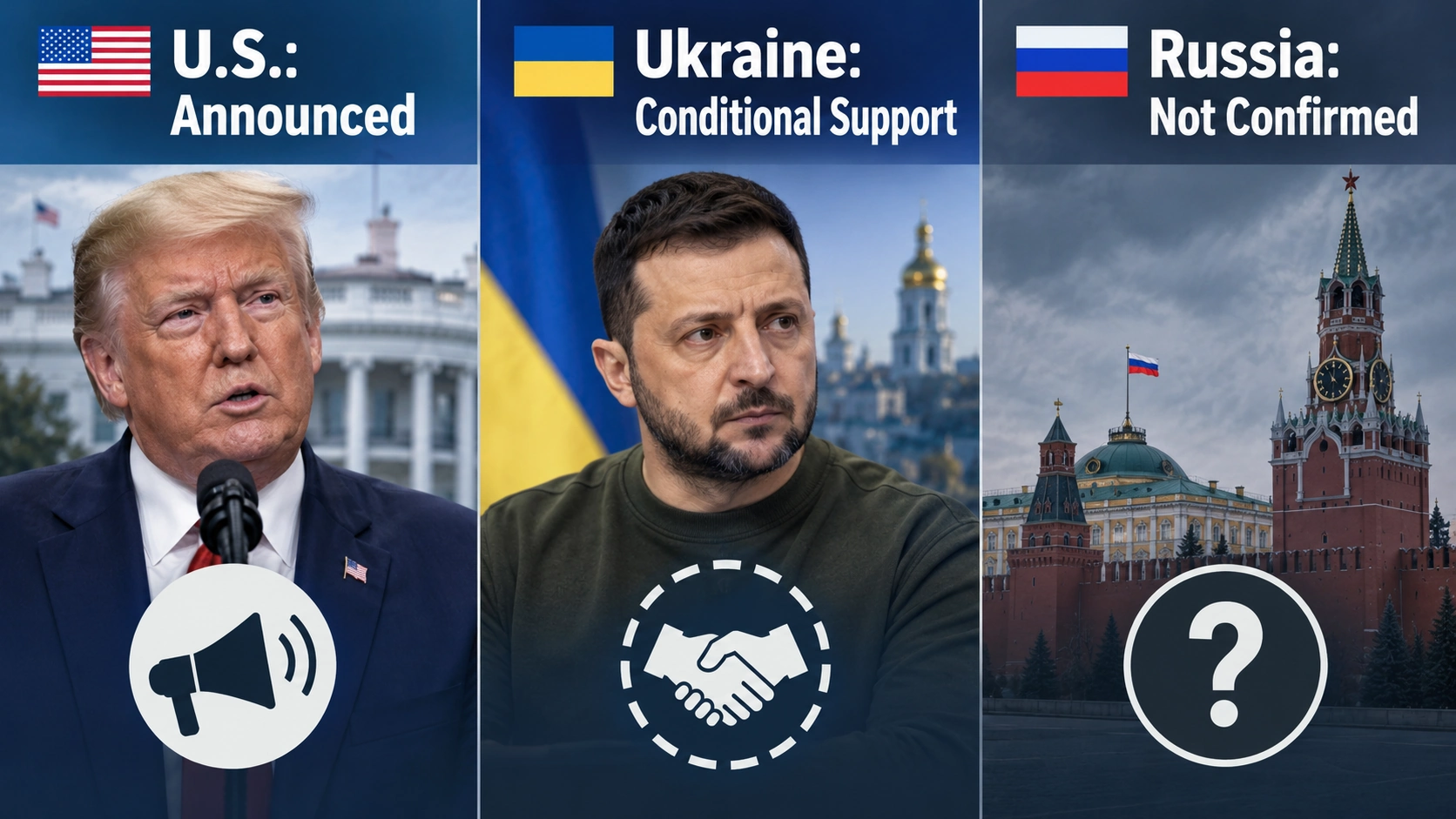
As of October 12, a mutually confirmed and functioning energy ceasefire had not been established publicly.
Ukraine expressed support for reciprocal restraint. Russia had not publicly confirmed the arrangement. Those positions were not equivalent to the mutual agreement Trump announced.
Here’s how the statements compare.
| Party | Public position | What it establishes |
|---|---|---|
| United States | Trump declared an immediate energy ceasefire and said both sides had agreed. | An American presidential announcement, without published operational terms. |
| Ukraine | Zelenskyy supported a reciprocal halt to energy attacks and awaited details. | Willingness to participate, conditional on Russian cooperation. |
| Russia | Moscow had not publicly confirmed the arrangement. | No publicly verified Russian commitment at that point. |
Ukrainian President Volodymyr Zelenskyy initially told Axios that Trump’s announcement was “news for me.”
He subsequently welcomed the possibility of an energy ceasefire while emphasizing that Ukraine would refrain from striking Russian energy facilities if Russia demonstrated the same willingness. Kyiv was also awaiting clearer information from Washington. (Axios · Office of the President of Ukraine)
This was not an outright rejection.
Ukraine was signaling that it could accept a reciprocal arrangement, rather than agreeing to stop its own attacks regardless of Russian conduct.
Being willing to observe a ceasefire is different from confirming that an enforceable ceasefire is already in effect.
The distinction becomes even more important when considering exactly what an energy ceasefire is supposed to stop.
What Is an Energy Ceasefire—and Does It Mean the War Is Ending?
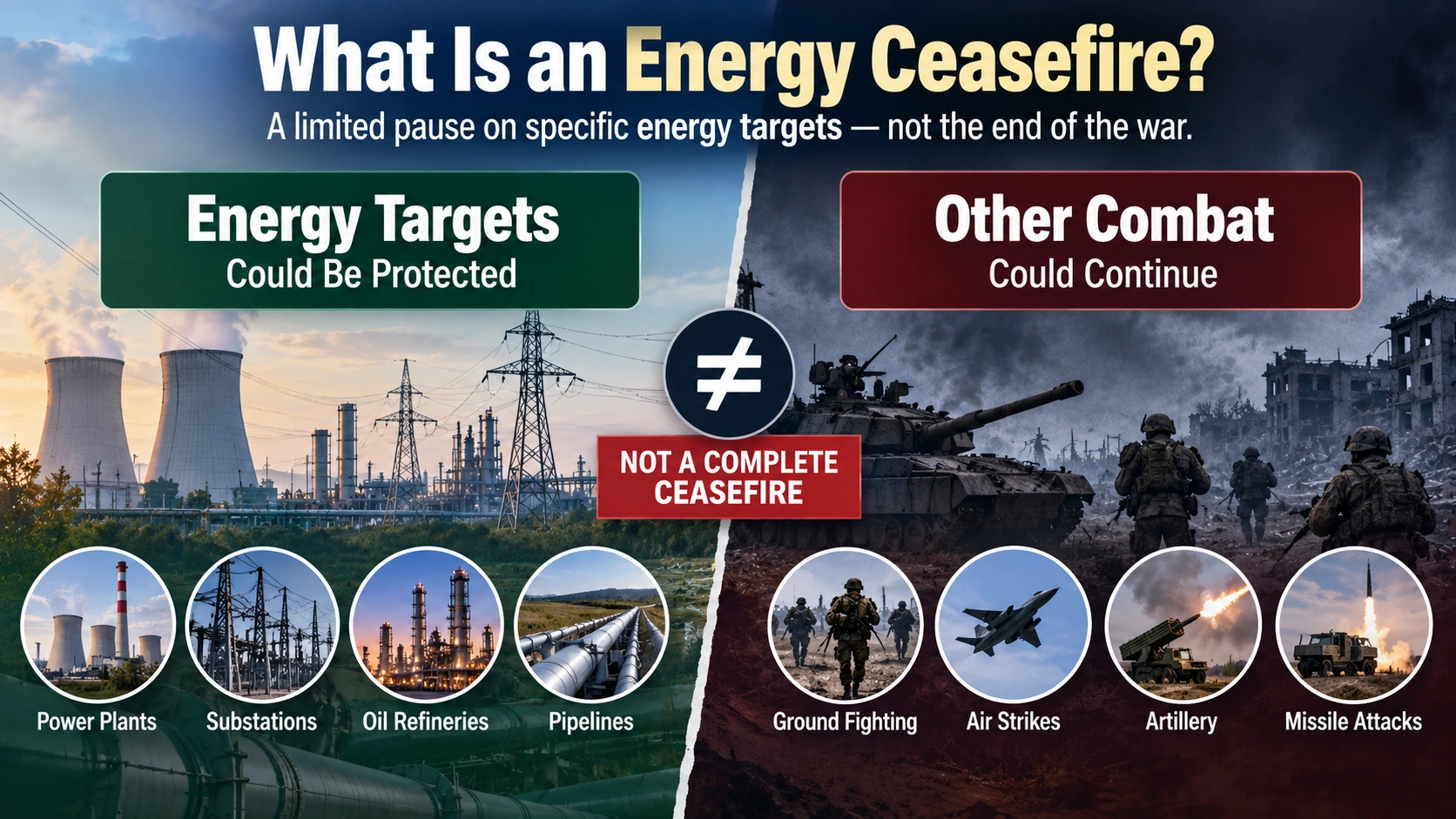
No. An energy ceasefire is a limited pause in attacks on specified energy infrastructure, not necessarily a halt to the wider war.
Even if Russia and Ukraine agreed to stop targeting power plants and oil refineries, fighting along the front line could continue unless a broader agreement prohibited it.
The distinction is easier to understand by comparing two arrangements.
| Energy ceasefire | Comprehensive ceasefire |
|---|---|
| Covers specified energy-related targets. | Seeks a wider halt to hostilities. |
| May allow other military operations to continue. | Generally places broader restrictions on military activity. |
| Requires agreement on which facilities qualify. | Requires agreement on the scope and timing of the wider halt. |
| May reduce damage to essential services and fuel supplies. | Can create conditions for broader political and security negotiations. |
The October 11 announcement did not publicly settle which precise facilities were covered.
That creates practical questions.
Would a strike on an oil refinery violate the ceasefire if the refinery also supplied military fuel?
Would a pipeline transporting both civilian and military supplies be protected?
What about an electricity substation that serves civilian neighborhoods but also supports military facilities?
These are not merely technical details. Different answers can produce entirely different understandings of what each side has promised.
A ceasefire therefore needs more than a headline. It needs sufficiently clear rules for military commanders to apply.
And that leads to another complication: Russia and Ukraine have been attacking different parts of each other’s energy systems for different strategic reasons.
Why Are Power Plants and Oil Refineries So Important to Both Sides?
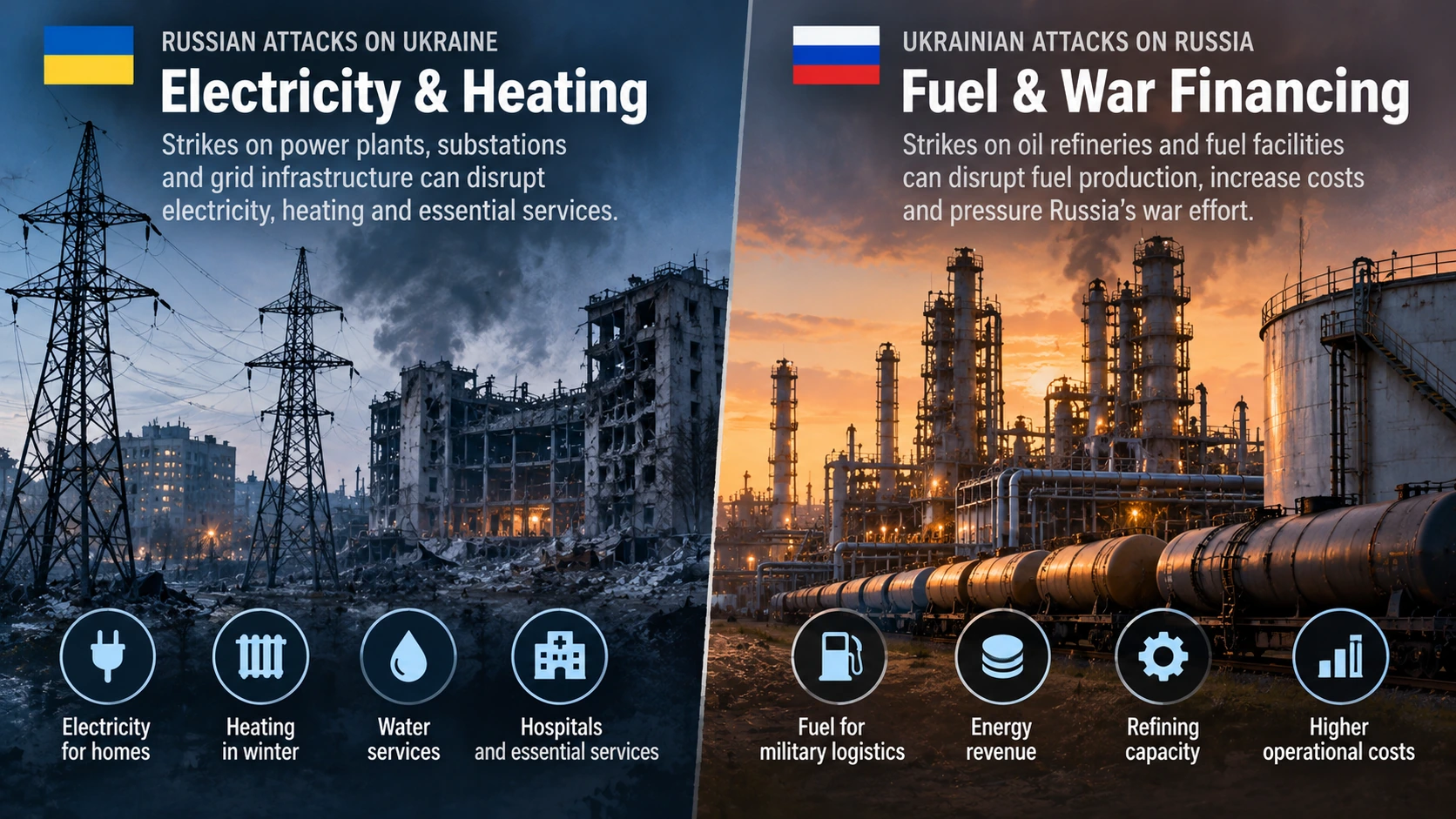
Russia and Ukraine both consider energy infrastructure strategically significant, but their campaigns have different characteristics.
Why Russia Attacks Ukraine’s Electricity System
Russia has repeatedly targeted Ukrainian power-generation facilities, substations, transmission networks, and other energy infrastructure since its full-scale invasion.
These attacks can disrupt electricity, heating, water services, transportation, and industrial activity.
For ordinary Ukrainians, the consequences can be immediate.
A damaged power plant may leave households without electricity. A disruption to the power grid can also affect water pumping, hospital operations, and heating systems.
The vulnerability becomes especially serious as winter approaches, when dependable electricity and heat are essential. (AP)
Attacking infrastructure can also place pressure on Ukraine’s economy and force the government to devote resources to emergency repairs, backup power, and air defenses.
Why Ukraine Attacks Russian Refineries
Ukraine has increasingly used drones to strike Russian oil refineries and other fuel-related facilities.
From Kyiv’s perspective, these attacks serve two overlapping military and economic objectives.
First, fuel is essential for operating military vehicles, moving supplies, and supporting logistics.
Second, Russia’s petroleum industry generates revenue that helps sustain its economy and, indirectly, its war effort.
Damage to refineries can also interfere with fuel production and create operational costs.
This is why Ukraine views its strikes as part of its effort to weaken Russia’s ability to continue the war. (Reuters)
The strategic effects are not identical.
| Russian attacks on Ukraine | Ukrainian attacks on Russia |
|---|---|
| Frequently target electricity and heating infrastructure. | Frequently target oil refining and fuel-related facilities. |
| Can disrupt essential civilian services. | Can disrupt fuel production and associated economic activity. |
| Increase Ukraine’s repair and air-defense burden. | Can increase Russia’s refining and logistical costs. |
| Put pressure on Ukraine’s ability to withstand the war. | Aim to reduce Russia’s capacity to sustain military operations. |
This comparison describes the broad strategic patterns, not the legality or justification of any individual strike. International humanitarian law still applies, including rules protecting civilians and civilian objects.
So both countries have reasons to consider an energy truce.
But each also fears that stopping its own attacks without reciprocal restraint could give the other side an advantage.
That concern sits at the center of Ukraine’s response to Trump.
Why Did Attacks Continue After the Ceasefire Announcement?
Because announcing a ceasefire did not establish that both militaries had agreed to implement it.
Ukrainian officials reported Russian attacks on energy infrastructure after Trump’s October 11 statement, including a strike on the CHP-5 combined heat and power plant in Kharkiv.
Such facilities can generate electricity and provide heat, making them particularly important to nearby communities.
According to ABC News, a local official said the Kharkiv plant was struck at least twice, causing a fire. Zelenskyy also reported a strike on energy infrastructure in Kyiv after Trump’s announcement. (ABC News · Office of the President of Ukraine)
On October 12, Ukrainian officials continued reporting attacks on energy facilities. European Union foreign policy chief Kaja Kallas also expressed doubt that Russia was observing the announced restraint. (AP)
Does that automatically prove Russia violated a formally agreed ceasefire?
Not necessarily.
It is evidence that attacks were continuing after Trump’s announcement. But determining whether there was a violation of mutually accepted terms would also require knowing what had actually been agreed, when the restrictions began, and which targets they covered.
Those details had not been publicly established.
This does not make the reported attacks any less serious. It explains why journalists and diplomats must distinguish between an announcement, a confirmed agreement, and an alleged violation.
A functioning agreement would also need a way to address disputes over attacks rather than leaving each side to announce its own interpretation.
The difficulty is hardly new.
Has Trump Tried an Energy Ceasefire Before?
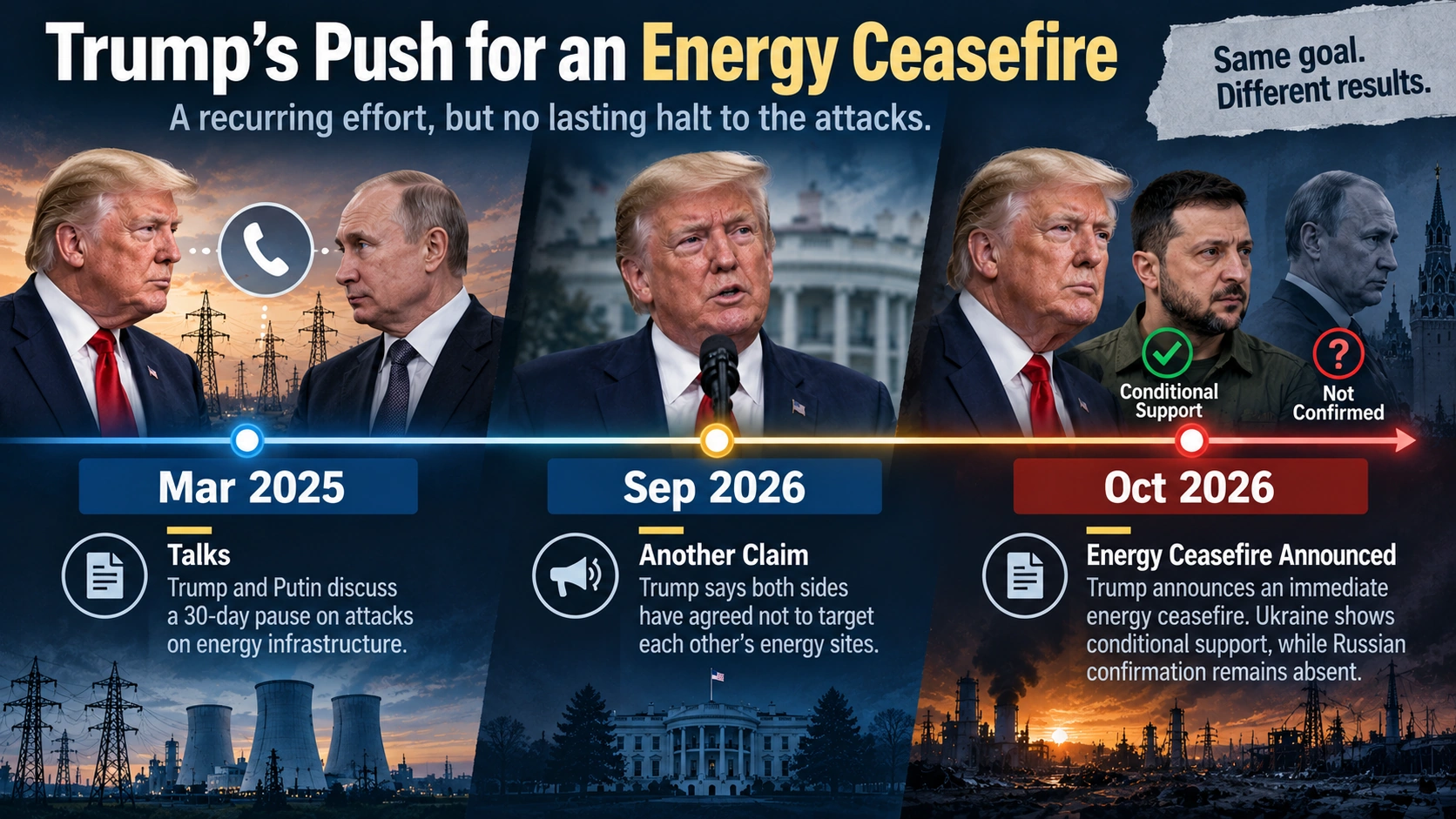
Yes. The October announcement followed earlier attempts to limit attacks on energy infrastructure.
One important precedent came in March 2025.
After talks between Trump and Russian President Vladimir Putin, the Kremlin said Putin had accepted a 30-day pause in attacks on energy infrastructure.
But that arrangement was narrower than the broader ceasefire Washington had been seeking. Questions soon emerged about which facilities would be protected and how the restrictions would operate. (Reuters)
The problem returned in 2026.
On September 14, Trump again claimed that both countries had agreed to refrain from attacking energy targets. Neither government confirmed a mutual arrangement, and the announcement did not lead to a lasting halt in strikes. (The Kyiv Independent · Axios)
A short timeline makes the pattern clearer.
| Date | Development | Why it matters |
|---|---|---|
| March 18, 2025 | Trump and Putin discussed a 30-day pause in energy strikes. | Agreement on a limited concept did not resolve every implementation question. |
| September 14, 2026 | Trump made another claim of mutual restraint on energy targets. | The announcement did not produce a lasting effective pause. |
| October 11, 2026 | Trump announced an immediate energy ceasefire. | Ukraine offered conditional support, while Russian confirmation and clear terms remained absent. |
| October 11–12, 2026 | Ukraine reported continued attacks on energy facilities. | Military activity did not reflect an observable cessation of such attacks. |
The recurring challenge is that the diplomatic goal is relatively simple to describe: stop damaging each other’s energy systems.
Turning that goal into orders that both militaries follow is much more difficult.
Why Does This Matter to Americans—and What Does Diesel Have to Do With It?
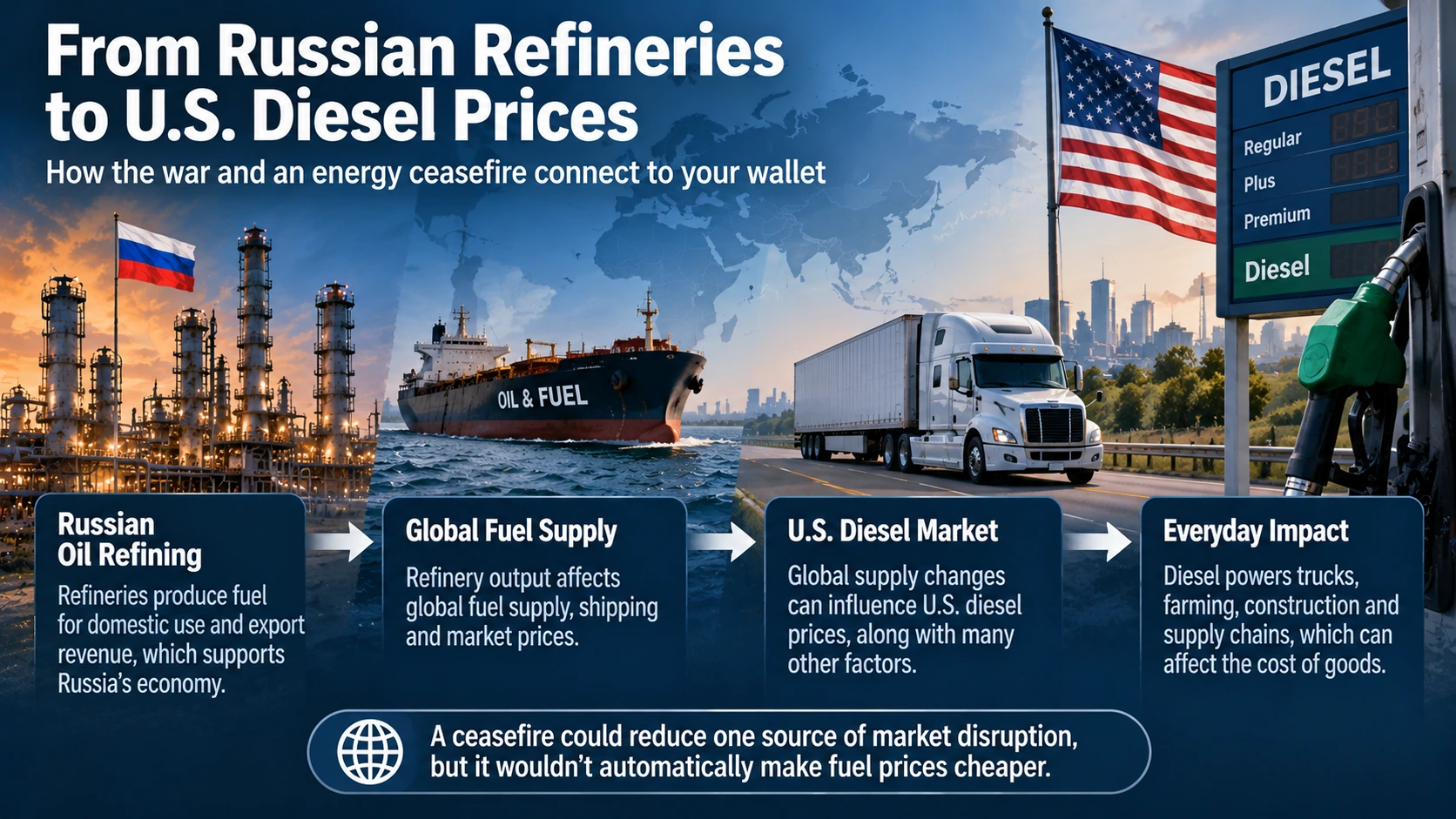
The energy ceasefire has become connected to a separate dispute over Russian fuel, American diesel prices, and U.S. sanctions policy.
In the days before the announcement, Trump criticized Ukraine’s attacks on Russian oil refineries and announced a controversial arrangement with Moscow involving Russian diesel supplies.
The administration presented the fuel initiative as a way to help ease supply pressures, while critics argued that expanded Russian energy sales could provide Moscow with additional revenue during its war against Ukraine. (AP · Reuters)
This creates a difficult policy choice for Washington.
Reducing disruptions to Russian refining capacity could help stabilize some fuel supplies. But allowing Russia to earn more from energy exports also raises questions about the effectiveness of economic pressure intended to constrain its war effort.
And diesel matters well beyond the price displayed at a gas station.
Diesel powers freight trucks, agricultural equipment, construction machinery, and many parts of the supply chain.
Higher fuel costs can eventually make transporting and producing goods more expensive.
Yet it would be misleading to suggest that Ukrainian attacks on Russian refineries alone explain U.S. fuel prices.
Oil and diesel markets are shaped by global production, refining capacity, shipping, inventories, sanctions, and multiple international conflicts. Tensions in the Middle East have also been a major source of pressure on energy markets in 2026. (Reuters)
For Americans, the important distinction is between a possible reduction in one source of fuel-market disruption and a broader solution to high energy costs.
Even a successful energy ceasefire would not guarantee cheaper diesel or gasoline.
Its impact would depend on whether the attacks stopped, how much production and distribution capacity remained available, and what happened elsewhere in global energy markets.
The diplomatic challenge is equally significant.
Washington is trying to influence the behavior of both Russia and Ukraine while managing fuel prices and political disagreements over sanctions.
But an arrangement that appears to protect Russia’s energy industry without comparable protection for Ukrainian civilians would be difficult for Kyiv to accept.
What Would Make an Energy Ceasefire Real?
A credible Russia–Ukraine energy ceasefire would require clear commitments from both governments and observable changes in military conduct.
That does not necessarily mean a lengthy public treaty must be signed before every limited ceasefire. Wartime arrangements can take different forms.
But the central operational questions still need answers.
1. Has Russia Clearly Accepted the Arrangement?
The first question is whether Moscow confirms its participation and communicates an actual commitment rather than remaining silent.
Ukraine’s willingness to reciprocate would also need to become a clearly understood operational arrangement.
2. Which Energy Facilities Are Protected?
Both sides would need a shared understanding of whether restrictions covered electricity plants, substations, refineries, oil depots, pipelines, and other facilities.
Ambiguous terms could leave significant room for conflicting accusations.
3. When Do the Restrictions Begin?
An immediate ceasefire requires military forces to know when new instructions take effect.
Without a clear starting point, even the timing of an alleged violation can become disputed.
4. How Would Attacks Be Verified?
The parties would need a credible way to establish what happened after the ceasefire began.
That could involve agreed reporting procedures, third-party monitoring, technical evidence, or other verification mechanisms.
None of those methods should be assumed to have been established merely because Trump announced a ceasefire.
5. What Happens After an Alleged Violation?
Even a genuine agreement can come under strain when one side claims the other has attacked a protected target.
The question then becomes whether the parties have a process for reviewing incidents, resolving disputes, and maintaining restraint.
These five questions form a practical test of the October 11 announcement.
The more of them that remain unanswered, the harder it is to treat the ceasefire as an established reality.
And until the attacks actually stop, the diplomatic language remains ahead of events on the ground.
Bottom Line: What This Story Really Means
Trump’s October 11, 2026 announcement presented an immediate Russia–Ukraine energy ceasefire as an accomplished agreement.
But the available evidence told a more complicated story.
Ukraine supported reciprocal restraint while awaiting details. Russia had not publicly confirmed the arrangement. Ukrainian officials reported continued attacks on energy facilities after the announcement.
A ceasefire is not established in practice simply because a mediator announces one.
The parties must understand what is prohibited, communicate those restrictions to their forces, and follow them.
The controversy also reveals why energy infrastructure has become such an important part of the war.
For Ukraine, electricity and heating are essential to protecting civilian life, especially during colder months.
For Russia, refineries and fuel infrastructure are economically and militarily important.
For the United States, the issue has become entangled with fuel costs, sanctions, and the credibility of American diplomacy.
The development worth watching is not another declaration from Washington.
It is whether Moscow and Kyiv confirm matching commitments—and whether attacks on the covered facilities actually stop.
Russia–Ukraine Energy Ceasefire: Key Questions Explained
Q. Did Trump announce an energy ceasefire between Russia and Ukraine?
Yes. On October 11, 2026, President Donald Trump announced that both countries had agreed to an immediate ceasefire covering energy infrastructure. He did not publish detailed terms.
Q. Did Russia officially confirm the October 11 agreement?
As of the reporting available on October 12, Russia had not publicly confirmed the arrangement. A Russian commitment could not be established from Trump’s statement alone.
Q. Did Zelenskyy reject Trump’s ceasefire announcement?
No. Ukrainian President Volodymyr Zelenskyy welcomed the possibility of an energy ceasefire and expressed willingness to refrain from attacking Russian energy infrastructure if Russia reciprocated.
Q. Were Ukrainian power plants attacked after Trump’s announcement?
Yes, according to Ukrainian officials. Zelenskyy reported an attack on Kharkiv’s CHP-5 power plant after the announcement, and further attacks on energy facilities were reported on October 12.
Q. Does an energy ceasefire mean the entire Russia–Ukraine war stops?
No. An energy ceasefire limits attacks on specified energy-related targets. Other military activity may continue unless a broader agreement prohibits it.
Q. Why is Ukraine attacking Russian oil refineries?
Ukraine considers Russian fuel infrastructure important to military logistics and the economy that helps sustain Russia’s war effort. Refinery strikes are intended to increase the costs and operational difficulties of continuing the conflict.
Q. Could an energy ceasefire lower U.S. diesel prices?
Possibly, but there is no guaranteed reduction. Fuel prices depend on global supply, refining, transportation, sanctions, demand, and other geopolitical developments.
Q. Has a Russia–Ukraine energy ceasefire been attempted before?
Yes. In March 2025, Trump and Putin discussed a 30-day pause in attacks on energy infrastructure, but implementation disputes complicated the arrangement. Another ceasefire claim followed in September 2026.
Q. What needs to happen before the October 2026 ceasefire can be considered effective?
Both countries need sufficiently clear commitments, a shared understanding of which targets are protected, implementation by their armed forces, and evidence that attacks on those targets have stopped.
Did this help make the story clearer? 🙂 WIN keeps unpacking the “why” behind the news—clearly and simply!
Sources
October 11 Announcement and Government Responses
AP — Trump Says Russia and Ukraine Agree to an Energy Ceasefire, but Kyiv Says Attacks Continue
Axios — Trump Claims Russia and Ukraine Agree to Energy Ceasefire
Office of the President of Ukraine — Zelenskyy’s October 11 Address on Reciprocal Energy Restraint
Continued Attacks and Implementation Uncertainty
ABC News — Russia Strikes a Power Plant in Ukraine After Trump’s Ceasefire Announcement
AP — Kyiv Reports Continued Russian Strikes on Energy Facilities
Earlier Ceasefire Attempts
Reuters — Putin Agrees to Trump’s March 2025 Proposal for a 30-Day Energy Strike Pause
The Kyiv Independent — Trump’s September 14, 2026 Energy Ceasefire Claim
Russian Diesel, Sanctions, and U.S. Economic Stakes
AP — Trump Says U.S. to Get Diesel From Russia, Relaxing Pressure on Moscow
Reuters — Trump’s October 11 Energy Ceasefire Announcement and the Refinery Dispute
Reuters — Global Markets Respond to Energy Ceasefire Claims and Fuel Supply Uncertainty