Why Did a U.S. Marine’s Arrest in Okinawa Become a U.S.–Japan Alliance Issue?

A U.S. Marine is accused of a serious crime in Japan. Japanese police arrested him. Japanese prosecutors are now reviewing the case.
So why is this being discussed as a problem for the entire U.S.-Japan alliance?
Because in Okinawa, a crime involving an American service member rarely exists in isolation from the much larger argument over who bears the costs of keeping U.S. forces in Japan.
The latest case also landed at an unusually sensitive moment. Japan is expanding its defenses in the southwest, Washington and Tokyo are tightening military cooperation as they watch China and Taiwan, and a newly elected Okinawa governor had been seen as more willing than his predecessor to cooperate with Tokyo over the long-disputed Futenma base. (Reuters)
Then this arrest happened.
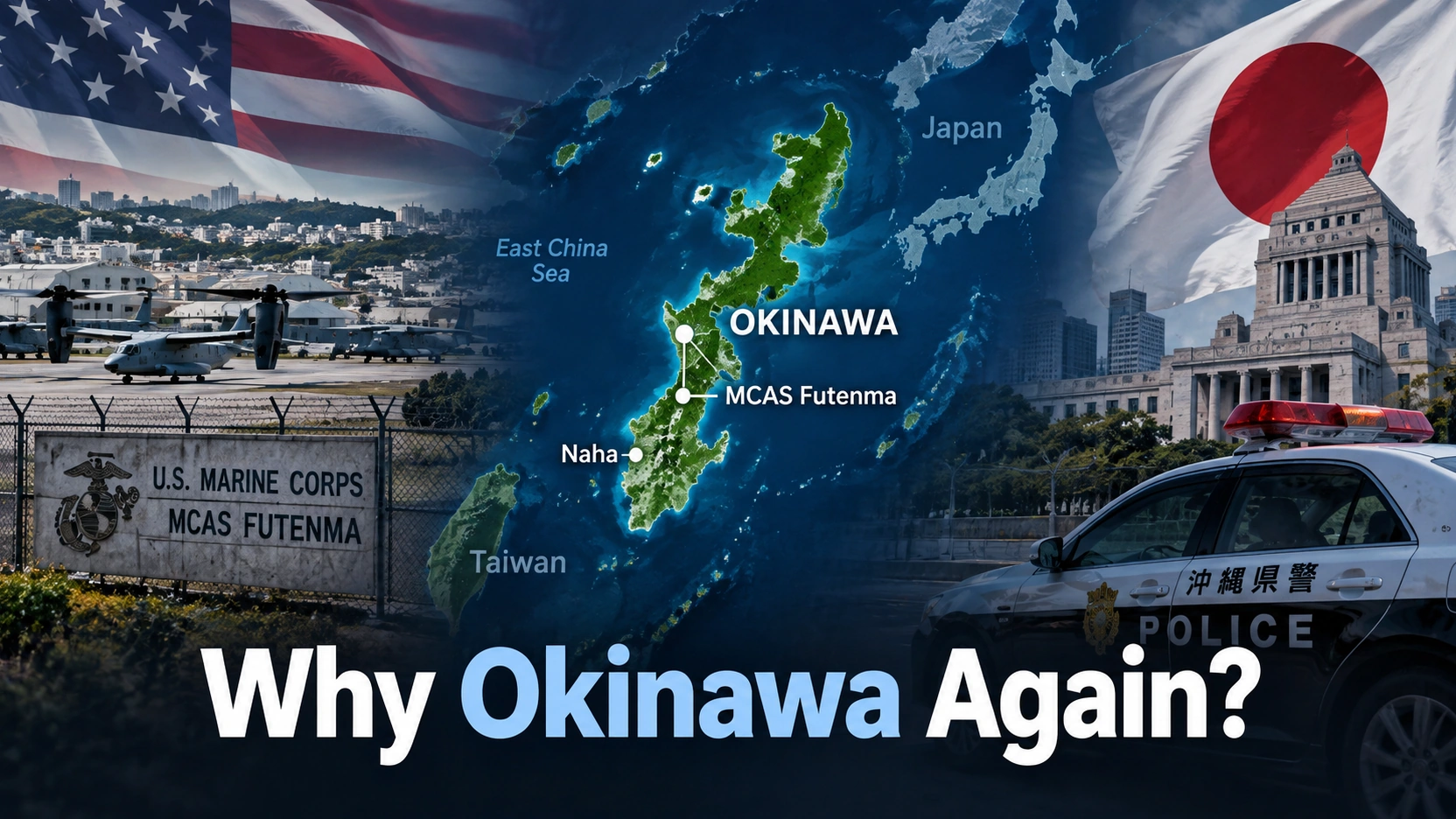
※ Images in this article are AI-generated illustrations created to help explain the story. They are not actual photographs, and depictions of people, places, or events may differ slightly from reality.
And one of the most important details is easy to miss: this is not a case in which the U.S. military has kept the suspect away from Japanese authorities. He is already in Japanese custody.
That makes the story less about a simple jurisdiction fight—and more about why decades of base politics can turn one criminal investigation into a national security issue.
What Happened—and What Is Still Only an Allegation?
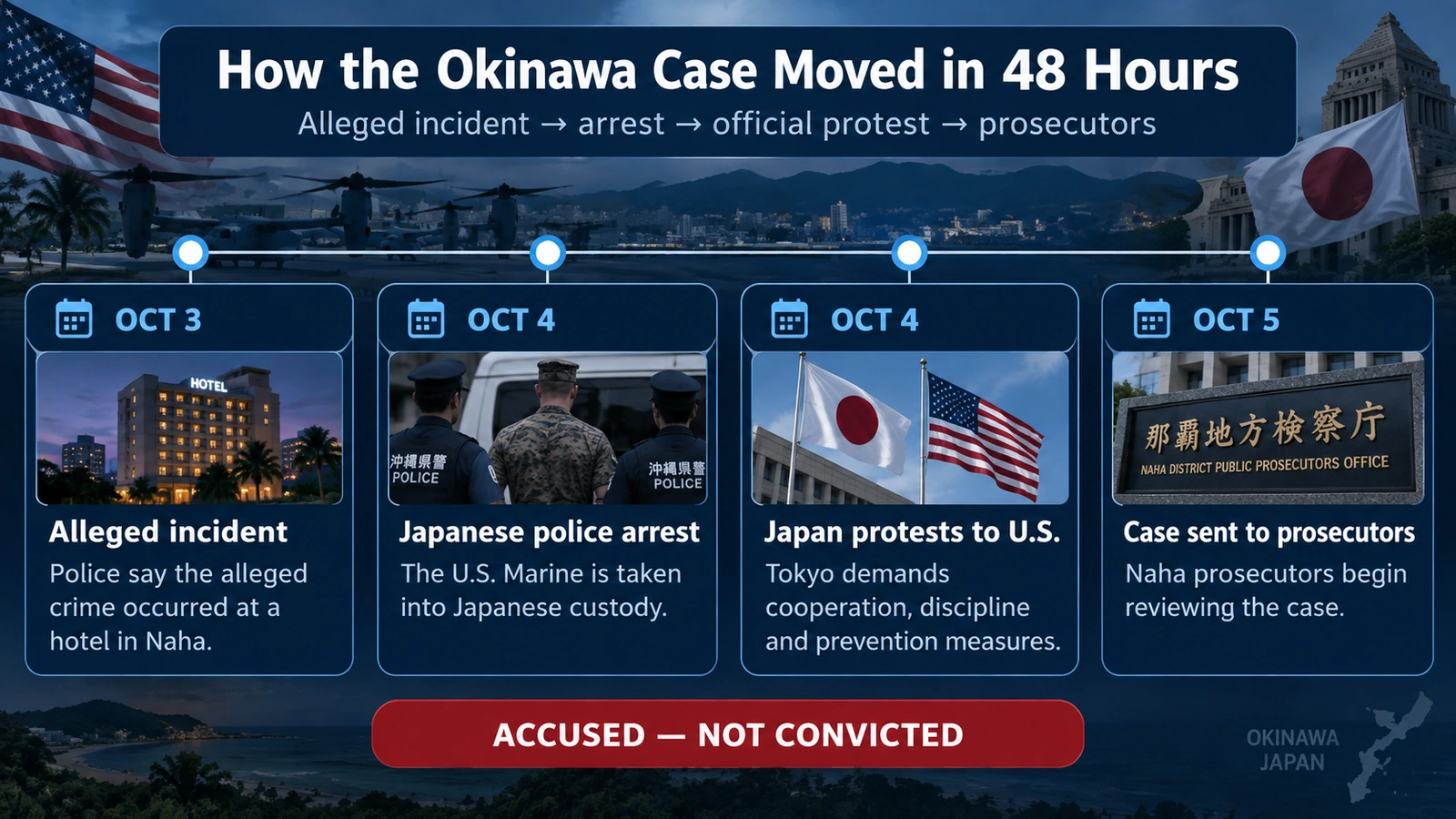
Japanese police arrested 20-year-old U.S. Marine Lance Cpl. Devin Jacob Ballard on October 4 on suspicion of robbery and murder in connection with the death of 39-year-old Naha resident Anna Yagi.
Police say the alleged crime occurred early on October 3 at a hotel in Naha, Okinawa’s capital. Ballard, who is assigned to III Marine Expeditionary Force and stationed at Marine Corps Air Station Futenma, has denied the allegations. (AP · Reuters)
On October 5, the case was forwarded to the Naha Public Prosecutors Office. That is an investigative and prosecutorial step—not a conviction. Ballard remains accused, and the allegations still have to be tested through Japan’s criminal justice process. (Nippon.com / Jiji Press)
Tokyo’s reaction was immediate.
Foreign Minister Toshimitsu Motegi summoned U.S. Ambassador George Glass and lodged what Japan’s Foreign Ministry called a strong protest. Japan demanded full cooperation with the investigation, tighter discipline among U.S. personnel and measures to prevent another incident. Glass said the United States would cooperate fully. (Japan Ministry of Foreign Affairs)
Defense Minister Shinjiro Koizumi separately summoned U.S. Forces Japan commander Lt. Gen. Stephen Jost and delivered a similar protest. (Japan Ministry of Defense)
Prime Minister Sanae Takaichi then raised the case at the start of her October 5 policy speech to parliament, giving what began as a local criminal investigation national political prominence. (AP)
That sounds unusually high-level for an individual criminal case.
In Okinawa, however, that reaction has a history.
Why Does Okinawa React So Strongly to Crimes Involving U.S. Troops?
Because Okinawa’s relationship with the U.S. military is not comparable to that of an ordinary Japanese prefecture.
Okinawa accounts for only about 0.6% of Japan’s total land area, yet roughly 70.3% of the land used exclusively by U.S. military facilities in Japan is concentrated there. On Okinawa’s main island, U.S.-exclusive facilities occupy roughly 15% of the land. (Okinawa Prefecture)
That distinction matters.
It does not mean 70.3% of all American troops in Japan are necessarily in Okinawa. The 70.3% figure refers specifically to the land area of U.S.-exclusive-use facilities.
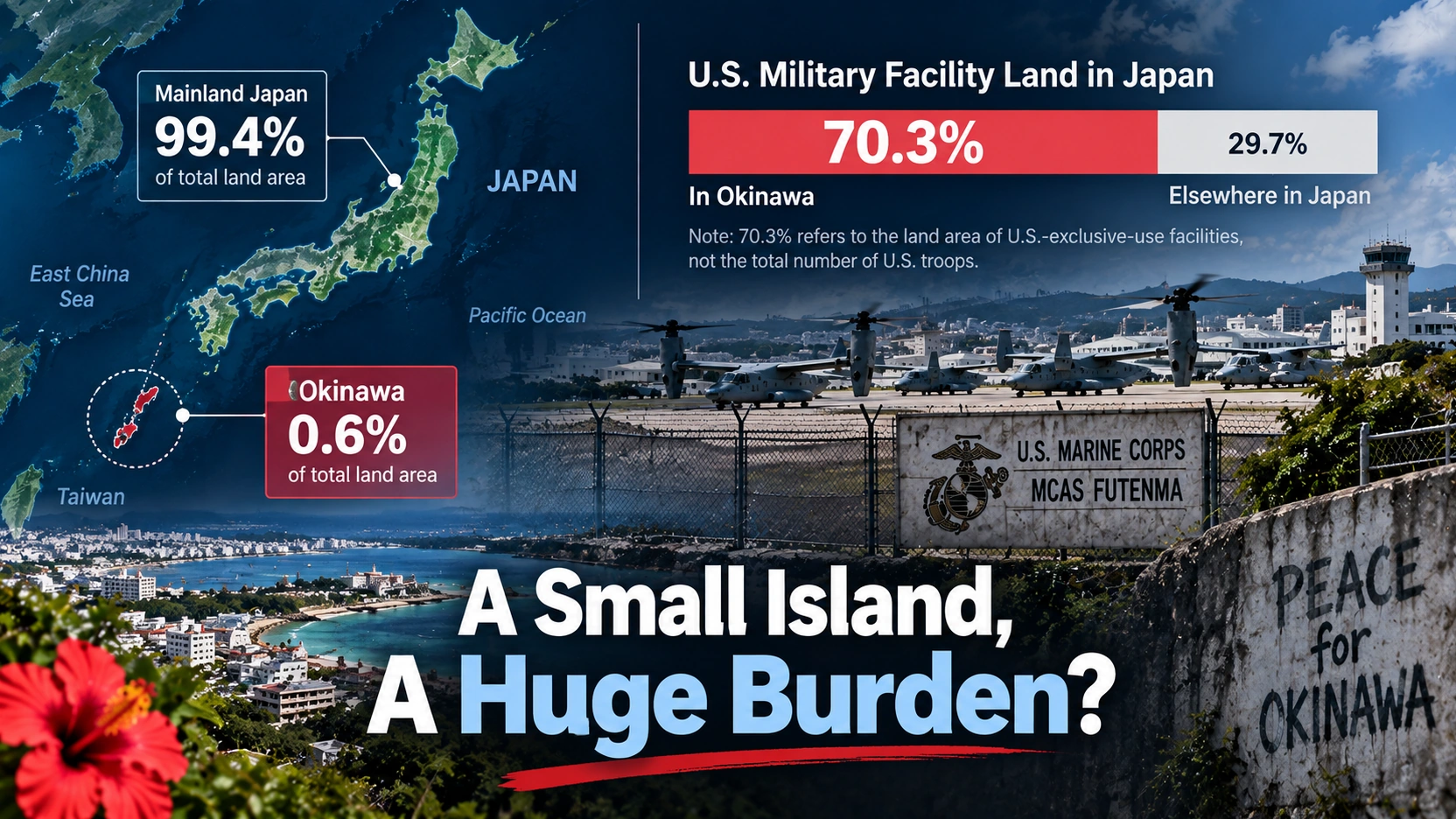
For residents, that concentration means the military presence is part of ordinary life: aircraft noise, land-use disputes, accidents, environmental concerns and occasional criminal cases involving military personnel.
And some cases have left lasting political scars.
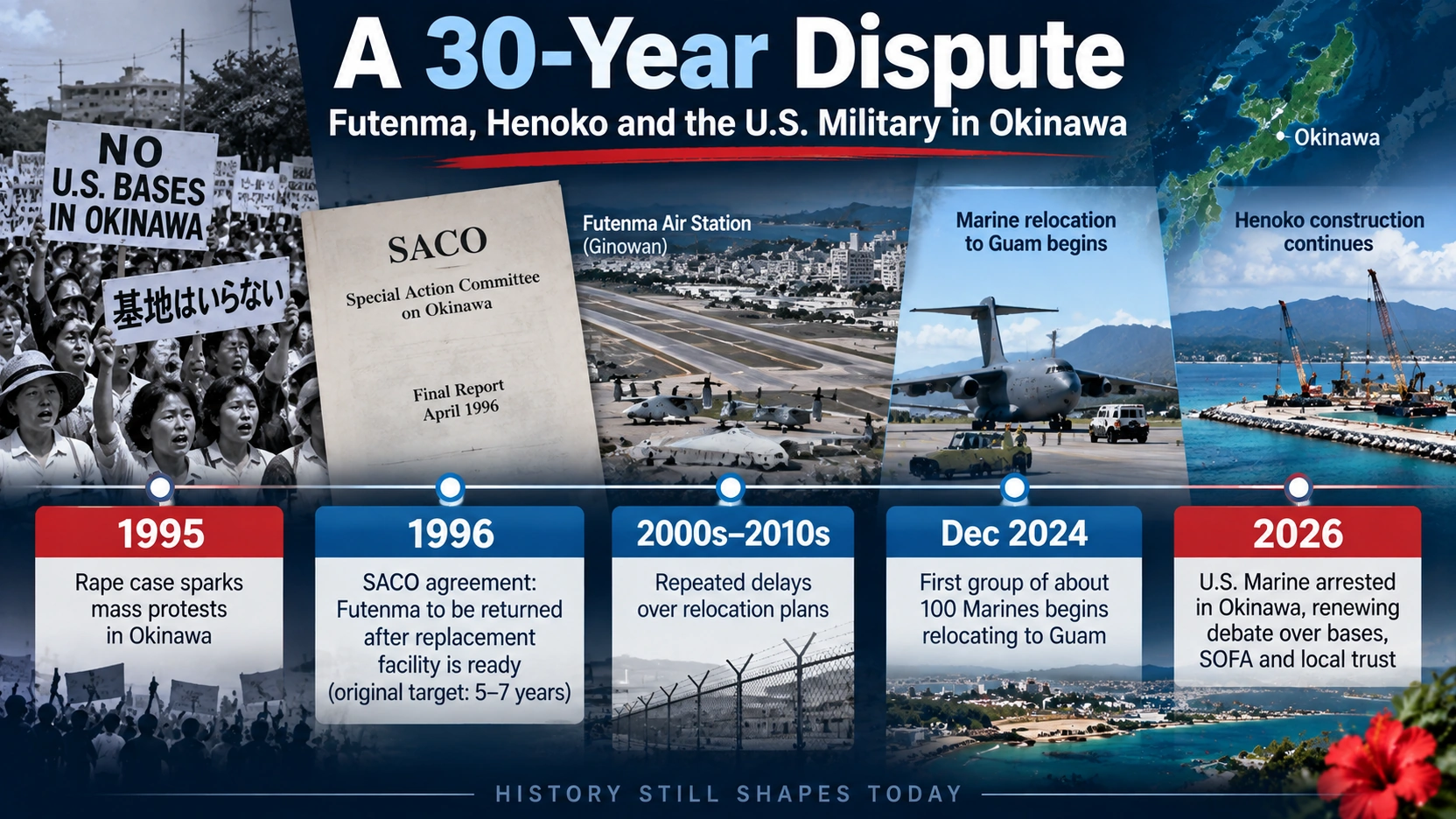
The most famous came in 1995, when three U.S. servicemen raped a 12-year-old Okinawan girl. The case triggered huge protests and intensified demands to reduce the American military footprint. (AP)
The political response eventually helped produce major negotiations over reducing the burden on Okinawa.
That history changes how a new case is received.
To many people outside Okinawa, the first question may be: “What did this Marine allegedly do?”
For many Okinawans, the next question is broader: how many times can officials promise tighter discipline before the public concludes that the underlying structure also needs to change?
Why Are So Many U.S. Bases Concentrated in Okinawa?
The short answer is history, geography and military strategy—but none of those factors makes the current concentration politically simple.
Okinawa was devastated during World War II and remained under U.S. administration long after the rest of occupied Japan regained sovereignty. It returned to Japanese administration in 1972, but a large American military presence remained. Okinawa’s own government notes that major base construction expanded during U.S. rule and that many facilities continued after reversion. (Okinawa Prefecture)
Its location is also strategically valuable.
The Okinawan island chain sits in Japan’s southwest, facing the East China Sea and extending toward Taiwan. Tokyo has been strengthening defenses across the southwestern islands as Chinese military activity and tensions around Taiwan grow. (Reuters)
That creates a difficult equation:
| Strategic view | Local view |
|---|---|
| Okinawa is extremely valuable for rapid military access in East Asia. | Okinawa carries a disproportionate share of the physical burden. |
| U.S. forces strengthen deterrence alongside Japan. | Bases bring noise, land restrictions, accidents and recurring fears about crime. |
| Washington and Tokyo want a credible forward presence. | Local governments want that presence reduced and better controlled. |
| Regional tensions make Okinawa more strategically important. | Greater military importance can mean even more pressure on local communities. |
This is why the debate never reduces neatly to “pro-American” versus “anti-American.”
Even Okinawa politicians who accept the need for the U.S.-Japan security alliance can object to how the burden is distributed.
And the latest case has made that distinction unusually visible.
Why Is the New Okinawa Governor’s Reaction So Important?
Because Genta Koja is not simply repeating the position of the administration he replaced.
Koja won Okinawa’s September 13 gubernatorial election with backing from Prime Minister Sanae Takaichi’s Liberal Democratic Party. His victory ended 12 years of prefectural leadership opposed to relocating Marine Corps Air Station Futenma to the Henoko area, and it was widely seen as giving Tokyo more room to advance its defense plans in Okinawa. (Reuters)
Then came the October arrest.
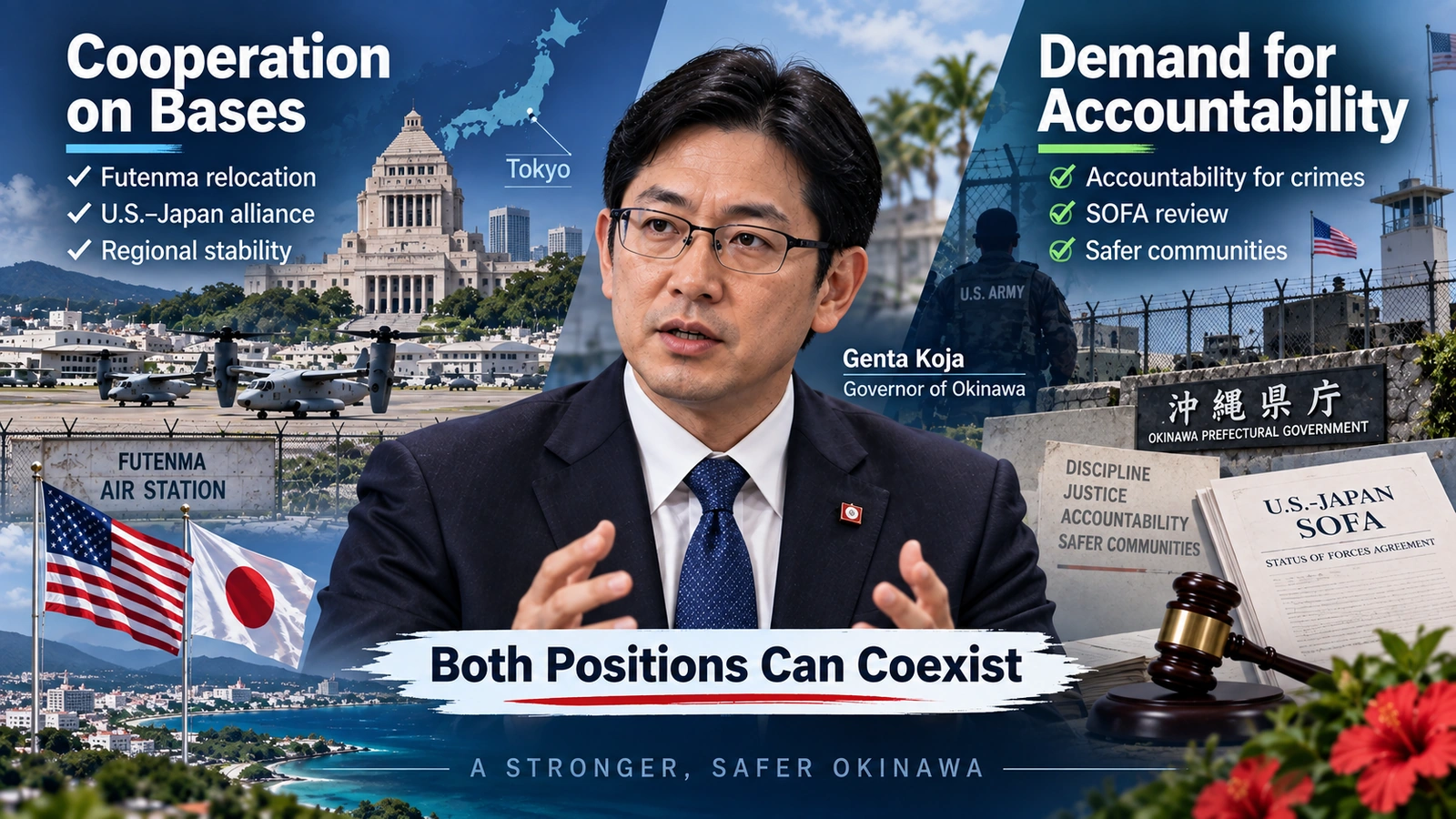
On October 5, Koja met senior U.S. military officials and demanded fundamental measures, including revision of the U.S.-Japan Status of Forces Agreement, commonly known as SOFA, as well as stronger education and discipline for U.S. personnel. (Nippon.com / Jiji Press)
That is politically significant.
Koja can be more cooperative with Tokyo over the Futenma relocation and argue that rules governing U.S. personnel need reform.
Those are not contradictory positions.
His reaction shows why this case could broaden beyond long-established anti-base groups. A governor elected partly on improving relations with Tokyo is now himself pressing for structural changes in how the U.S. military presence is managed.
Does the U.S.–Japan SOFA Keep the Marine Out of Japanese Custody?
No—not in this case.
This is one of the most important misunderstandings to clear up.
The U.S.-Japan Status of Forces Agreement sets rules for criminal jurisdiction and custody involving American military personnel in Japan. When jurisdiction is concurrent, the United States has the primary right in certain cases involving U.S. property, U.S. personnel or acts performed in official duty; Japan has the primary right in other cases. (Japan Ministry of Foreign Affairs)
The part that has generated controversy over the years concerns who holds a suspect before Japanese prosecutors formally indict that person.
If a U.S. service member is already in U.S. custody and Japan is to exercise jurisdiction, Article XVII generally allows the United States to retain custody until Japan files charges. A 1995 bilateral agreement added that the United States would give sympathetic consideration to Japanese requests for pre-indictment transfer in certain serious cases involving murder or rape. (Japan Ministry of Foreign Affairs)
But there is a crucial difference here:
Japanese police arrested Ballard, and he is already in Japanese custody. The current case is therefore proceeding through Japanese police and prosecutors. (AP)
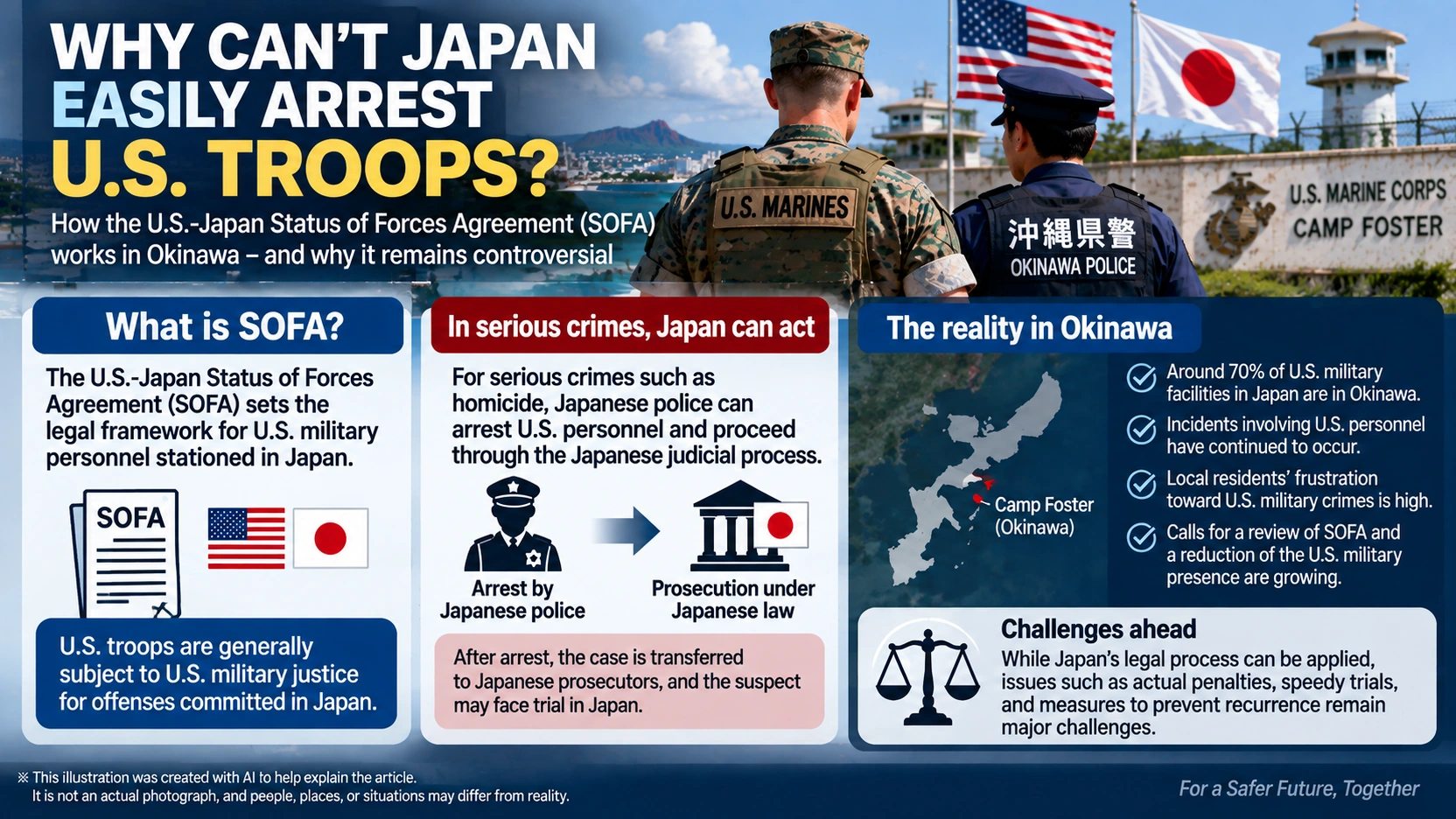
So SOFA does not mean American personnel can commit crimes in Japan and simply be removed from the Japanese justice system.
Japan is investigating this case.
Japanese prosecutors will decide whether to file formal charges.
The larger SOFA debate concerns the legal framework surrounding U.S. forces more broadly—including custody arrangements, access to bases and other aspects of the American military presence.
That broader framework is what Koja is asking to revisit.
Why Does Futenma Keep Coming Back Into the Story?
Because the suspect is stationed at Marine Corps Air Station Futenma—and Futenma has symbolized the Okinawa base problem for three decades.
After the political crisis of the mid-1990s, Japan and the United States created the Special Action Committee on Okinawa, or SACO, to reduce the burden of U.S. military facilities on local communities.
In 1996, the two governments agreed that Futenma would be returned after an adequate replacement facility became operational.
The original target was striking: five to seven years. (Japan Ministry of Foreign Affairs)
Thirty years later, Futenma is still operating.
The replacement facility is being built in the Henoko area of Nago, also in Okinawa, meaning the long-running dispute has often been framed locally as moving the burden from one part of the prefecture to another rather than removing it altogether.
There has been some movement.
In December 2024, an initial group of about 100 logistics-support Marines began relocating from Okinawa to Guam, the first phase of a broader effort to move thousands of Marines outside Japan while retaining a substantial Marine presence on Okinawa. (Japan Ministry of Defense)
So the base structure is changing.
It is just changing much more slowly than the public arguments surrounding it.
Why Can One Criminal Case Become an Alliance Problem?
Because alliances depend on more than treaties, aircraft and troop numbers.
They also depend on political support in the communities that host military forces.
The U.S.-Japan security treaty gives American forces an important role in Japan’s defense. But keeping those forces stationed in populated communities also requires sustained cooperation from Japan’s national government and a workable relationship with local residents.
Repeated incidents can erode that relationship.
A useful way to see the chain is:
Alleged crime involving a service member → local anger and fear → demands for tighter U.S. military controls → renewed SOFA and base debate → pressure on Tokyo → more difficulty sustaining the military presence that Washington and Tokyo consider strategically important
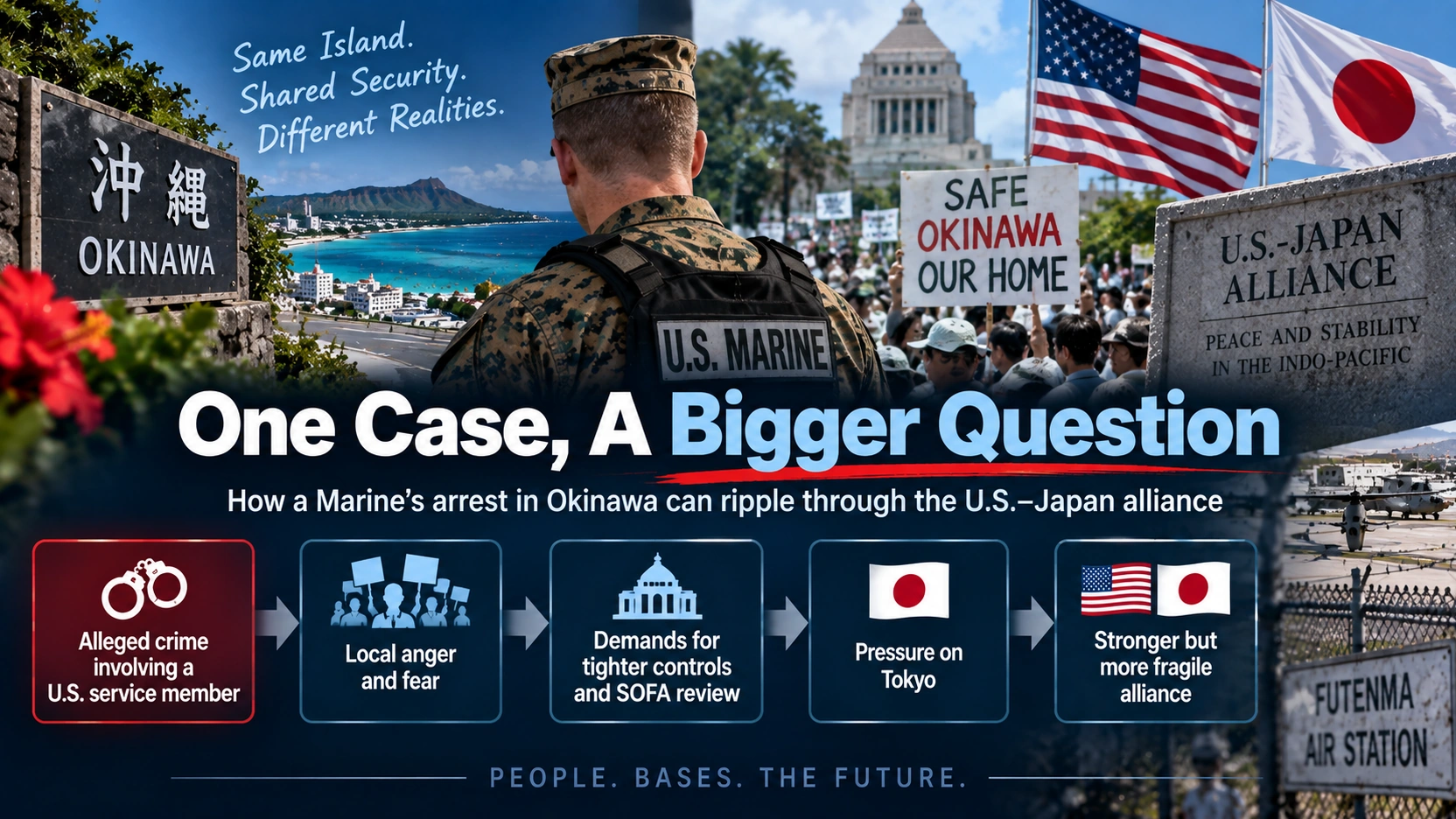
That is why Japan’s national government reacted so forcefully.
Takaichi’s government is trying to strengthen Japan’s defense posture in the southwest while also maintaining public cooperation around the U.S. military presence. The arrest makes those two tasks harder to manage at the same time. (AP)
Why Is Okinawa More Strategically Important Now?
Okinawa’s strategic value is rising at almost the same time that frustration over its military burden keeps returning.
That is the tension at the center of the story.
Japan has been reinforcing defenses across its southwestern islands as China’s military activity grows and Taiwan remains a possible regional flashpoint. Washington also relies on forward-deployed forces in Japan to respond quickly to crises across the western Pacific. (Reuters)
That makes Okinawa difficult to replace strategically.
But strategic value can create a political paradox:
The more important Okinawa becomes to regional defense, the more important local acceptance of that military presence becomes.
A base can be useful on a map and politically difficult on the ground at the same time.
That is why another pledge to “strengthen discipline” may not, by itself, settle the argument.
What Could Actually Change After This Case?
The criminal case itself and the political response should be watched separately.
First, Japanese prosecutors will determine whether to formally charge Ballard. The legal process should not be confused with the broader political debate.
Second, U.S. military leaders may consider additional discipline, training or liberty restrictions for personnel stationed in Japan. U.S. officials have said they will cooperate with Japanese authorities and hold personnel to high standards, but any new restrictions should be treated as confirmed only when formally announced. (AP)
Third, Koja’s call for SOFA revision will test how far Tokyo is willing to go beyond demanding better enforcement of existing rules.
And fourth, the case could affect the politics surrounding Futenma and the broader defense buildup in Okinawa.
Those are separate questions:
| What to watch | What it would tell us |
|---|---|
| Prosecutorial decision | Where the criminal case stands |
| New U.S. military restrictions | Whether Washington changes personnel controls |
| Formal SOFA talks | Whether the dispute moves from protest to structural negotiation |
| Futenma and Henoko politics | Whether the case changes local support for base policy |
| Tokyo-Okinawa relations | Whether Koja remains able to cooperate closely with the central government |
The biggest mistake would be to assume that all of these outcomes move together.
A criminal prosecution does not automatically produce a SOFA revision.
A SOFA debate does not automatically end the U.S. military presence.
And anger over an alleged crime does not mean Okinawans all hold the same view about the alliance.
Bottom Line: What This Story Really Means
The arrest of a U.S. Marine in Okinawa matters far beyond one criminal investigation because it touches a political problem that Japan and the United States have never fully solved.
Okinawa is strategically valuable to both countries, especially as security concerns grow around China and Taiwan.
But it also carries an unusually large share of the physical and social burden of the American military presence in Japan.
That combination means every major incident involving U.S. personnel can revive questions about bases, discipline, SOFA and whether Okinawa is being asked to carry too much of an alliance designed to protect the entire country.
The most revealing development may be the reaction of Governor Genta Koja.
He is more willing than his predecessor to cooperate with Tokyo over Futenma relocation and the defense buildup, yet he is now demanding revision of the agreement governing U.S. forces. (Reuters · Nippon.com / Jiji Press)
That is why this is not simply another crime story. It is a test of whether Washington and Tokyo can maintain a strategically important military presence without steadily losing the trust of the community that hosts it.
Okinawa U.S. Military Presence: Key Questions Explained
Q. What is the U.S. Marine in Okinawa accused of doing?
Japanese police arrested Lance Cpl. Devin Jacob Ballard on suspicion of robbery and murder in connection with the death of 39-year-old Anna Yagi at a Naha hotel. He has denied the allegations, and the case remains in the Japanese criminal justice process. (AP)
Q. Is the Marine being held by the U.S. military?
No. Ballard is in Japanese custody after being arrested by Japanese authorities. The case therefore does not fit the common assumption that SOFA automatically leaves an accused American service member in U.S. custody.
Q. What is the U.S.-Japan Status of Forces Agreement?
The U.S.-Japan SOFA establishes rules governing American forces stationed in Japan, including criminal jurisdiction and custody. In concurrent-jurisdiction cases, the agreement specifies when the United States or Japan has the primary right to exercise jurisdiction. (Japan Ministry of Foreign Affairs)
Q. Does SOFA give U.S. troops immunity from Japanese law?
No. SOFA does not provide blanket immunity. In cases where Japan has the primary right to exercise jurisdiction, U.S. military personnel can be investigated and prosecuted under Japanese law.
Q. Why does Okinawa host so many U.S. military facilities?
History and strategic location both matter. U.S. bases expanded during the postwar period when Okinawa remained under American administration, and the island chain later retained major military value because of its position in the western Pacific. (Okinawa Prefecture)
Q. Is it true that 70% of U.S. troops in Japan are in Okinawa?
That is not what the frequently cited 70.3% figure means. About 70.3% of the land area used exclusively by U.S. military facilities in Japan is concentrated in Okinawa, according to Okinawa Prefecture. (Okinawa Prefecture)
Q. Why is Marine Corps Air Station Futenma so controversial?
Futenma is surrounded by densely populated communities in Ginowan, and Japan and the United States agreed in 1996 to return the base after replacement facilities were completed. The replacement project in Henoko has faced decades of political, legal and construction disputes. (Japan Ministry of Foreign Affairs)
Q. Why is Governor Genta Koja’s response politically significant?
Koja won office as a governor more willing than his predecessor to cooperate with Tokyo over the Futenma relocation and defense policy. After the Marine arrest, however, he called for revision of SOFA as well as stronger measures to prevent future incidents. (Nippon.com / Jiji Press)
Q. Could this case damage the U.S.-Japan alliance?
It does not mean the alliance is breaking apart. The risk is political: repeated incidents can weaken local trust and make it harder for Tokyo and Washington to sustain the military presence they consider important for regional security.
Q. What should happen next?
The immediate questions are whether Japanese prosecutors formally charge Ballard, whether U.S. military authorities announce new preventive measures, whether Tokyo seriously considers SOFA changes, and whether the case alters Okinawa’s politics around Futenma and other bases.
Did this help make the story clearer? 🙂 WIN keeps unpacking the “why” behind the news—clearly and simply!
Sources
Arrest, Investigation and Government Response
Japan Ministry of Defense — October 4 Statement on the Marine’s Arrest
AP — Anger in Japan Grows After U.S. Marine Is Arrested Over the Killing of a Woman on Okinawa
Reuters — Japan’s Takaichi Protests to U.S. After Marine Accused of Murder in Okinawa
Okinawa Government and Political Follow-Up
Nippon.com / Jiji Press — Okinawa Governor Protests to U.S. Forces Over Marine Arrest
Reuters — Okinawa Election Win May Give Tokyo Freer Hand on Military Build-Up
Okinawa Prefecture — U.S. Military Base Concentration and the Henoko Issue
SOFA, Futenma and Burden Reduction
Japan Ministry of Foreign Affairs — U.S.-Japan Status of Forces Agreement, Article XVII
Japan Ministry of Foreign Affairs — 1996 SACO Final Report on Futenma Air Station
Japan Ministry of Defense — Start of Marine Relocation From Okinawa to Guam
Keep Reading
How did the United States and Japan go from wartime enemies to close allies?
The Okinawa base debate makes more sense when the modern U.S.-Japan alliance is separated from the countries’ World War II relationship. This earlier WIN story explains how that historical distinction became politically relevant again in 2026.
Why Did Trump Call China a World War II Ally—and Why Did Japan Respond So Quickly?