Brazil Election 2026: Why Did Flávio Bolsonaro Finish Ahead of Lula—and What Happens in the Runoff?

Wasn’t Brazil supposed to be watching President Luiz Inácio Lula da Silva try to win one more term?
So how did the election turn into Lula versus Bolsonaro all over again—except the Bolsonaro on the ballot is the former president’s son?
And there is an even more surprising part.
On October 4, Flávio Bolsonaro did not merely force Lula into a runoff. He finished the first round ahead of the incumbent, with roughly 47% of valid votes to Lula’s 45%. Neither crossed the majority threshold needed to win outright, so Brazil will vote again on October 25. (Reuters · Associated Press)
That changes the story considerably.
A few days ago, the big question was whether Lula could survive a difficult reelection campaign. Now the question is why an 80-year-old president seeking a fourth nonconsecutive term is entering the decisive round behind the 45-year-old son of the man he defeated four years ago. (Associated Press)
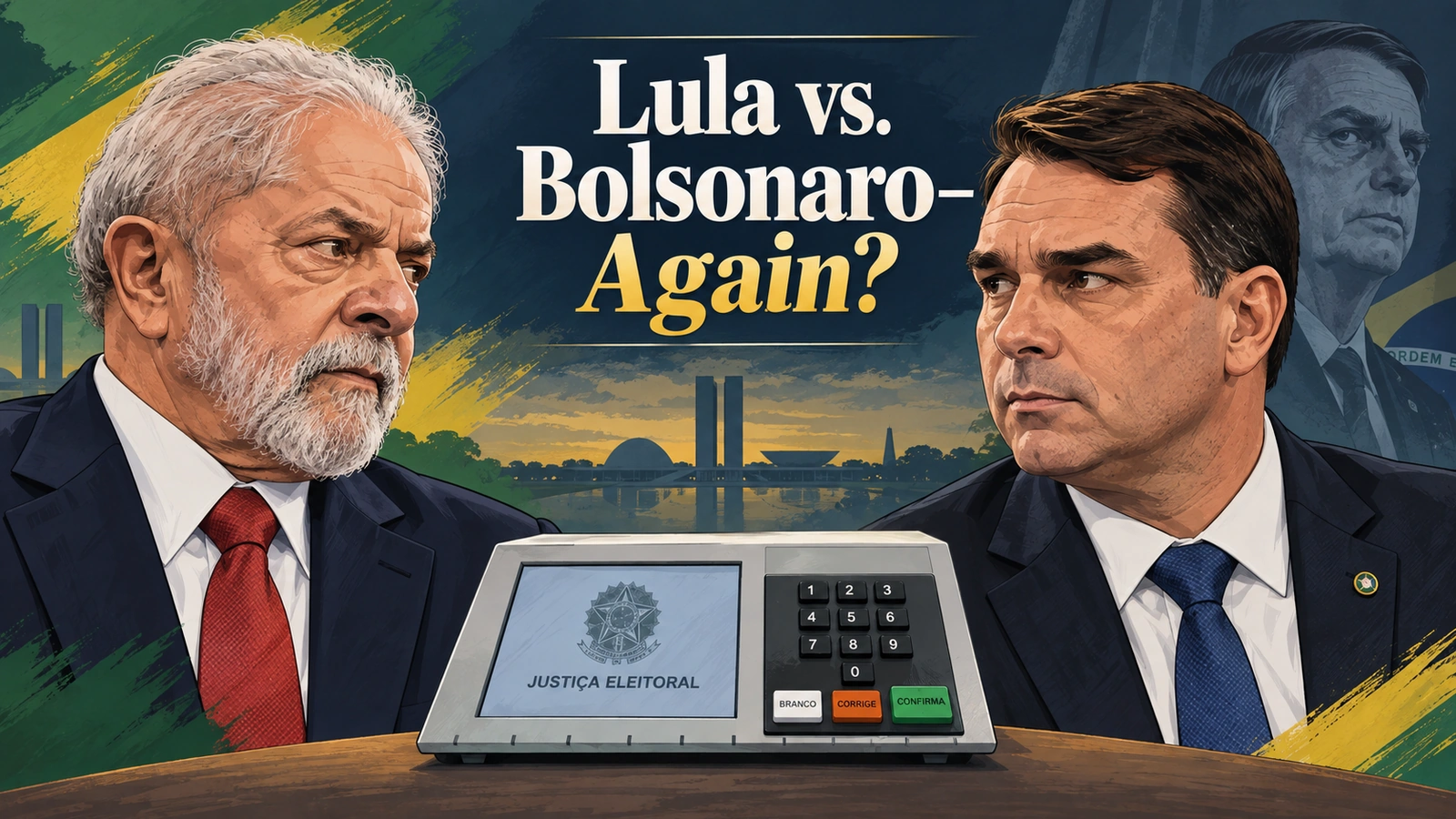
※ Images in this article are AI-generated illustrations created to help explain the story. They are not actual photographs, and depictions of people, places, or events may differ slightly from reality.
The answer is not one dramatic event.
Brazil’s race has become a collision of economic frustration, fear of crime, the enduring Bolsonaro political movement, changing religious politics and deep fatigue with the country’s left-versus-right divide.
What Actually Happened in Brazil’s First Round?
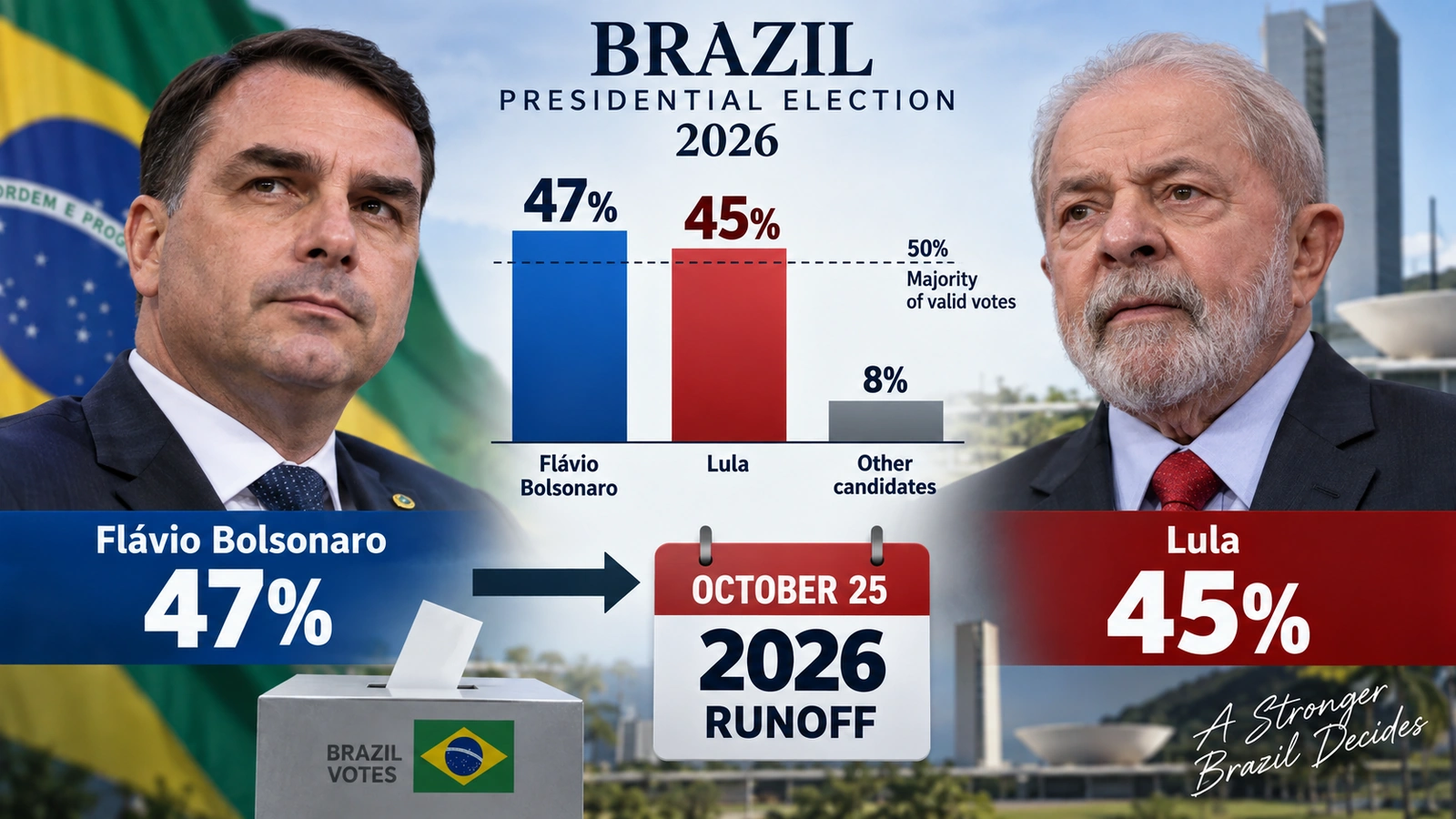
The simplest way to understand the result is that Flávio Bolsonaro finished first, but he did not win the presidency.
Brazil elects its president by an absolute majority of valid votes. If no candidate reaches that threshold in the first round, the two highest finishers advance to a new second-round vote. Brazil’s official 2026 election calendar sets that runoff for October 25, 2026. (Brazil’s Superior Electoral Court · 2026 Election Calendar)
| First-round picture | Approximate result | What it means |
|---|---|---|
| Flávio Bolsonaro | 47% | Finished first and advanced |
| Luiz Inácio Lula da Silva | 45% | Finished second and advanced |
| All other candidates combined | About 8% | Their voters become a major runoff target |
| Rule for a first-round win | Absolute majority of valid votes | Neither candidate reached it |
| Runoff | October 25 | Lula and Flávio face each other again |
With nearly all ballots counted, AP reported that Flávio had received just over 56 million votes and Lula about 53.7 million. Reuters likewise reported the first-round split at roughly 47% to 45%. (Associated Press · Reuters)
That roughly 8% outside the two leading candidates is now disproportionately important.
The runoff is a new election between only two candidates. Voters who backed smaller candidates, along with people who did not participate in the first round, can change the balance.
Who Is Flávio Bolsonaro—and Why Is His Father Still at the Center of This Story?
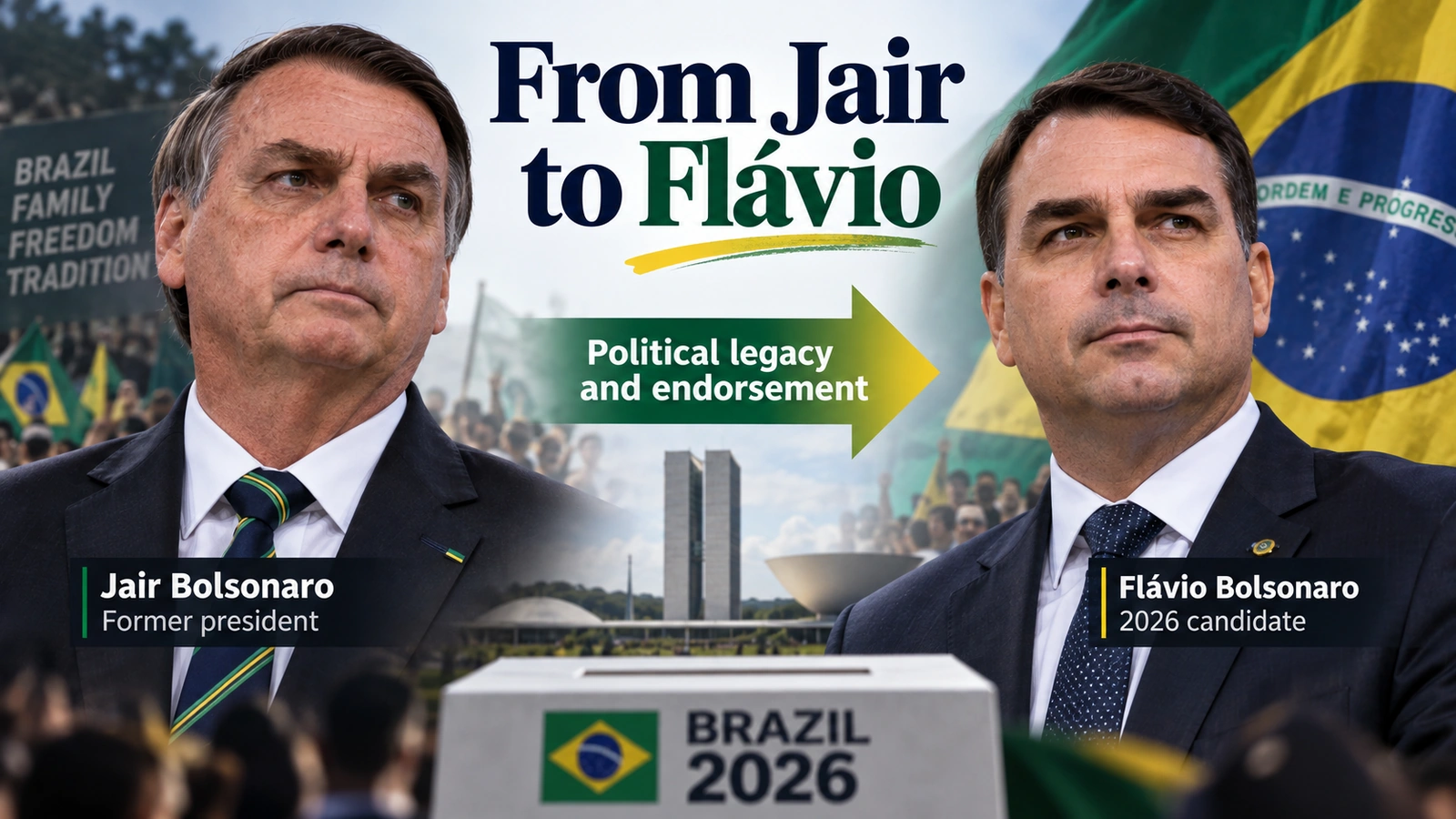
Flávio Bolsonaro is a senator from Rio de Janeiro and the eldest son of former President Jair Bolsonaro.
That family relationship is not background trivia. It is central to why Flávio became a national contender.
Jair Bolsonaro backed his son as the political heir to the movement he built. Flávio has tried to preserve that base while presenting himself as a more measured version of his father, combining Christian traditionalism, market-friendly policies and a hard line against the left. (Reuters)
Jair Bolsonaro is serving a 27-year sentence after his conviction over a failed coup plot related to the aftermath of the 2022 election. Brazil’s National Archives also records that he was declared ineligible by the Superior Electoral Court in 2023 and later convicted by the Supreme Court. (Reuters · Brazilian National Archives)
That is why some coverage has framed Flávio’s campaign in almost cinematic terms: the son returning to challenge the man who defeated his father.
But describing the campaign simply as “revenge for his father” goes too far.
Flávio has made his family’s legal battles part of his political message and has said he wants to undo legal actions affecting his father and brother. At the same time, his campaign has a broader agenda built around public security, Christian conservative politics, fiscal restraint and a more market-friendly economic program. (Reuters)
So the father-son storyline is real.
Calling the entire election a revenge mission is an interpretation.
Why Did Lula’s Comeback Stop Looking So Secure?
Lula’s political story is extraordinary.
He governed Brazil from 2003 through 2010, returned to the presidency in 2023 after defeating Jair Bolsonaro and is now seeking a fourth nonconsecutive term. Brazil’s National Archives records his first two presidential terms beginning in 2003 and his return to office in 2023. (Brazilian National Archives)
But incumbency creates a different political problem.
A challenger can promise change. An incumbent has to explain why voters should be satisfied with what they already have.
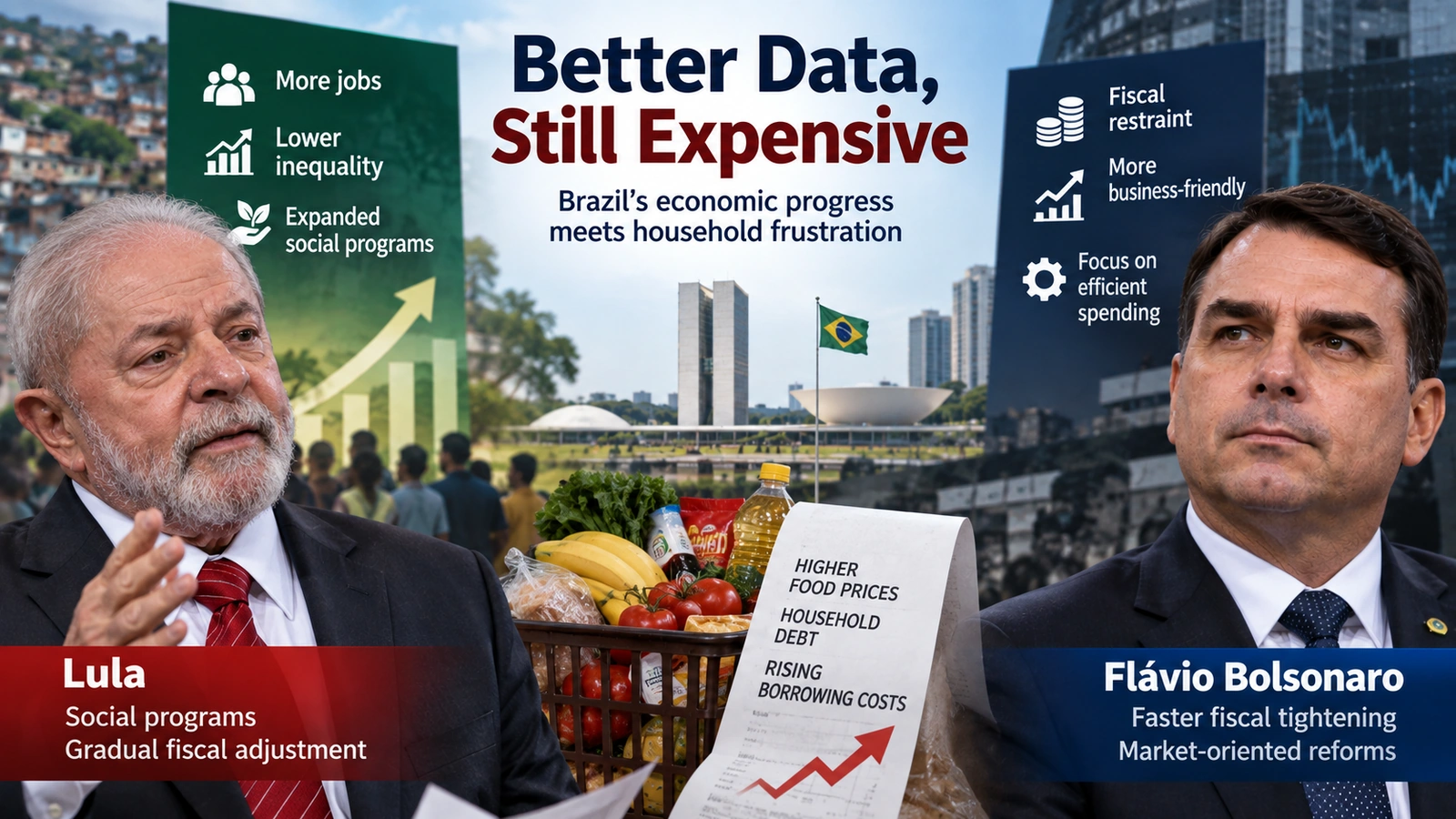
Lula entered the campaign pointing to gains such as lower unemployment and reduced inequality. Yet Reuters found substantial frustration over household finances, especially food prices, debt and the continuing feeling that everyday life remained expensive. A September Quaest poll cited by Reuters found nearly half of Brazilians saying the economy had worsened over the previous year even while several headline indicators had improved. (Reuters)
That apparent contradiction is important.
Imagine your employer tells you the company is doing better, unemployment nationally is down and the economy is growing—but your grocery bill, credit payments and monthly debt still feel painful.
Both statements can be true.
Governments are judged not only by national statistics, but by whether people feel those improvements in their own budgets.
Lula tried to strengthen that household-economy message before the election. In September, he signed a decree raising the minimum Bolsa Família payment by 15%, with the higher benefit scheduled to begin on October 19. (Associated Press)
Flávio, meanwhile, attacked the government over public debt and spending and presented himself as more business-friendly.
Reuters reported that the two campaigns proposed significantly different approaches to Brazil’s fiscal problem. Lula’s advisers favored a more gradual adjustment intended to protect social programs, while Flávio’s advisers proposed a faster fiscal adjustment tied more directly to the debt-to-GDP ratio. (Reuters)
That helps explain why the election cannot be reduced to left versus right.
For many voters, it is also “Do I feel better off than I did four years ago?”
Why Has Crime Become Such a Powerful Election Issue?
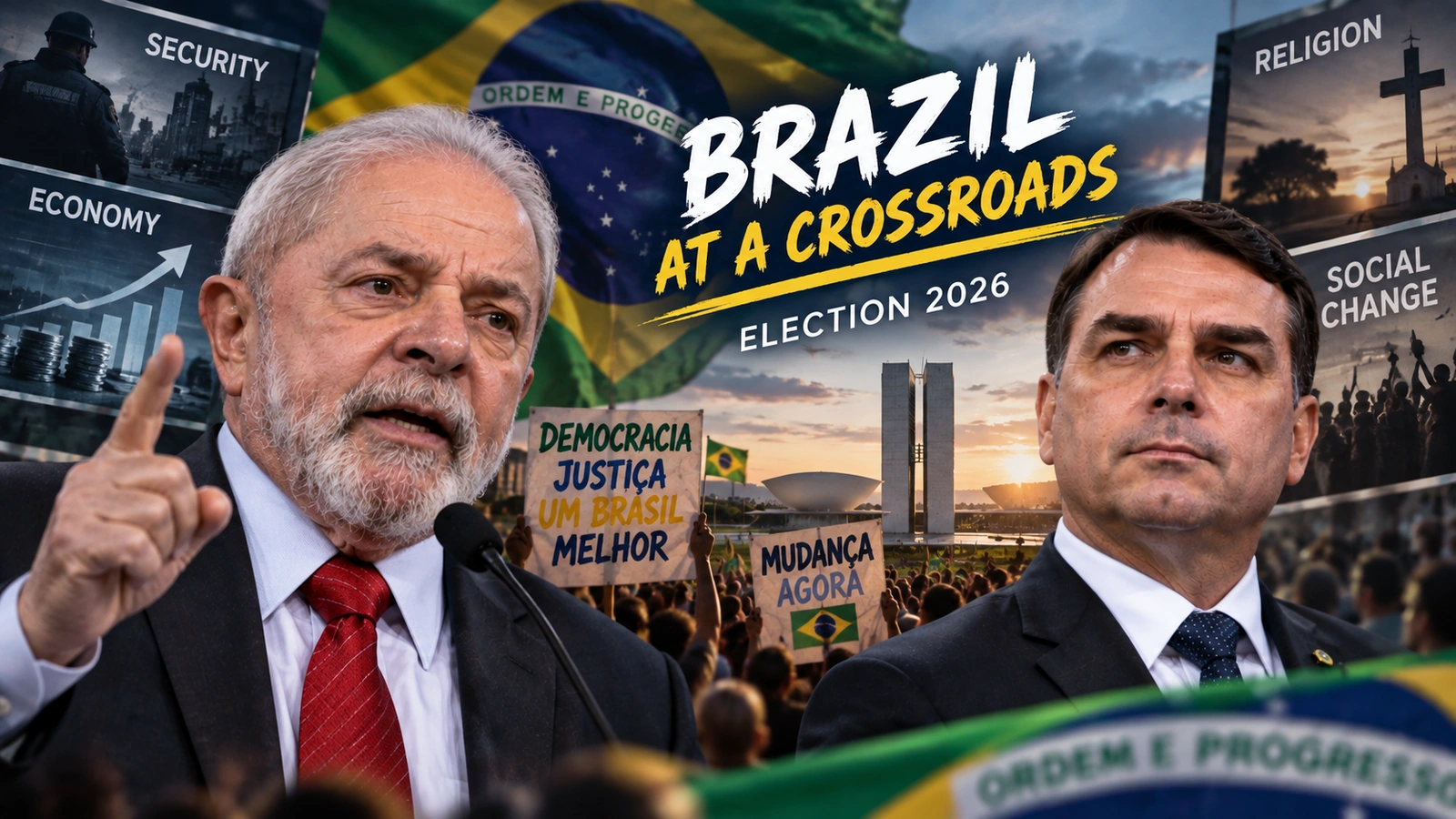
Because public safety is one of the places where voter anxiety and ideological differences meet.
Flávio has campaigned on a hard-line security message. AP reported proposals including building large new prisons and lowering the age of criminal responsibility. Other campaign coverage has also described his support for treating major transnational gangs with a terrorism-style legal approach. (Associated Press · Associated Press)
Lula has responded by pushing a stronger federal role against organized crime.
In September, his administration announced a pilot plan in Rio de Janeiro centered on shared intelligence, coordinated federal-state-municipal operations, inspections and efforts to disrupt the weapons and financial networks used by criminal groups. (Associated Press)
The difference is partly about emphasis.
| Public-safety question | Lula’s emphasis | Flávio Bolsonaro’s emphasis |
|---|---|---|
| Organized crime | Intelligence, financial disruption and federal-state coordination | Tougher punishment and expanded incarceration |
| Gangs | Criminal enforcement plus financial and institutional disruption | More aggressive legal treatment of major transnational gangs |
| Campaign message | Make existing institutions coordinate more effectively | Existing policies are too soft and require a sharper break |
That does not mean every voter is choosing only on crime.
It means crime gives Flávio a clear way to argue that Brazil needs a change in direction, while Lula has been trying to show that his government can deliver a stronger response without adopting his opponent’s model.
What Does Religion Have to Do With a Presidential Election?
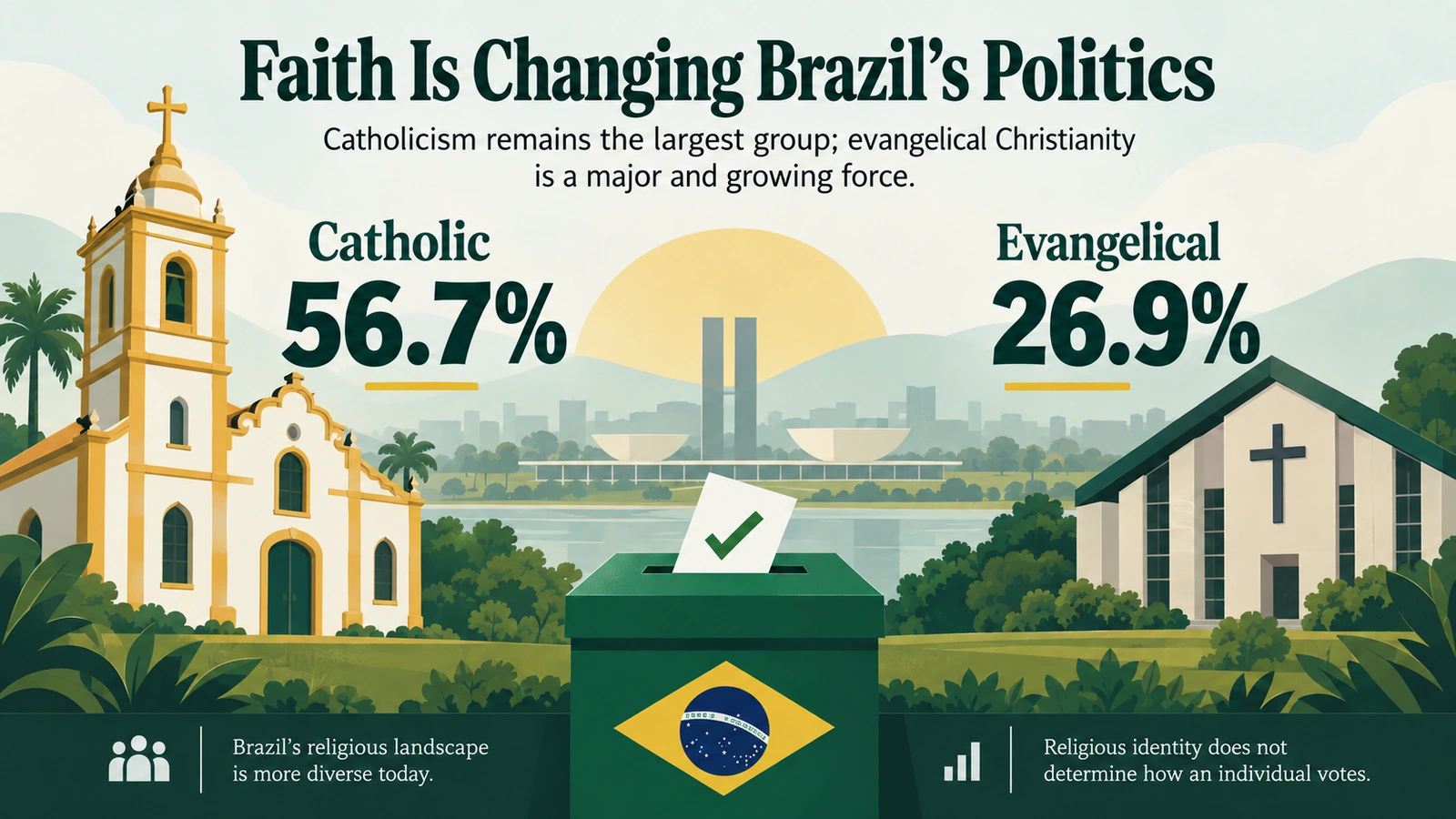
Brazil is still predominantly Catholic, but the religious landscape has changed dramatically over several decades.
The 2022 census found that 56.7% of Brazilians age 10 and older identified as Roman Catholic, while roughly 26.9% identified as evangelical Christians. Brazil’s national statistics agency counted about 100.2 million Catholics, while AP reported the evangelical share from the same census data. (IBGE · Associated Press)
That does not create two automatic voting blocs.
A Catholic voter can support Flávio. An evangelical voter can support Lula. Religion interacts with region, income, gender, age and political identity.
But religious networks and explicitly Christian political messaging have become increasingly important.
Flávio has emphasized Christian conservative themes, and the issue became especially visible late in the campaign when a statement about dedicating Brazil to Jesus triggered claims that he wanted to diminish the status of Our Lady of Aparecida, Brazil’s Catholic patron saint.
Flávio denied that interpretation and called the allegation false, saying his statement was religious rather than an attempt to change the saint’s status. (Associated Press)
That episode shows why the religious shift matters politically.
The competition is not simply “Catholics versus evangelicals.”
It is about which political messages resonate inside a religious society that is becoming more diverse.
Is This Really Lula Versus the Bolsonaro Family?
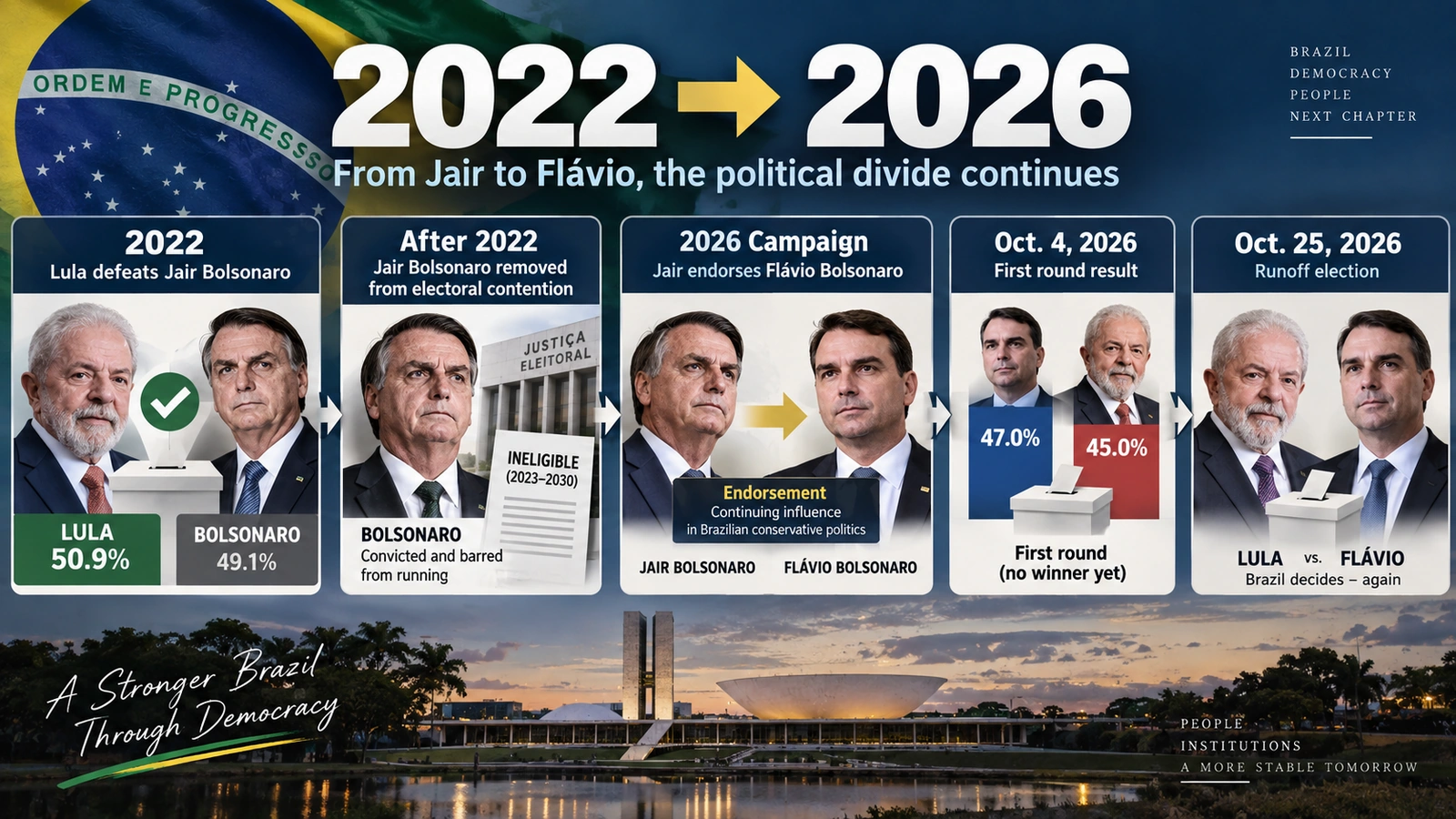
In one sense, yes.
The candidate is different, but much of the political divide survived.
| Period | Lula side | Bolsonaro side |
|---|---|---|
| 2022 | Lula returned as challenger | Jair Bolsonaro was president |
| After 2022 | Lula began a third presidential term | Jair was declared ineligible and was later convicted |
| 2026 campaign | Lula sought a fourth nonconsecutive term | Jair endorsed Flávio as his political successor |
| October 4 first round | About 45% | Flávio about 47% |
| October 25 | Lula | Flávio Bolsonaro |
Flávio inherited several advantages that do not disappear simply because his father cannot run: the Bolsonaro name, a large conservative activist network, strong support among parts of the religious right and voters intensely opposed to Lula’s Workers’ Party.
But he has also tried to distinguish himself from his father.
Reuters has described Flávio as presenting himself as a “more centered Bolsonaro,” while preserving major elements of the movement’s Christian conservative and market-oriented agenda. (Reuters)
That creates a difficult balancing act.
Move too far from Jair Bolsonaro and Flávio risks weakening the political identity that made him a national candidate.
Stay too close and he also carries the controversies and high rejection that surround the former president.
Lula faces the mirror image of that problem.
His long record is one of his greatest political assets. It is also why voters looking for political or generational change can see him as the establishment rather than the insurgent.
What Is the Runoff Actually About?
The runoff is broader than one personality contest.
The clearest way to understand it is as several elections happening at once.
| Question voters are being asked | Lula | Flávio Bolsonaro |
|---|---|---|
| Who can manage household economic pressure? | Social programs, income support and gradual fiscal adjustment | Faster fiscal tightening and more market-oriented reforms |
| Who can respond to violent crime? | Coordination, intelligence and stronger federal participation | Harsher punishment, large new prisons and tougher enforcement |
| What should happen after the Bolsonaro era? | Keep the Bolsonaro movement out of national power | Restore Bolsonarism through a new generation |
| How should religion appear in politics? | Broader center-left coalition with religious outreach | More explicit Christian conservative identity |
| What should U.S.-Brazil relations look like? | Greater emphasis on sovereignty and strategic independence | Closer political alignment with the Trump administration |
Neither column tells voters what they should prefer.
It shows why the same person can agree with one candidate on crime and the other on social spending, or like one candidate’s foreign policy while distrusting his economic approach.
That is also why the first-round totals do not automatically determine the runoff.
A presidential runoff is about building a majority from voters who did not all start in the same coalition.
Why Should Americans Care About Brazil’s Election?
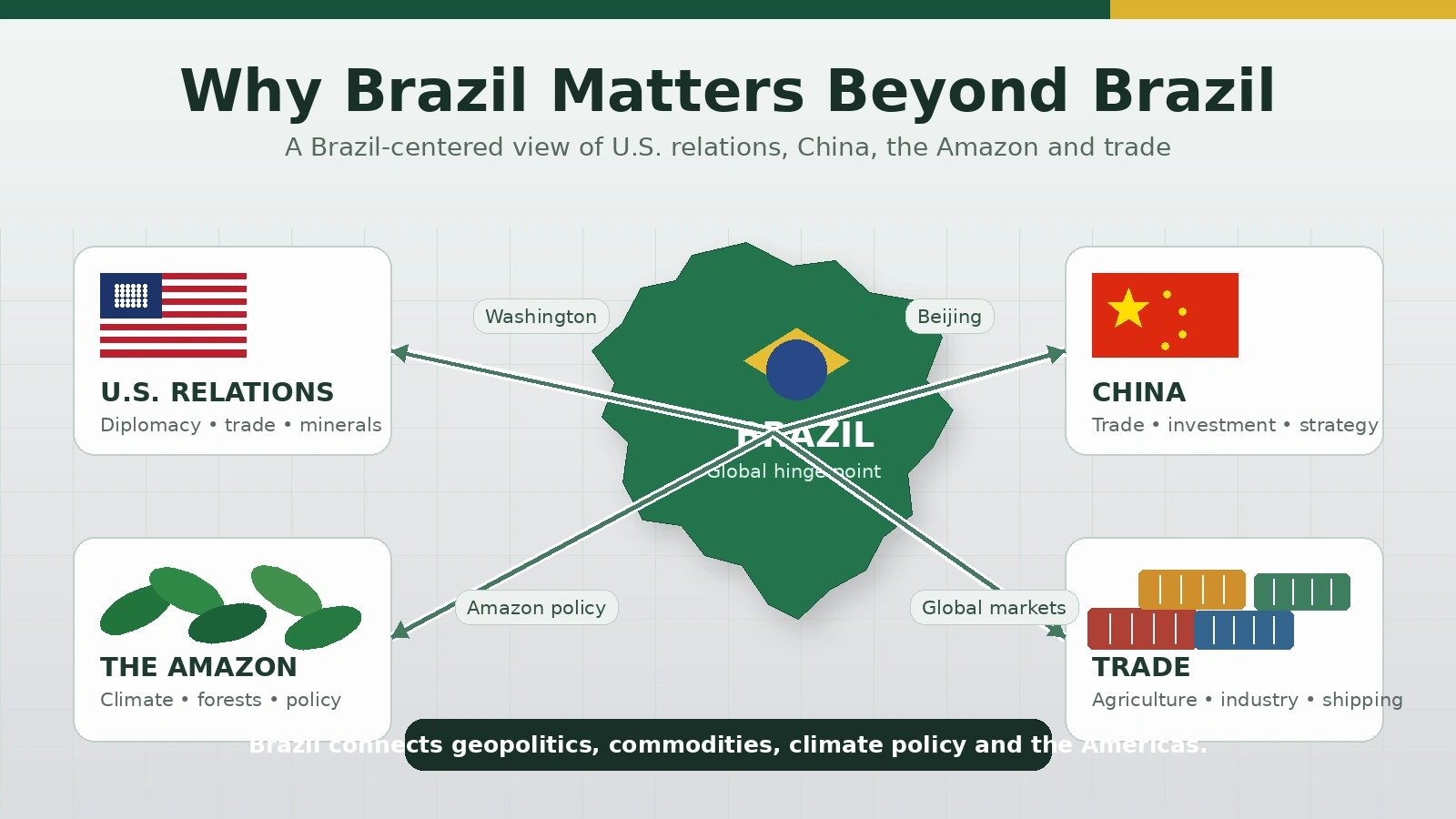
Because Brazil is Latin America’s largest economy and an important diplomatic power, and the election could reshape Brasília’s relationship with Washington.
Lula has repeatedly stressed Brazilian sovereignty and strategic independence, while Flávio has cultivated closer political ties with President Donald Trump. Reuters has identified foreign influence, tariffs and the candidates’ sharply different approaches to Washington as prominent parts of the campaign. (Reuters · Reuters)
The candidates also differ in tone toward China.
Lula has deepened Brazil’s ties with China and other emerging powers while maintaining relations with Europe and the United States. Flávio has campaigned as a much more openly Trump-aligned candidate. (Reuters)
That matters for trade, critical minerals, agriculture, environmental policy and regional diplomacy.
It also means Brazil’s runoff sits inside a broader question facing many governments in the Americas:
How closely should they align with Washington, and how much strategic distance should they preserve?
What Happens Between Now and October 25?
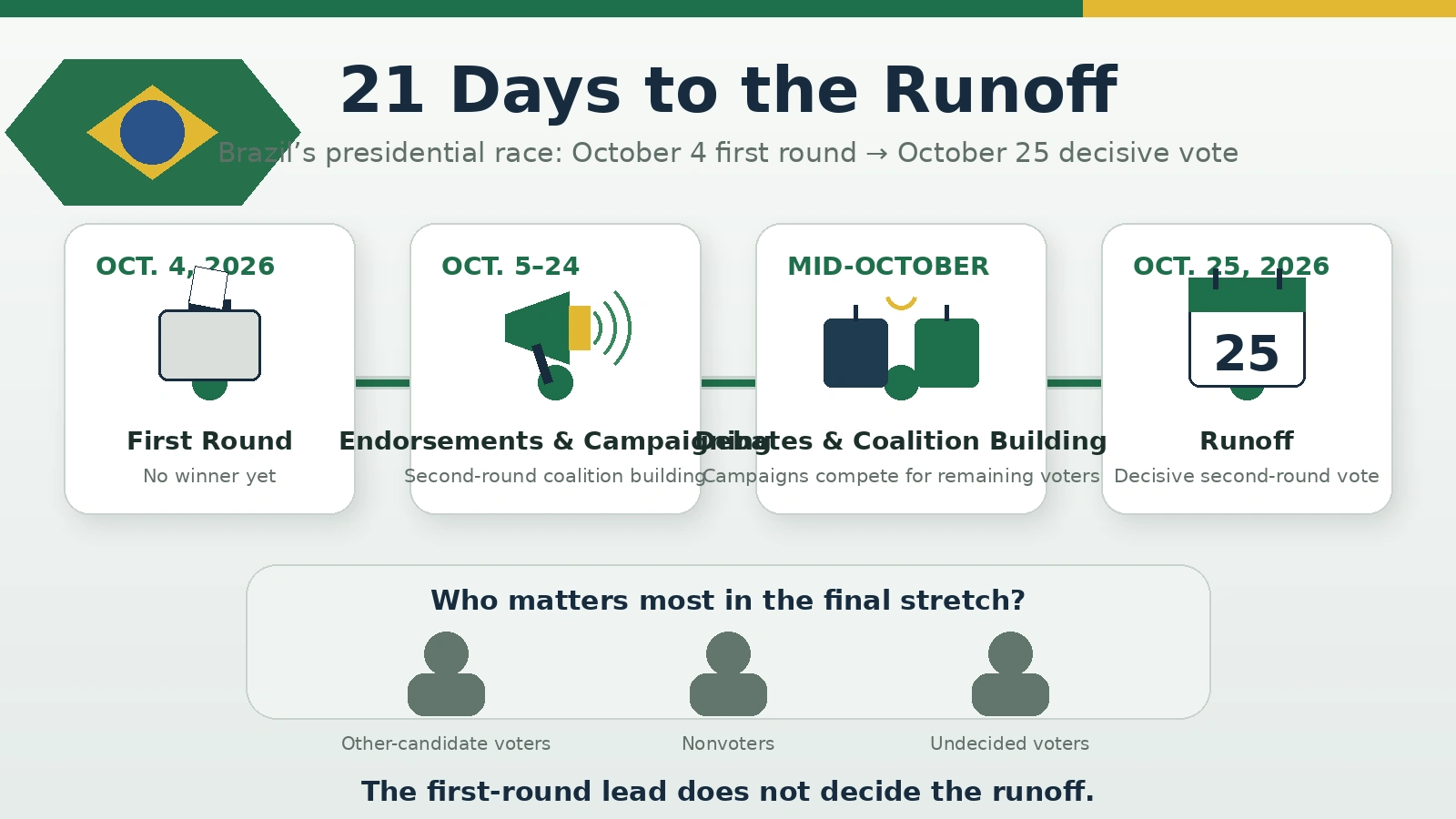
Now the race becomes much simpler—and in some ways harder.
Only Lula and Flávio remain in the presidential contest.
That means both campaigns will focus on people who chose another candidate in the first round, voters who stayed home and citizens whose first-round choice was primarily a protest vote rather than enthusiastic support.
Endorsements will matter, but not mechanically. A defeated candidate can endorse Lula or Flávio without delivering every supporter.
Campaign emphasis may also change.
Flávio can argue that finishing first demonstrates demand for a change in government.
Lula can argue that the runoff presents a binary choice between his governing record and a return of the Bolsonaro political movement.
And because the first round was close, seemingly secondary issues can become more important: a debate performance, an economic announcement, a crime story, a corruption investigation or a religious controversy.
The official election calendar sets the decisive vote for Sunday, October 25. Brazil’s electoral court has already moved into preparations for the second round. (Brazil’s Superior Electoral Court · TSE First-Round Wrap-Up)
What happens after that depends on the voters.
Not on the first-round lead.
Bottom Line: What This Story Really Means
Brazil’s election has become far more dramatic than a straightforward attempt by Lula to secure one more term.
Flávio Bolsonaro finished the first round ahead of the sitting president, turning the October 25 runoff into a direct test of whether the Bolsonaro political movement can return to the presidency through a new generation.
But that is only part of the explanation.
Lula’s vulnerability reflects frustration over the cost of living and crime despite improvements in some economic indicators. Flávio has benefited from his father’s enduring political base while presenting a harder security message, more conservative religious identity and more market-oriented economic approach.
So the easiest way to understand the runoff is not simply “Lula versus Jair Bolsonaro’s son.”
It is continuity versus change, two different approaches to security and the economy, and another vote on what Brazil wants to keep—or leave behind—from the political divide that has shaped the country for years.
Brazil Election 2026: Key Questions Explained
Q. Did Flávio Bolsonaro win Brazil’s presidential election?
No. Flávio Bolsonaro finished first in the October 4 first round, but he did not win a majority of valid votes. He and Lula therefore advance to an October 25 runoff.
Q. How much of the first-round vote did Flávio Bolsonaro receive?
Flávio received roughly 47% of valid votes, while Lula received about 45%, according to reporting based on the official count. (Reuters)
Q. Is Jair Bolsonaro running for president again?
No. Jair Bolsonaro is not the 2026 presidential candidate. His son, Senator Flávio Bolsonaro, is running with his father’s endorsement and much of the political movement associated with the former president.
Q. Why can Lula run for a fourth term?
Lula is seeking a fourth nonconsecutive presidential term. He served two terms from 2003 through 2010, returned to office in 2023 and is now seeking another term beginning in 2027. (Brazilian National Archives)
Q. Is Flávio Bolsonaro running mainly to avenge his father?
That is too simple. His father’s legal and political legacy is a major part of the campaign, and Flávio has said he wants to reverse legal actions affecting his family. But his campaign also has distinct positions on crime, government spending, business policy and religion. (Reuters)
Q. Why is Brazil’s cost of living important in the election?
Because voters do not experience the economy only through GDP or unemployment data. Many Brazilians continue to report pressure from food prices, household debt and borrowing costs even as some national economic indicators have improved. (Reuters)
Q. Why are evangelical voters important in Brazil?
Evangelical Christianity has become a major part of Brazil’s religious landscape. The 2022 census put evangelicals at roughly 26.9% of Brazilians age 10 and older, while Catholics remained the largest group at 56.7%. Religious communities are politically diverse, but explicitly Christian political messaging now reaches a very large electorate. (Associated Press · IBGE)
Q. When is Brazil’s presidential runoff?
The runoff is scheduled for October 25, 2026. Only Lula and Flávio Bolsonaro advance from the first-round presidential field. (Brazil’s Superior Electoral Court)
Q. Why does Brazil’s election matter to the United States?
The result could affect U.S.-Brazil relations, trade, cooperation over critical minerals, policy toward China and regional diplomacy. Lula emphasizes Brazilian strategic independence, while Flávio is politically closer to the Trump administration. (Reuters)
Did this help make the story clearer? 🙂 WIN keeps unpacking the “why” behind the news—clearly and simply!
Sources
First-Round Result and Runoff Rules
Reuters — Bolsonaro beats expectations in Brazil presidential vote, will face Lula in runoff
Brazil’s Superior Electoral Court — How Brazil’s majoritarian election system works
Brazil’s Superior Electoral Court — 2026 election calendar
Lula, Flávio Bolsonaro and the Campaign
Reuters — In Brazil, frustration over cost of living undermines Lula’s reelection bid
Associated Press — Lula increases flagship welfare payments ahead of the election
Security, Religion and International Stakes
Associated Press — Lula and Flávio Bolsonaro campaign ahead of Brazil’s presidential vote
Associated Press — Lula ramps up federal push against organized crime in Rio
Associated Press — What to know about the viral claim involving Brazil’s patron saint
IBGE — 2022 Census religion results: Catholic population continues to decline
Reuters — Brazil election results and the international stakes
Keep Reading
Why has Lula been warning so strongly about U.S. pressure and Brazilian sovereignty?
The runoff is also unfolding during an unusually tense period in U.S.-Brazil relations. Lula’s recent U.N. message helps explain why sovereignty, tariffs and concerns about foreign influence have become part of the political backdrop.
Did Trump Threaten Macron and Lula? What Their U.N. Speeches Actually Said