Is Kim Jong Un Dead? What North Korea’s New Photos Actually Show

Is Kim Jong Un dead?
For a brief period, that question spread across social media and international news headlines. Online claims alleged that North Korea’s leader had suffered a severe brain hemorrhage, fallen into a coma, been rushed to a hospital in China and died.
Then North Korea released photographs showing him examining children’s shoes, looking at clothing and speaking with officials at an exhibition in Pyongyang.
So was the death story completely fabricated? And do the new photographs prove that Kim is healthy?
There is no verified evidence that Kim Jong Un suffered the reported medical emergency or died. North Korean state media says he attended the exhibition on October 19, 2026, and South Korean security officials have reported no information supporting the death allegations. (Yonhap)
But there is an important distinction between evidence that challenges a death rumor and independent proof of someone’s medical condition.
※ Images in this article are AI-generated illustrations created to help explain the story. They are not actual photographs, and depictions of people, places, or events may differ slightly from reality.
The episode also raises a larger question: Why can an unsupported claim about one man’s health become an international news story—and what would actually happen if North Korea suddenly lost its leader?
What Did North Korea Actually Show on October 19?
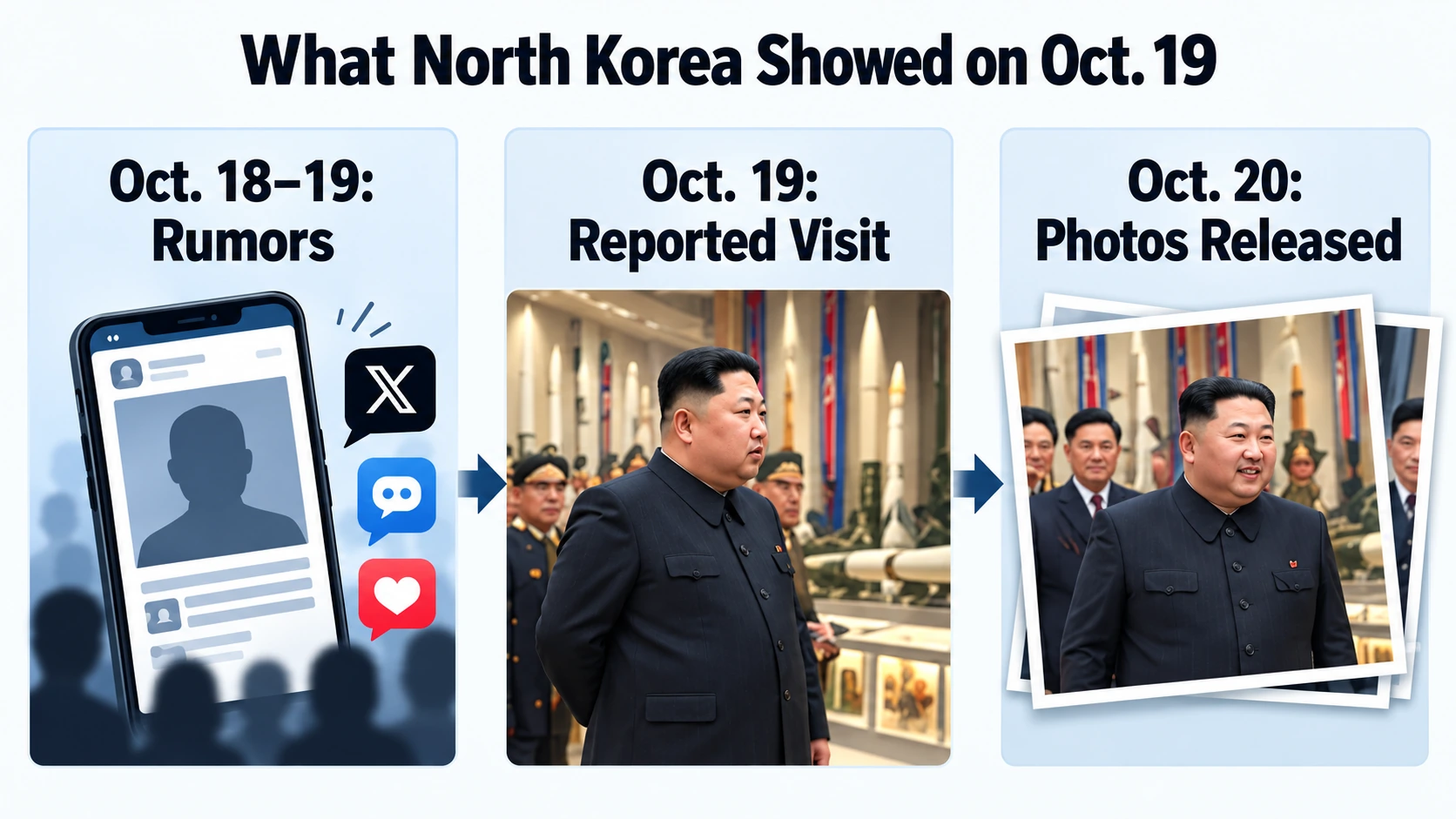
North Korea’s Korean Central News Agency (KCNA) reported on October 20 that Kim Jong Un had visited the 2026 National Garment and Footwear Exhibition in Pyongyang the previous day.
The photographs showed him accompanied by his wife, Ri Sol Ju, and daughter, widely known as Kim Ju Ae. Kim was seen inspecting clothing and footwear, including children’s shoes, and interacting with officials. (Yonhap)
The official purpose of the visit was economic rather than medical. Kim was inspecting consumer products produced by North Korea’s light-industry factories.
According to KCNA, the exhibition featured approximately 70,700 clothing items and more than 170,000 pairs of shoes from hundreds of production units. The agency presented the event as evidence of progress under Kim’s regional industrial development policy. (KCNA via Korea News Service)
Why did the photos attract so much attention?
Because they appeared just as extraordinary claims about Kim’s death were circulating internationally.
The timing made a routine factory-product exhibition unexpectedly important to foreign observers. Images of Kim standing, examining merchandise and interacting with officials directly conflicted with claims that he had already died.
North Korea did not explicitly announce that it was responding to the rumors. The exhibition report contained its usual emphasis on industrial production and government policy.
The interpretation that the photographs were intended to counter the rumors is reasonable given the timing, but the regime did not publicly confirm that this was its purpose.
That difference matters when evaluating a government whose public information is tightly controlled.
Where Did the Brain Hemorrhage and Death Rumors Come From?

The latest rumors did not begin with a confirmed medical announcement, a hospital statement or an intelligence agency report.
They spread through social media posts made around October 18–19, including claims associated with Wanjun Xie, a Chinese dissident based in the United States.
Xie alleged that Kim had suffered a serious cerebral hemorrhage, that Chinese medical specialists had become involved in his treatment and that he had been transferred to a hospital in Beijing before dying.
Other unsupported claims suggested that his body had been secretly returned to North Korea and that an emergency political transition was underway. (Yonhap · NK News)
Some posts even alleged that thousands of Chinese troops had entered North Korea.
No verifiable evidence was presented to establish those extraordinary claims.
There were no authenticated medical records, independently verified hospital admissions, official confirmation of Kim’s death or substantiated evidence of an emergency transfer of power.
How did the rumors reach international newspapers?
The claims were repeated and discussed by several overseas news organizations, including Britain’s The Sun and the New York Post.
A critical distinction is easy to miss here.
A newspaper reporting that a rumor is circulating does not mean the newspaper independently verified that the underlying event happened.
For example, these are three very different statements:
| Statement | What it establishes |
|---|---|
| An online account claims Kim is dead. | Someone made the allegation. |
| Several newspapers report the allegation. | The rumor attracted media attention. |
| Reliable, independent evidence confirms Kim died. | The underlying event has been verified. |
The third step has not been established in this case.
Multiple articles repeating the same original claim do not automatically create multiple independent sources.
According to NK News, at least two prominent accounts critical of the Chinese Communist Party circulated unsupported claims before the story attracted wider attention. The topic subsequently appeared among trending discussions on X. (NK News)
This is why identifying the original source—and what evidence that source actually possesses—is more valuable than counting how many outlets repeated the story.
Do the New Photos Prove Kim Jong Un Is Healthy?

No. The newly released photographs provide evidence that challenges the death rumors, but they do not amount to an independent medical examination.
North Korean state media says the images were taken during Kim’s October 19 visit. They depict him participating in activities that would be inconsistent with the claim that he had already died.
However, independent journalists were not given access to cover the event directly. The precise circumstances and timing of the photographs cannot be established solely from the government’s account. (Hindustan Times)
There are two separate questions:
Is there credible evidence that Kim is dead?
No such evidence has been publicly established.
Do the photographs establish that Kim has no medical problems?
No. A person can appear at a public event while having health risks or conditions that are not visible in a photograph.
The same caution applies to the opposite conclusion. A person’s appearance, weight or facial expression in a photograph cannot establish that a particular medical emergency occurred.
What would constitute stronger evidence?
A reliably authenticated, contemporaneous appearance could offer stronger evidence that Kim was active at a particular time. A verified medical assessment would be needed to make specific claims about his health.
North Korea has released neither a detailed, independently verified medical evaluation nor evidence supporting the dramatic allegations circulating online.
South Korean diplomatic and security officials told Yonhap on October 20 that they had heard nothing supporting the death claims. (Yonhap)
The available evidence therefore supports a narrower conclusion than either sensational headline:
The death story remains unsupported, while the state-reported public appearance strongly challenges it.
Why Do Rumors About Kim Jong Un’s Death Keep Returning?
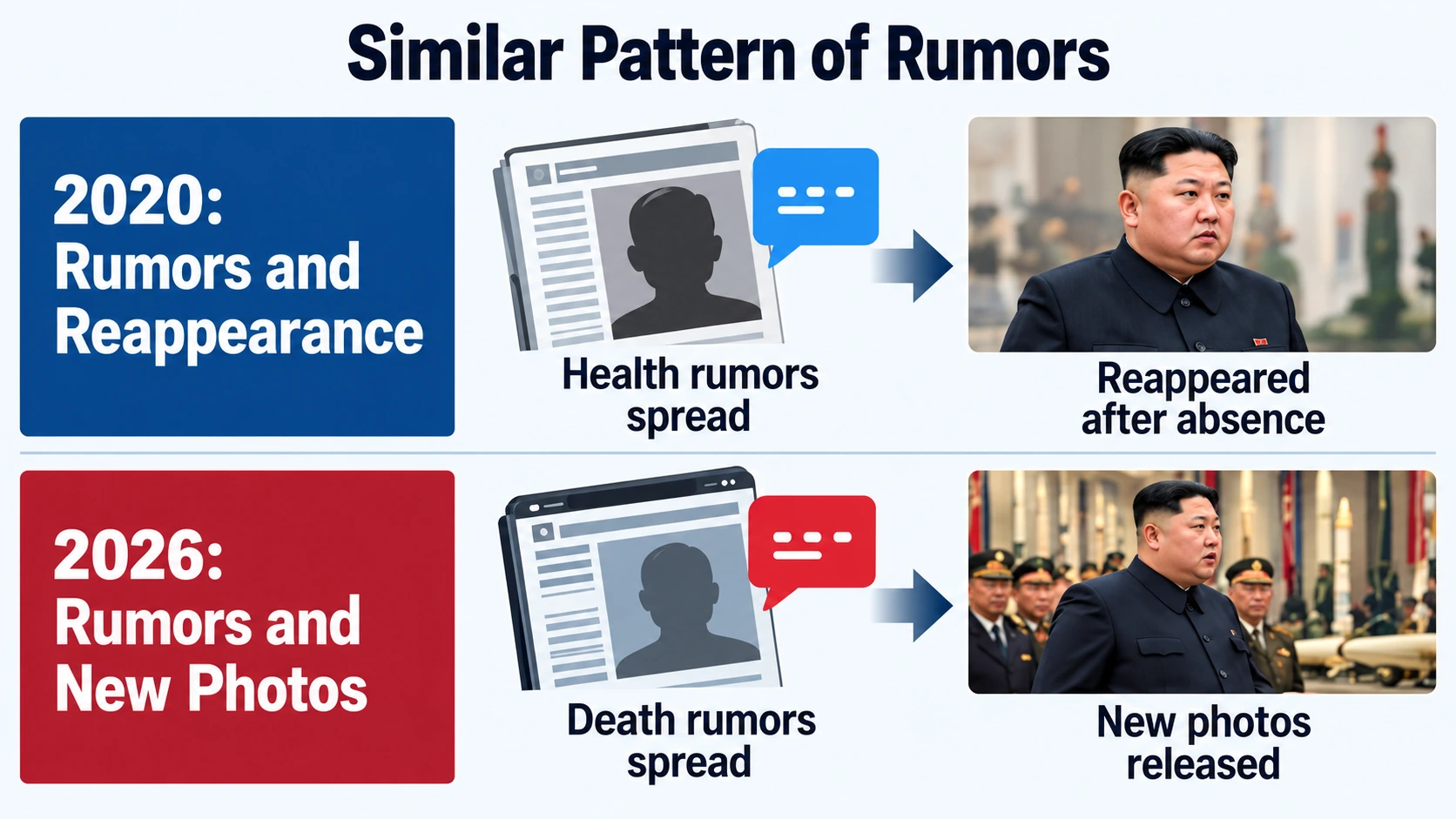
Because North Korea provides so little independently verifiable information about its leader.
Kim is not simply a president whose medical condition can be openly debated through press conferences, legislative oversight and independent medical reporting.
He controls a highly secretive political system in which the public receives limited information about the leadership’s internal affairs. Foreign journalists and researchers often have to interpret official photographs, appearances, statements and other indirect signals.
That creates fertile ground for speculation.
The 2020 episode is the clearest comparison
In April 2020, Kim disappeared from publicly reported activities and missed celebrations marking the birthday of his grandfather, North Korean founder Kim Il Sung.
His absence prompted widespread speculation that he was critically ill or dead.
Then North Korean media reported that Kim attended the opening of a fertilizer factory on May 1, 2020, releasing images that showed him smiling and participating in the ceremony. (Yonhap)
The episode demonstrated how quickly uncertainty about Kim’s whereabouts could develop into dramatic international claims.
It also showed why an absence from state television does not, by itself, establish that someone is incapacitated.
The circumstances in October 2026 are not identical. The latest allegations arose through online accounts making specific medical claims, while North Korea’s new exhibition photographs provided a conflicting account of Kim’s activities.
Still, the underlying information problem is familiar.
Why is his health treated as a national security issue?
Kim Jong Un is North Korea’s supreme leader and the central figure in a political system dominated by the ruling Workers’ Party and the Kim family.
His sudden incapacity or death could raise questions about control of the government, military leadership and nuclear weapons.
Those are legitimate subjects for security analysis.
But the seriousness of the potential consequences does not make an unsupported allegation more credible.
A story can concern an extraordinarily important person and still lack reliable evidence.
What Has South Korean Intelligence Actually Said About His Health?
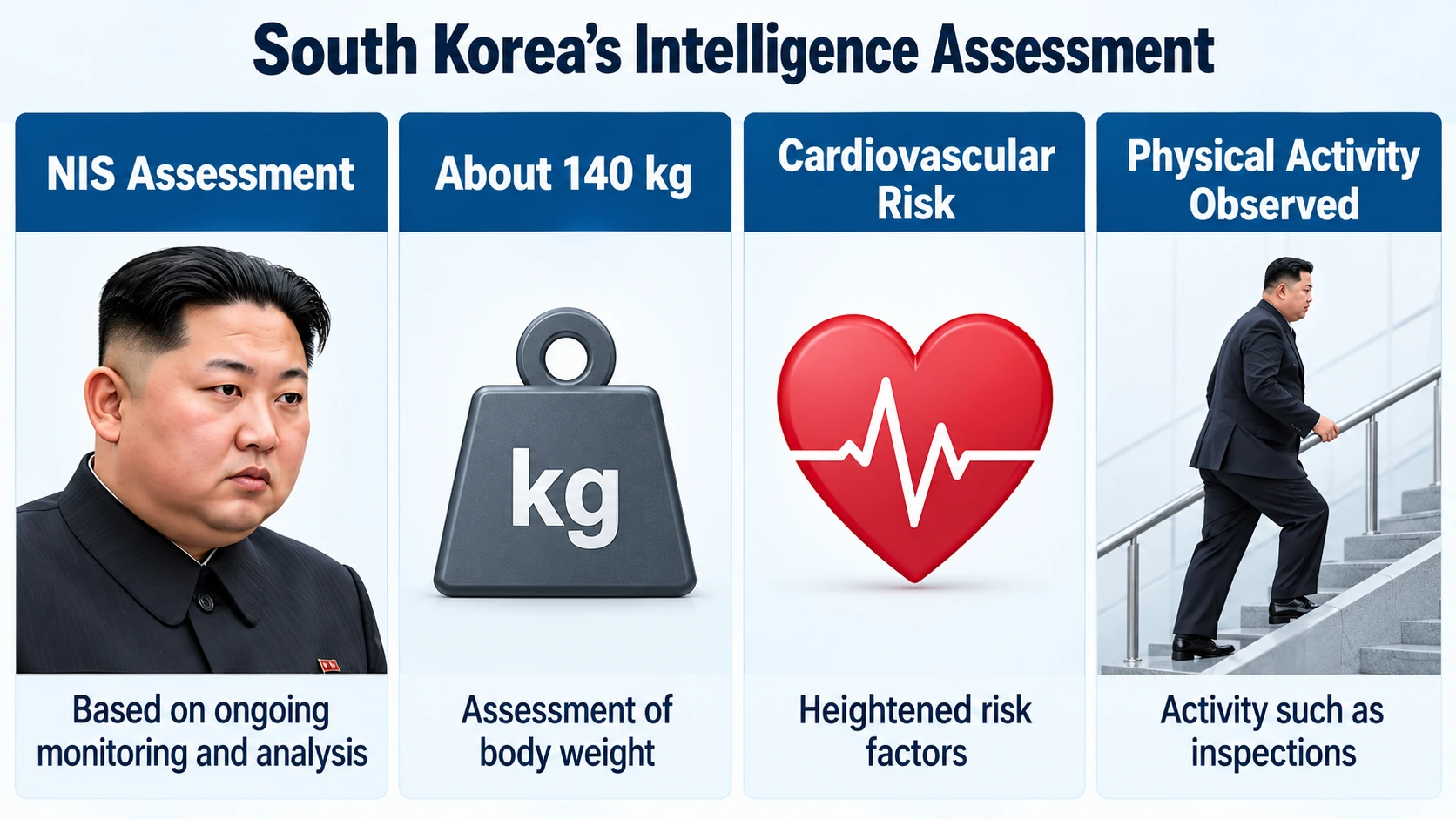
South Korea’s National Intelligence Service (NIS) has assessed that Kim faces significant cardiovascular risk factors, but it has not publicly corroborated the recent claims that he suffered a brain hemorrhage.
At a September 30, 2026, briefing to South Korean lawmakers, the agency estimated that Kim weighed in the 140-kilogram range, approximately 309 pounds.
Lawmakers relaying the assessment said the NIS viewed his obesity as a significant cardiovascular risk factor. However, the agency also reported that it had not identified major signs of deteriorating health in his recent public activities.
One example involved footage in which Kim reportedly ran up stairs while inspecting a naval destroyer. (KBS World)
That assessment is more limited than it may initially sound.
Risk factors are not the same as a diagnosis
An elevated risk of cardiovascular disease does not establish that a particular person has suffered a stroke or brain hemorrhage.
Likewise, the ability to climb stairs during one public event does not rule out every medical condition.
The NIS assessment should therefore be understood as an intelligence evaluation based on information available to the agency at the time—not as an independently released medical chart.
| Issue | What is publicly supported |
|---|---|
| Estimated weight | South Korean intelligence placed Kim in the 140-kilogram range on September 30. |
| Cardiovascular concerns | The NIS assessed elevated risk associated with severe obesity. |
| Recent physical activity | The agency reported observing activity inconsistent with obvious severe physical impairment at that time. |
| October brain hemorrhage allegation | No verified evidence has been publicly provided. |
| Claim that Kim died in Beijing | No credible confirmation has been established. |
The distinction is important because the rumor combines a genuine long-running concern about the leader’s health with specific events for which no credible evidence has been supplied.
There is no contradiction in recognizing health-related risk factors while rejecting an unsupported report of a medical emergency.
Would Kim Yo Jong or Kim Ju Ae Take Power if Something Happened?
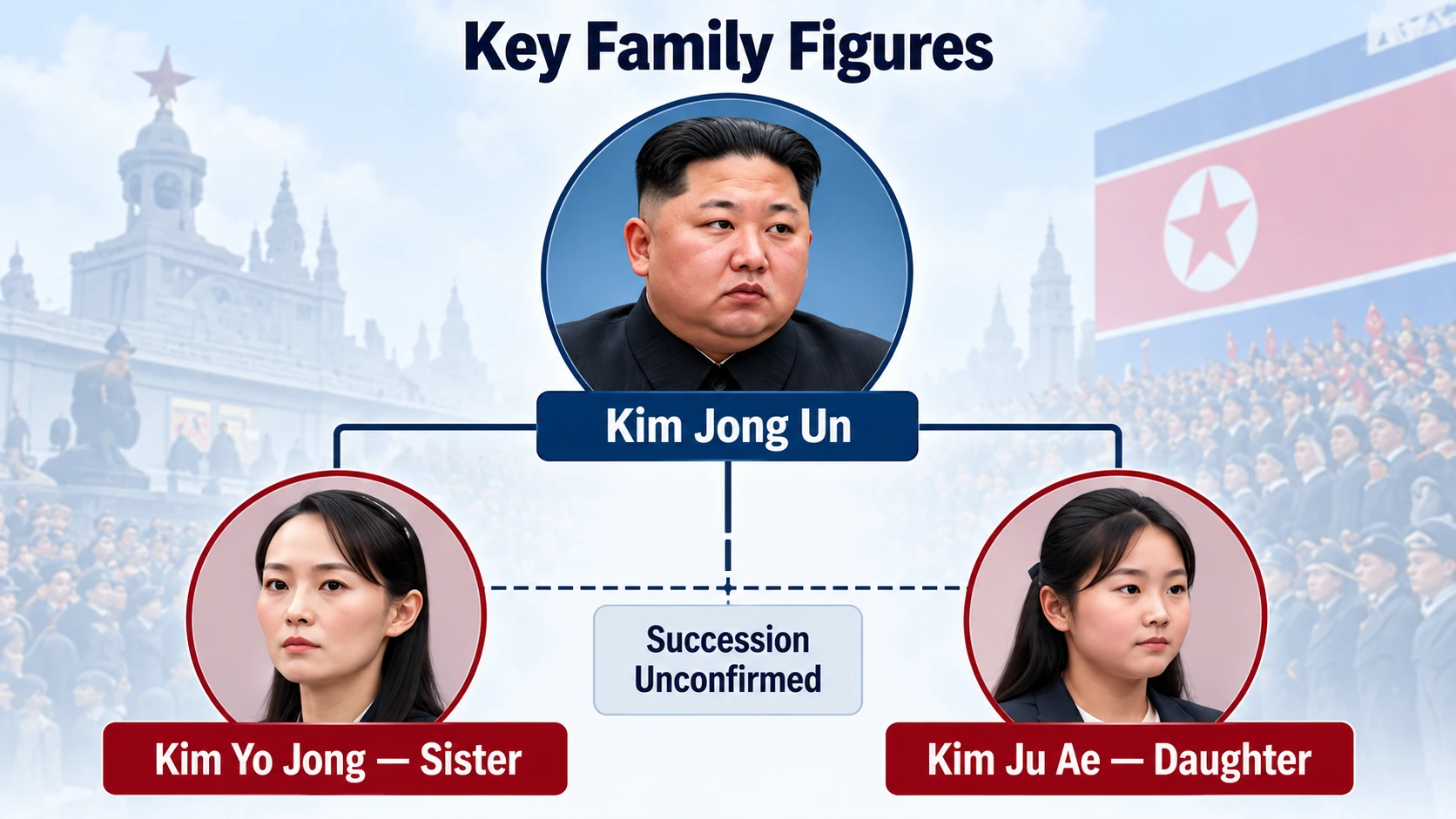
Neither Kim Yo Jong nor Kim Ju Ae has been publicly confirmed as having taken power in an emergency succession.
The rumors about Kim Jong Un’s death also included speculation about his younger sister taking temporary control before eventually transferring leadership to his daughter.
But those claims should not be confused with the genuine, longer-running debate about North Korea’s succession plans.
Kim Yo Jong: An influential political figure
Kim Yo Jong is Kim Jong Un’s younger sister and a prominent official in North Korea’s political system.
She frequently delivers statements on sensitive issues involving South Korea and the United States.
For example, on October 19, North Korean state media carried statements from Kim Yo Jong concerning border tensions and possible military countermeasures against South Korea. Her political role was therefore publicly visible independently of the online succession rumors. (Reuters)
Her influence does not establish that she has assumed her brother’s authority or that a transfer of power has occurred.
Kim Ju Ae: A possible future successor
Kim Jong Un’s teenage daughter, widely identified as Kim Ju Ae, has appeared increasingly often alongside her father at major public events.
South Korea’s intelligence agency has assessed that she is being positioned as his likely successor, citing her growing public prominence and participation in political and military-related events. (KBS World)
Her presence at the October 19 exhibition is another example of that visibility.
But North Korea has not publicly announced a formal leadership position for her or named her the next supreme leader.
The important difference is between these three concepts:
| Person or concept | What is known |
|---|---|
| Kim Yo Jong | Influential senior political figure and the leader’s sister |
| Kim Ju Ae | Frequently appears beside her father and is viewed by South Korean intelligence as a likely successor |
| Emergency succession | No publicly verified transfer of leadership or predetermined emergency arrangement has been established |
North Korea’s political leadership has passed from Kim Il Sung to Kim Jong Il and then to Kim Jong Un, reinforcing the importance of the ruling family’s lineage.
Nevertheless, a sudden leadership transition would involve more than identifying a relative. The Workers’ Party, senior military leadership and security institutions would all be important to the exercise of state power.
A possible long-term successor and a person able to exercise authority immediately are not necessarily the same person.
That is why specific predictions about an interim ruler, a transfer timetable or a guaranteed successor go beyond the available evidence.
Why Does This Matter to the United States?
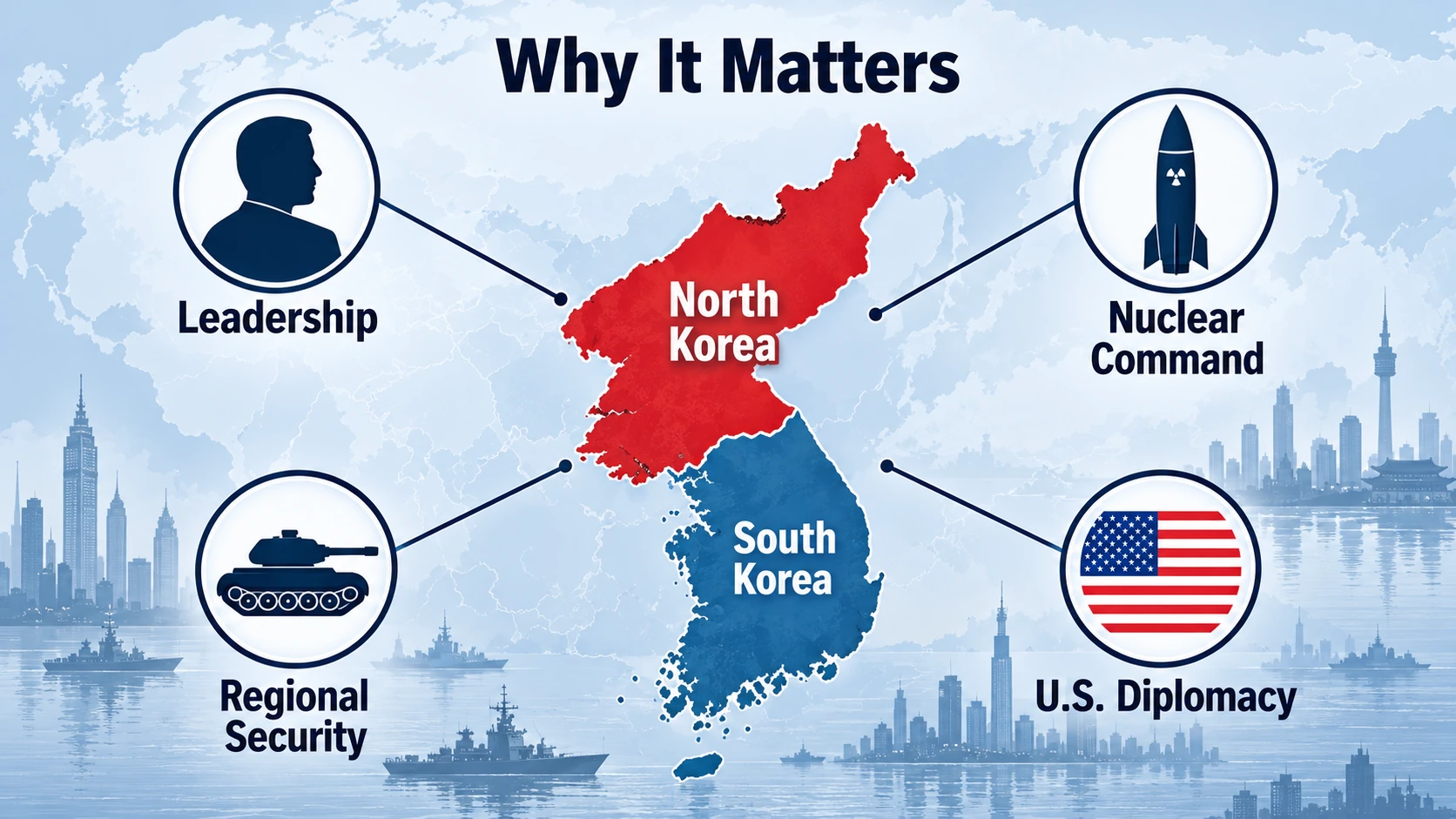
Because the consequences of an unexpected leadership crisis in North Korea would extend far beyond the country itself.
North Korea possesses nuclear weapons and has developed long-range missiles that it presents as capable of threatening the United States.
Washington also has major security commitments to South Korea and Japan, making stability on the Korean Peninsula an important American interest.
Those circumstances explain why intelligence agencies, policymakers and international media pay close attention to information about Kim Jong Un.
A leadership crisis could raise several different questions
First is nuclear command and control.
In any sudden leadership transition, foreign governments would want to understand who had authority over North Korea’s military and nuclear decision-making.
Second is the stability of the governing system.
The country has a powerful ruling party, armed forces and security institutions. A change at the top could raise questions about how authority would be exercised among those institutions.
Third is diplomacy.
The United States and North Korea have a history of direct negotiations, including meetings between Kim Jong Un and President Donald Trump in 2018 and 2019.
In September 2026, South Korean intelligence briefed lawmakers on signs that Washington and Pyongyang might resume dialogue, although it did not confirm specific direct contacts. (Reuters)
An actual leadership transition could complicate such efforts.
But that remains a hypothetical consideration, not evidence that a transition is underway.
For Americans, the significance of the October rumors lies in the importance of reliable information about a nuclear-armed state’s leadership—not in any confirmed change of government.
What Should We Watch After the Latest Death Rumor?
The most useful developments would be independently verifiable information, not another round of anonymous claims.
Further public appearances reported by North Korean media could add to the record of Kim’s activities. Consistent reporting from multiple sources would help establish a clearer timeline.
Official assessments from South Korean or other governments could also matter, particularly if authorities disclose new, substantiated information rather than speculation.
Any genuine change in North Korea’s leadership would require much stronger evidence than social media posts discussing possible successors.
There is also a distinction between an unusual absence and a confirmed medical event.
North Korea’s information environment makes uncertainty unavoidable, but uncertainty is not permission to assume the most dramatic explanation.
As of October 20, 2026, the verified public record does not support the claim that Kim Jong Un died after a brain hemorrhage.
Bottom Line: What This Story Really Means
The latest Kim Jong Un death rumors illustrate how quickly dramatic claims can spread when reliable information is scarce.
Online allegations described a brain hemorrhage, emergency treatment in Beijing and a secret transfer of power. None of those claims has been substantiated by credible, independently verified evidence.
North Korean state media subsequently reported that Kim visited a garment and footwear exhibition in Pyongyang on October 19, releasing photographs of him with his wife and daughter.
Those images challenge the death narrative, although they are not a substitute for independent medical verification.
South Korean intelligence has previously assessed that Kim faces cardiovascular risk factors, but that assessment does not establish that he suffered the specific medical emergency described in the rumors.
The broader issue is real: North Korea’s highly centralized leadership, nuclear capabilities and uncertain succession arrangements make the condition of its leader an important international security concern.
But a genuine reason to pay attention is not the same as evidence that a sensational claim is true.
For now, the story is about an unverified rumor, a newly reported public appearance and the difficulty of separating reliable information from speculation about one of the world’s most secretive governments.
Kim Jong Un Death Rumors: Key Questions Explained
Q. Is Kim Jong Un dead as of October 20, 2026?
There is no credible public evidence confirming his death. North Korean state media reported that he attended a garment and footwear exhibition on October 19, and South Korean security officials reported no information supporting the death rumors.
Q. Did Kim Jong Un suffer a brain hemorrhage?
The allegation is unverified. No authenticated medical record, official medical announcement or independent evidence has established that he suffered the reported hemorrhage.
Q. Was Kim Jong Un flown to Beijing for emergency treatment?
No verified evidence supports that claim. The alleged transfer to a Beijing hospital originated in unsupported online reports.
Q. Who started the latest Kim Jong Un death rumors?
The claims spread through online accounts around October 18–19, including posts by U.S.-based Chinese dissident Wanjun Xie. Reporting indicates that more than one account helped circulate the allegations.
Q. When were the latest Kim Jong Un photographs taken?
North Korean state media says they show Kim at an exhibition in Pyongyang on October 19, 2026. The images were released on October 20, but the event was not independently covered by foreign journalists.
Q. Does Kim Jong Un have serious health risks?
South Korea’s National Intelligence Service assessed in September 2026 that Kim’s severe obesity creates elevated cardiovascular risk. That assessment does not establish a specific current diagnosis or confirm the recent online allegations.
Q. Has Kim Yo Jong taken control of North Korea?
There is no verified evidence of a transfer of power to Kim Yo Jong. She remains a prominent political figure, but claims that she assumed emergency leadership have not been substantiated.
Q. Is Kim Ju Ae officially North Korea’s successor?
No formal public designation has been announced by North Korea. South Korean intelligence considers her a likely successor based on her increasingly prominent public appearances.
Q. Did similar death rumors circulate in 2020?
Yes. Kim disappeared from publicly reported activities for approximately 20 days in April 2020, prompting speculation about his health and possible death. State media subsequently reported his attendance at a fertilizer factory ceremony on May 1.
Q. Why are Americans concerned about North Korea’s leadership?
North Korea possesses nuclear weapons, has developed long-range missiles and maintains tense security relationships with the United States and its regional allies. An actual leadership crisis could raise important questions about military command, regional stability and diplomacy.
Did this help make the story clearer? 🙂
WIN keeps unpacking the “why” behind the news—clearly and simply!
Sources
October 2026 Rumors and Official Exhibition Report
KCNA — Kim Jong Un’s October 19 Garment and Footwear Exhibition Visit
Yonhap — Unverified Rumors of North Korean Leader’s Death Spread Overseas, October 20, 2026
Yonhap — North Korea’s Kim Tours Light-Industry Exhibition, October 20, 2026
NK News — Kim Jong Un Appears at Clothing Expo After Latest Internet Death Rumors
Health Assessments and Earlier Rumors
KBS World — South Korean Intelligence Assessment of Kim Jong Un’s Health, September 30, 2026
Yonhap — Kim Jong Un Reemerges After 20-Day Absence in May 2020
Succession and Regional Security
Reuters — Kim Yo Jong Comments on Military Measures Along the Korean Border, October 19, 2026
Keep Reading
Could Kim Jong Un’s Daughter Eventually Become North Korea’s Next Leader?
The latest rumors revived speculation about who might lead North Korea if Kim Jong Un were suddenly unable to rule. A separate question is whether his daughter’s increasingly prominent public role reflects an actual succession plan—or something less definitive.
Is Kim Jong Un’s Teenage Daughter Really Being Groomed to Rule North Korea?