Why Is Israel Restricting West Bank Travel Days Before Its Election?

Israelis are preparing to vote on October 27. But why does an election inside Israel mean Palestinian workers in the occupied West Bank may be unable to reach their jobs?
It sounds like an unusual connection. After all, most Palestinians living in the West Bank cannot vote in Israel’s parliamentary elections.
Yet the Israeli military has announced a series of movement restrictions extending through election day, including limits on Palestinian workers entering Israeli settlements and the planned closure of land crossings between the West Bank and Israel.
The immediate explanation is security. Israel is preparing for a closely watched election while responding to a deadly shooting near Hebron that killed two Israeli soldiers.
But there are two overlapping stories here: a nationwide election-security decision and an ongoing military operation affecting Palestinian communities.
Understanding the difference helps explain why a temporary election measure can have consequences far beyond the voting booths.
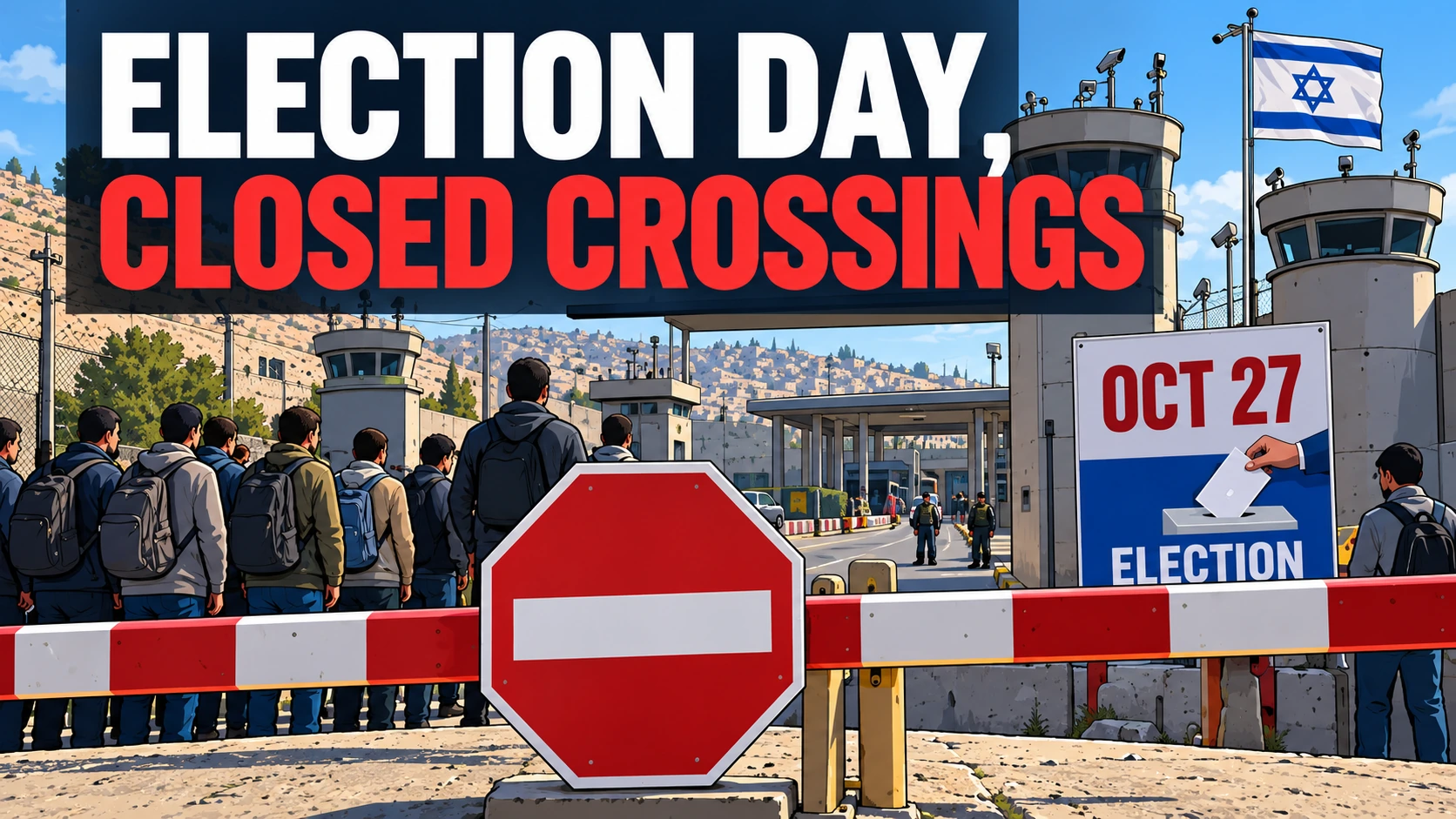
※ Images in this article are AI-generated illustrations created to help explain the story. They are not actual photographs, and depictions of people, places, or events may differ slightly from reality.
The timing is especially sensitive because Prime Minister Benjamin Netanyahu is seeking to remain in power, and his government’s security record is a central election issue. Meanwhile, Palestinians whose lives are affected by the restrictions generally have no direct vote in choosing Israel’s next government. (AP)
What Exactly Is Israel Restricting Before the Election?
Israel’s restrictions are being implemented in stages. The limits on Palestinian workers began before election day, while the broader crossing closure is scheduled for Tuesday, October 27.
The distinction matters because the restrictions do not have the same scope on every day.
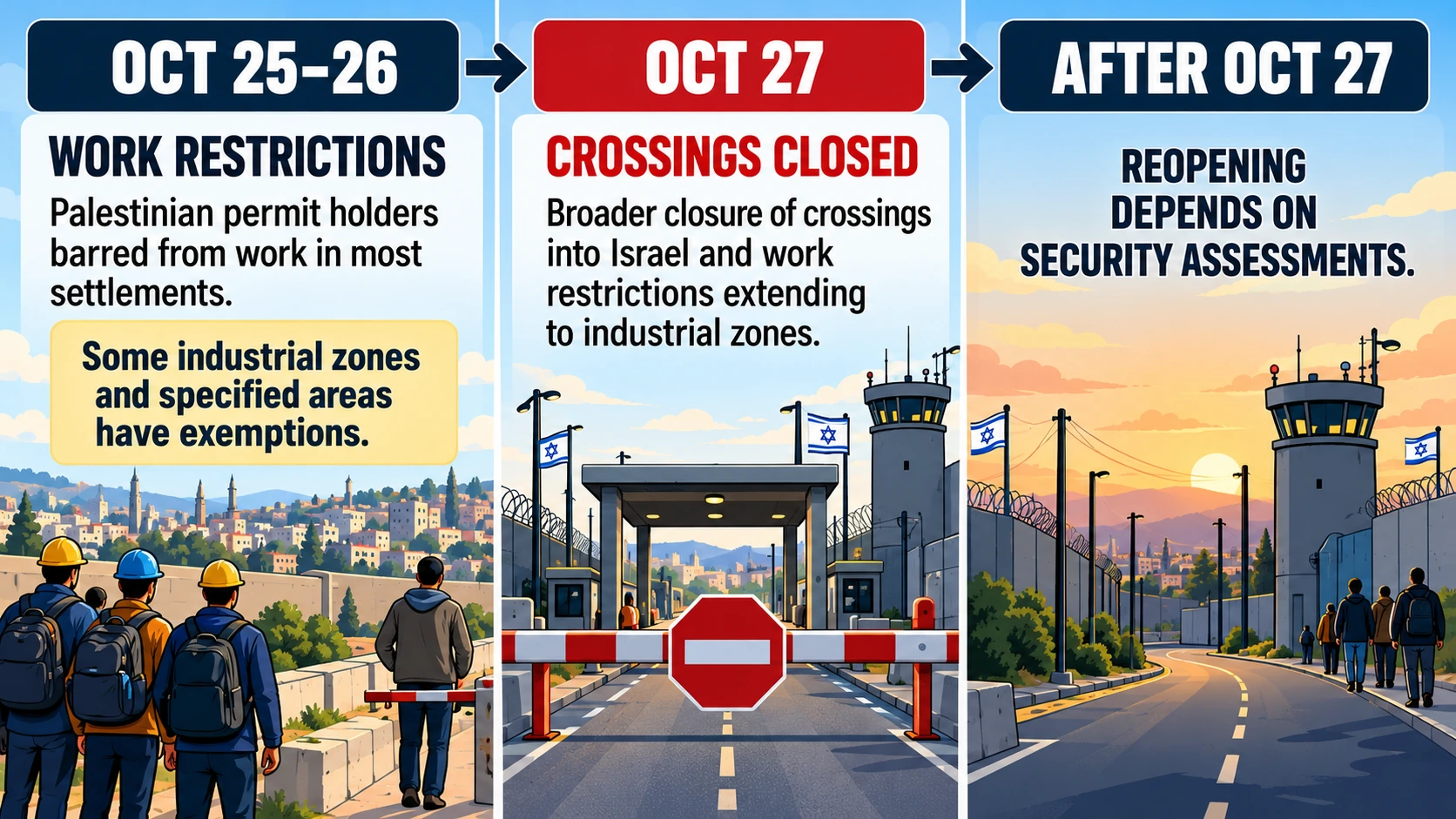
The Three-Day Timeline
| Date | What changes | Important detail |
|---|---|---|
| October 25, Sunday | Palestinian workers barred from most Israeli settlements in the West Bank | Industrial zones and some approved areas remain exempt |
| October 26, Monday | Settlement work restrictions continue | Limited exceptions still apply |
| October 27, Tuesday | All West Bank land crossings with Israel are scheduled to close to Palestinians for election day | Worker restrictions expand to industrial zones |
The Israel Defense Forces (IDF) said the initial restrictions followed a security assessment. Israel’s political leadership then approved the wider election-day measures on the recommendation of security officials.
The military said the restrictions were expected to be lifted after the election. However, the precise reopening would depend on subsequent security assessments. (Times of Israel · Euronews)
This is not the same as saying Palestinians will be prohibited from moving anywhere within the entire West Bank for three days.
The announcement concerns specific employment access and crossings, while separate military operations have imposed additional restrictions around Hebron.
That distinction becomes important when considering who is actually affected.
Why Does Israel Control Palestinian Movement in the West Bank?
Israel controls major crossings, security arrangements, and significant parts of the movement-permit system in the West Bank. That gives Israeli authorities the ability to restrict Palestinian travel and employment access during periods they consider especially sensitive.
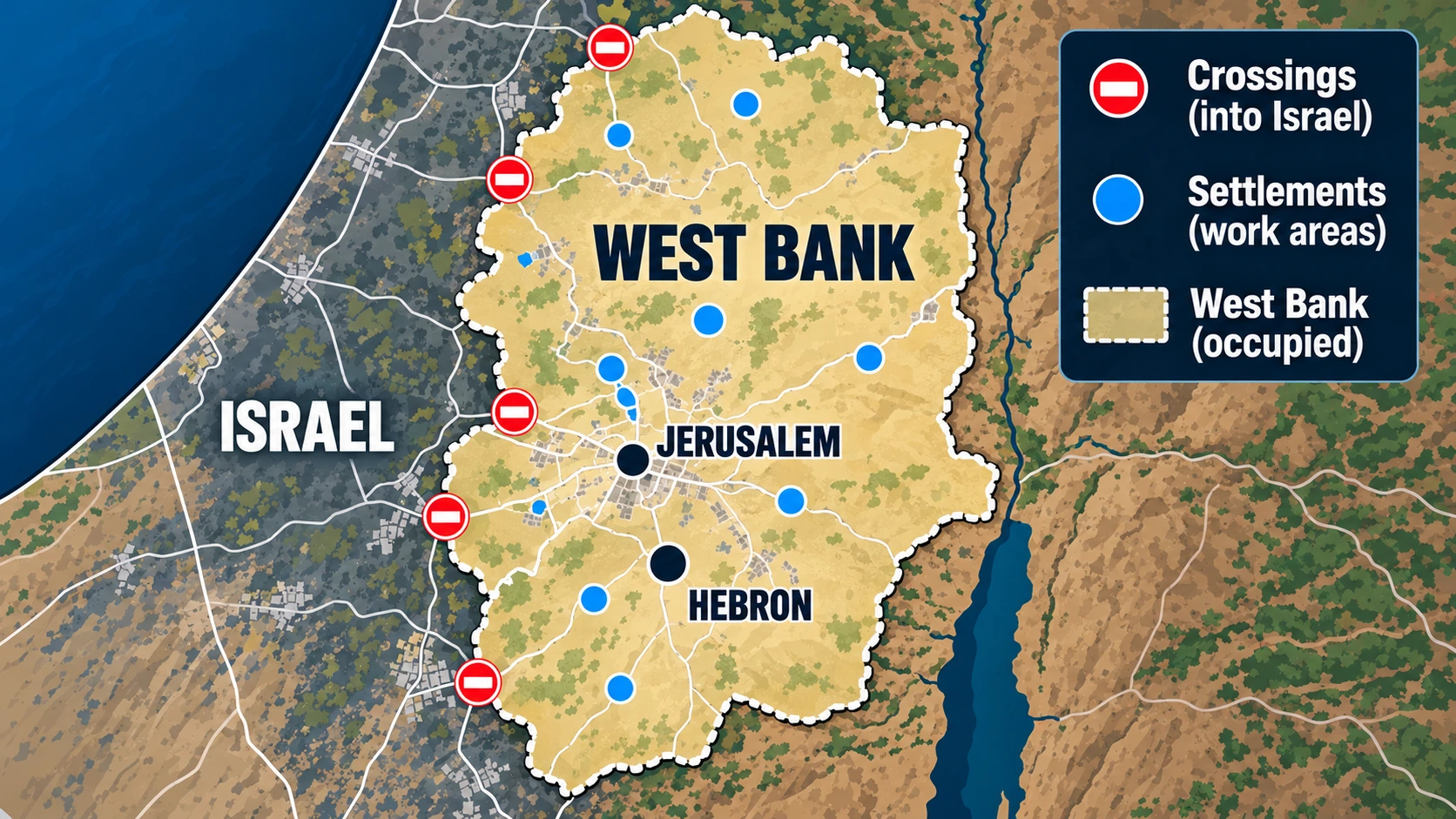
The West Bank has been under Israeli occupation since the 1967 war. Its geography is complicated by Palestinian communities, Israeli settlements, military-controlled areas, and a network of roads and checkpoints.
The Palestinian Authority administers aspects of civilian life in parts of the territory, but it does not independently control all its external crossings or movement arrangements.
Three Different Restrictions That Can Be Confused
| Type of restriction | What it means |
|---|---|
| Crossing closure | Palestinians cannot use designated crossings between the West Bank and Israel during the closure |
| Settlement work restriction | Palestinian workers cannot enter specified Israeli settlements or industrial areas for employment |
| Local military cordon | Roads and access points around a particular area, such as Hebron, are restricted during an operation |
These measures can operate simultaneously, but they serve different administrative and military purposes.
For example, someone could be unable to enter Israel for work because a crossing is closed, while another family might be unable to drive out of a Hebron neighborhood because of a local military cordon.
The United Nations has documented extensive movement obstacles throughout the West Bank, meaning these new measures are being added to an already restrictive transportation environment. (UN OCHA)
This geographical reality explains how a political event inside Israel can directly influence everyday life in Palestinian communities outside Israel’s internationally recognized pre-1967 boundaries.
How Did the Deadly Hebron Shooting Change the Situation?
A shooting near Hebron on October 23 killed two Israeli soldiers and prompted an Israeli military operation, intensifying an already heightened security environment before the election.
Two Palestinian gunmen opened fire at a military checkpoint near Hebron, in the southern West Bank.
The attack killed Israeli soldiers Ron Yonatan Roytman, 23, and Yuval Shai Svilem, 20. Three other soldiers were wounded. Israeli forces killed both gunmen during the confrontation.
Israeli authorities said the attackers had ammunition that suggested they might have been preparing a larger attack, although that assessment was based on the military’s investigation. (AP)
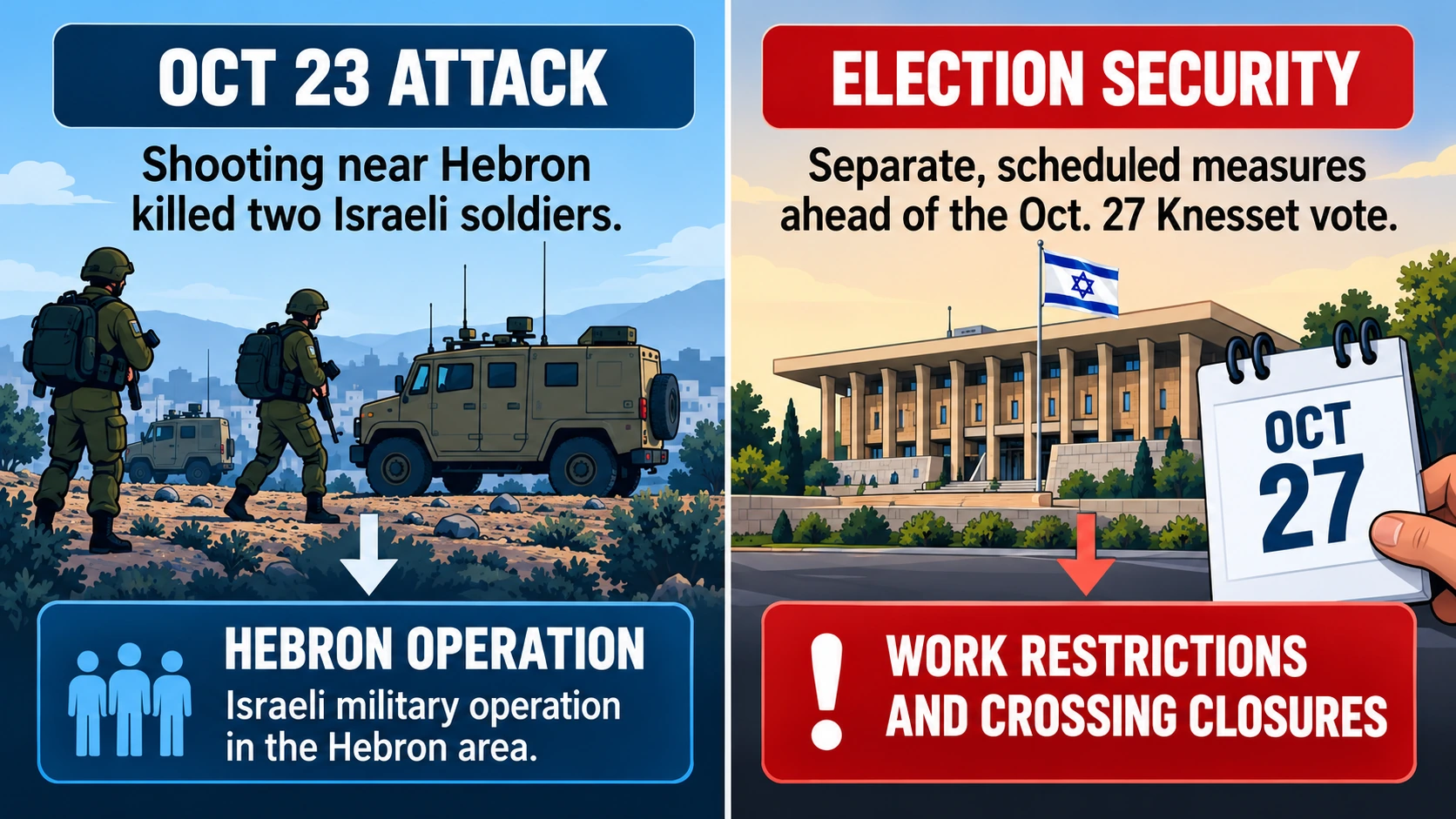
Following the attack, Netanyahu ordered security forces to cordon off Hebron and take additional measures.
The IDF launched a substantial operation involving searches, arrests, roadblocks, and efforts to locate weapons and suspected militant infrastructure.
By October 25, the military said it had operated in hundreds of locations in the West Bank and arrested dozens of Palestinians it alleged were affiliated with militant organizations. These were military claims about the suspects, not court findings.
Palestinian officials and residents reported that thousands of people had been displaced from parts of Hebron during the operation. Reports described damage to homes and businesses and severe disruption to daily life. The IDF disputed accounts of forced evacuation, saying residents were permitted to leave through designated screening points, while Palestinian residents described being ordered out. (AP · Euronews)
Was the Election the Only Reason for the Restrictions?
No.
The IDF had already raised its alert level ahead of the October 27 vote. Chief of Staff Eyal Zamir ordered additional preparations and emphasized the military’s responsibility to allow the election to proceed safely. (Times of Israel)
The Hebron attack then added a concrete security incident to those preparations.
Israel’s stated position is that the restrictions are intended to reduce security risks.
But Palestinian residents and officials have challenged the scope of the response. Hebron’s mayor described the broader operation as collective punishment and questioned its political timing.
That accusation is a criticism of Israeli policy, not an established finding about the government’s motives. (Reuters)
The result is a disagreement not simply about whether Israel faces security threats, but about whether the breadth and consequences of its response are justified.
What Happens to Palestinian Workers and Their Families?
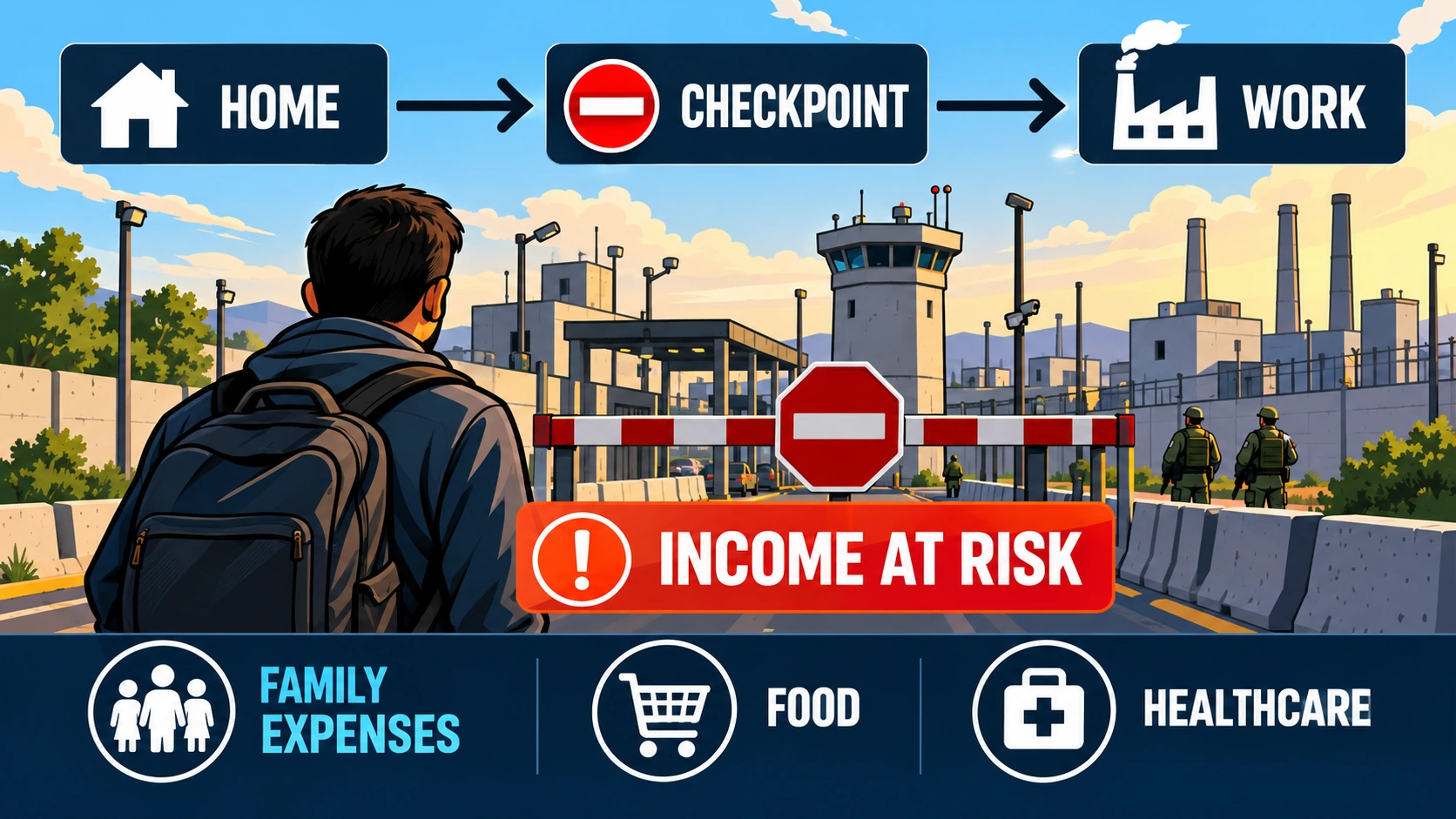
For affected Palestinian workers, the immediate consequence is lost access to employment—even when they hold valid work permits.
Many Palestinian families depend on wages earned in Israeli settlements, industrial zones, or workplaces inside Israel.
Work authorization, however, does not guarantee entry when the military imposes a security closure.
According to figures cited by the Times of Israel, roughly 9,000 Palestinians had permits in 2025 to work in settlements or nearby industrial zones. That figure describes permit holders, not the verified number unable to work during this particular closure. (Times of Israel)
Why Can Even a Short Closure Matter?
The West Bank economy is already under substantial strain.
The World Bank estimates that unemployment in the West Bank remained around 28% in 2025, despite some improvement from the much higher levels reached after the conflict escalated in 2023.
It also identifies limited access to employment in Israel as an important factor affecting Palestinian household spending and economic recovery. (World Bank)
Consider a worker who normally travels to an industrial zone several days a week.
If the worker cannot enter the workplace, the immediate issue may be a missed shift. Depending on the employment arrangement, that could mean lost wages.
For a household already managing high living costs or irregular work, even a short disruption can matter.
The military operation around Hebron has created additional problems beyond employment. Reports from the area describe residents struggling to access medical appointments, businesses, and transportation routes.
Those consequences cannot be reduced to a simple election-day inconvenience. (AP)
It is also important not to assume every worker faces the same situation. The announced restrictions include exemptions before election day, while local security arrangements and actual access can vary.
Can Palestinians Vote in the Israeli Election That Is Affecting Their Movement?
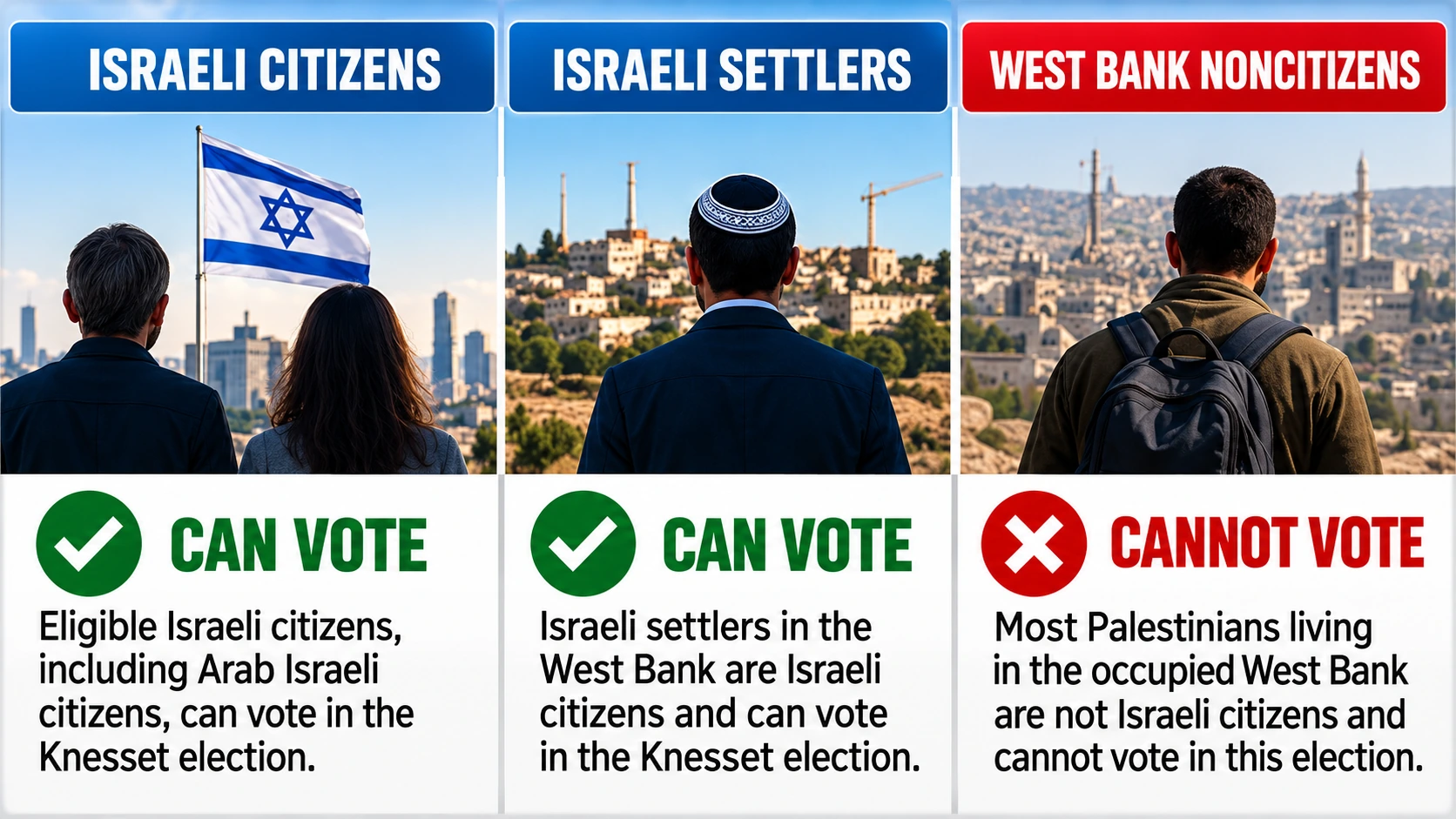
Most Palestinians who live in the occupied West Bank cannot vote in Israel’s Knesset election because they are not Israeli citizens.
That is different from Palestinian citizens of Israel, who are entitled to vote under Israeli election law.
Israeli citizens living in West Bank settlements also have voting rights, subject to ordinary voter eligibility requirements.
The Voting Rights Difference
| Group | Can vote for the Knesset? |
|---|---|
| Eligible Israeli citizens, including Arab citizens of Israel | Yes |
| Eligible Israeli citizens living in West Bank settlements | Yes |
| Palestinian West Bank residents who are not Israeli citizens | No |
Israel’s Basic Law: The Knesset establishes the right to vote for eligible Israeli citizens aged 18 and older.
The rule is based on citizenship and voter eligibility, not simply where someone lives or their religion or ethnicity. (Israel’s Basic Law: The Knesset)
This creates an important political distinction.
An Israeli citizen living in a West Bank settlement can participate in choosing the parliament that influences security policy and settlement policy.
A Palestinian resident living nearby, without Israeli citizenship, generally cannot participate in that same election—even though decisions by Israel’s military and political leadership can profoundly affect that person’s movement and livelihood.
That imbalance is one reason West Bank restrictions are not viewed as an ordinary domestic election-security issue by many international observers and Palestinian advocates.
It is a dispute about security, political representation, military control, and the rights of people living under occupation.
Why Is This Election Especially Sensitive for Netanyahu?
The October 27 election is widely viewed as a major test of Netanyahu’s leadership following years of war and controversy over Israel’s security policies.
Israeli voters are deciding who will represent them in the 120-seat Knesset, the parliament whose governing coalition determines who can lead the government.
A governing bloc generally needs support from at least 61 members to command a parliamentary majority.
Netanyahu’s coalition faces an opposition that has challenged his handling of the October 7, 2023, Hamas-led attack, subsequent wars, and security failures.
Former military chief Gadi Eisenkot has emerged as a leading opposition figure. (AP)
Security is therefore more than a routine campaign topic.
A major attack days before voting can intensify public concerns about whether the government is protecting Israeli civilians and soldiers.
Israel’s governing coalition argues that military action and strong security measures are necessary to prevent further attacks.
Critics, including Palestinian officials and some Israeli opposition figures, question the effectiveness, proportionality, or political consequences of the government’s approach.
The views are not identical: Israeli opposition criticism often centers on Netanyahu’s security performance, while Palestinian criticism also focuses on the effect of military control and displacement on civilians.
There is no verified basis for assuming that the crossing restrictions were ordered solely to improve Netanyahu’s election prospects.
What can be established is that security concerns, military operations, and a highly consequential election are unfolding at the same time.
The political implications are real, even though they do not prove a particular political motive.
Will the West Bank Restrictions End After Election Day?
Israel says the election-related restrictions are temporary, but that does not mean every restriction around Hebron will automatically disappear when voting ends.
The announced election-day crossing closures are expected to end after October 27, subject to further security assessments.
Military measures connected to the Hebron shooting involve a separate operation, and their duration may depend on decisions by security authorities. (Times of Israel)
That leaves three separate developments worth monitoring.
1. Will Crossings Reopen as Planned?
The most immediate question for affected workers is whether crossing access and employment permits return to their previous arrangements after the election.
A scheduled reopening is not the same as a confirmed reopening.
2. Will the Hebron Operation Continue?
The scope of the military operation, the status of displaced residents, and access to affected neighborhoods could remain pressing issues even after election-related measures expire.
3. Could the Election Change West Bank Policy?
The election may alter the composition of Israel’s government, but an election result alone would not automatically reverse existing security arrangements or settlement policies.
Government formation, coalition agreements, and subsequent policy decisions would determine whether significant changes follow.
For Palestinians whose work, transportation, and family life depend on movement permissions, those practical decisions may matter more immediately than the election’s political headlines.
Bottom Line: What This Story Really Means
Israel is restricting Palestinian movement before its October 27 election because its security authorities say heightened precautions are necessary, particularly after the deadly October 23 shooting near Hebron.
The restrictions involve different measures on different days: limits on workers entering settlements before the election, broader crossing closures on election day, and separate military operations around Hebron.
But the larger significance goes beyond temporary security precautions.
Israel’s election will help determine who governs the country, while many Palestinians affected by Israeli security decisions cannot participate in that election.
For Israeli voters, the immediate question is whether the government’s security approach is effective.
For affected Palestinian communities, the questions are also practical and immediate: Can people get to work, receive medical care, return home, and move safely?
Those realities explain why a brief announcement about election-day crossings has become part of a much wider debate over security and daily life in the occupied West Bank.
Israel West Bank Travel Restrictions: Key Questions Explained
Q. When is Israel’s 2026 parliamentary election?
Israel’s election for the 26th Knesset is scheduled for Tuesday, October 27, 2026.
Q. Are all West Bank roads closed before the election?
No. The announcement distinguishes settlement employment restrictions on October 25–26 from broader crossing closures scheduled for October 27. Separate restrictions also apply around Hebron.
Q. Are Palestinian workers allowed into Israeli settlements on October 26?
Generally not under the announced restrictions, although industrial zones and a limited number of approved areas are exempt before election day.
Q. Will industrial zones also be restricted on election day?
Yes. The announced October 27 measures extend the worker restrictions to industrial zones and include closure of West Bank land crossings with Israel.
Q. What happened near Hebron on October 23?
Two Palestinian gunmen attacked an Israeli military checkpoint, killing two Israeli soldiers and wounding three others. Israeli forces killed the two gunmen.
Q. Did Hamas claim responsibility for the Hebron shooting?
The reports reviewed did not establish a formal Hamas claim of responsibility. Hamas praised the attack, while Israel investigated possible militant connections.
Q. Can Palestinians living in the West Bank vote in Israeli elections?
Most cannot because they are not Israeli citizens. Palestinian citizens of Israel and eligible Israeli citizens living in West Bank settlements can vote.
Q. How many Palestinian workers could be affected?
The exact number affected by the October 2026 measures has not been independently established. Reports citing 2025 data put the number of Palestinians with permits to work in settlements or nearby industrial zones at around 9,000.
Q. Will checkpoints reopen on October 28?
Israeli officials indicated that the election-related measures were expected to end after voting, subject to a new security assessment. A specific reopening cannot be treated as guaranteed in advance.
Q. Does Israel’s election automatically change its West Bank policies?
No. Even if a new governing coalition emerges, changes to security operations, settlement policy, or movement rules would require subsequent decisions.
Did this help make the story clearer? 🙂
WIN keeps unpacking the “why” behind the news—clearly and simply!
Sources
Election-Day Restrictions and Official Security Measures
Times of Israel — IDF Announces West Bank Lockdown and Palestinian Worker Restrictions
Euronews — Israel Orders West Bank Crossings Closed on Election Day
Times of Israel — IDF Chief Raises Security Alert Ahead of October 27 Vote
Hebron Shooting and Military Operations
Associated Press — Two Israeli Soldiers Killed in West Bank Checkpoint Attack
Associated Press — Israel Presses Ahead With West Bank Operation as Election Approaches
Reuters — Palestinians Displaced in Hebron During Israeli Military Operation
Voting Rights and Palestinian Economic Conditions
Israeli Ministry of Interior — October 27, 2026 Knesset Election Information
Israel’s Basic Law: The Knesset — Electoral System and Voting Rights
World Bank — West Bank and Gaza Economic Overview
Election Context and Political Stakes
Associated Press — Israelis Living Abroad Return for the 2026 Election
Keep Reading
Why Does Washington Remain Closely Involved in Israel’s Security Decisions?
Israel’s election may affect the approach its next government takes toward Palestinians. Understanding the long-standing U.S.–Israel relationship adds context to why decisions made in the West Bank also matter internationally.
Why Does the U.S. Support Israel So Strongly? 5 Reasons Behind the Money and Weapons