Why Did Netanyahu Call the Man Who Indicted Him as a Defense Witness?

The man who decided to prosecute Benjamin Netanyahu has just appeared in court as a witness called by Netanyahu’s own lawyers.
Wait. Isn’t he supposed to be on the other side?
That’s what makes this moment in the Israeli prime minister’s long-running corruption trial so unusual. On October 11, 2026, former Israeli attorney general Avichai Mandelblit began testifying in the Jerusalem District Court. He was the official who authorized investigations into Netanyahu and later decided to bring criminal charges against him.
Yet Netanyahu’s defense team wanted him on the witness stand.
The reason wasn’t that Mandelblit had switched sides. A defense witness doesn’t have to agree with the defendant. Lawyers can call someone precisely because they want to challenge that person’s earlier decisions.
In this case, the questions were pointed: Did investigators have the legal permission they needed? Did they go beyond what Mandelblit approved? And did he personally review all the material supporting one of the most serious charges?
Mandelblit’s first day of testimony produced an important distinction. He acknowledged that police took some serious steps without his approval, but maintained that he had authorized the principal investigations. He also acknowledged that he had not personally reviewed the hundreds of examples of alleged favorable news coverage listed in an amended indictment. (The Jerusalem Post · The Times of Israel)
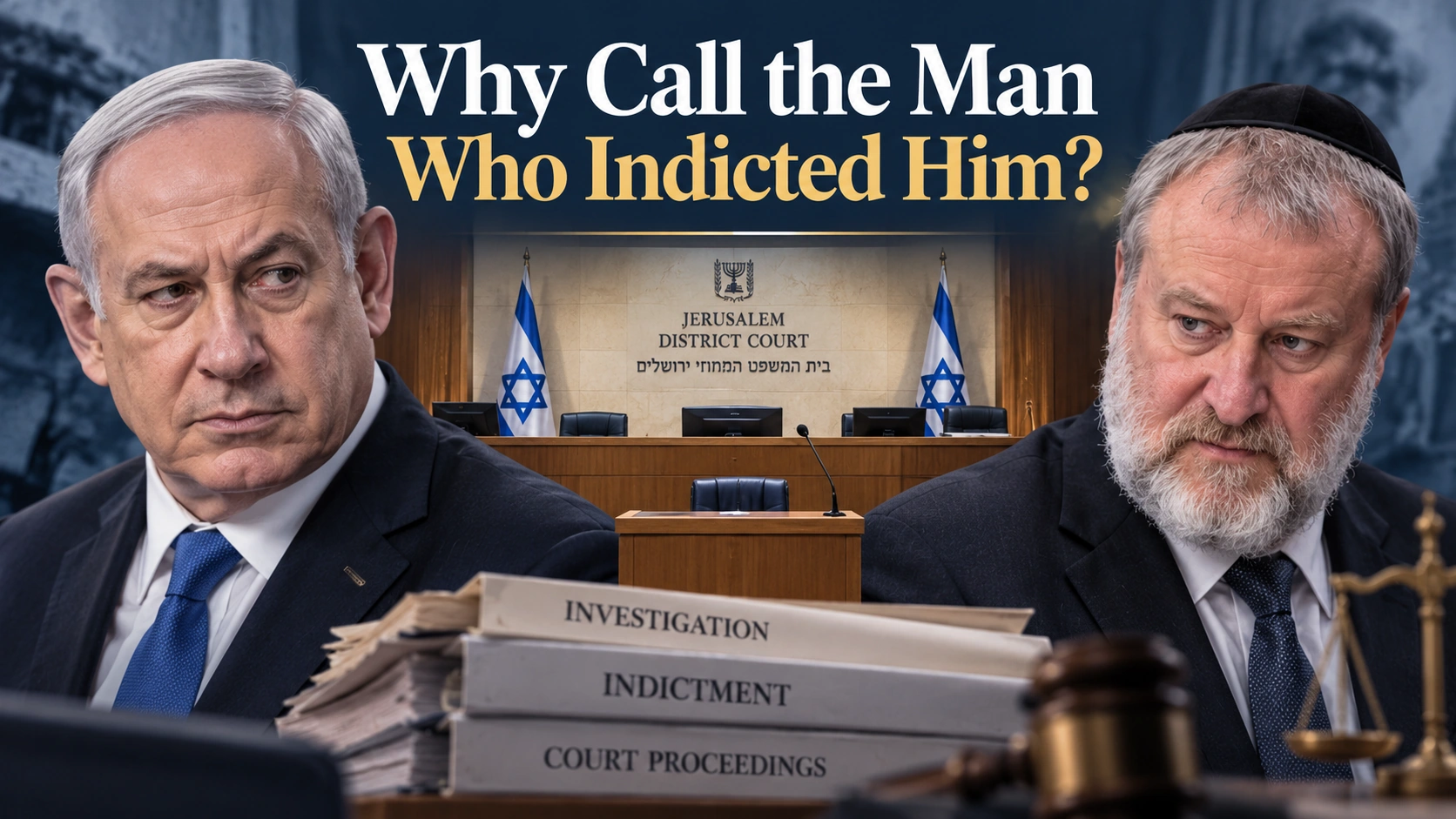
※ Images in this article are AI-generated illustrations created to help explain the story. They are not actual photographs, and depictions of people, places, or events may differ slightly from reality.
That leaves a more complicated question than whether the former attorney general supports or opposes Netanyahu: How much can problems with an investigation change a trial that has already lasted more than six years?
Why Would Netanyahu’s Lawyers Call the Official Who Indicted Him?
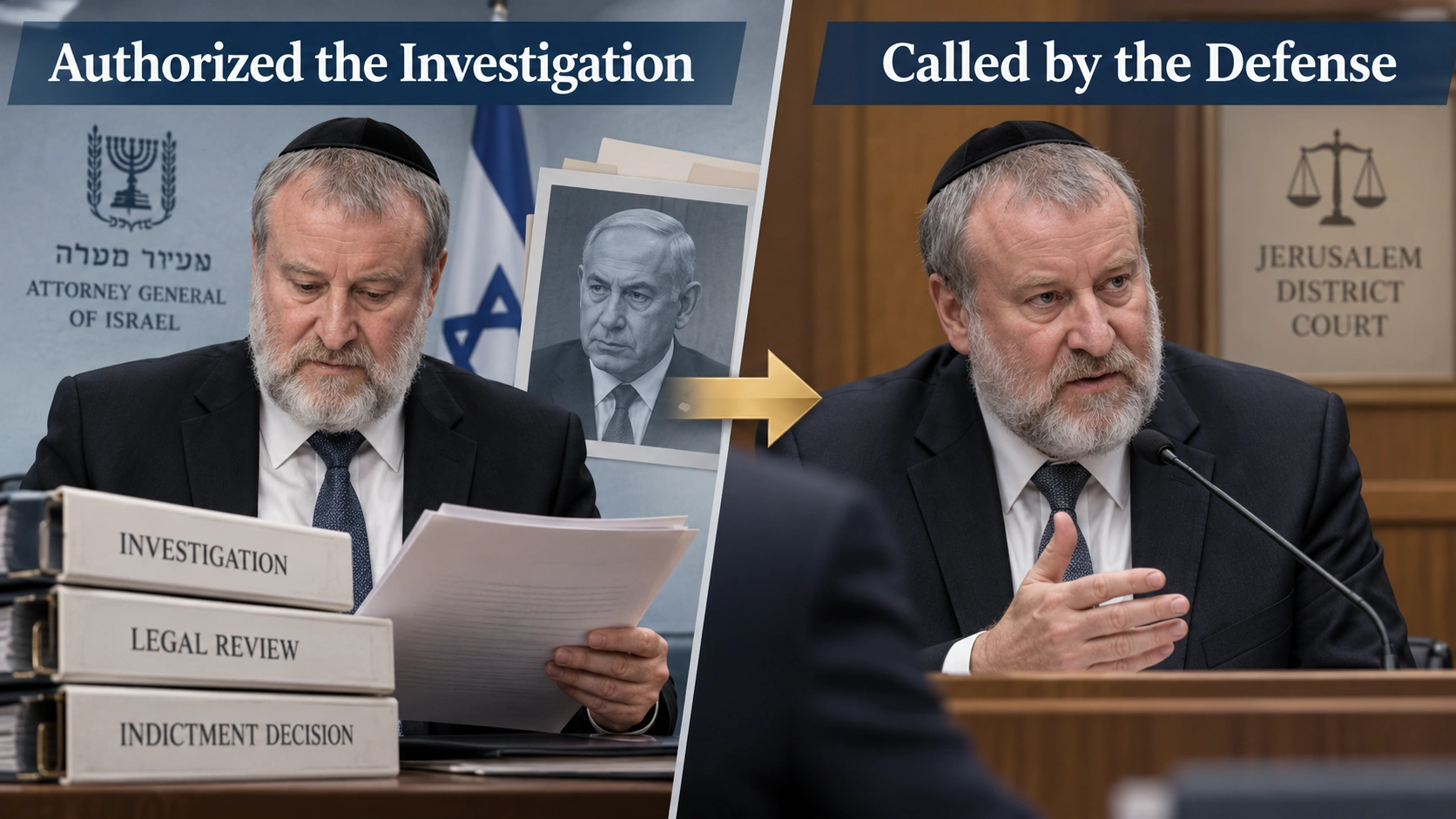
Netanyahu’s lawyers called Mandelblit because he is one of the people best positioned to explain how the investigations were authorized and supervised.
Mandelblit served as Israel’s attorney general from 2016 to 2022. In that position, he played a central role in the legal decisions that led to the prime minister’s prosecution.
Israel’s attorney general is not merely an adviser to the government. The office also carries major responsibilities for criminal prosecution and the legality of government action.
On November 21, 2019, Mandelblit announced his decision to indict Netanyahu. The formal indictment followed in January 2020, and the trial began in May of that year. (The Times of Israel · The Jerusalem Post)
That history makes his evidence potentially important for both sides. The defense wants to question the scope and documentation of his approvals. Prosecutors have maintained that the investigations were properly authorized.
Netanyahu has accused Mandelblit of using prosecution to remove him from office. Mandelblit has denied that allegation. (The Times of Israel)
Mandelblit was not summoned as an eyewitness to an alleged exchange of gifts or favors. His importance lies in the official decisions he made and what he knew about investigators’ conduct.
That is how the man who brought the charges can end up answering questions from the defendant’s lawyers.
What Permission Did Police Need to Investigate a Sitting Prime Minister?
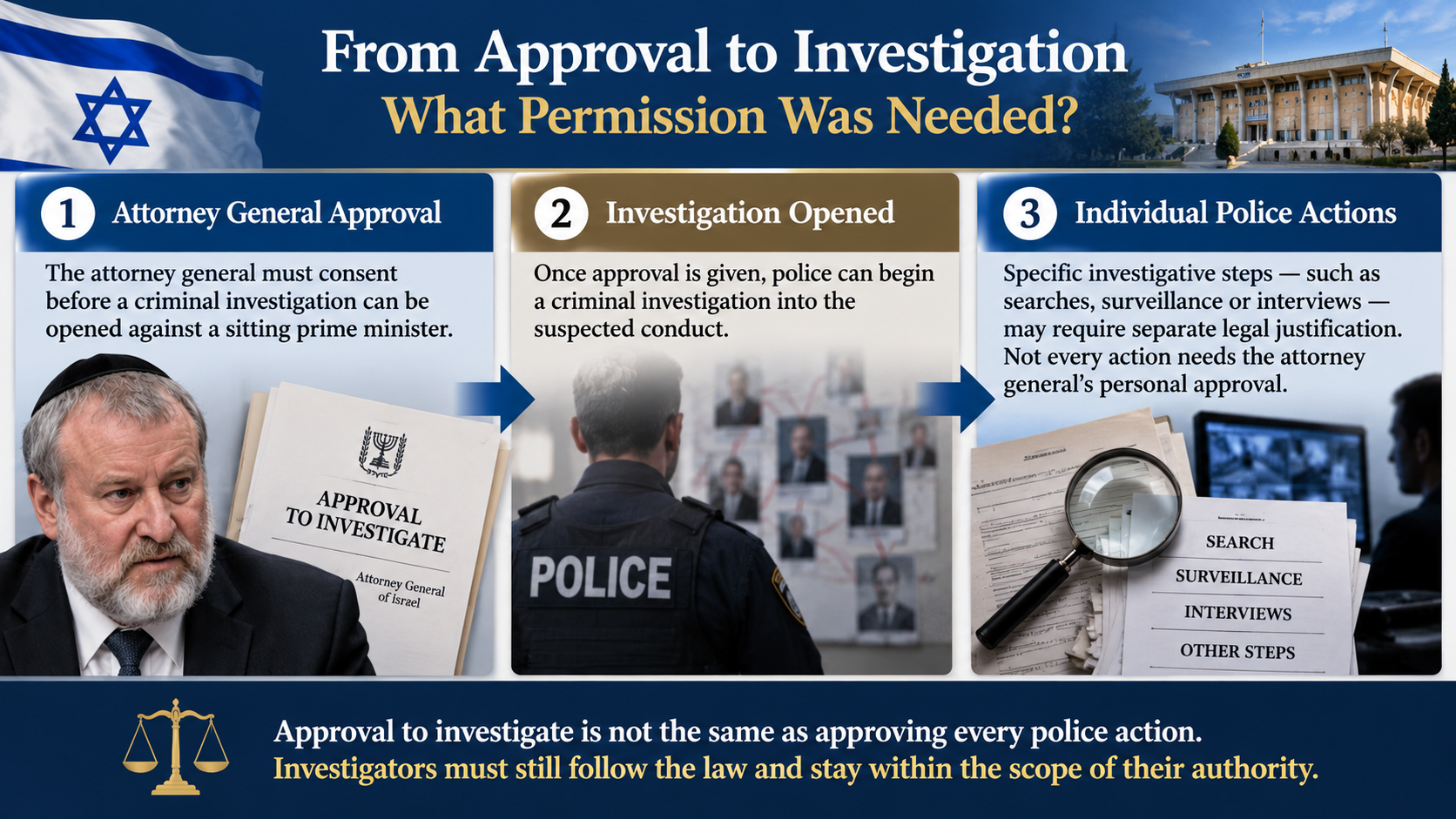
Israeli law requires the attorney general’s consent before a criminal investigation can be opened against a sitting prime minister.
The requirement appears in Section 17(a) of Israel’s Basic Law: The Government. Section 17(c) also provides that an indictment against the prime minister is filed by the attorney general in the Jerusalem District Court. (Knesset)
But permission to open an investigation is not necessarily the same as approving every action investigators subsequently take.
Think of an organization authorizing an internal investigation. The decision to open it does not necessarily involve personally signing off on every interview or request for documents. Investigators still have to follow the laws and limits that apply to each step.
That comparison is only a way to understand the distinction; Israel’s legal rules govern what was actually required in Netanyahu’s case.
| Legal question | What it means | Why it matters |
|---|---|---|
| Was the investigation authorized? | Did the attorney general consent to opening the investigation? | The Basic Law requires consent. |
| What did the authorization cover? | Which suspected conduct did the approval encompass? | The defense challenges whether police stayed within its scope. |
| Were particular police actions lawful? | Did surveillance or interrogation tactics meet applicable rules? | Individual evidence-gathering methods can be contested. |
| What follows if a rule was broken? | Would a finding of misconduct affect evidence or proceedings? | Judges must determine the legal consequence; dismissal is not automatic. |
Netanyahu’s lawyers argue that police exceeded the authorizations they received or began investigating without sufficient consent. Prosecutors dispute that account and point to records of meetings and Mandelblit’s insistence that he approved the inquiries.
This argument predates the October 2026 hearing. In 2021, the court examined the defense’s authorization challenge. Mandelblit stated that he had given consent orally and that Israeli law did not require his approval to be in a separate written document. (The Times of Israel)
The latest testimony did not change the statute. It put the person who gave the approvals on the stand to answer questions directly.
What Did Mandelblit Actually Say About Police Conduct?
Mandelblit acknowledged that investigators carried out significant actions without his personal approval. But he did not say that the entire investigation had been unauthorized.
One example concerned the wiretapping of Natan Eshel, a Netanyahu associate and former senior aide. Mandelblit said the surveillance was sufficiently sensitive that investigators should have consulted him first. When he learned about it, he ordered it stopped. (The Times of Israel)
Another controversy involved Nir Hefetz, a former Netanyahu aide who became a state witness. Investigators used a woman close to Hefetz in a tactic designed to pressure him during questioning.
Mandelblit criticized the tactic as improper and said he did not order disciplinary action against the investigators because he feared interfering with the criminal case. (The Times of Israel)
There was a separate issue involving the amended indictment in Case 4000. Prosecutors had listed 315 examples of alleged efforts to obtain favorable coverage on the Walla news website. During questioning by defense attorney Amit Hadad, Mandelblit acknowledged that he had not personally examined those hundreds of examples in full. This was a question about his review of case materials, not a judicial finding that every allegation was false. (The Times of Israel)
All of this gives the defense matters to press in court. Still, finding that a police action lacked Mandelblit’s personal approval does not automatically prove the action legally required that approval or that all resulting evidence must be thrown out.
What Are Netanyahu’s Three Corruption Cases Actually About?

Netanyahu’s trial combines three separate cases, known as Cases 1000, 2000 and 4000. Each involves different alleged conduct.
| Case | Prosecutors’ allegation | Charges against Netanyahu |
|---|---|---|
| Case 1000 | Gifts from wealthy businessmen allegedly created improper benefits. | Fraud and breach of trust |
| Case 2000 | Discussions with a newspaper publisher allegedly involved a deal over coverage and a rival paper. | Fraud and breach of trust |
| Case 4000 | Regulatory measures allegedly benefited Bezeq in exchange for favorable coverage on Walla. | Bribery, fraud and breach of trust |
Netanyahu denies wrongdoing in all three cases. These are prosecution allegations, not findings of guilt. (The Times of Israel)
Case 1000 concerns gifts, including cigars and champagne, and whether receiving them violated the obligations of public office.
Case 2000 concerns discussions involving Arnon Mozes, publisher of Yedioth Ahronoth, about potential favorable coverage and restrictions on rival newspaper Israel Hayom.
Case 4000 includes the bribery allegation. Prosecutors contend that favorable regulatory decisions benefiting telecommunications company Bezeq were linked to more favorable coverage of Netanyahu and his family on Walla, then owned by Bezeq.
For an American audience, the central distinction in the media cases is straightforward: Favorable press coverage alone is not proof of bribery. The criminal questions concern whether an illegal arrangement involving public power and a benefit can be established.
The judges must decide whether the evidence supports the charges, while also considering the defense’s challenges to how it was collected.
Could Mandelblit’s Testimony Get the Charges Dismissed?
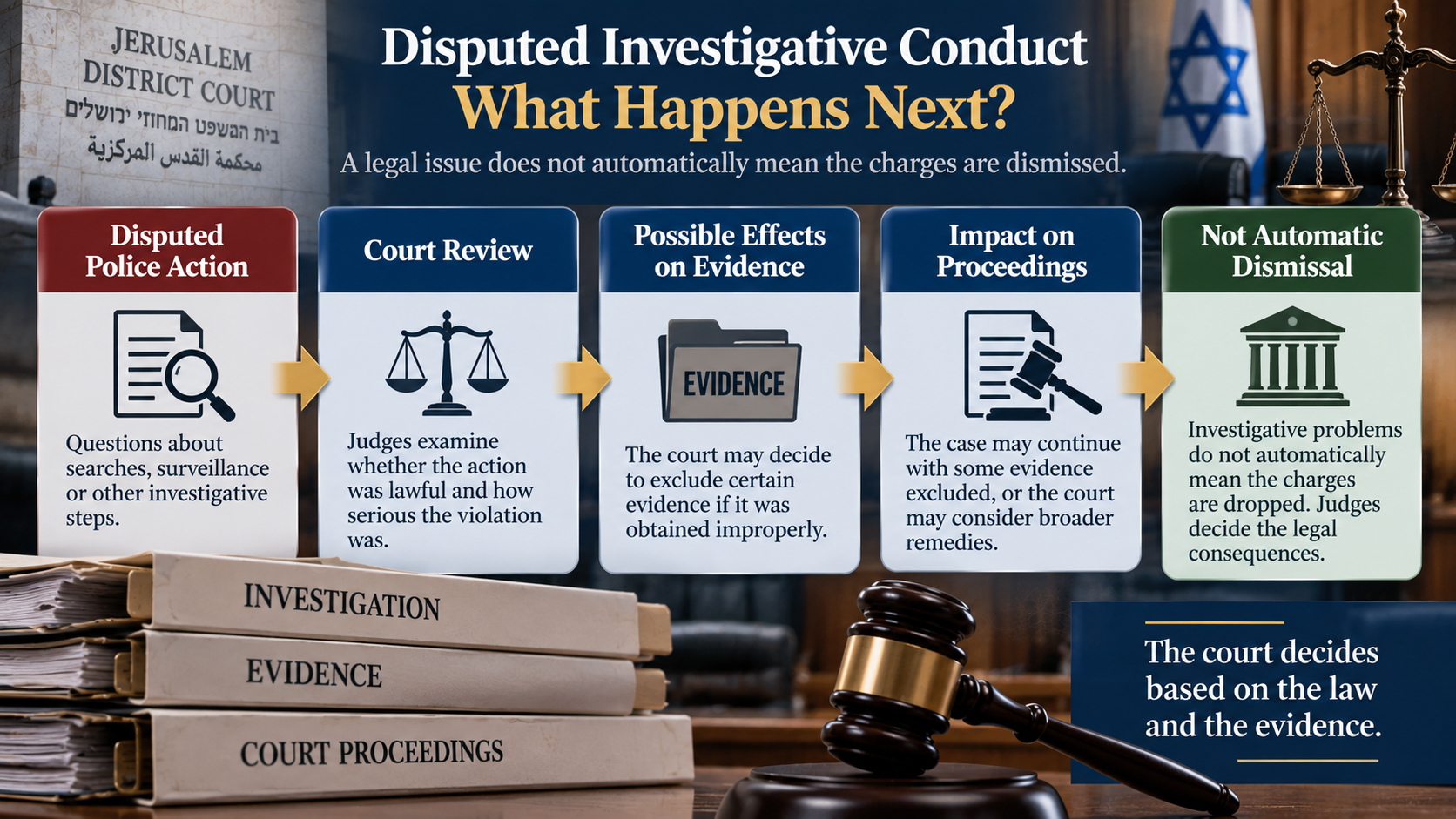
Not automatically. Mandelblit’s testimony could strengthen particular defense arguments, but judges must still decide what legal significance those arguments have.
A court can consider conduct improper without concluding that the entire investigation was invalid. Judges may also consider whether a particular piece of evidence was obtained unlawfully and whether admitting it would undermine the fairness of the proceedings.
In the Israeli Supreme Court’s Yissacharov decision, the court established a discretionary framework under which illegally obtained evidence can be excluded when admitting it would substantially violate a defendant’s right to a fair trial. That determination depends on the circumstances; it is not an automatic response to every investigative mistake. (Cardozo Israeli Supreme Court Project)
| Development | What it establishes |
|---|---|
| A witness criticizes an investigative action | A question about police conduct has been raised. |
| Defense lawyers challenge particular evidence | The court has an argument to evaluate. |
| Judges exclude evidence | Specific evidence is affected by a judicial decision. |
| Judges dismiss charges or reach a verdict | The court has made a separate determination about the case. |
After the October 11 testimony, Netanyahu’s Likud party demanded that the trial be stopped and accused investigators of fabricating the case. That was a political demand, not a ruling by the court. Mandelblit continued to maintain that he had authorized the principal investigations. (The Times of Israel)
The hearing therefore raised new arguments for the defense to emphasize, not an automatic end to the trial.
Why Is This Happening Just Before Israel’s October 27 Election?

The timing matters because Israel is scheduled to hold a parliamentary election on October 27, 2026, barely two weeks after Mandelblit’s first appearance.
The defense requested testimony on October 11 and 12 and from October 18 through 22. A request for those dates is not a guarantee that all of them will be used. (The Times of Israel · Library of Congress)
The proximity gives politicians an opportunity to emphasize whichever parts of the testimony support their arguments.
Netanyahu and his allies have long maintained that the charges were politically motivated. They can highlight Mandelblit’s criticism of police tactics. Defenders of the prosecution can point to his testimony that the main investigations were properly authorized.
But an election and a criminal trial operate under different rules. Israeli citizens vote for parties to represent them in the Knesset. Political parties then seek to form a governing coalition. Judges, meanwhile, must decide criminal charges on the basis of law and evidence.
Winning an election would not itself erase the charges. Losing one would not establish guilt.
The election’s proximity makes the testimony politically consequential without turning the courtroom into an election tribunal.
Why Has Netanyahu’s Corruption Trial Taken So Long?
The case combines several complex allegations, extensive documentary records and many witnesses. It has also involved disputes over courtroom scheduling and the admissibility and interpretation of evidence.
Netanyahu himself began testifying in December 2024 and completed his testimony on June 24, 2026, after 98 hearing days. Other defense witnesses continued afterward. (The Jerusalem Post)
The timeline makes it easier to see how the case reached Mandelblit’s testimony:
| Date | Development |
|---|---|
| November 21, 2019 | Mandelblit announced his decision to indict Netanyahu. |
| January 2020 | The indictment was formally filed. |
| May 2020 | Netanyahu’s criminal trial began. |
| January–February 2021 | The parties contested the documentation and scope of the attorney general’s approvals. |
| December 2024 | Netanyahu began testifying. |
| June 24, 2026 | Netanyahu finished his testimony after 98 hearing days. |
| October 11, 2026 | Mandelblit began testifying after the defense called him. |
The Jerusalem District Court scheduled five hearing days per week beginning in October 2026 to accelerate the remaining evidence stage. The schedule has been contentious, particularly because the presiding judge is expected to retire in 2028. (The Jerusalem Post)
When the evidence stage ends, the parties may present closing arguments before the judges decide the remaining charges. No verdict had been reached as of the October 11 hearing.
A major new witness can therefore attract attention in a trial already more than six years old. What the witness says may affect particular disputes even if it does not resolve the entire case.
Is This the Same Case as the International Criminal Court Warrant Against Netanyahu?
No. Netanyahu’s domestic corruption trial and the International Criminal Court proceedings relating to the Gaza conflict are entirely separate legal matters.
The corruption trial is in Israel’s Jerusalem District Court and concerns alleged gifts, media-related arrangements and regulatory favors.
The International Criminal Court, based in The Hague, has proceedings concerning alleged crimes connected with the Gaza war. The institutions have different jurisdictions, defendants, allegations and legal tests. An international arrest warrant is not a criminal conviction.
For readers seeing several Netanyahu-related court stories in the news, identifying the court is the first step. A development in the Israeli corruption case does not automatically decide the ICC matter, and the reverse is also true. (International Criminal Court)
What Should We Watch as Mandelblit’s Testimony Continues?
The next important development is not simply whether another damaging statement makes a headline. It is whether the defense connects alleged investigative problems to evidence and legal questions that the judges consider consequential.
Will the defense show that any investigation began without the consent required under Israeli law or went beyond the authorized scope? Can prosecutors establish when and how the attorney general approved the relevant steps? Will judges find that questionable surveillance or interrogation tactics affect the use or weight of particular evidence?
Mandelblit’s first hearing was October 11, and the defense requested further questioning dates through October 22. Those dates are still best understood as the defense’s requested schedule rather than a confirmed final day of testimony. (The Times of Israel)
Political statements may influence public perceptions, especially near an election. Judicial decisions will determine what the testimony legally changes.
Bottom Line: What This Story Really Means
Benjamin Netanyahu’s lawyers called Avichai Mandelblit because the former attorney general had authorized the investigations and brought the charges now being contested in court.
His first day of testimony gave the defense material to highlight: he acknowledged serious police actions that he had not personally approved, criticized specific tactics and said he had not fully examined hundreds of examples of alleged favorable media coverage in the amended indictment.
But he also maintained that the main investigations were properly authorized. The testimony was neither a judicial finding that Netanyahu is guilty nor a ruling that the case must be thrown out.
With Israel’s October 27 election approaching, the political stakes are high. The legal questions remain more precise: Were the investigations properly authorized, were particular police methods lawful, and what should judges do if they find a significant violation?
Netanyahu Mandelblit Trial: Key Questions Explained
Q. Who is Avichai Mandelblit?
Avichai Mandelblit was Israel’s attorney general from 2016 to 2022. He authorized investigations into Netanyahu and announced the decision to prosecute him in November 2019.
Q. Why did Netanyahu call Mandelblit as a defense witness?
Netanyahu’s lawyers wanted to challenge how the former attorney general approved and supervised the police investigations. Being called by the defense does not mean Mandelblit supports Netanyahu.
Q. Did Mandelblit admit the entire investigation was illegal?
No. He said that some significant police steps were taken without his personal approval, while maintaining that he had authorized the principal investigations.
Q. What did Mandelblit say about the Case 4000 indictment?
He acknowledged that he had not personally examined all 315 examples of alleged favorable Walla coverage listed in the amended indictment. That testimony was not a court ruling on the truth of each example.
Q. Has Netanyahu been convicted in the Israeli corruption case?
No. As of the October 11, 2026 hearing, the trial was ongoing without a verdict. Netanyahu denies wrongdoing.
Q. What is Netanyahu accused of in Case 4000?
Prosecutors allege that favorable regulatory treatment for Bezeq was tied to more favorable media coverage on Walla. Netanyahu faces a bribery charge along with fraud and breach-of-trust charges in that case.
Q. Can an Israeli court exclude evidence obtained improperly?
Yes, under a discretionary legal framework. Whether the evidence can be excluded depends on the nature of the violation and its implications for a fair trial.
Q. When is Israel’s next parliamentary election?
The election is scheduled for October 27, 2026, just over two weeks after Mandelblit’s first day of testimony.
Q. Would the election automatically end Netanyahu’s trial?
No. Election outcomes and judicial proceedings are separate. The charges do not disappear simply because a party wins or loses an election.
Q. Is Netanyahu’s domestic corruption case the same as the ICC case?
No. Israel’s corruption trial concerns domestic criminal allegations. The International Criminal Court proceedings relate to alleged crimes associated with the Gaza conflict.
Did this help make the story clearer? 🙂 WIN keeps unpacking the “why” behind the news—clearly and simply!
Sources
October 11 Testimony and Defense Claims
The Jerusalem Post — Mandelblit Says Some Serious Police Actions Were Not Approved
The Times of Israel — Mandelblit on Police Actions and the Amended Indictment
The Times of Israel — Likud’s Demand to Halt the Trial
Legal Framework and Case Background
Knesset — Basic Law: The Government, Section 17
The Times of Israel — Mandelblit’s 2021 Explanation of Investigation Approvals
Cardozo Israeli Supreme Court Project — Yissacharov v. Chief Military Prosecutor
International Criminal Court — Benjamin Netanyahu Case
The Times of Israel — Attorney General’s Announcement of Netanyahu Indictment
Trial Schedule and Election Context
The Jerusalem Post — Netanyahu Finishes Testimony After 98 Hearings
The Jerusalem Post — Defense Phase and Five-Day Trial Schedule
The Times of Israel — Mandelblit Witness Dates Requested Before Election
Library of Congress — Israel’s October 27, 2026 Election
Keep Reading
How Is Netanyahu’s International Criminal Court Case Different?
The domestic corruption case is only one of the legal controversies involving Israel’s prime minister. This WIN explainer distinguishes the ICC warrant, international legal proceedings and the political meaning of diplomatic protests.
Why Did U.N. Delegates Walk Out on Netanyahu—and What Did the Protest Actually Mean?