Christa Pike Survived Tennessee’s Execution. Can the State Legally Try Again?

If a state gives a prisoner its lethal-injection drugs and the prisoner survives, is the death sentence over?
It sounds as though it should be a simple yes-or-no question.
It is not.
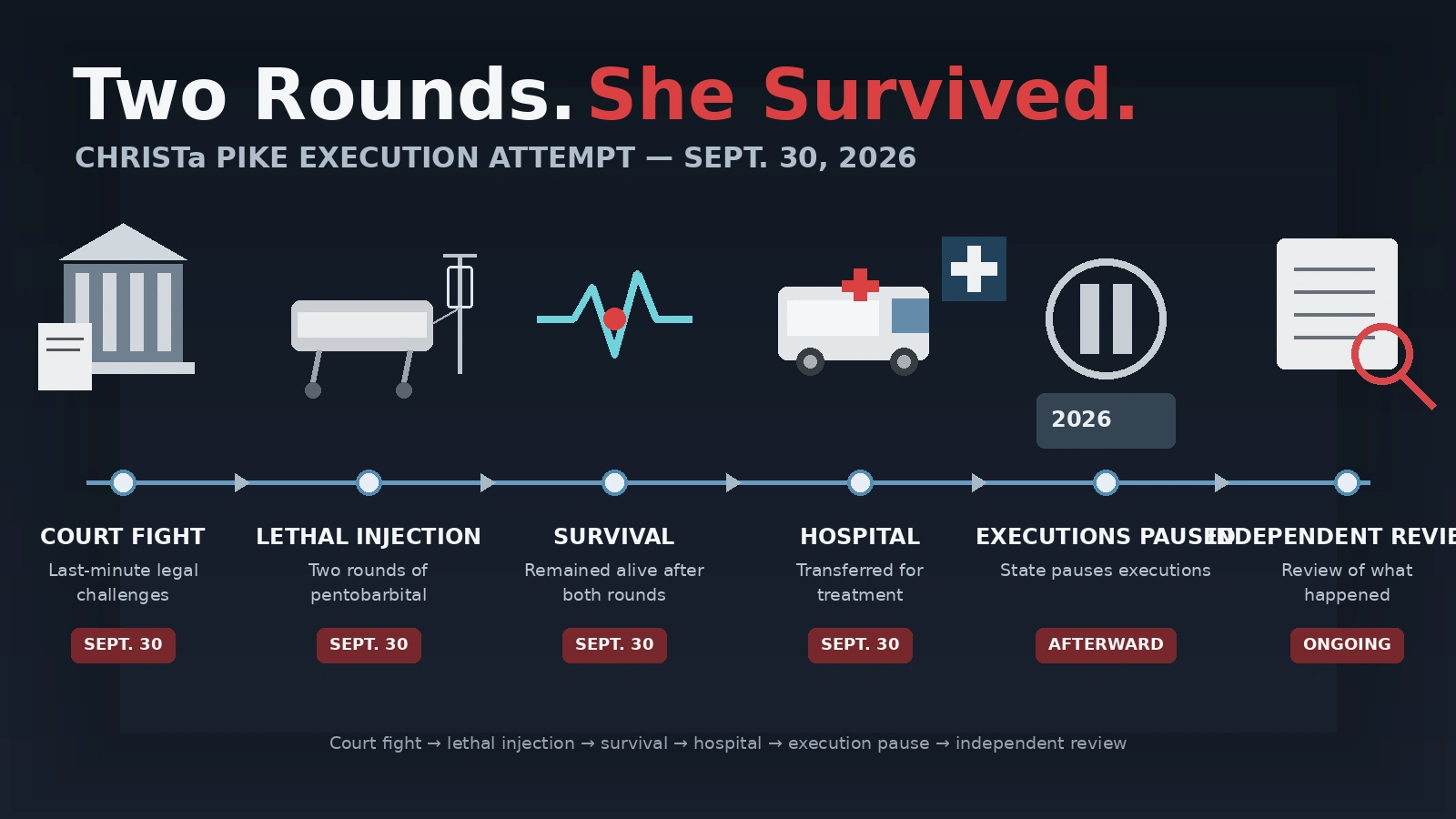
Tennessee tried to execute Christa Pike on September 30, 2026. Pike received two rounds of pentobarbital, continued breathing, and was eventually taken from Riverbend Maximum Security Institution to a hospital. The Tennessee Department of Correction said afterward that it had followed every step allowed by its execution protocol and that the protocol authorized no additional procedure after the steps already carried out. (Tennessee Department of Correction · AP)
As of the latest public update on October 5, Pike remained hospitalized on a ventilator, and her attorney said it was still unclear whether she would regain consciousness. (CBS News · AP)
Surviving the execution did not automatically erase her death sentence.
But that does not mean Tennessee can simply wheel her back into an execution chamber and start over.
※ Images in this article are AI-generated illustrations created to help explain the story. They are not actual photographs, and depictions of people, places, or events may differ slightly from reality.
Her medical condition now matters. So does Tennessee law. So do old Supreme Court cases involving people who survived earlier execution attempts.
And one distinction makes Pike’s case especially unusual: the lethal drug was actually administered.
What Exactly Happened During Christa Pike’s Execution?
Pike, now 50, was convicted of first-degree murder and sentenced to death in 1996 for killing 19-year-old Colleen Slemmer in 1995. Pike was 18 when the crime occurred and 20 when she entered death row. She has remained Tennessee’s only woman under a death sentence. (Tennessee Department of Correction · AP)
The Tennessee Supreme Court had ordered her execution for September 30, 2026. After last-minute federal court litigation, the execution went forward that evening. (Tennessee Supreme Court · AP)
What followed was extraordinary.
Media witnesses and court filings described Pike receiving two rounds of pentobarbital while continuing to breathe. She was eventually transported to a Nashville-area hospital. Her lawyers later said her arms were burned and blistered and alleged that problems with the IV lines caused at least some of the drug to enter surrounding tissue instead of flowing properly through her bloodstream. (AP · Washington Post)
That last part is important to phrase carefully.
The IV explanation comes from Pike’s lawyers and court filings; it is not yet the final finding of the independent state review. The Department of Correction said it followed its approved protocol. Gov. Bill Lee ordered an independent review to determine what happened. (Tennessee Department of Correction · WSMV)
Slemmer’s mother, May Martinez, had traveled to witness the execution and has long supported carrying out Pike’s sentence. The failure therefore created another painful uncertainty for the victim’s family as well as a legal crisis for the state. (AP)
Has Tennessee Failed an Execution Like This Before?
Yes—but not in quite the same way.
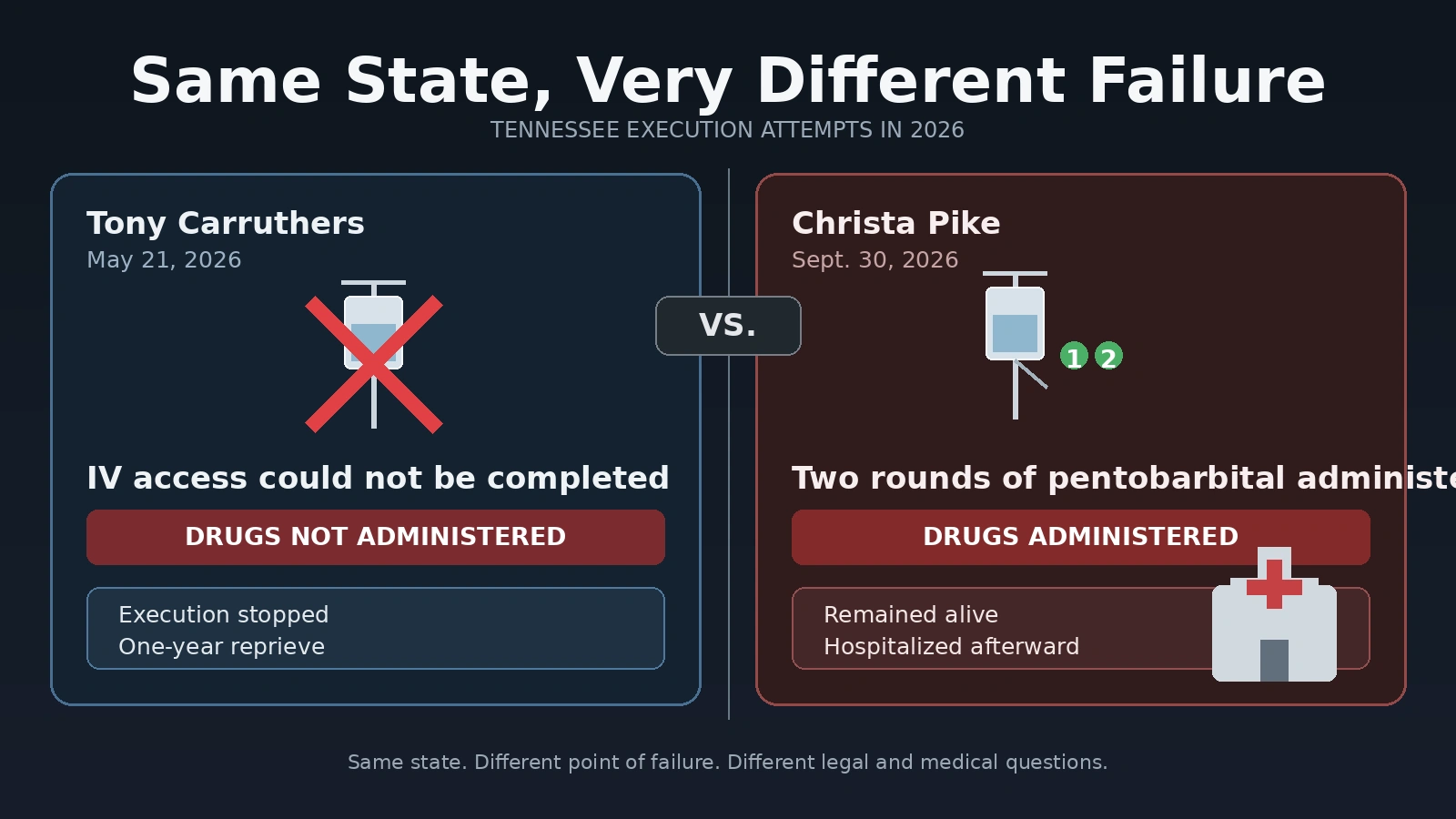
Tennessee failed to execute Tony Carruthers on May 21 after officials spent more than an hour trying to establish the IV access required by the state protocol. Officials established a primary IV line but could not secure the required backup line or a central line, so the execution was stopped before the lethal drug was administered. Lee then granted Carruthers a one-year reprieve. (AP)
Pike’s case went further.
| 2026 Tennessee case | What went wrong | Was the execution drug administered? | Immediate result |
|---|---|---|---|
| Tony Carruthers, May 21 | Required backup IV access could not be completed | No | Execution stopped; one-year reprieve |
| Christa Pike, Sept. 30 | Two rounds of pentobarbital did not produce death | Yes | Pike hospitalized in critical condition |
That distinction is one reason Pike’s situation is unusually difficult.
There are precedents involving prisoners who survived malfunctioning electric chairs or lethal-injection attempts that were halted before the execution drugs were delivered.
Pike’s case is different because Tennessee administered the execution drug, she survived, and she then required life-saving hospital treatment. AP reported that she appears to be the first known person in the modern U.S. death-penalty era to remain alive after receiving lethal-injection drugs. (AP)
Does Surviving an Execution Cancel the Death Sentence?
No.
This is probably the most important legal distinction in the entire story.
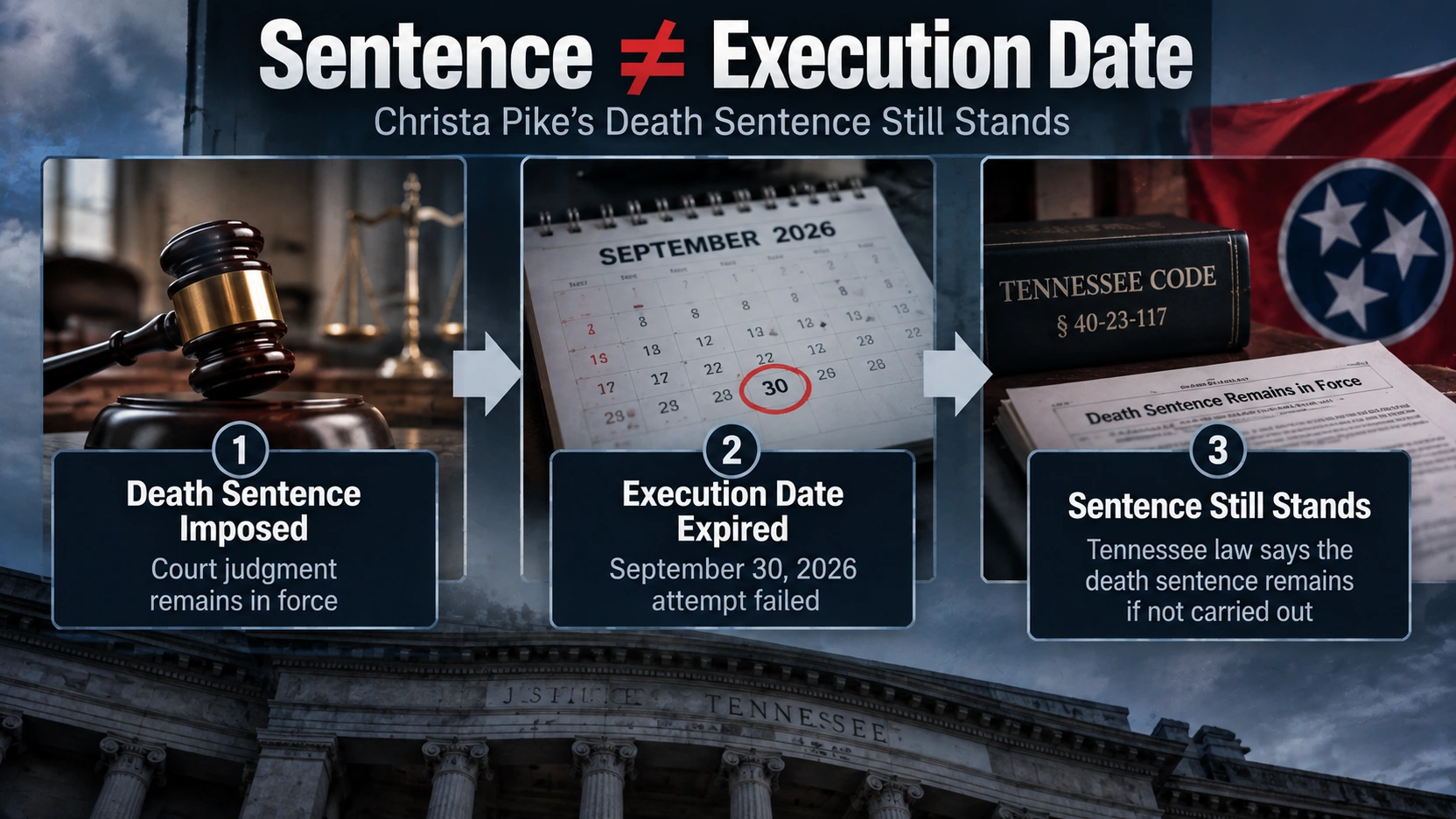
A death sentence and a particular execution date are not the same thing.
Tennessee Code § 40-23-117 says that when a person sentenced to death has not been executed “from any cause,” the sentence remains in full force. (Tennessee Code § 40-23-117)
So Pike’s September 30 execution date passing without her death did not by itself convert her sentence into life imprisonment.
Think of it this way.
A court judgment imposed the death sentence. September 30 was the date selected for carrying it out.
The attempt failed.
The date is over. The underlying judgment is not automatically over.
That could change if Lee grants clemency, if a court later grants Pike relief, or if some other lawful action alters the sentence.
But survival alone does not do that.
Would a Second Execution Be Double Jeopardy?
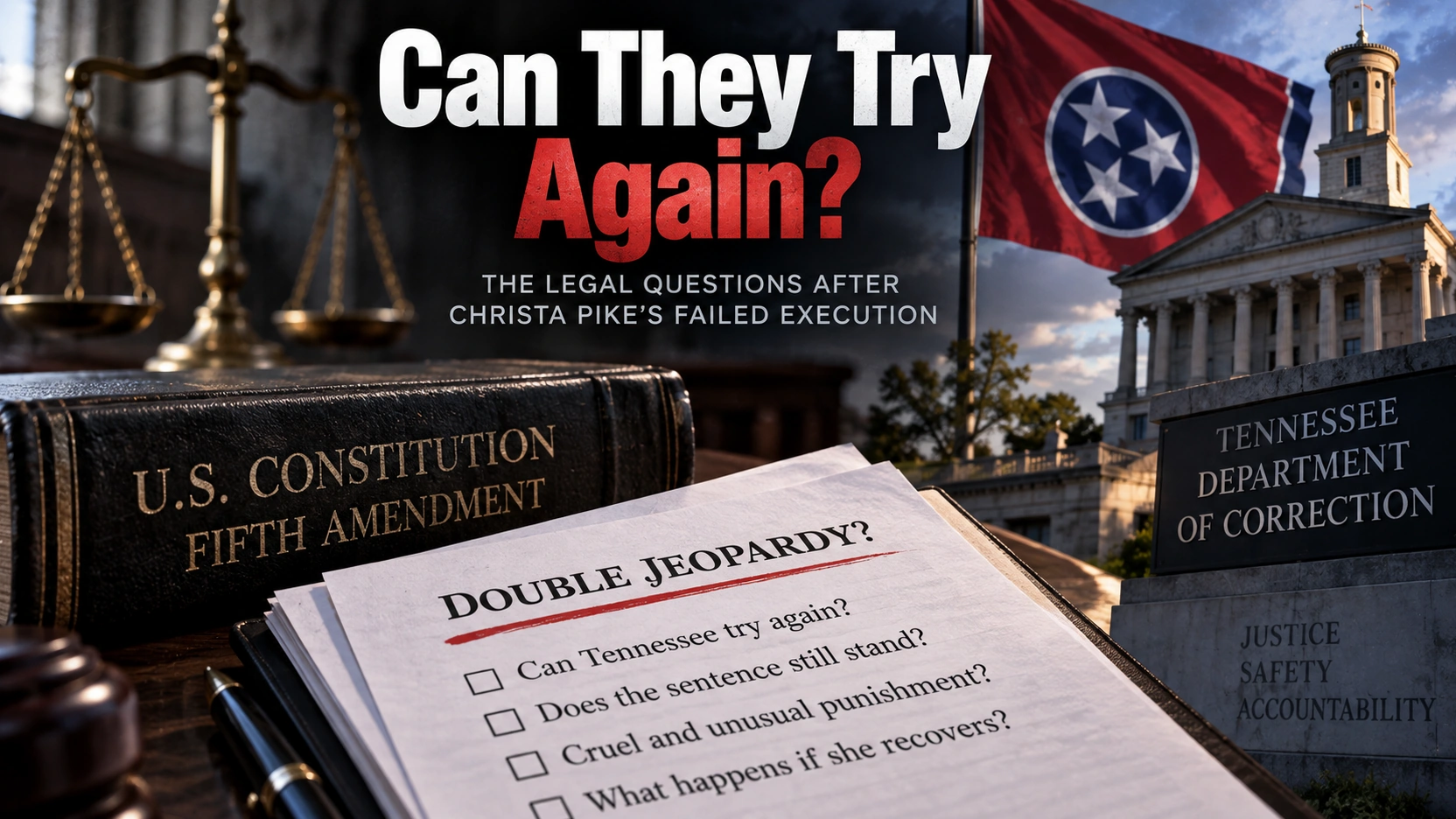
Probably not under existing Supreme Court precedent.
That answer can feel counterintuitive.
The Fifth Amendment’s Double Jeopardy Clause protects a person from being prosecuted again for the same offense after certain final outcomes and from receiving multiple punishments for the same offense.
But a second attempt to complete an existing death sentence has historically been treated differently.
The key case is Louisiana ex rel. Francis v. Resweber, decided by the U.S. Supreme Court in 1947.
Willie Francis had been placed in Louisiana’s electric chair in 1946, but the equipment malfunctioned and no current of sufficient intensity to kill him passed through his body. Louisiana planned another execution.
Francis argued that trying again would violate protections against double jeopardy and cruel and unusual punishment.
The Supreme Court rejected those constitutional claims and allowed the state to proceed. The controlling opinion treated the planned second attempt as continued enforcement of the original death sentence rather than a second punishment for the murder. (U.S. Supreme Court — Resweber)
That precedent means “I survived once” is not, by itself, a constitutional double-jeopardy defense.
But Pike’s lawyers would have an important factual distinction to emphasize.
Resweber involved a failed electrocution caused by an equipment malfunction. Pike was given two rounds of the drug Tennessee intended to use to kill her and then ended up critically ill in a hospital.
No U.S. Supreme Court decision has squarely resolved a modern lethal-injection case with exactly those facts.
So Is the Eighth Amendment the Bigger Issue?
Potentially, yes.
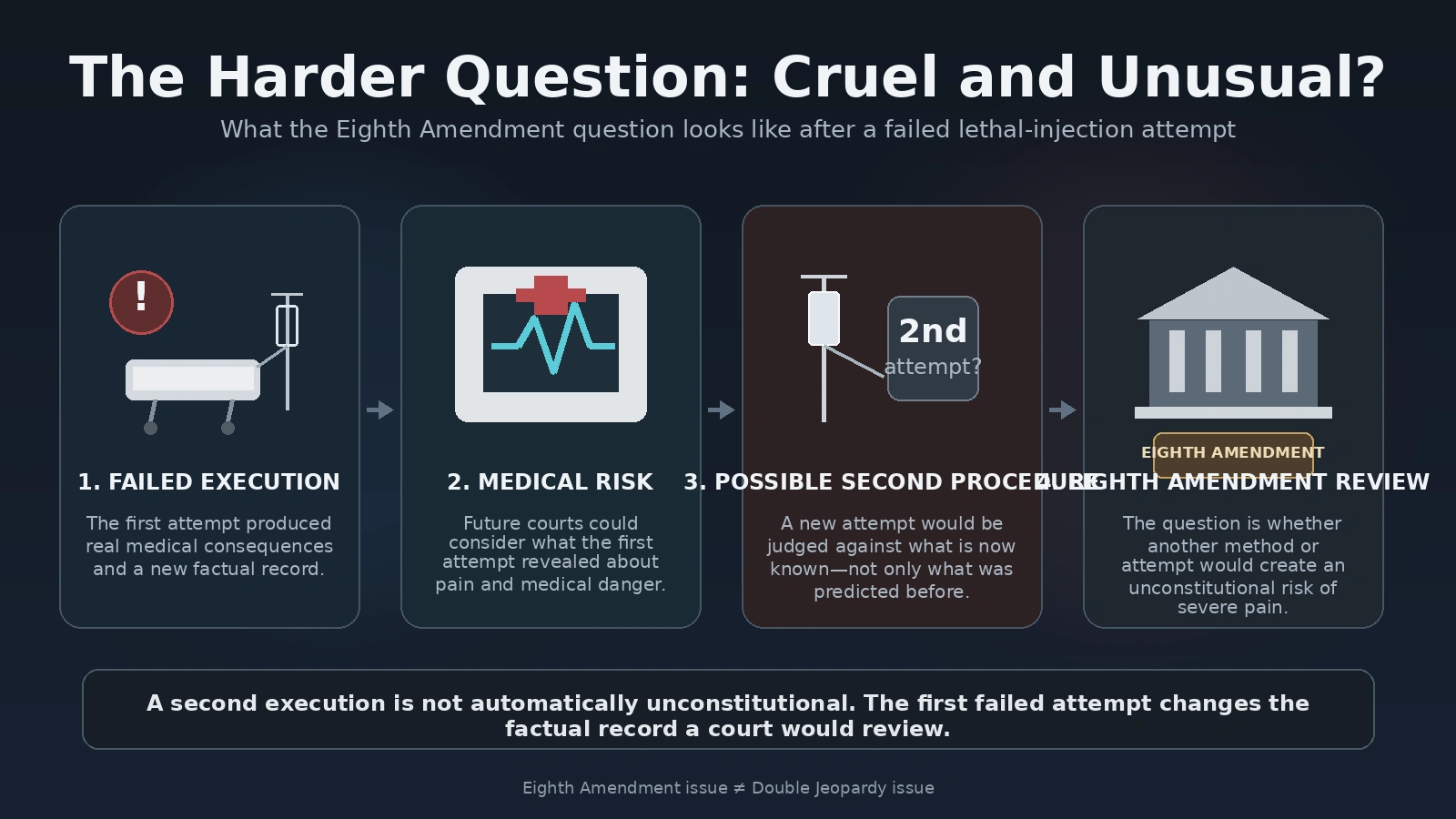
The Eighth Amendment prohibits “cruel and unusual punishments,” but Supreme Court precedent does not require an execution method to eliminate every risk of pain.
Under Baze v. Rees, Glossip v. Gross, and Bucklew v. Precythe, a prisoner bringing a method-of-execution claim generally must identify a feasible, readily implemented alternative that would significantly reduce a substantial risk of severe pain. Bucklew also confirms that this framework applies to an as-applied challenge based on a prisoner’s particular medical condition. (Bucklew v. Precythe)
Pike’s case now contains evidence that did not exist before September 30.
The state actually attempted the execution.
The intended drugs did not produce the intended result.
Pike was hospitalized afterward in critical condition.
Her attorneys allege that the IV lines failed and caused painful injuries. The independent review has not yet produced a final public finding establishing exactly why the procedure failed. (AP · WSMV)
That does not automatically make a second execution unconstitutional.
It does mean a future court could be evaluating a materially different factual record from the one that existed before the first attempt.
The question would no longer be only:
“Could Tennessee’s protocol cause Pike severe pain?”
It could also become:
“After what actually happened the first time, what would Tennessee have to change before it could constitutionally try again?”
That is a much more concrete question.
Could Pike’s Medical Condition Itself Prevent Another Execution?
Yes, depending on what happens medically.
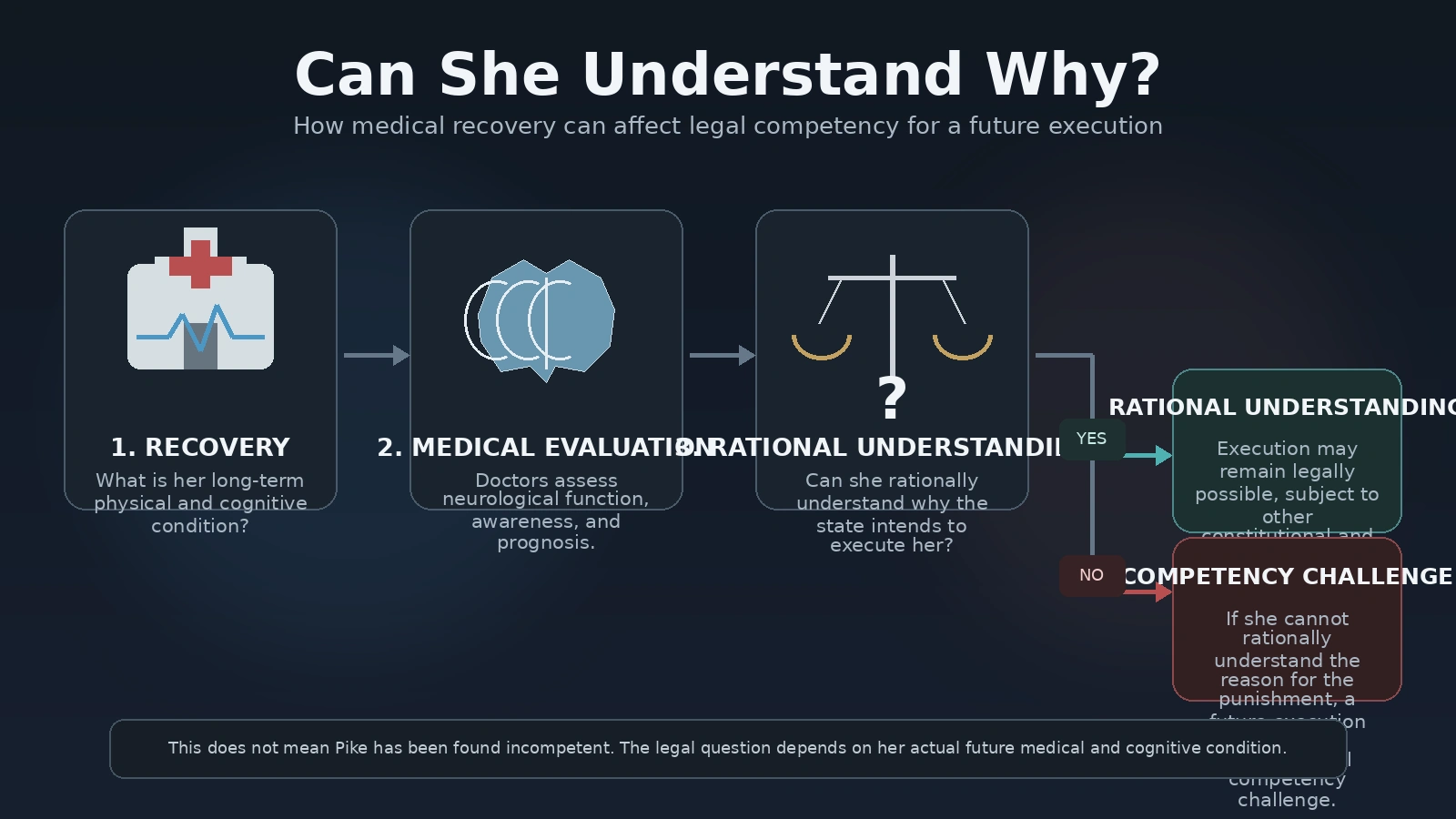
The Eighth Amendment does not permit a state to execute a prisoner whose mental condition prevents the required understanding of why the state seeks to impose the death penalty.
In Ford v. Wainwright, the Supreme Court held that the Eighth Amendment bars execution of a prisoner who is incompetent for execution. The Court later clarified in Panetti v. Quarterman that simple awareness of the state’s stated reason is not necessarily enough; the prisoner must have a rational understanding of the connection between the crime and the punishment. (Ford v. Wainwright · Panetti v. Quarterman)
In Madison v. Alabama, the Court made clear that the constitutional problem does not depend on one particular diagnosis. Dementia or another disorder can matter if its effect prevents the prisoner from rationally understanding why the state intends to execute them. (Madison v. Alabama)
This does not mean Pike has already been found legally incompetent.
As of the latest public update on October 5, her attorney said she remained hospitalized on a ventilator and that it was still unclear whether she would regain consciousness. (CBS News)
If she recovers without a condition that impairs the required rational understanding, competency may not become the central issue.
If she survives but is left with serious cognitive impairment that prevents that understanding, the legal picture changes substantially.
So the next medical update is not merely a health update.
It could determine which constitutional questions become relevant.
Why Can’t Tennessee Simply Schedule Another Execution Now?
Because several things stand between the failed attempt and any second one.
First, Lee called off the remaining Tennessee execution scheduled for 2026 and ordered a comprehensive third-party review. Former U.S. Attorney Ed Stanton, who also conducted Tennessee’s 2022 execution-protocol review, was retained to examine the Department of Correction’s actions and whether the protocol was followed. (WSMV)
Tennessee Department of Correction Commissioner Frank Strada also offered his resignation and is stepping down while the review proceeds. (Reuters)
Second, Pike’s lawyers are seeking preservation of records and evidence from the execution and are again asking Lee to commute her death sentence to life imprisonment. (AP · CBS News)
Third, another execution attempt would almost certainly generate new litigation based on the events of September 30 and Pike’s medical condition.
And fourth, Tennessee would need a new execution date. Under Tennessee Supreme Court Rule 12.4, the state attorney general requests an execution date from the Tennessee Supreme Court, which then decides whether a date should be set. (Tennessee Supreme Court Rule 12.4)
The death sentence remains. The failed September 30 execution does not remain permanently “open.”
That distinction explains why there can be a surviving death sentence but no imminent second attempt.
What Would Have to Happen Before Tennessee Could Try Again?
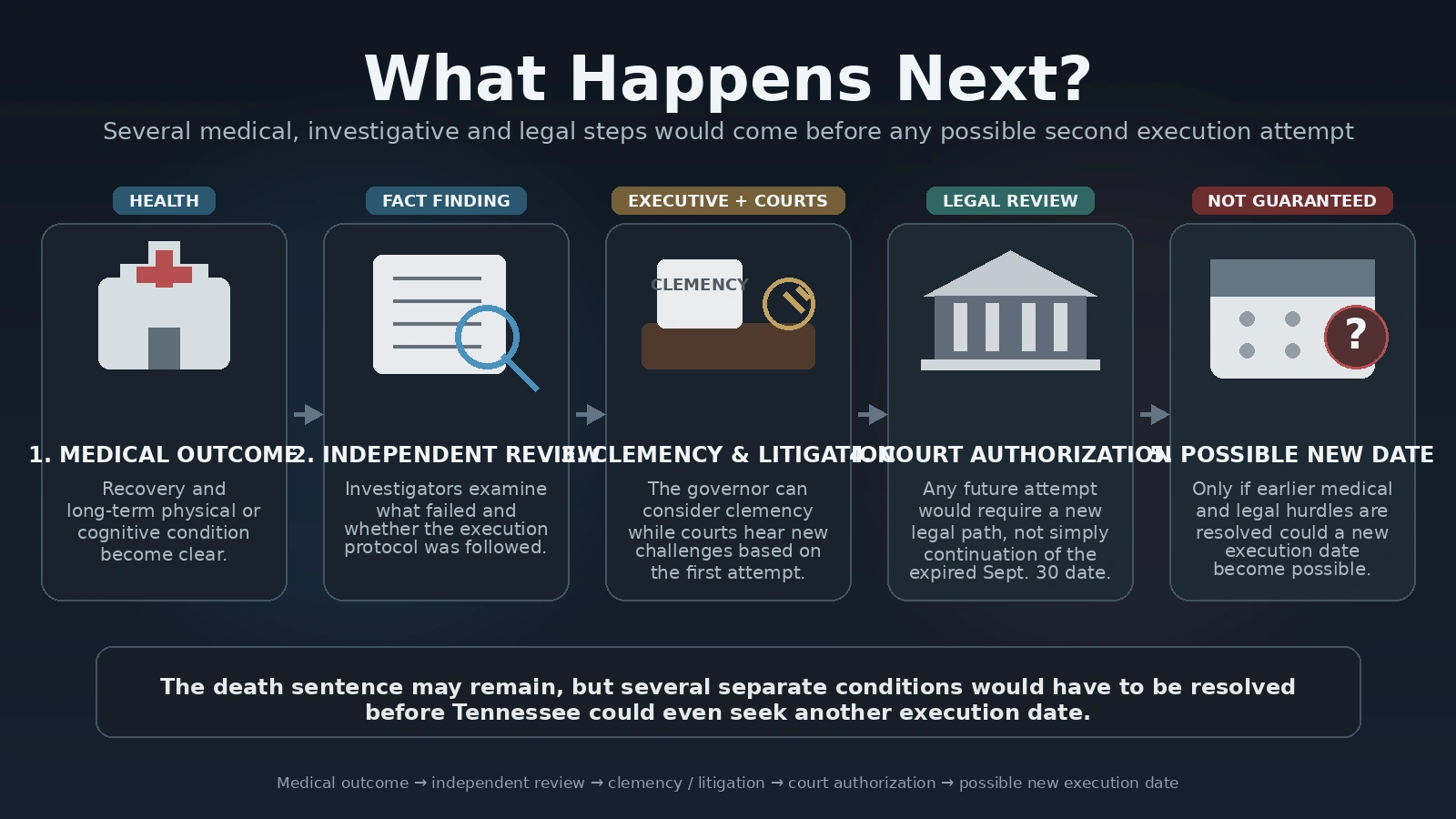
The cleanest way to understand the case is as a series of gates.
| Question | Why it matters |
|---|---|
| Does Pike survive, and what is her long-term medical condition? | Her physical and cognitive condition could shape future constitutional claims |
| What does the independent review find? | It could establish what happened during the first attempt and whether the protocol was followed |
| Does the governor commute the sentence? | Clemency could replace the death sentence with imprisonment |
| What do courts say about new challenges? | Pike can raise claims based on what occurred during the first execution attempt |
| Is Pike competent to be executed? | The Eighth Amendment requires the necessary rational understanding |
| Does the state seek and obtain a new execution date? | Tennessee cannot simply continue the expired September 30 process |
This is why predictions that Tennessee “will execute her again” are premature.
It is legally possible that the state could seek another execution.
Existing Supreme Court precedent does not automatically prohibit a second attempt.
But possible is not the same as imminent, inevitable, or constitutional under whatever facts emerge next.
The investigation has to establish what happened.
Pike’s medical condition has to become clearer.
Her lawyers can litigate the consequences of the first attempt.
And the governor still has clemency authority.
That is a lot of unresolved ground between “the death sentence still exists” and “Tennessee gets to try again.”
Bottom Line: What This Story Really Means
Christa Pike surviving Tennessee’s lethal injection did not automatically cancel her death sentence.
Tennessee law says an uncompleted death sentence remains in force, and longstanding U.S. Supreme Court precedent says that a failed execution does not necessarily make another attempt double jeopardy.
But Pike’s case is unusually complicated because Tennessee did more than prepare to execute her: it administered two rounds of pentobarbital, she survived, and she required hospitalization afterward.
That makes the most important questions forward-looking ones.
What actually failed?
What lasting injuries, if any, did Pike suffer?
Would another attempt expose her to an unconstitutional risk of severe pain?
And if her cognitive condition is seriously impaired, would she still be legally competent to be executed?
For now, the clearest answer is this:
Tennessee may still have a death sentence on the books, but it does not yet have a clear path to carrying it out again.
Christa Pike Execution: Key Questions Explained
Q. Did Christa Pike survive a lethal injection?
Yes. Tennessee attempted to execute Pike on September 30, 2026, using pentobarbital. She remained alive after two rounds of the drug and was transported to a hospital. (AP)
Q. Is Christa Pike still alive?
As of the latest public update on October 5, her attorney said Pike remained hospitalized on a ventilator and it was still unclear whether she would regain consciousness. (CBS News)
Q. Did surviving the execution erase her death sentence?
No. Tennessee Code § 40-23-117 says a death sentence remains in force when an execution has not been completed. (Tennessee Code § 40-23-117)
Q. Can Tennessee legally try to execute Christa Pike again?
Potentially, but another execution is neither automatic nor currently scheduled. Tennessee called off its remaining execution for 2026, and any future attempt could face new medical and constitutional challenges.
Q. Would a second execution violate double jeopardy?
Existing Supreme Court precedent suggests that a second attempt is not automatically double jeopardy. In the 1947 Resweber case, the Court allowed Louisiana to proceed with another execution attempt after an electric-chair malfunction. (U.S. Supreme Court — Resweber)
Q. Why is Pike’s case different from older failed executions?
Pike was not merely prepared for an execution that was then abandoned. Tennessee actually administered the lethal-injection drug, and she survived while suffering serious medical complications. That creates factual questions the Supreme Court has not addressed in exactly the same setting.
Q. Could serious cognitive impairment stop a future execution?
Potentially. Supreme Court precedent prohibits executing a prisoner who lacks a rational understanding of why the state is imposing the death penalty. A future competency claim would depend on Pike’s actual medical and cognitive condition. (Panetti v. Quarterman · Madison v. Alabama)
Q. What is Tennessee investigating now?
The independent review is examining the Department of Correction’s actions during the failed execution, including whether the protocol was followed and whether additional recommendations are needed. Former U.S. Attorney Ed Stanton was retained to conduct the review. (WSMV)
Q. What does Pike’s legal team want?
Her attorneys are asking the governor to commute her death sentence to life imprisonment and are seeking preservation of evidence connected to the failed execution. (AP · CBS News)
Did this help make the story clearer? 🙂 WIN keeps unpacking the “why” behind the news—clearly and simply!
Sources
Failed Execution and Pike’s Current Condition
Associated Press — What to know about Christa Pike and the failed lethal-injection attempt
Associated Press — Pike’s lawyer says she had not regained consciousness
CBS News — Attorneys renew request to commute Pike’s death sentence
Reuters — Tennessee death-row prisoner survives execution attempt
Tennessee’s Execution Process and State Response
Tennessee Department of Correction — September 30 media advisory
Tennessee Supreme Court — Order setting Pike’s September 30, 2026 execution
Tennessee Code § 40-23-117 — Death sentence stands if not carried out
Associated Press — Tennessee fails to execute Tony Carruthers after IV difficulties
WSMV — Ed Stanton retained for independent review
Reuters — Tennessee prison chief resigns after failed execution
Constitutional Questions About Another Execution
Legal Information Institute — Louisiana ex rel. Francis v. Resweber
Legal Information Institute — Bucklew v. Precythe
Justia U.S. Supreme Court Center — Ford v. Wainwright