Why Did the Astros Part Ways With Joe Espada After Winning the AL West?

Wait—the Houston Astros won their division, didn’t they?
They did. And they reached the playoffs despite finishing the regular season with exactly as many losses as wins.
So why would the team decide it no longer wanted Joe Espada as manager?
On October 14, 2026, Houston announced it would not renew Espada’s contract, ending his three-season tenure in charge of the team.
At first glance, that sounds like an unusually harsh decision for someone who won two American League West titles in three years.
But Houston’s division championships tell only part of the story.
The Astros won 256 regular-season games under Espada without winning a single postseason game. Their most recent division title came with an 81–81 record, followed almost immediately by another first-round playoff sweep. (MLB · AP)

※ Images in this article are AI-generated illustrations created to help explain the story. They are not actual photographs, and depictions of people, places, or events may differ slightly from reality.
That raises a larger question about how Major League Baseball works.
If winning a division is supposed to be a major accomplishment, how can it still leave a manager without a job?
The answer involves an unusual division race, a postseason that ended in just two games, and a franchise facing much bigger problems than one manager could solve.
What Did the Astros Actually Decide About Joe Espada?
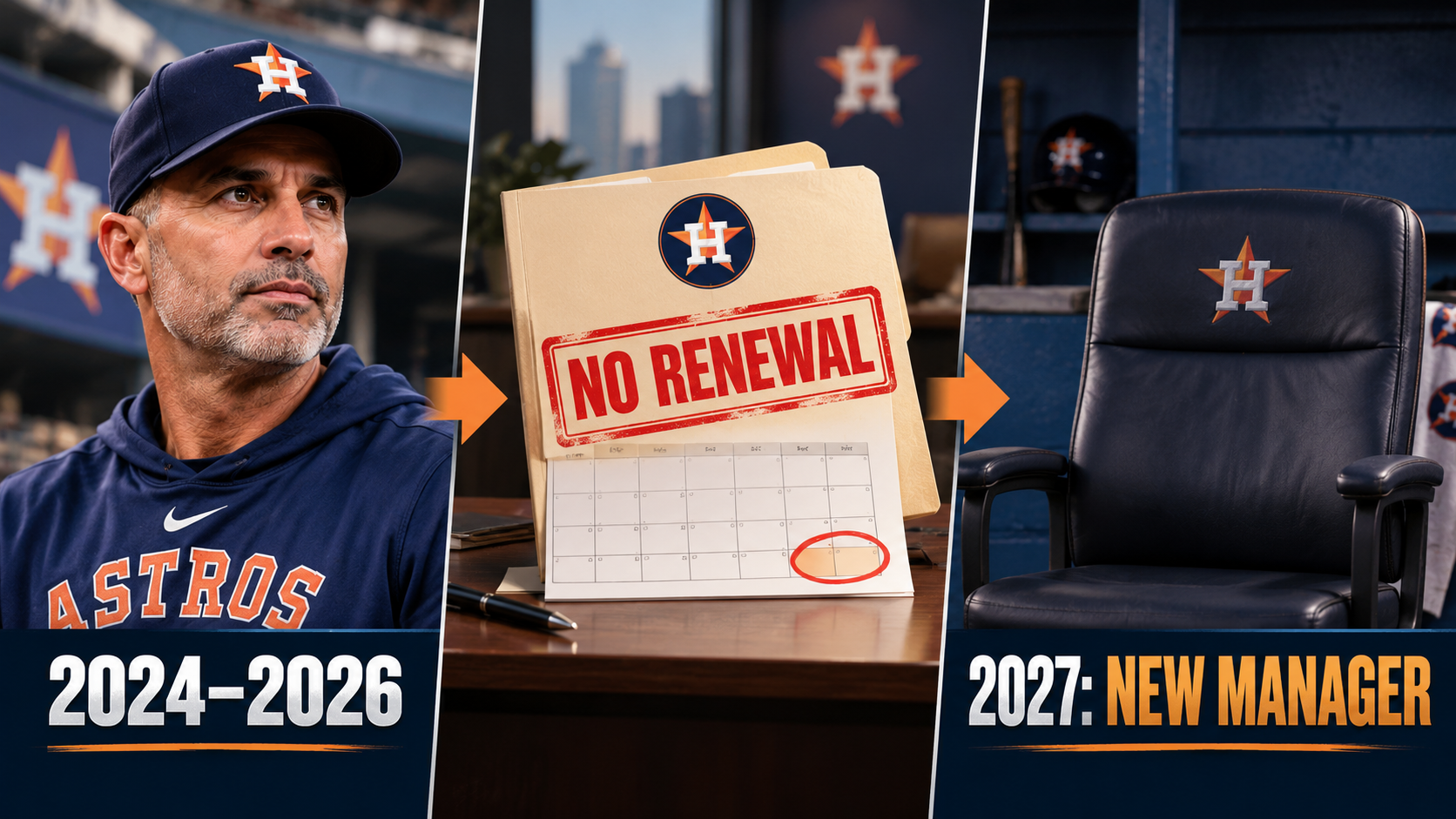
The Astros decided not to renew Joe Espada’s expiring contract. His agreement was scheduled to run through the end of October 2026, and the club announced that he would not return for the 2027 season.
That distinction matters. Houston was not announcing the dismissal of a manager in the middle of an active season. The team was deciding who should lead it into the next one.
Owner Jim Crane thanked Espada for his work, commitment and representation of the organization. The official announcement did not identify a single specific failure as the reason for the decision. (Houston Astros)
Espada had spent nine seasons with Houston, first as bench coach from 2018 through 2023 and then as manager beginning in 2024.
He replaced Dusty Baker, who retired after the 2023 season. That was a demanding assignment: Baker had led Houston to the 2022 World Series championship, and the franchise had become accustomed to playing deep into October.
Espada’s regular-season results were respectable. His teams reached the postseason twice, and his career winning percentage as Houston’s manager was .528.
But the October results were far less impressive.
And even the latest division title was more complicated than it appeared.
How Can a Team Go 81–81 and Still Win Its Division?
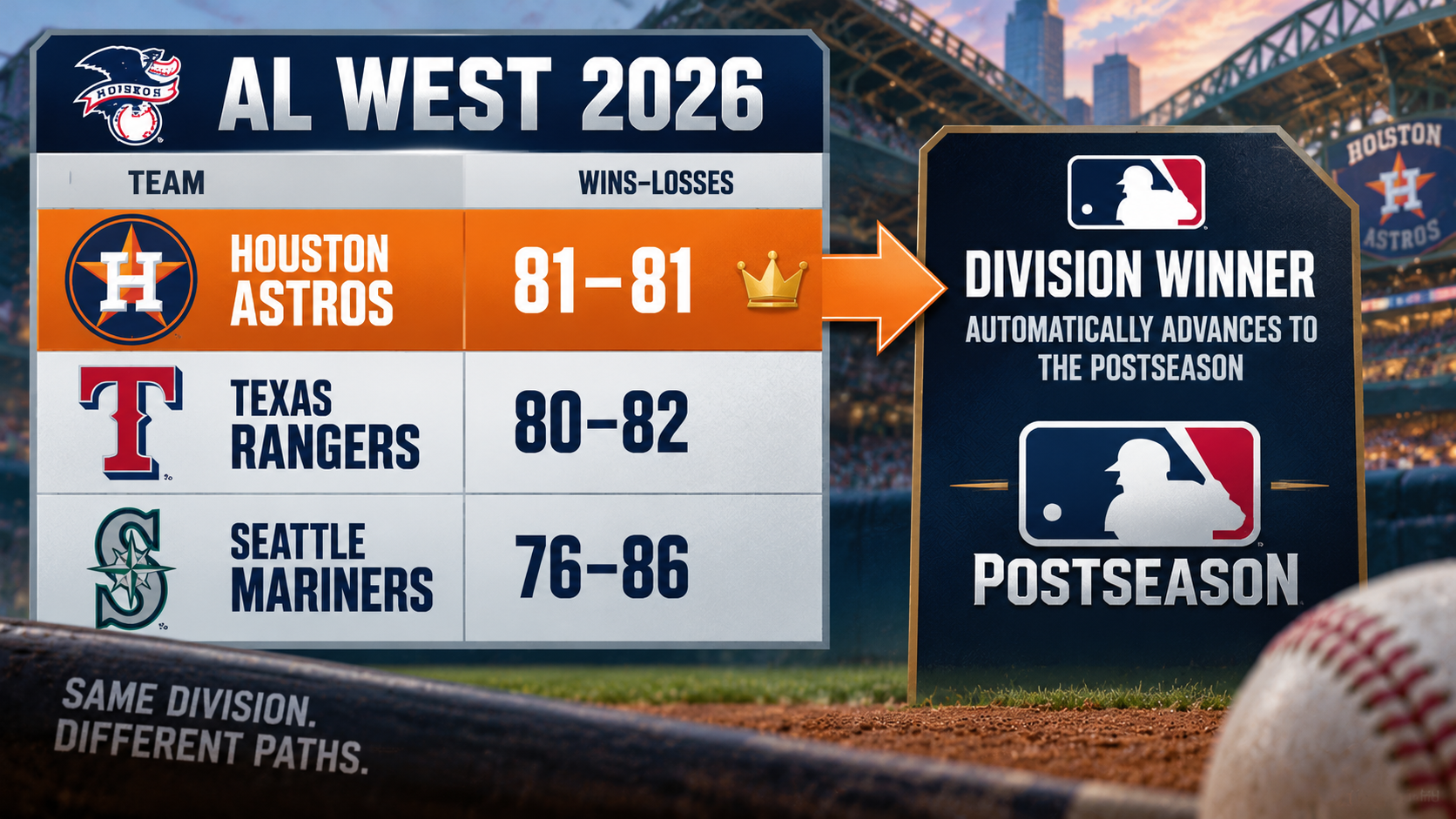
Because MLB does not require a team to finish above .500 to win its division.
A division title goes to the team with the best record in that division, even if that record would be unimpressive elsewhere in the league.
That is exactly what happened in the American League West in 2026.
Here is how the top three teams finished:
| AL West team | Wins–Losses | Winning percentage |
|---|---|---|
| Houston Astros | 81–81 | .500 |
| Texas Rangers | 80–82 | .494 |
| Seattle Mariners | 76–86 | .469 |
No team in the AL West finished with a winning record. Houston simply finished ahead of everyone else.
The Astros clinched on September 27, the final day of the regular season, when the Rangers lost to the Minnesota Twins. Houston then completed its own season with a 9–0 victory over the Athletics. (MLB)
There is a subtle distinction here.
Houston also held the head-to-head tiebreaker over Texas, having won nine of their 13 meetings. That advantage would have mattered if the teams had finished with identical records.
But they did not. Houston ended one game ahead of Texas, so the final standings did not require a tiebreaker. (MLB)
Why Didn’t the Astros Need More Than 81 Wins?
MLB divides its 30 teams into six divisions, three in the American League and three in the National League.
Each division champion automatically qualifies for the postseason. Additional teams enter through Wild Card positions, generally earned by the best records among teams that did not win their divisions.
The result is that two teams can follow very different paths to October.
Consider Houston’s first-round opponent, the Chicago White Sox.
Chicago finished 84–78, winning three more games than Houston. Yet Chicago entered as a Wild Card team, while Houston entered as the AL West champion.
That gave the Astros the No. 3 seed in the American League and home-field advantage for their best-of-three series against the sixth-seeded White Sox. (MLB)
In other words, winning your division determines one part of playoff eligibility and seeding. Your overall record does not always determine the whole picture.
That explains how an 81-win team reached October.
It also explains why a division title alone did not necessarily persuade ownership that the team had enjoyed a successful season.
Why Was Winning the AL West Not Enough to Save Espada?
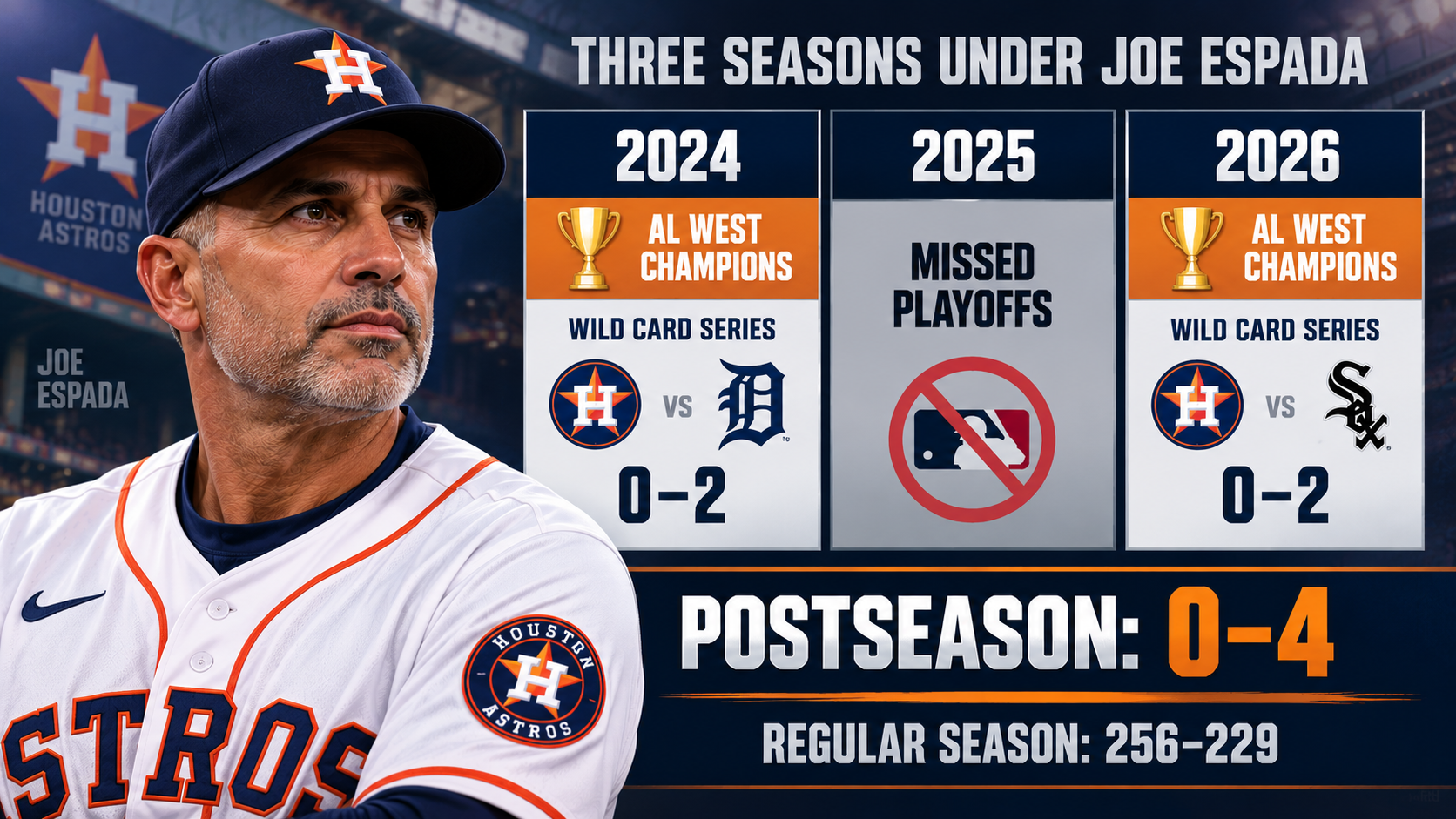
Houston reached the postseason twice during Espada’s three years as manager. Both appearances ended without a victory.
That does not prove the postseason record was the sole reason the Astros declined to renew his contract. But it is the clearest competitive contrast between his regular-season accomplishments and the franchise’s expectations.
Here is the full three-year picture:
| Season | Regular-season record | Outcome |
|---|---|---|
| 2024 | 88–73 | AL West champions; swept 2–0 by Detroit |
| 2025 | 87–75 | Missed the postseason |
| 2026 | 81–81 | AL West champions; swept 2–0 by Chicago |
| Total | 256–229 | 0–4 in postseason games |
The 2024 record reflects a 161-game schedule; the other two seasons had 162 games. Espada’s season-by-season record and Houston’s postseason results are documented in MLB records. (Baseball-Reference · MLB)
Those numbers tell two stories at once.
One is about Espada’s ability to keep Houston competitive, including during seasons disrupted by injuries.
The other is about a team that no longer looked like the postseason powerhouse it had been under A.J. Hinch and Dusty Baker.
From 2017 through 2023, the Astros reached four World Series and won championships in 2017 and 2022.
By comparison, Espada’s teams never advanced beyond the Wild Card round.
Why Did Two Losses End Houston’s 2026 Playoff Run?
Because the Wild Card Series is a best-of-three competition. The first team to win two games advances.
Houston lost Game 1 to Chicago, 6–3, on September 29.
The following evening, the White Sox won again, 7–3.
That was the entire series. The Astros were eliminated without winning a postseason game, despite hosting both contests.
In Game 2, Chicago took advantage of Houston’s defensive mistakes and scored four runs in the first inning. The Astros responded with three solo home runs, but Chase Meidroth’s three-run homer in the sixth inning effectively ended the comeback. (MLB)
For fans, there is an important distinction.
A two-game playoff sweep is a small sample compared with a 162-game regular season. It does not automatically establish that the losing manager made poor decisions.
But MLB managers are evaluated partly on whether their teams are prepared to win the highest-pressure games.
When a franchise has grown accustomed to competing for championships, repeated early exits can overshadow division titles.
Still, was Houston’s decline really just a managerial problem?
How Much of Houston’s Struggles Came From the Roster?
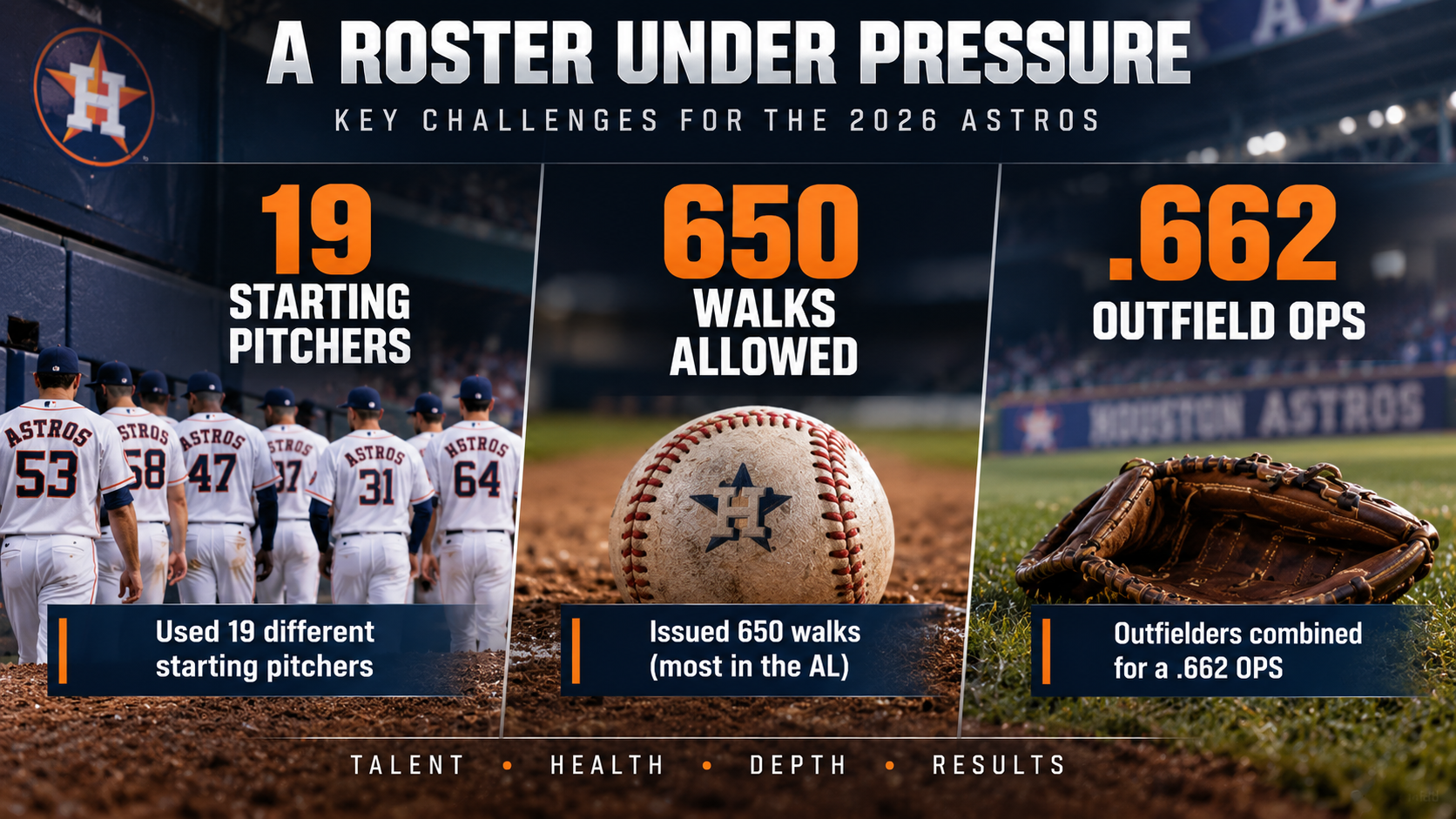
Houston’s problems extended well beyond Espada’s in-game decisions.
The 2026 Astros were repeatedly forced to adjust their pitching staff because of injuries and a lack of reliable depth.
According to MLB’s assessment of the season, Houston used a franchise-record 19 different starting pitchers and issued an American League-high 650 walks. Its outfielders also combined for a .662 OPS, one of the weakest offensive performances by an Astros outfield in recent franchise history. (MLB)
OPS combines on-base percentage and slugging percentage. It is a common shorthand for how well a hitter reaches base and produces power.
The .662 figure was a sign that Houston was struggling to generate offense from an important part of its lineup.
Those weaknesses had consequences.
When a pitching staff lacks dependable starters, a manager may have to rely more heavily on relief pitchers. That can leave the bullpen tired or force difficult pitching choices in crucial games.
The problem was visible in Houston’s Wild Card opener.
With its rotation stretched by the final days of the division race, the Astros used a bullpen game rather than starting ace Hunter Brown on short rest. Chicago took advantage and won 6–3. (MLB)
That strategy did not work.
But the decision also reflected the personnel available to the manager.
Who Is Responsible When a Roster Isn’t Good Enough?
That question goes to the difference between a manager and a general manager.
| Manager | General manager |
|---|---|
| Sets daily lineups | Builds the roster |
| Manages pitchers during games | Acquires pitchers and other players |
| Makes in-game tactical decisions | Handles trades and major personnel decisions |
| Leads the clubhouse | Oversees longer-term roster planning |
These responsibilities overlap in practice, but they are not interchangeable.
Espada was responsible for how Houston used its available players.
The front office was responsible for helping ensure enough productive players were available in the first place.
Houston had lost important contributors, including Alex Bregman, Kyle Tucker and Framber Valdez, through free agency or trades in recent seasons. Replacing that production proved difficult. (MLB)
By May 21, 2026, the Astros were just 20–31; as many as 16 players had been on the injured list at one time. (MLB)
They eventually recovered and won the division, an achievement that reflected the team’s resilience.
Yet the season also revealed how thin the roster had become.
That makes the managerial decision harder to reduce to one explanation.
Espada did not control every decision that created the roster. At the same time, the owner had to decide whether retaining him was the right choice for the next stage of the franchise.
And by October, Houston had already started changing the people who made those broader decisions.
Was the Decision Part of a Larger Astros Shake-Up?

Yes. The Astros’ decision to move on from Espada was part of a broader change in baseball operations.
Houston had already parted ways with general manager Dana Brown on August 24, nearly seven weeks before announcing Espada’s departure.
At the time, owner Jim Crane said the organization needed a change at the top. He also indicated that Espada’s future would be evaluated after the season rather than immediately. (MLB)
That earlier decision helps explain why October 14 was more than an isolated announcement.
The sequence matters:
| Date | What happened |
|---|---|
| August 24, 2026 | Astros parted ways with GM Dana Brown |
| August 25 | Jim Crane said Espada’s status would be assessed after the season |
| September 27 | Houston clinched the AL West despite an 81–81 finish |
| September 30 | White Sox completed a two-game Wild Card sweep |
| October 14 | Astros announced Espada’s contract would not be renewed |
The timeline shows something important: Houston had already begun changing its leadership before the latest playoff disappointment.
The postseason did not create every problem facing the Astros. It provided the final competitive result before the club made its managerial decision.
The October 14 announcement also included changes to the coaching staff.
Five major league staff members were retained for 2027, including pitching coach Josh Miller and hitting coach Victor Rodriguez. Five others were told they would not return, and bench coach Omar López was offered another role within the organization. (Houston Astros)
That combination suggests a selective overhaul rather than the removal of everyone associated with Espada.
It also leaves Houston with an unusual organizational task: rebuilding key leadership positions while determining what kind of roster and coaching structure can make the Astros a serious championship contender again.
Could Joe Espada Manage Another MLB Team?

Yes. Espada could manage another major league team, and Seattle has already emerged as a possible destination.
Before Houston officially announced that he would not return, the Astros granted Espada permission to speak with the Seattle Mariners about their vacant managerial position.
Seattle was searching for a replacement for Dan Wilson, whose tenure ended after a 76–86 season.
The opportunity is particularly interesting because the Mariners and Astros compete in the same division. (MLB · Reuters)
However, permission to interview is not the same as a job offer or a completed hiring.
As of the October 14 announcement, Espada had not been confirmed as Seattle’s next manager.
His experience could still appeal to another club. He spent years as an Astros bench coach during a period of sustained success and then won two division titles as manager.
The lack of postseason victories is part of his record, but it is not his entire résumé.
What Does Houston Need to Decide Next?
The Astros face two related decisions.
First, they must settle the leadership of their baseball operations after Brown’s departure.
Second, they must select the manager who will lead the major league team in 2027.
Those choices could influence everything from roster construction and pitching strategy to player development and clubhouse leadership.
Houston also has to answer an uncomfortable competitive question.
Was the 2026 division title evidence that the Astros remain a contender, or did it partly reflect the weakness of the AL West?
The answer cannot come from the standings alone.
Winning the division with 81 games proved Houston could finish ahead of its immediate rivals. It did not prove the Astros had enough roster depth to compete successfully against stronger postseason opponents.
That distinction will matter regardless of who becomes the next manager.
Bottom Line: What This Story Really Means
Joe Espada did not lose his job because the Astros failed to win the American League West.
They won it.
The larger issue is that a division championship did not erase Houston’s declining regular-season results, repeated early playoff exits or significant roster problems.
Espada delivered a 256–229 regular-season record and two division titles. He also finished with an 0–4 postseason record, while the Astros missed October entirely in 2025.
Houston’s 81–81 division championship was unusual because the rest of the AL West performed even worse. Once the Astros faced the Chicago White Sox, their weaknesses became much harder to overcome.
The franchise had already parted ways with its general manager before that postseason defeat.
When Espada’s contract approached expiration, ownership decided to continue its organizational changes rather than bring him back.
That does not mean every problem was his fault. The available evidence points to issues involving injuries, pitching depth, roster construction and the performance expected from a former World Series powerhouse.
The most revealing part of this story may be the difference between winning a division and building a team capable of winning a championship.
Houston accomplished the first.
It is now changing leadership in pursuit of the second.
Joe Espada Astros Manager Decision: Key Questions Explained
Q. Did the Houston Astros fire Joe Espada in October 2026?
The Astros announced on October 14, 2026, that they would not renew Espada’s contract, which was scheduled to expire at the end of the month. The decision ended his three-season tenure as manager.
Q. Why did the Astros move on from Joe Espada after winning the AL West?
Houston had already begun a wider organizational overhaul. Despite two division championships under Espada, the Astros went 0–4 in postseason games during his tenure and struggled with roster weaknesses in 2026. The club did not publicly identify one exclusive reason for not renewing his contract.
Q. How did the Astros win the AL West with an 81–81 record?
Houston finished with the best record in a weak division. The Rangers were 80–82 and the Mariners were 76–86. MLB awards division titles to the teams that finish first, even if their records are not above .500.
Q. Did the Astros win the division through a tiebreaker?
No. Houston finished one game ahead of Texas. The Astros held the head-to-head tiebreaker, having beaten the Rangers nine times in 13 games, but the final standings did not require it.
Q. Did Joe Espada ever win a playoff game as Astros manager?
No. His teams were swept 2–0 by the Detroit Tigers in the 2024 Wild Card Series and 2–0 by the Chicago White Sox in the 2026 Wild Card Series. Houston missed the playoffs in 2025.
Q. What was Joe Espada’s overall managerial record in Houston?
Espada compiled a 256–229 regular-season record from 2024 through 2026, with a .528 winning percentage and two AL West championships.
Q. Why did the Astros lose to the White Sox in the 2026 playoffs?
Chicago won the best-of-three Wild Card Series in two games, 6–3 and 7–3. Houston struggled with limited pitching depth, while Chicago capitalized on early pitching and defensive problems.
Q. What happened to Astros general manager Dana Brown?
Houston parted ways with Brown on August 24, 2026. Owner Jim Crane subsequently oversaw baseball operations during the transition. Brown’s departure came before Espada’s contract nonrenewal.
Q. Is Joe Espada becoming the Seattle Mariners’ manager?
That had not been confirmed as of October 14, 2026. Houston permitted Espada to speak with Seattle about its managerial vacancy, but permission to interview does not establish that he has been hired.
Q. Who will manage the Astros in 2027?
Houston had not announced a replacement when it confirmed Espada’s departure on October 14. The club also needed to address its vacant general manager position and broader baseball operations structure.
Did this help make the story clearer? 🙂 WIN keeps unpacking the “why” behind the news—clearly and simply!
Sources
Astros Managerial Decision and Official Announcement
Houston Astros / MLB — Official Announcement That Joe Espada Will Not Return
MLB — Detailed Report on Espada’s Departure and Roster Problems
Associated Press — Astros Decline to Renew Joe Espada’s Contract
AL West Standings and 2026 Postseason Results
MLB — Astros Clinch the 2026 American League West Title
MLB — White Sox–Astros Wild Card Series Matchup and Seeding
MLB — Astros Eliminated by White Sox in Wild Card Series
Baseball-Reference — Joe Espada’s Year-by-Year Managerial Record
Organizational Changes and Managerial Future
MLB — Jim Crane Addresses Dana Brown’s Departure and Espada’s Future
MLB — Astros Part Ways With General Manager Dana Brown
MLB — Mariners Considering Joe Espada for Managerial Vacancy