Christa Pike Survived a Lethal Injection—Can Tennessee Try to Execute Her Again?

Wasn’t the point of a lethal injection that the person would not survive it?
That is what makes the Christa Pike case so unusual. Late on September 30 in Nashville, Pike remained alive after receiving two doses of pentobarbital during Tennessee’s execution attempt and was taken to an off-site medical facility. (Tennessee Department of Correction · Reuters) On October 4, one of her lawyers said she still had not regained consciousness and remained on a ventilator. (AP)
Then another question followed almost immediately: If the state already tried to carry out the death sentence once, can it legally try again?
The short answer is that a failed execution does not automatically erase a death sentence. But Pike’s case is now much more complicated than simply setting another date. Her medical condition, the injuries alleged by her lawyers, Tennessee’s execution protocol, a new independent review, and old Supreme Court precedent could all matter before the state ever gets close to another attempt.
※ Images in this article are AI-generated illustrations created to help explain the story. They are not actual photographs, and depictions of people, places, or events may differ slightly from reality.
The story also now reaches beyond Pike herself. Tennessee Correction Commissioner Frank Strada announced on October 3 that he would resign, while Governor Bill Lee’s administration launched an outside review of what happened. (AP · Reuters)
What Actually Happened During Christa Pike’s Execution?
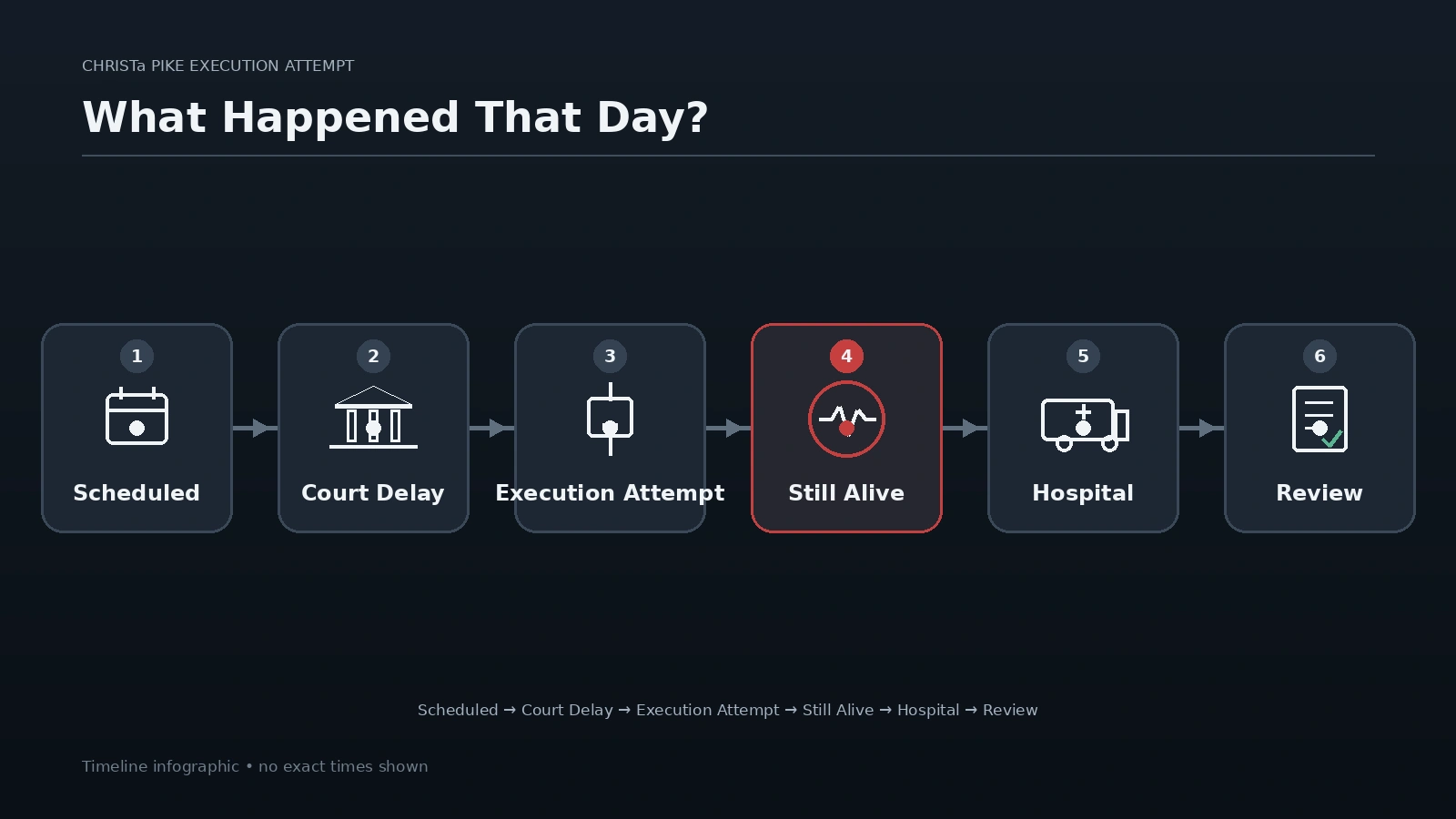
Pike had been scheduled to die by lethal injection at Riverbend Maximum Security Institution in Nashville on September 30. The U.S. Court of Appeals for the Sixth Circuit entered a short stay that morning, but the U.S. Supreme Court vacated the stay later the same day, clearing the way for Tennessee to proceed. (U.S. Supreme Court) The execution attempt then moved forward that evening. (AP · Reuters)
Tennessee uses pentobarbital in its lethal-injection protocol. During Pike’s execution attempt, the state administered two doses. She did not die. Witnesses could hear her breathing after the drug had been given, and she was eventually removed from the prison by ambulance and taken to an off-site medical facility. (Tennessee Department of Correction · AP)
Pike, now 50, was sentenced to death for the 1995 murder of 19-year-old Colleen Slemmer. She was 18 at the time of the crime. Had the execution succeeded, Pike would have been the first woman executed by Tennessee in more than two centuries. (AP)
The failed execution also left Slemmer’s family without the ending they had expected. Slemmer’s mother, May Martinez, witnessed the attempt and expressed anger and frustration after it failed. That part of the story matters because the state’s failure affected both the person it was trying to execute and the victim’s family, which had waited more than three decades for the sentence to be carried out. (AP)
How Can Two Doses of Pentobarbital Fail to Kill Someone?
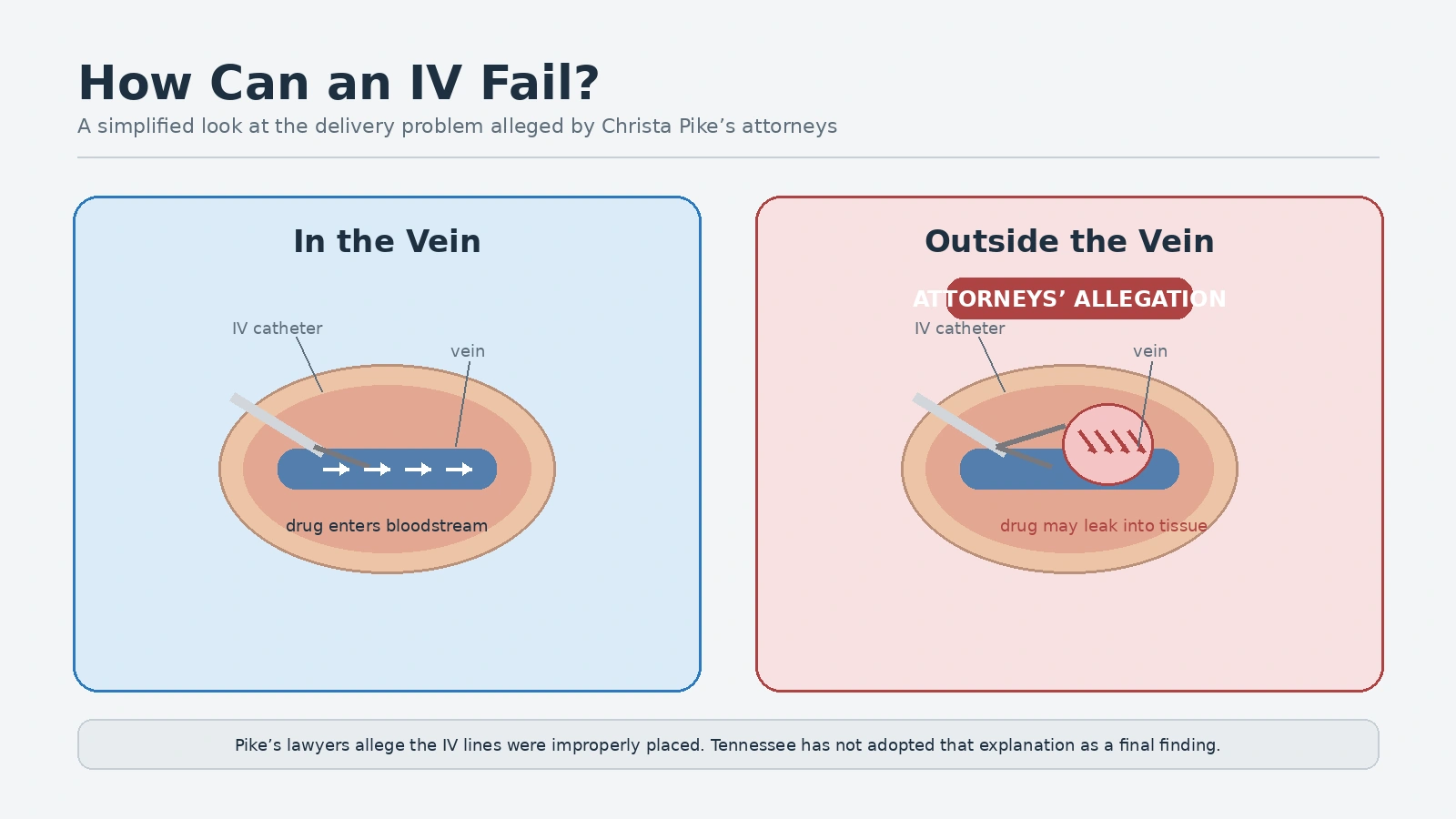
The main explanation being advanced by Pike’s lawyers is not that pentobarbital somehow stopped being a powerful drug. It is that the drug may not have been delivered into the bloodstream the way the procedure required.
In an emergency court filing, her attorneys alleged that the IV lines were improperly placed and that the drug entered surrounding tissue instead of flowing properly through a vein. They said Pike arrived at the hospital with both arms swollen, burned, and blistered, and they described repeated attempts to obtain IV access. Those claims are now part of the evidence the state’s outside review is expected to examine. (Reuters · WSMV)
This distinction is important. Receiving a drug and receiving it effectively into the bloodstream are not necessarily the same thing.
Think of an IV as a delivery line. If the line is correctly inside a vein, the medication can circulate through the body. If the line has moved out of the vein or never entered it correctly, some of the medication can instead collect in surrounding tissue. In ordinary medicine, that kind of problem is called infiltration or, depending on the drug and injury, extravasation.
Tennessee has not accepted Pike’s attorneys’ explanation as the final answer. The Department of Correction said after the execution attempt that it had followed every step of the state’s established protocol and that the protocol did not authorize additional procedures beyond what had been done that night. (Tennessee Department of Correction)
That disagreement—between the state saying the protocol was followed and Pike’s lawyers saying the drug delivery itself went badly wrong—is exactly why the independent review matters.
Why Is Frank Strada Resigning If Tennessee Says It Followed the Protocol?
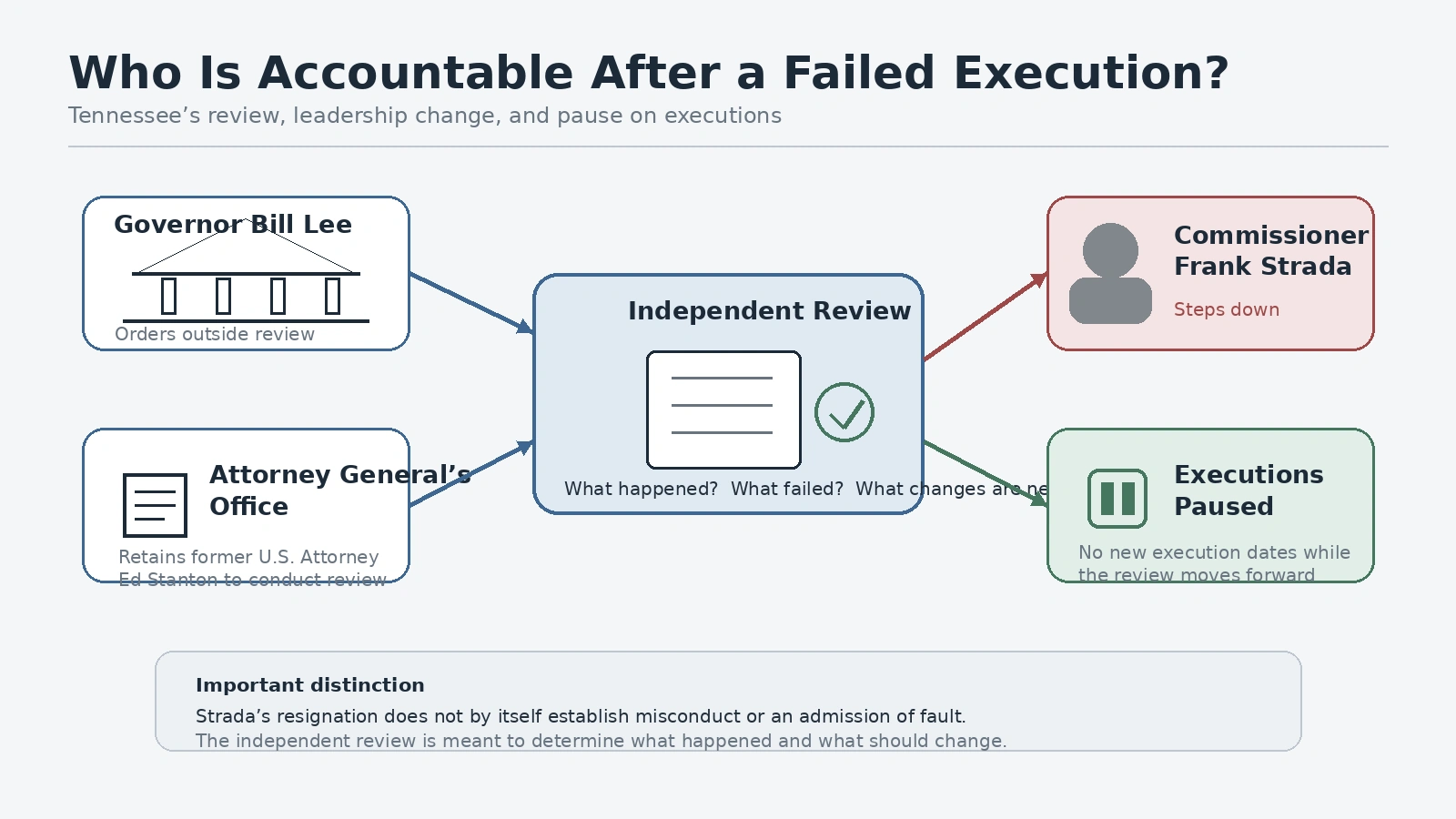
Because resignation and admission of fault are not the same thing.
On October 3, Governor Bill Lee announced that Frank Strada, the commissioner of the Tennessee Department of Correction, would step down during the month. Strada continued to say that he believed the department had carried out its responsibilities under the established protocol, while also saying that leaving was in the public interest as the outside review moved forward. (AP · Reuters)
The state also retained former U.S. Attorney Ed Stanton to conduct the review. His assignment is not merely to decide whether a written checklist was followed. The review is also expected to consider whether changes are needed so Tennessee’s execution protocol remains lawful and effective. Stanton is familiar with the issue: he led an earlier review of Tennessee’s lethal-injection process in 2022. (WSMV)
That makes the current question more complicated than “Did employees follow the rules?”
There are really two questions:
| Question | What the review needs to determine |
|---|---|
| Was the existing protocol followed? | Whether the execution team performed the required steps as written |
| Is the protocol itself adequate? | Whether the rules provide enough safeguards when IV access or drug delivery goes wrong |
A procedure can fail because people did not follow it. It can also fail because people followed it and the procedure was not robust enough for the situation they encountered.
The review will have to distinguish between those possibilities.
Why Does Tennessee’s Failed May Execution Matter Here?
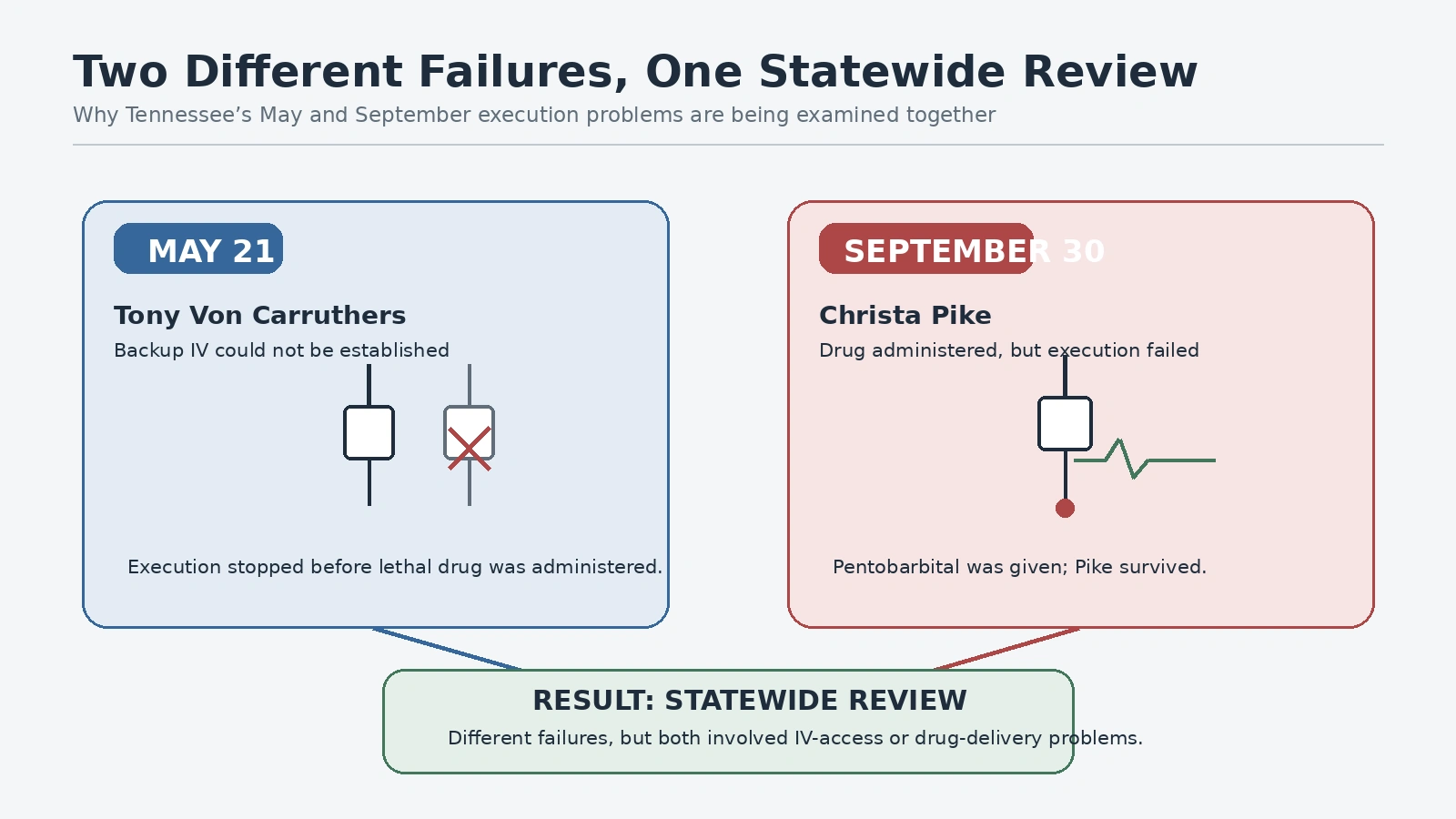
Because Pike’s execution was not Tennessee’s first serious problem with IV access in 2026.
On May 21, Governor Lee granted Tony Von Carruthers a one-year reprieve after the execution team established a primary IV line but could not establish the required backup line. The team then tried to insert a central line, but that procedure also failed, and the execution was called off. (Tennessee Governor’s Office)
The Carruthers and Pike cases are not the same. Carruthers’ execution was stopped before the lethal drug was administered. In Pike’s case, the state went ahead and administered pentobarbital, but she survived.
Still, the two incidents point to a common operational problem: getting reliable vascular access during an execution can determine whether the protocol can even work as designed.
That is why the Pike failure created a much larger crisis for Tennessee than one terrible night. The state had already paused executions in the past over protocol problems, rewritten its process, resumed executions, and then encountered two major failures involving IV access in the same year. (AP)
This is also why Governor Lee called off the remaining execution scheduled for 2026 while the new review is underway. (AP)
Can Tennessee Legally Try to Execute Christa Pike Again?
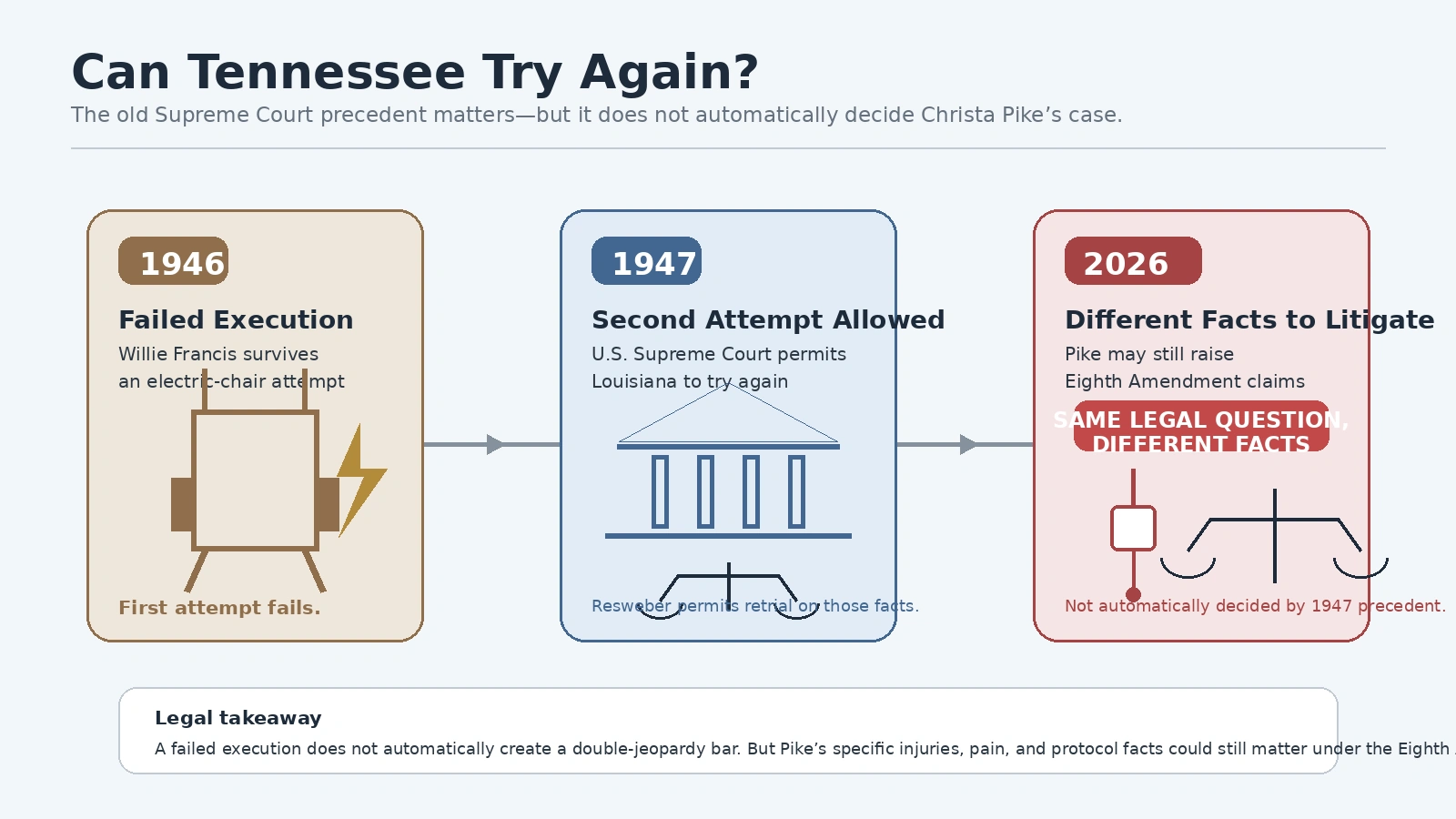
Potentially, yes. A failed execution does not automatically prevent a state from trying again.
The most important Supreme Court precedent is a case from nearly 80 years ago: Louisiana ex rel. Francis v. Resweber.
In 1946, Louisiana tried to execute 17-year-old Willie Francis in the electric chair. The equipment failed, and Francis survived. He argued that making him go through another execution would violate the Constitution’s protections against double jeopardy and cruel and unusual punishment.
In 1947, the Supreme Court rejected those arguments and allowed Louisiana to try again. The Court treated the first failure as an accident rather than a second punishment for the same crime. (Cornell Legal Information Institute)
But the detail that matters is why the Court reached that result.
The case is narrower than a blanket rule for every failed execution. The four-justice plurality described the first failure as an accidental malfunction rather than a second punishment and emphasized that the record did not show an intent to inflict unnecessary pain; Justice Felix Frankfurter supplied the fifth vote for the judgment on separate Fourteenth Amendment reasoning. The result allowed Louisiana to try again on those facts, but it did not make every later failed execution constitutionally identical. (Cornell Legal Information Institute)
That makes Pike’s case legally different in at least one obvious way: her attorneys allege that the execution attempt itself caused serious physical injuries and that officials continued after IV problems they say should have been recognized. Those allegations have not yet been established as the state’s official findings. But if the state eventually seeks another execution date, the facts uncovered by the independent review could become central to a new Eighth Amendment challenge.
So the legal picture looks like this:
| Question | Likely answer right now |
|---|---|
| Did the failed execution automatically erase Pike’s death sentence? | No |
| Does double jeopardy automatically block another attempt? | No, based on existing Supreme Court precedent |
| Could Pike still challenge another execution? | Yes, especially based on the facts of what happened and the method the state proposes to use |
| Has a court already approved a second Pike execution? | No |
The distinction between those four answers is crucial.
Could Pike’s Medical Condition Stop Another Execution?
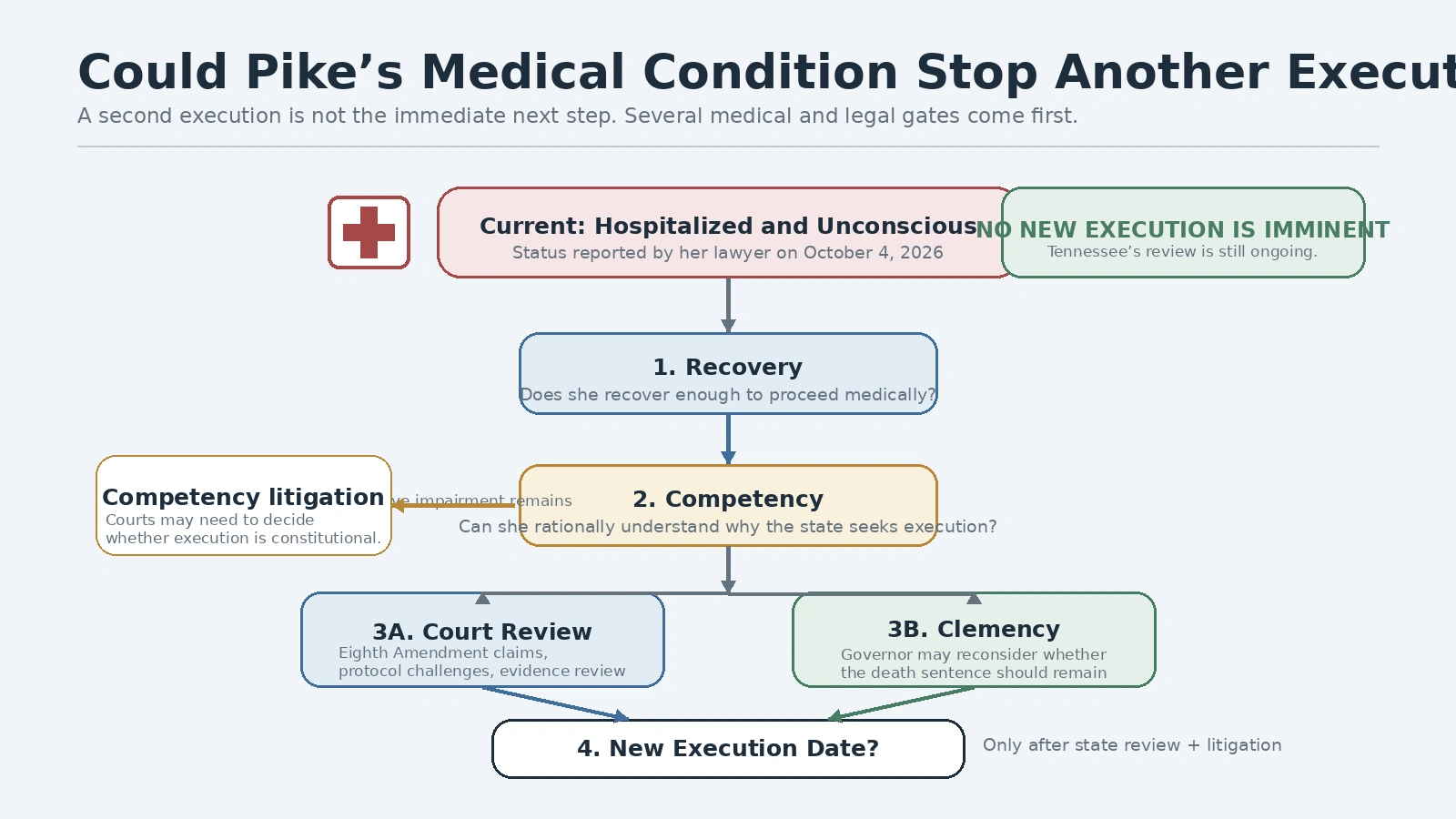
Yes. Her condition could become a separate legal issue from the failed procedure itself.
On October 4, one of Pike’s lawyers said she had not regained consciousness since the execution attempt and remained on a ventilator. Her legal team has said the extent of any long-term injury is still unknown. (AP)
If Pike recovers enough for Tennessee to consider another execution in the future, the state would still face a basic constitutional rule: a prisoner must be competent to be executed.
The Supreme Court has held that the Eighth Amendment does not allow a state to execute a prisoner who lacks a rational understanding of why the state intends to put them to death. That legal rule comes from cases including Ford v. Wainwright and Panetti v. Quarterman. (Cornell Legal Information Institute)
That does not mean Pike has already been found legally incompetent. No such determination has been made.
It means that if her medical condition leaves her with serious cognitive impairment, competency could become another issue that courts would have to address before any future execution could proceed.
There is also executive clemency. Pike’s lawyers are again asking Governor Lee to commute her death sentence to life imprisonment. Lee rejected clemency before the September 30 execution attempt, but the failed execution created a new set of facts that did not exist when he made that earlier decision. (AP)
Clemency is different from a court ruling. A court asks whether the Constitution or law permits the execution. A governor considering clemency can decide that a lawful death sentence should nevertheless be reduced.
What Happens to Tennessee’s Death Penalty Process Now?
The immediate answer is: review first, executions later—if they resume at all under the current protocol.
Governor Lee has stopped the remaining execution scheduled for 2026 while Ed Stanton conducts the outside review. The review is supposed to determine whether Tennessee followed its protocol during Pike’s execution and whether additional changes are needed to keep the process lawful and effective. (AP · WSMV)
The review could lead to several different outcomes. Tennessee could conclude that personnel made mistakes while the written protocol remains sound. It could rewrite parts of the protocol. It could change training or medical-access requirements. It could delay executions longer. Or the review could become evidence in new litigation over whether the current method creates an unacceptable risk of severe pain.
What it cannot do is erase the underlying conflict.
Tennessee still has valid death sentences it intends to enforce. At the same time, the state now has to explain how two major execution attempts in the same year ran into serious IV-related problems—and why the most recent one ended with the condemned prisoner alive, critically ill, and receiving life-saving medical care.
That is why Frank Strada’s resignation matters even though it does not establish personal wrongdoing. It signals that the failed Pike execution is being treated as an institutional crisis, not a minor procedural glitch.
Bottom Line: What This Story Really Means
Christa Pike surviving Tennessee’s lethal injection does not automatically cancel her death sentence, and existing Supreme Court precedent means the state is not automatically barred from trying again.
But that is only the beginning of the legal analysis.
Pike remains hospitalized and unconscious. Her lawyers allege serious IV failures and injuries. Tennessee has paused executions, its correction commissioner is stepping down, and an independent review is now examining both what happened and whether the protocol itself needs to change.
So the real question is no longer simply, “Can Tennessee schedule another execution?”
It is whether Pike recovers, whether she is legally competent, what the investigation finds, whether courts view another attempt as constitutionally permissible under the new facts, and whether the governor chooses to leave the death sentence in place.
Christa Pike Execution: Key Questions Explained
Q. Is Christa Pike still alive?
Yes. On October 4, 2026, one of her lawyers said Pike remained alive, unconscious, and on a ventilator after Tennessee’s failed September 30 execution attempt. (AP)
Q. What drug did Tennessee use in Christa Pike’s execution attempt?
Tennessee used pentobarbital, the drug in its single-drug lethal-injection protocol. Pike was given two doses during the failed execution attempt. (AP · Tennessee Department of Correction)
Q. Why didn’t the lethal injection kill Christa Pike?
The final cause has not yet been officially established. Pike’s lawyers allege that the IV lines were improperly placed and that the drug entered surrounding tissue instead of being delivered properly into her bloodstream; Tennessee has ordered an independent review. (Reuters)
Q. Did Tennessee admit that it botched the execution?
No. The Department of Correction said it followed every step of the state’s established execution protocol. The independent review is intended to determine what happened and whether the protocol itself needs changes. (Tennessee Department of Correction · WSMV)
Q. Why is Tennessee Correction Commissioner Frank Strada resigning?
Strada said he still believed the department followed protocol but that stepping aside was in the best interest of Tennesseans while the independent review proceeds. His resignation does not itself establish misconduct. (AP)
Q. Can Tennessee execute Christa Pike a second time?
Potentially. The Supreme Court held in Louisiana ex rel. Francis v. Resweber that a second execution attempt after an accidental failure was not automatically barred by double jeopardy or the Eighth Amendment. Pike could still raise new constitutional challenges based on the specific facts of her failed execution. (Cornell Legal Information Institute)
Q. Does surviving an execution count as serving the death sentence?
Not automatically under existing Supreme Court precedent. A failed attempt does not by itself convert a death sentence into life imprisonment or mean the punishment has legally been completed. (Cornell Legal Information Institute)
Q. Could Pike’s health prevent another execution?
Yes, depending on her recovery. If she were left unable to rationally understand the reason for her execution, competency-to-be-executed rules under the Eighth Amendment could become a separate barrier. No court has yet found Pike incompetent to be executed. (Cornell Legal Information Institute)
Q. Are Tennessee executions continuing in 2026?
No. Governor Bill Lee called off the remaining scheduled execution for the year while the independent review is underway. (AP)
Did this help make the story clearer? 🙂 WIN keeps unpacking the “why” behind the news—clearly and simply!
Sources
Failed Execution and Pike’s Current Condition
AP — Christa Pike’s lawyer says she has not regained consciousness since the failed execution
AP — How Tennessee’s failed execution of Christa Pike unfolded
Reuters — Tennessee execution survivor Christa Pike on a ventilator, attorneys say
Tennessee Department of Correction — Media Advisory: Christa Pike #261368
Resignation, Review, and Tennessee’s 2026 Execution Problems
AP — Tennessee prisons chief resigning after failed execution of Christa Pike
AP — Tennessee’s handling of the death penalty questioned after failed execution
Tennessee Governor’s Office — Temporary reprieve for Tony Von Carruthers after IV-access failure
WSMV — Former U.S. Attorney Ed Stanton retained for independent review
Court Orders and Legal Rules Governing Another Execution
U.S. Supreme Court — Nelsen v. Pike, No. 26A428
Cornell Legal Information Institute — Louisiana ex rel. Francis v. Resweber