
How Can the U.S. Deport Someone to a Country They’re Not From? The Supreme Court’s Order Explained
If someone is ordered deported from the United States, doesn’t that mean they are sent back to their own country?
Not necessarily.
U.S. immigration law provides circumstances in which the government may remove a person to another country that will accept them. That is what officials and courts mean by a “third-country removal.” (U.S. Code)
But that leaves a harder question.
What happens if the person says the new destination is dangerous for them—even though it is not their home country?
That question moved back to the center of U.S. immigration law on September 29, 2026, when the Supreme Court allowed the Trump administration’s third-country removal policy to operate again while the justices consider the case itself. The Court also agreed to hear the dispute on the merits in its December 2026 argument session. (Reuters · Associated Press)
The crucial distinction is this:
The Supreme Court did not rule on September 29 that the policy is ultimately lawful.
For now, it has stayed the lower-court judgment that restricted the policy. The deeper questions—about immigration law, due process, and protection from persecution or torture—are still before the justices. (Reuters)

That difference between “allowed for now” and “finally upheld” is the key to understanding the news.
What Did the Supreme Court Actually Do?
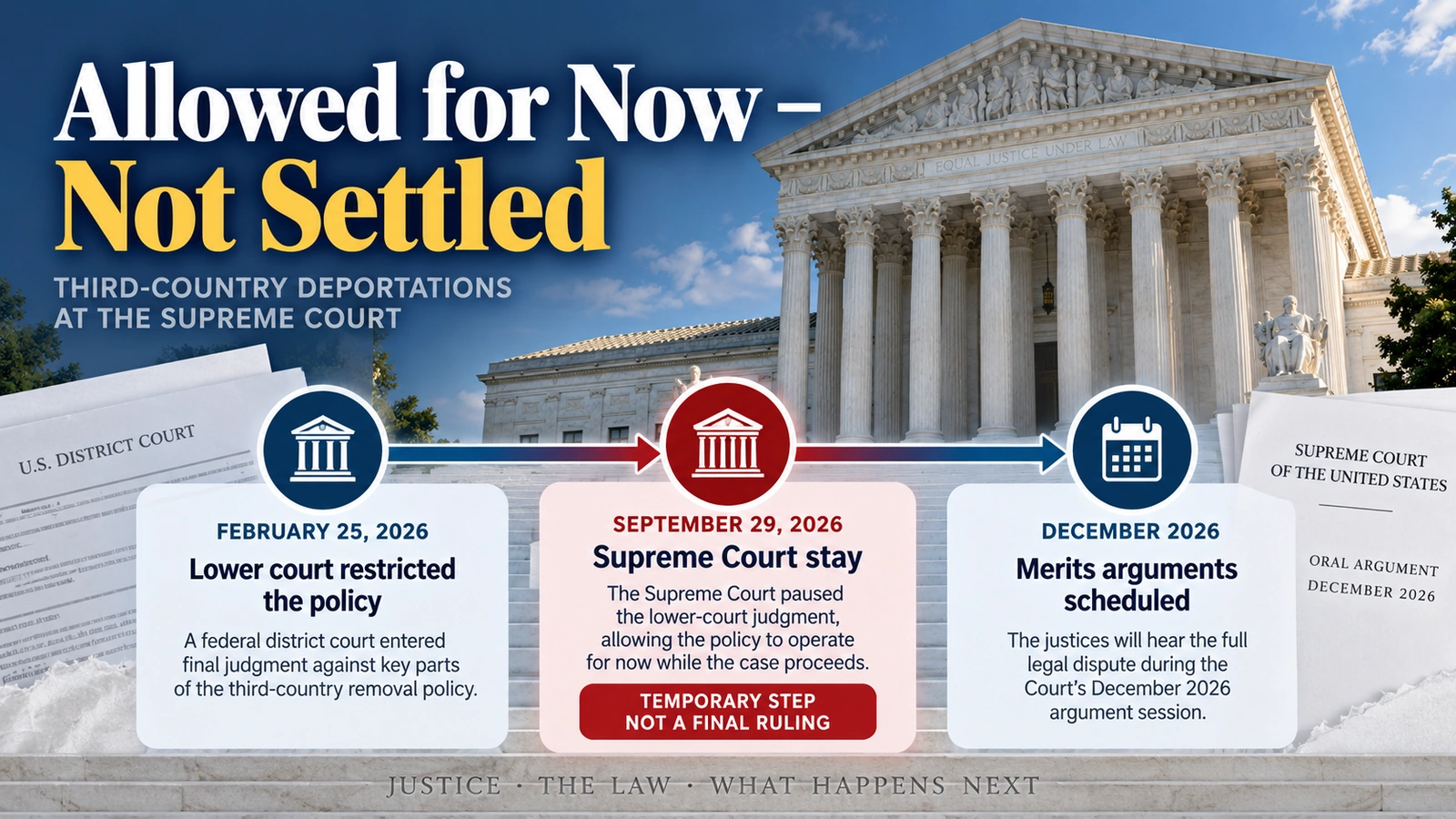
The Supreme Court did two important things.
First, it stayed the February 25 federal district-court judgment, meaning that judgment will not control the policy while the Supreme Court case proceeds.
Second, the justices treated the government’s emergency application as a petition for review, granted review, and directed the case to be briefed for argument during the Court’s December 2026 session. (U.S. Supreme Court docket · Reuters)
That means the legal timeline now looks roughly like this:
| Date | What happened | What it meant |
|---|---|---|
| March 30, 2025 | DHS issued third-country removal guidance | The administration established procedures for sending some people with final removal orders to other countries |
| June 23, 2025 | Supreme Court stayed an earlier preliminary injunction | DHS could continue using the policy while that stage of litigation continued |
| February 25, 2026 | Federal district court entered final judgment against key parts of the policy | The dispute moved from preliminary relief to a merits judgment |
| September 18, 2026 | First Circuit largely affirmed that judgment | Most notice and fear-review requirements remained intact |
| September 29, 2026 | Supreme Court stayed the lower-court judgment and took up the case | DHS may use the challenged policy for now; the legal merits remain unresolved |
| December 2026 | Supreme Court arguments scheduled | Justices will hear the full legal dispute |
The First Circuit’s September 18 opinion is especially important. It rejected two declarations about the required sequence of destination countries on standing grounds, but otherwise affirmed the lower court’s judgment concerning effective notice, a meaningful opportunity to raise fear-based claims, and the setting aside of the DHS guidance under the Administrative Procedure Act. (U.S. Court of Appeals for the First Circuit)
Justices Sonia Sotomayor, Elena Kagan, and Ketanji Brown Jackson would have denied the government’s request for a stay. (Associated Press)
How Can the U.S. Send Someone to a Country They’re Not From?
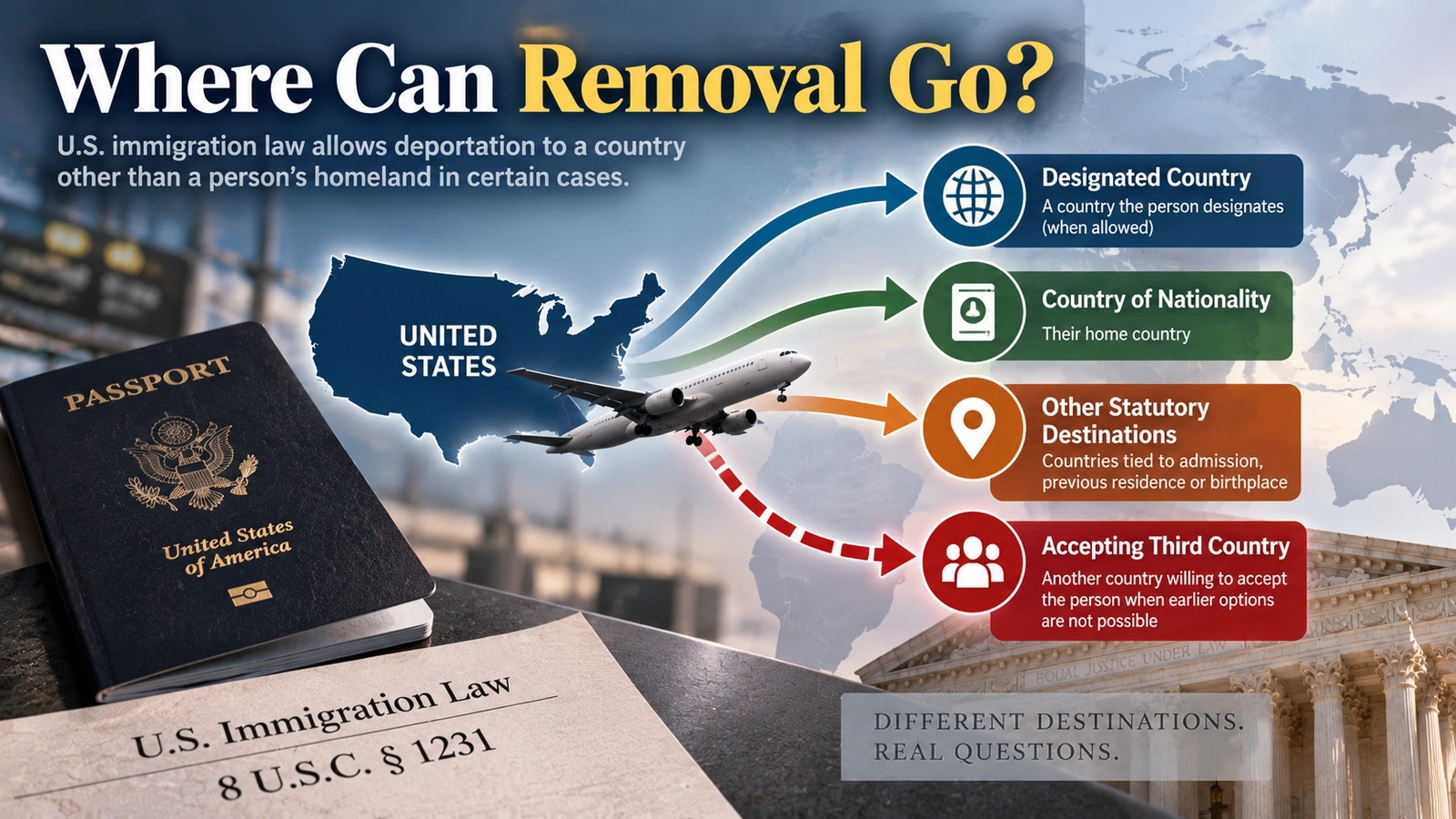
Because deportation law does not always require one simple route of United States → country of citizenship.
Section 1231 of Title 8 lays out a series of possible destinations for people with final removal orders. The exact sequence depends on how the person entered the United States and which statutory provision applies. (U.S. Code)
For many people already inside the United States, a simplified way to understand the structure is:
| Stage | Possible destination |
|---|---|
| First | A country properly designated by the person, when the statute permits |
| Next | A country of nationality or citizenship |
| Additional possibilities | Countries connected to admission, previous residence, or birthplace |
| Later statutory option | Another country whose government will accept the person when earlier destinations are impracticable, inadvisable, or impossible |
That final category is where the idea of a third country comes from. (U.S. Code)
So the legal question is not simply, “Can the United States ever deport someone somewhere other than their homeland?”
The statute itself contemplates situations in which that can happen.
The dispute is much more about which requirements must be satisfied before it happens—and what opportunity the person must get to object to the specific destination.
What Does DHS’s Third-Country Policy Actually Require?
DHS’s guidance does not use exactly the same process in every third-country removal.
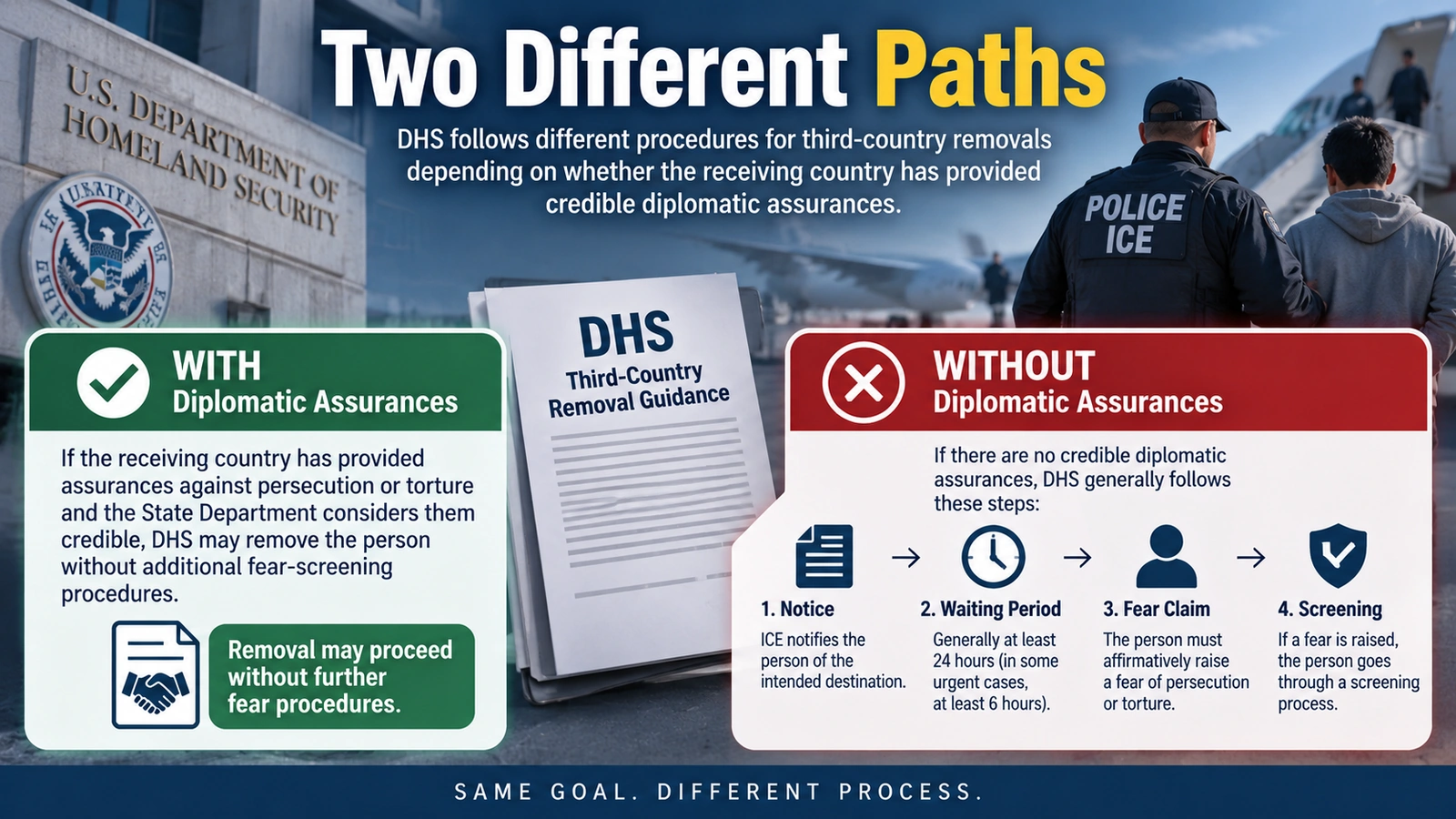
Under the March 2025 policy and the July implementation guidance, one major dividing line is whether the receiving country has provided assurances that deportees will not be persecuted or tortured and whether the State Department considers those assurances credible. (Supreme Court record — July 2025 ICE guidance)
If those assurances exist, the guidance says the person may be removed without additional fear-screening procedures.
If they do not, ICE is generally supposed to notify the person of the intended destination. ICE does not affirmatively ask whether the person fears that country. Instead, the person must express such a fear. ICE generally waits at least 24 hours after notice, although the guidance allows removal after at least six hours in certain exigent circumstances if the person has a reasonable opportunity to speak with an attorney. (Supreme Court record — July 2025 ICE guidance)
If the person affirmatively raises a fear of persecution or torture, the guidance provides for screening to determine whether the person would more likely than not face qualifying harm. (Supreme Court filing by the U.S. government)
That structure explains why the case is not merely a fight over whether third-country deportations exist.
It is a fight over what process has to happen before the plane leaves.
Why Did the Lower Courts Say the Process Was Not Enough?
The lower courts did not say that every third-country removal is inherently illegal.
Their concern was the procedure created by this particular DHS guidance.
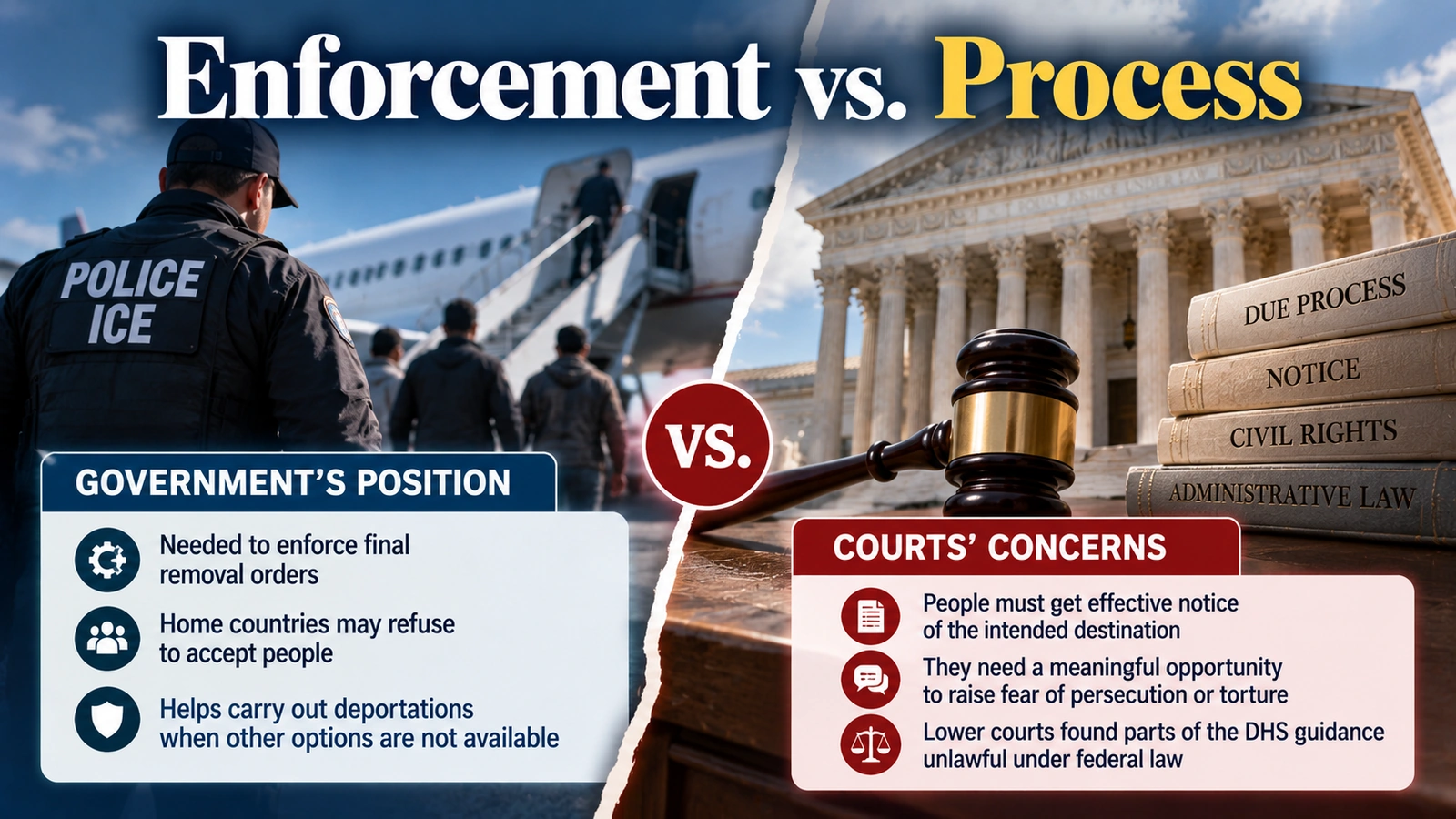
The First Circuit concluded that people covered by the case were entitled to effective notice of the intended third country and a meaningful opportunity to raise a reasonable fear of persecution or torture before removal. It also upheld the district court’s decision setting aside the challenged guidance under the Administrative Procedure Act. (U.S. Court of Appeals for the First Circuit)
The distinction is important.
The plaintiffs were not arguing that a deportation case had to start over from the beginning every time DHS selected another destination. The First Circuit described the dispute more narrowly: whether DHS must provide effective notice of the specific third country and a meaningful opportunity to raise a fear-based claim concerning that destination. (U.S. Court of Appeals for the First Circuit)
The administration argues that the existing policy already provides the process the law requires and that the lower courts imposed obligations beyond what immigration law demands. It has also argued that restrictions on third-country removals can disrupt diplomatic arrangements and make some final removal orders harder to carry out. (Supreme Court filing by the U.S. government)
Those competing interpretations are now before the Supreme Court.
Why Does the Convention Against Torture Matter Here?
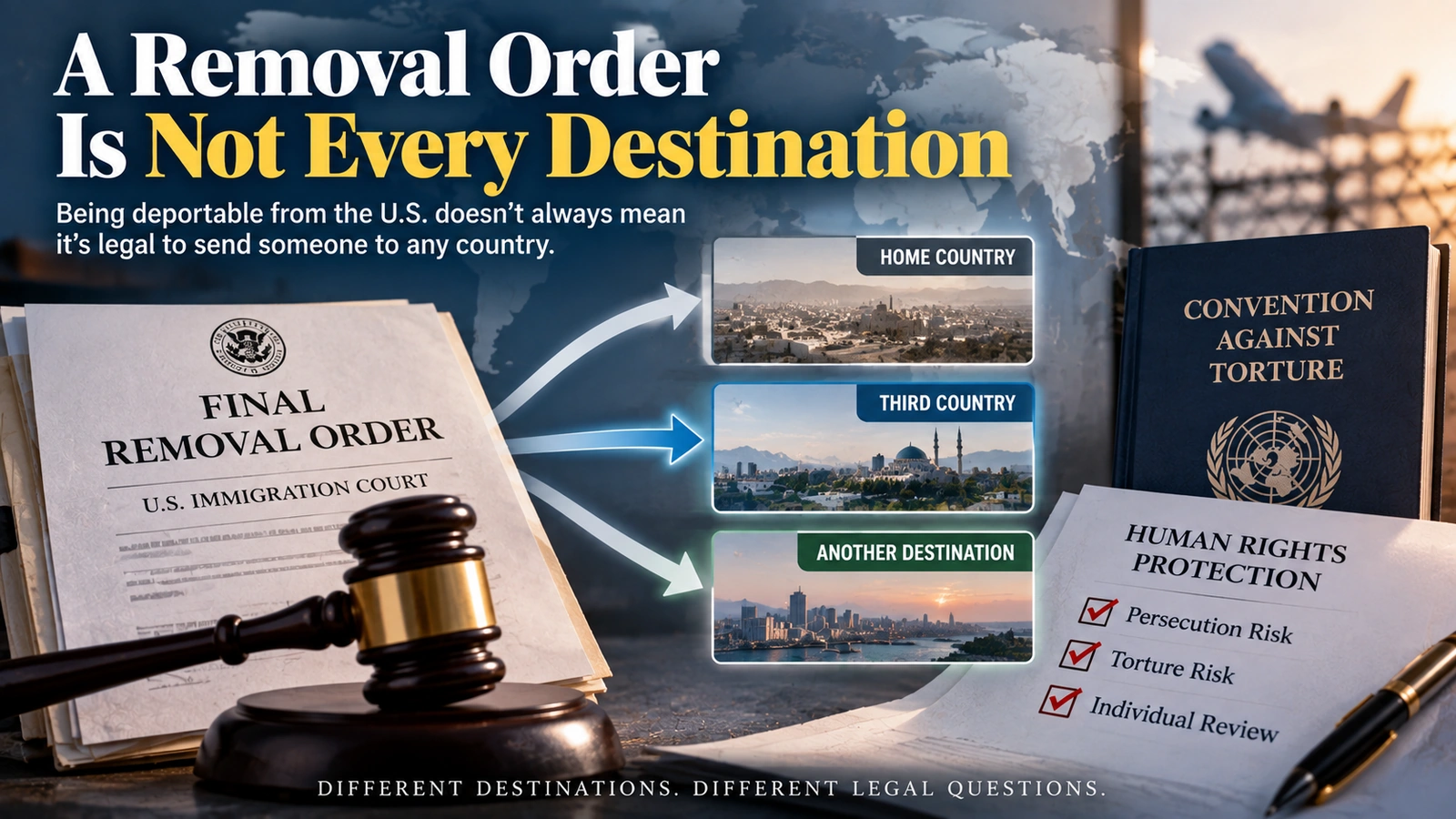
Because being removable from the United States and being removable to one particular country are not always the same legal question.
Federal law restricts removal to a country when the government determines that a person’s life or freedom would be threatened there on specified protected grounds. U.S. regulations also implement protections connected to the Convention Against Torture. (8 U.S.C. § 1231 · 8 C.F.R. § 1208.16)
At the same time, protection against removal to one country does not necessarily mean the person gets to remain in the United States permanently.
Federal regulations specifically contemplate removal to another country when the relevant protection bars removal to a particular destination. (8 C.F.R. § 1208.16)
Think of it as two separate questions:
- Can this person be removed from the United States?
- Can this person legally be sent to this particular country?
A final removal order may answer the first question without automatically answering every version of the second.
That is why a country the person has never lived in can suddenly become legally important.
Why Does the Government Want Third-Country Deportations?
The government says third-country removals are necessary when a person has a final removal order but the more obvious destination is unavailable.
A home government might refuse to accept the person. Removal to another country may be legally restricted. Travel documents may not be obtainable. Other practical or diplomatic barriers can also prevent a straightforward return.
The administration has described third-country removals as an important enforcement tool, particularly for people it says cannot otherwise be removed despite final orders. In its September Supreme Court filing, the government said renewed lower-court restrictions forced the cancellation of a flight involving 70 people it described as having criminal convictions and required new diplomatic coordination. That was the government’s account in its emergency application, not an independent judicial finding about the passengers. (Supreme Court filing by the U.S. government)
That distinction matters because the litigation covers a class of people with final removal orders; it does not establish that everyone potentially affected by the policy has the same criminal history or circumstances.
Why Do the Challengers Say More Process Is Necessary?
Their argument begins with a practical problem:
How can someone object to being sent to a country if they do not know where they are being sent—or do not have enough time to explain why that destination is dangerous for them?
The challengers argue that a brief notice period, combined with a system in which ICE does not affirmatively ask about fear, can leave too little opportunity to raise a meaningful claim before removal.
They also challenge the provision allowing removal without further procedures when the United States has received diplomatic assurances against persecution or torture.
The lower courts agreed with substantial parts of those procedural objections. The First Circuit said the applicable law required effective notice and a meaningful opportunity to raise fear-based objections to the intended third country. (U.S. Court of Appeals for the First Circuit)
The Supreme Court will now decide how far those protections extend and whether the lower courts had authority to provide the relief they did.
Why Is the Supreme Court Reviewing More Than One Question?
This is not only a dispute over immigration policy.
It is also a case about what federal courts are allowed to do when they conclude that an executive-branch policy violates federal law.
The Supreme Court directed the parties to address whether the district court had jurisdiction, whether it could provide classwide declaratory relief and set aside the guidance under the Administrative Procedure Act, and whether the third-country guidance violates federal immigration law, due process, or U.S. protections implementing the Convention Against Torture. The case is set for argument during the December 2026 session. (Reuters · U.S. Supreme Court docket)
That gives the case two layers.
| Layer | Central question |
|---|---|
| Immigration law | What must DHS do before sending someone to a third country? |
| Judicial power | What relief may a federal court order if DHS’s policy is unlawful? |
A Supreme Court ruling could therefore matter beyond the specific mechanics of deportation.
It could also clarify how courts may respond when they find a federal agency policy unlawful.
What Changes Right Now?
For now, the September 29 stay means the lower-court judgment does not prevent the administration from operating the challenged third-country policy while Supreme Court review continues. (Reuters · Associated Press)
But it would be a mistake to describe that as a final Supreme Court endorsement of the policy.
Emergency stays answer a different question from a final merits judgment.
The justices have not yet issued the decision that will determine whether the challenged procedures themselves comply with federal immigration law, constitutional due process requirements, and the legal protections against removal to places where persecution or torture may occur.
That decision comes later.
What Happens Next?
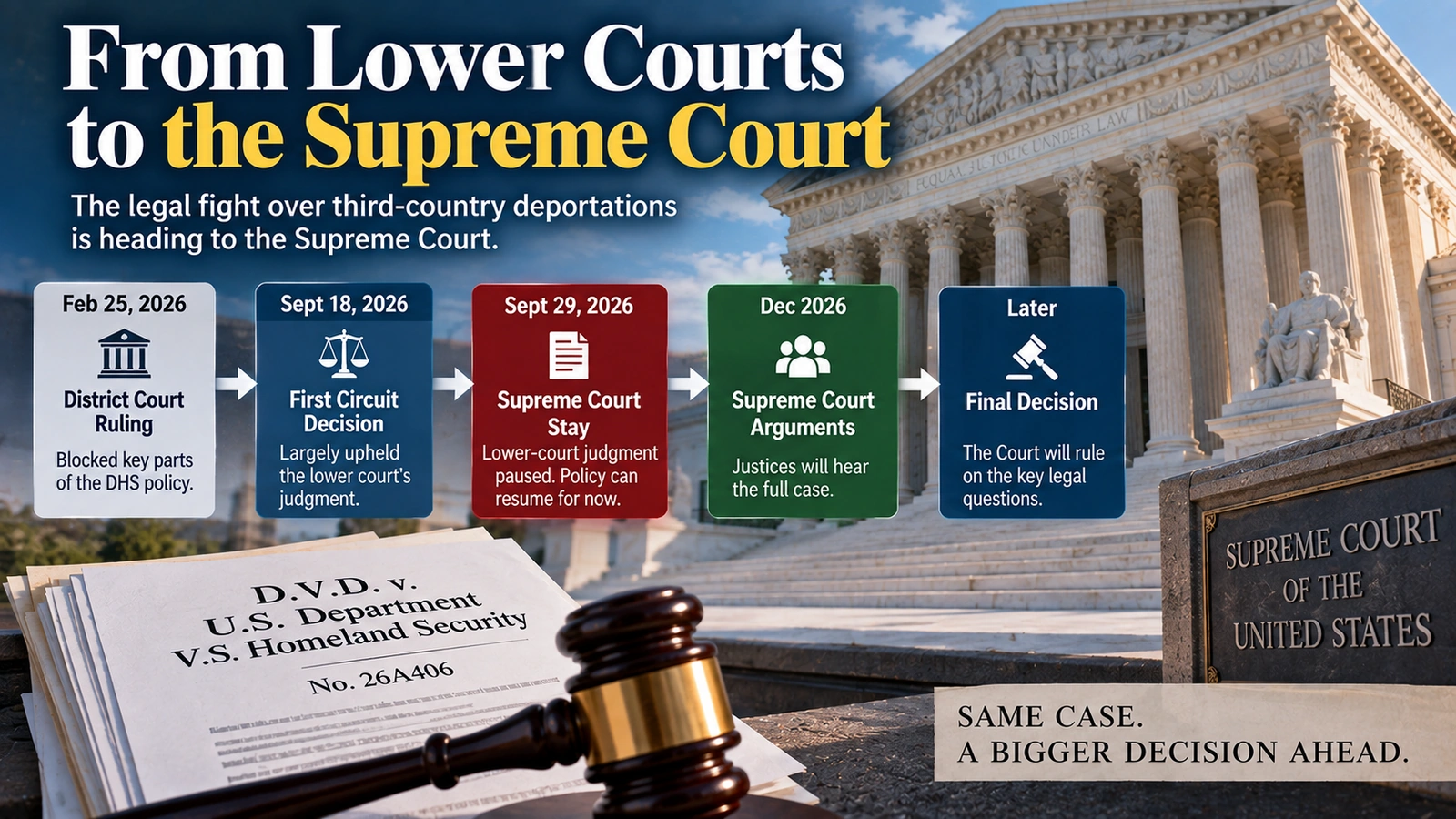
The next major event is Supreme Court oral argument in December 2026. (Reuters)
Before then, both sides will submit fuller legal briefs addressing the questions the justices agreed to review.
The Court will ultimately have to sort through several distinct issues:
- whether the plaintiffs’ claims were properly before the federal courts,
- what remedies the lower court was legally allowed to use,
- how the destination rules in federal immigration law should be interpreted,
- what notice and opportunity to object are required,
- and how protections against persecution and torture apply when DHS chooses a country that was not previously part of the person’s removal proceedings.
Until a merits decision comes down, the most accurate description of the current situation is straightforward:
Third-country deportations under the challenged DHS policy can resume for now, but the Supreme Court has not yet decided whether that policy is ultimately lawful.
Bottom Line: What This Story Really Means
Yes, U.S. immigration law can allow removal to a country other than a person’s homeland under certain circumstances.
But that does not answer the central question now before the Supreme Court.
The real dispute is over what the government must do before selecting and using that third country—especially when the person says they could face persecution or torture there.
The September 29 order changed what DHS can do immediately. It did not settle what the law ultimately requires.
That answer is now headed for Supreme Court arguments in December.
Supreme Court Third-Country Deportations: Key Questions Explained
Q. What is a third-country deportation?
A third-country deportation sends a person with a removal order to a country other than the destination normally associated with that person, such as their country of citizenship or a country previously identified during the removal process. Federal immigration law provides circumstances in which another country willing to accept the person may be used.
Q. Did the Supreme Court rule that third-country deportations are legal?
Not finally. The September 29 order temporarily stayed the lower-court judgment and allows the challenged policy to operate while the Supreme Court considers the case on the merits.
Q. Can the United States deport someone to a country they have never lived in?
In some circumstances, federal law permits removal to another accepting country after statutory requirements are met. The current dispute concerns what those requirements mean and what procedural protections apply before the removal occurs.
Q. What happens if someone fears persecution or torture in the third country?
That is one of the central issues in the case. Federal law and U.S. implementation of the Convention Against Torture restrict certain removals where a person faces qualifying danger, but the parties disagree over what notice and screening procedures DHS must provide before a third-country removal.
Q. Does protection from removal to one country mean a person can stay in the United States?
Not necessarily. Protection can be country-specific. A person who cannot legally be removed to one country may still potentially be removed to another country if the government satisfies the applicable legal requirements.
Q. Why did lower courts reject the DHS policy?
The district court found significant parts of the guidance unlawful, and the First Circuit largely affirmed the judgment, including requirements for effective notice and a meaningful opportunity to raise fear-based objections. The Supreme Court has now stayed that judgment while it reviews the dispute.
Q. When will the Supreme Court hear the case?
The Court has directed that the case be scheduled for oral argument during its December 2026 argument session. A final merits decision will come later.
Q. What is the biggest misconception about the September 29 order?
The biggest misconception is that the Supreme Court already made a final ruling approving the policy. It did not. The Court changed the policy’s temporary legal status while the case proceeds, and it will separately decide the underlying legal questions.
Did this help make the story clearer? 🙂
WIN keeps unpacking the “why” behind the news—clearly and simply!
Sources
Supreme Court Action and Current Case Status
U.S. Supreme Court — Department of Homeland Security v. D.V.D., No. 26A406
Reuters — Supreme Court lets Trump resume deporting migrants to countries not their own
Associated Press — Supreme Court lets quick deportations to third countries resume for now
Lower-Court Rulings and DHS Procedures
U.S. District Court for the District of Massachusetts — February 25, 2026 judgment in D.V.D. v. DHS
Supreme Court record — July 9, 2025 ICE third-country removal guidance
U.S. government application for a stay in No. 26A406
Federal Removal Law and Protection From Harm
8 U.S.C. § 1231 — Detention and removal of aliens ordered removed
8 C.F.R. § 1208.16 — Withholding of removal and Convention Against Torture standards