
Why Was Harvey Weinstein Sentenced Again After His New York Conviction Was Overturned?
Why Was Harvey Weinstein Sentenced Again After His New York Conviction Was Overturned?
Wasn’t Harvey Weinstein’s New York conviction thrown out?
So how did he end up back in a Manhattan courtroom on September 23, 2026, receiving a 15-year prison sentence?
The answer comes down to one legal distinction that can easily get lost in a headline: New York’s highest court did not acquit Weinstein in 2024. It ruled that serious errors in his first trial required the conviction to be erased and the case tried again.
A new jury then convicted him again in 2025 on the charge involving former production assistant Miriam Haley. The 15-year sentence imposed in September 2026 belongs to that new conviction—not to the overturned 2020 judgment. (nycourts.gov)

That difference explains almost everything that otherwise looks contradictory about the case.
What Did the New 15-Year Sentence Actually Cover?
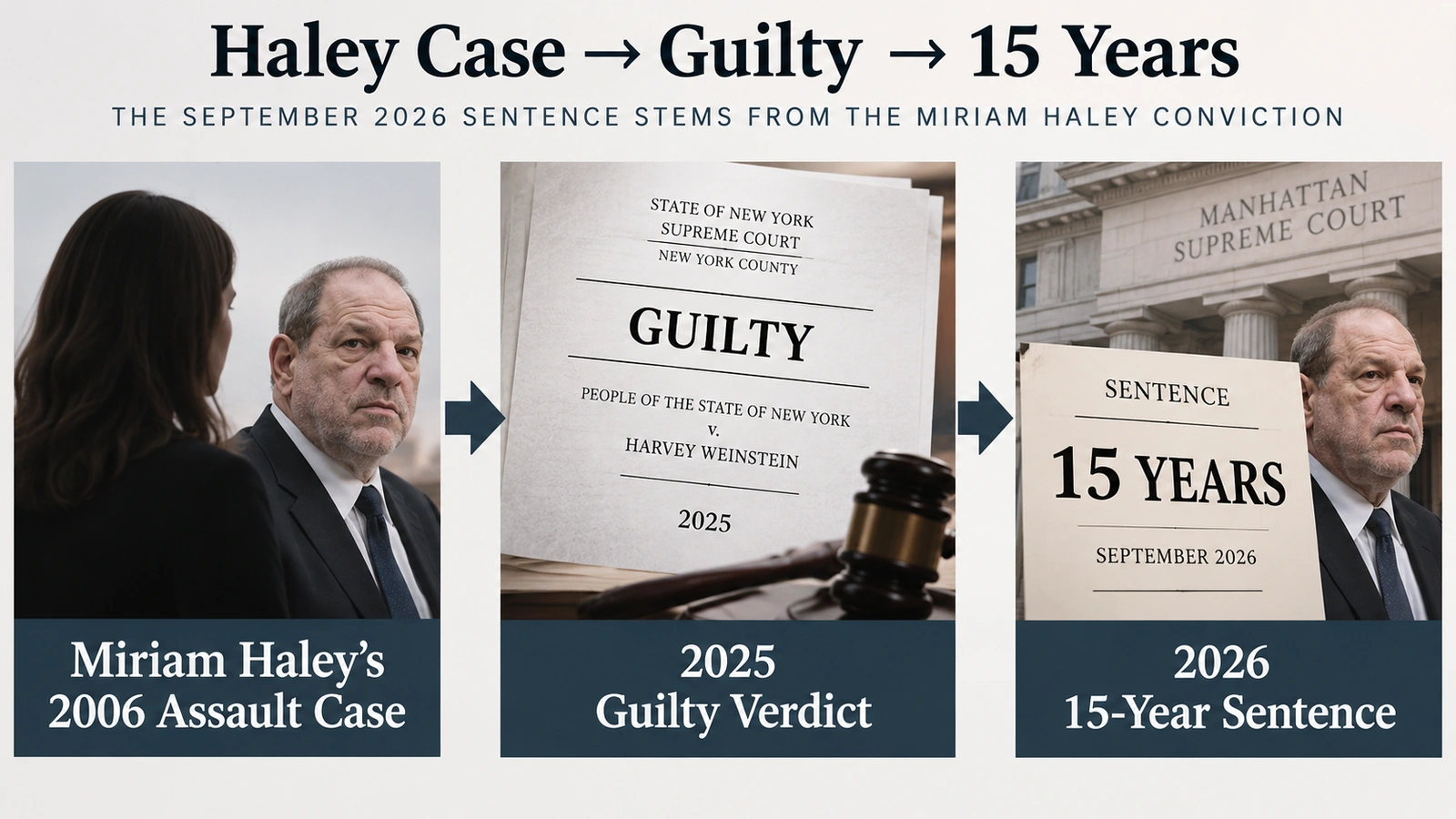
The September 23 sentence covers one New York conviction: first-degree criminal sexual act involving Miriam Haley, who testified that Weinstein forcibly performed oral sex on her at his Manhattan apartment in 2006. (Associated Press)
A jury found Weinstein guilty on that count on June 11, 2025. (Manhattan District Attorney)
On September 23, 2026, prosecutors asked for 20 years, Weinstein’s lawyers asked for nine, and Judge Curtis Farber imposed 15 years plus five years of post-release supervision. Weinstein maintained his innocence and said he would appeal. (Manhattan District Attorney · Associated Press)
Under the version of New York Penal Law § 130.50 applicable to the 2006 conduct, first-degree criminal sexual act was a Class B felony. New York’s felony-sex-offense sentencing rules provide a determinate term of 5 to 25 years for a Class B felony. (Penal Law § 130.50 · Penal Law § 70.80)
So the easiest way to read the latest headline is:
This is not the old 23-year sentence coming back.
It is a new sentence following a new guilty verdict.
Why Could Weinstein Be Tried Again After His Conviction Was Overturned?
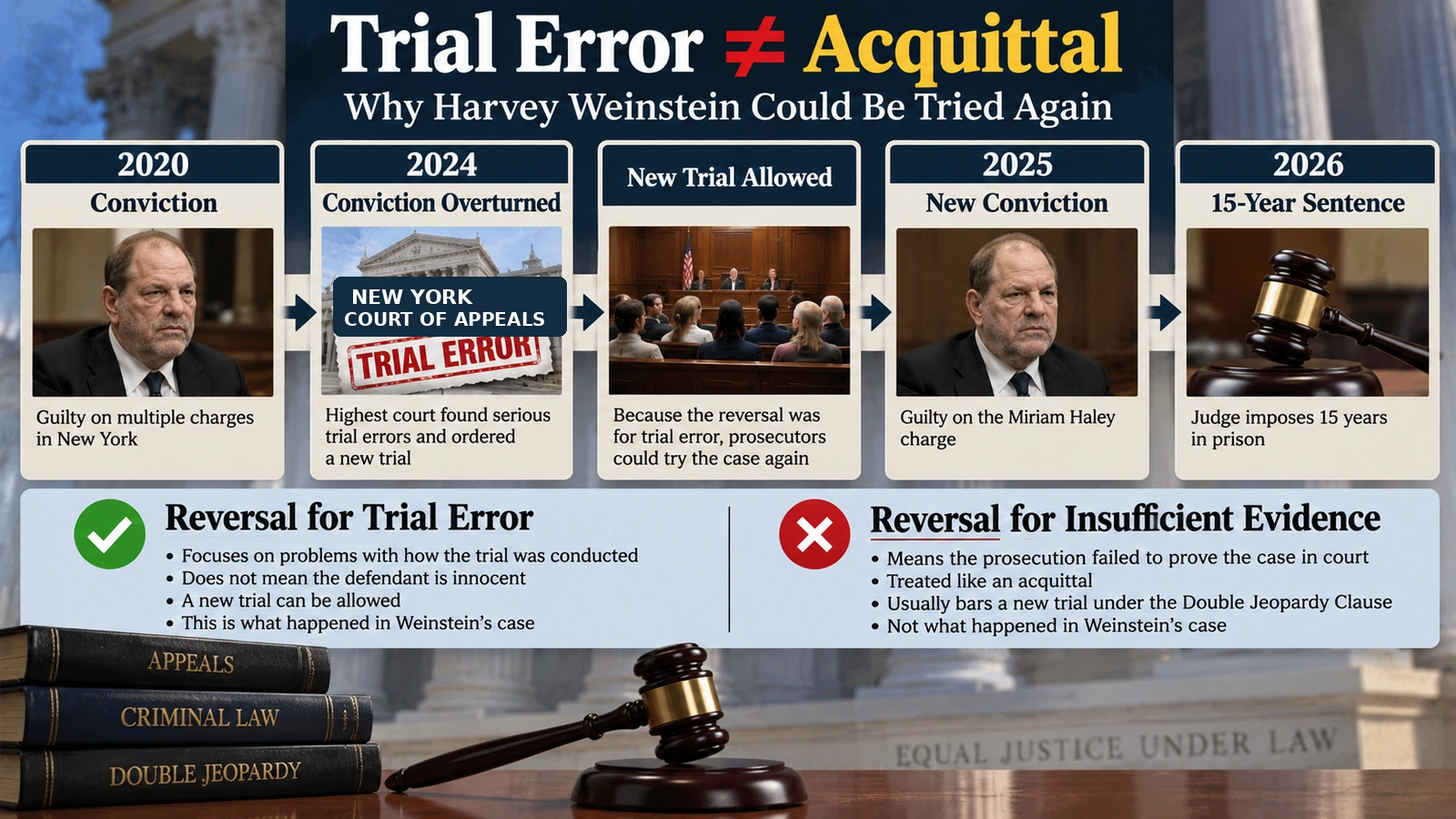
Because the 2024 ruling was about how the trial was conducted—not a finding that prosecutors had failed to present legally sufficient evidence.
That distinction matters under the Double Jeopardy Clause.
As a general rule, when an appellate court reverses a conviction because of a serious trial error, another trial can be allowed. A different rule applies when a conviction is reversed because the evidence was legally insufficient; in that situation, retrying the same charge is barred. The U.S. Supreme Court drew that distinction in Burks v. United States. (Cornell LII)
Weinstein’s case fell into the first category.
The New York Court of Appeals ordered a new trial. It did not order an acquittal. (nycourts.gov)
This is why “conviction overturned” does not always mean “case over.”
What Exactly Did New York’s Highest Court Say Was Wrong?
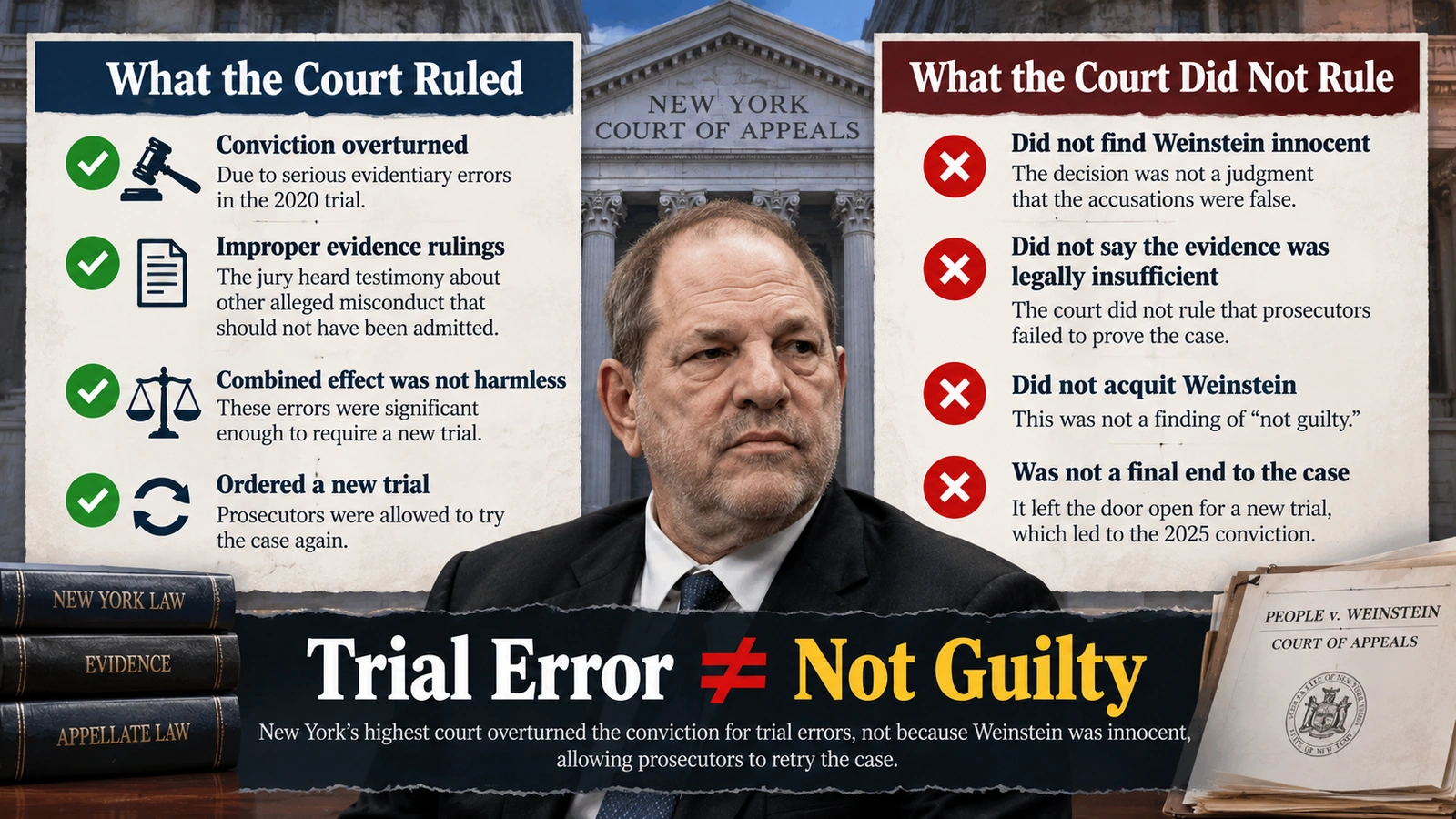
The 2024 decision focused heavily on evidence that the first jury was allowed to hear.
At Weinstein’s original trial, prosecutors presented testimony from women whose alleged encounters with him were not themselves the crimes being decided by that jury. The trial judge also made a broad ruling about other alleged misconduct that prosecutors could potentially use to challenge Weinstein if he testified.
The Court of Appeals majority concluded that these rulings exposed the jury to prejudicial allegations that were not properly tied to a permissible evidentiary purpose. The majority said the combined effect was not harmless and ordered a new trial. (nycourts.gov)
That is very different from saying the court found Haley or the other accusers untruthful.
It is also different from saying Weinstein was innocent.
The decision was about whether the first trial met the legal requirements for a fair criminal proceeding. The court’s dissenting judges strongly disagreed with the majority’s treatment of the evidence, illustrating how contested the evidentiary issue itself was. (nycourts.gov)
There is another naming trap here: in New York, the “Supreme Court” is a trial-level court, while the “Court of Appeals” is the state’s highest court.
So the 2024 decision came from the highest New York state court, even though “Court of Appeals” may sound like a lower court to readers elsewhere in the country.
How Did the Case Change Between 2020 and 2026?
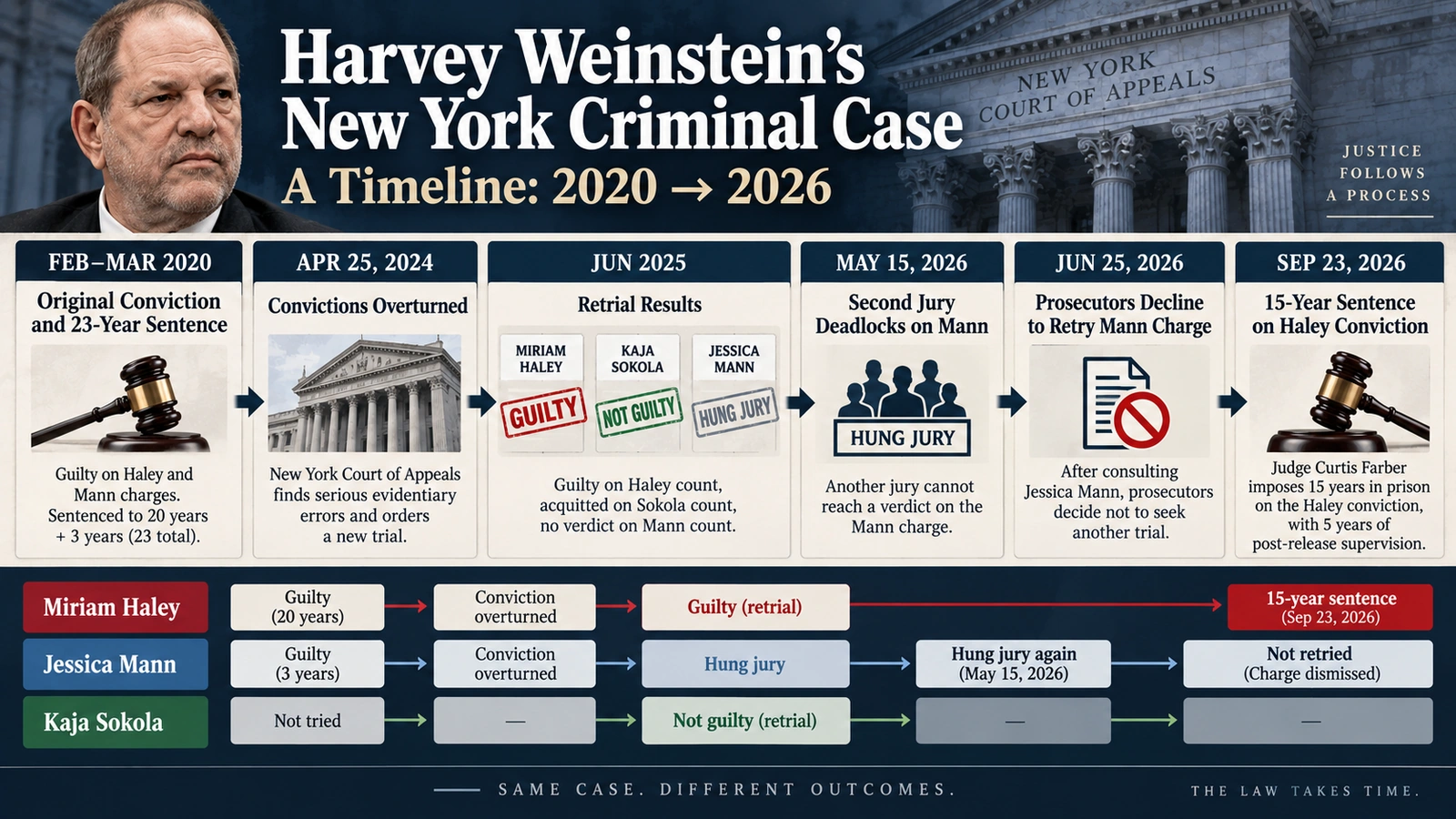
The easiest way to understand the case is to separate the different women and verdicts instead of treating “the Weinstein case” as one single charge.
| Date | What happened | Why it mattered |
|---|---|---|
| February–March 2020 | Weinstein was convicted in New York of a first-degree criminal sexual act involving Miriam Haley and third-degree rape involving Jessica Mann. He received consecutive terms of 20 years and 3 years. | This produced the original 23-year New York sentence. |
| April 25, 2024 | The New York Court of Appeals overturned the convictions and ordered a new trial because of evidentiary errors. | The convictions disappeared, but prosecutors were allowed to retry the case. |
| June 2025 | A new jury convicted Weinstein on the Haley count, acquitted him on a separate charge involving Kaja Sokola, and failed to reach a verdict on the Mann rape charge. | Only the Haley guilty verdict was resolved against Weinstein. |
| May 15, 2026 | Another jury deadlocked on the Mann charge. | A second mistrial left that rape count unresolved. |
| June 25, 2026 | Prosecutors moved to dismiss the Mann charge after Mann said she did not want to testify in another trial. | The move ended plans for a fourth New York trial and cleared the way toward sentencing on the Haley conviction. |
| September 23, 2026 | Judge Curtis Farber sentenced Weinstein to 15 years on the Haley conviction. | This created the new New York prison term now in the headlines. |
The 2020 sentencing structure is confirmed in New York appellate records: 20 years on the Haley criminal-sexual-act conviction plus three years on the Mann rape conviction, served consecutively. (nycourts.gov)
The 2025 retrial produced a guilty verdict involving Haley, an acquittal involving Sokola and a mistrial involving Mann. The Mann charge was tried again in 2026, but that jury also deadlocked. (manhattanda.org)
After consulting Mann, prosecutors moved to dismiss the remaining third-degree rape charge rather than put her through another trial. (Reuters)
That sequence is why a headline saying Weinstein was “convicted again” can be accurate without meaning that every part of the old 2020 case was restored.
Why Is the New Sentence 15 Years Instead of the Old 23?
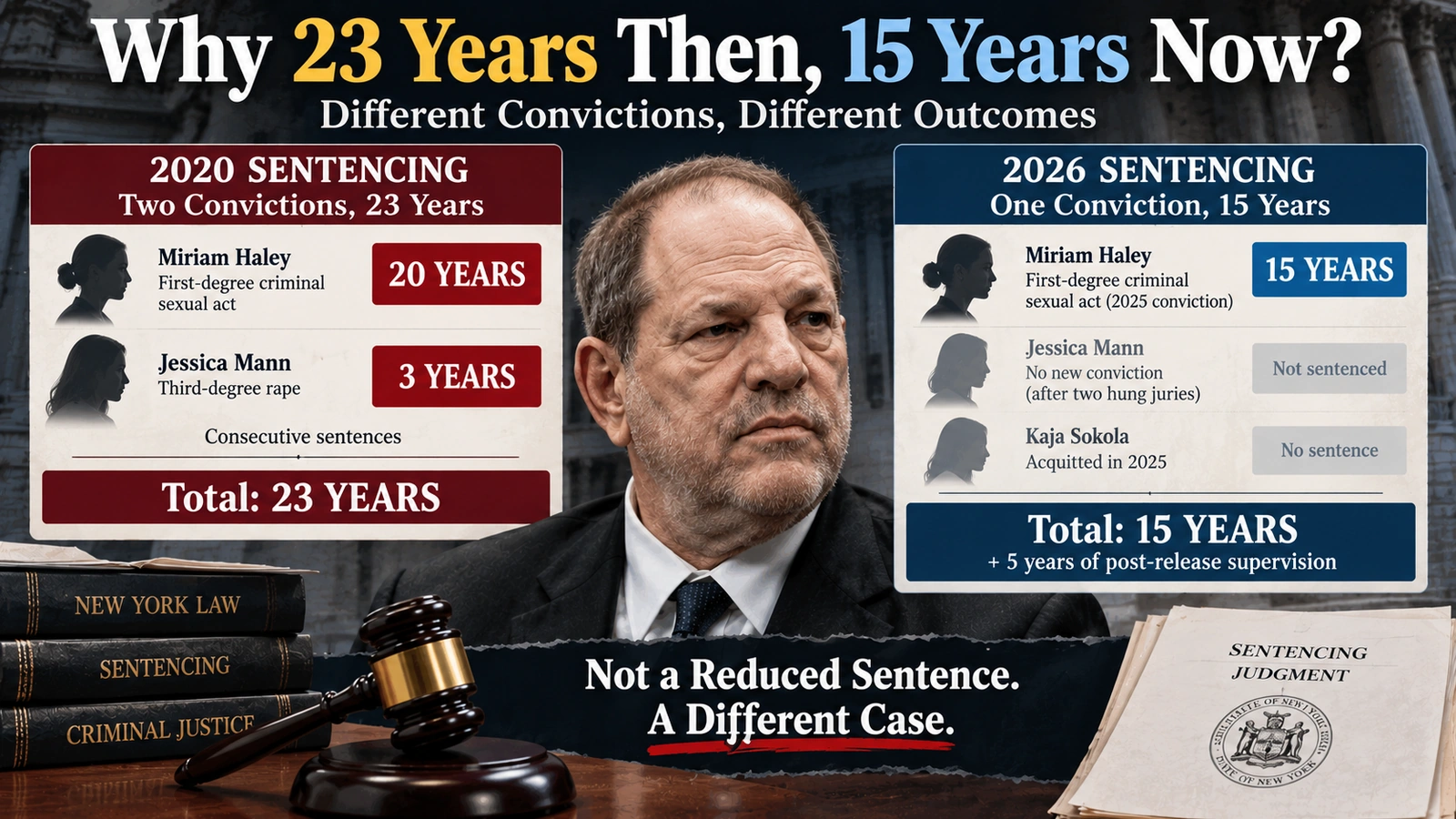
Because the two sentencing hearings were not based on the same set of convictions.
In 2020, Weinstein was being sentenced on two guilty verdicts. The judge imposed 20 years for the Haley offense and another three years for the Mann rape conviction, consecutively, producing 23 years in total. (nycourts.gov)
In 2026, the Mann conviction no longer existed. The only New York guilty verdict being sentenced was the 2025 Haley conviction.
| 2020 sentencing | 2026 sentencing |
|---|---|
| Haley: guilty | Haley: guilty again after retrial |
| Mann: guilty | Mann: no new conviction after two deadlocked juries; prosecutors later moved to dismiss the charge |
| 20 years + 3 years | 15 years |
| Total: 23 years | Total New York sentence imposed September 23: 15 years |
Prosecutors asked for 20 years on the Haley conviction in 2026. Weinstein’s lawyers asked for nine years, citing his age, health problems and the more than six years he had already spent in custody. Farber chose 15 years. (Manhattan District Attorney · Associated Press)
So the 15-year sentence should not be read as a simple reduction from 23 years to 15 years for the same judgment.
The underlying legal picture changed.
What About Weinstein’s Separate California Conviction?
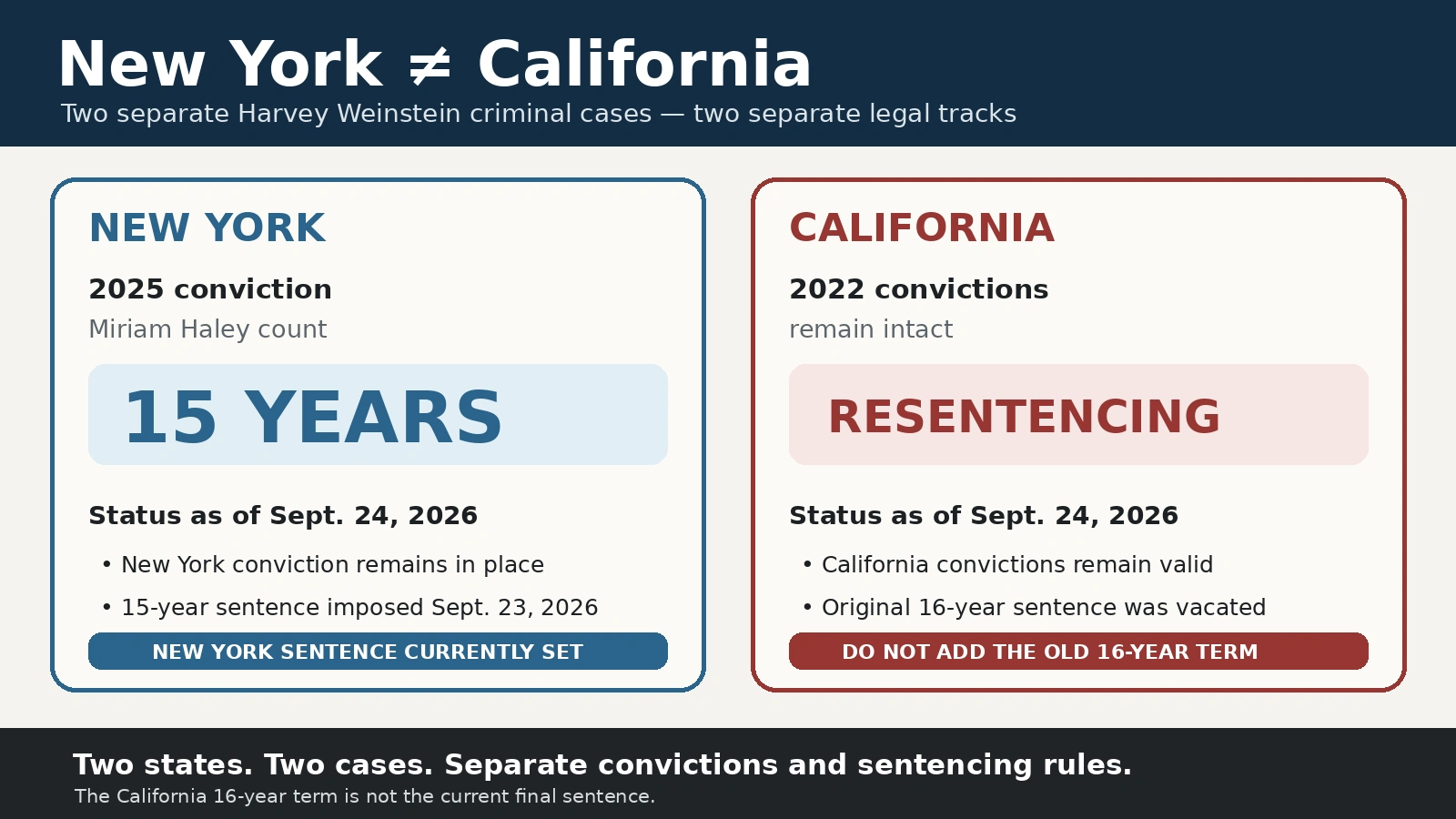
This is the other major source of confusion: Weinstein has a separate criminal case in California.
A Los Angeles jury convicted him in 2022 of rape and two other sexual-assault offenses involving Evgeniya Chernyshova. He was originally given a 16-year California prison sentence.
In June 2026, a California appeals court upheld those convictions but vacated the 16-year sentence and ordered a new sentencing hearing. The problem was not the California jury verdict itself; the appellate court concluded that the original sentencing process had improperly relied on New York convictions that were later overturned. (apnews.com)
That means the situation as of September 24, 2026, looks like this:
| State | Conviction status | Sentence status |
|---|---|---|
| New York | 2025 Haley conviction remains in place | 15 years imposed September 23, 2026; appeal expected |
| California | 2022 rape and sexual-assault convictions remain in place | Original 16-year sentence vacated; resentencing pending |
Weinstein has also sought further review of the California case. (appellatecases.courtinfo.ca.gov)
One question still matters enormously: how the eventual California sentence will interact with the New York sentence.
At the September 23 hearing, Farber said the California judge will decide whether Weinstein’s New York and California sentences run concurrently or consecutively. Farber added that, if it were his decision, he would make the sentences consecutive. (Associated Press)
Until the California resentencing is resolved, simply adding “15 + 16” does not accurately describe Weinstein’s current legal position.
What Happens Next?
The New York sentencing closes one major stage of the case, but it does not necessarily end the litigation.
Weinstein has said he plans to appeal the New York conviction and sentence. (Associated Press)
California still has to resentence him. Weinstein filed a petition for review with the California Supreme Court on August 5, 2026, and the public docket showed the case still pending during this review. (California Courts)
So three different questions should not be mixed together:
-
Is Weinstein currently convicted in New York? Yes, based on the 2025 Haley verdict.
-
Was the original 2020 New York conviction overturned? Yes.
-
Does he also have a separate California conviction? Yes, although the sentence attached to that conviction must be redone.
The word “overturned” sounds final.
In this case, it was not.
Why It Matters in One Sentence
Harvey Weinstein was sentenced again because New York’s highest court threw out his first conviction over trial errors rather than acquitting him, allowing prosecutors to retry the case and obtain a new guilty verdict involving Miriam Haley.
Harvey Weinstein: Key Questions Explained
Q. Why was Harvey Weinstein sentenced to 15 years in 2026?
A New York judge sentenced Weinstein to 15 years on September 23, 2026, after a 2025 jury convicted him of first-degree criminal sexual act involving Miriam Haley. (manhattanda.org)
Q. Didn’t New York overturn Harvey Weinstein’s conviction in 2024?
Yes. New York’s Court of Appeals overturned his 2020 convictions because the majority found serious evidentiary errors in the original trial. The court ordered a new trial rather than an acquittal. (nycourts.gov)
Q. Why didn’t double jeopardy prevent another Harvey Weinstein trial?
Because the reversal was based on trial error rather than a ruling that the prosecution’s evidence was legally insufficient. U.S. double-jeopardy law generally permits a retrial after that kind of reversal. (Cornell LII)
Q. What happened at Weinstein’s 2025 retrial?
The jury convicted Weinstein on the Miriam Haley charge, acquitted him on a separate charge involving Kaja Sokola and could not reach a verdict on the Jessica Mann rape charge. (manhattanda.org)
Q. What happened to the Jessica Mann rape charge?
A second jury deadlocked on that charge in May 2026. Prosecutors later moved to dismiss it after Mann said she did not want to testify in another trial. (Reuters — May mistrial · Reuters — June dismissal motion)
Q. Why did Weinstein receive 23 years in 2020 but 15 years in 2026?
The 2020 sentence covered two convictions—20 years on the Haley count and three consecutive years on the Mann count. The 2026 sentence covers the new Haley conviction alone. (nycourts.gov)
Q. Is Harvey Weinstein’s California conviction still valid?
Yes. A California appeals court upheld the convictions in June 2026 but vacated the original 16-year sentence and ordered resentencing. (apnews.com)
Q. Does Weinstein now have to serve 15 years plus another 16 years?
No. California’s original 16-year sentence was vacated, so simply adding 15 and 16 would be wrong. A new California sentence has not yet been imposed, and the California judge will decide whether the state sentences run concurrently or consecutively. (California Courts · Associated Press)
Q. Can Weinstein appeal the new New York sentence?
Yes. Weinstein has said he intends to appeal the New York conviction and sentence. (Associated Press)
Did this help make the story clearer? 🙂
WIN keeps unpacking the “why” behind the news—clearly and simply!
Sources
September 2026 Sentencing
Associated Press via NY1 — Harvey Weinstein Sentenced to 15 Years in Prison for 2006 Sex Crime
Reuters via Investing.com — Harvey Weinstein Sentenced to 15 Years for New York Sexual Assault
New York Conviction, Reversal and Retrials
New York Court of Appeals — People v. Weinstein, April 25, 2024
Manhattan District Attorney — 2025 Retrial Conviction of Harvey Weinstein
Reuters — Weinstein’s 2026 Jessica Mann Retrial Ends in Mistrial
Reuters — Prosecutors Move to Drop Remaining Jessica Mann Charge, June 25, 2026
New York Appellate Division — People v. Weinstein, Original 20-Year and 3-Year Sentences
Cornell Legal Information Institute — Burks v. United States on Retrial After Reversal
New York Sentencing Law
New York Penal Law § 130.50 — Criminal Sexual Act in the First Degree
New York Penal Law § 70.80 — Sentencing for Felony Sex Offenses
California Case and Resentencing
Associated Press — California Conviction Upheld, Resentencing Ordered, June 26, 2026
California Courts — People v. Weinstein Appellate Docket
California Supreme Court — People v. Weinstein Review Docket