Why Is DoorDash Paying $131.5 Million—and Does Waiting for an Order Count as Paid Work?
A DoorDash driver finishes a delivery, stays logged into the app, and waits for the next order.
Is that person still working?
And if the answer is yes, who decides how that waiting time should be paid?
Those questions sit near the center of a $131.5 million settlement announced by New York City on September 22. The city says DoorDash violated local delivery-worker pay laws, including through missing or late payments and by excluding categories of working time from its calculations. DoorDash acknowledges payment mistakes but says an important part of the dispute involved a genuine disagreement over how the city’s complicated pay formula should be applied. (NYC DCWP)
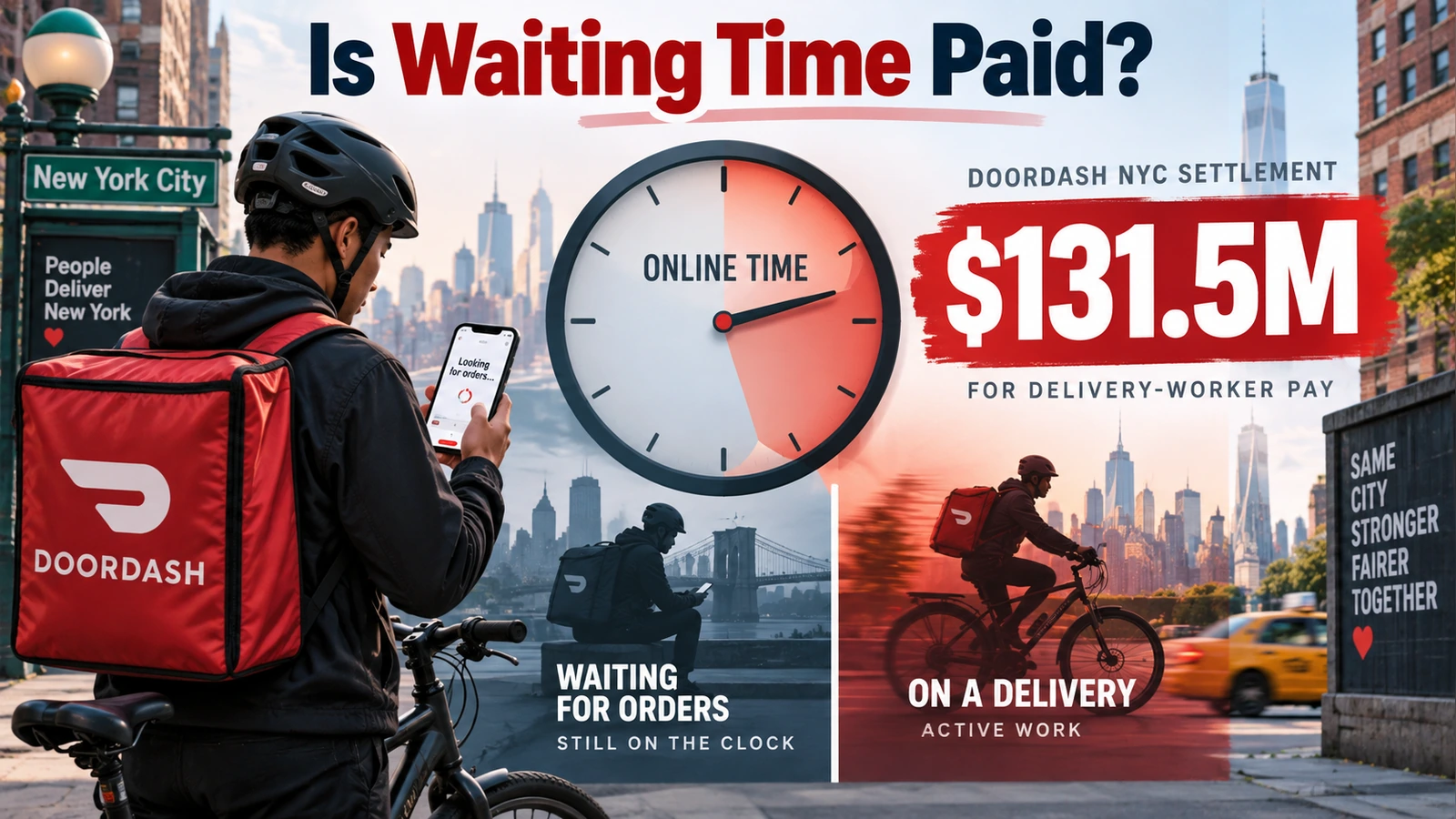
More than 260,000 workers are expected to receive relief. But the story is more complicated than “DoorDash forgot to pay drivers $131.5 million.”
To understand what happened, you first have to understand something unusual about New York City’s law: there is more than one kind of work time.
Where Is the $131.5 Million Actually Going?

The easiest way to understand the settlement is to separate compensation for workers from penalties paid to the city.
New York City says more than $115 million will go to delivery workers, while DoorDash says $16.7 million will be paid in fines. About 264,000 Dashers are expected to receive payments. (Reuters)
| Part of the settlement | What it addresses |
|---|---|
| More than $115 million | Money going to affected delivery workers |
| More than $83 million | Dispute over how online or on-call time was calculated |
| $12.3 million | Missing or late payments |
| $16.7 million | Civil fines paid to the city |
DoorDash says approximately $6.6 million in payments never reached workers and another $5.7 million arrived late. The company says less than 1% of its NYC Dasher payments were affected by those particular payment problems. (DoorDash)
The much bigger issue, however, was how working time itself was counted.
Does Waiting for a DoorDash Order Count as Work?
Sometimes—but not in the simple way the phrase “$22.13 an hour” might suggest.
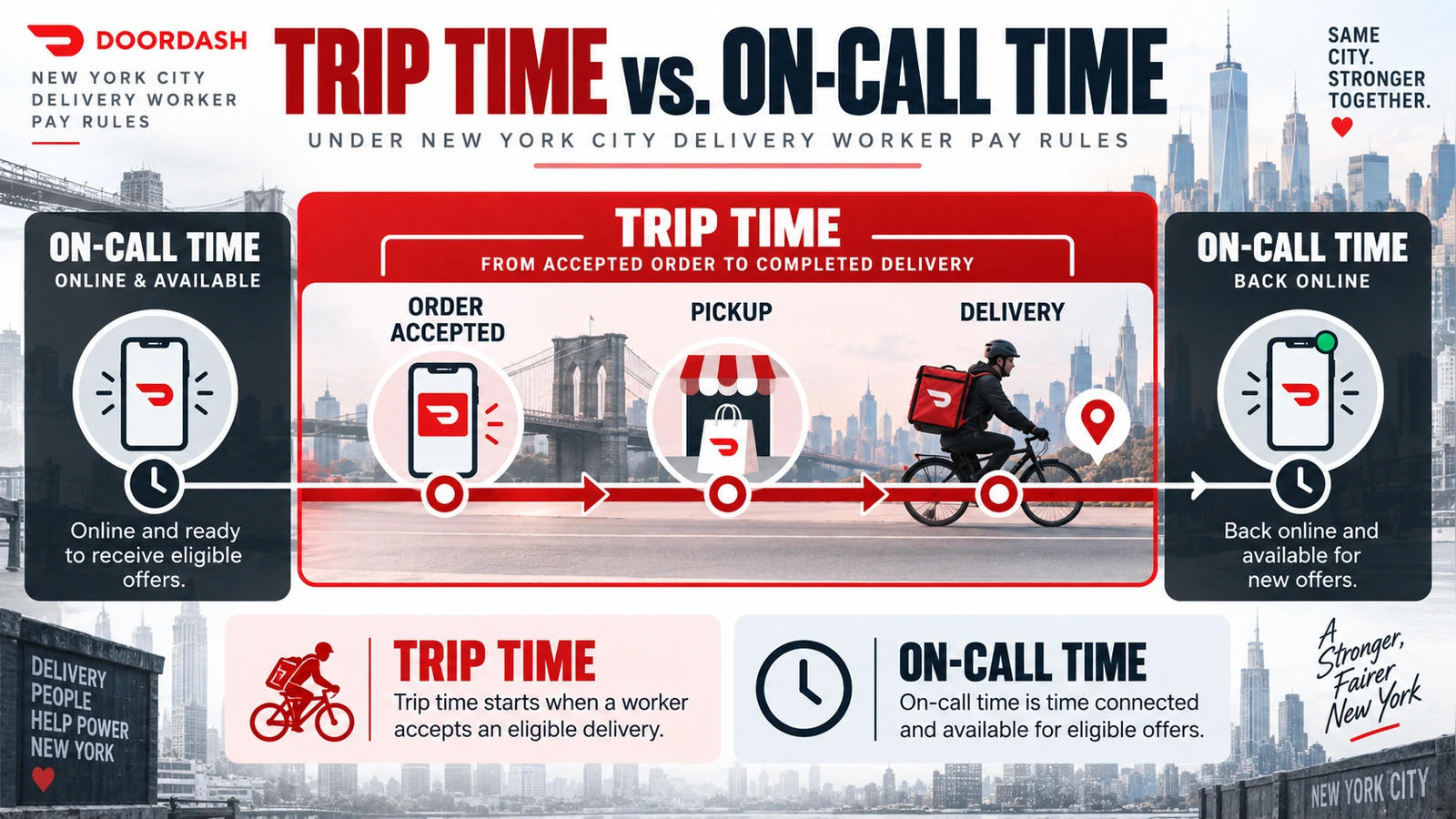
New York City distinguishes between “trip time” and “on-call time.” Trip time starts when a worker accepts an eligible delivery and can include traveling to a pickup, waiting for an order to be prepared, picking it up and delivering it. On-call time is the period when a worker is connected to the app and available to receive eligible delivery offers but is not already on a trip. (NYC DCWP)
That distinction matters because the city allows apps to comply with the minimum-pay law in two different ways.
Under the Standard Method, an individual worker must receive at least the minimum rate for that worker’s trip time. But the app must also pay its workforce, in the aggregate, enough to cover the combined trip time and on-call time of all covered workers.
That means the law does not simply say, “Every individual Dasher gets $22.13 for every minute the app is turned on.”
Under the Alternative Method, an app can pay a higher rate for trip time instead, with no separate right to on-call compensation under that method. The city limits when apps may use that option. (NYC DCWP)
That is why a dispute about “waiting time” can become enormously complicated once millions of deliveries and thousands of workers are involved.
Why Did DoorDash and New York City Disagree?
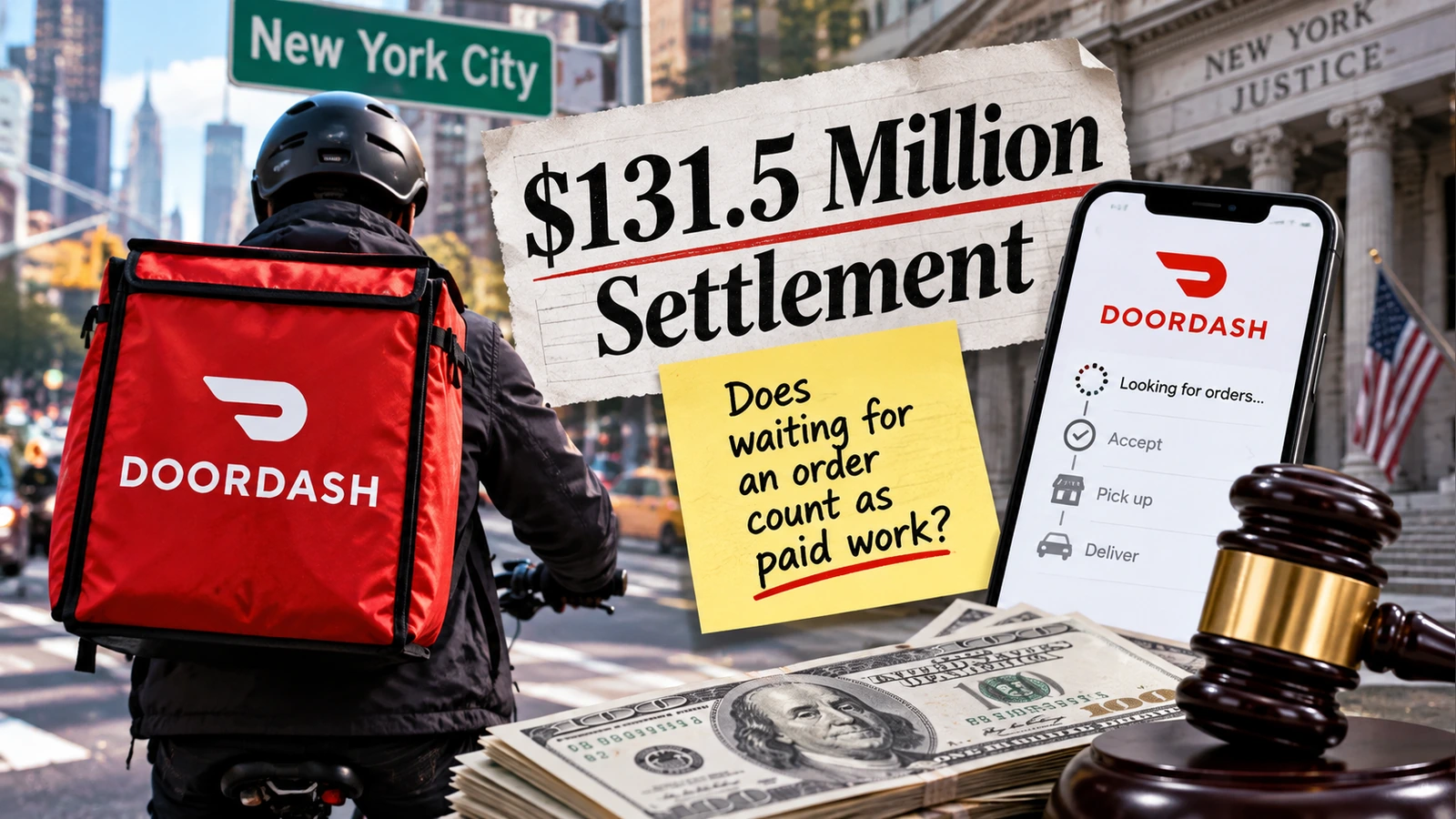
New York City says DoorDash excluded categories of trip time and on-call time that should have been included when calculating compliance with the minimum-pay rules. The city’s investigation expanded from worker complaints into a large-scale review of company data, including more than 152 million payment transactions and 110 million working hours. (NYC DCWP)
DoorDash describes the on-call issue differently.
The company says workers were paid for online time, but DoorDash calculated that time differently from the city. DoorDash says it believed its approach was “fair, practical, and legal” and decided to settle rather than spend years litigating the issue. (DoorDash)
Those are not identical claims.
The city’s position is that DoorDash’s calculation violated the minimum-pay requirements. DoorDash accepts that it made other payment mistakes and is changing its method, while maintaining that the on-call calculation dispute was not the same thing as simply refusing to pay workers who were waiting.
That distinction explains why the $83 million-plus portion of the settlement deserves separate treatment from ordinary missing-paycheck errors.
How Does New York City’s Delivery Pay System Actually Work?
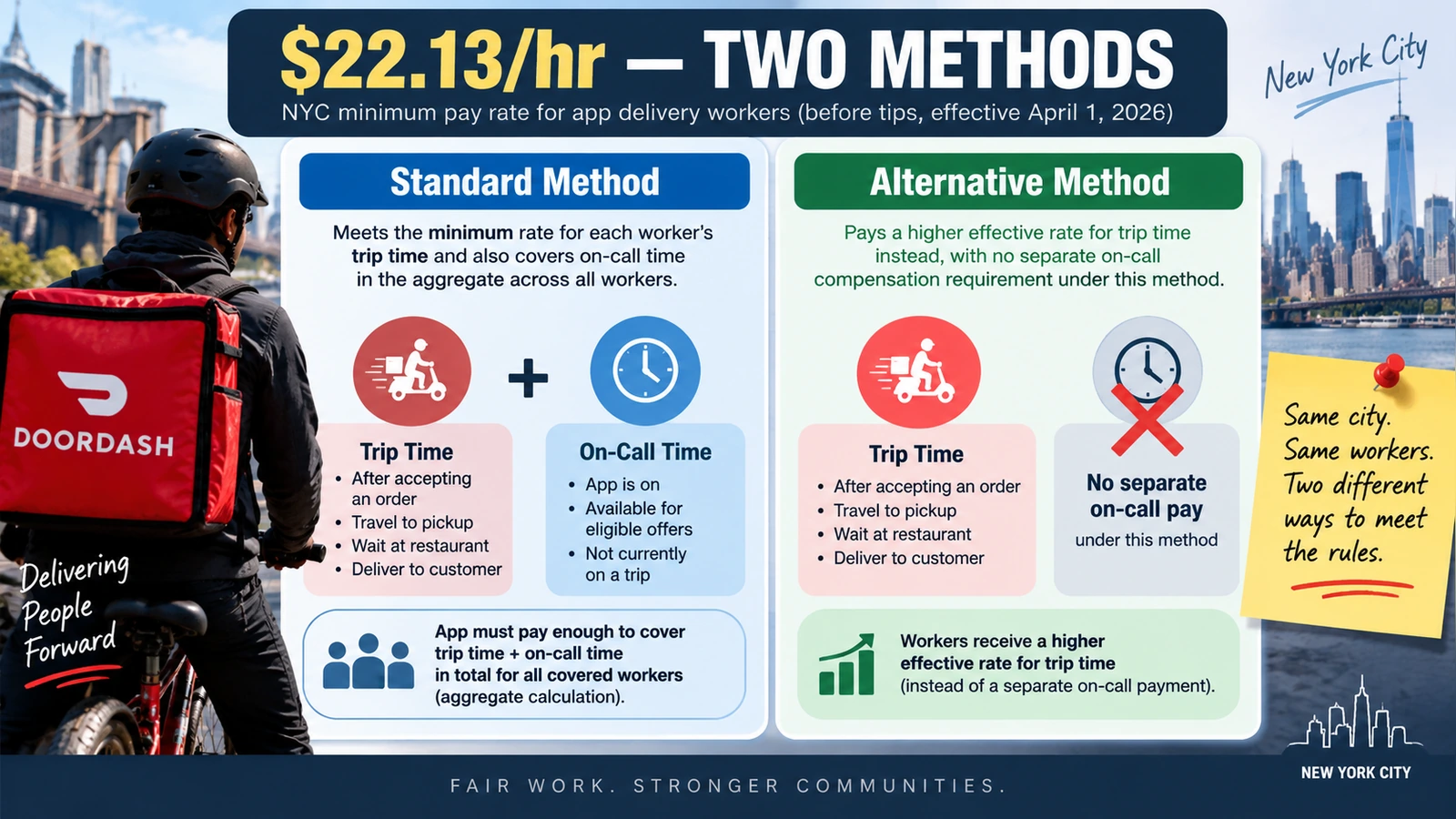
The current New York City minimum pay rate for covered restaurant and grocery delivery workers is $22.13 per hour before tips for pay periods beginning on or after April 1, 2026. The rate is adjusted annually for inflation. (NYC DCWP)
But again, $22.13 is not as simple as punching a time clock at a conventional hourly job.
| Method | Basic idea | How on-call time is treated |
|---|---|---|
| Standard Method | Each worker must receive at least $22.13 multiplied by trip time, while the app must satisfy a broader workforce-level payment requirement | Included in the app-wide aggregate calculation |
| Alternative Method | Workers receive a higher effective rate for trip time | No separate on-call compensation requirement under this method |
For example, under the city’s current Standard Method, if workers collectively record 70,000 hours of trip time and 30,000 hours of on-call time, the app’s total payments to those workers must reach at least $2.213 million.
But the money does not have to be allocated as exactly $22.13 for every individual worker’s personal waiting hour. (NYC DCWP)
The worker can still be classified as an independent contractor. New York City’s delivery-worker law specifically covers qualifying workers whom apps classify that way. (NYC DCWP)
That is one reason this case matters beyond DoorDash: app-based work does not always fit neatly into the old choice between “on the clock” and “off the clock.”
How Did a Few Small Payment Errors Become Such a Large Case?
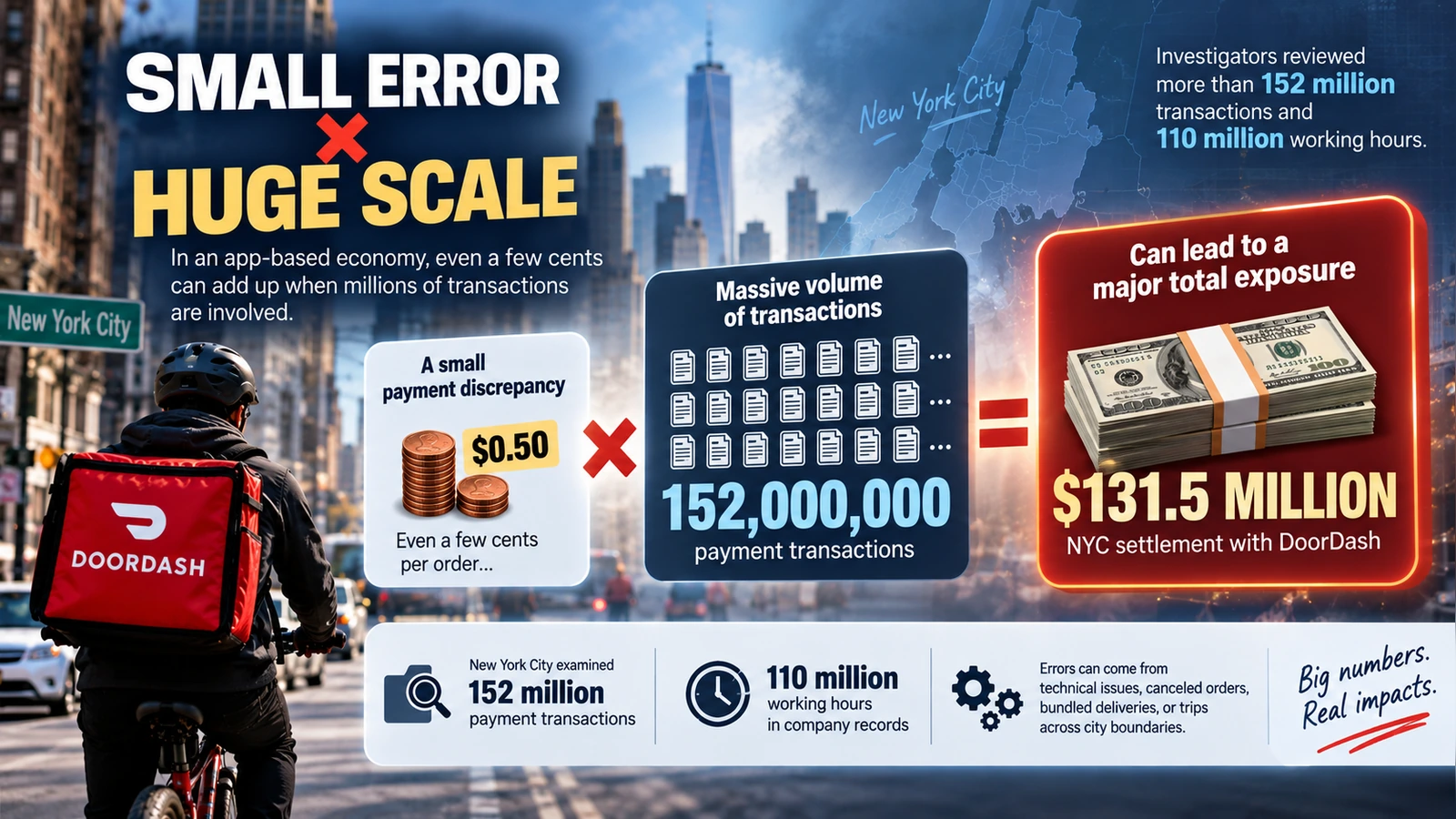
Because app-based payroll happens at enormous scale.
DoorDash says the average missing payment among the affected workers in that category was only $7.70, and 65% of those workers were short by $1 or less. That sounds tiny. (DoorDash)
But a delivery platform processes huge numbers of payments, trips, cancellations, batched orders and trips crossing city boundaries. New York City says its investigators examined terabytes of DoorDash records encompassing more than 152 million payment transactions. (NYC DCWP)
DoorDash says some errors arose from technical bugs, incomplete banking information, multiple pickup or drop-off locations, partially completed orders, canceled orders and trips that crossed New York City boundaries. (DoorDash)
A useful way to think about it is payroll software at supermarket scale: an error worth a few cents or dollars in one transaction may look trivial, but when the same logic is applied repeatedly across a massive platform, the total exposure can become substantial.
Will Every Worker Get a Huge Check?

No.
The more than $115 million in worker relief is not being divided evenly among everyone covered by the settlement.
DoorDash says the median payment will be around $48, although individual amounts can vary substantially depending on the type and size of the underpayment. The company says affected workers will receive at least $10. (DoorDash)
For workers identified by New York City, there is another important point: they are not expected to file a traditional claim and prove their loss themselves.
DCWP says it identified affected workers using DoorDash’s records. The city plans to have the settlement administrator begin sending personalized notices in late October to workers covered by the first payment group. Workers will be offered electronic payment or a mailed check. (NYC Mayor’s Office)
A smaller group is expected to receive payments in early 2027 as DoorDash corrects additional elements of its compensable-time calculations. (NYC DCWP)
What Changes for DoorDash After the Settlement?
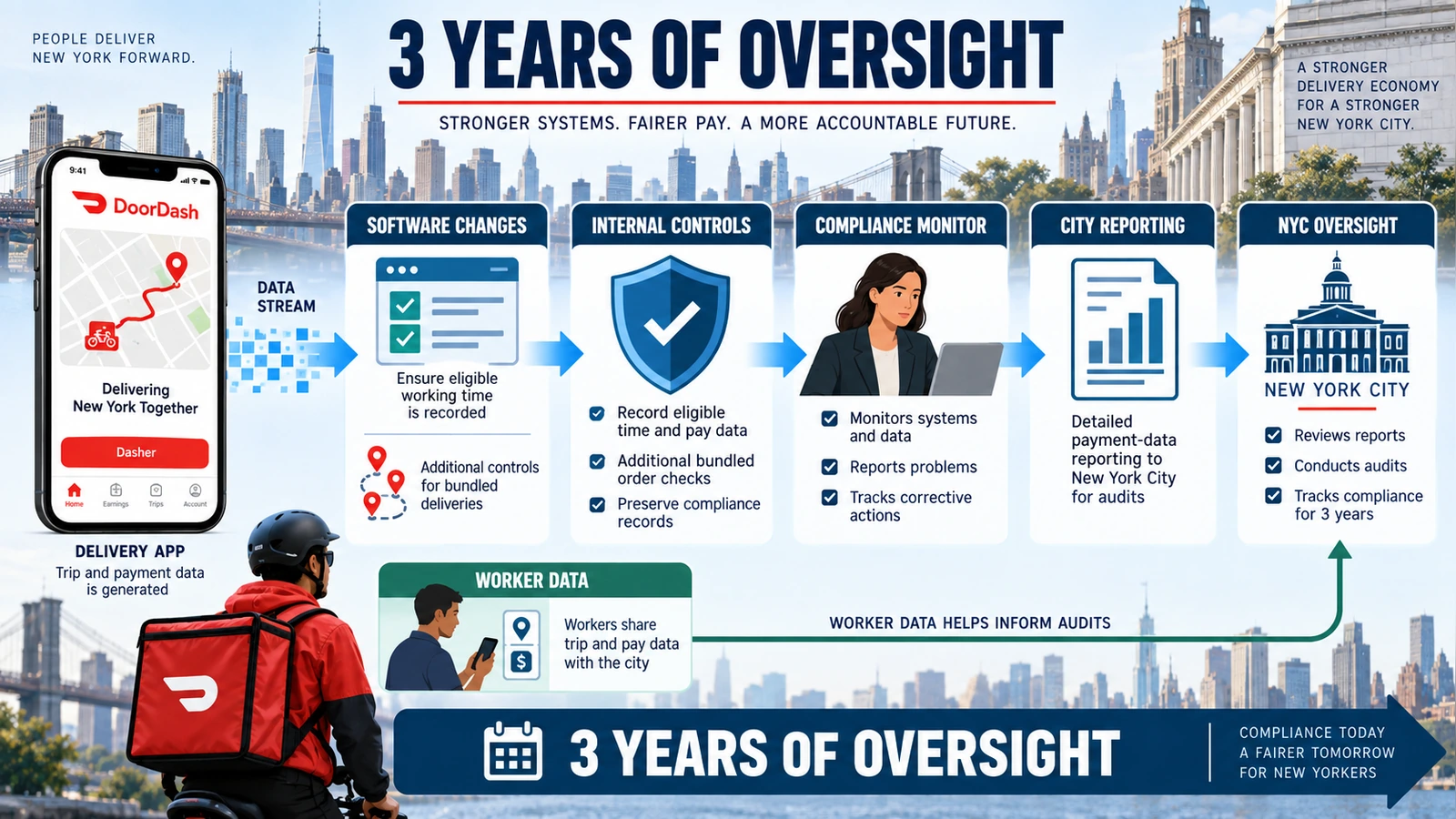
The settlement is not simply a check.
DoorDash will be subject to a three-year compliance structure that gives New York City substantially more information about how the company calculates worker pay.
The agreement includes software changes intended to ensure that eligible working time is recorded, additional controls for bundled deliveries, preservation of compliance records and an internal compliance monitor who must report problems and corrective actions. The city will also receive detailed payment information it can use for audits. (NYC Mayor’s Office)
A worker-data component is especially notable. Workers Justice Project and the Workers’ Algorithm Observatory are expected to develop software that lets workers capture information presented to them about trips and pay and share it with the city. DoorDash may not retaliate against workers for using that tool. (NYC Mayor’s Office)
That represents a different approach to enforcing labor rules in an algorithmic workplace: instead of waiting only for individual complaints, regulators can compare platform data with information workers themselves see.
Does This Mean DoorDash Delivery Will Cost Customers More?
Not automatically.
Nothing in this settlement itself requires DoorDash to add a specific new customer fee.
DoorDash has, however, argued for years that New York City’s delivery regulations raise the cost of operating there. In April 2026, the company announced NYC fee increases of up to 50 cents on many standard orders and up to 30 cents on many DashPass orders, specifically citing the higher minimum-pay requirement and other regulations. Those fee increases predated this settlement. (DoorDash)
So it would be too strong to say the $131.5 million settlement itself will cause your next delivery bill to rise.
What the settlement does show is that New York City is treating the algorithms behind app-based work as something regulators can audit—not simply as proprietary software that determines pay behind the scenes.
Wasn’t There Already Another DoorDash Settlement in New York?
Yes, but it was a different case.
In 2025, the New York State Attorney General announced a separate $16.75 million DoorDash settlement involving an earlier pay model used between 2017 and 2019. In that case, state officials said customer tips had effectively been used to offset DoorDash’s guaranteed pay to some workers. (New York Attorney General)
The current $131.5 million case is a New York City enforcement matter focused on the city’s delivery-worker laws, including missing or late payments and minimum-pay calculations.
| Settlement | Main issue |
|---|---|
| New York State $16.75M case | Earlier treatment of customer tips |
| New York City $131.5M case | Delivery-worker payment and minimum-pay compliance |
The two cases are easy to confuse because both involve DoorDash worker compensation in New York, but they involve different periods, legal authorities and pay issues.
Why It Matters in One Sentence
DoorDash’s $131.5 million New York City settlement shows that in app-based work, the most important payroll question may no longer be just how much a delivery pays—it can also be whether the software correctly recognizes when work begins, when it ends and what happens during the time in between.
DoorDash NYC Settlement: Key Questions Explained
Q. Why is DoorDash paying $131.5 million to New York City?
The settlement resolves a New York City investigation into missing and late payments and alleged violations of the city’s delivery-worker minimum-pay rules. More than $115 million is expected to go to workers, while DoorDash says $16.7 million will be paid in fines.
Q. How many DoorDash workers are affected?
Approximately 264,000 Dashers are expected to receive some form of payment under the settlement. Individual payment amounts will vary.
Q. Does New York City require DoorDash to pay drivers for all time they are logged into the app?
Not as a simple individual hourly rule. Under the Standard Method, on-call time enters an aggregate workforce-level payment calculation, while the Alternative Method allows a higher trip-time rate without separate on-call compensation.
Q. What is DoorDash “on-call time”?
New York City defines on-call time as time when a worker is connected to an app and available to receive eligible delivery offers but is not already on a delivery trip.
Q. What is the NYC minimum pay rate for app delivery workers in 2026?
The current minimum pay rate is $22.13 per hour before tips for covered restaurant and grocery delivery workers, effective for pay periods beginning on or after April 1, 2026.
Q. Do eligible DoorDash workers need to file a claim?
New York City says workers it has identified do not need to submit a claim or provide their own evidence. The settlement administrator is expected to contact eligible workers directly.
Q. How much money will an individual DoorDash worker receive?
There is no single amount. DoorDash says the median payment will be around $48 and affected workers will receive at least $10, but some workers may receive substantially more depending on the nature of their underpayment.
Q. Did DoorDash admit intentionally underpaying workers?
DoorDash acknowledges that some workers were underpaid or paid late but says those mistakes were not intentional. On the larger on-call calculation issue, DoorDash says it disagreed with the city’s interpretation while agreeing to adopt the city’s method going forward.
Q. Will the settlement raise DoorDash fees for customers?
The settlement does not require a specific consumer fee increase. DoorDash had already raised some New York City fees earlier in 2026 and attributed those changes partly to the city’s delivery-worker regulations.
Q. What happens to DoorDash now?
The company faces a three-year monitoring and compliance structure that includes software changes, internal controls, reporting requirements and oversight designed to catch future payment problems more quickly.
Did this help make the story clearer? 🙂
WIN keeps unpacking the “why” behind the news—clearly and simply!
Sources
Settlement Terms and Worker Payments
NYC DCWP — Record $131.5 Million DoorDash Settlement
NYC DCWP — Information for DoorDash Workers
Associated Press — DoorDash to Pay $131M for Underpaying Delivery Workers in New York City
DoorDash’s Explanation
DoorDash — Making It Right: Our Settlement with the City of New York
Reuters — DoorDash to Pay $131.5 Million to Resolve New York City Probe Over Delivery Workers’ Pay
New York City Delivery Worker Pay Rules
NYC DCWP — Delivery Worker Laws: Frequently Asked Questions
NYC DCWP — Delivery Worker Rights and Minimum Pay Rate
Earlier DoorDash Pay Case
New York Attorney General — Settlement with DoorDash over Unpaid Tips