Why Could a 15-Year-Old Face Adult Charges After the Florida A&M Shooting?

A 15-year-old accused of opening fire near a college football stadium is facing 11 counts of attempted second-degree murder. Prosecutors say they intend to try him as an adult.
But how can someone who is legally still a child face an adult criminal prosecution?
The answer lies in a Florida law that allows prosecutors to move certain serious juvenile cases into the adult court system—even when the defendant is only 14 or 15.
And there is an important distinction: Being prosecuted as an adult does not mean a teenager has been convicted or that an adult prison sentence has already been decided.
That distinction has become central to the case of Anthony Rivers III, the teenager arrested after gunfire injured 12 people near Florida A&M University’s football stadium during homecoming weekend. (Tallahassee Police Department · WTXL)
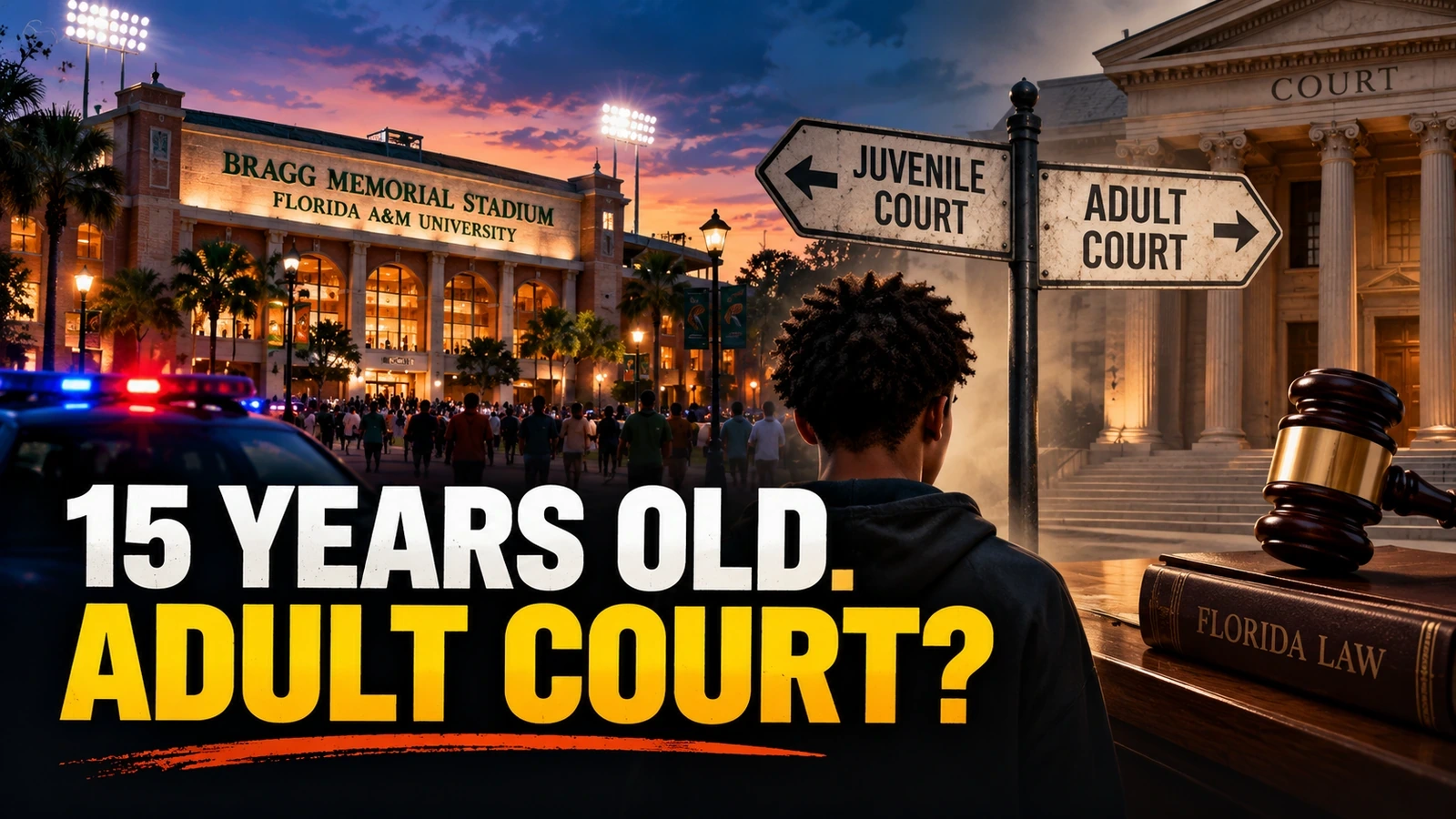
※ Images in this article are AI-generated illustrations created to help explain the story. They are not actual photographs, and depictions of people, places, or events may differ slightly from reality.
The case raises two different questions: what investigators can prove about the shooting, and why Florida allows a juvenile defendant to face the possibility of adult punishment.
Understanding those questions separately makes the legal controversy much clearer.
What Happened Outside the Florida A&M Stadium?
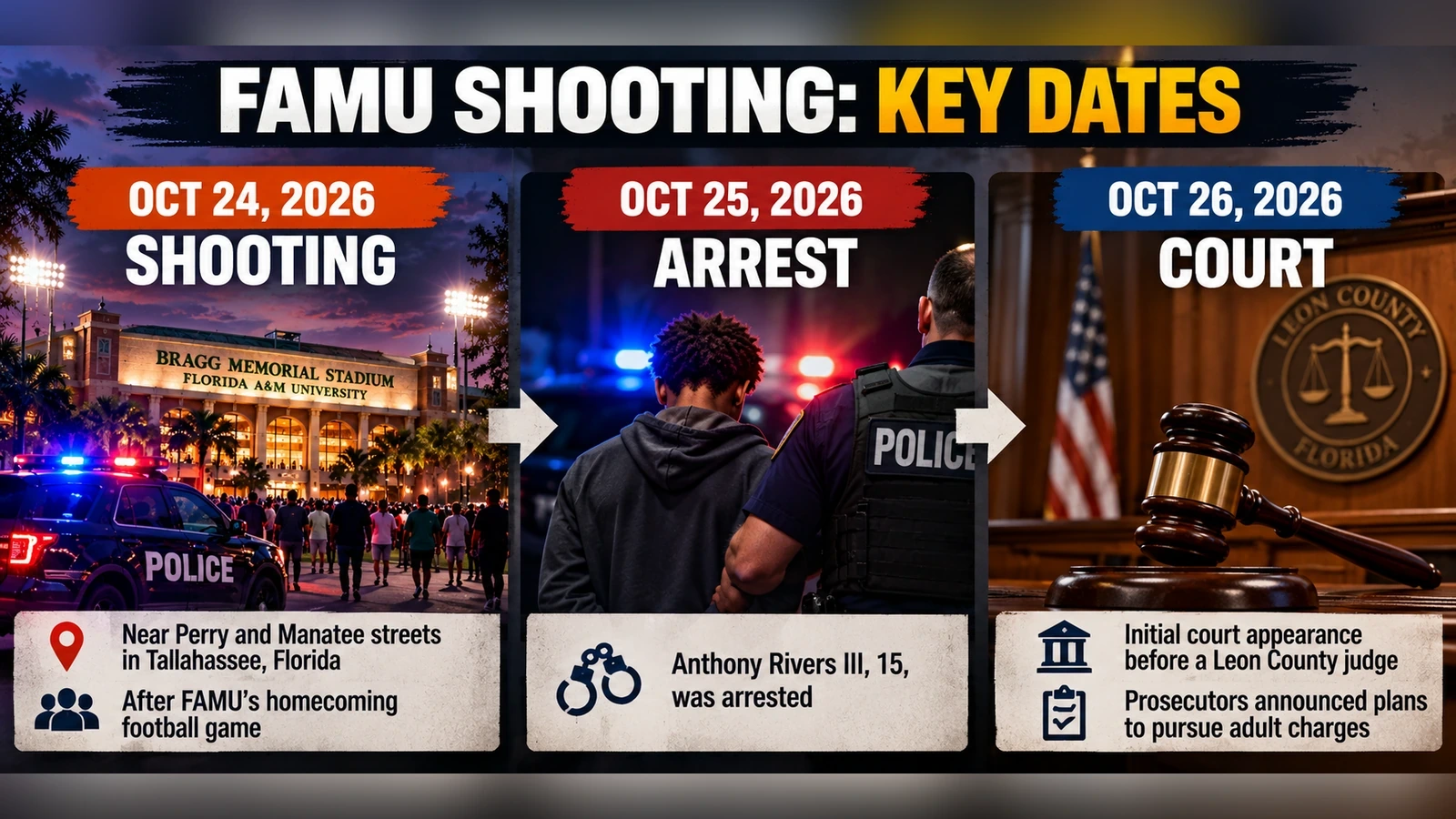
The shooting occurred on October 24, 2026, at approximately 8 p.m. near Perry and Manatee streets in Tallahassee, Florida, just outside Florida A&M University’s Bragg Memorial Stadium.
It happened after the university’s homecoming football game against the University of Arkansas at Pine Bluff. The area was crowded with people attending homecoming celebrations.
According to Tallahassee police, a physical confrontation between people who knew one another preceded the gunfire. Investigators initially believed the dispute was isolated and that none of those injured appeared to have been the intended targets. Those findings remain preliminary. (Tallahassee Police Department · AP)
How Many People Were Injured?
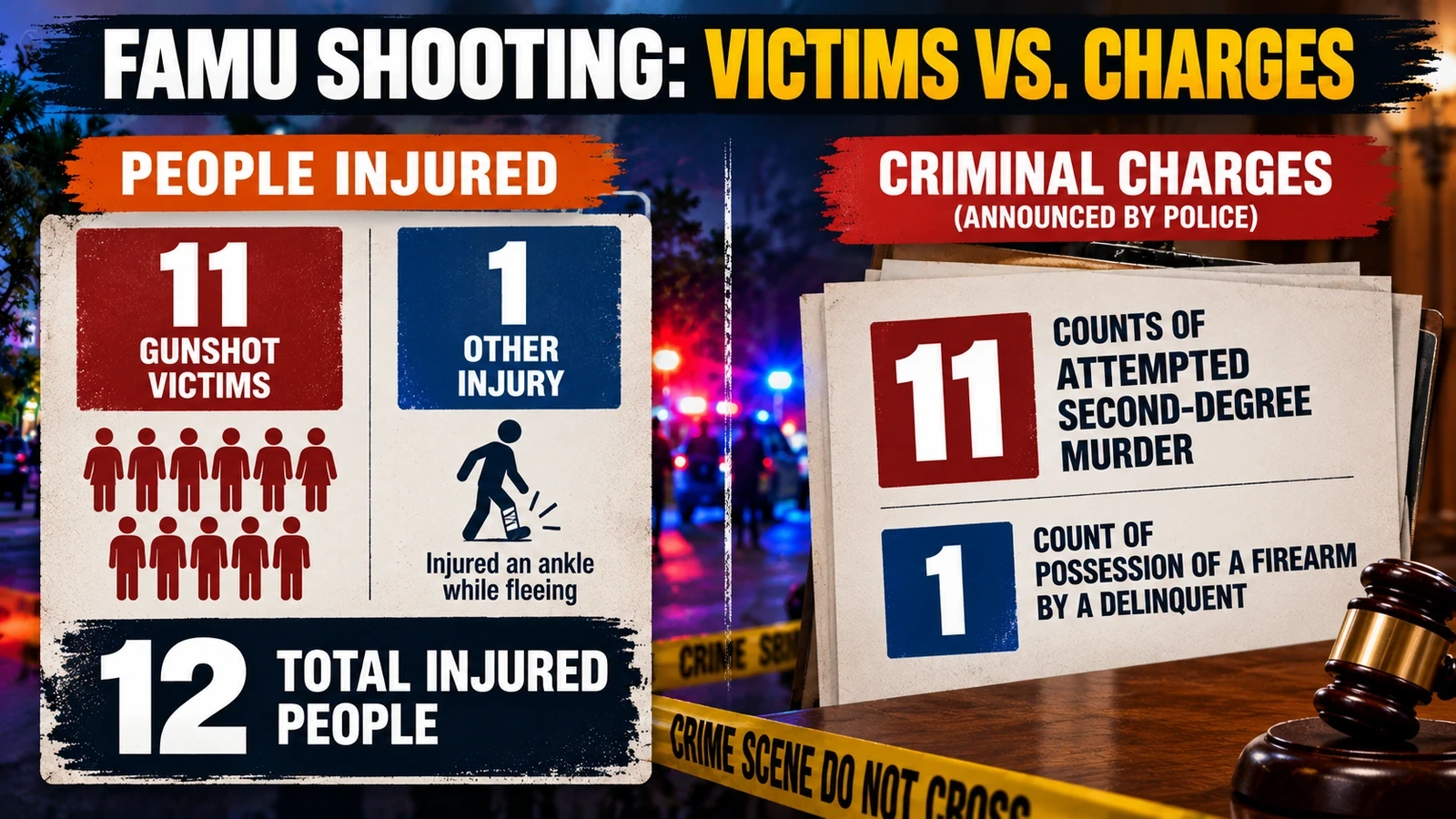
Police reported 12 injured people, including 11 who sustained gunshot wounds.
The twelfth person injured an ankle while fleeing the gunfire. Six of those injured were minors, including an 11-year-old child.
At least three people suffered serious injuries. WFSU reported on October 26 that one victim remained in critical condition. No deaths had been reported in connection with the shooting. (Tallahassee Police Department · WFSU)
Police arrested Anthony Rivers III, 15, on October 25.
He appeared before a judge the following day, when authorities publicly described the charges and prosecutors’ plan to pursue an adult criminal case.
Does This Mean the University or Football Game Caused the Shooting?
No such connection has been established.
The shooting happened near the stadium after the homecoming game, but investigators have described a dispute involving individuals who knew each other rather than an attack specifically directed at the university or football spectators.
The timing and location help explain why so many people were nearby. They do not, by themselves, establish the motive. (AP)
Why Does One Shooting Lead to 11 Attempted Murder Counts?
The number of charges reflects the multiple alleged offenses prosecutors are pursuing—not the number of separate shooting incidents.
Tallahassee police announced that Rivers faces:
- 11 counts of attempted second-degree murder.
- One count of possession of a firearm by a delinquent.
These are the charges reported by authorities, not findings of guilt. (Tallahassee Police Department)
What Does Attempted Second-Degree Murder Mean?
Florida’s second-degree murder law addresses certain extremely dangerous acts demonstrating a depraved disregard for human life, without requiring the premeditated design associated with first-degree murder.
An attempted offense involves conduct alleged to have gone beyond preparation toward committing the underlying crime, without its completion.
That legal distinction matters in a shooting where investigators say the injured people may not have been the intended targets.
A person does not necessarily have to be the specific intended target for prosecutors to allege attempted second-degree murder. But the prosecution must still establish the elements of each charge under applicable Florida law.
The publicly reported charges alone do not prove how the shooting occurred, the defendant’s state of mind, or whether prosecutors can establish each count.
Another important detail is the separate firearm charge. Police described it as possession of a firearm by a delinquent, but publicly available reports have not fully established the underlying juvenile-history facts relevant to that allegation.
It would be premature to infer a specific prior offense from the charge alone.
How Can Florida Prosecute a 15-Year-Old in Adult Court?
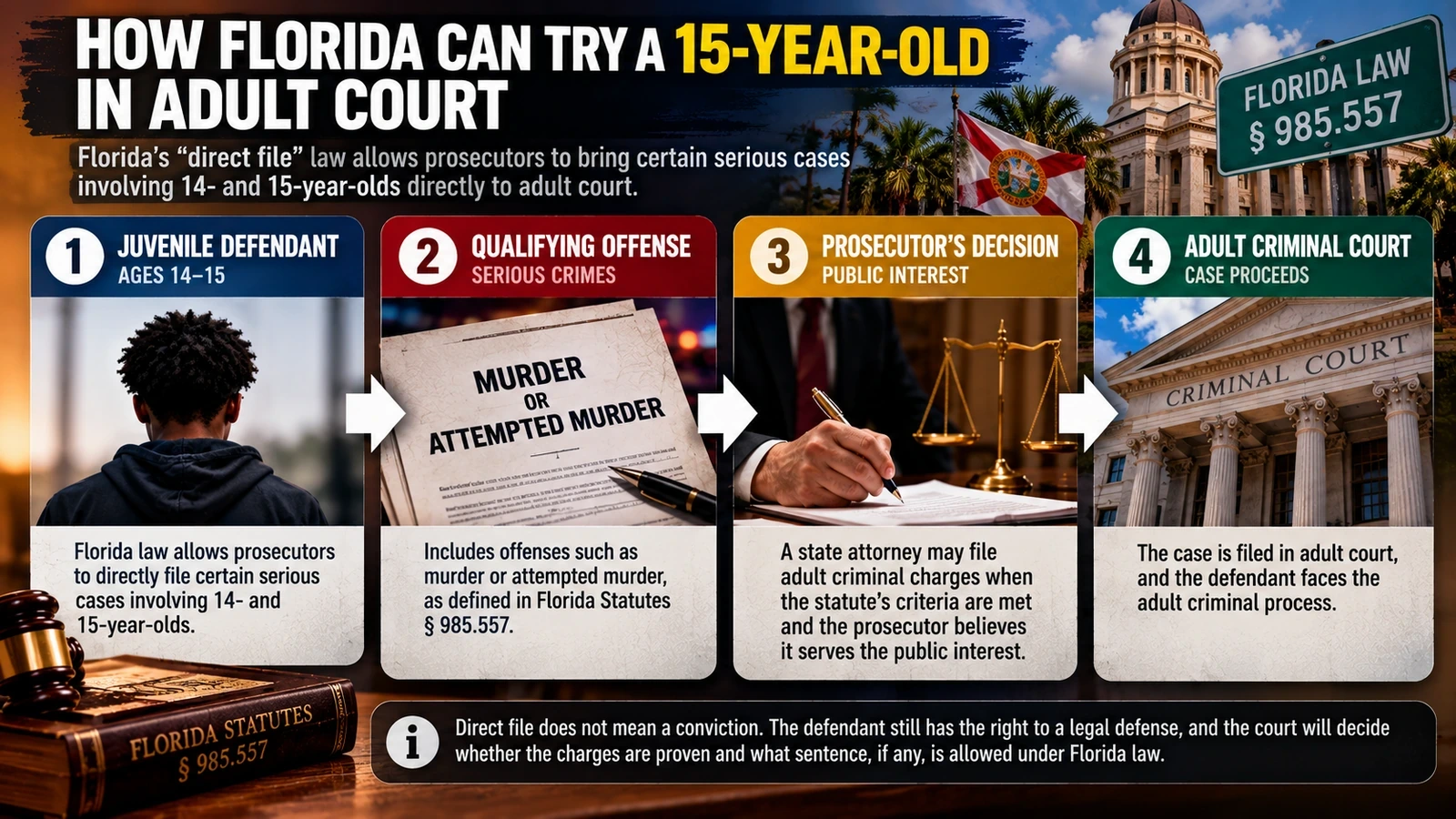
Florida law allows prosecutors to bring certain serious criminal cases involving 14- and 15-year-olds directly into adult court.
The relevant provision is Florida Statutes Section 985.557, which establishes a process commonly called direct file.
Under this law, a state attorney may file adult criminal charges against a 14- or 15-year-old when the alleged conduct involves specified serious offenses—including murder or attempted murder—and the prosecutor determines that considering adult sanctions serves the public interest. (Florida Senate)
What Is the Difference Between Juvenile Court and Adult Court?
Juvenile court generally handles cases involving minors through a system that places substantial emphasis on rehabilitation, supervision, treatment, and accountability appropriate to their age.
Adult criminal court follows the ordinary criminal prosecution framework. Defendants face adult criminal charges and potentially much more serious sentencing consequences.
Florida’s direct-file law creates an important exception to the usual juvenile process.
| Question | Juvenile Court | Adult Criminal Court |
|---|---|---|
| Main legal framework | Juvenile delinquency | Adult criminal prosecution |
| Potential outcomes | Juvenile supervision, treatment, or commitment | Adult penalties or other legally permitted dispositions |
| Who handles the case? | Juvenile court | Adult criminal court |
| Does prosecution mean guilt? | No | No |
The difference is not simply whether the courtroom has adult defendants.
It changes the legal system in which the case is prosecuted and the potential range of consequences.
Does the Prosecutor Need a Judge to Approve Every Transfer?
Not under the direct-file procedure.
Florida has more than one route for moving a juvenile case into adult court. Some involve a judicial waiver process. Direct file is different because the statute gives prosecutors discretion to initiate adult prosecution for specified eligible cases.
That does not eliminate judicial oversight of the criminal proceedings or the defendant’s legal rights.
State Attorney Jack Campbell said he had decided to pursue adult prosecution in Rivers’ case. As of the latest reporting reviewed through October 27, the publicly confirmed development was that prosecutorial decision, not a completed trial or conviction. (WTXL · Florida Senate)
Does Being Tried as an Adult Automatically Mean Adult Prison?
No. Adult prosecution and adult sentencing are separate legal decisions.
Florida Statutes Section 985.565 provides sentencing alternatives for juveniles prosecuted as adults. Depending on the legal circumstances and findings, a court may have options that include adult sanctions, youthful-offender treatment, or juvenile sanctions.
Those alternatives are not available in every situation. Florida law also identifies circumstances in which adult sanctions are required. (Florida Senate)
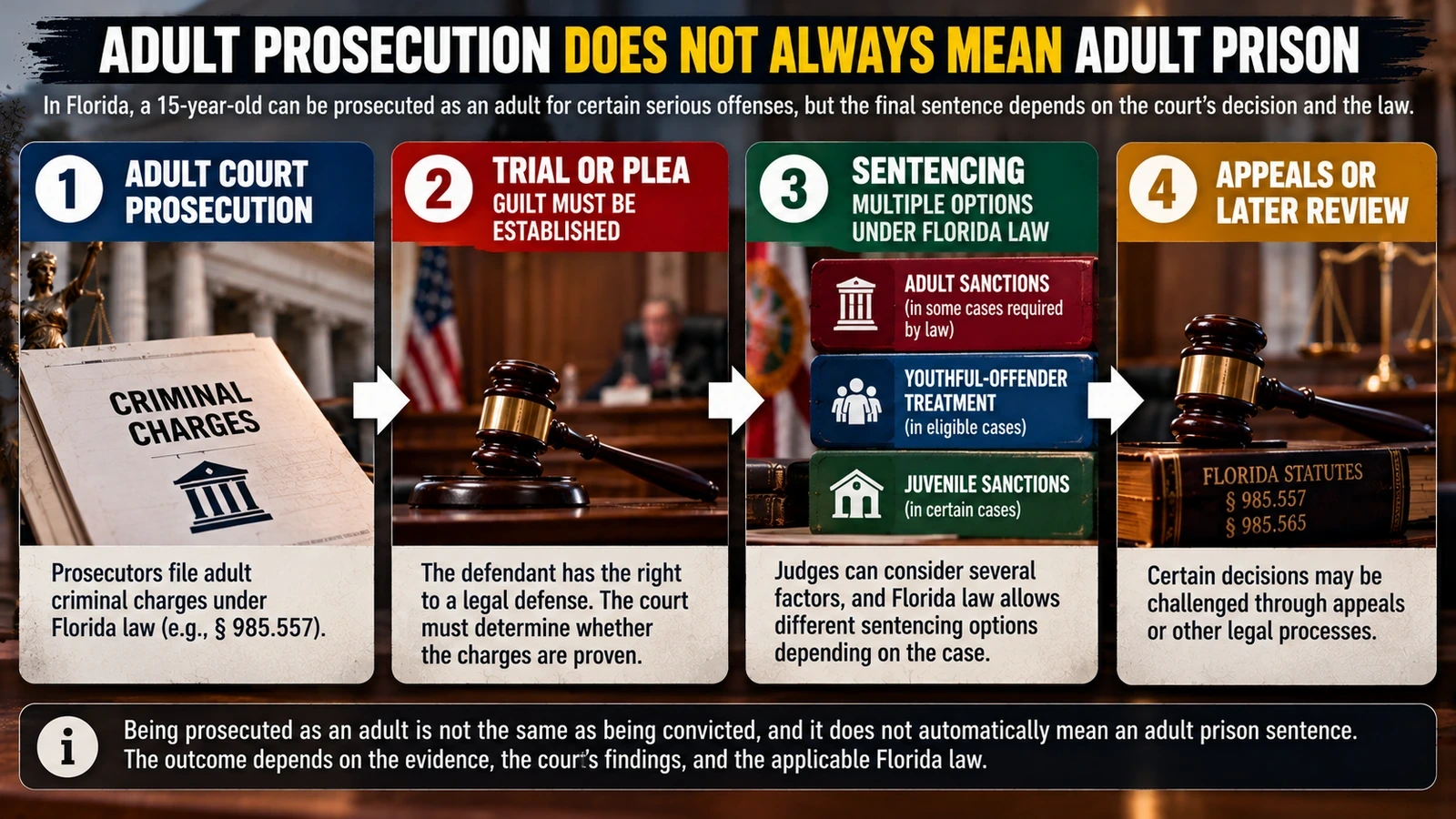
Florida law directs judges to consider several factors when deciding whether juvenile sanctions are appropriate, including the seriousness of the offense, violence involved, the defendant’s maturity and history, public protection, and rehabilitation prospects.
Here is how the stages differ:
| Stage | What It Determines |
|---|---|
| Adult prosecution decision | Which criminal court handles the case |
| Trial or plea | Whether criminal responsibility is established |
| Sentencing | What legally authorized consequences follow |
| Appeals or later review | Whether qualifying decisions can be challenged |
The state attorney’s decision to pursue adult court does not resolve the other stages.
This matters because headlines can make an adult prosecution decision sound like a finished criminal judgment.
For Rivers, those outcomes have not been determined.
What Did the Judge Actually Decide on October 26?
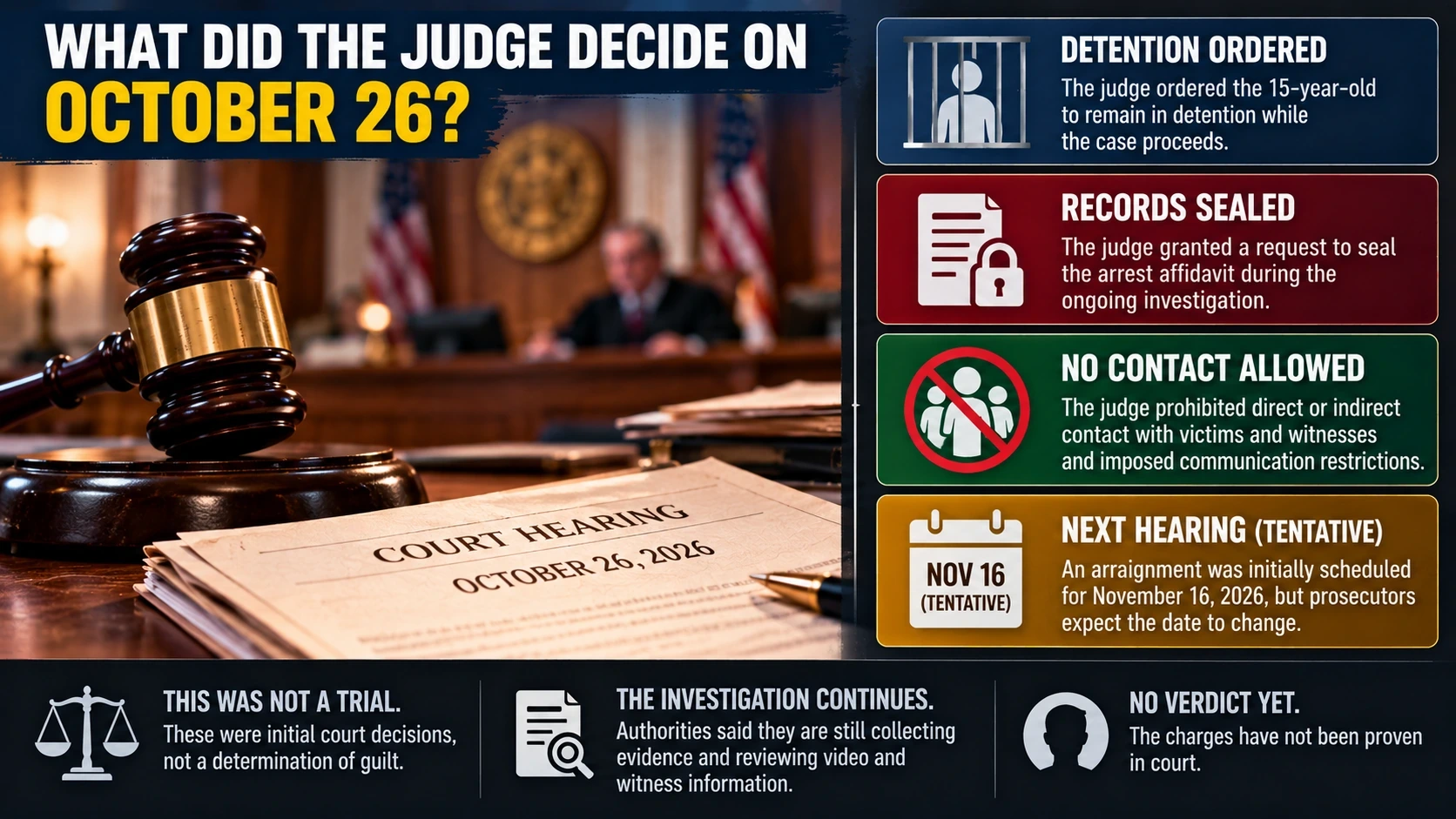
At Rivers’ initial court appearance on Monday, October 26, Leon County Circuit Judge Andrew Sheeran ordered the teenager to remain in detention while the case proceeds.
According to local reporting, the judge also prohibited direct or indirect contact with victims and witnesses and imposed restrictions on his communications.
The court granted a police request to seal the arrest affidavit during the ongoing investigation. (WTXL · WFSU)
Why Were the Arrest Records Sealed?
State Attorney Campbell said investigators were still collecting evidence and needed to preserve details that could help them assess witness accounts.
The public radio station WFSU reported that authorities were gathering surveillance footage, reviewing available video, and seeking additional witnesses.
A judge’s decision to seal certain investigative documents does not mean every part of the court case will necessarily remain closed to the public.
Nor should the lack of publicly available details be treated as proof of allegations circulating online.
What About the Next Court Date?
WTXL reported that an arraignment had initially been scheduled for November 16, 2026, but Campbell expected that date to change as the case moved toward adult court.
An arraignment is typically a proceeding in which formal charges are addressed and the defendant enters a plea.
Because the reported schedule was tentative, November 16 should not be treated as a confirmed final court date. (WTXL)
Why Does This Case Raise a Larger Juvenile Justice Question?
The central policy question is how the justice system should respond when someone accused of extremely serious violence is still a child.
There are two competing concerns.
One is public protection and accountability. Prosecutors pursuing adult court may argue that the alleged conduct is serious enough to warrant adult criminal sanctions being considered.
The other is the purpose of juvenile justice. Adolescents are still developing, and rehabilitation and age-appropriate treatment are important considerations in how the legal system handles them.
Florida’s statutes reflect both concerns by allowing adult prosecution in certain circumstances while retaining specified sentencing alternatives and procedural safeguards.
Neither principle answers whether Rivers is guilty of the alleged offenses.
The serious injuries suffered by people near the stadium are confirmed. The teenager’s individual criminal responsibility remains a question for the legal process.
Treating those two facts separately does not minimize what happened to the victims. It preserves the distinction between an investigated event and a legally established finding of guilt.
What Happens Next in the FAMU Shooting Case?
Several important questions remain unresolved.
Investigators are examining evidence to reconstruct the shooting, identify everyone involved, and determine whether additional arrests are warranted.
Police have specifically requested photos, videos, and witness information from the public. Authorities have said the investigation remains active and additional arrests are possible. (Tallahassee Police Department)
The main developments to watch are:
- The formal adult-court filing: How and when prosecutors formally place the case in adult criminal court.
- The evidence: What available surveillance video, witness statements, and forensic findings establish.
- The charges: Whether prosecutors maintain or modify the counts originally announced.
- The defense response: How Rivers responds through counsel, including any legal challenges or plea.
- The victims’ recovery: Whether authorities provide further medical updates on those injured.
There is also the question of who was involved in the initial confrontation and whether the evidence supports allegations against others.
Police have said the injured people did not appear to be the intended targets. That is a preliminary investigative assessment, not a final finding about what happened or anyone’s criminal responsibility.
The public record remains incomplete.
Bottom Line: What This Story Really Means
The Florida A&M shooting left 12 people injured, including six minors. A 15-year-old was arrested, and prosecutors announced plans to pursue his case in adult court.
Florida law permits that route for certain serious allegations involving children as young as 14, including attempted murder.
But three questions must remain separate:
Can the state prosecute the teenager as an adult? Florida law provides a legal route to do so.
Has he been proven guilty? No. The announced charges and detention order do not establish guilt.
Would adult prosecution automatically require an adult prison sentence? Not necessarily. The answer depends on the eventual findings and applicable sentencing rules.
The case illustrates how a single violent incident can raise difficult questions about public safety, accountability, juvenile justice, and the legal rights of a child accused of a serious crime.
The next meaningful development will come from the evidence and court proceedings—not from treating a prosecutor’s announced decision as a final verdict.
FAMU Shooting: Key Questions Explained
Q. Where did the Florida A&M shooting happen?
The shooting occurred near Perry and Manatee streets outside Bragg Memorial Stadium in Tallahassee, Florida, on October 24, 2026, after FAMU’s homecoming football game.
Q. How many people were shot at FAMU?
Eleven people sustained gunshot wounds. A twelfth person injured an ankle while escaping the gunfire, making 12 reported injured people in total.
Q. Who is Anthony Rivers III?
Anthony Rivers III is the 15-year-old arrested in connection with the shooting. Police announced 11 counts of attempted second-degree murder and a separate firearm-possession charge. The allegations have not been proven in court.
Q. Can a 15-year-old legally be prosecuted as an adult in Florida?
Yes. Under Florida Statutes Section 985.557, prosecutors can directly file certain serious cases involving 14- and 15-year-olds in adult criminal court when the statutory criteria are met.
Q. Has Anthony Rivers III already been convicted?
No. Rivers has been arrested and faces serious criminal allegations, but the initial detention hearing was not a trial, and no conviction was established in the reporting reviewed.
Q. Does being tried as an adult always mean going to adult prison?
No. Florida law provides multiple sentencing possibilities for qualifying juveniles prosecuted as adults, although some circumstances require adult sanctions. The applicable outcome depends on the charges, legal findings, and statutory requirements.
Q. Were the FAMU shooting victims deliberately targeted?
Investigators initially believed that the people injured were not the intended targets. Police said a dispute between individuals who knew each other preceded the gunfire, but the investigation remains open.
Q. Was anyone killed in the FAMU homecoming shooting?
No deaths had been reported in the police updates reviewed. Eleven people suffered gunshot wounds, and one other person was injured while fleeing.
Q. When is the next court hearing?
An arraignment was initially scheduled for November 16, 2026, according to local reporting, but prosecutors expected the date to change during the adult-court process. A replacement date was not confirmed in the reports reviewed.
Did this help make the story clearer? 🙂
WIN keeps unpacking the “why” behind the news—clearly and simply!
Sources
Police Investigation and Shooting Timeline
Tallahassee Police Department — Perry Street Shooting Investigation and October 26 Arrest Update
Associated Press — 15-Year-Old Arrested After Florida A&M Homecoming Shooting
Court Proceedings and Adult Prosecution Decision
WFSU Public Media — Accused Gunman in FAMU-Area Shooting to Face Adult Charges, October 26, 2026
WTXL — Teen Accused in Tallahassee Mass Shooting Will Be Prosecuted as an Adult
Florida Juvenile Justice Law
2026 Florida Statutes, Section 985.557 — Direct Filing and Prosecutorial Discretion
2026 Florida Statutes, Section 985.565 — Sentencing Alternatives for Juveniles Prosecuted as Adults