Why Is Cambridge Analytica Back in the News—and What Did a New Mexico Jury Just Decide?
Wasn’t the Cambridge Analytica scandal supposed to be over years ago?
Facebook paid a $5 billion federal privacy penalty. Cambridge Analytica went out of business after filing for bankruptcy. The scandal that exploded into public view in 2018 seemed to have moved from breaking news into tech history.
Then, on September 25, 2026, a New Mexico jury found Facebook liable for misleading users about privacy protections and other platform practices. The verdict came after a two-week trial in Santa Fe in a lawsuit New Mexico originally filed in 2021. (CBS News/AP)
So this is not a new Cambridge Analytica data breach.
It is a new legal judgment about what Facebook told users before, during and after the scandal—and whether those statements violated New Mexico consumer-protection law.

That distinction explains why a story associated with the 2016 election and the headlines of 2018 is suddenly back in court in 2026.
What Did the New Mexico Jury Actually Decide?

The jury decided that Facebook violated New Mexico’s Unfair Practices Act by making deceptive or unfair statements to consumers. It did not determine the final dollar penalty.
Jurors were asked to examine 34 Facebook statements and found 31 of them unfair or deceptive under New Mexico law. Across those findings, the jury counted more than 43 million violations. (Albuquerque Journal · Source New Mexico)
The smaller figure of “more than 2 million” reported in some coverage refers to one part of the verdict: Facebook’s statements about investigations into data brokers after the Cambridge Analytica revelations. It is not the overall violation count. (CBS News/AP)
The next major question is money.
New Mexico has asked for the maximum civil penalty available under the state’s Unfair Practices Act—up to $5,000 per violation. But Judge Francis Mathew, not the jury, will determine the amount Facebook must actually pay. (Source New Mexico · CBS News/AP)
That means headlines that jump directly from the violation count to a gigantic theoretical penalty are getting ahead of the court.
There is a liability verdict. There is not yet a final monetary judgment.
How Did the Cambridge Analytica Data Chain Actually Work?

One of the easiest ways to misunderstand Cambridge Analytica is to imagine a conventional cyberattack.
That is not what happened.
A researcher, Aleksandr Kogan, developed a Facebook personality-quiz application. People who used the app provided information, but Facebook’s platform at the time also allowed certain information about users’ Facebook friends to be collected through apps those friends used.
The Federal Trade Commission later said Kogan’s application collected information from users and people in their social networks and that data was used with Cambridge Analytica to create personality scores and match them with U.S. voter records. (Federal Trade Commission)
By the time the scandal became public in 2018, Facebook estimated information associated with as many as 87 million profiles could have been improperly shared. The New Mexico trial focused on accusations that Facebook failed to adequately protect or warn users and misrepresented what it was doing about third-party access to data. (Associated Press)
A useful way to see the difference is:
| What many people remember | What the case is actually about |
|---|---|
| “Cambridge Analytica hacked Facebook.” | Data was harvested through Facebook’s third-party app ecosystem. |
| “Only people who took the quiz were affected.” | Friends of app users could also have data collected under Facebook’s former platform rules. |
| “The scandal ended when Cambridge Analytica shut down.” | Regulatory settlements followed, and New Mexico’s separate lawsuit continued. |
| “The 2026 jury was deciding the 2016 election.” | The jury was deciding whether Facebook’s statements and practices violated New Mexico consumer-protection law. |
That last distinction is especially important.
Cambridge Analytica worked for political clients, including Donald Trump’s 2016 presidential campaign, and voter targeting was part of the scandal. But the September 2026 New Mexico verdict was not a judicial ruling on who should have won the 2016 election or whether the election result itself was valid. It was a consumer-protection case about Facebook’s conduct and representations. (Associated Press)
Why Did This Take Until 2026?

Because the scandal produced several different investigations, settlements and lawsuits—and New Mexico chose a separate legal path.
Here is the simplified timeline:
| Year | What happened |
|---|---|
| 2014 | Kogan’s personality app collected Facebook data that was later used in work connected to Cambridge Analytica. |
| 2015 | Facebook became aware that user information had been transferred to Cambridge Analytica, according to later federal enforcement findings. |
| 2018 | The Cambridge Analytica scandal became a major public controversy. |
| 2019 | Facebook agreed to a $5 billion FTC privacy settlement and a separate $100 million SEC settlement. |
| 2021 | New Mexico filed its own lawsuit against Facebook. |
| September 2026 | The case went to trial in Santa Fe. |
| September 25, 2026 | The jury found Facebook liable under New Mexico consumer-protection law. |
The Securities and Exchange Commission said Facebook knew by December 2015 that a researcher had improperly transferred information involving tens of millions of users to Cambridge Analytica, while the company continued for more than two years to describe misuse of user data in public filings as a hypothetical risk. Facebook ultimately settled the SEC case for $100 million without admitting or denying the allegations. (U.S. Securities and Exchange Commission)
The FTC case was even larger.
In 2019, Facebook agreed to pay $5 billion and accept a new privacy oversight structure to resolve allegations that it had violated a previous FTC privacy order. The settlement included board-level privacy oversight and additional compliance requirements. (Federal Trade Commission)
So why was New Mexico still able to go to trial?
Because this was a separate state lawsuit under New Mexico law. The state filed the case in 2021 and pursued its own allegations about representations made to New Mexico consumers. The New Mexico court identifies the case as State of New Mexico, et al. v. Facebook, Inc., D-101-CV-2021-00132. (New Mexico Courts)
Why Was New Mexico Still Fighting When So Many Other Cases Settled?

New Mexico had gone its own way before the September trial.
When the case opened, the Associated Press reported that New Mexico was the only state taking a Cambridge Analytica-related Facebook case all the way to trial. In August 2026, Meta separately reached a multistate settlement over youth-safety claims; participating states also agreed to release future liability tied to the Cambridge Analytica privacy breach. New Mexico’s already-pending 2021 Facebook case continued. (Associated Press · CBS News/AP)
The practical result was unusual: years after federal agencies had imposed major privacy penalties, a Santa Fe jury was still being asked to examine Facebook’s statements one by one.
Jurors considered 34 of them.
They found violations involving 31.
That is one reason the September 25 verdict matters beyond the history of Cambridge Analytica. It tests whether an old privacy scandal can still produce new state-law liability years after federal settlements and corporate changes.
Is This the Same Meta Case That Already Cost $942 Million in New Mexico?

No. This is a different lawsuit.
That is easy to miss because both cases involve Meta, both were tried in Santa Fe, both rely in part on New Mexico’s Unfair Practices Act, and both produced major 2026 headlines.
But they concern different conduct.
| Case | Main issue | 2026 status |
|---|---|---|
| New Mexico child-safety case | Allegations involving youth safety, sexual exploitation risks and platform design | Jury awarded $375 million; judge later ordered another $567 million and platform changes |
| Cambridge Analytica/privacy case | Statements about user privacy, third-party data access and related Facebook practices | Jury found Facebook liable on September 25; financial penalty still to be decided |
The child-safety case produced $942 million in combined financial liability after the March jury verdict and August court judgment. It also resulted in requirements involving protections for young users in New Mexico. Meta has challenged those rulings. (New Mexico Department of Justice)
The Cambridge Analytica case has not yet produced a comparable final dollar figure.
Do not add the new verdict to $942 million yet.
The September jury decided liability. Judge Mathew still has to decide the financial consequences of that verdict.
What Did Facebook Say in Its Defense?
Facebook argued that New Mexico was asking jurors to judge an older version of the company without giving enough weight to changes made since the Cambridge Analytica scandal.
Its lawyers argued that much of the state’s evidence was outdated and emphasized that Facebook had investigated suspicious apps, restricted developers and improved privacy and safety protections after the scandal. (CBS News/AP)
After the verdict, Meta said it disagreed with the jury’s decision and would continue defending its record. The company also argued that First Amendment questions were part of the case because some challenged statements concerned how Facebook manages speech and content on its platform. (CBS News/AP)
Those arguments matter because the trial went beyond a single question—“Did Cambridge Analytica receive Facebook data?”
The jury also examined what Facebook told consumers about its privacy controls, investigations of data brokers and other platform practices.
The verdict therefore does not mean every claim New Mexico made about Facebook was accepted wholesale. Jurors rejected three of the 34 challenged statements while finding violations involving the other 31. (Albuquerque Journal)
What Happens After the Jury Verdict?
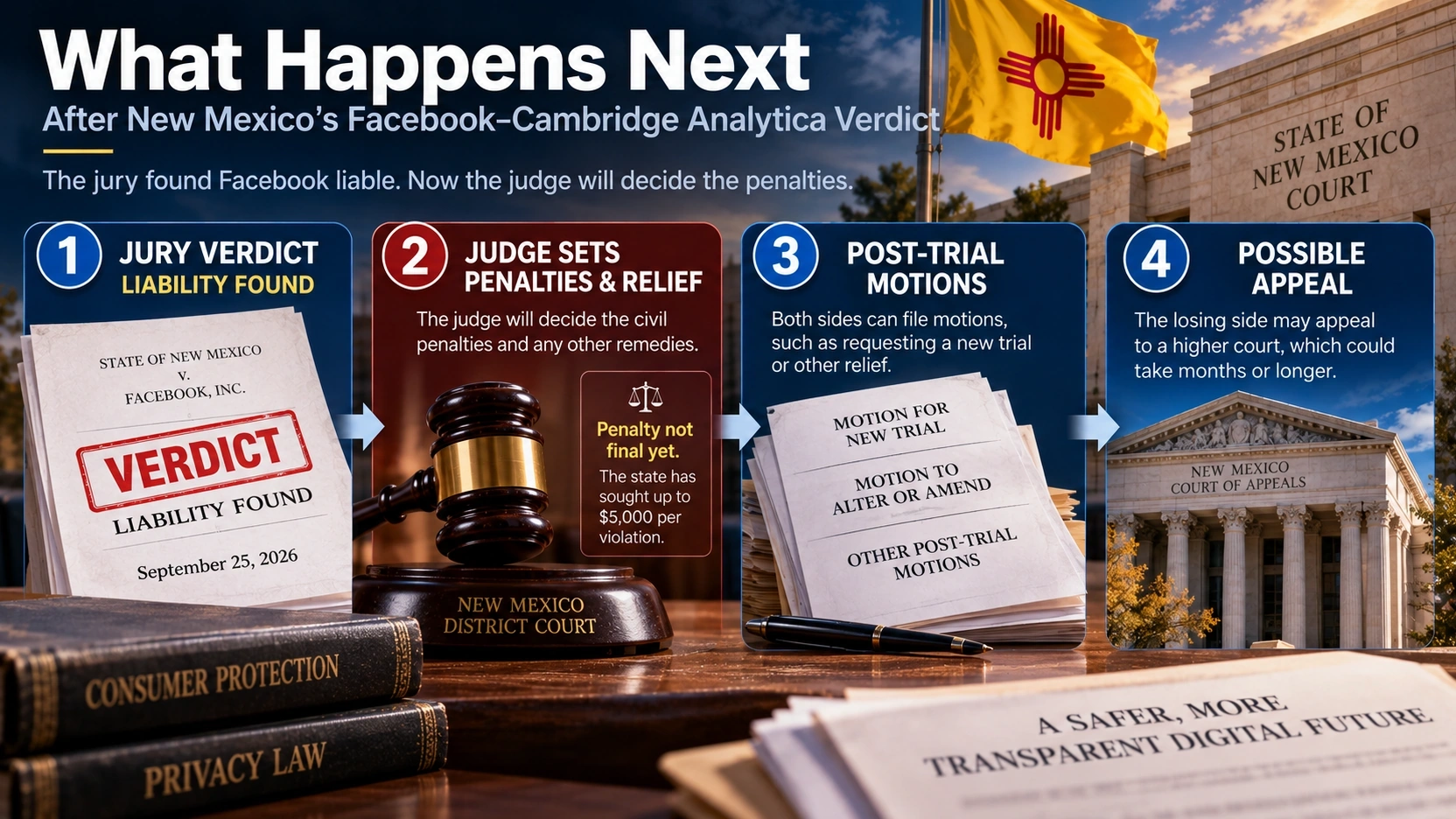
The September 25 verdict settles one major question at the trial level: the jury found Facebook liable.
It does not settle everything else.
The next steps can include:
- Judge Francis Mathew determining civil penalties. New Mexico has asked for the maximum allowed under the Unfair Practices Act.
- Consideration of additional relief. The state entered the trial seeking both civil penalties and injunctive relief intended to prevent similar conduct. (New Mexico Department of Justice)
- Post-trial motions. Meta can ask the trial court to alter or set aside aspects of the verdict.
- An appeal. Meta has publicly disputed the verdict, making further litigation a realistic next stage.
That means September 25 is better understood as a major new milestone than the end of the Cambridge Analytica legal story.
The scandal exposed a basic weakness in the old Facebook ecosystem: one person’s decision to use an app could expose information connected to many other people.
The 2026 trial asked a different question.
What happens when a platform tells millions of people that their information is protected, but a jury later concludes that many of those statements were deceptive?
New Mexico’s answer, at least at the trial stage, is that old promises about digital privacy can still carry legal consequences years later.
Why It Matters in One Sentence
The Cambridge Analytica scandal is back in the news not because another breach happened, but because a New Mexico jury has now found Facebook legally responsible for deceptive statements about privacy and related practices—and a judge must still decide how costly those violations will be.
Cambridge Analytica: Key Questions Explained
Q. What did the New Mexico jury decide about Facebook?
The jury found that Facebook engaged in unfair or deceptive practices in violation of New Mexico’s Unfair Practices Act. It found violations involving 31 of 34 challenged company statements. (Albuquerque Journal · Source New Mexico)
Q. Has Meta already been ordered to pay billions of dollars in this case?
No. The jury decided liability and the number of violations, but Judge Francis Mathew still has to determine the civil penalty. New Mexico is seeking up to $5,000 per violation. (CBS News/AP)
Q. Did Cambridge Analytica hack Facebook?
Not in the conventional sense of breaking into Facebook’s servers. The controversy centered on information collected through a third-party Facebook app and the way Facebook’s former platform rules allowed data connected to app users and their friends to be accessed. (Federal Trade Commission)
Q. How many Facebook profiles were involved in the Cambridge Analytica scandal?
Facebook estimated that information associated with as many as 87 million profiles may have been improperly shared. (Associated Press)
Q. Why is this being decided in 2026 if the scandal became public in 2018?
New Mexico filed its lawsuit in 2021, and the case proceeded separately through years of litigation before reaching a jury trial in September 2026. (New Mexico Courts)
Q. Is this the same New Mexico Meta lawsuit that produced $942 million in penalties and remedies?
No. The $942 million figure comes from a separate New Mexico case involving child safety and harms to young users. The Cambridge Analytica privacy case is a different lawsuit, and its financial penalty has not yet been finalized. (New Mexico Department of Justice)
Q. Was the jury deciding whether Cambridge Analytica changed the result of the 2016 election?
No. The trial concerned whether Facebook violated New Mexico consumer-protection law through deceptive or unfair statements and practices. The verdict was not a ruling on the legitimacy or outcome of the 2016 presidential election. (Albuquerque Journal)
Q. What happens next in the Facebook privacy case?
The judge must determine penalties and potentially other relief, after which Meta can pursue post-trial challenges and an appeal. Meta has said it disagrees with the verdict and will continue defending its position. (CBS News/AP)
Did this help make the story clearer? 🙂
WIN keeps unpacking the “why” behind the news—clearly and simply!
Sources
September 25 Jury Verdict and Current Case
Associated Press/CBS News — Jury Finds Facebook Liable in Cambridge Analytica Case
Source New Mexico — New Mexico Jury Finds Facebook at Fault Over Data Collection
Albuquerque Journal — Jury Finds Meta Violated New Mexico Consumer Law
New Mexico Courts — High Profile Cases
Cambridge Analytica and Facebook Privacy History
Federal Trade Commission — $5 Billion Facebook Privacy Settlement
Federal Trade Commission — Cambridge Analytica, Kogan and Nix Enforcement Action
U.S. Securities and Exchange Commission — Facebook $100 Million Data-Misuse Disclosure Case
New Mexico Litigation and Separate Meta Case
New Mexico Department of Justice — Cambridge Analytica Facebook Trial Begins
New Mexico Department of Justice — Separate $942 Million Meta Child-Safety Judgment