Why Is Missouri Using Its Old Congressional Map After Holding the Primary Under a New One?
Missouri voters already cast their congressional primary ballots under one set of district lines.
So how can they vote in the November general election under a different map?
And when the U.S. Supreme Court stepped in on September 25, did the justices finally decide which map is legally valid?
Not exactly. Missouri’s map fight is confusing because several different legal questions collided at once: whether the 2025 map satisfied state redistricting rules, whether voters had a valid right to force a referendum on that map, whether switching maps between a primary and general election created a federal constitutional problem, and whether courts could still change the rules after voting had already begun. (Missouri Supreme Court · Eighth Circuit · U.S. Supreme Court)
The immediate result is much simpler: Missouri is proceeding with the congressional districts enacted in 2022 for the November 3, 2026 general election. On September 25, the U.S. Supreme Court stayed lower-court orders that would have required the state to use the 2025 map. By then, ballots using the 2022 districts had already been printed and mailed, absentee voting had begun, and military and overseas voting was underway. (U.S. Supreme Court · CBS News)
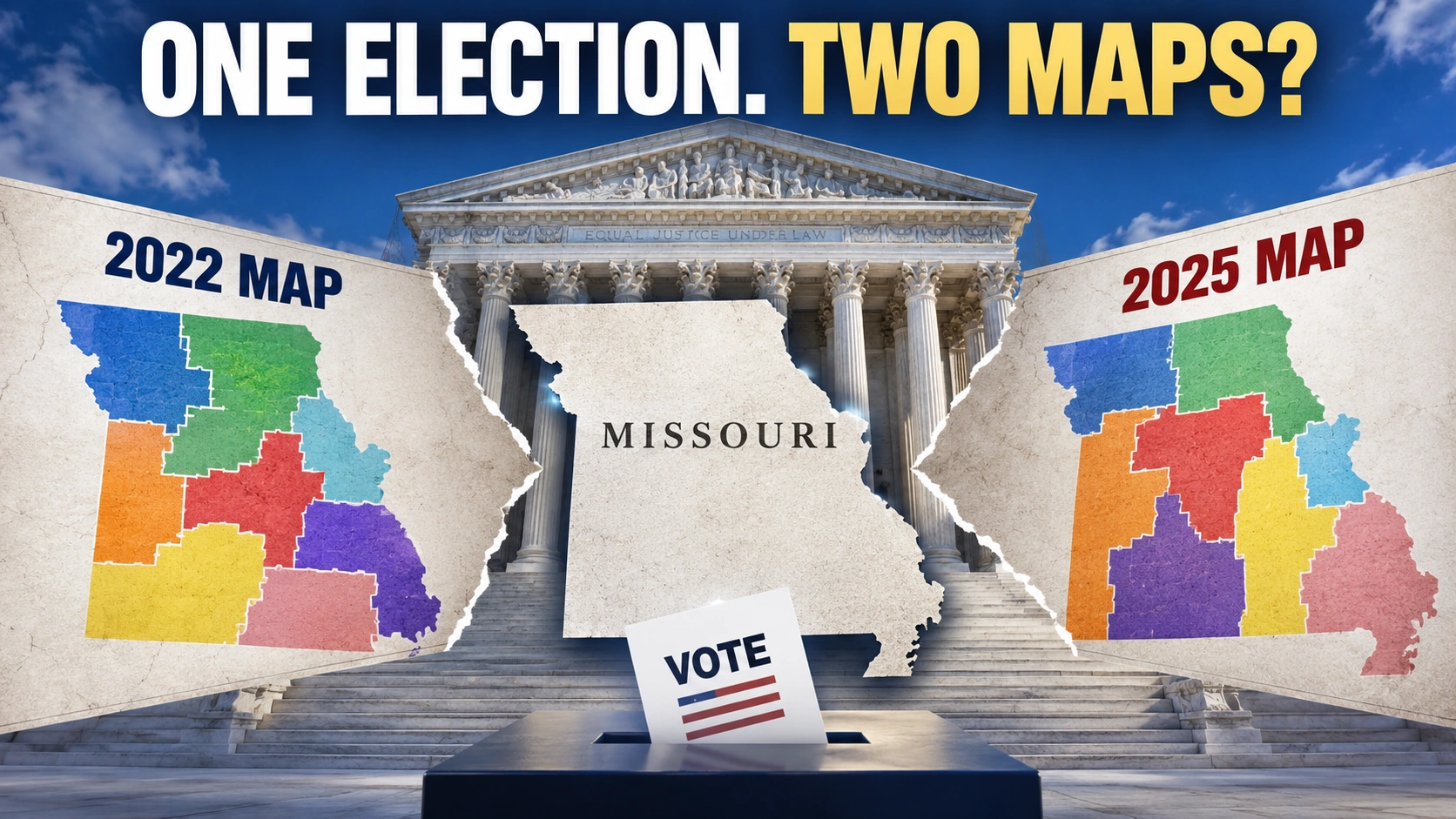
But understanding how Missouri reached that point requires going back more than a year.
How Did Missouri End Up With a New Map in the Middle of the Decade?

Missouri drew congressional districts in 2022 after the 2020 census, as states normally do at the beginning of a decade. Those districts were used in the 2022 and 2024 elections. (Eighth Circuit)
Then, in September 2025, Missouri’s Republican-controlled legislature passed House Bill 1, creating a new congressional map before the next census. Gov. Mike Kehoe signed it on September 28. The plan substantially reconfigured the Kansas City area and Democratic Rep. Emanuel Cleaver’s 5th District. Supporters described the plan as a lawful mid-decade redraw; critics argued it was designed to improve Republican chances of gaining another U.S. House seat. (Missouri Governor’s Office · AP)
Missouri currently sends eight members to the U.S. House, with six seats held by Republicans and two by Democrats. The 2025 map would have made the Kansas City-based Democratic seat more competitive for Republicans and created a path to a possible 7–1 Republican delegation if the GOP won the reconfigured district. That was a potential partisan effect of the map, not a guaranteed election result. (AP · Reuters)
The unusual part was not merely that Missouri changed its map. It was that the state did so mid-decade, without a new census requiring a redraw.
Didn’t Missouri’s Supreme Court Already Uphold the 2025 Map?
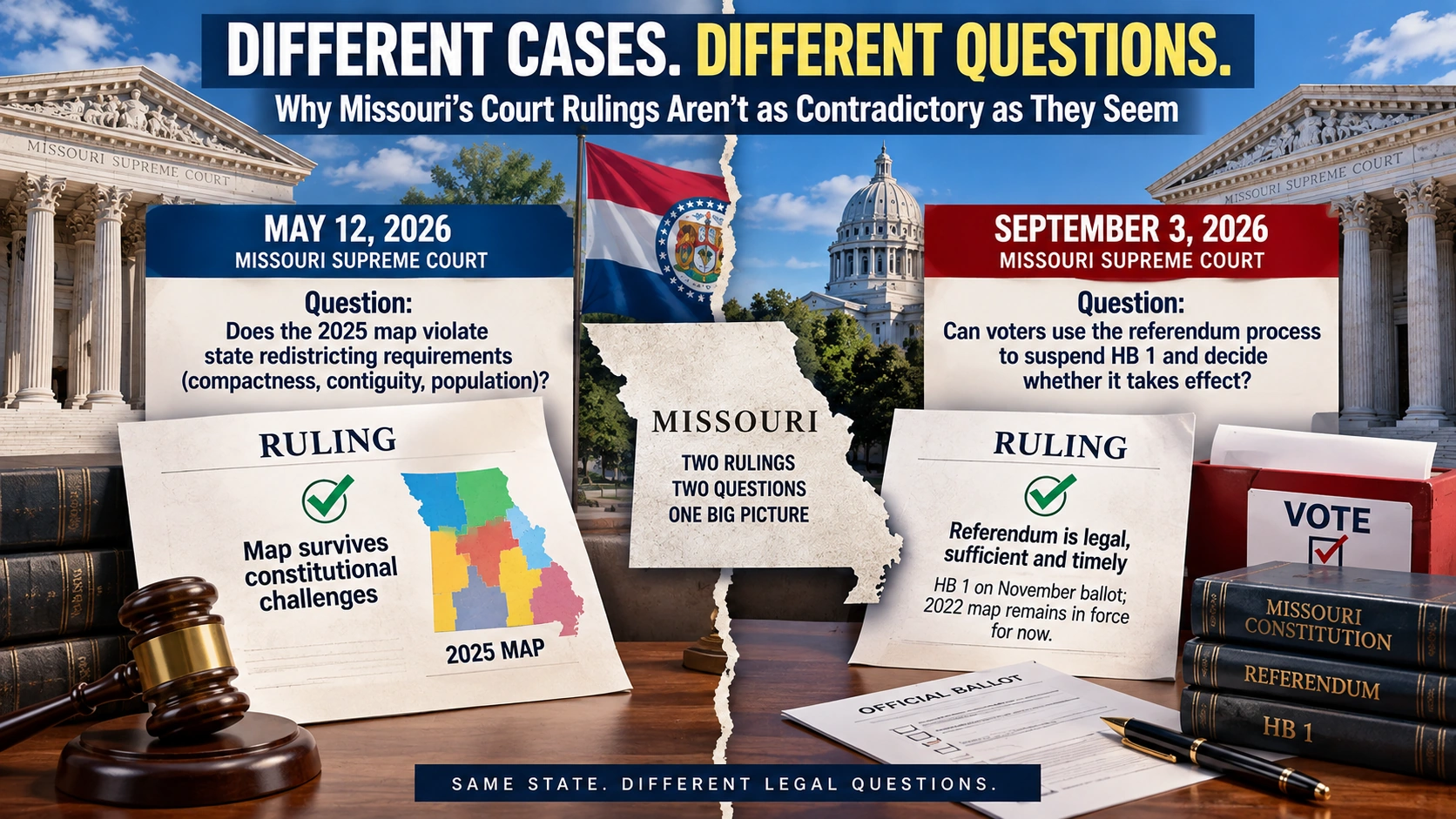
Yes—but that ruling answered a different question.
On May 12, 2026, the Missouri Supreme Court rejected challenges claiming the 2025 districts violated the state constitution’s requirements involving compactness, contiguity and population equality. The court emphasized that those cases concerned the specific constitutional standards the challengers had raised; the plaintiffs had not brought a partisan-gerrymandering claim. (Healey v. State)
That did not settle the separate referendum fight.
Missouri’s constitution reserves to voters the power to approve or reject acts of the General Assembly through a referendum, subject to specified exceptions. Opponents of HB 1 had submitted petitions seeking such a statewide vote. (Missouri Constitution)
Earlier in the process, the Missouri Supreme Court had concluded that merely filing referendum petitions did not automatically suspend the new law before officials determined whether the petitions were legally sufficient. That helped explain why state officials continued preparing the 2026 election using the 2025 map. (Maggard v. State)
Then came the crucial change.
On September 3, the Missouri Supreme Court ruled that the referendum petition was legal, sufficient and timely. Under the court’s reading of Missouri law, that meant HB 1 had never taken effect because the valid referendum process suspended it pending the voters’ decision. The court ordered the referendum onto the November ballot and said the 2022 districts remained the operative congressional map. (Missouri Supreme Court)
So the two rulings are not as contradictory as they first appear:
| Question | Missouri Supreme Court’s answer |
|---|---|
| Did the 2025 map violate the specific state constitutional redistricting requirements challenged in May? | The challengers did not prove that it did. |
| Could voters use Missouri’s referendum process to suspend HB 1 and decide whether it takes effect? | Yes. |
| What map therefore remained in force after the referendum was certified as valid? | The 2022 map. |
That distinction is the first key to understanding the case.
Then Why Was the 2025 Map Used in the August Primary?

Because the decisive referendum ruling came after the primary.
Missouri Secretary of State Denny Hoskins rejected the referendum petition on August 4, 2026, concluding that the state constitution did not permit a referendum on a congressional redistricting act. Missouri held its congressional primaries that same day using the 2025 districts. (Missouri Supreme Court)
The Missouri Supreme Court reversed that decision on September 3. It said the state constitution permits a referendum on an act of the General Assembly such as HB 1 and ordered the state to use the 2022 districts for the general election unless voters ultimately approved HB 1. (Missouri Supreme Court)
That created the strange situation at the center of the federal case:
Candidates were nominated under one map, while the state was preparing to conduct the general election under another.
More than 1.2 million Missourians voted in the August 4 primary under the 2025 districts, according to the Eighth Circuit’s opinion. (Eighth Circuit)
That is where the dispute stopped being only a question of Missouri law.
Why Did Federal Courts Try to Put the 2025 Map Back?

Two congressional candidates and two voters went to federal court arguing that switching maps between the primary and general election created federal constitutional problems.
Their basic argument was straightforward: if voters selected nominees in one district, could those nominees then compete in a general election containing a different group of voters?
A federal district judge sided with that argument in a temporary order requiring use of the 2025 map. On September 10, however, the U.S. Supreme Court stayed the federal court’s orders, leaving the 2022 map in place while the case continued. Missouri’s secretary of state then instructed local election authorities to use the 2022 districts. (U.S. Supreme Court · Missouri Secretary of State)
The federal case did not end there.
On September 21, a panel of the U.S. Court of Appeals for the Eighth Circuit held that using the 2022 map in the general election after conducting the primary under the 2025 map would violate the Constitution and federal law. It directed the district court to issue a permanent injunction barring use of any map other than the 2025 map. (Eighth Circuit)
But the appeals court delayed that order until September 28 so the dispute could return to the U.S. Supreme Court.
That produced the third major turn in less than three weeks.
What Did the U.S. Supreme Court Actually Do on September 25?

The Supreme Court stopped the federal lower courts from forcing Missouri to switch back to the 2025 map.
Its September 25 action stayed the lower-court judgment requiring the 2025 map and left Missouri free to use the 2022 districts for the 2026 congressional election. The Court said the election had already started and warned that another late map change would create serious disruption. (U.S. Supreme Court · CBS News)
Timing was central.
By then:
| Election step | Status |
|---|---|
| Ballots based on the 2022 districts | Printed |
| Mail ballots | Already being sent |
| Absentee voting | Underway |
| Military and overseas voting | Underway |
| Some ballots | Already cast |
The Court described the election as already underway and warned that another last-minute switch could produce serious disruption. (CBS News)
This reflects a broader principle in federal election cases often associated with Purcell v. Gonzalez: courts are generally cautious about changing election rules close to an election when doing so could create voter confusion or administrative disruption.
An unusual twist here is that both sides invoked that principle.
Supporters of the 2025 map argued that switching away from the districts used during candidate filing and the primary created the disruption. Opponents argued that, by late September, election officials had already moved forward under the 2022 map, making another switch even more disruptive. (Eighth Circuit · U.S. Supreme Court)
By September 25, the Supreme Court focused on the situation that actually existed on the ground: ballots tied to the 2022 map were already moving through the election system.
Did the Supreme Court Rule That the 2025 Map Is Unconstitutional?
No.
That is one of the easiest parts of the story to misunderstand.
The September 25 action was an emergency stay ruling about which map could be required during the ongoing 2026 election process. It did not finally decide every underlying federal constitutional question surrounding Missouri’s redistricting dispute. The emergency case arose from the Eighth Circuit litigation, and the Court stayed the lower-court judgment while the election proceeded under the 2022 map. (U.S. Supreme Court)
Nor did the U.S. Supreme Court decide whether partisan considerations made the 2025 map unlawful.
The relevant state-law conclusion came from the Missouri Supreme Court: because the referendum petition was legally sufficient, HB 1 had not taken effect, and the 2022 map remained Missouri’s operative map unless and until voters approved HB 1. (Missouri Supreme Court)
That means three different statements can all be true at once:
- Missouri’s 2025 map survived earlier challenges to specific state constitutional redistricting requirements.
- Missouri’s Supreme Court later concluded that a valid referendum prevented HB 1 from taking effect before voters had their say.
- The U.S. Supreme Court then prevented federal lower courts from forcing the state to switch back to the 2025 districts once the November election under the 2022 map was already underway.
The cases involved overlapping facts, but they were not all deciding the same legal question.
Why Does Emanuel Cleaver’s District Matter So Much?
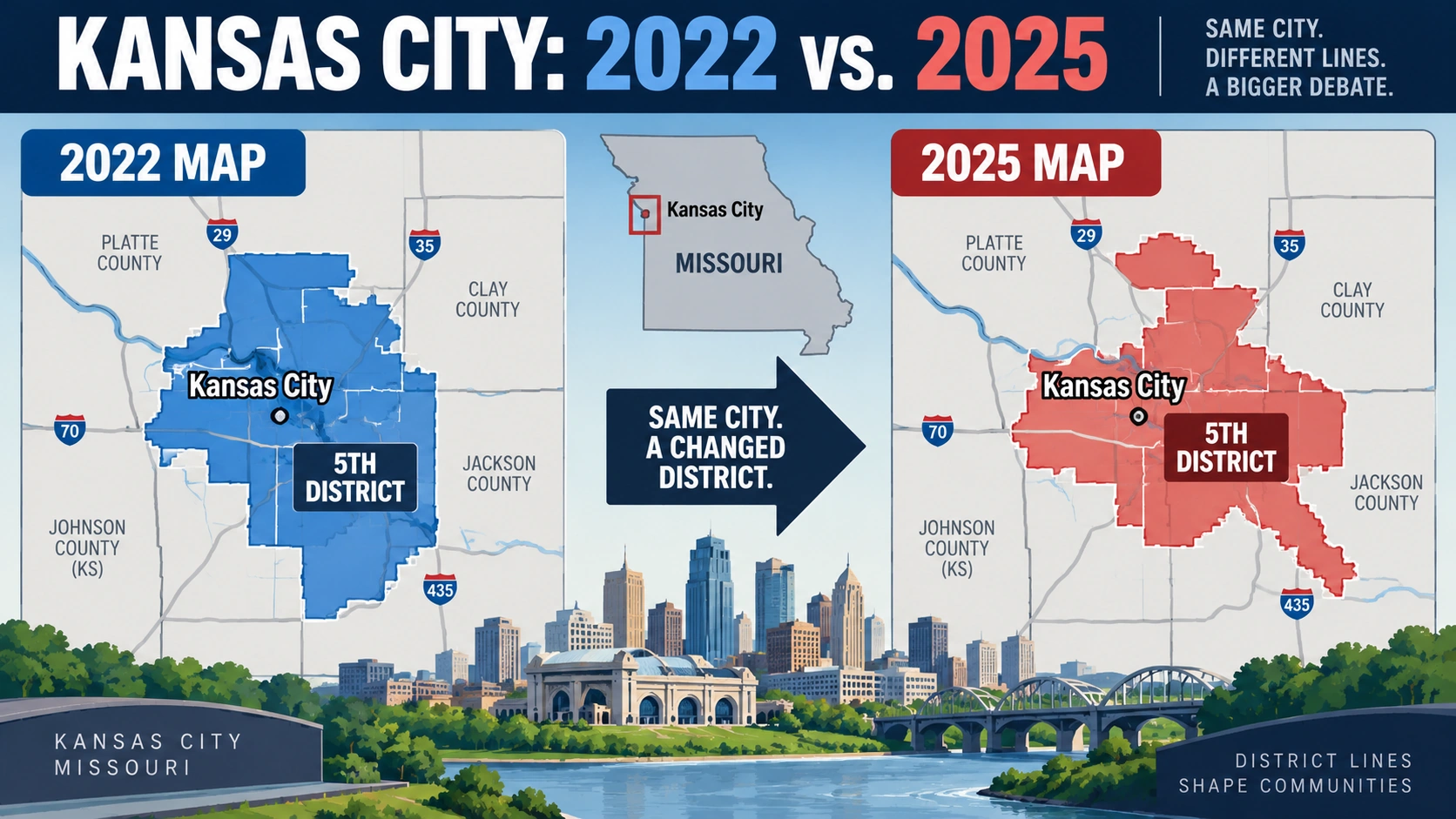
The national political significance centers heavily on Missouri’s 5th Congressional District.
Under the 2022 map, the Kansas City-based district is represented by Democrat Emanuel Cleaver. In the 2024 general election, Cleaver received about 60% of the vote in that district, according to official Missouri results. (Missouri Secretary of State)
The 2025 map divided Kansas City differently and shifted portions of the metropolitan area among multiple congressional districts. Republican supporters said the new boundaries better represented Missouri, while Democrats and other critics argued that the plan was intended to weaken Cleaver’s existing constituency. Major news organizations described the map as potentially giving Republicans an opportunity to win a seventh Missouri House seat. (Missouri Governor’s Office · AP · Reuters)
That does not mean a particular 2026 result can be assumed from either map. District boundaries affect the electorate, but candidates, turnout and voter behavior still determine the election.
What the map changes is who votes with whom.
And in a closely divided U.S. House, changing even one district can have national consequences.
So Can the Primary and General Election Really Use Different Maps?
For 2026, that is now the practical outcome Missouri is preparing to administer.
The August primary was held using the 2025 districts. The November congressional general election is proceeding under the 2022 districts after the state-court referendum ruling and the U.S. Supreme Court’s emergency interventions. (Eighth Circuit · U.S. Supreme Court)
That means some voters can find themselves in a different congressional district from the one in which they participated during the primary. Some general-election candidates can also face an electorate whose geographic boundaries differ from those used to nominate them.
The Eighth Circuit held that using the 2022 map after the 2025-map primary violated federal constitutional requirements. The Supreme Court’s September 25 action, however, prevented that lower-court remedy from controlling the ongoing election. (Eighth Circuit · U.S. Supreme Court)
The Supreme Court therefore resolved the immediate operational question without necessarily resolving every broader legal theory raised by the dispute.
That distinction matters: what map Missouri uses in November and what constitutional rules future courts may establish for similar situations are not necessarily the same question.
What Happens to the 2025 Map Now?

The 2025 map has not simply disappeared from Missouri law and politics.
The Missouri Supreme Court ordered the HB 1 referendum placed on the November 2026 ballot. Under that ruling, the 2025 map does not take effect unless voters approve it; the court said an approved HB 1 would take effect 30 days after the election. (Missouri Supreme Court)
So Missouri voters face two related but distinct actions in November:
For U.S. House races: the election is proceeding under the 2022 congressional districts.
For the referendum: voters can separately decide whether HB 1, containing the 2025 congressional plan, should take effect. The official ballot language says a “yes” vote approves HB 1 and a “no” vote leaves the 2022 boundaries in place. (Missouri Secretary of State)
That is another reason headlines saying the 2025 map was simply “overturned” can be misleading.
For the immediate congressional election, the 2022 map is controlling.
The longer-term fate of HB 1 remains tied to Missouri’s referendum process and any subsequent litigation or legal developments.
The Timeline That Makes the Missouri Map Fight Easier to Follow
| Date | What happened | Map status |
|---|---|---|
| 2022 | Missouri enacted post-census congressional districts | 2022 map |
| September 2025 | Legislature passed HB 1 with new districts | 2025 map enacted |
| September 28, 2025 | Gov. Mike Kehoe signed HB 1 | 2025 map |
| December 2025 | Referendum petitions submitted | Legal effect disputed |
| May 12, 2026 | Missouri Supreme Court rejected separate structural challenges to the new map | 2025 map remained in use |
| August 4, 2026 | Secretary of State rejected referendum petition; congressional primary held | Primary used 2025 map |
| September 3 | Missouri Supreme Court ruled referendum valid and said HB 1 had not taken effect | 2022 map restored |
| September 10 | U.S. Supreme Court stayed a federal order requiring the 2025 map | 2022 map remained |
| September 21 | Eighth Circuit ruled the 2025 map should be used | Order temporarily paused |
| September 25 | U.S. Supreme Court stayed that ruling after voting under the 2022 map had begun | 2022 map for November |
The sequence is supported by Missouri court records, federal court opinions, election guidance and contemporaneous reporting. (Missouri Supreme Court · Eighth Circuit · U.S. Supreme Court)
Why It Matters in One Sentence
Missouri is using its 2022 congressional map in November not because the U.S. Supreme Court permanently declared the 2025 map invalid, but because the Missouri Supreme Court held that a valid referendum prevented HB 1 from taking effect and the U.S. Supreme Court blocked a late federal-court-ordered switch after voting under the 2022 map had begun. (Missouri Supreme Court · U.S. Supreme Court · CBS News)
Missouri Redistricting: Key Questions Explained
Q. Which congressional map will Missouri use in the November 2026 election?
Missouri is proceeding with the congressional districts enacted in 2022. The U.S. Supreme Court’s September 25 action blocked lower federal courts from requiring use of the 2025 map for the ongoing election. (U.S. Supreme Court · CBS News)
Q. Which map did Missouri use in the August 2026 primary?
The state held its August 4 congressional primary under the 2025 map. The Missouri Supreme Court’s decisive referendum ruling came about a month later. (Eighth Circuit · Missouri Supreme Court)
Q. Why did Missouri switch back to the 2022 congressional map?
The Missouri Supreme Court determined that the referendum petition challenging HB 1 was legal, sufficient and timely. Under its interpretation of Missouri law, HB 1 therefore had not taken effect, leaving the 2022 map in force. (Missouri Supreme Court)
Q. Did the U.S. Supreme Court rule that Missouri’s 2025 map is unconstitutional?
No. The September 25 action stayed the lower-court judgment requiring the 2025 map during the ongoing election. It was not a final merits ruling declaring the 2025 map unconstitutional. (U.S. Supreme Court)
Q. Why had Missouri’s Supreme Court previously allowed the 2025 map?
Earlier cases addressed different questions. In May, the court rejected challenges to the map under specific state constitutional standards for congressional districts. The later September case dealt with whether Missouri voters had a valid referendum right that prevented HB 1 from taking effect. (Healey v. State · Missouri Supreme Court)
Q. Why did the Eighth Circuit want Missouri to use the 2025 map?
The federal appeals court held that using the 2022 map after the primary had been conducted under the 2025 districts violated the Constitution and federal law. It ordered use of the 2025 map, but the U.S. Supreme Court stayed that remedy before it could control the ongoing election. (Eighth Circuit · U.S. Supreme Court)
Q. Why did the Supreme Court focus so heavily on timing?
By September 25, ballots using the 2022 map had already been printed and mailed, absentee voting had started, and military and overseas voting was underway. The Court said another late change risked serious election disruption. (U.S. Supreme Court · CBS News)
Q. What happens to Missouri’s 2025 map after the November election?
HB 1 is also the subject of a statewide referendum. Under the Missouri Supreme Court’s ruling, it does not take effect unless voters approve it; the official ballot language says a “no” vote leaves the 2022 congressional boundaries in place. (Missouri Supreme Court · Missouri Secretary of State)
Q. Why is this congressional map politically important?
The 2025 plan substantially changes the Kansas City area and the district represented by Democrat Emanuel Cleaver. AP and Reuters reported that the new boundaries could give Republicans an opportunity to compete for a seventh Missouri House seat, though the actual election result would still depend on voters. (AP · Reuters)
Did this help make the story clearer? 🙂
WIN keeps unpacking the “why” behind the news—clearly and simply!
Sources
September 25 Supreme Court Action and Election Status
U.S. Supreme Court docket — People Not Politicians v. Onder, No. 26A388
CBS News — Supreme Court again blocks Missouri’s new map
KCUR / St. Louis Public Radio — U.S. Supreme Court again blocks Missouri map
Missouri Referendum and State-Law Ruling
Supreme Court of Missouri — von Glahn v. Hoskins, September 3, 2026
Missouri Constitution, Article III, Section 49
Healey v. State — May 12, 2026 Missouri Supreme Court decision
Maggard v. State — May 12, 2026 Missouri Supreme Court decision
Missouri Secretary of State — 2026 Ballot Measures and HB 1 Referendum
Missouri Secretary of State — September 10 map guidance
Federal Court Dispute Over Primary and General Election Maps
Eighth Circuit — Onder v. von Glahn opinion, September 21, 2026
Reuters — Appeals court backs Missouri’s 2025 congressional map
AP — Appeals court ruling and Missouri map dispute
2025 Map and Kansas City Background
Missouri Governor’s Office — Governor Kehoe Signs Missouri First Map into Law
Missouri Office of Administration — 2025 U.S. Congressional House Maps