What Is the SAVE Voter Database—and What Did the Supreme Court Actually Allow?
Wasn’t SAVE originally a government system for checking whether someone qualified for certain public benefits?
So why is the U.S. Supreme Court now deciding whether it can be used in connection with voter rolls?
The answer is that SAVE is no longer the same tool it was for most of its history.
The federal government dramatically expanded the system in 2025, connecting it to Social Security records, making it possible to search information on many U.S.-born citizens and allowing state and local agencies to submit multiple records at once.
A federal judge struck down those changes in June 2026.
Then, on September 25, the Supreme Court put that ruling on hold.
That does not mean the Supreme Court has finally ruled that the expanded SAVE system is legal. It means the government can use it while the litigation continues. (U.S. Supreme Court · CBS News)

That distinction matters, because this fight is really about three separate questions: what information the federal government may combine, what states may do with the results, and which federal law controls when different statutes appear to point in different directions.
What Did the Supreme Court Actually Do?

The Court issued a 6–3 emergency decision granting the federal government a stay of the June 22 district court ruling that had vacated the expanded SAVE system.
That means the lower court’s order is temporarily suspended while the case continues through the appeals process. Justices Sonia Sotomayor, Elena Kagan, and Ketanji Brown Jackson dissented. (U.S. Supreme Court)
The sequence is easier to understand as a timeline:
| Date | What Happened | Why It Matters |
|---|---|---|
| March 25, 2025 | President Donald Trump signed Executive Order 14248 | Directed federal agencies to expand citizenship-verification capabilities for election officials |
| May 22, 2025 | Federal agencies launched the modified SAVE system | Connected SAVE more extensively with Social Security data and added bulk searches |
| June 22, 2026 | U.S. District Court for the District of Columbia ruled against the modified system | Court found violations of the Social Security Act, Privacy Act, and Administrative Procedure Act |
| July 8, 2026 | District court refused to pause its ruling | Expanded SAVE remained blocked |
| September 4, 2026 | D.C. Circuit refused the government’s requested stay, 2–1 | Block remained in place during the appeal |
| September 25, 2026 | Supreme Court granted a stay, 6–3 | Expanded SAVE can operate again while the litigation continues |
(White House · District Court Opinion · D.C. Circuit · U.S. Supreme Court)
The case is Department of Homeland Security v. League of Women Voters, No. 26A308.
What Is SAVE—and Why Is the New Version So Different?

SAVE stands for Systematic Alien Verification for Entitlements.
Congress created the underlying program in the 1980s to help government agencies verify immigration or citizenship information when determining eligibility for benefits. For most of its history, SAVE relied largely on immigration-related federal records.
States had also used SAVE for voter-related citizenship checks before 2025. What changed was the scale and the data behind the system. (U.S. Supreme Court)
Before the overhaul, most U.S.-born citizens were essentially outside SAVE’s normal search universe because they did not have the immigration identifiers the system typically used.
The 2025 version changed that.
| Traditional SAVE | Modified SAVE |
|---|---|
| Primarily immigration-related records | Also queries Social Security Administration records |
| Generally required immigration-related identifiers | Can use full or partial Social Security numbers and other biographical data |
| Most natural-born citizens were not normally searchable | Can return information associated with U.S.-born citizens |
| Searches generally handled one person at a time | Allows bulk submissions involving multiple records |
| Developed mainly for benefit and licensing verification | Expanded for broader citizenship verification, including election-related use |
The Social Security database connected to the system, known as NUMIDENT, contains far more than Social Security numbers. Court records describe fields including names, birth information, citizenship indicators, death information, and other records generated through Social Security applications. (District Court Opinion)
That is why calling this simply an old immigration database misses the central point of the lawsuit.
The legal fight is largely about what happened when an old verification system was connected to a much broader pool of Americans’ data.
How Does the Expanded SAVE System Work?

This is one of the easiest parts of the story to misunderstand.
SAVE is often described as a “database,” but the expanded system also functions as a verification gateway connecting information held by different federal agencies.
The Supreme Court described the process this way: a state or local agency can submit identifying information such as a name, birth date, and full or partial Social Security number. SAVE passes information to the Social Security Administration, SSA searches its records, and information then moves back through DHS before the requesting agency receives a result. (U.S. Supreme Court)
In simplified form:
State or local agency → SAVE → SSA records → DHS/SAVE → citizenship-verification response
The system can return a confirmation or indicate that more information is necessary.
An important distinction follows from that.
SAVE does not itself cancel someone’s voter registration.
State and local election authorities retain the relevant election-administration responsibilities under federal and state law. But an inconclusive or conflicting SAVE response can become information an election agency uses when deciding whether additional verification is necessary.
That is why data accuracy matters so much.
Why Did the Lower Court Block the System?

The June ruling was not simply “a judge opposed voter verification.”
U.S. District Judge Sparkle Sooknanan concluded that the way the federal government built and operated the modified SAVE system conflicted with several federal statutes.
The ruling rested on three connected legal frameworks.
First was the Social Security Act, which contains confidentiality protections for Social Security numbers and related records.
Second was the Privacy Act, which regulates the disclosure and computer matching of information held by federal agencies and imposes procedural requirements when agencies change how records are used.
Third was the Administrative Procedure Act, which allows courts to set aside unlawful federal agency action.
The district court held that the modified SAVE system violated the Social Security Act and Privacy Act and that the related agency actions were unlawful under the Administrative Procedure Act. It vacated the modified system and related federal notices. (District Court Opinion)
The administration disagreed and argued that another federal statute gave DHS broader authority to obtain and provide citizenship information.
That disagreement became the central issue before the Supreme Court.
Why Did the Supreme Court See the Law Differently—for Now?
The key provision is 8 U.S.C. §1373, enacted as part of the Illegal Immigration Reform and Immigrant Responsibility Act of 1996.
Among other things, the statute says government entities generally may not prohibit or restrict the exchange of citizenship or immigration-status information with federal immigration authorities, and it requires the federal government to respond to certain state and local inquiries seeking citizenship or immigration-status verification. (U.S. Code)
The Supreme Court majority reasoned that this provision appears broad enough to support an information-sharing arrangement like modified SAVE.
That mattered because the lower court had treated the Social Security Act and Privacy Act restrictions as barriers to the program.
The Supreme Court concluded at this emergency stage that the plaintiffs likely have standing to bring the lawsuit but are unlikely to prevail on their statutory claims.
That is important language for an emergency order.
The Court did more than simply preserve the status quo: at this stage, it said there was a fair prospect that a majority would reverse the judgment below. That remains an interim assessment, not a final merits ruling. (U.S. Supreme Court)
The full appellate process has not ended.
Why Did Three Justices Disagree?
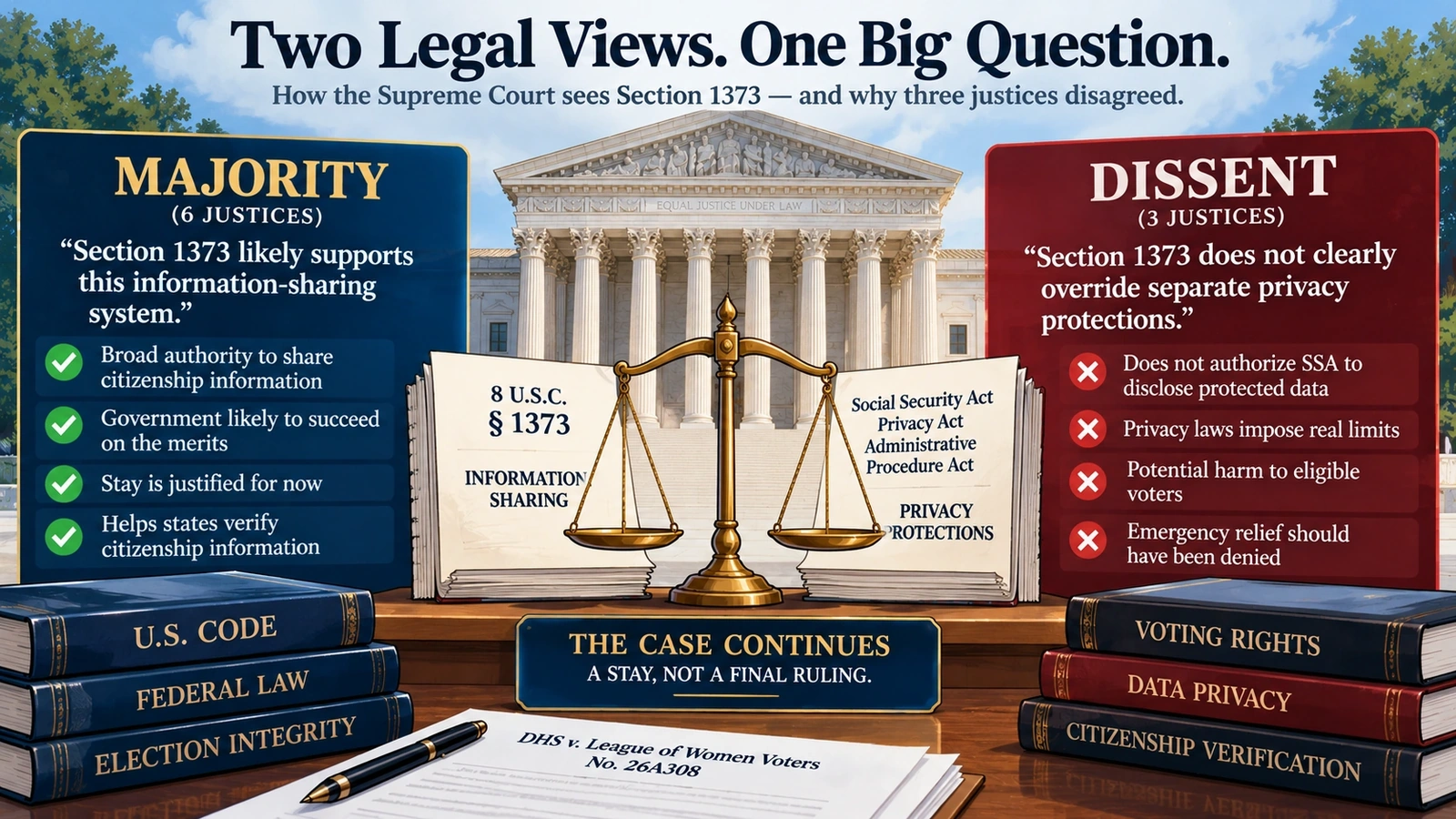
Justice Ketanji Brown Jackson wrote the dissent, joined by Justices Sonia Sotomayor and Elena Kagan.
Their disagreement was not over whether DHS may ever answer citizenship questions.
The dispute was over how far §1373 reaches when other federal statutes specifically restrict the disclosure of sensitive data.
The majority’s basic reasoning was that §1373’s broad language likely prevents other laws from blocking citizenship-information sharing with DHS.
The dissent argued that this goes too far. In Jackson’s reading, §1373 requires DHS to respond to lawful inquiries but does not necessarily authorize the Social Security Administration to disclose information that other federal laws require it to keep confidential. (U.S. Supreme Court)
A simplified comparison looks like this:
| Majority’s Interim View | Jackson Dissent |
|---|---|
| §1373 likely supports the information-sharing structure | §1373 does not clearly override separate confidentiality laws |
| Government is likely to succeed on the merits | Government has not shown it is likely to prevail |
| Blocking modified SAVE interferes with federal assistance to states | Voter and privacy harms weigh against restoring the system |
| Stay is justified while litigation continues | Extraordinary emergency relief should have been denied |
Neither column is a final judgment from a completed merits case.
It is a disagreement about what should happen while that case continues—and about how the relevant statutes should ultimately be read.
Why Can Social Security Citizenship Data Be Wrong?
This may be the most important practical part of the case.
A Social Security record can contain a citizenship indicator, but that field does not necessarily update automatically every time someone’s immigration or citizenship status changes.
That matters especially for naturalized citizens.
Someone might have received a Social Security number while still a noncitizen, become a U.S. citizen later, and never have had a reason to update the citizenship information associated with the Social Security record.
The district court record discussed this risk, and the Supreme Court itself acknowledged a plaintiff from Louisiana whose SSA records did not accurately reflect that she had become a naturalized U.S. citizen. (District Court Opinion · U.S. Supreme Court)
That example illustrates the difference between two concepts that can easily be confused:
A database mismatch is not the same thing as proof that a person is not a citizen.
The administration has argued that federal information-sharing can help states identify records that warrant additional verification.
The plaintiffs have argued that stale or inaccurate data can instead place unnecessary burdens on eligible citizens, particularly naturalized Americans. (U.S. Supreme Court)
The Supreme Court accepted that the Louisiana plaintiff’s situation was sufficient to support standing to sue.
It did not decide that data-accuracy concerns are imaginary.
The disagreement is over whether those concerns make the modified federal system unlawful.
Does This Mean States Can Run Systematic Voter-Roll Removals Right Before the Midterms?

Not simply because of this ruling.
Federal law contains what is commonly called the 90-day rule in the National Voter Registration Act.
It says a state generally must complete a program whose purpose is to systematically remove ineligible voters from federal-election registration lists no later than 90 days before a federal primary or general election. (52 U.S.C. §20507)
The November 3, 2026 general election is already inside that window.
The Supreme Court explicitly acknowledged that this rule limits the immediate effect of restoring modified SAVE.
At the same time, the Court said the lower court’s order also prevented individualized inquiries, which the parties agreed could still occur during this period. That helped the majority conclude that the government was suffering an ongoing injury from the block. (U.S. Supreme Court)
There is another complication.
The Supreme Court specifically noted that a different pending case asks about the precise scope of the 90-day rule when states seek to remove people believed not to be U.S. citizens.
The Court said it was not resolving that separate question in the SAVE decision.
So a headline suggesting that the Supreme Court authorized unrestricted voter-roll removals before the midterms would leave out an important legal limitation.
What Did the Court Not Decide?
Several things.
It did not issue a final ruling on whether every aspect of modified SAVE is lawful.
The September 25 order is a stay pending further litigation.
It did not order every state to use SAVE.
States’ participation in election-related use of the system remains a separate matter governed by federal law, state law, and applicable agreements.
It did not decide that every SAVE mismatch proves that someone is ineligible.
The Court itself recognized the possibility of inaccurate citizenship information in SSA records.
It did not decide the full meaning of the NVRA’s 90-day restriction.
The justices expressly left that question for another case.
And the Court did not resolve every legal fight surrounding President Trump’s broader 2025 election executive order. SAVE is one part of a much larger set of election-related disputes arising from that directive. (White House · U.S. Supreme Court)
Keeping those questions separate is essential.
Otherwise, a temporary emergency order can easily be mistaken for a sweeping final judgment on American election law.
What Happens to the SAVE Case Next?
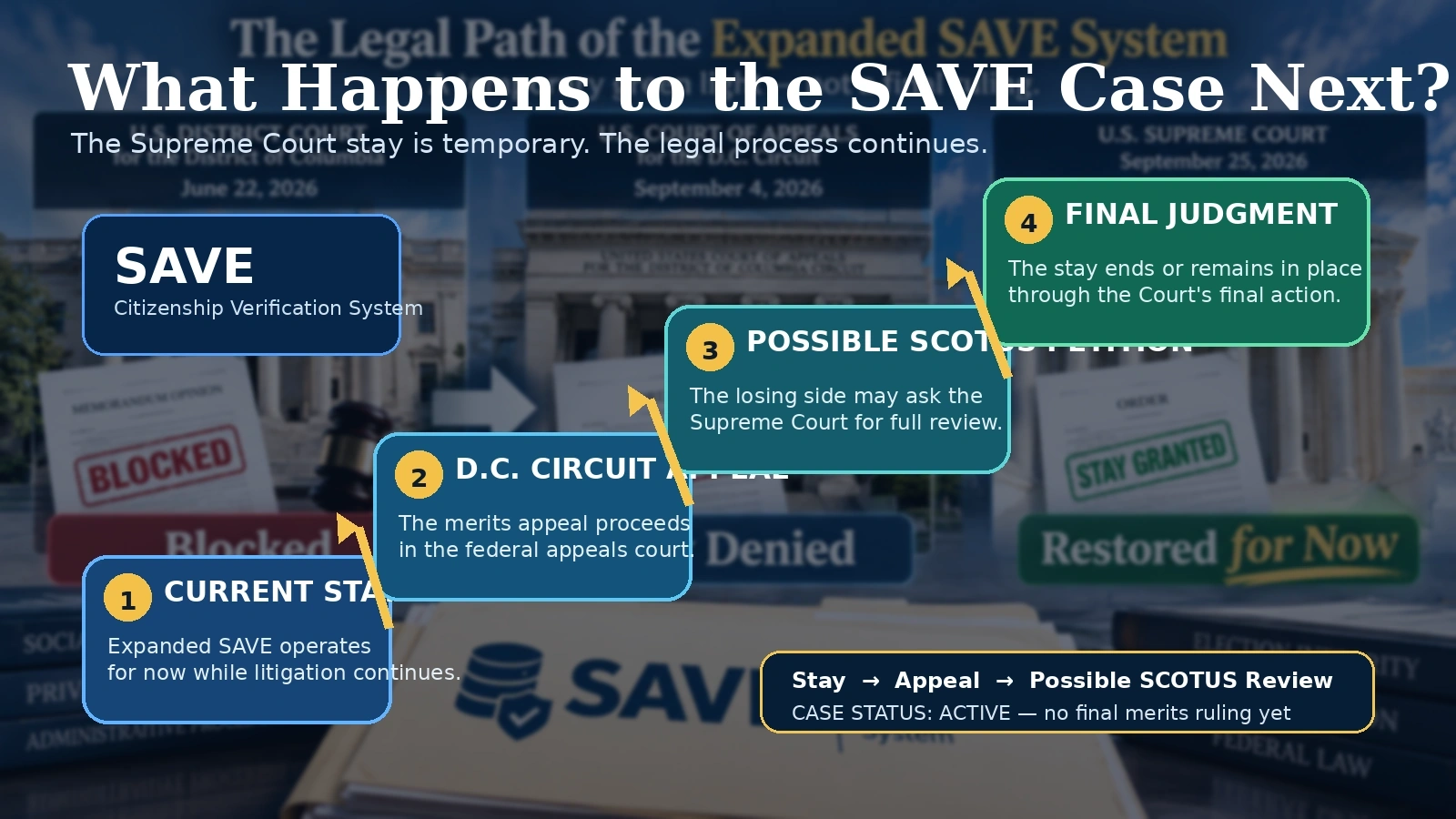
The case goes back into the ordinary appellate process.
The government’s appeal remains before the U.S. Court of Appeals for the D.C. Circuit.
The Supreme Court said its stay will remain in effect through the disposition of that appeal and through a timely petition asking the Supreme Court to take the case.
If the Court eventually declines to hear such a petition, the stay ends automatically.
If the justices agree to hear the case, the stay remains until the Supreme Court sends down its judgment. (U.S. Supreme Court)
That means September 25 was highly consequential—but it was not the last word.
The most important thing to watch now is whether the D.C. Circuit reaches the same statutory conclusion as the Supreme Court’s emergency majority, and whether the justices ultimately decide to review the dispute through the Court’s normal merits process.
Why It Matters in One Sentence
The Supreme Court has temporarily restored an expanded federal citizenship-verification system that can connect voter records with Social Security data, but the decision does not finally settle whether that data-sharing structure complies with federal privacy laws—or how broadly states may use the results.
SAVE Database: Key Questions Explained
Q. What is the SAVE database?
SAVE is the federal Systematic Alien Verification for Entitlements program, originally developed to help government agencies verify immigration and citizenship information for benefit and licensing decisions. Its 2025 expansion connected the system more extensively with Social Security records and added broader search capabilities.
Q. Did the Supreme Court rule that the expanded SAVE system is permanently legal?
No. The September 25 decision granted a stay, temporarily suspending the district court’s order while appellate litigation continues. The Court did, however, indicate that a majority currently believes the federal government is likely to succeed on the disputed statutory issues.
Q. What changed in SAVE in 2025?
The modified system incorporated Social Security Administration data, made Social Security numbers usable in searches, expanded the universe of searchable citizens, and introduced bulk-query capabilities.
Q. Does SAVE automatically remove someone from a voter roll?
No. SAVE provides verification information to authorized agencies. Election officials operate under separate federal and state laws when making registration-list decisions.
Q. Why are Social Security records controversial in this case?
Because citizenship information in SSA records can sometimes be outdated. A person who became a naturalized citizen after receiving a Social Security number may not necessarily have an updated citizenship indicator in SSA’s files.
Q. Why did the district court find modified SAVE unlawful?
The district court concluded that the system violated provisions of the Social Security Act and Privacy Act and that the related agency actions were unlawful under the Administrative Procedure Act.
Q. Why did the Supreme Court majority disagree?
The majority said 8 U.S.C. §1373 likely gives DHS broad authority to receive and provide citizenship-status information and that this provision likely supports an information-sharing system such as modified SAVE.
Q. What did Justice Jackson argue in dissent?
Justice Jackson argued that §1373 does not clearly authorize SSA to disregard separate federal confidentiality laws and that the potential burden on eligible voters weighed against granting emergency relief.
Q. Can states conduct systematic voter-roll removals immediately before the November 2026 election?
Federal law generally requires programs aimed at systematically removing ineligible voters from federal-election registration lists to be completed at least 90 days before the election. The Supreme Court said that restriction limits the SAVE ruling’s immediate effect, while distinguishing individualized inquiries.
Q. What happens next in DHS v. League of Women Voters?
The appeal continues in the D.C. Circuit. Depending on the outcome, the dispute could return to the Supreme Court through a petition for full review.
Did this help make the story clearer? 🙂
WIN keeps unpacking the “why” behind the news—clearly and simply!
Sources
Supreme Court Decision and Case Status
U.S. Supreme Court — Case Docket No. 26A308
CBS News — Supreme Court Allows Trump Administration to Use SAVE Database for Now
Lower-Court Rulings and SAVE Structure
U.S. District Court for the District of Columbia — June 22, 2026 Opinion
D.C. Circuit — September 2026 Stay Decision
Associated Press — June 22 Ruling Blocking the Modified SAVE System
Federal Authority and Election-Law Background
White House — Executive Order 14248, Preserving and Protecting the Integrity of American Elections
52 U.S.C. §20507 — National Voter Registration Act Voter-List Maintenance Rules