
Why Did CMS Cancel ACA Enrollments Covering More Than 760,000 People?
Did the federal government just kick 760,000 people off Obamacare?
That is the easy way to read the headline. It is also incomplete.
On September 22, the Centers for Medicare & Medicaid Services said it had canceled about 315,000 Affordable Care Act Marketplace enrollments covering more than 760,000 people after CMS and participating insurers determined that the enrollments were unauthorized. The cancellations themselves took place on August 31; September 22 was when CMS publicly disclosed the scale of the action. (CMS · Reuters)
That timing matters, but so does another distinction: CMS did not say that 760,000 people each filed fraudulent applications. One Marketplace enrollment can cover multiple members of a household, and the agency describes these as enrollments that were confirmed to be unauthorized.

The bigger story is how a health-insurance system built around brokers, online enrollment platforms, federal subsidies, and household applications created opportunities for coverage to be started or changed without a consumer’s meaningful authorization—and why CMS is now rebuilding some of those controls.
What Exactly Happened on August 31?

CMS says that on August 31 it canceled approximately 315,000 enrollments covering more than 760,000 individuals after reviews by CMS and health insurers confirmed those enrollments were unauthorized. The agency expects the action to lead to the return of about $2.2 billion in advance premium tax-credit payments tied to those enrollments. (CMS)
Then, on September 22, CMS announced the numbers publicly and paired them with a broader set of enforcement and technology changes. Those measures include tighter identity checks for agents and brokers, additional applicant-identification requirements, electronic consumer authorization, and a temporary pause on registration by certain new Marketplace agents and brokers for the 2027 plan year. (CMS)
So the news is not simply “760,000 people lost insurance on September 22.” The more accurate sequence is: CMS says it identified and canceled confirmed unauthorized enrollments on August 31, then disclosed the scale and expanded its anti-fraud response on September 22.
How Can 315,000 Enrollments Cover More Than 760,000 People?

Because an ACA Marketplace enrollment can include more than one person.
A parent might apply for coverage for themselves, a spouse, and children through the same household application. If that enrollment is later determined to have been unauthorized, one canceled enrollment record can affect several covered people.
That is why the two headline numbers describe different things:
| Number | What it refers to |
|---|---|
| About 315,000 | Marketplace enrollments CMS says were confirmed as unauthorized and canceled |
| More than 760,000 | Individuals covered through those enrollments |
| About $2.2 billion | Advance premium tax-credit payments CMS expects to recover or have returned in connection with the canceled enrollments |
The distinction also matters politically and financially. Saying “760,000 fraudulent enrollments” would overstate what CMS announced. Saying “760,000 people committed fraud” would go even further and would not be supported by the agency’s statement.
CMS’s claim is about unauthorized enrollments, not a finding that every covered individual knowingly did something wrong. GAO has separately documented cases in which consumers were enrolled or had plans switched without authorization. (GAO)
How Could Someone Be Enrolled Without Knowing It?
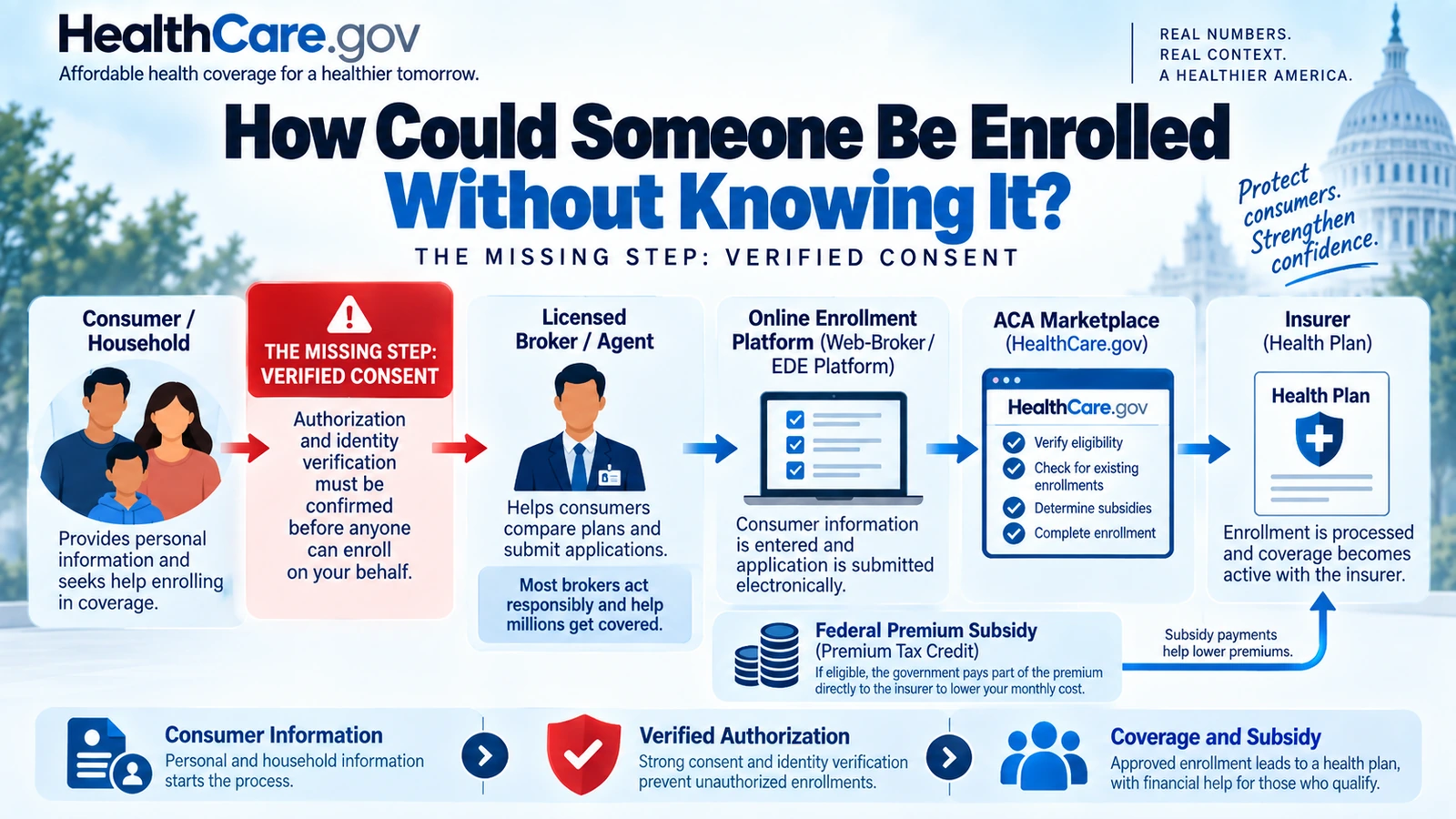
The federal Marketplace allows licensed agents and brokers to help consumers enroll, and many people rely on them. But a July 2026 Government Accountability Office review found that CMS’s safeguards did not always adequately verify that consumers had authorized agent or broker activity. GAO said complaints tied to confirmed unauthorized enrollments and plan switches grew more than fourfold from 2023 through 2025. (GAO)
One reason this matters is Enhanced Direct Enrollment, or EDE. Approved insurers and web-brokers can use EDE technology to submit Marketplace applications and enroll people directly through their own platforms instead of sending every applicant through HealthCare.gov. CMS said in an August 2026 FAQ that about 76% of active plan selections during the 2026 open-enrollment period involved agents or brokers. (CMS)
That model can make enrollment easier. It also makes identity verification and consent controls especially important.
GAO identified three broad weaknesses in the federal system: weak processes for confirming consumer consent, insufficient restrictions on access to consumer Marketplace records, and incomplete notifications to consumers about agent or broker actions. GAO recommended stronger controls such as one-time passcodes. HHS agreed with the recommendations. (GAO)
There is another reason unauthorized enrollment can be hard to notice immediately: the subsidy system can reduce a person’s monthly premium to very little or even zero. HHS has argued that this can make “phantom” enrollment harder for a consumer to detect because there may be no monthly bill that alerts the person that coverage exists. That is an administration analysis rather than a finding that every zero-premium enrollment is improper. (HHS ASPE)
Why Are Brokers at the Center of the Crackdown?

Because brokers are both a major gateway into the Marketplace and a point where CMS says a relatively small group of bad actors can affect many consumers.
CMS says it has sent termination notices to more than 200 noncompliant agents and brokers since January 2026. It also issued 569 notices of intent to terminate agreements with agents and brokers that submitted 2026 applications without key identifying information such as Social Security numbers. (CMS)
The agency says brokers who first registered for the 2026 plan year account for a disproportionate share of high-risk activity. Compared with agents and brokers registered before 2026, CMS says the newer group was 2.8 times more likely to be associated with unresolved income-verification issues, 2.7 times more likely to have applications missing Social Security numbers, and 2.6 times more likely to have unresolved citizenship or immigration-status verification issues. (CMS)
But that does not mean new brokers as a class have been found guilty of fraud. Those figures are risk indicators used by CMS to justify stronger controls.
The National Association of Benefits and Insurance Professionals has supported stronger fraud protections while objecting to a broad pause on new Marketplace broker registrations. Reuters reported that the group argued for more targeted enforcement so legitimate agents are not blocked from helping consumers. (Reuters)
That is the policy tension: CMS wants to close a vulnerability quickly, while broker groups argue that the solution should not make it harder for legitimate professionals to serve people who need help choosing coverage.
Does the $2.2 Billion Mean Consumers Took $2.2 Billion in Cash?

No. The $2.2 billion figure refers to advance payments of the premium tax credit, or APTC, that CMS says are associated with the canceled enrollments.
Eligible Marketplace consumers can choose to have all, some, or none of their estimated premium tax credit paid in advance directly to their insurance company. When advance payments are used, they reduce what the consumer owes for monthly premiums. (IRS)
So when CMS says roughly $2.2 billion is expected to be returned, it is referring to advance premium tax-credit payments associated with the canceled enrollments—not $2.2 billion in cash handed to the 760,000 people.
CMS says it will work with insurers to recoup associated past APTC payments and stop future subsidy payments on confirmed unauthorized enrollments. (CMS)
This distinction is important because unauthorized enrollment can create problems for consumers even when they never received money directly. A person may discover unfamiliar coverage, encounter problems when trying to use the plan they actually chose, or face tax-document complications that need to be corrected.
What Is Changing Before the 2027 Enrollment Season?

The September 22 package adds more preventive checks before a broker can act, alongside CMS’s existing process for investigating and canceling unauthorized enrollments.
The September 22 package includes several changes:
| Change | What it is designed to do |
|---|---|
| Re-identity proofing for existing agents and brokers | Require them to verify identity again through Login.gov or ID.me |
| Verified applicant identifiers | Require Social Security numbers or verifiable immigration-document numbers for non-newborn applicants on broker-involved applications |
| Electronic consumer authorization | Require a consumer’s electronic approval before an agent or broker can act on an application or enrollment |
| Limits on broker attachment | Prevent agents or brokers from being added to applications consumers should be completing on their own through HealthCare.gov |
| Temporary registration moratorium | Pause registration of certain new agents and brokers who did not have a 2026 Exchange agreement |
CMS’s interim rule says the moratorium for those new agents and brokers is scheduled to remain in place until February 1, 2027, unless CMS lifts it earlier or extends or modifies it through a later notice. The agency says the pause gives it time to implement stronger identity, authentication, monitoring, and program-integrity controls. (Federal Register public-inspection document)
CMS’s September 22 fact sheet covers the Federally-facilitated Exchanges and State-based Exchanges on the Federal Platform. Some measures, including the temporary registration moratorium, are specifically tied to registration for the federal Exchanges. State-based Marketplaces that operate their own platforms can have different enrollment systems and controls. (CMS)
What Should You Do if You See Coverage You Never Chose?

Start by checking the coverage shown in your Marketplace account and comparing it with the plan and household members you actually selected.
If you believe an agent or broker enrolled you, switched your plan, or changed your Marketplace information without authorization, HealthCare.gov lists the Marketplace Call Center at 1-800-318-2596, with TTY service at 1-855-889-4325. The main line is available 24 hours a day, seven days a week except holidays. (HealthCare.gov)
CMS has previously said that when unauthorized activity is confirmed, it can work to cancel or restore coverage and update tax information to reduce the risk that the consumer is harmed by a change they did not authorize. (CMS)
The practical lesson is simple: do not assume that an unfamiliar Marketplace notice is merely junk mail. If the plan, broker, household members, or subsidy information does not match what you chose, check it.
What Happens Next?
The next major test will be whether the new identity and consent controls reduce unauthorized activity without making legitimate enrollment assistance substantially harder to obtain.
GAO’s July 2026 report is useful context here. It found that some state-based Marketplaces already used stronger controls, including one-time passcodes, and recommended that CMS strengthen federal safeguards. HHS agreed with those recommendations. (GAO)
CMS is now moving in that direction with electronic authorization, broker re-verification, more applicant identification checks, and the temporary new-broker registration pause.
The September 22 announcement therefore is not just a cleanup of old enrollments. It is also a redesign of who can act on a Marketplace application, what proof they need, and how the consumer’s approval is documented.
Why It Matters in One Sentence
CMS says it canceled 315,000 unauthorized ACA Marketplace enrollments covering more than 760,000 people, and the larger change is a shift toward stronger identity and consent checks designed to make it harder for anyone to enroll or switch a consumer without authorization.
ACA Unauthorized Enrollment: Key Questions Explained
Q. Did CMS cancel health insurance for 760,000 people on September 22?
Not exactly. CMS says the cancellations occurred on August 31 and covered more than 760,000 individuals through about 315,000 enrollments; the agency publicly announced the scale of the action on September 22.
Q. Why are there 315,000 enrollments but more than 760,000 people?
Because a single Marketplace enrollment can cover multiple members of a household. The enrollment count and the number of covered individuals are different units.
Q. Did CMS say all 760,000 people committed fraud?
No. CMS said the enrollments were confirmed as unauthorized. That does not mean every person listed on those enrollments knowingly committed fraud.
Q. How could someone be enrolled in an ACA plan without knowing it?
Federal reviews have found weaknesses in how consumer consent and broker access were verified. A broker or web-broker with enough information could in some circumstances submit or change an enrollment without adequate real-time confirmation from the consumer.
Q. What is the $2.2 billion CMS says will be returned?
It is approximately the amount of advance premium tax-credit payments CMS says are associated with the canceled enrollments. Those subsidies are generally paid to insurers to reduce monthly premiums, not handed to consumers as cash.
Q. Is CMS banning all new health-insurance brokers?
No. The temporary moratorium applies to agents and brokers seeking Plan Year 2027 registration for the federal Exchanges who do not have a Plan Year 2026 Exchange agreement. The public-inspection rule says the pause is scheduled to last until February 1, 2027, unless CMS lifts it earlier or extends or modifies it through a later notice.
Q. Are all ACA brokers suspected of fraud?
No. CMS has not characterized broker-assisted enrollment generally as fraudulent. Its enforcement materials focus on unauthorized activity, noncompliant agents and brokers, and specific higher-risk patterns among some newer registrants.
Q. What should a consumer do if a Marketplace plan looks unfamiliar?
Check the enrollment in your Marketplace account and contact the Marketplace Call Center if the plan, household members, agent, or other information does not match what you authorized. HealthCare.gov lists the Call Center at 1-800-318-2596.
Did this help make the story clearer? 🙂
WIN keeps unpacking the “why” behind the news—clearly and simply!
Sources
September 22 Enforcement Announcement
CMS — Federal Marketplace Anti-Fraud Actions
CMS — Crackdown on Fraud, Waste, and Abuse in the Federal Health Insurance Marketplace
Reuters — U.S. says it canceled 315,000 Obamacare policies last month
Consumer Consent and Broker Controls
CMS — EDE Identity Proofing and Agent/Broker Authorization FAQs
Federal Register Public Inspection — Temporary Moratorium for Plan Year 2027
Subsidy Mechanics and Consumer Help
IRS — Premium Tax Credit Overview
HealthCare.gov — Contact the Marketplace Call Center


