
Can Retiring Early Affect Your Memory? What a New Study Actually Found
Can leaving work earlier really make your memory worse?
A new U.S. study gives that question a reason to be taken seriously—but not a reason to panic. Researchers found that certain long-term employment patterns, including early labor-force exits and unstable employment, were associated with poorer cognitive performance later in life.
The important word is associated. The study did not prove that retirement itself causes dementia.

The findings were first published September 23, 2026, in Alzheimer’s & Dementia. Rather than simply comparing “working” people with “retired” people, the researchers reconstructed long-term employment trajectories and compared them with detailed cognitive outcomes measured in 2016. (Alzheimer’s & Dementia · Columbia Mailman School of Public Health)
That makes the real question more interesting: Is retirement itself the issue, or does the way someone moves through work and retirement matter more?
What Did the New Study Actually Find?
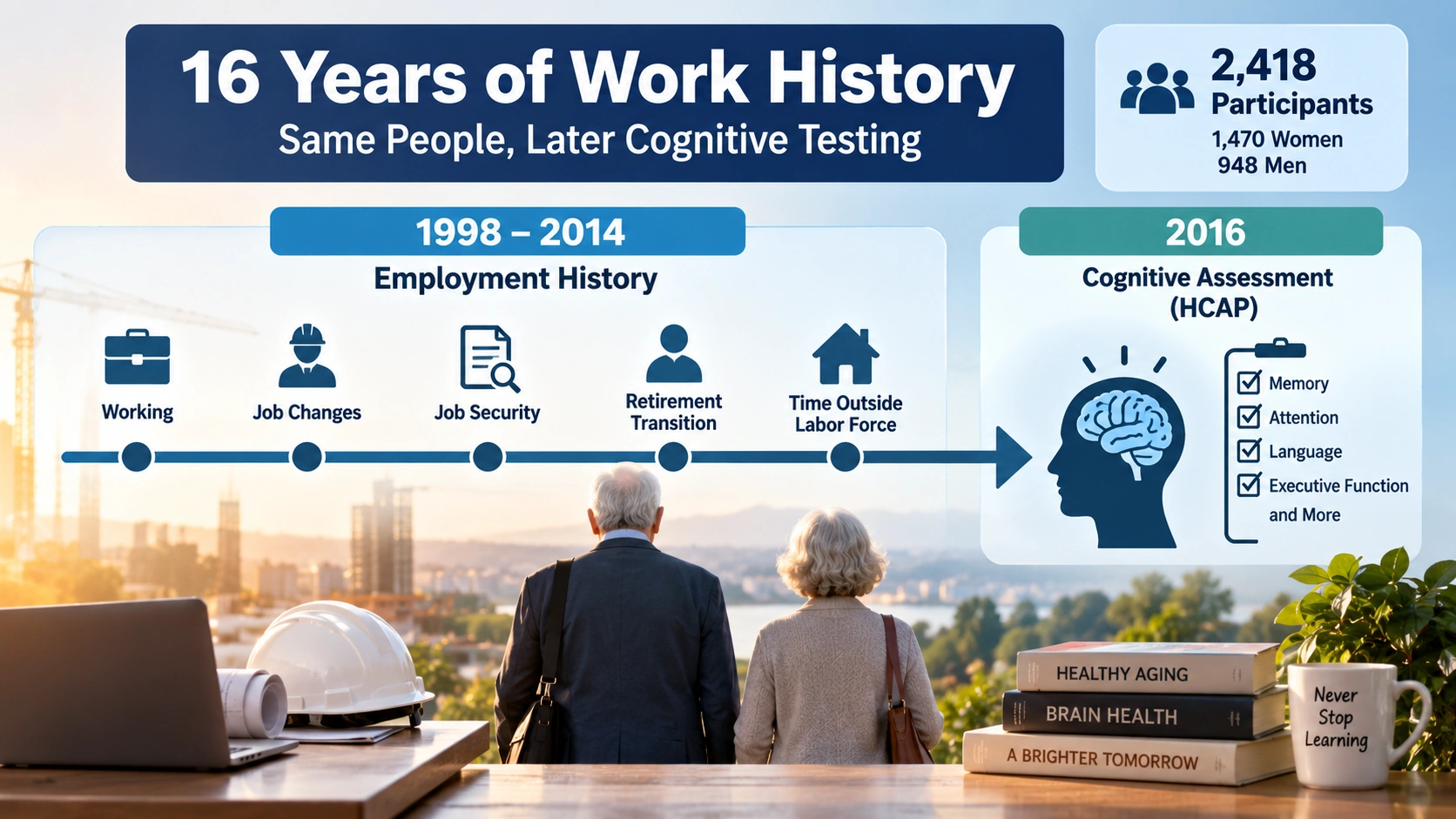
Researchers analyzed 2,418 participants—1,470 women and 948 men—drawn from the U.S. Health and Retirement Study. Their employment and perceived job-security histories were followed across 16 years, from 1998 through 2014. Cognitive outcomes were then assessed using the 2016 Harmonized Cognitive Assessment Protocol, or HCAP. (Columbia Mailman School of Public Health · Health and Retirement Study)
HCAP is not a quick memory quiz. It uses an in-depth neuropsychological assessment and informant information to characterize cognitive function in older adults; the study analyzed domains including memory, executive function, language and fluency, orientation, and global cognition. The broader 2016 HCAP project included 3,496 participants, while this employment study used a smaller subset that met its eligibility requirements. (Alzheimer’s & Dementia · Health and Retirement Study)
The researchers grouped participants according to patterns such as relatively stable employment, retirement transitions, prolonged time outside the labor force and inconsistent employment.
The clearest findings were not identical for women and men.
| Employment trajectory | Main later-life finding |
|---|---|
| Predominantly job-secure employment | Reference group with the most favorable overall cognitive profile |
| Women: early retirement | Lower memory and executive-function scores; nearly twice the adjusted odds of cognitive impairment |
| Women: not in the labor force | Lower memory and executive-function scores; higher adjusted odds of cognitive impairment |
| Men: inconsistent employment | Poorer performance across most cognitive domains; about twice the adjusted odds of cognitive impairment |
Among the analytic sample, about 30% of women and 31% of men met the HCAP criteria for cognitive impairment, including mild cognitive impairment or dementia. In adjusted models, the odds ratio was 1.97 for women in the early-retirement trajectory, 1.80 for women in the not-in-labor-force trajectory, and 2.02 for men in the inconsistent-employment trajectory, compared with the predominantly job-secure group. (Alzheimer’s & Dementia)
Why Did the Pattern Look Different for Women and Men?

The study does not show that women’s and men’s brains respond differently to retirement for some simple biological reason.
Instead, the researchers emphasized that work histories themselves often differ. Women in these generations were more likely to experience prolonged periods outside formal employment or interrupted careers, including time connected with family and caregiving responsibilities. Men were more likely to show a pattern involving repeated moves into and out of employment. (Columbia Mailman School of Public Health)
For women, early retirement and prolonged time outside the labor force were associated with memory differences that researchers described as roughly comparable to six years of cognitive aging.
For men, inconsistent employment was associated with cognitive differences estimated at roughly seven years of cognitive aging. (Columbia Mailman School of Public Health)
That wording can sound more dramatic than it is. It does not mean a 68-year-old participant literally had the brain of a 75-year-old. It means the difference in cognitive-test performance was similar in size to the difference the researchers would statistically expect across those years of age.
Does This Mean Early Retirement Causes Dementia?

No. This study does not establish that retiring early causes dementia.
The research used longitudinal observational data and statistical adjustment, not random assignment to retirement or continued work. That means it can identify strong associations, but it cannot by itself prove that the employment trajectory caused the later cognitive outcome. (Alzheimer’s & Dementia)
Reverse causation is one concern: declining physical health, disability, or subtle cognitive changes may contribute to leaving work earlier. The authors ran sensitivity analyses designed to reduce this problem—including ending the employment window earlier and excluding participants with baseline impairment or disability—and many associations remained, but they still noted that residual health selection and unmeasured confounding could not be ruled out. (Alzheimer’s & Dementia)
That is one reason the broader retirement literature still needs careful interpretation. A 2026 study of Black older adults also linked earlier retirement with faster cognitive decline, but it likewise reported associations within a specific population rather than a universal rule for every retiree. (Alzheimer’s & Dementia)
Why Might Stable Work Be Connected to Better Cognitive Aging?
Work changes much more than a paycheck.
The authors point to several plausible pathways. Paid work can provide regular cognitive stimulation, problem-solving, social interaction, and economic stability, while employment disruption can reduce those forms of engagement and bring financial stress. These are proposed mechanisms, not proof that staying employed itself protects the brain. (Alzheimer’s & Dementia)
Work conditions also matter. A 2026 review of social environments and cognitive aging emphasizes that workplace conditions, occupations, labor-market dynamics, and social connections can all shape cognitive health across the life course. (Alzheimer’s & Dementia)
So the more useful idea may be continuity of cognitive, social, and economic engagement—not simply staying on a payroll as long as possible.
Is Retirement Itself Bad for the Brain?
Probably not in any simple, universal sense.
Other studies illustrate why the answer remains complicated. A 2026 German study used a retirement-age reform to estimate retirement effects among women ages 63 to 67. It found declines in some measures of fluid cognitive ability with additional time in retirement, while crystallized intelligence was unaffected; it also found no increase in diagnosed cognitive disorders and fewer diagnoses of several dementia-related risk factors. (Journal of Health Economics)
That result also should not be generalized to every worker: it applies to a specific age group of women affected by a particular German reform. The Columbia study is therefore better read as evidence about long-term employment trajectories and later-life cognition than as a warning against retirement itself.
If You’re Already Retired, What Should You Take From This?

The study does not suggest that retired people need to find another job to protect their memory.
The National Institute on Aging points to several broader habits associated with cognitive health: staying physically active, keeping the mind engaged, maintaining social connections and managing conditions such as high blood pressure, diabetes, depression and high cholesterol. It also emphasizes adequate sleep and regular health care. (National Institute on Aging)
That distinction is useful because retirement and disengagement are not the same thing.
Someone can stop paid work while remaining intensely engaged through volunteering, caregiving, community groups, exercise, travel, classes, hobbies, part-time work or regular social activities.
And someone can remain employed while doing repetitive, isolated or stressful work that offers little of the stimulation people often assume comes automatically with having a job.
The new study therefore should not be read as “work longer or get dementia.” The evidence does not support that claim.
What Should Researchers Figure Out Next?
The next challenge is separating the effect of employment itself from everything that tends to travel with it.
Researchers still need better answers to questions such as:
- Does voluntary retirement affect cognition differently from forced retirement?
- Does mentally demanding work have a different effect from physically demanding work?
- Does part-time work provide some of the same benefits as full-time employment?
- What happens when retirement is followed by volunteering, study or strong social engagement?
- How much of the association is actually driven by health problems that caused people to stop working?
- Do caregiving-related career interruptions produce different outcomes from unemployment or disability-related exits?
Those distinctions could turn a broad statistical association into something people can actually use when planning later life.
Why It Matters in One Sentence
The new study suggests that stable employment across late midlife is associated with better later-life cognition, but it does not show that early retirement itself causes dementia; health selection, job conditions, and life after work remain important pieces of the puzzle.
Early Retirement: Key Questions Explained
Q. Does early retirement cause dementia?
No. The new study found an association between certain early labor-force exits and poorer later-life cognitive outcomes, but it was not designed to prove that retirement caused those outcomes.
Q. How many people were included in the new study?
The final analysis included 2,418 Health and Retirement Study participants, including 1,470 women and 948 men. Their employment patterns were tracked from 1998 through 2014 and compared with cognitive testing in 2016.
Q. Was job insecurity or retirement more important?
The researchers reported that continuity of employment appeared more important than perceived job security alone. The strongest poorer cognitive outcomes were concentrated in groups with early labor-force exits or inconsistent employment histories. (Columbia Mailman School of Public Health)
Q. What does “six or seven years of cognitive aging” mean?
It is a statistical comparison of cognitive-test scores. It does not mean that retirement literally aged a person’s brain by six or seven years.
Q. Did women and men show the same pattern?
No. Women showed stronger associations with early retirement and prolonged labor-force exit, while inconsistent employment was especially notable among men. The study did not establish that biology caused this difference.
Q. Should someone delay retirement because of this study?
This study alone does not justify that conclusion. Retirement decisions also involve physical health, job quality, finances, family responsibilities and personal circumstances, and research on retirement and cognition remains mixed.
Q. Does being retired mean becoming mentally inactive?
No. Paid employment is only one source of cognitive and social engagement. Learning, volunteering, physical activity, hobbies and maintaining social connections can continue long after a person leaves the workforce.
Q. What is HCAP?
The Harmonized Cognitive Assessment Protocol is an intensive cognitive-assessment program within the Health and Retirement Study. It uses established neuropsychological testing and informant information to study cognitive aging, mild cognitive impairment and dementia in older adults. (Health and Retirement Study)
Did this help make the story clearer? 🙂
WIN keeps unpacking the “why” behind the news—clearly and simply!
Sources
New Study and Employment Findings
Alzheimer’s & Dementia — Trajectories of Late-Life Job Insecurity and Labor Force Participation
Health and Retirement Study and Cognitive Assessment
Health and Retirement Study — Harmonized Cognitive Assessment Protocol
National Institute on Aging — HRS and the Harmonized Cognitive Assessment Protocol
Retirement, Cognitive Aging, and Healthy Aging
Alzheimer’s & Dementia — Timing of Retirement and Cognitive Decline Among Older Black Adults
Journal of Health Economics — Retirement and Cognitive Abilities
National Institute on Aging — Cognitive Health and Older Adults


