
Could Some Workers Get Full Social Security at 60? How the New Bill Would Decide Who Qualifies
Did Social Security just lower the retirement age to 60?
No. Nothing in current law has changed.
On September 23, 2026, Rep. Haley Stevens of Michigan introduced the Blue Collar Social Security Fairness Act, a proposal designed to let certain workers in physically demanding occupations begin receiving unreduced Social Security retirement benefits at age 60. The sponsor’s draft changes both the minimum claiming-age rule for a new category of “covered workers” and the early-retirement reduction that normally applies before full retirement age. (Rep. Haley Stevens — Sponsor Draft)
Under current law, retirement benefits can generally begin at 62, while the full retirement age is 67 for people born in 1960 or later. Starting at 62 can reduce a worker’s monthly benefit by as much as 30%. (Social Security Administration)
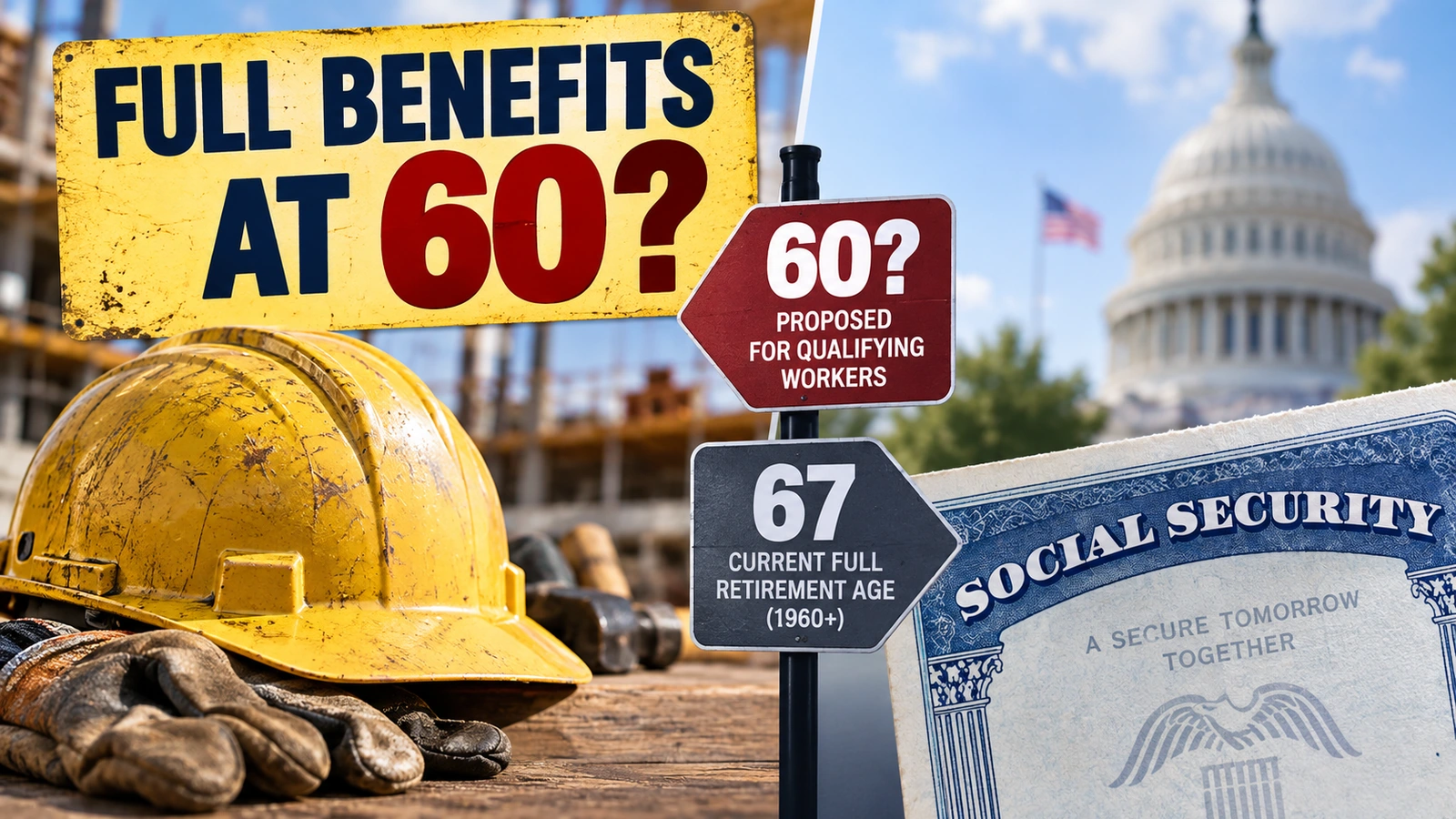
What makes this proposal unusual is that it would not simply lower the retirement age for everybody.
It would create a special route to unreduced benefits at 60 based partly on the physical demands of a person’s work history.
And that leads to the question that matters most: Who would actually qualify?
What Would the Bill Actually Change?
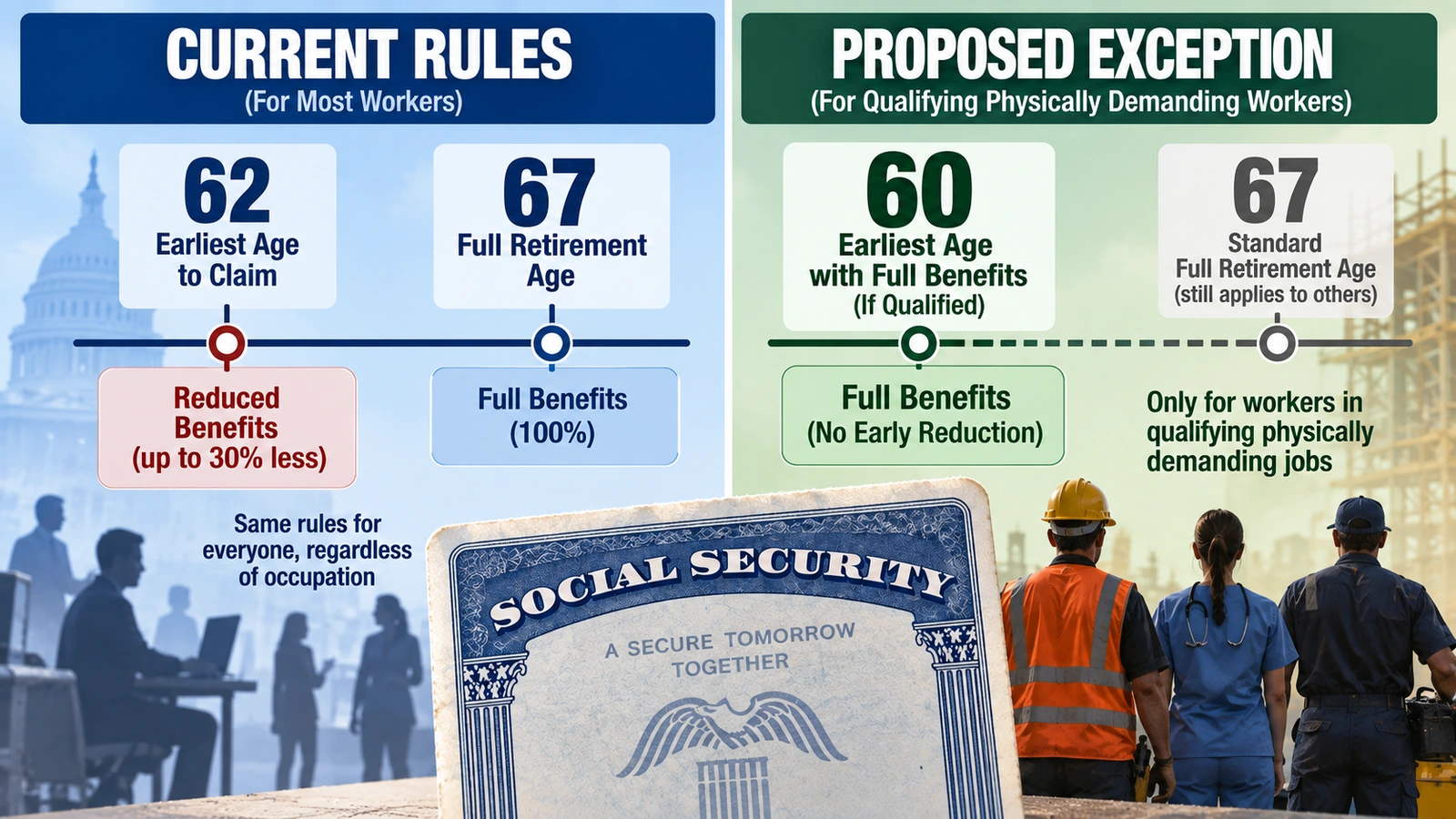
The proposal would create an exception to the normal Social Security claiming rules for a new category called a “covered worker.”
The draft would allow a fully insured covered worker to qualify for old-age benefits at 60 and would make the normal early-retirement reduction inapplicable to that worker’s old-age benefit.
That distinction is important. The bill does not simply rewrite the full retirement age from 67 to 60 for the entire country.
| Rule | Current law | Proposed rule for covered workers |
|---|---|---|
| Earliest retirement-benefit age | Generally 62 | 60 |
| Benefit before age 67 for people born in 1960 or later | Reduced | Early-retirement reduction would not apply |
| Occupation requirement | None | Must have qualifying physically demanding work |
| Additional physical-work test | None | 20 base points or 15 adjusted points |
| Legal status | In effect now | Proposed legislation only |
Sources: (Social Security Administration · Rep. Haley Stevens — Sponsor Draft)
There is another basic requirement: the worker would still have to be fully insured under Social Security. SSA says workers born in 1929 or later generally need 40 Social Security credits—usually the equivalent of 10 years of covered work—to qualify for retirement benefits under current rules. (Social Security Administration)
How Would the 15-Point and 20-Year Rules Work?
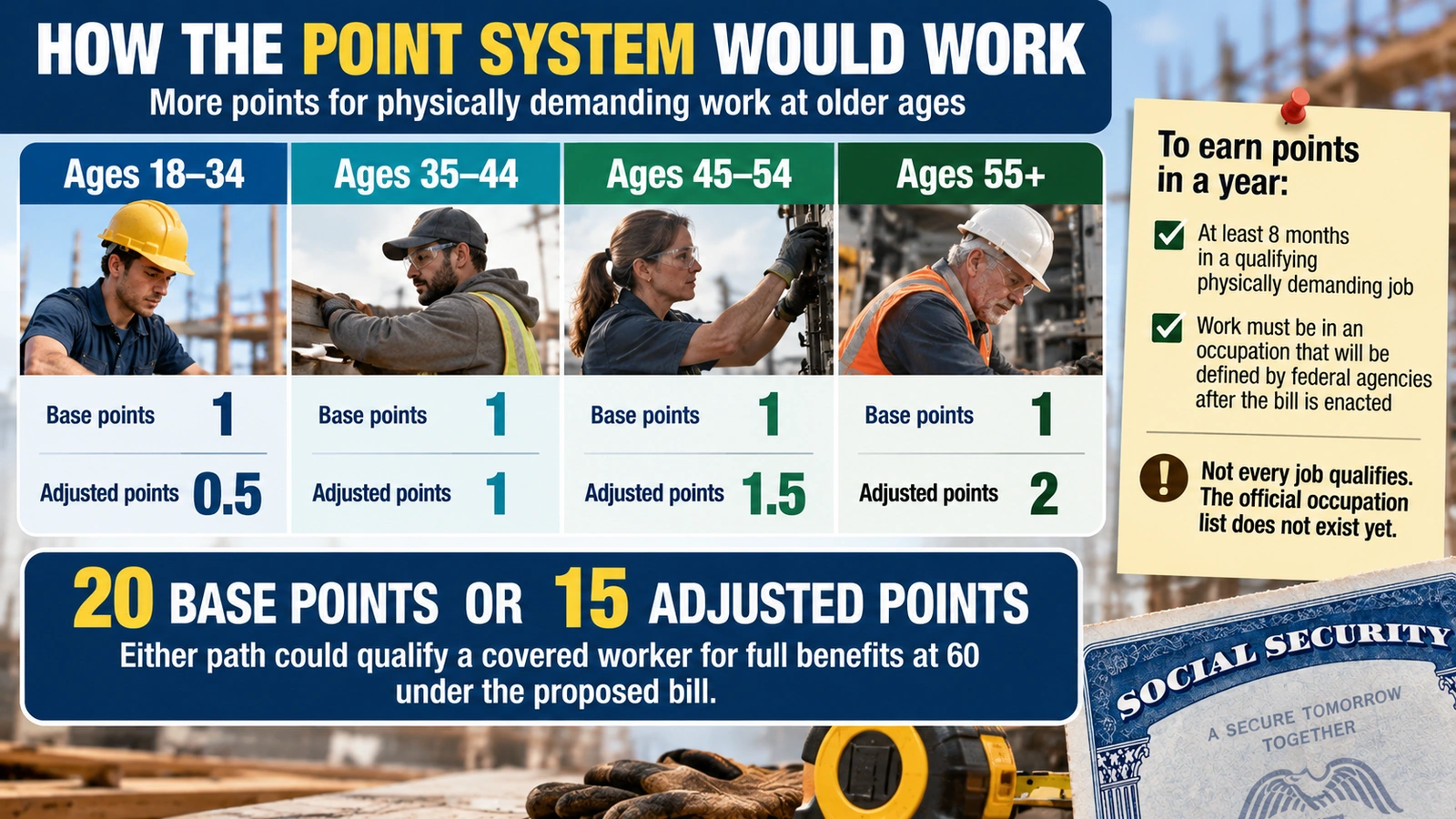
The proposal actually creates two different ways to satisfy the physical-work requirement.
A worker could qualify by accumulating either 20 base points or 15 adjusted points. To earn points for a particular calendar year, the sponsor draft says the person must have worked in a qualifying physically demanding job for at least eight months during that year. (Rep. Haley Stevens — Sponsor Draft)
A base point is straightforward: one qualifying calendar year earns one base point.
The adjusted-point system gives more weight to physically demanding work performed later in life:
| Worker’s age on December 31 | Base points for a qualifying year | Adjusted points |
|---|---|---|
| 18–34 | 1 | 0.5 |
| 35–44 | 1 | 1 |
| 45–54 | 1 | 1.5 |
| 55 or older | 1 | 2 |
Source: (Rep. Haley Stevens — Sponsor Draft)
That means the often-repeated phrase “20 years of physical work” is only one route.
Someone with fewer than 20 qualifying years could potentially reach the alternative 15-point threshold because later-career years receive more weight.
Would Construction, Nursing, or Manufacturing Automatically Qualify?
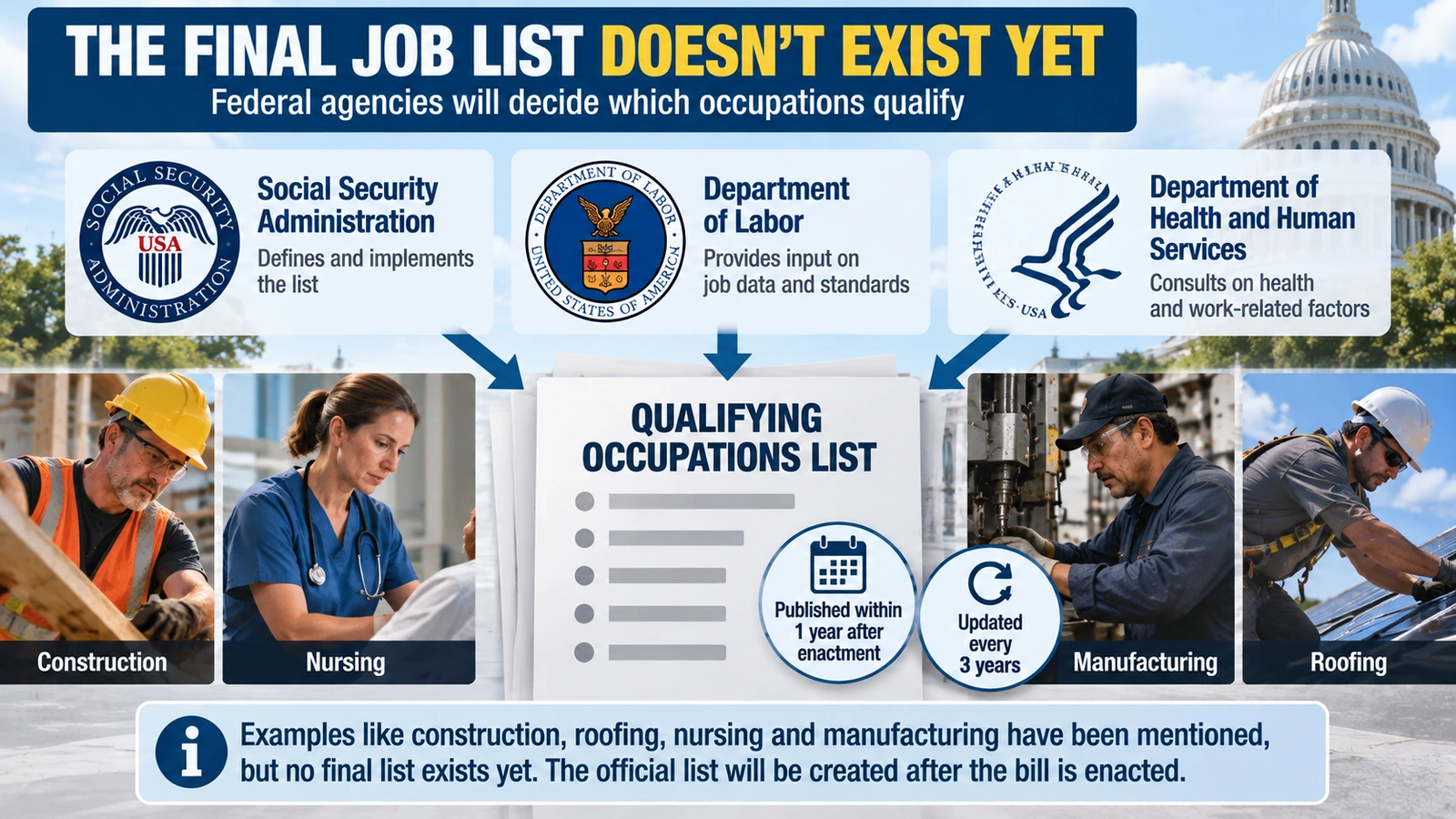
Not necessarily. This is one of the most important details in the proposal.
News reports have cited construction, roofing, nursing and manufacturing as examples of the kinds of work the proposal is meant to address. But the actual draft legislation does not contain a final list of qualifying occupations. (InvestmentNews)
Instead, the Social Security commissioner, in consultation with the secretaries of Labor and Health and Human Services, would have up to one year after enactment to publish the list. It would then have to be updated every three years. (Rep. Haley Stevens — Sponsor Draft)
The legal standard in the draft focuses on occupations with substantial physical demands that could reasonably be expected to reduce a person’s ability to continue performing that kind of work at an advanced age.
Why leave the list to agencies?
Because “physically demanding” is not one simple category. The Bureau of Labor Statistics tracks factors including lifting, carrying and how much of the workday is spent standing, and separates jobs into sedentary, light, medium, heavy and very heavy strength levels. In 2025, 6.2% of civilian workers were in jobs classified at the heavy strength level and 0.7% at the very heavy level. (Bureau of Labor Statistics)
So being a nurse, construction worker or manufacturing employee would not, by itself, establish eligibility based on the draft as written. The eventual federal occupation list would be decisive.
What Does “Full Social Security at 60” Actually Mean?

“Full” does not mean every qualifying worker would receive the maximum Social Security benefit.
Social Security first calculates a worker’s own basic benefit—called the primary insurance amount, or PIA—using that person’s earnings history. The PIA is essentially the amount payable at normal retirement age before early-retirement reductions or delayed-retirement increases are applied. (Social Security Administration)
Under current rules, a worker born in 1960 or later who starts at 62 receives 70% of the full retirement benefit amount, reflecting a 30% early-claiming reduction. (Social Security Administration)
The proposed legislation would remove that early-retirement reduction for a qualifying covered worker.
So the real change is:
an eligible worker could potentially receive his or her own unreduced retirement benefit at 60 rather than waiting until 67.
There is also a separate age that should not be confused with Social Security retirement benefits: Medicare. SSA says the current Medicare eligibility age remains 65. The draft reviewed here changes Social Security old-age benefit provisions; it does not move Medicare eligibility to 60. (Social Security Administration)
Why Is Congress Even Considering a Different Rule for Physical Work?
Stevens has framed the proposal around a simple problem: some occupations may become much harder to continue as workers get older, even though Social Security generally applies the same claiming-age framework regardless of occupation. (PLANADVISER)
Federal labor data show how different working conditions can be from one occupation to another.
For example, BLS estimated that construction and extraction workers spent an average of 79.5% of their workday standing in 2025, while 90.9% were in jobs requiring work in low postures. (Bureau of Labor Statistics)
Those numbers do not prove that every construction worker should qualify under the bill. They illustrate the policy question the legislation is trying to address: Should the same Social Security age rules apply to a desk worker and someone whose job imposes substantial physical demands for decades?
The bill proposes one answer—an occupation-based exception—but the exact boundaries of that exception would depend heavily on how federal agencies eventually define the qualifying jobs.
How Does This Fit With Social Security’s 2032 Funding Problem?
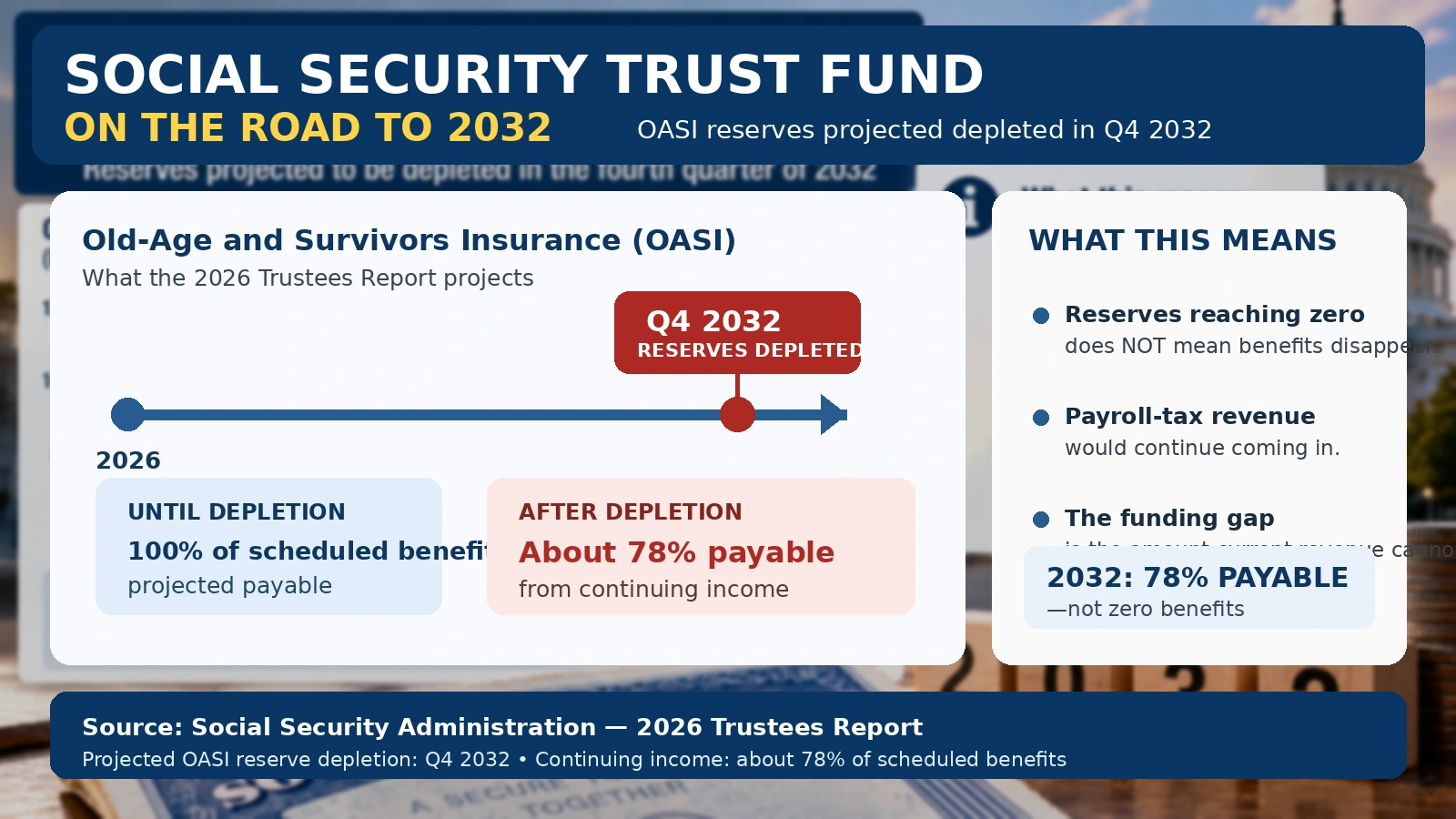
This is the biggest financial question surrounding any proposal to expand retirement benefits.
The Social Security trustees’ 2026 report projects that the Old-Age and Survivors Insurance Trust Fund, which pays retirement and survivor benefits, can pay 100% of scheduled benefits until the fourth quarter of 2032. If its reserves were depleted then and Congress made no changes, continuing income would be sufficient to pay an estimated 78% of scheduled benefits. (Social Security Administration)
That does not mean Social Security disappears in 2032. Payroll-tax revenue would continue coming in. The issue is that current projected revenue would no longer be enough to pay every scheduled benefit in full.
The sponsor draft focuses on eligibility rules and does not establish a new dedicated funding source for the proposed age-60 benefit exception. Retirement-industry coverage has noted that expanding eligibility could increase Social Security spending, although the size of any effect would depend on how the policy ultimately operated. (Rep. Haley Stevens — Sponsor Draft · PLANADVISER)
That makes cost analysis an important part of any future congressional debate over the proposal.
The two questions are separate:
Should physically demanding work justify earlier unreduced benefits?
And if Congress says yes, how should that additional cost fit into Social Security’s existing financing problem?
So When Could Anyone Actually Claim at 60?

There is no age-60 Social Security benefit available under this proposal today.
A federal bill is only a proposal when it is introduced. It must go through the congressional process, including committee consideration and approval by both chambers, before it can be presented to the president. (USAGov)
The sponsor draft says its amendments would apply to benefits paid for months after 2026. But that effective-date language does not make the proposal law by itself. The bill would still have to be enacted, and the agencies responsible for identifying physically demanding occupations would then have up to one year after enactment to publish their list. (Rep. Haley Stevens — Sponsor Draft)
For readers following the proposal, the most useful things to watch are concrete legislative actions rather than predictions about whether it will pass: committee action, amendments to the eligibility formula, any official cost analysis, and whether the process for defining qualifying occupations changes.
Until legislation is enacted, 62 remains the earliest standard age for Social Security retirement benefits, and 67 remains the full retirement age for people born in 1960 or later. (Social Security Administration)
Why It Matters in One Sentence
The Blue Collar Social Security Fairness Act would create a new path to unreduced Social Security retirement benefits at 60 for certain workers with long histories in physically demanding jobs—but it is only a proposal, and the occupations that would qualify have not yet been finalized.
Social Security at 60: Key Questions Explained
Q. Did the Social Security retirement age just change to 60?
No. Current Social Security rules have not changed. Age 60 appears in newly introduced legislation for a limited category of qualifying workers, not in current retirement law. (Rep. Haley Stevens — Sponsor Draft)
Q. Who could receive full Social Security benefits at 60 under the proposal?
A person would need to be fully insured under Social Security and meet the bill’s definition of a covered worker through qualifying physically demanding employment. The worker would need either 20 base points or 15 adjusted points.
Q. Would everyone need 20 years in a physically demanding job?
No. Twenty base points—effectively 20 qualifying calendar years—is one route. The alternative is 15 adjusted points, with qualifying work performed at older ages receiving more points per year.
Q. Does any amount of work during a year earn a point?
No. The draft says a worker must spend at least eight months of that calendar year in a qualifying physically demanding job before the year can generate base or adjusted points.
Q. Are construction workers and nurses definitely covered?
Not yet. Those occupations have been discussed as examples, but the draft does not contain a final occupation list. The Social Security commissioner, working with Labor and HHS, would establish the list after enactment. (Rep. Haley Stevens — Sponsor Draft)
Q. Does “full benefits at 60” mean the maximum Social Security check?
No. It means the qualifying worker would not receive the usual early-retirement reduction. The worker’s actual full benefit would still depend largely on his or her Social Security earnings record. (Social Security Administration)
Q. Would Medicare also begin at age 60?
No change to Medicare’s current age is established by this proposal. SSA currently lists Medicare eligibility at 65, while the draft legislation addresses Social Security old-age insurance benefits. (Social Security Administration)
Q. Would the bill make Social Security run out of money in 2032?
That is not what the 2032 projection means. Under current-law projections, OASI reserves are expected to be depleted in the fourth quarter of 2032, but continuing income would still cover about 78% of scheduled benefits at that point. The financial effect of any new benefit expansion depends on its final design. (Social Security Administration)
Q. When could this proposal actually affect benefits?
Only after it becomes law. The draft says the amendments would apply to benefits paid after 2026, but enactment and the creation of the qualifying-occupation list would still be necessary before the new system could operate. (Rep. Haley Stevens — Sponsor Draft)
Did this help make the story clearer? 🙂
WIN keeps unpacking the “why” behind the news—clearly and simply!
Sources
Bill Text and Proposed Eligibility Rules
Blue Collar Social Security Fairness Act — Sponsor Draft
InvestmentNews — Social Security Bill Offers Blue-Collar Workers Full Benefits at 60
Current Social Security Retirement Rules
Social Security Administration — At What Age Should I Start Receiving Retirement Benefits?
Social Security Administration — What Is Full Retirement Age?
Social Security Administration — Retirement Benefits for People Born in 1960 or Later
Social Security Administration — Retirement Benefits
Social Security Administration — Primary Insurance Amount
Physical Work and Social Security Financing
Bureau of Labor Statistics — Strength Levels
Bureau of Labor Statistics — Construction and Extraction Occupations
Social Security Administration — 2026 Trustees Report Highlights