
Why Is Google Sending AI Chips Into Space—and Could Data Centers Really Move Off Earth?
Google is about to put its own AI chips into orbit.
Does that mean the company has decided that the next generation of data centers belongs in space?
Not quite.
The first Project Suncatcher mission is much smaller—and in some ways more interesting. Google says a prototype satellite will carry its Tensor Processing Units, or TPUs, into low Earth orbit to find out whether existing high-performance AI hardware can survive launch vibration, radiation, extreme temperatures and an entirely different cooling environment. The mission is scheduled to fly on SpaceX’s Transporter-18 rideshare mission, currently targeted for October 1, 2026. (Google · Ars Technica)
Ars Technica reports that the first spacecraft is roughly refrigerator-sized, carries four TPUs and has only about a kilowatt of solar power. That is nowhere close to a modern AI data center with thousands of accelerators. (Ars Technica)
That distinction matters.
Google is not moving a data center into space on October 1. It is testing whether some of the building blocks of a future orbital data center can work there at all.
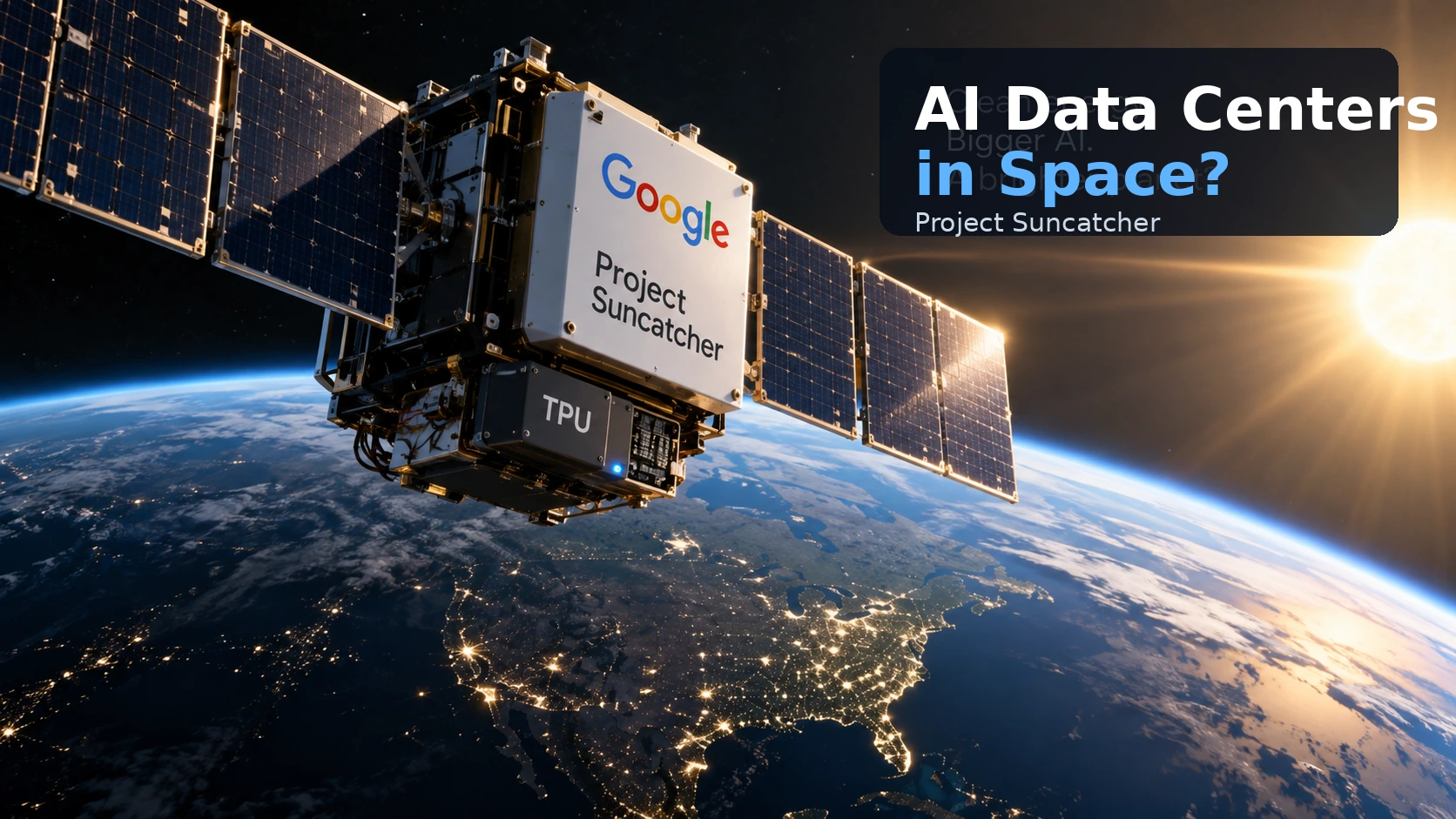
The bigger question is why one of the world’s largest computing companies thinks this experiment is worth doing.
The answer starts with something much closer to home: electricity.
What Is Google Actually Launching?
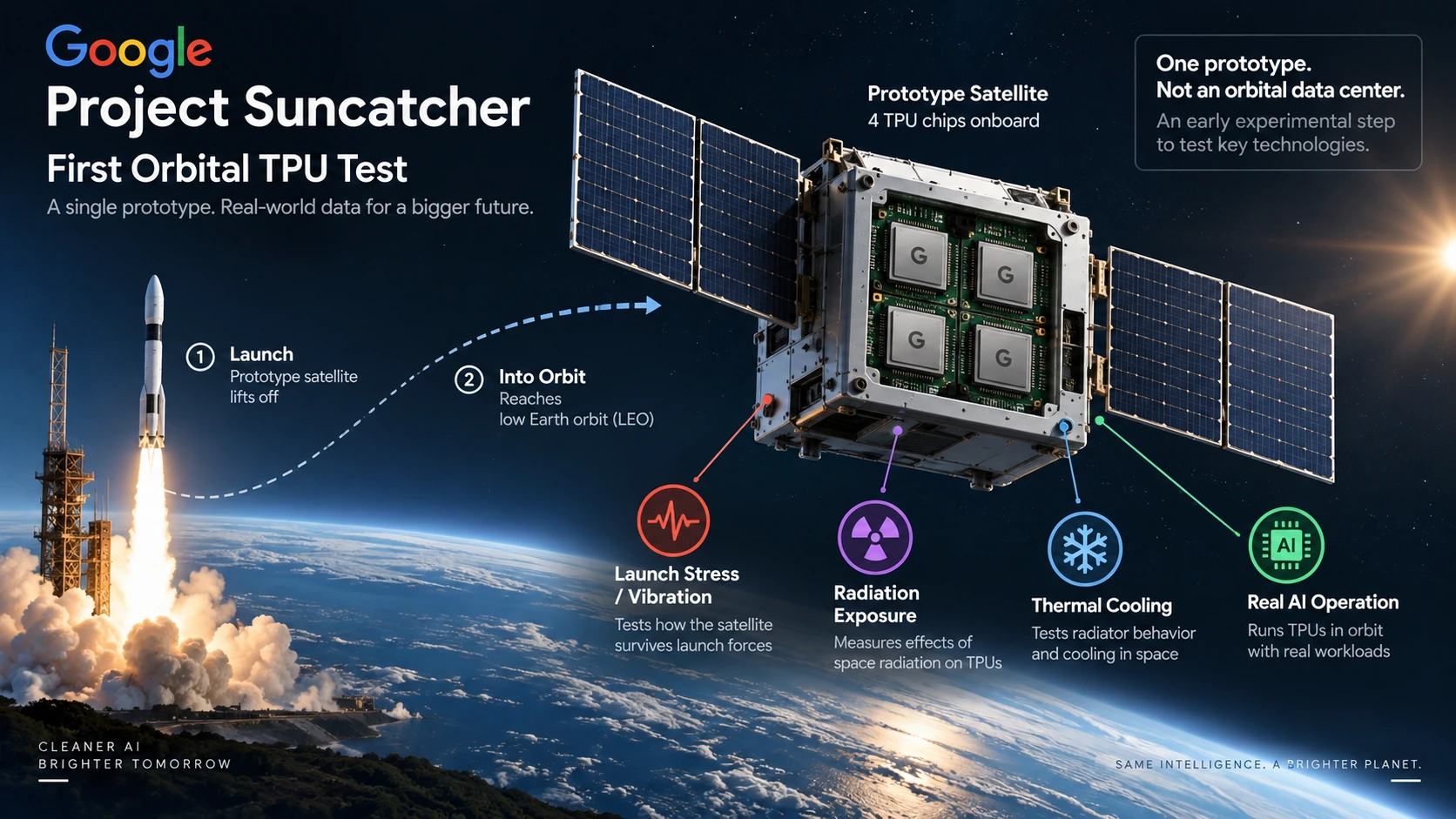
Project Suncatcher is a Google research program first publicly described in November 2025. Its long-term idea is to build groups of solar-powered satellites carrying AI accelerators and connect them with extremely fast optical links so that many spacecraft could eventually work together like one distributed computing system. (Google Research)
The upcoming October 2026 mission is an accelerated first step.
According to Google, the satellite was developed with Planet and will fly on SpaceX’s Transporter-18 mission. The immediate questions are straightforward:
| Test | What Google wants to learn |
|---|---|
| Launch survival | Can TPUs tolerate intense vibration and acceleration? |
| Radiation | Will space radiation cause errors or long-term hardware damage? |
| Cooling | Can high-power AI chips shed enough heat in a vacuum? |
| Real operation | Will the hardware actually run AI workloads reliably in orbit? |
Those are basic questions compared with building an entire data center.
But if the answers are bad, the larger Project Suncatcher idea becomes much harder to justify.
Why Put AI Computing in Space at All?
AI requires enormous amounts of electricity, and that demand is becoming harder for power systems to ignore.
The International Energy Agency expects data-center expansion to account for about half of U.S. electricity-demand growth through 2030. The agency also says U.S. data-center electricity consumption is rising much faster than overall power demand. (IEA)
That does not mean the country is running out of electricity.
It means data centers can create unusually large new loads in specific places, often much faster than utilities can build generation, transmission lines and substations.
Google’s space idea tries to attack that constraint from an unusual direction.
Instead of asking:
“How do we build enough power around the data center?”
Project Suncatcher asks:
“What if we move some of the computing closer to an enormous energy source?”
That energy source is the Sun.
Google says solar panels in the right low-Earth-orbit environment could produce as much as eight times the energy of comparable panels on Earth, largely because they can receive sunlight for much longer periods without clouds, nighttime weather conditions or atmospheric losses. (Google)
That sounds like a major advantage.
But generating electricity is only one part of operating a data center.
Why Is Cooling Actually Harder in Space?

This is one of the most counterintuitive parts of the story.
Space is cold, so a computer should be easy to cool there—right?
No. A vacuum can actually make cooling high-power electronics much more difficult.
On Earth, data centers move enormous quantities of heat into air or liquid cooling systems. Air carries heat away through convection.
In space, there is essentially no surrounding air.
That means a satellite cannot simply blow hot air away from its processors. Heat has to move through solid materials or fluids to a radiator, which then releases that energy as infrared radiation.
Google says its experimental cooling system uses heat pipes and radiators, and it has already tested the design in a thermal-vacuum chamber on Earth. The company now wants to find out how it behaves in the actual space environment. (Google)
The scale difference is important.
A future AI data center could generate enormous amounts of waste heat continuously. Every extra radiator adds surface area, mass and launch cost.
Ars Technica reports that the initial Suncatcher prototype can run its AI hardware only in relatively short bursts before allowing the cooling system to catch up. (Ars Technica)
So abundant solar energy does not automatically mean abundant usable computing power.
You still have to get rid of the heat.
Can Normal AI Chips Survive a Rocket Launch and Space Radiation?
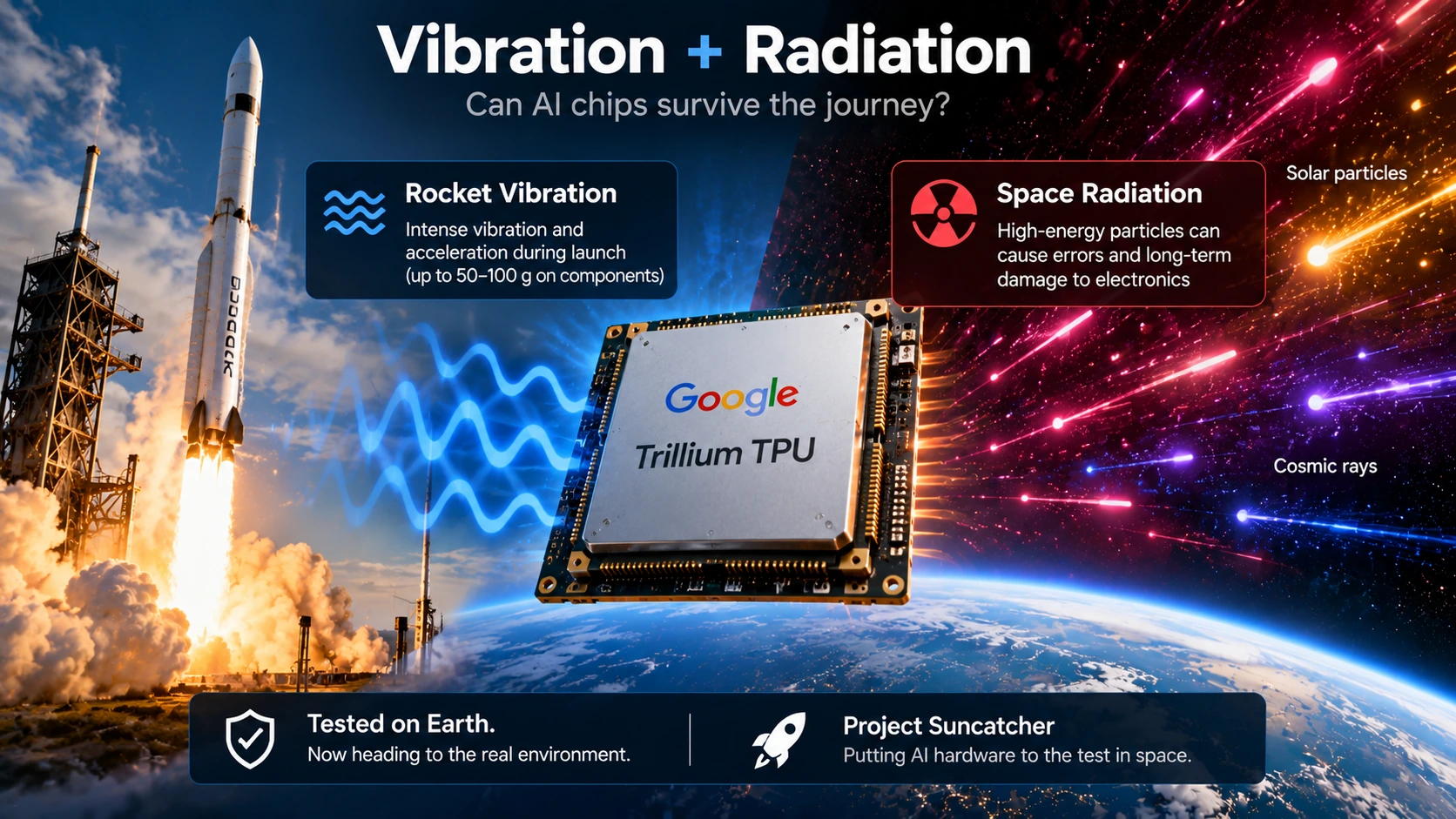
Google is not starting with a specially designed science-fiction “space TPU.”
It has been testing Trillium TPUs, the company’s existing AI accelerator hardware.
That makes the experiment more consequential. If commercial-style computing hardware can survive orbital conditions with manageable modifications, Google would not necessarily need to redesign every chip from scratch.
Launch itself is violent.
Google says the spacecraft can experience sustained loads of around 10 times Earth’s gravity during ascent, while individual components can experience amplified forces reaching roughly 50 to 100 g. The team has already subjected the hardware to vibration testing on the ground. (Google)
Radiation creates a different problem.
High-energy particles can interfere with electronics and flip individual bits in computer memory or logic. Enough radiation over time can also degrade semiconductor components.
Google previously tested Trillium TPUs in a proton beam. Its researchers reported no permanent failures attributable to total ionizing radiation at doses substantially above what their model estimated for a shielded five-year mission, although some memory components showed sensitivity earlier. (Google Research · Research Paper)
That was encouraging.
It was not proof that the system will work reliably for years in orbit.
That is why Google is now sending the hardware into the real environment.
How Could Satellites Ever Behave Like One Giant Data Center?
A modern AI system rarely runs on one processor.
Large workloads are divided across many accelerators that constantly exchange data.
Inside a terrestrial data center, those processors can be connected by extremely fast networking equipment over very short physical distances.
In orbit, Google would have to recreate that relationship across separate spacecraft.
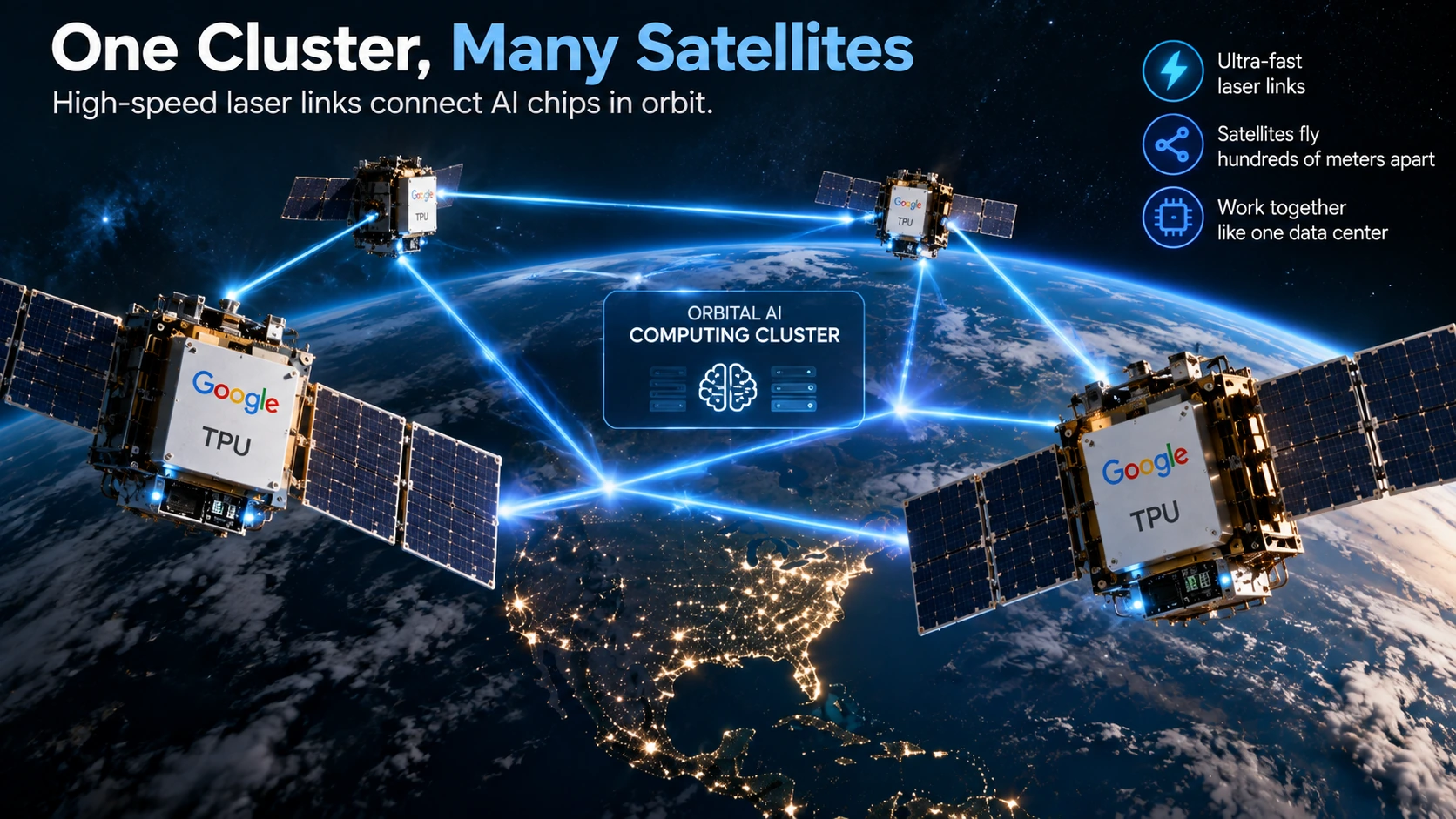
Project Suncatcher’s proposed answer is laser communication between closely grouped satellites.
Google’s earlier research describes future systems in which satellites could fly only hundreds of meters apart and exchange data using free-space optical links. The team has demonstrated an experimental optical connection transmitting 800 gigabits per second in each direction with a single transceiver pair. (Google Research)
That does not mean an orbital cluster already performs like a Google data center.
It shows why the satellites would need to fly unusually close together.
The farther apart they are, the harder it becomes to maintain the enormous communication bandwidth required for distributed AI computation.
There is another complication: the satellites themselves are moving.
A future system would have to keep track of the exact position of every spacecraft while aiming high-bandwidth laser links at moving neighbors.
Google compares the precision challenge to hitting a coin-sized target from miles away while both sides are moving.
The company says a two-satellite experiment planned for 2027 is intended to test this networking problem in orbit. (Google)
So the 2026 mission asks:
Can the chips operate in space?
The 2027 milestone asks a harder question:
Can multiple computing satellites begin operating together?
Could a Space Data Center Ever Be Cheaper Than One on Earth?
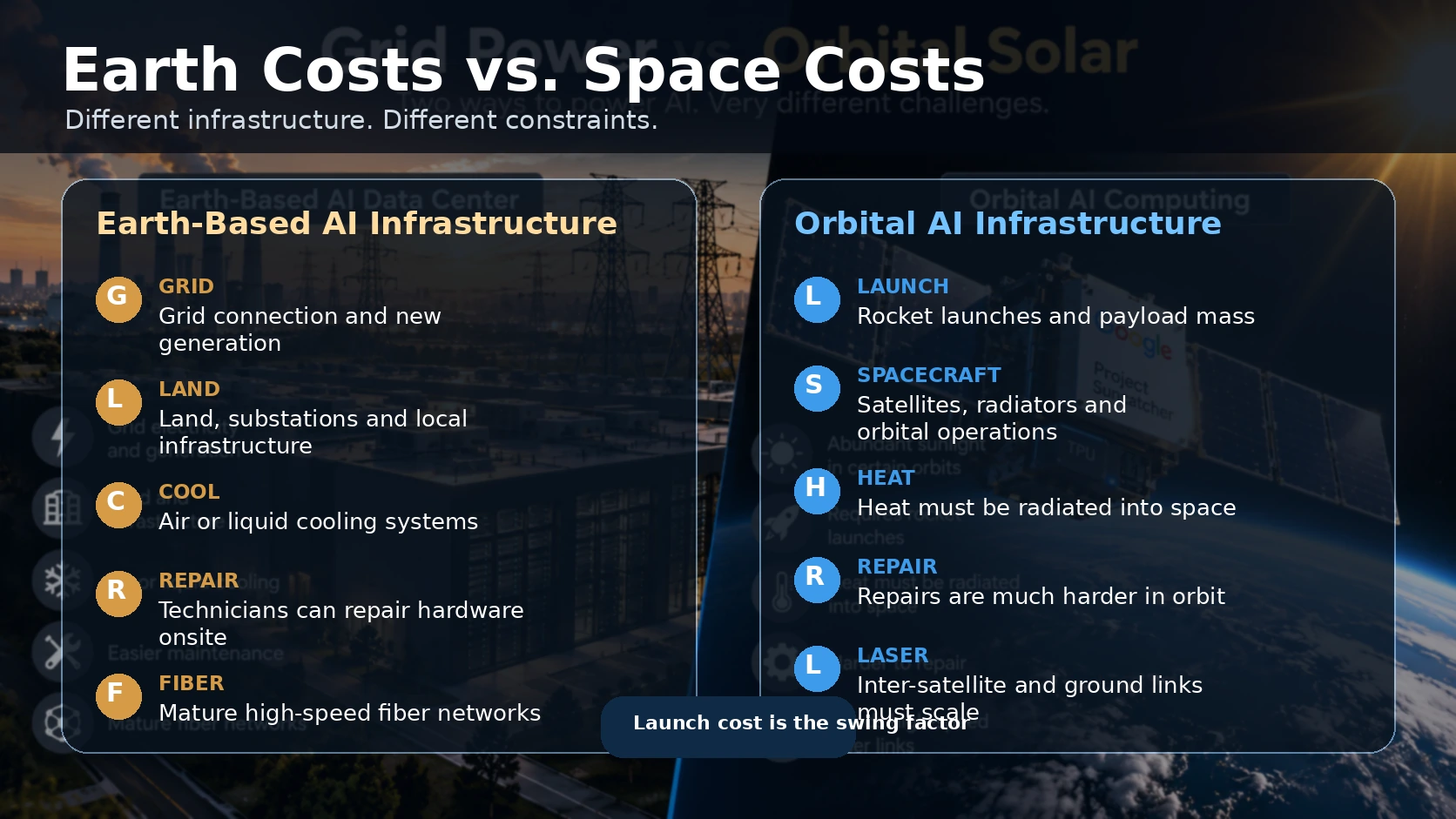
This is where Project Suncatcher moves from physics into economics.
Space removes some terrestrial constraints, but replaces them with entirely different ones.
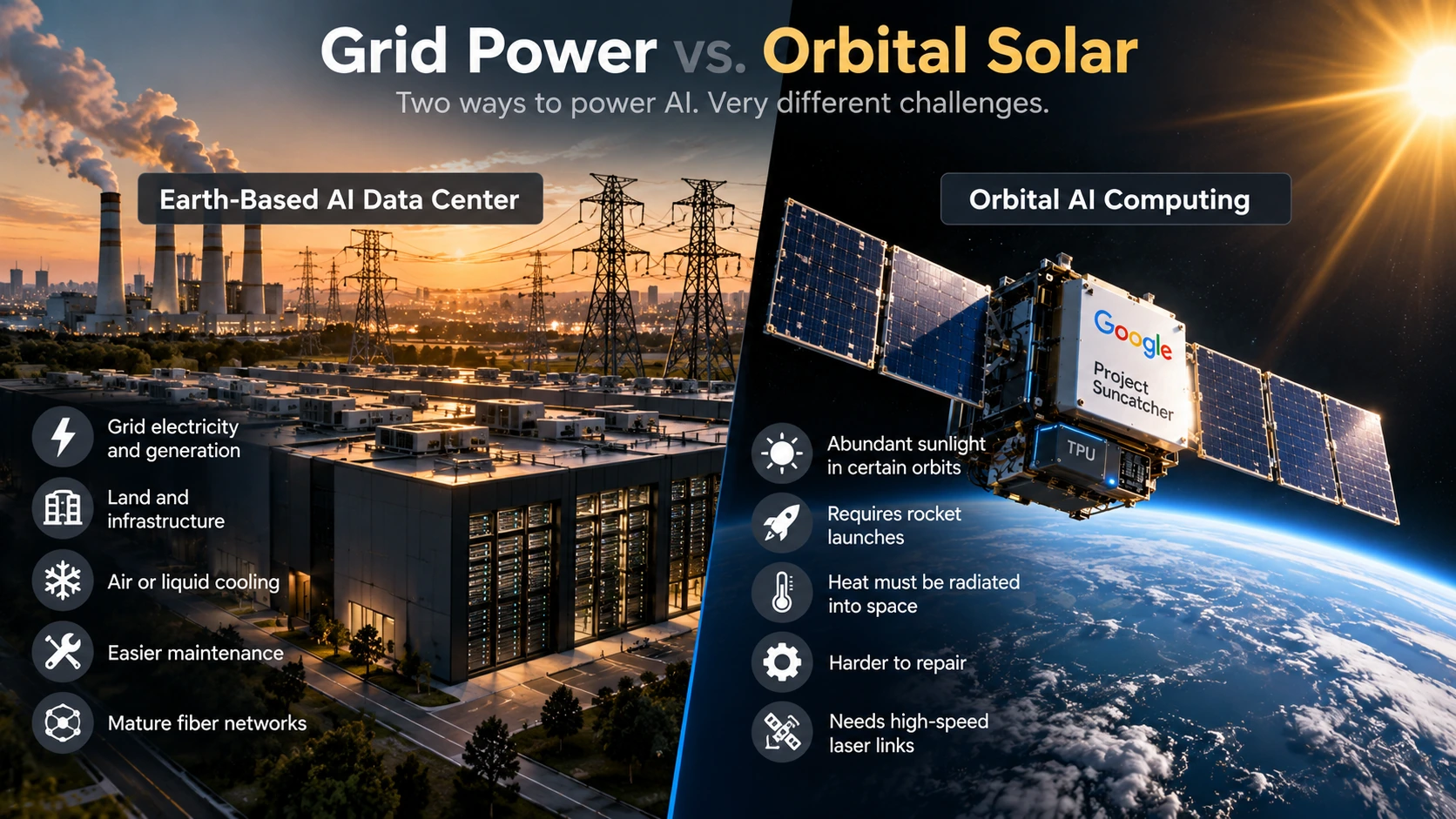
| Earth-based AI infrastructure | Orbital AI infrastructure |
|---|---|
| Requires grid connection and generation | Requires rocket launches |
| Needs land and local infrastructure | Needs satellites and orbital operations |
| Cooling can use air or liquid systems | Heat must ultimately be radiated into space |
| Hardware can be physically repaired | Repairs are far more difficult |
| Fiber networking is mature | Satellite-to-satellite and ground links must scale |
| Solar power faces weather and night | Certain orbits can provide much longer solar exposure |
The biggest unknown may be launch cost.
Google’s 2025 research modeled a scenario in which low-Earth-orbit launch prices eventually fall below roughly $200 per kilogram in the mid-2030s. Under that assumption, the company argued that the energy economics of space-based computing could begin to approach those of terrestrial infrastructure. (Google Research · Research Paper)
That is not a prediction that launch prices definitely will reach that level.
It is a condition in Google’s economic model.
If launches remain expensive, radiators remain heavy or satellites need frequent replacement, the economics could look very different.
There is also a question Earth-based data centers can answer easily and space-based systems cannot:
What happens when something breaks?
On Earth, technicians can replace a failed power supply, networking card or accelerator.
In orbit, even routine maintenance becomes a spacecraft problem.
Does This Mean Google Wants to Abandon Earth-Based Data Centers?
No.
Nothing Google has announced suggests terrestrial data centers are about to disappear.
The current AI buildout on Earth is still enormous, and governments, utilities and technology companies are investing heavily in new power generation, transmission, cooling and data-center infrastructure.
The U.S. Department of Energy cites a Lawrence Berkeley National Laboratory reference-case estimate that data centers could account for 11.8% of total U.S. electricity use in 2030, with modeled scenarios ranging from 9.5% to 15.3%. (U.S. Department of Energy)
Project Suncatcher is better understood as a long-term alternative for some future computing capacity, not a replacement for everything on Earth.
Different workloads also have different needs.
A service that must respond instantly to users may care greatly about latency and connectivity to terrestrial networks.
A massive training workload that can be moved and scheduled more flexibly may face different tradeoffs.
Google has not yet demonstrated which workloads would make the most economic sense in orbit at scale.
That is one reason the company still calls Suncatcher a moonshot.
What Happens Next?
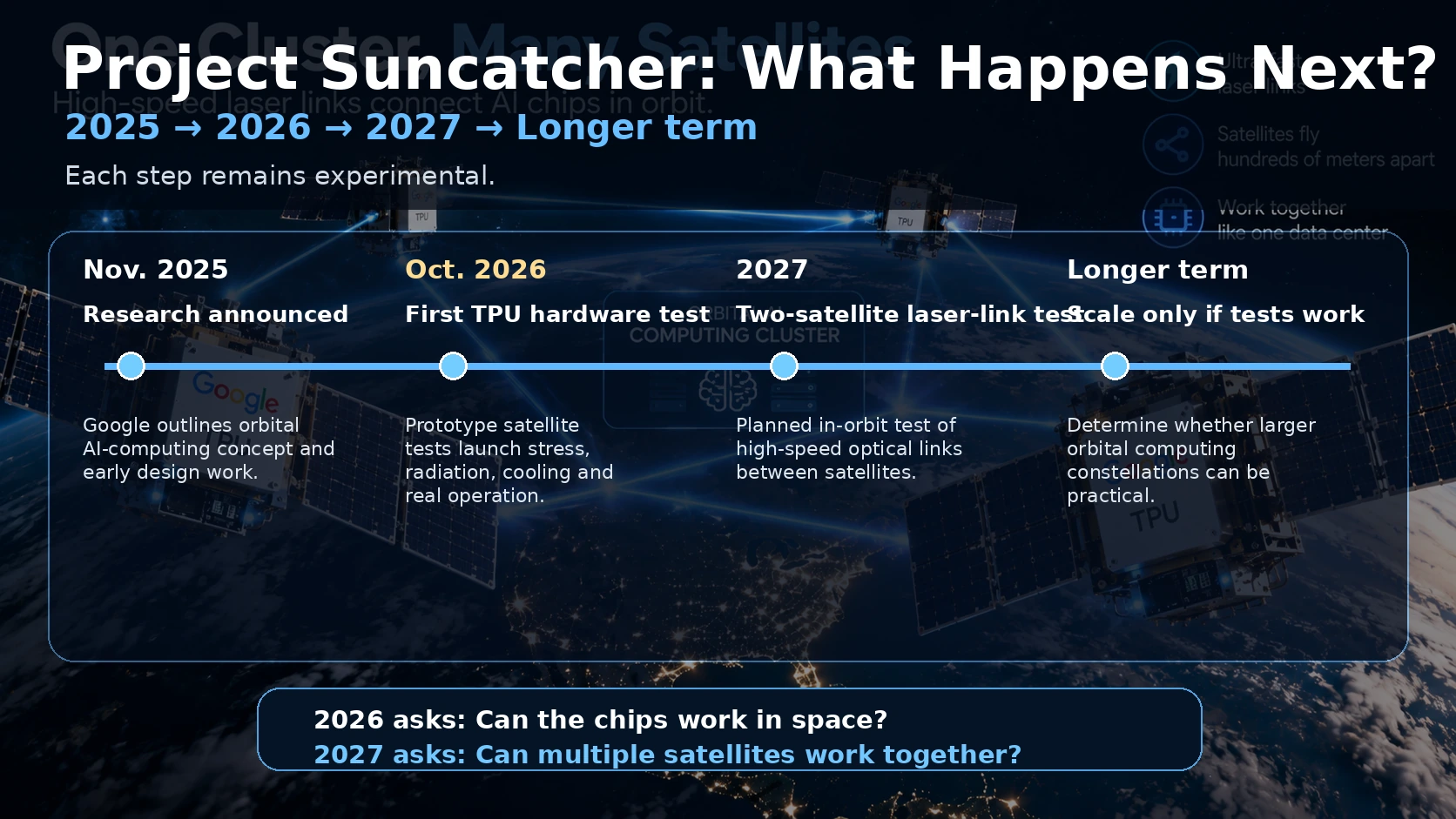
Project Suncatcher is moving in stages.
| Stage | What it is meant to test |
|---|---|
| November 2025 | Google publicly outlines the orbital AI-computing concept and early research |
| October 1, 2026 (currently scheduled) | First TPU hardware experiment in orbit |
| 2027 | Planned two-satellite test of high-speed optical links |
| Longer term | Determine whether larger computing constellations can be technically and economically practical |
The first mission may reveal that some pieces work better than expected.
It may also expose problems that are difficult or expensive to solve.
That is what makes the experiment worth watching.
The most important result is not simply whether a TPU can run Gemini workloads for about 15 minutes at a time. (Ars Technica)
It is whether the test begins closing the gap between two very different things:
“AI chips can operate in space.”
and
“A space-based AI data center can actually compete with one on Earth.”
Google is about to test the first statement.
The second remains very far from proven.
Why It Matters in One Sentence
Google’s Project Suncatcher is not moving today’s data centers into orbit—it is testing whether abundant solar energy in space could eventually outweigh the enormous challenges of cooling, radiation, networking, maintenance and launch cost.
Project Suncatcher: Key Questions Explained
Q. What is Google Project Suncatcher?
Project Suncatcher is Google’s research effort to explore whether solar-powered satellites carrying TPU AI accelerators could eventually form large-scale computing systems in space.
Q. Is Google launching a full AI data center into space?
No. The 2026 mission is a small prototype hardware test designed primarily to study how TPUs perform during launch and in low Earth orbit.
Q. When is Google’s first Project Suncatcher orbital test scheduled?
The first orbital test is currently scheduled to launch on SpaceX’s Transporter-18 rideshare mission on October 1, 2026. Launch schedules can change. (Ars Technica)
Q. Why would Google put AI chips in space?
One attraction is solar energy. Google says certain low-Earth-orbit configurations could give solar panels much longer exposure to sunlight and substantially higher energy production than comparable panels on Earth.
Q. Are data centers really creating that much electricity demand?
Yes. The IEA expects data-center growth to account for about half of the increase in U.S. electricity demand through 2030, although actual consumption will depend on future construction and efficiency.
Q. Why is cooling difficult in space if space is cold?
Because space is a vacuum. There is no surrounding air to carry heat away through convection, so the system must conduct heat to radiators and release it as thermal radiation.
Q. Can Google’s TPU chips survive space radiation?
Ground tests of Trillium TPUs produced encouraging results, but Google is conducting the orbital mission because laboratory testing cannot fully reproduce the real space environment over time.
Q. How would many AI satellites communicate with one another?
Google’s concept uses high-speed optical, or laser, links between satellites flying relatively close together. A two-satellite networking experiment is planned for 2027.
Q. Will space data centers be cheaper than normal data centers?
That has not been proven. Google’s own economic analysis depends heavily on launch costs falling dramatically along with progress in cooling, reliability and satellite manufacturing.
Q. Are Earth-based AI data centers going away?
No. Project Suncatcher is a long-term research project. Terrestrial data centers remain the foundation of current AI infrastructure, and large investments in power and computing capacity on Earth are continuing.
Did this help make the story clearer? 🙂
WIN keeps unpacking the “why” behind the news—clearly and simply!
Sources
Project Suncatcher and the 2026 Orbital Test
Google — Behind Project Suncatcher, Our Moonshot to Put AI in Space
Ars Technica — Google’s First Suncatcher Orbital Data Center Test Launches October 1
System Design, Radiation and Long-Term Economics
Google Research — Exploring a Space-Based, Scalable AI Infrastructure System Design
Research Paper — Towards a Future Space-Based, Highly Scalable AI Infrastructure System Design
AI Data Centers and Electricity Demand
International Energy Agency — Electricity 2026: Demand
U.S. Department of Energy — Powering America’s AI Future: Data Center Resource Hub
Keep Reading
Why Has Data-Center Power Become a Political Issue on Earth?
Project Suncatcher looks to space partly because electricity, grid connections and infrastructure have become major constraints on Earth. Texas and California are already confronting the question of who should pay for the enormous power and water systems required by new data centers.
Why Are Texas and California Putting New Limits on Data Centers—and Who Pays for the Power?