Why Is UnitedHealth Earning More While Losing Nearly a Million Medicare Advantage Members?

How can a health insurance company make more money while losing nearly a million people from one of its biggest insurance programs?
That sounds backward. Fewer members should mean less money coming in, shouldn’t it?
Yet that’s the picture emerging from UnitedHealth Group’s latest earnings report. The company reported substantially higher operating profits even as its Medicare Advantage membership remained sharply below where it stood at the end of last year.
The explanation reveals something important about how health insurance works: Having more customers doesn’t always make an insurer more profitable. What matters is how much it receives for covering those customers—and how much their medical care costs.
There’s also a distinction that could easily get lost in the headline. The reported membership decline does not mean nearly a million Americans suddenly lost Medicare coverage.
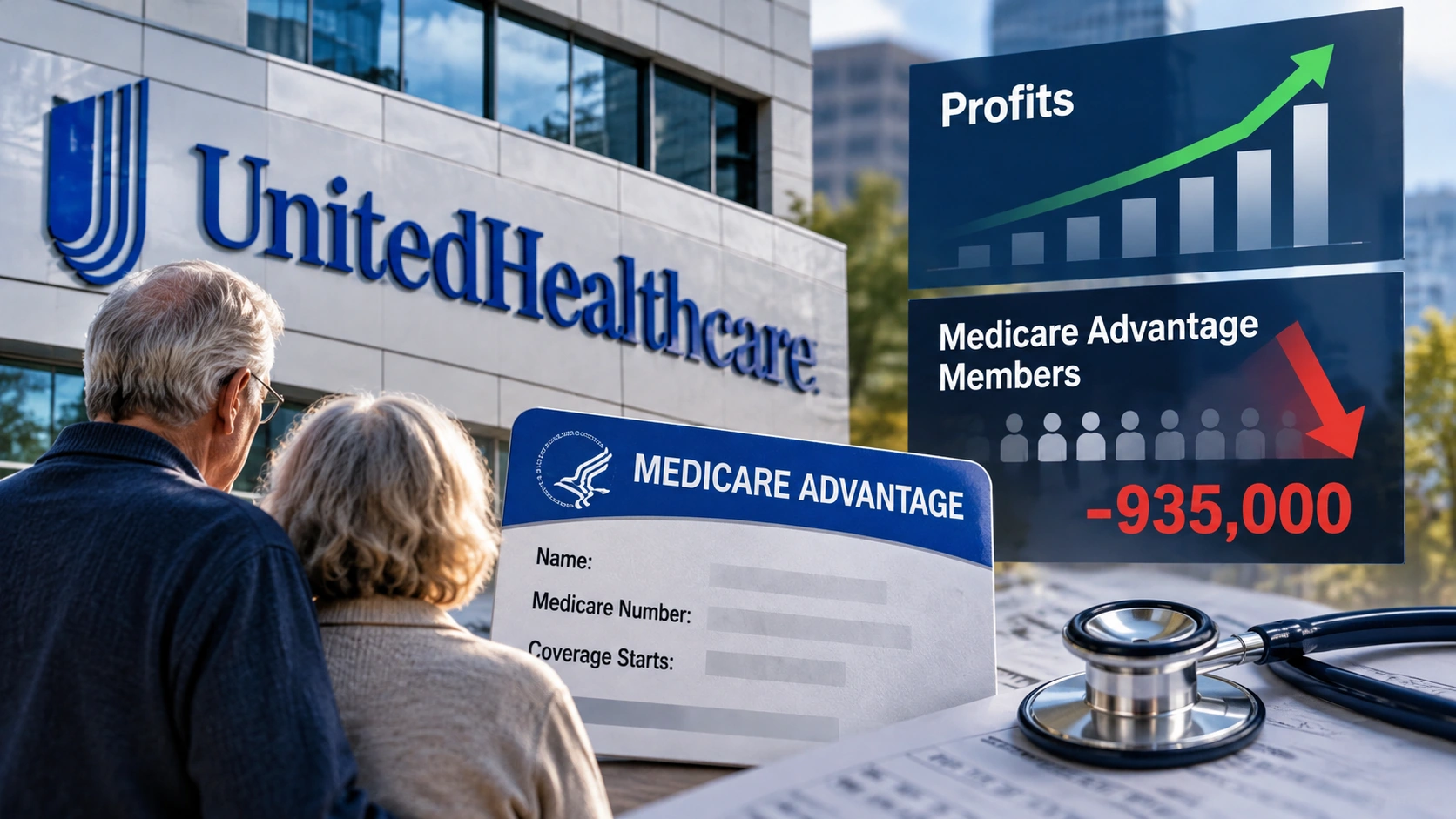
※ Images in this article are AI-generated illustrations created to help explain the story. They are not actual photographs, and depictions of people, places, or events may differ slightly from reality.
And with Medicare’s annual Open Enrollment period beginning October 15, the timing gives the earnings report a significance beyond Wall Street.
It raises a more personal question: If insurers are changing their businesses to restore profitability, what might that mean for the plans older Americans can choose next year?
What Did UnitedHealth Actually Report?
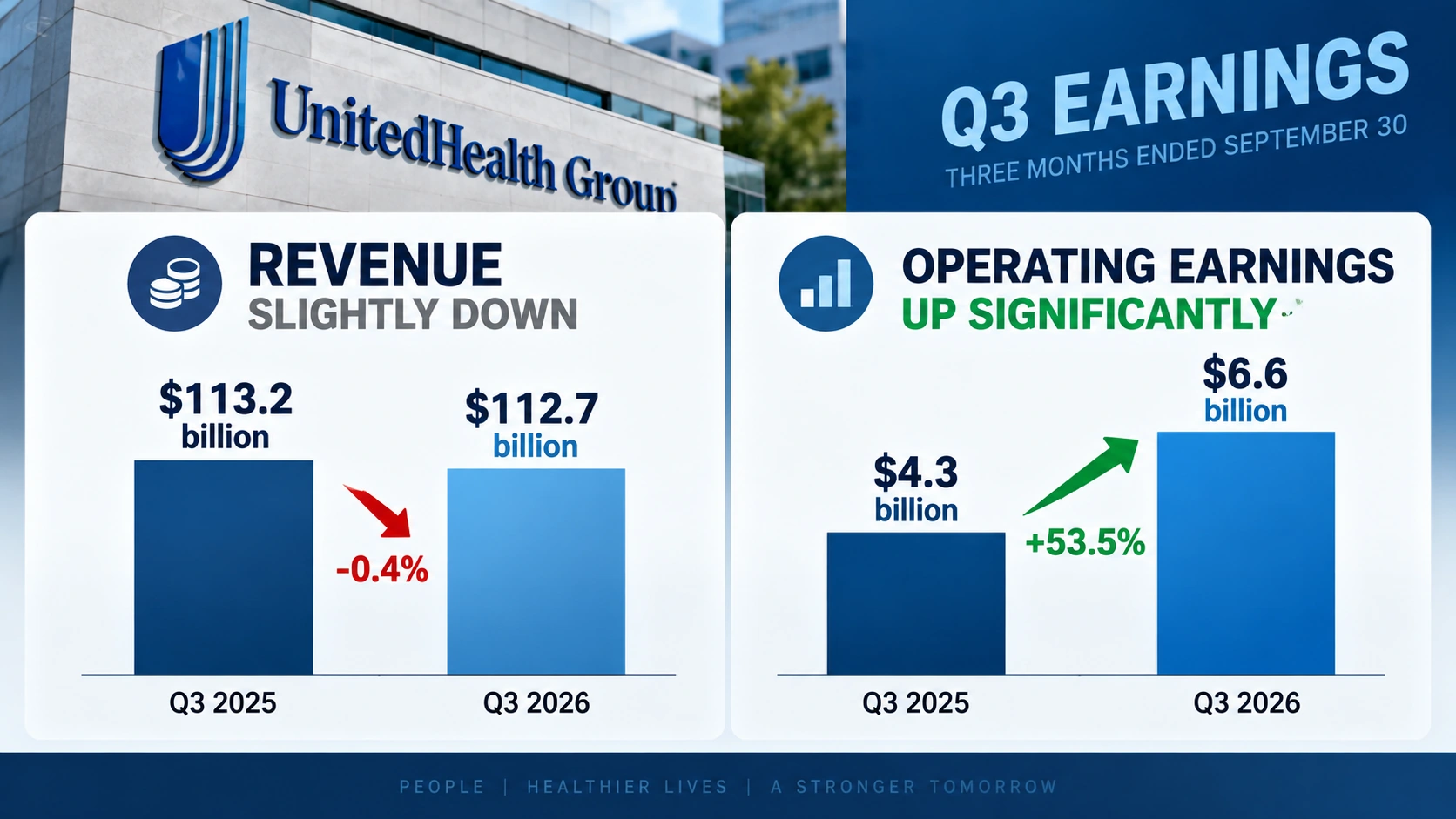
On October 13, 2026, UnitedHealth Group released results for the three months ended September 30.
The company reported $6.6 billion in operating earnings, up from $4.3 billion a year earlier. Revenue, however, slipped slightly from $113.2 billion to $112.7 billion.
UnitedHealth also raised its full-year outlook for adjusted earnings per share to at least $20.50. (UnitedHealth Group · Reuters)
The numbers tell a more interesting story when placed side by side.
| Financial measure | Q3 2025 | Q3 2026 |
|---|---|---|
| Revenue | $113.2 billion | $112.7 billion |
| Operating earnings | $4.3 billion | $6.6 billion |
| Medical care ratio | 89.9% | 88.4% |
| Operating cost ratio | 13.5% | 12.8% |
(UnitedHealth Group SEC earnings release)
Revenue measures how much money the company brought in. Operating earnings measure what remained from its business operations after operating costs, before certain other expenses and taxes.
UnitedHealth wasn’t earning more because its overall revenue was growing. It was earning more because its operating costs had fallen relative to revenue.
That difference matters.
A company can become more profitable without selling more products or serving more customers. It can improve profitability by changing prices, reducing expenses, altering the products it offers, or moving away from business that produces weak financial returns.
UnitedHealth’s latest results show several of those forces at work.
But the membership numbers deserve a closer look.
Did 935,000 People Actually Lose Medicare?
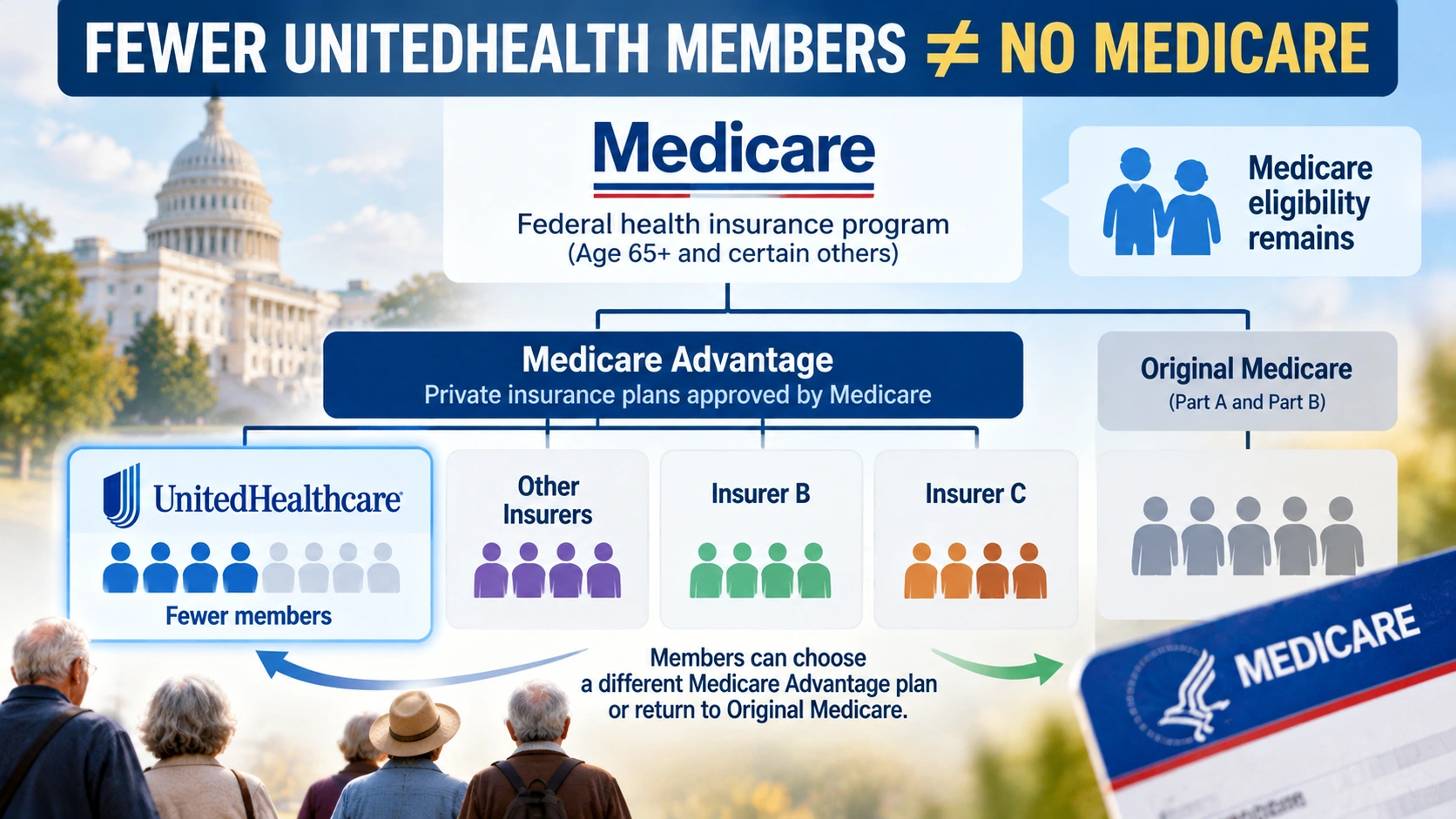
No. The 935,000 figure does not establish that 935,000 Americans lost their federal Medicare eligibility or became uninsured.
According to UnitedHealth’s October 13 earnings release, the number of older adults served through its Medicare Advantage business—including certain programs for people also covered by Medicaid—was 935,000 lower than at the end of 2025.
That is a net enrollment decline across the first nine months of 2026, not a count of everyone who lost coverage during the third quarter. (SEC)
The distinction is important because Medicare and Medicare Advantage are not interchangeable terms.
Medicare is the federal health insurance program primarily serving people age 65 and older, along with certain younger people who qualify.
Medicare Advantage is one way to receive Medicare benefits through a private insurance company approved by Medicare.
Someone who stops being enrolled in a UnitedHealthcare Medicare Advantage plan could move to another private Medicare Advantage insurer or return to Original Medicare, depending on the circumstances and applicable enrollment rules.
The earnings report does not trace every departed member’s next destination.
It also doesn’t tell us that every person who left did so voluntarily.
The Membership Decline Didn’t All Happen at Once
Earlier in 2026, UnitedHealth reported a net Medicare Advantage membership contraction of 965,000 from year-end 2025 through June 30.
By September 30, that cumulative decline had narrowed slightly to 935,000.
| Reporting point | Net change from year-end 2025 |
|---|---|
| June 30, 2026 | Down 965,000 |
| September 30, 2026 | Down 935,000 |
(Q2 SEC filing · Q3 SEC filing)
Those figures imply a modest net recovery of approximately 30,000 members in the third quarter on the company’s reported basis.
That doesn’t erase the larger decline. But it shows why describing the entire 935,000 as people who left during the latest quarter would be inaccurate.
There’s another surprising detail.
The broader Medicare Advantage market has continued to grow, even while UnitedHealth has lost members.
KFF reported that approximately 55% of eligible Medicare beneficiaries were enrolled in Medicare Advantage in 2026. UnitedHealth remained the largest Medicare Advantage insurer, although its national market share declined from 29% to 26%. (KFF)
In other words, UnitedHealth’s shrinking enrollment is not evidence that Americans as a whole are abandoning Medicare Advantage.
It is partly a story about where they are getting that coverage—and which customers insurers are trying to attract.
How Does Medicare Advantage Make Money for Insurance Companies?
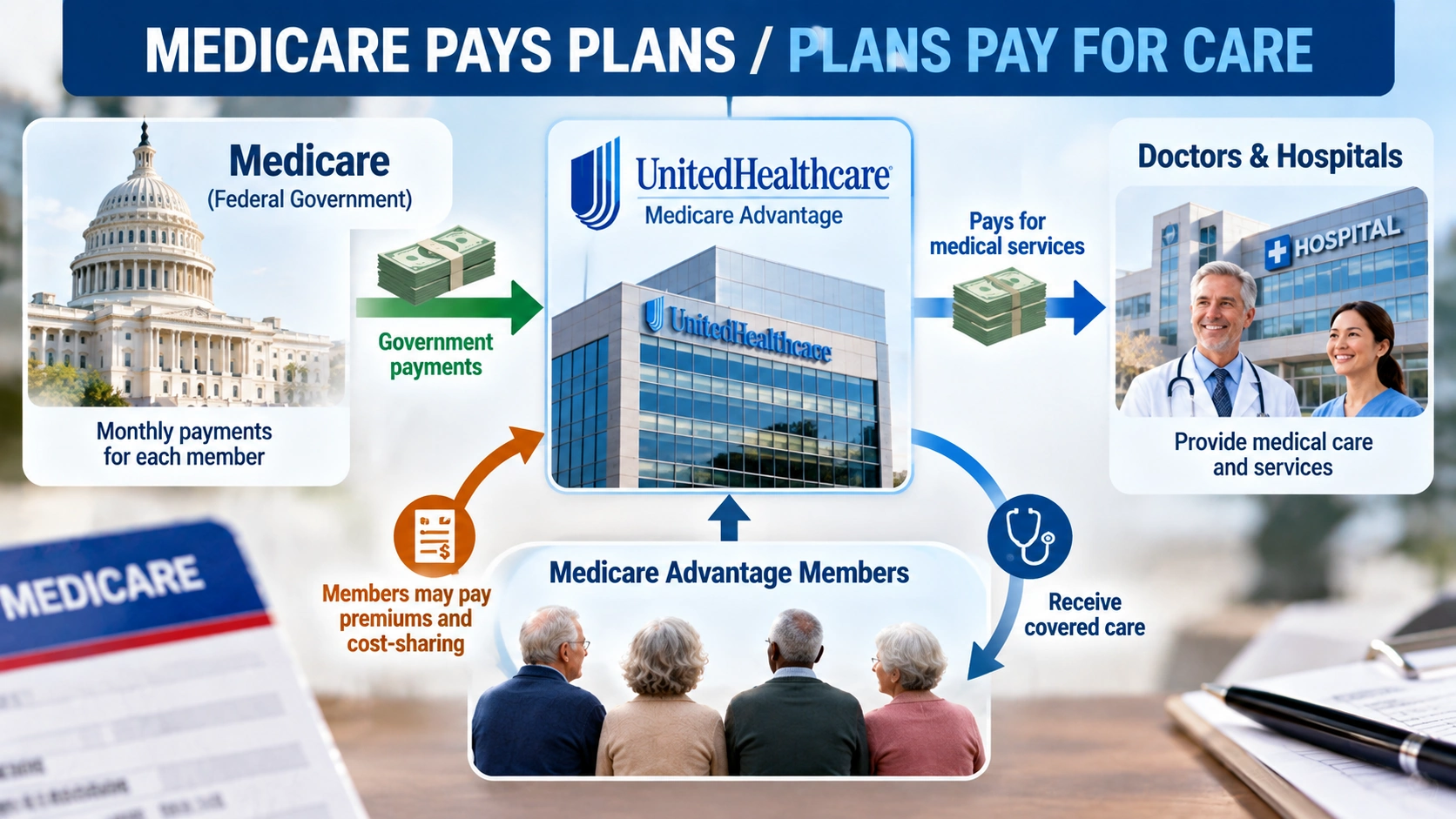
Medicare Advantage insurers generally receive monthly payments from the federal government to provide covered benefits to enrolled members.
The amount is adjusted according to various factors, including the characteristics and health risks of the people covered.
An insurer then arranges and pays for covered medical services under the plan’s rules. Members may also pay premiums, deductibles, copayments, or coinsurance, depending on their plan and the care they receive. (Medicare.gov)
Think of it as a business with two important sides.
First, the insurer receives money to cover its members.
Second, it must pay for the medical care those members use.
If the cost of providing coverage rises faster than the money coming in, the insurer’s financial margin gets squeezed.
For example, imagine a hypothetical insurance plan receiving $1,000 a month to cover one member.
If the member’s expected medical costs average $900, the plan has $100 left before administrative expenses and other costs.
But if those medical costs rise to $970, only $30 remains before those other expenses.
The member count hasn’t changed, but the economics of covering that member have changed dramatically.
This helps explain why insurers pay close attention to hospital use, prescription drug spending, medical procedures, and how their plans are priced.
It also explains why the number of members alone doesn’t tell the whole financial story.
Original Medicare Versus Medicare Advantage
| Feature | Original Medicare | Medicare Advantage |
|---|---|---|
| Coverage administration | Federal Medicare program | Medicare-approved private insurers |
| Core coverage | Part A and Part B | Part A and Part B benefits through the plan |
| Drug coverage | Usually requires separate Part D enrollment | Usually included |
| Provider access | Generally broad access to providers accepting Medicare | Often governed by plan networks |
| Extra benefits | Generally limited | May include dental, vision, or hearing |
| Costs | Medicare cost-sharing rules apply | Plan-specific premiums and cost-sharing rules apply |
Medicare Advantage plans must provide the medically necessary benefits covered by Original Medicare, with limited exceptions, but they may use different networks, referral requirements, and other plan rules.
That means private insurers have some flexibility in designing how coverage works.
And that flexibility becomes especially important when medical costs rise.
Why Would UnitedHealth Allow Its Medicare Advantage Membership to Shrink?
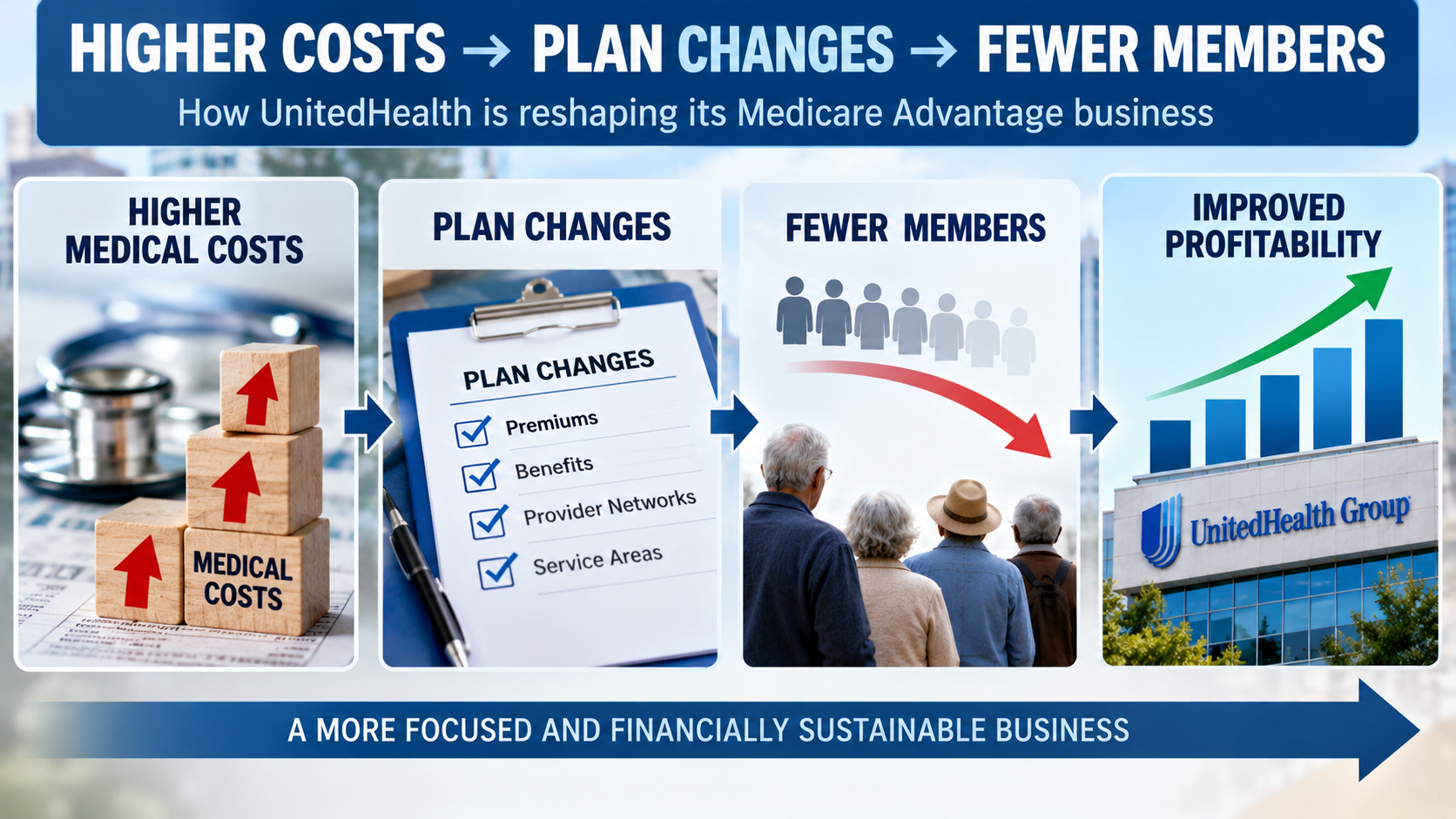
Because UnitedHealth has deliberately prioritized recovering financial margins over maintaining every part of its previous Medicare Advantage enrollment.
This strategy was visible before the latest earnings report.
In its January 2026 outlook, UnitedHealth projected a substantial reduction in Medicare Advantage membership as it worked to improve financial performance.
Its earlier full-year projection included a decline of approximately 1.3 million to 1.4 million people across its broader reported Medicare Advantage population, including certain members with both Medicare and Medicaid coverage. That was a forecast, not a final enrollment result. (SEC)
Higher medical costs had put pressure on insurers, while companies were reassessing plan offerings and the economics of serving different markets.
A major insurer has several ways to respond.
It can adjust premiums or benefits within Medicare’s rules. It can change provider networks. It can discontinue particular products or stop offering plans in certain counties.
Those decisions can reduce enrollment if customers find other options or if plans are no longer offered where they live.
Independent research supports the broader pattern.
KFF found that UnitedHealthcare withdrew Medicare Advantage offerings from 225 counties for the 2026 plan year while entering 14 new counties. Other large insurers also reduced their geographic footprints. (KFF)
The business consequences become clearer when viewed from both sides.
| Insurer decision | Potential business effect | Possible member consequence |
|---|---|---|
| Reduce unprofitable offerings | Improve financial performance | Fewer local plan choices |
| Adjust benefits or cost-sharing | Better align expected costs and revenue | Different out-of-pocket expenses |
| Change provider networks | Manage care costs | Some doctors may be out of network |
| Prioritize different plan types | Focus on preferred business segments | Different available coverage options |
These are possible effects of the strategy, not proof that every UnitedHealthcare member experienced every change.
The key difference is between maximizing enrollment and optimizing profitability.
For years, expansion was a major part of Medicare Advantage’s business story. Now, some large insurers are placing greater emphasis on whether their coverage remains financially sustainable.
That also creates tension between what works for an insurer and what works for an individual member.
An insurer can improve its operating margin by offering a less costly product.
But a consumer might place more value on keeping a familiar doctor, retaining a prescription benefit, or avoiding a higher hospital copayment.
Both sides are making decisions about cost. They just aren’t always looking at the same costs.
Where Did UnitedHealth’s Higher Profits Come From?
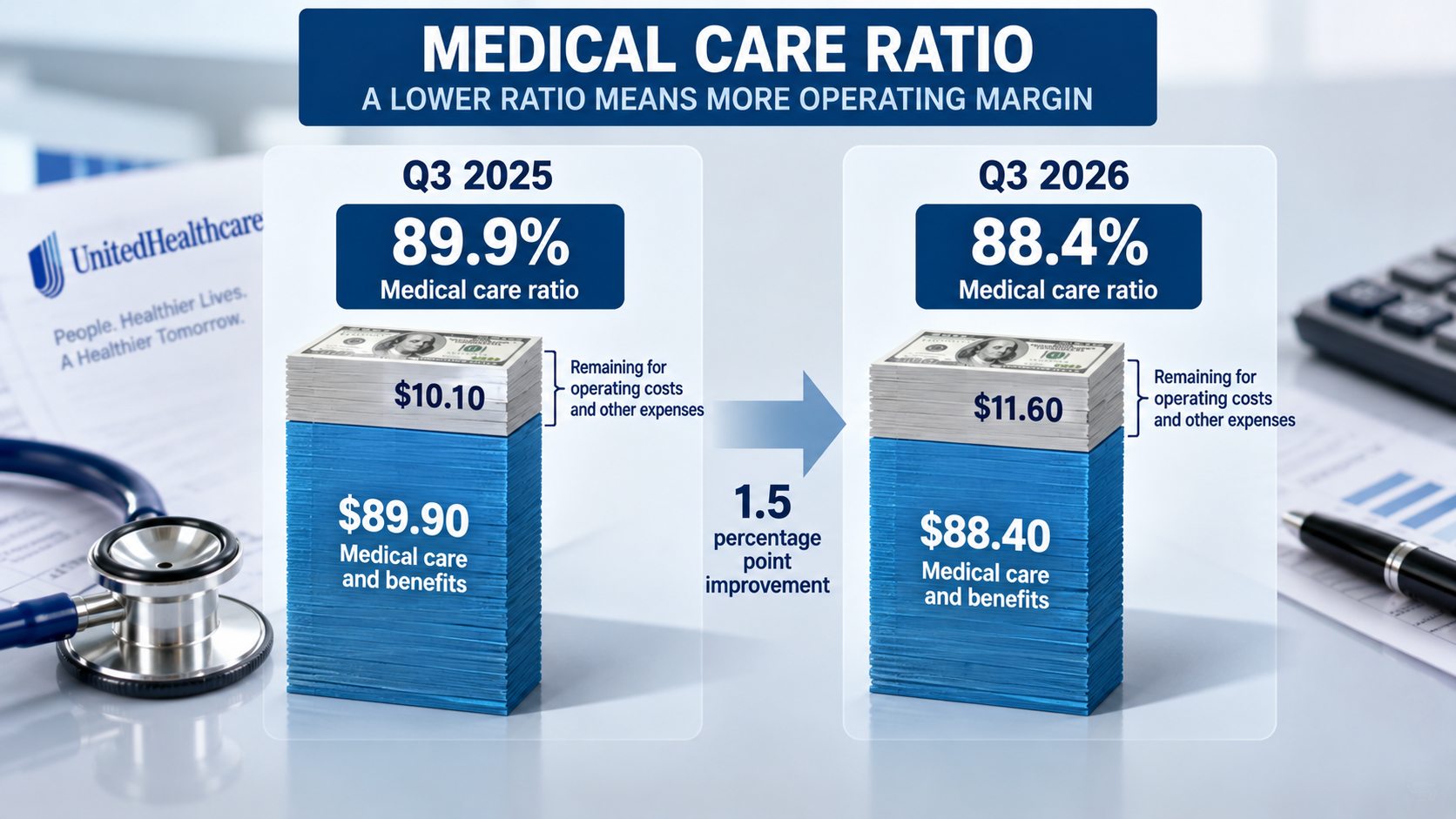
One of the most important numbers in UnitedHealth’s report was its medical care ratio, which declined from 89.9% to 88.4%.
The medical care ratio measures the share of applicable premium revenue used for medical care and related benefits.
A simplified way to understand the change is to imagine the company receiving $100 in insurance premium revenue.
At a medical care ratio of 89.9%, approximately $89.90 goes toward medical care and related benefit costs.
At 88.4%, that amount falls to approximately $88.40.
That is a difference of $1.50 for every $100 in applicable premium revenue.
It sounds small, but across a very large insurance business, changes of that magnitude can have a major financial impact.
The remaining share is not pure profit. It must also cover administrative expenses and other costs.
UnitedHealth attributed its improved medical care ratio to measures including medical cost management, changes to insurance benefits, pricing discipline, and care delivery improvements.
The company also reported a $610 million favorable prior-period medical reserve development related to 2026 services. That accounting adjustment contributed to the reported medical cost ratio, so the entire improvement should not automatically be interpreted as a permanent decline in underlying medical expenses. (SEC)
UnitedHealth has more than one source of operating earnings, too.
Its UnitedHealthcare business sells and administers insurance coverage, while Optum provides healthcare services, pharmacy-related services, data, and technology.
Both operations contribute to the parent company’s financial results.
In the third quarter, UnitedHealthcare generated $2.8 billion in operating earnings, up from $1.8 billion a year earlier. Optum generated approximately $3.7 billion in operating earnings. (UnitedHealth Group)
That wider business structure helps explain why falling enrollment in one insurance segment does not automatically produce falling profits for the entire company.
It also means the company-level earnings rebound cannot be attributed solely to Medicare Advantage.
Does Higher Profit Mean Medicare Advantage Members Will Pay Less?
Not necessarily.
UnitedHealth becoming more profitable does not automatically lower a member’s premium, copayment, deductible, or prescription drug expense.
Those costs depend on the terms of the specific plan a person has and how the plan changes from one year to the next.
On October 1, UnitedHealthcare introduced its 2027 Medicare plans, emphasizing affordable coverage, $0-premium options in many areas, prescription drug benefits, and additional services for people with complex medical needs.
The company said approximately 90% of Medicare-eligible consumers who have access to one of its Medicare Advantage plans will have a $0 plan-premium option. (UnitedHealthcare)
But that statement requires two important qualifications.
First, it applies to people in areas where the company offers the relevant plans. It does not mean everyone in the United States can choose one.
Second, a $0 Medicare Advantage plan premium does not mean healthcare is completely free.
Members generally still pay their Medicare Part B premium, unless another benefit or assistance arrangement covers it. They may also face other costs when receiving medical services.
Meanwhile, UnitedHealthcare has confirmed that it is changing Medicare Advantage service areas and discontinuing some plans for 2027.
The company said notices dated October 2, 2026, would inform affected members about nonrenewals and their options. (UnitedHealthcare Provider)
This makes the situation more complicated than a simple headline about a profitable insurer.
The same company can offer attractive benefits in one county while discontinuing another plan elsewhere.
The most important question for a Medicare beneficiary is not whether UnitedHealth had a profitable quarter. It’s whether that person’s particular plan still offers the coverage, providers, and costs they need.
What Should Medicare Members Check Before 2027 Open Enrollment?
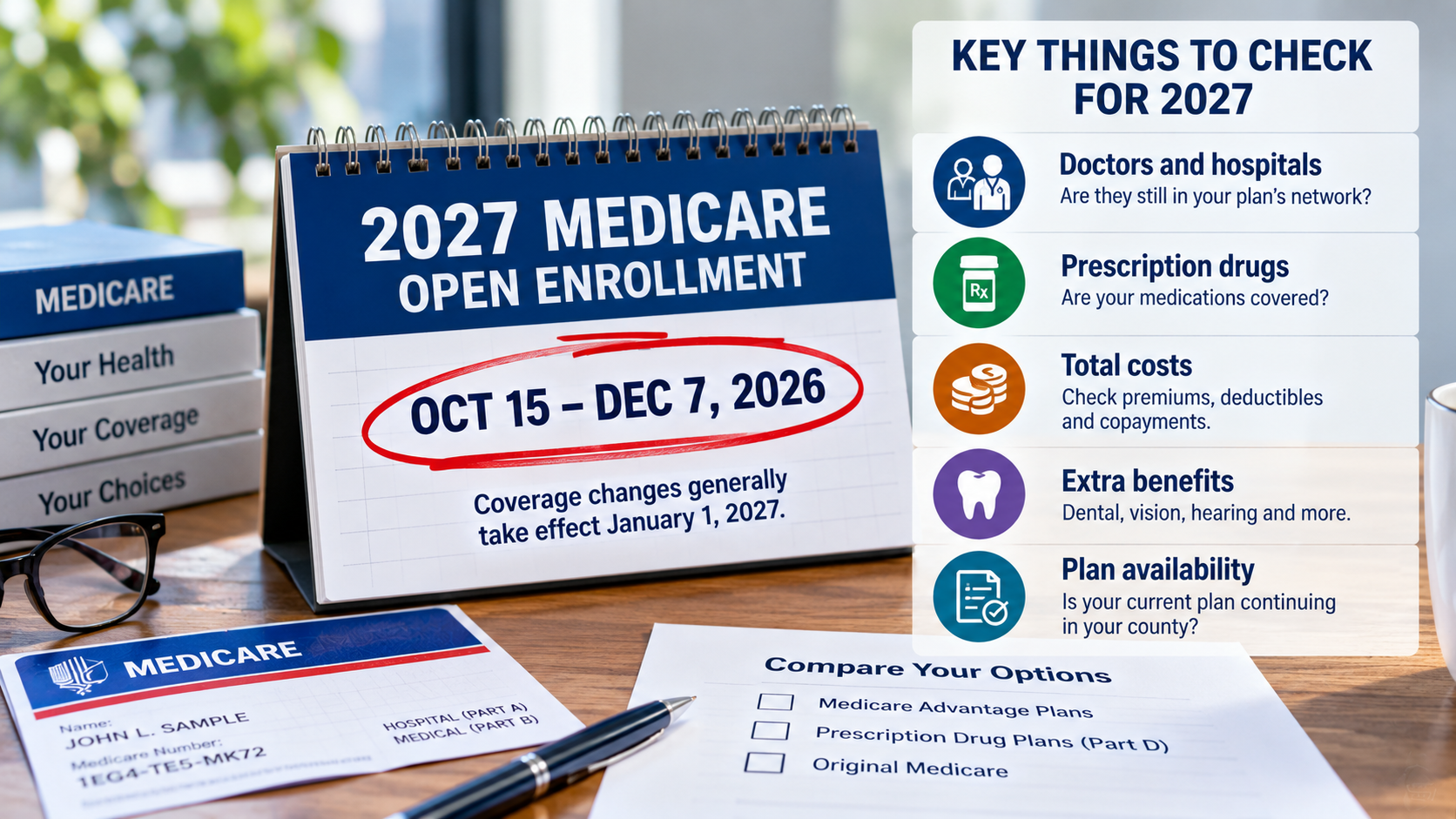
Medicare’s annual Open Enrollment period runs from October 15 through December 7, 2026, for coverage changes generally taking effect January 1, 2027.
During this period, eligible beneficiaries can compare Medicare Advantage and prescription drug plans, switch plans, or change between Original Medicare and Medicare Advantage under the applicable rules. (Medicare.gov)
For anyone currently enrolled in a UnitedHealthcare plan—or another Medicare Advantage plan—the company’s earnings report provides a useful reason to pay attention to annual plan changes.
Here are five things worth reviewing before choosing 2027 coverage:
- Plan availability: Is your current plan continuing in your county? If you received a nonrenewal notice, review your replacement options rather than assuming the plan will continue automatically.
- Doctors and hospitals: Are your primary care physician, specialists, and preferred hospitals still in the plan’s network for 2027?
- Prescription drugs: Are your medications covered, and have their copayments, pharmacy requirements, or coverage rules changed?
- Total costs: Compare the premium, deductible, copayments, coinsurance, and annual out-of-pocket maximum—not just the advertised monthly premium.
- Benefits and quality: Check changes to dental, vision, hearing, and other supplemental benefits, along with the plan’s Medicare Star Ratings.
One of the most useful documents is the Annual Notice of Change.
Medicare says plans send this notice each fall to explain changes in coverage, costs, and other terms for the coming January. (Medicare.gov)
Another document, the Evidence of Coverage, explains the detailed rules and costs of the plan.
If your plan is ending, a Plan Non-Renewal Notice is especially important. Medicare says beneficiaries receiving such a notice need to find another coverage option for the next year. (Medicare.gov)
The comparison should be personal.
For someone who regularly sees a specialist, an out-of-network doctor could matter more than a small difference in monthly premiums.
For someone taking several expensive medications, a change in the drug formulary could have a bigger impact than an advertised dental benefit.
And someone considering a move from Medicare Advantage to Original Medicare should also examine prescription drug coverage and whether a Medigap supplemental policy is available on acceptable terms. Federal guaranteed-issue protections do not apply in every switching situation, and state rules can matter.
There is no single Medicare plan that’s best for everyone.
What Happens Next for UnitedHealth in 2027?
The next important test will be whether UnitedHealth can maintain stronger earnings while stabilizing enrollment and keeping its Medicare Advantage offerings competitive.
That will depend on more than the results of a single quarter.
One factor is the cost of medical care. If hospital visits, specialty treatments, or prescription drug costs increase faster than insurers anticipated, financial margins can come under pressure again.
Another factor is how customers respond to 2027 plans.
UnitedHealthcare’s decisions about premiums, benefits, networks, and geographic availability could influence whether members stay or choose other insurers during Open Enrollment.
Plan quality matters as well.
On October 8, the Centers for Medicare & Medicaid Services published the 2027 Medicare Advantage and Part D Star Ratings.
These ratings help consumers compare plan quality. They also affect certain future quality bonus payments to insurers, making them financially important to companies as well as relevant to members. The 2027 ratings affect 2028 Medicare Advantage quality bonus payments. (CMS)
UnitedHealth said at least 69% of its Medicare Advantage members were associated with plans rated four stars or higher in the 2027 results. That companywide measure should not replace checking the rating of a specific local plan. (SEC)
There is a wider question, too.
How far can Medicare Advantage insurers go in restoring profitability before changes to benefits, provider access, or local plan choices begin to affect how attractive the program feels to consumers?
The answer won’t come from earnings alone.
It will become clearer through 2027 enrollment results, actual plan offerings, medical cost trends, and the experience of the people using those plans.
Bottom Line: What This Story Really Means
UnitedHealth’s latest earnings report demonstrates that a health insurance company can become more profitable even while its enrollment shrinks.
The company reported $6.6 billion in third-quarter operating earnings, up from $4.3 billion a year earlier, despite slightly lower revenue.
Meanwhile, its reported Medicare Advantage population was 935,000 below its level at the end of 2025.
Those two developments are related to a broader strategy of improving financial margins through pricing, benefit design, operating efficiencies, and a more selective approach to insurance business.
But 935,000 fewer UnitedHealthcare Medicare Advantage members does not mean 935,000 Americans lost Medicare itself.
For older Americans, the most immediate concern is what happens to the specific plans available where they live.
The earnings recovery is encouraging from a business perspective. Whether that recovery translates into affordable, dependable coverage for members is a separate question.
And with 2027 Medicare Open Enrollment about to begin, it’s a question that deserves attention.
UnitedHealth Medicare Advantage: Key Questions Explained
Q. Did UnitedHealth lose 935,000 Medicare Advantage members in the third quarter of 2026?
No. UnitedHealth reported a cumulative net decline of 935,000 from year-end 2025 through September 30, 2026. It was not a loss of 935,000 during the third quarter alone.
Q. Does that mean 935,000 people lost their Medicare insurance?
No. The figure measures UnitedHealth’s reported Medicare Advantage membership decline. It does not establish that those individuals lost federal Medicare eligibility or became uninsured.
Q. Why did UnitedHealth’s profit increase even though membership fell?
Operating expenses fell relative to revenue, reflecting factors including medical cost management, pricing and benefit adjustments, and operational improvements. UnitedHealth also earns money through its Optum healthcare services businesses.
Q. Did UnitedHealth’s revenue increase in the third quarter?
No. Revenue declined slightly from $113.2 billion in the third quarter of 2025 to $112.7 billion in the third quarter of 2026, while operating earnings increased.
Q. What does an 88.4% medical care ratio mean?
It means approximately 88.4% of the applicable insurance premium revenue was used for medical care and related benefit costs. The remaining amount is not all profit because other operating expenses must still be paid.
Q. Is UnitedHealthcare discontinuing Medicare Advantage plans for 2027?
Yes, the company has confirmed some service-area changes and plan discontinuations. Whether an individual member is affected depends on their specific plan and location.
Q. Does a $0 Medicare Advantage premium mean no healthcare expenses?
No. A plan may charge no additional monthly plan premium while members still owe Medicare Part B premiums and potentially other medical costs, subject to applicable assistance and benefit arrangements.
Q. When can Medicare beneficiaries change plans for 2027?
The annual Medicare Open Enrollment period runs from October 15 through December 7, 2026. Changes made during that period generally take effect January 1, 2027.
Q. Is Medicare Advantage enrollment declining across the United States?
Not overall. KFF reported that Medicare Advantage enrollment continued to grow in 2026, although the pace slowed and membership shifted among major insurance companies.
Q. What should a UnitedHealthcare Medicare Advantage member review first?
Check whether the current plan will continue in 2027, then compare provider networks, prescription drug coverage, total out-of-pocket costs, and changes described in the Annual Notice of Change.
Did this help make the story clearer? 🙂 WIN keeps unpacking the “why” behind the news—clearly and simply!
Sources
Third-Quarter Earnings and Membership Figures
UnitedHealth Group — Third Quarter 2026 Results, October 13, 2026
U.S. Securities and Exchange Commission — UnitedHealth Third Quarter 2026 Earnings Exhibit
Reuters — UnitedHealth Raises Profit Forecast as Turnaround Efforts Gather Pace
SEC — UnitedHealth Second Quarter 2026 Earnings Exhibit
Medicare Advantage Business Strategy and Plan Changes
SEC — UnitedHealth 2025 Results and 2026 Outlook
KFF — Medicare Advantage in 2026: Enrollment Update and Key Trends
KFF — Medicare Advantage 2026 Spotlight: A First Look at Plan Offerings
UnitedHealthcare — 2027 Medicare Plan Announcement
UnitedHealthcare Provider — 2027 Medicare Advantage Service Area Changes
Medicare Coverage Rules, Enrollment, and Quality
Medicare.gov — How Does Medicare Work?
Medicare.gov — Medicare Health Plan Options
Medicare.gov — Open Enrollment
Medicare.gov — Annual Notice of Change
Medicare.gov — Plan Non-Renewal Notice
CMS — 2027 Medicare Advantage and Part D Star Ratings, October 8, 2026