Why Are Americans Open to Medicare for All—and Would It Replace Private Insurance?

What if Americans could get health insurance without relying on an employer or shopping for a private plan?
That idea has been debated for years. Now, a new poll suggests more Americans are willing to consider it than reject it.
On October 13, 2026, Axios and Ipsos released survey findings showing that 43% of U.S. adults support Medicare for All, compared with 24% who oppose it.
But the proposal contains a detail that can be easy to miss: Medicare for All would not simply give everyone access to the Medicare program Americans know today.
It could fundamentally change how the country pays for healthcare—and largely replace private insurance.
So would you lose your employer’s health plan? Would your taxes go up? And would you still be able to see your doctor?
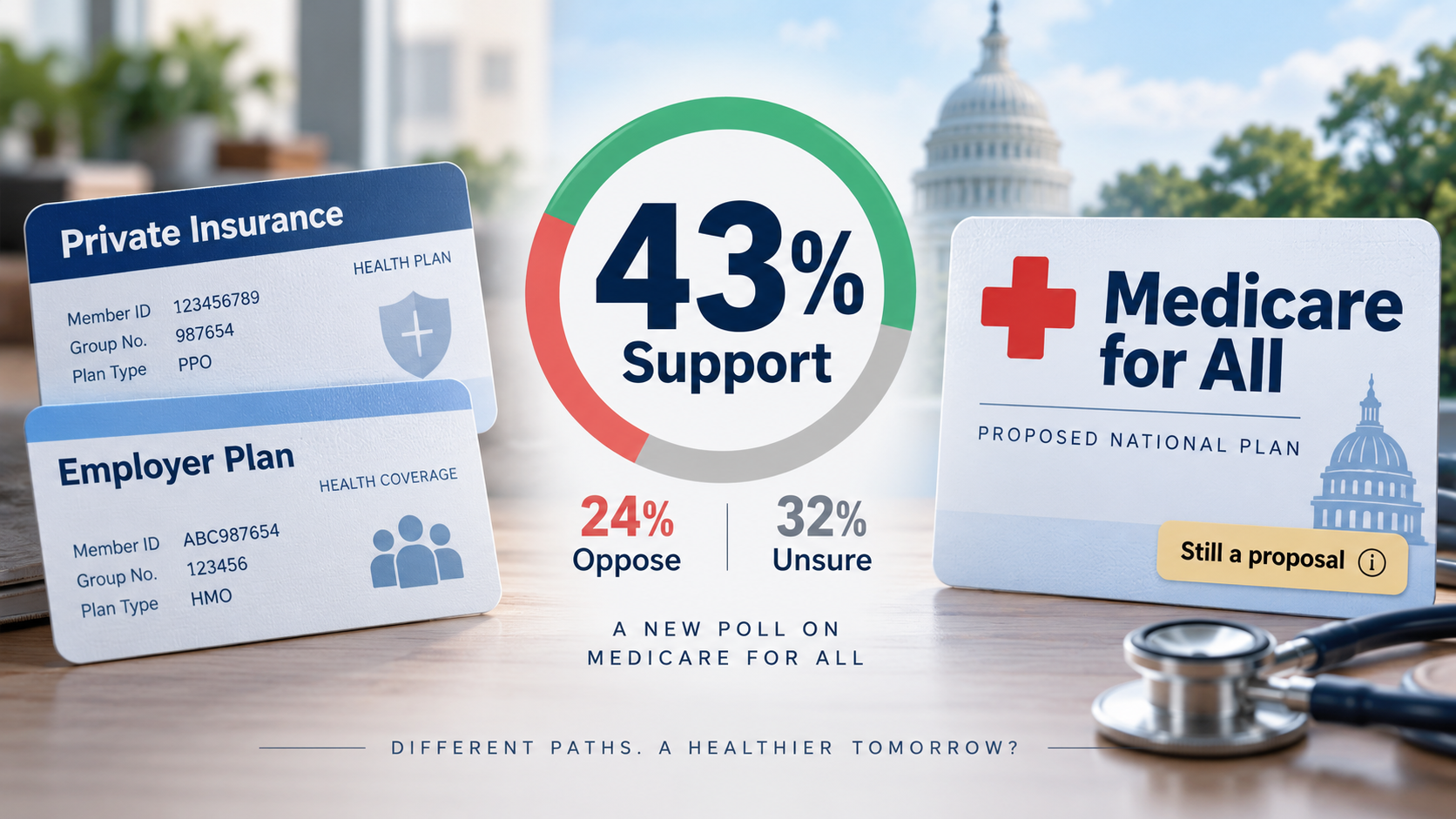
※ Images in this article are AI-generated illustrations created to help explain the story. They are not actual photographs, and depictions of people, places, or events may differ slightly from reality.
The answers depend on the difference between today’s Medicare, the broader Medicare for All proposal, and the insurance system most Americans currently use.
And that difference helps explain why this poll is attracting attention.
What Did the New Medicare for All Poll Actually Find?
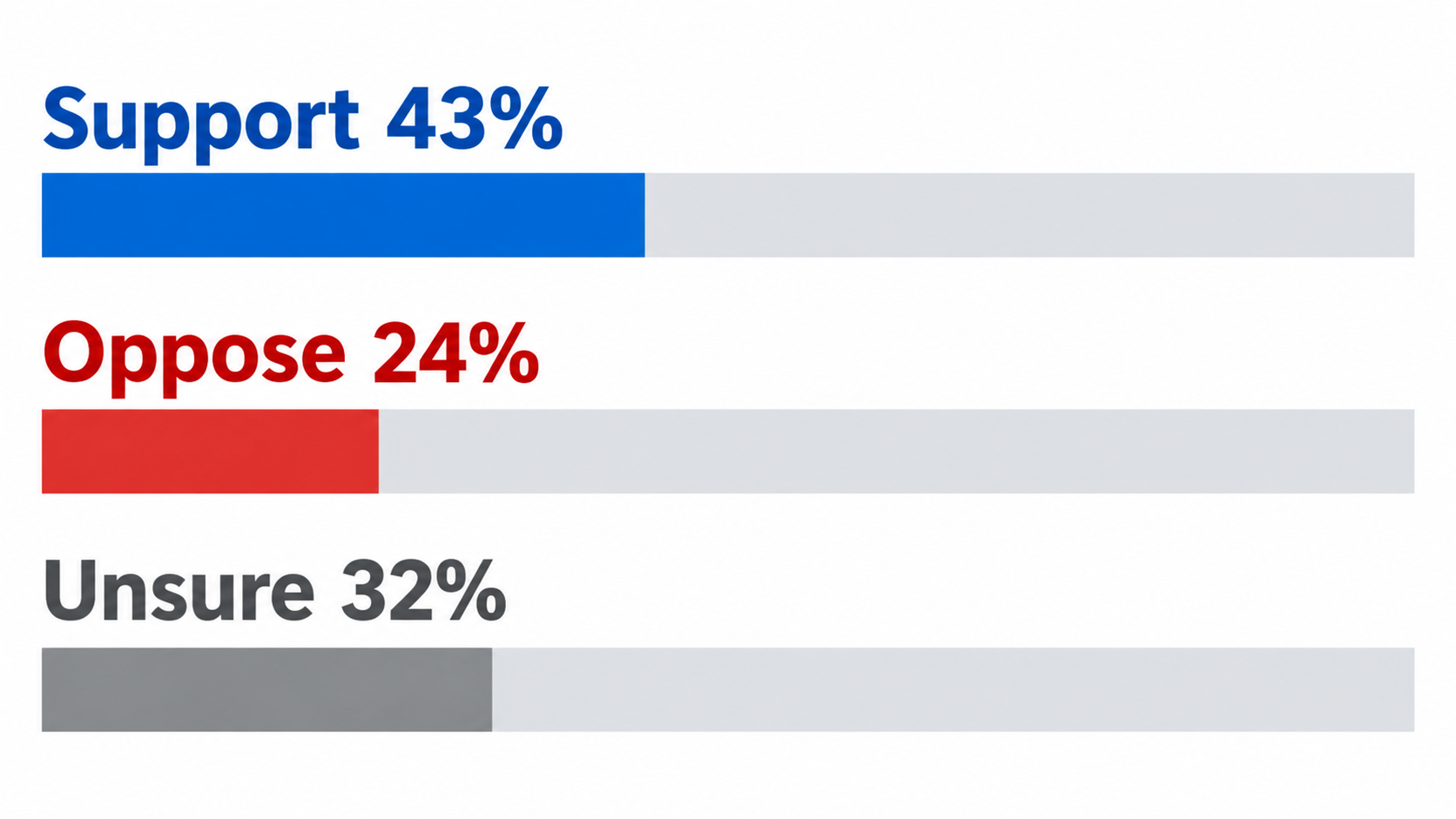
The new Axios-Ipsos American Health Index found that supporters of Medicare for All outnumber opponents by nearly two to one.
But 43% is not a majority of Americans. It is a plurality—the largest individual response group.
Here is how respondents answered:
| Response | Share of U.S. adults |
|---|---|
| Support Medicare for All | 43% |
| Oppose Medicare for All | 24% |
| Unsure | 32% |
The figures total 99% because of rounding.
The survey was conducted September 25–28, 2026, among 1,122 U.S. adults using Ipsos’s nationally representative KnowledgePanel. The findings were released October 13. (Ipsos · Axios)
The undecided group matters enormously.
Nearly one in three respondents had not settled on a position, even though the survey explicitly described Medicare for All as government-run insurance that would largely replace private coverage.
There is another figure readers may have seen: a separate KFF survey released October 6 found 66% support for a national Medicare-for-all plan. In that survey, support fell to 52% when respondents were told the plan would eliminate private health insurance companies. The figures are not interchangeable: KFF and Ipsos used different questions and response formats, illustrating how much the wording and trade-offs matter. (KFF)
Political affiliation also made a substantial difference.
| Political affiliation | Support for Medicare for All |
|---|---|
| Democrats | 62% |
| Independents | 47% |
| Republicans | 21% |
A majority of Republicans—52%—opposed the proposal. (Axios)
These figures show that Medicare for All remains politically divisive, even while many Americans favor greater government involvement in making healthcare affordable.
There is also an important distinction between supporting a proposal and wanting the government to spend more on healthcare.
In the same survey, 66% agreed that the federal government should be willing to spend more tax dollars to lower Americans’ healthcare costs.
That is broader support than Medicare for All itself received.
Wanting cheaper healthcare does not necessarily mean agreeing on how to redesign the insurance system. (Ipsos)
What Is Medicare for All—and How Is It Different From Medicare Today?
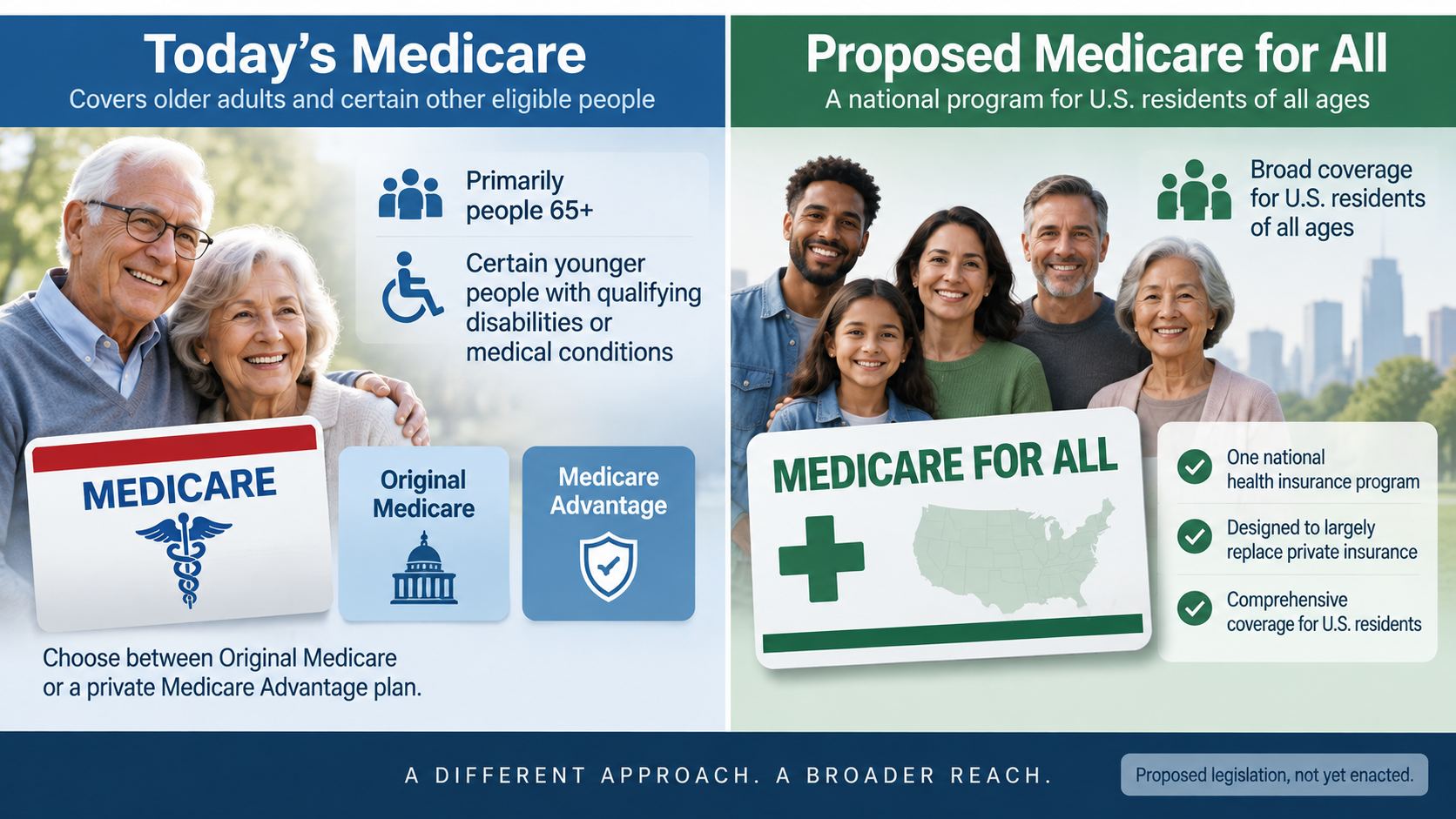
Medicare for All is a proposal for a national health insurance system that would cover people across age groups, rather than limiting Medicare primarily to older adults and certain other eligible individuals.
It would be a much larger change than simply lowering Medicare’s eligibility age.
Today’s Medicare is a federal health insurance program primarily serving Americans age 65 and older, along with certain younger people with qualifying disabilities or medical conditions.
People enrolled in Medicare generally choose between Original Medicare and Medicare Advantage.
Original Medicare is administered through the federal program. Medicare Advantage plans are offered by private insurers under Medicare rules. (Medicare.gov)
The broader Medicare for All model is different.
Under legislation introduced in Congress in 2025, a national program would provide comprehensive healthcare coverage to U.S. residents.
Rather than relying on separate employer plans, individual Marketplace policies, and existing government programs for most healthcare needs, people would receive covered benefits through the proposed national system. (U.S. Government Publishing Office)
Here is the essential comparison:
| Feature | Today’s Medicare | Proposed Medicare for All |
|---|---|---|
| Who is covered? | Primarily people 65+ and certain other eligible groups | Broad coverage for U.S. residents |
| Main insurance structure | Federal Medicare or private Medicare Advantage plans | National public insurance program |
| Private insurance | Continues to play a major role | Largely replaced for covered benefits |
| Out-of-pocket costs | Deductibles and cost-sharing may apply | Major proposals eliminate them for covered services |
| Current legal status | Operating federal program | Proposed legislation, not enacted |
Medicare for All is often described as a single-payer system.
That means one primary public insurance program pays for covered healthcare services, rather than having many separate private insurers act as the main payers.
It does not necessarily mean the government would own every hospital or employ every doctor.
That distinction becomes especially important when discussing what would happen to private insurance.
Would Medicare for All Really Replace Private Health Insurance?
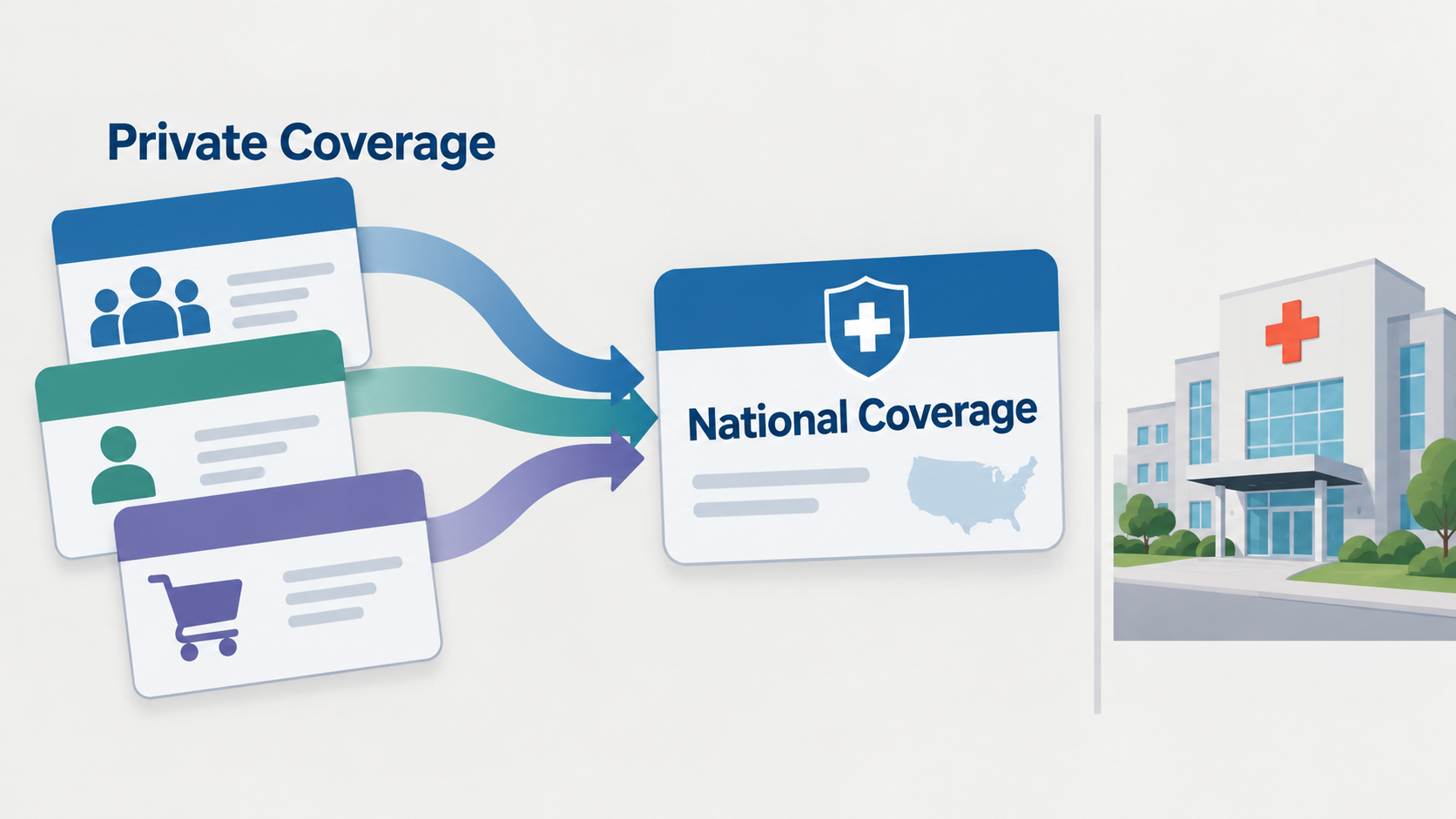
Under major Medicare for All proposals, private health insurance would largely be replaced for benefits covered by the new national program.
That is not the same as banning every private insurance product.
Consider the Medicare for All Act introduced by Representative Pramila Jayapal in the House in April 2025.
Section 107 of H.R. 3069 would prohibit private insurers from selling coverage that duplicates benefits available under the national program. Employers would also be restricted from offering duplicative coverage.
But insurers could still sell policies covering additional benefits not included in the public program. (U.S. Government Publishing Office)
For someone receiving health insurance through an employer, that would represent a fundamental change.
Today, a company may select an insurer, negotiate coverage terms, and pay part of the premium. The employee pays another portion through payroll deductions.
Under the proposed national system, qualifying medical coverage would come primarily from the public program instead.
That does not mean private hospitals would close or doctors would automatically become government employees.
The insurer paying the medical bill and the organization delivering the medical care are two different things.
There is also a distinction between Medicare for All and a public option.
A public option generally means allowing people to choose a government-run insurance plan while private insurance continues to operate alongside it.
Medicare for All, in its broad single-payer form, would replace much of that existing insurance structure.
That is why two politicians can both say they want more public healthcare coverage while advocating very different policies.
Why Are Americans So Interested in Changing the Health Insurance System?
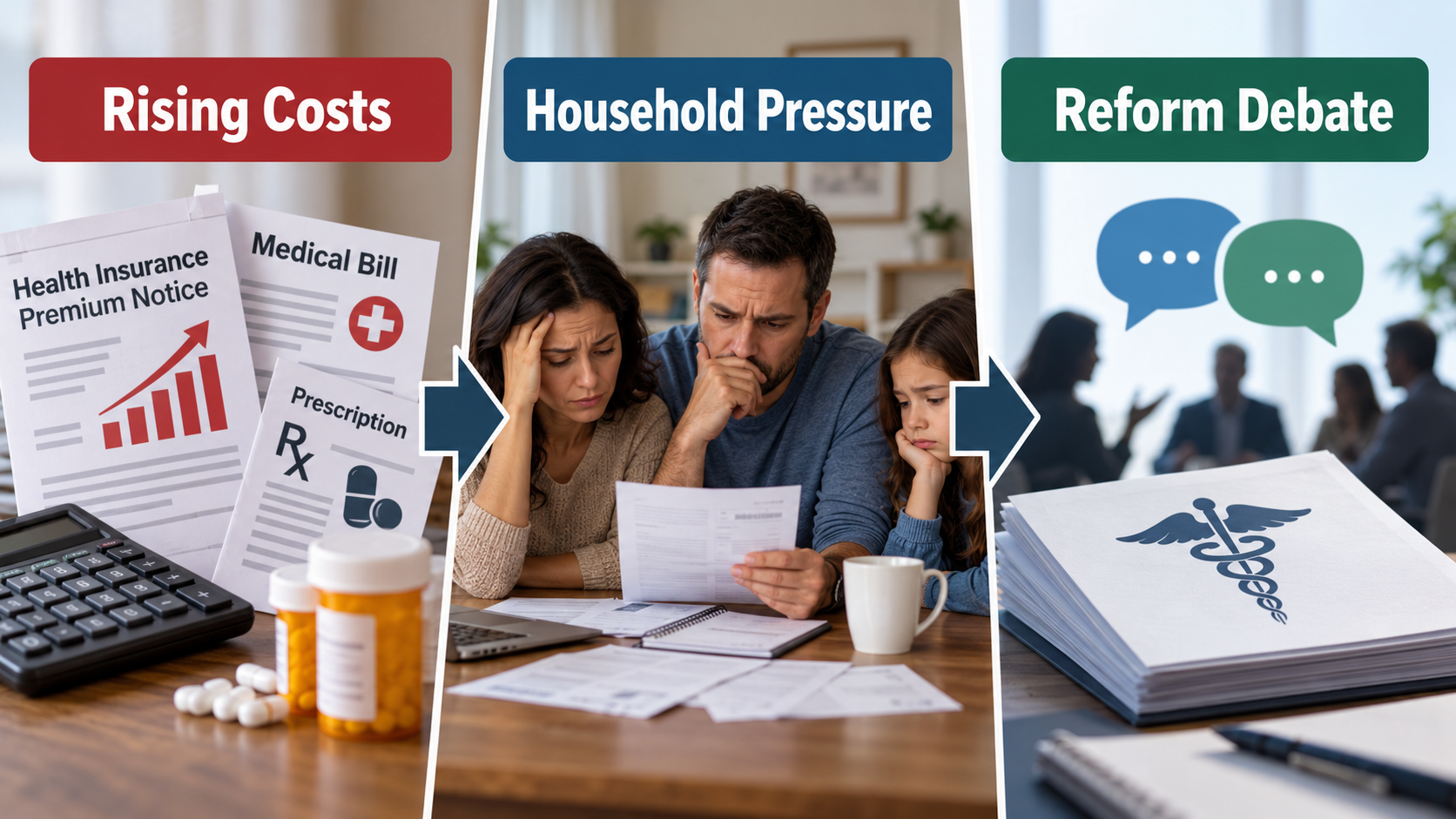
Healthcare affordability is a major part of the debate, although the poll alone cannot establish every respondent’s motivation.
Americans do not need to agree on a national insurance system to agree that healthcare is becoming difficult to afford.
The Axios-Ipsos survey found that 69% were concerned about rising healthcare costs, while another 69% said a 10% increase in health insurance costs would negatively affect their household finances. (Ipsos)
For someone buying private insurance, the monthly premium is only one part of the bill.
There may also be:
- A deductible that must be met before certain coverage payments begin.
- Copayments for office visits or prescriptions.
- Coinsurance that leaves patients responsible for a percentage of covered costs.
- Additional expenses when healthcare providers are outside the plan’s network.
Even people who have insurance can face substantial bills.
The Affordable Care Act, commonly called Obamacare, expanded access to health coverage and created insurance Marketplaces where eligible consumers can receive premium tax credits.
But it did not replace private insurance with a universal public plan.
And in 2026, affordability became an even more pressing issue after the enhanced federal premium tax credits that had helped many Marketplace customers expired at the end of 2025.
That change, combined with rising insurance premiums, increased the pressure on many households buying their own coverage. (KFF · Pew Research Center)
Medicare for All offers one possible response: replace much of the existing insurance structure with a national system.
But whether Americans would prefer that system once the specific financial and operational trade-offs are explained is a separate question.
The new poll measures attitudes toward a broadly described proposal. It does not establish that Americans have agreed on a detailed implementation plan.
Would Medicare for All Raise Taxes or Lower Healthcare Costs?
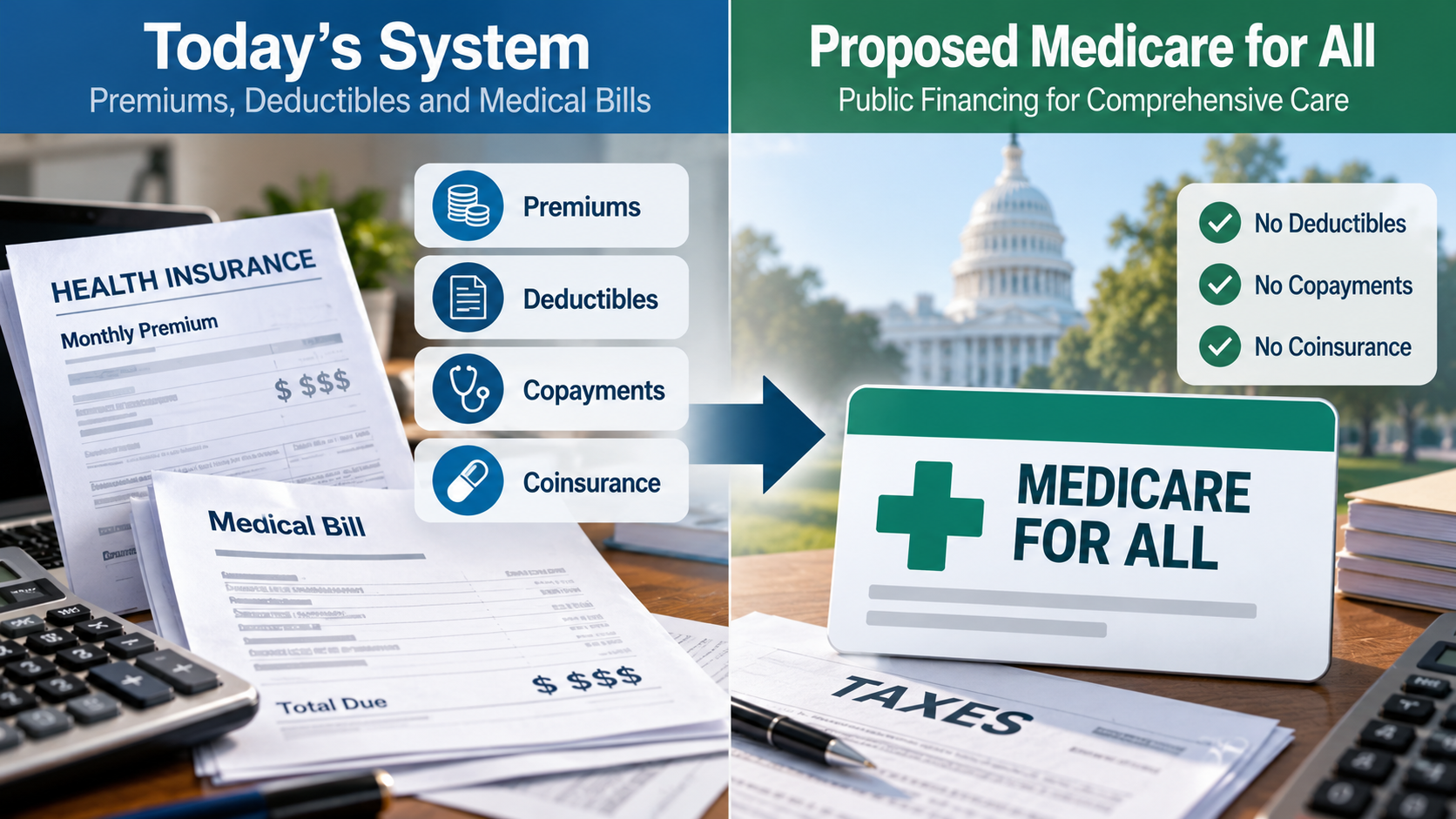
Medicare for All could substantially reduce or eliminate certain private insurance premiums and out-of-pocket charges, depending on the legislation enacted.
But providing healthcare through a national program would require public financing.
Those two facts must be considered together.
The 2025 House Medicare for All Act proposes eliminating deductibles, copayments, and coinsurance for covered services.
It also establishes a national healthcare financing structure, including a Universal Medicare Trust Fund.
The bill does not establish a simple, universal tax increase that can be applied to every household to calculate what each person would pay. (U.S. Government Publishing Office)
Think about how families pay for healthcare today.
A worker might see an insurance premium deducted from every paycheck. The employer could be paying an additional amount that never appears as take-home wages.
If that worker needs treatment, deductibles and copayments may create further expenses.
Under Medicare for All, many of those direct insurance payments could disappear for covered services.
But the government would need revenue to pay hospitals, doctors, and other providers.
Here is a useful way to compare the questions:
| Question | Today’s system | Proposed single-payer system |
|---|---|---|
| Who pays providers? | Private insurers and public programs | A national public program for covered care |
| How do households pay? | Premiums, taxes, and medical bills | Primarily public financing |
| What happens at a medical visit? | Cost-sharing may apply | Major proposals eliminate cost-sharing for covered care |
| What determines a household’s net cost? | Premiums, medical expenses, and taxes | Financing rules, taxes, and covered benefits |
This distinction is essential: higher taxes would not automatically mean higher total healthcare costs for every household.
But eliminating premiums would not automatically mean every household saves money, either.
The outcome would depend on tax design, household income, employer contributions, healthcare utilization, provider payments, and the overall cost of the system.
A fair comparison must examine both sides of the equation.
That is also why claims that Medicare for All would definitely save everyone money—or inevitably bankrupt the country—go beyond what this new opinion poll establishes.
Would You Still Be Able to Choose Your Doctor?
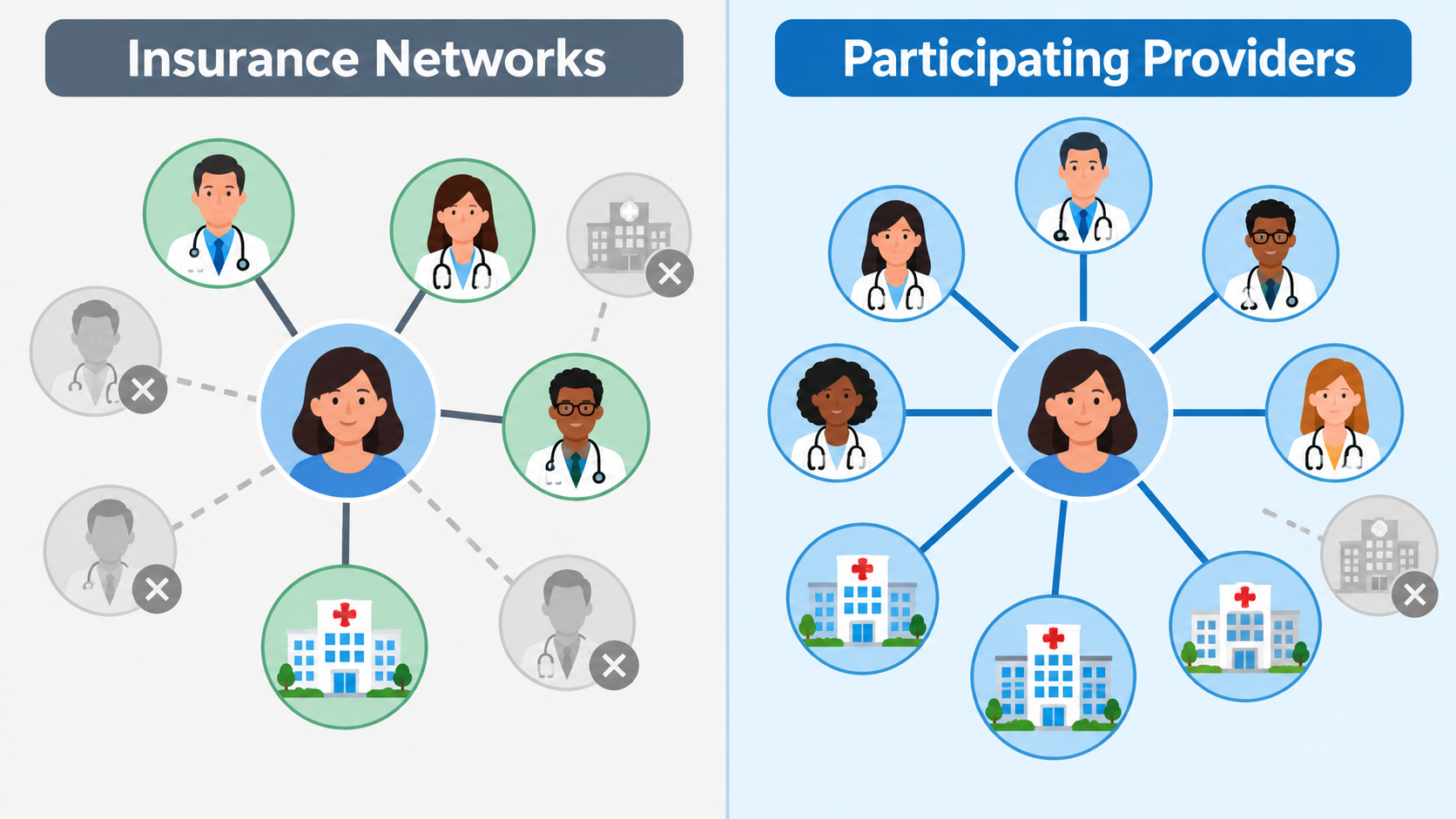
Under the 2025 House Medicare for All proposal, patients would be able to obtain covered services from healthcare providers qualified to participate in the national program.
But that does not guarantee that every existing doctor-patient relationship would remain unchanged.
The bill emphasizes freedom of choice among participating providers. It also includes provisions intended to protect continuity of care during the transition. (U.S. Government Publishing Office)
Today’s insurance system works differently.
People with private coverage often must consider whether a doctor, specialist, or hospital is in their insurer’s network.
Medicare Advantage plans can also use provider networks and require prior authorization for certain services. Original Medicare generally allows patients to use any provider that accepts Medicare, subject to the program’s coverage rules. (Medicare.gov)
A national insurance system could change how those relationships operate.
Supporters argue that a broad public insurance program could reduce the complications associated with switching employers or insurers.
Critics question whether changes in provider payment and administration could affect hospital finances, access to specialists, and the availability of care.
Those are substantive policy questions, not matters settled by the October poll.
A person’s practical access to care would depend on the rules of an enacted program and how doctors and hospitals participate.
If Medicare for All Has More Support Than Opposition, Why Hasn’t It Become Law?
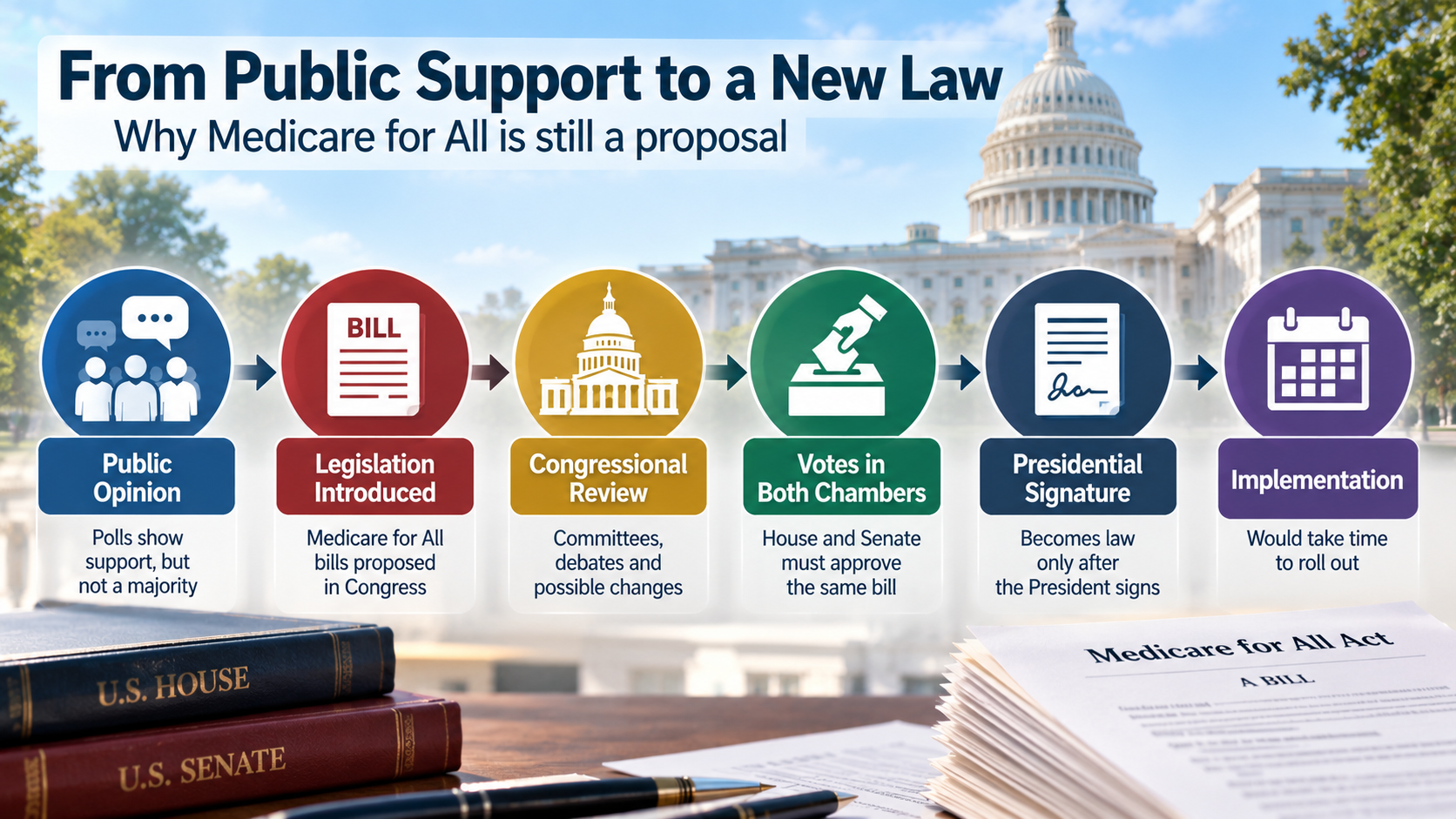
Because a favorable poll is not a law—and Medicare for All would require one of the biggest structural changes in modern American healthcare.
Congress would need to agree on who is covered, which services are included, how the program is financed, how providers are paid, and how the transition affects existing coverage.
The 119th Congress has had major Medicare for All proposals introduced in both chambers, including H.R. 3069 in the House and S. 1506 in the Senate.
The House measure was introduced on April 29, 2025, and its published text establishes a proposed national insurance program rather than an already operating one. (U.S. Government Publishing Office — House Bill · U.S. Government Publishing Office — Senate Bill)
The House proposal includes a transition period, with some age groups eligible earlier and broader benefits beginning two years after enactment.
That is a proposed timeline measured from a future enactment date—not a deadline currently approaching for Americans to switch insurance.
There are several major obstacles to turning Medicare for All into law.
First, the public itself is divided. The Ipsos poll found that 32% remained unsure, while Republicans were considerably more likely than Democrats to oppose the proposal.
Second, support for lower healthcare costs does not mean agreement on a single-payer system.
Third, the proposal would require lawmakers to settle difficult questions about taxes, employer coverage, private insurance, provider payment, and the transition for people who already have care arrangements they want to preserve.
The survey also identified why opponents are concerned.
Among respondents who opposed Medicare for All, 38% cited fears that care would be worse than under private insurance, 22% worried about taxpayer costs, and 21% objected to government involvement in providing healthcare. (Ipsos)
These are views expressed by respondents, not findings that the predicted outcomes would necessarily occur.
For the proposal to move forward, lawmakers would need to address those concerns as well as secure the votes required to enact the legislation.
What Could the Medicare for All Poll Mean for the 2026 Midterm Elections?
The poll suggests that healthcare affordability could remain an important political issue in the November 2026 midterm elections.
But it does not prove that Medicare for All itself will determine how Americans vote.
There are several different policy choices lawmakers can offer voters.
One is to expand financial assistance for people buying private insurance through the Affordable Care Act.
Another is to pursue changes that lower prescription drug prices.
A third is to introduce a government-run insurance option without removing private plans.
And Medicare for All represents a broader restructuring of the insurance system itself.
The distinction is important because the Ipsos survey found broad support for additional federal spending to reduce healthcare costs, while support for the much more sweeping Medicare for All proposal was lower. (Ipsos)
That creates an opening for different political approaches to the same problem.
A voter might favor stronger Marketplace subsidies but oppose replacing employer-sponsored insurance.
Another might believe that the existing insurance system is too complicated and would prefer a single national program.
A third might agree that insurance is unaffordable but remain unconvinced that government administration would improve it.
The October poll captures those competing instincts.
It shows meaningful interest in major reform, but also considerable uncertainty about the form that reform should take.
What matters next is whether candidates offer detailed plans—and whether voters respond differently when presented with specific costs, benefits, and trade-offs.
Does the New Poll Change Your Health Insurance Right Now?
No. The October 13, 2026, Axios-Ipsos poll does not change Medicare eligibility, replace private health insurance, or create a new federal coverage benefit.
It measures public opinion.
Medicare for All remains a legislative proposal, not the insurance system currently operating across the United States.
For Americans making healthcare decisions today, the existing rules still matter.
People eligible for Medicare must continue following the current enrollment and coverage requirements.
Those with Medicare Advantage should still review their plan’s coverage, provider network, and annual changes.
People insured through an employer remain subject to the terms of their existing coverage.
And people buying insurance through an Affordable Care Act Marketplace still need to review applicable premiums, subsidies, enrollment periods, and plan terms.
A poll can affect political debate. It does not automatically change anyone’s policy or insurance card.
Bottom Line: What This Story Really Means
The October 2026 Axios-Ipsos poll found that 43% of Americans support Medicare for All, while 24% oppose it and 32% remain unsure.
That is a meaningful gap between support and opposition, but it is not majority support.
The most revealing finding may be the difference between two ideas: Americans are more united in wanting relief from healthcare costs than they are in agreeing on a particular insurance system.
Medicare for All would go considerably further than expanding existing Medicare or making Obamacare subsidies more generous. Major proposals would establish a national insurance program and largely replace private coverage for benefits included in that program.
Such a change could alter premiums, taxes, out-of-pocket costs, employer benefits, and the way healthcare providers are paid.
But it would require legislation, financing decisions, and a major transition.
The new poll shows that the public is willing to discuss that possibility.
It does not mean the country has agreed to make it happen.
Medicare for All: Key Questions Explained
Q. How many Americans support Medicare for All in the new poll?
In the Axios-Ipsos poll released October 13, 2026, 43% supported Medicare for All, 24% opposed it, and 32% were unsure.
Q. Does the poll show that most Americans support Medicare for All?
No. Supporters outnumber opponents, but 43% is below the 50% threshold for majority support.
Q. Would Medicare for All eliminate private health insurance?
Major single-payer proposals would largely replace private insurance for covered medical services. Some supplemental private coverage for benefits outside the public program could remain available.
Q. Is Medicare for All the same as Medicare Advantage?
No. Medicare Advantage is part of the existing Medicare system and is delivered through private insurers. Medicare for All proposes a broader national insurance program.
Q. Would Medicare for All be free?
Not in the sense that healthcare would have no cost. Major proposals would eliminate many direct patient charges for covered services, but the national program would require public financing.
Q. Would everyone’s taxes increase under Medicare for All?
That cannot be determined from the poll. Any tax changes would depend on the financing legislation enacted, and the effects could differ among households.
Q. Could I keep my current doctor under Medicare for All?
Major proposals would allow patients to use participating healthcare providers. Whether a particular doctor would participate, and how care would change during a transition, would depend on the final rules and implementation.
Q. Has Congress passed Medicare for All?
No. The Medicare for All bills discussed here are legislative proposals, not enacted laws.
Q. Does Medicare for All change eligibility for people under age 65 right now?
No. The new poll does not change current Medicare eligibility rules. Broad eligibility under Medicare for All would require a new law.
Q. Why does the Medicare for All poll matter before the midterm elections?
It shows that healthcare affordability and the government’s role in insurance remain important subjects of public debate. But voters’ support for lowering costs does not necessarily translate into support for replacing private health insurance.
Did this help make the story clearer? 🙂
WIN keeps unpacking the “why” behind the news—clearly and simply!
Sources
October 2026 Poll Findings and Public Opinion
Axios — Axios-Ipsos Poll: Medicare for All Support Surges
KFF — Health Tracking Poll: Health Care Issues Before the 2026 Midterm Election
Medicare for All Legislation and Existing Coverage
U.S. Government Publishing Office — Medicare for All Act, H.R. 3069
U.S. Government Publishing Office — Medicare for All Act, S. 1506
Medicare.gov — Parts of Medicare
Medicare.gov — How Medicare Works
Insurance Affordability and the Affordable Care Act
KFF — Did the Affordable Care Act Make Health Care More Affordable?
Pew Research Center — Key Facts on Affordable Care Act Insurance Exchanges
Keep Reading
How Does Today’s Marketplace Handle Private Plans, Brokers, and Federal Subsidies?
Medicare for All would replace much of the current private-insurance framework. An earlier WIN report explains how ACA Marketplace enrollments, brokers, and federal subsidies interact—and what can go wrong when consumer authorization controls fail.
Why Did CMS Cancel ACA Enrollments Covering More Than 760,000 People?