Why Is Matt Gaetz Facing a Sex Trafficking Lawsuit After the DOJ Declined to Charge Him?

Wasn’t the Matt Gaetz investigation already over?
In one important sense, yes. Federal prosecutors decided not to charge the former Florida congressman after investigating allegations involving sex trafficking.
That happened in 2023.
So why are two women now taking him to federal court over allegations connected to the same period?
The answer is that ending a criminal investigation does not necessarily prevent someone from filing a civil lawsuit.
A federal civil lawsuit that became public on October 15, 2026, accuses Gaetz and several other defendants of involvement in the sexual exploitation of two young women. Gaetz denies the allegations.
The distinction between what prosecutors decided, what congressional investigators found, and what the women must now prove in court is what makes this case more complicated than it first appears. (AP · Roll Call)

※ Images in this article are AI-generated illustrations created to help explain the story. They are not actual photographs, and depictions of people, places, or events may differ slightly from reality.
What Do the Two Women Say Happened?
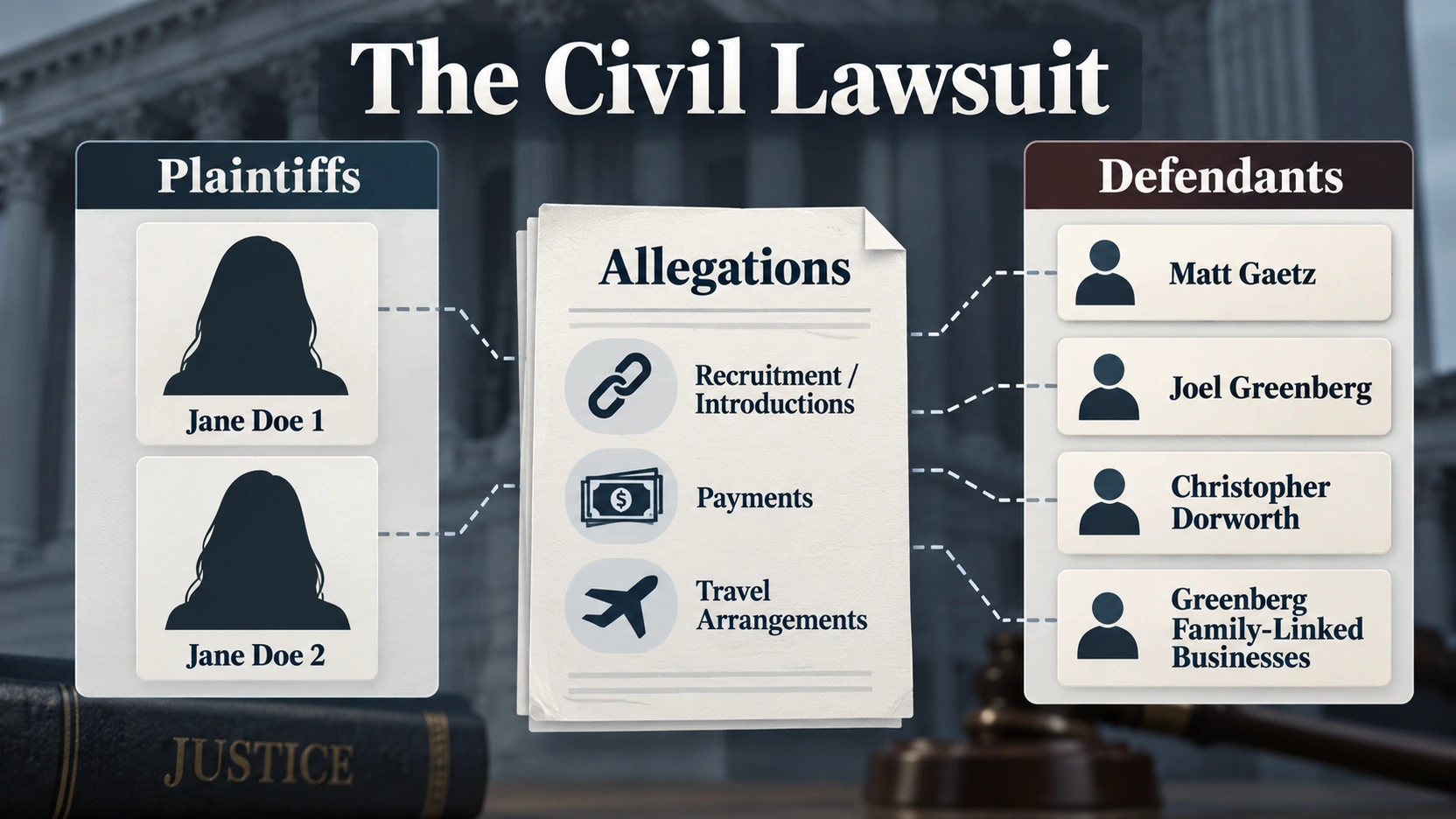
The two women allege that Matt Gaetz and other defendants participated in an arrangement involving payments, drugs, travel, and commercial sexual activity between 2017 and early 2019.
The case was brought in the U.S. District Court for the Middle District of Florida, with proceedings in Orlando.
The plaintiffs, identified publicly as Jane Doe 1 and Jane Doe 2, were adults in their early 20s when they encountered Gaetz through Joel Greenberg, a former Seminole County tax collector.
According to the complaint as described in news reports, Greenberg helped connect the women with influential men, while Gaetz allegedly provided money and helped finance travel and accommodations connected to sexual encounters.
The lawsuit also names Christopher Dorworth, a former Florida state legislator, and businesses associated with Greenberg’s family. The plaintiffs allege Dorworth made his home available for relevant gatherings and that certain businesses helped finance the arrangement.
These remain claims made in a civil complaint, not facts established by a court. (The Washington Post · AP)
Who Is Accusing Whom?
| Party | Role in the Case | Current Legal Status |
|---|---|---|
| Jane Doe 1 and Jane Doe 2 | Women alleging sexual exploitation | Civil plaintiffs |
| Matt Gaetz | Accused of participating in the alleged arrangement and making payments | Civil defendant; denies allegations |
| Joel Greenberg | Accused of helping organize the alleged arrangement | Civil defendant; separately convicted of federal crimes |
| Christopher Dorworth | Accused of knowingly making his property available | Civil defendant; allegations unproven |
| Businesses linked to Greenberg’s family | Accused of helping finance the alleged operation | Named defendants; allegations unproven |
The lawsuit describes the women as financially vulnerable and alleges that the defendants used their wealth, connections, and positions of influence to exploit that vulnerability.
Those claims matter because the plaintiffs are not simply alleging that money changed hands. They are attempting to establish conduct that would qualify as a violation of federal anti-trafficking law.
Gaetz has rejected much of the complaint. In a statement reported by The Washington Post, he disputed the allegations and said he welcomed the opportunity to question the plaintiffs under oath.
His response makes clear that the central facts remain contested. (The Washington Post)
But Didn’t Federal Prosecutors Already Close the Case?
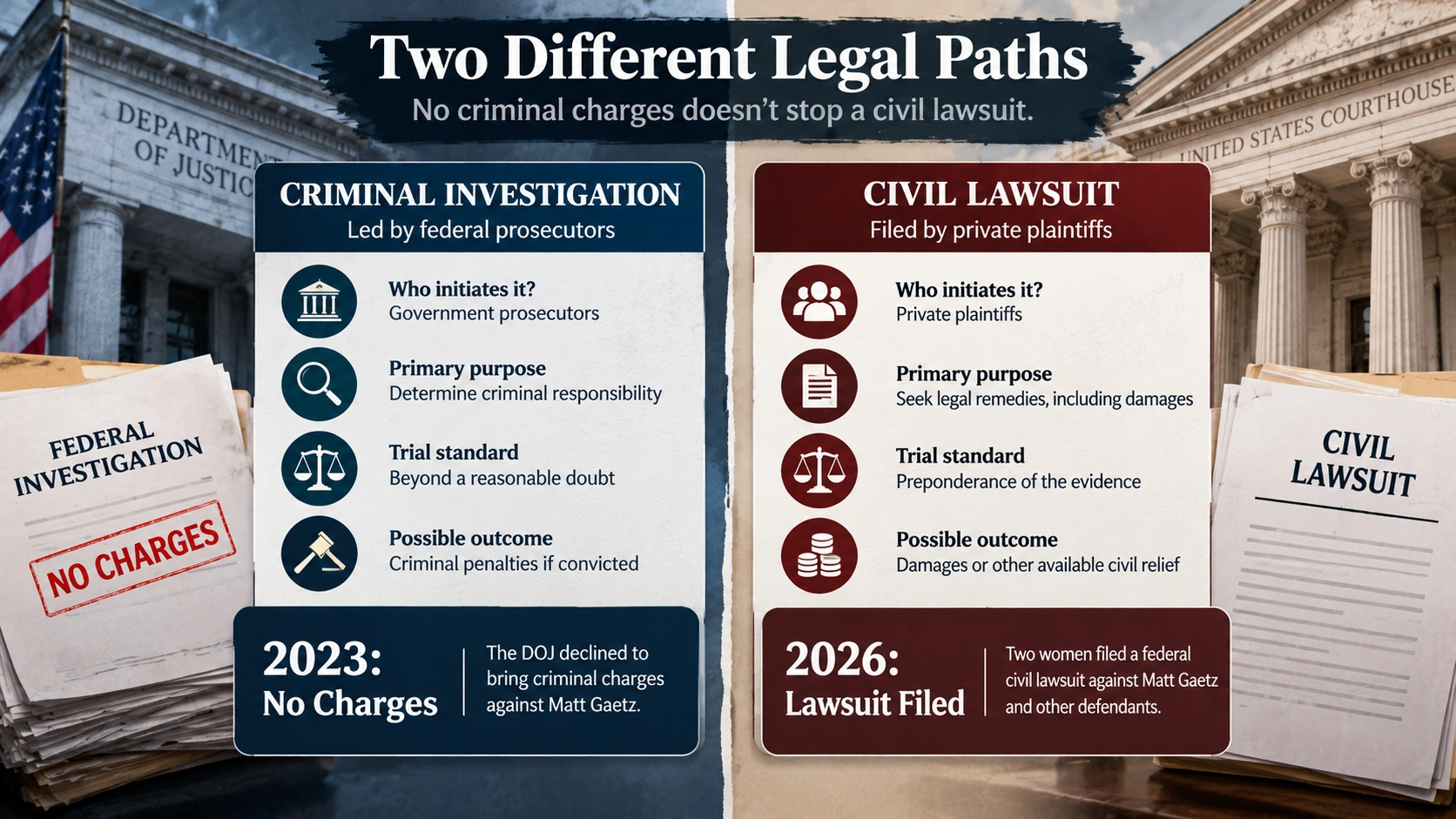
Yes. The Department of Justice decided in February 2023 not to bring criminal charges against Gaetz following a federal investigation into allegations of sexual misconduct and sex trafficking.
But that decision did not amount to a court ruling on every allegation, and it did not automatically eliminate the possibility of civil litigation.
Prosecutors must decide whether the available evidence justifies bringing criminal charges they would need to prove beyond a reasonable doubt.
A civil lawsuit is different. Private individuals can seek compensation for alleged violations of their legal rights, generally under a lower standard of proof. (CBS News · U.S. Code)
Criminal Investigation vs. Civil Lawsuit
| Question | Criminal Investigation | Civil Lawsuit |
|---|---|---|
| Who initiates it? | Government prosecutors | Private plaintiffs |
| Primary purpose | Determine criminal responsibility | Seek legal remedies, including damages |
| General trial standard | Beyond a reasonable doubt | Preponderance of the evidence |
| Possible outcome | Criminal penalties if convicted | Damages or other available civil relief |
| Gaetz case status | DOJ declined charges in 2023 | New federal lawsuit in 2026 |
A preponderance of the evidence generally means showing that a claim is more likely true than not.
Imagine that prosecutors investigate an incident but decide the evidence is insufficient to pursue a criminal conviction.
Someone who claims to have been harmed may still have a legal avenue to seek compensation through civil court.
That does not mean the civil claim will succeed. It means the plaintiff is entitled to attempt to establish the claim under the rules governing civil litigation.
No criminal charges is not the same thing as a civil court finding that nothing happened.
And filing a civil lawsuit is not proof that the defendant committed a crime.
Both distinctions are essential to understanding the new Gaetz case.
What Did the House Ethics Committee Actually Find?
This is where the earlier history becomes especially important.
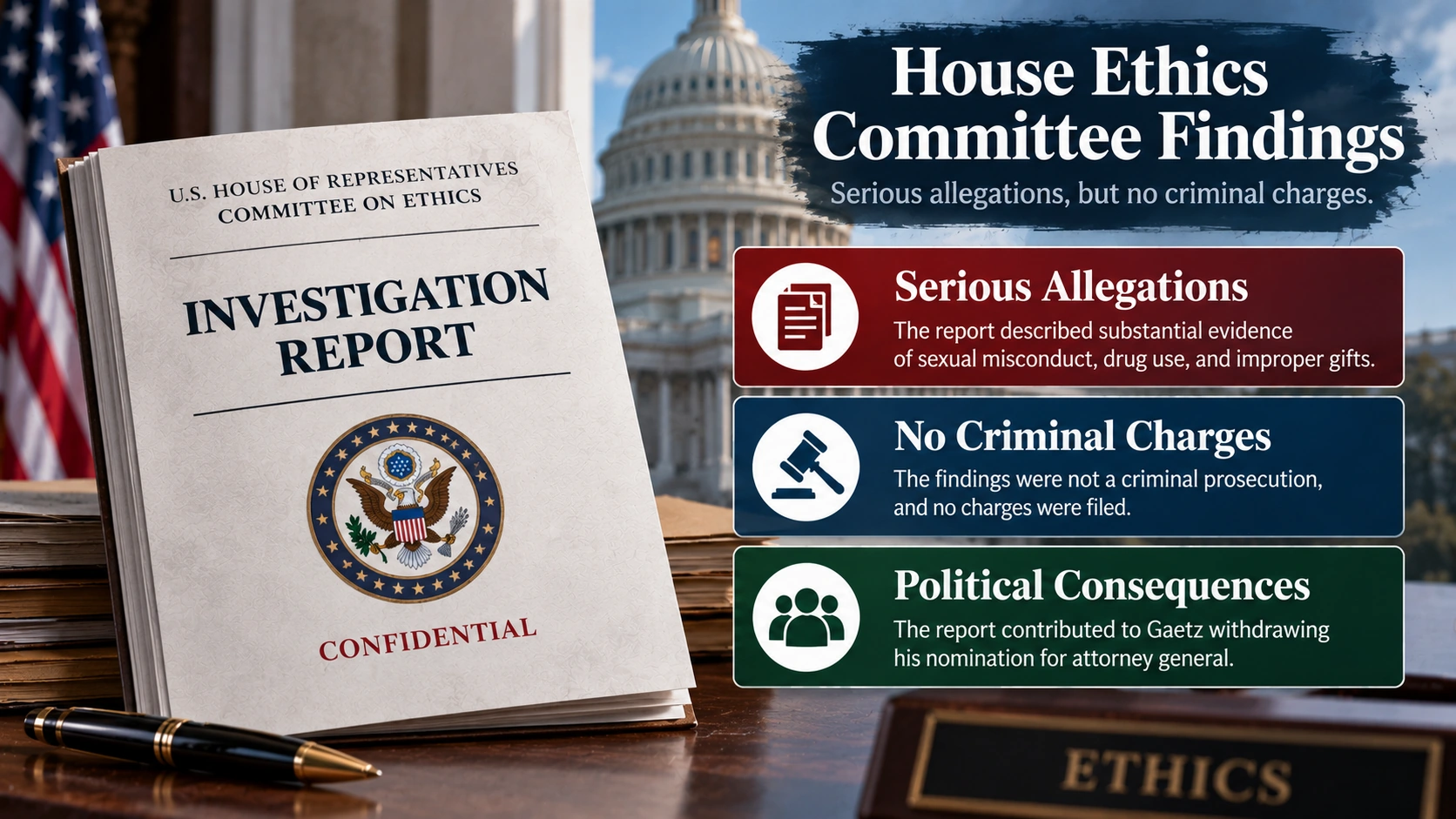
On December 23, 2024, the House Ethics Committee released a report examining Gaetz’s conduct while he was a member of Congress.
The committee reported substantial evidence that he had regularly paid women for sex, used or possessed illegal drugs, and engaged in sexual activity with a 17-year-old girl in 2017.
Gaetz denied wrongdoing.
But the report also reached another conclusion that is particularly relevant to the new lawsuit.
The committee said it did not obtain sufficient evidence to conclude that Gaetz violated federal sex-trafficking law.
Its investigators found evidence that adult women traveled across state lines for commercial sex, but they did not establish that the women were minors at the relevant times or that qualifying force, fraud, or coercion had been used.
Those findings appear together in the committee’s official report. (House Ethics Committee)
Why the Two Findings Are Not Contradictory
The committee was examining several different potential violations.
Paying for sex, violating congressional conduct rules, engaging in illegal drug activity, and committing a federal sex-trafficking offense are not interchangeable legal conclusions.
Conduct may violate one law or ethical standard without satisfying every element of another law.
The committee therefore could report substantial evidence of certain misconduct while finding insufficient evidence to establish a separate federal trafficking violation.
There is another distinction worth remembering.
The committee’s findings about an encounter involving a 17-year-old concerned a different individual, not either of the two adult women now suing Gaetz.
The new lawsuit’s two pseudonymous plaintiffs were adults during the alleged events. Their claims should not automatically be treated as allegations that they themselves were minors. (AP · House Ethics Committee)
And although a congressional investigative report can contain serious findings, it is not itself a criminal conviction or a civil court judgment.
That means the new lawsuit must be evaluated on its own evidence and applicable law.
Why Isn’t Paying for Sex Automatically Federal Sex Trafficking?
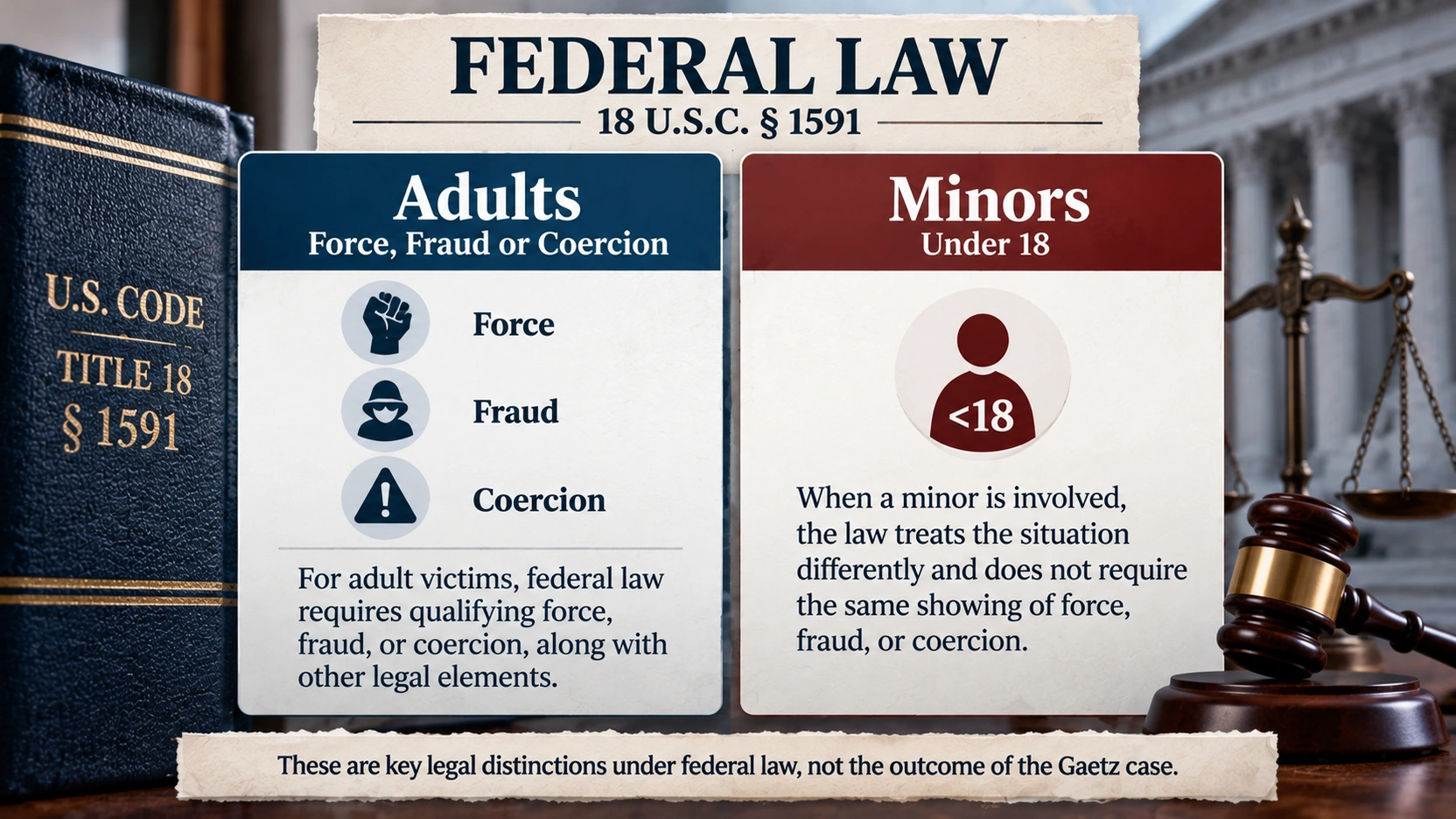
Because federal sex-trafficking law requires more than proof that money was exchanged for sex.
Under 18 U.S.C. § 1591, federal law addresses commercial sexual exploitation involving minors, as well as certain commercial sexual activity involving adults through force, fraud, or coercion.
For adult victims, the relevant legal requirements include the use of qualifying force, threats, fraud, or coercion, along with the statute’s other elements.
When a minor is involved, the law treats the situation differently and does not require the same showing of force, fraud, or coercion.
The law also addresses people who knowingly participate in or benefit from qualifying trafficking ventures under specified conditions. (U.S. Code, Section 1591)
This matters in the Gaetz case because the plaintiffs describe economic vulnerability, payments, drugs, and travel arrangements.
Those details may be relevant to a trafficking claim, but their existence alone does not automatically establish every required legal element.
A court would need to examine what happened, how each defendant allegedly participated, and whether the evidence satisfies the applicable statute.
Why the Civil Remedy Matters
Federal law also gives certain trafficking victims the right to pursue civil lawsuits.
Under 18 U.S.C. § 1595, qualifying plaintiffs can seek damages and reasonable attorneys’ fees.
The statute permits claims against perpetrators and, under specified circumstances, people who knowingly benefit from participation in a trafficking venture they knew or should have known involved a violation.
A person does not necessarily have to be criminally convicted before a civil claim can proceed.
But the plaintiff still must establish the applicable requirements for civil liability. (U.S. Code, Section 1595)
That distinction helps explain both sides of the present dispute.
The women argue that their experiences fit within federal anti-trafficking protections.
Gaetz disputes the allegations, and the earlier congressional investigation did not find sufficient evidence of a federal trafficking violation.
The civil court will have to consider the actual claims and evidence presented to it.
Who Is Joel Greenberg, and Why Does His Guilty Plea Matter?

Joel Greenberg is central to the story because he was convicted of federal offenses involving sexual exploitation and is also accused of helping arrange the encounters described in the new lawsuit.
Greenberg previously served as the tax collector for Seminole County, Florida.
On May 17, 2021, he pleaded guilty to six federal offenses, including sex trafficking of a minor, aggravated identity theft, wire fraud, stalking, and other crimes.
In December 2022, a federal judge sentenced him to 11 years in prison.
Those are established outcomes of Greenberg’s own criminal case, not allegations in the new lawsuit. (U.S. Department of Justice · AP)
According to federal prosecutors, Greenberg had paid a minor for commercial sexual activity and introduced that individual to other adult men.
But Greenberg’s guilty plea did not establish that Gaetz committed a crime.
That distinction is essential.
The new civil lawsuit alleges that Greenberg and Gaetz coordinated activities involving the two adult plaintiffs, including money, travel, and sexual encounters.
The plaintiffs must establish any liability they attribute to each defendant rather than relying on Greenberg’s conviction as automatic proof against the others.
How Did the Matt Gaetz Allegations Reach Court in 2026?

The new complaint did not appear out of nowhere. It follows years of investigations, a separate criminal conviction, and public debate over Gaetz’s conduct.
The sequence becomes easier to understand when each development is placed alongside the institution responsible for it.
| Date | What Happened | Why It Matters |
|---|---|---|
| 2017–early 2019 | Period of alleged conduct described in the new civil lawsuit | Central allegations remain disputed |
| May 17, 2021 | Joel Greenberg pleaded guilty to federal crimes | Established criminal conduct involving a separate defendant |
| December 1, 2022 | Greenberg received an 11-year federal prison sentence | His criminal case resulted in punishment |
| February 2023 | DOJ decided not to charge Gaetz | Federal criminal investigation ended without charges against Gaetz |
| November 2024 | Gaetz left Congress and withdrew from consideration for attorney general | Previous allegations became part of a major political controversy |
| December 23, 2024 | House Ethics Committee released its report | Congressional investigators published findings, including insufficient evidence of federal sex trafficking |
| October 15, 2026 | New federal civil lawsuit became public | Two women are pursuing claims through a separate legal process |
The dates are established through the Justice Department’s records, the House Ethics Committee report, and contemporaneous coverage of the new lawsuit. (U.S. Department of Justice · House Ethics Committee · Roll Call)
Notice that the timeline covers four separate legal or investigative tracks.
Greenberg’s criminal case resulted in a guilty plea and prison sentence.
The federal investigation of Gaetz ended without criminal charges.
The House investigation produced an ethics report, while the new civil case seeks to establish liability under federal law.
Those are different outcomes involving different legal questions.
Understanding that separation helps explain why a dispute over events from 2017 can still be making news in 2026.
What Happens Next in the Civil Lawsuit?
The next stage is the defendants’ response to the complaint and the court’s determination of which claims, if any, can proceed.
Gaetz has publicly disputed the allegations and indicated that he wants to question the plaintiffs through depositions.
A deposition is testimony given under oath outside the courtroom, usually during the evidence-gathering stage of litigation.
If the case advances, the parties may seek documents, communications, financial records, and testimony relevant to the disputed claims.
The plaintiffs’ allegations about money, travel, and the circumstances of sexual encounters would need to be examined against the defendants’ responses and the applicable legal requirements.
The women are seeking damages and other civil relief and have requested a jury trial. Filing that request does not mean a trial is guaranteed. (WPBF · The Washington Post)
Why Can a Lawsuit Still Be Filed So Many Years Later?
Federal trafficking law provides an extended period for certain civil claims.
Under 18 U.S.C. § 1595, the general limitations period is 10 years after the cause of action arose. The statute also provides a separate rule for people who were minors when the alleged offense occurred.
That helps explain how a lawsuit filed in 2026 can concern alleged conduct dating back to 2017.
The specific applicability of filing deadlines, including any legal disputes over when claims accrued, would ultimately be determined under the governing law. (U.S. Code, Section 1595)
Could This Lead to Criminal Charges?
The civil lawsuit itself does not bring new criminal charges against Gaetz.
A civil court can address damages and other available civil remedies, but it does not impose a criminal prison sentence through the civil case.
Any criminal prosecution would require separate government action and the applicable criminal process.
There is no basis to treat the filing of this civil lawsuit as an announcement that federal prosecutors have reopened their earlier investigation.
The immediate question is narrower: whether the plaintiffs can establish legally sufficient civil claims and prove them.
That is what the new court proceedings must determine.
Bottom Line: What This Story Really Means
Matt Gaetz is facing a new sex trafficking-related civil lawsuit because two women have brought allegations to federal court that were not resolved by a criminal conviction or civil judgment in the earlier proceedings.
The Justice Department decided not to charge Gaetz in 2023. That decision did not prevent private plaintiffs from pursuing a qualifying civil claim.
The House Ethics Committee later reported substantial evidence of several forms of misconduct but did not find sufficient evidence that Gaetz violated federal sex-trafficking law.
Those earlier conclusions matter, but neither automatically decides the outcome of the new lawsuit.
The central legal question is whether the two plaintiffs can establish the elements of a federal trafficking-related civil claim against Gaetz and the other defendants.
Gaetz denies the allegations. The plaintiffs say they were exploited.
The allegations have not been established by a court.
The new development is not a reversal of the earlier DOJ decision. It is a separate legal effort to determine whether the defendants bear civil responsibility for the conduct alleged.
Matt Gaetz Sex Trafficking Lawsuit: Key Questions Explained
Q. Was Matt Gaetz criminally charged with sex trafficking in October 2026?
No. The October 2026 development concerns a federal civil lawsuit brought by two women, not a new criminal indictment against Gaetz.
Q. Did the Justice Department clear Matt Gaetz in 2023?
The Justice Department decided not to bring charges after its investigation. That does not mean a court issued a finding of innocence or that every related civil claim was resolved.
Q. Who filed the new lawsuit against Matt Gaetz?
Two women identified as Jane Doe 1 and Jane Doe 2 filed the civil complaint. They allege that Gaetz and other defendants were involved in their sexual exploitation.
Q. Were the two women minors during the alleged events?
No. The two plaintiffs were adults in their early 20s in 2017. A separate allegation involving a 17-year-old was examined during the earlier investigation and discussed in the House Ethics Committee report.
Q. Did the House Ethics Committee find that Matt Gaetz violated federal sex-trafficking law?
No. Its December 2024 report said investigators did not obtain sufficient evidence to establish that violation, although the committee reported substantial evidence of other misconduct.
Q. Who is Joel Greenberg, and was he convicted?
Joel Greenberg is a former Seminole County tax collector who pleaded guilty to six federal offenses, including sex trafficking of a minor. He received an 11-year prison sentence in December 2022.
Q. Can someone sue for sex trafficking without a criminal conviction?
Yes. Federal law allows qualifying victims to bring civil actions seeking damages and reasonable attorneys’ fees. A prior criminal conviction is not necessarily required, but the civil claim must still be proven.
Q. Could the Matt Gaetz civil lawsuit send him to prison?
Not by itself. A civil lawsuit addresses civil liability and remedies. A prison sentence would require a separate criminal process and conviction.
Q. Why can the women sue over events dating back to 2017?
Federal law generally permits certain trafficking-related civil claims within 10 years after the cause of action arose, subject to the applicable statutory rules and any legal disputes about timing.
Q. What should readers watch for next?
The defendants’ court responses, any rulings on the legal sufficiency of the claims, and whether evidence-gathering proceeds will help show how the allegations are tested. A settlement or trial is possible, but neither is guaranteed.
Did this help make the story clearer? 🙂
WIN keeps unpacking the “why” behind the news—clearly and simply!
Sources
October 2026 Lawsuit and Responses
Associated Press — Lawsuit by 2 Women Accuses Ex-Florida Rep. Matt Gaetz of Sex Trafficking
The Washington Post — Matt Gaetz Accused of Sex Trafficking Young Women, Lawsuit Says
Roll Call — Former Rep. Matt Gaetz Faces Sex Trafficking Lawsuit
Earlier Investigations and Criminal Proceedings
U.S. Department of Justice — Joel Greenberg Pleads Guilty to Multiple Federal Offenses, May 2021
Associated Press via Los Angeles Times — Joel Greenberg Sentenced to 11 Years, December 2022
Federal Trafficking Law and Civil Remedies
U.S. Code — 18 U.S.C. § 1591: Sex Trafficking of Children or by Force, Fraud, or Coercion
U.S. Code — 18 U.S.C. § 1595: Civil Remedy
Keep Reading
Can a Sexual Misconduct Case Return After a Court Overturns a Conviction?
Gaetz’s earlier no-charge decision and Harvey Weinstein’s overturned conviction are different legal outcomes. Weinstein’s case shows why the exact reason a previous proceeding ended matters when asking whether further court action is possible.
Why Was Harvey Weinstein Sentenced Again After His New York Conviction Was Overturned?