Is Britain Rejoining the EU? What the 2026 Brexit Reset Really Means

Wasn’t Brexit supposed to settle Britain’s relationship with Europe?
In 2016, British voters chose to leave the European Union. The country eventually walked away from the EU’s political institutions and its vast single market. For years, returning seemed politically unthinkable.
But in October 2026, Britain is having a different conversation.
Prime Minister Andy Burnham has questioned whether the country’s post-Brexit relationship with Europe is working. A major UK-EU summit is scheduled for November 20, and even the possibility of eventually rejoining the bloc is being discussed again. (Reuters)
So is Britain preparing to reverse Brexit?
No—not yet. The government is pursuing closer economic and political cooperation, not a formal application to rejoin the EU. But its willingness to reconsider long-standing limits on that relationship is significant.
And to understand why this is happening, it helps to examine what Brexit actually changed—and why the debate has become so difficult to avoid.
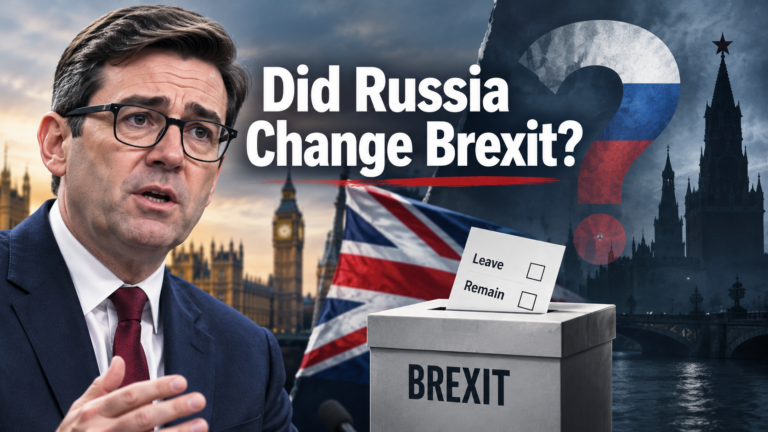
※ Images in this article are AI-generated illustrations created to help explain the story. They are not actual photographs, and depictions of people, places, or events may differ slightly from reality.
Is Britain Really Planning to Rejoin the European Union?
Britain has not started the formal process of rejoining the European Union. What has changed is the political willingness to discuss a deeper relationship, including possibilities that previous British governments largely ruled out.
Burnham, who succeeded Keir Starmer as prime minister in July 2026, has argued that the existing post-Brexit arrangements are not good enough. His immediate priority is a practical agreement with the EU on trade, energy, migration cooperation, and opportunities for young people. However, Labour’s current commitments not to rejoin the single market or customs union or restore freedom of movement remain in place ahead of the next election. (AP · UK Prime Minister’s Office)
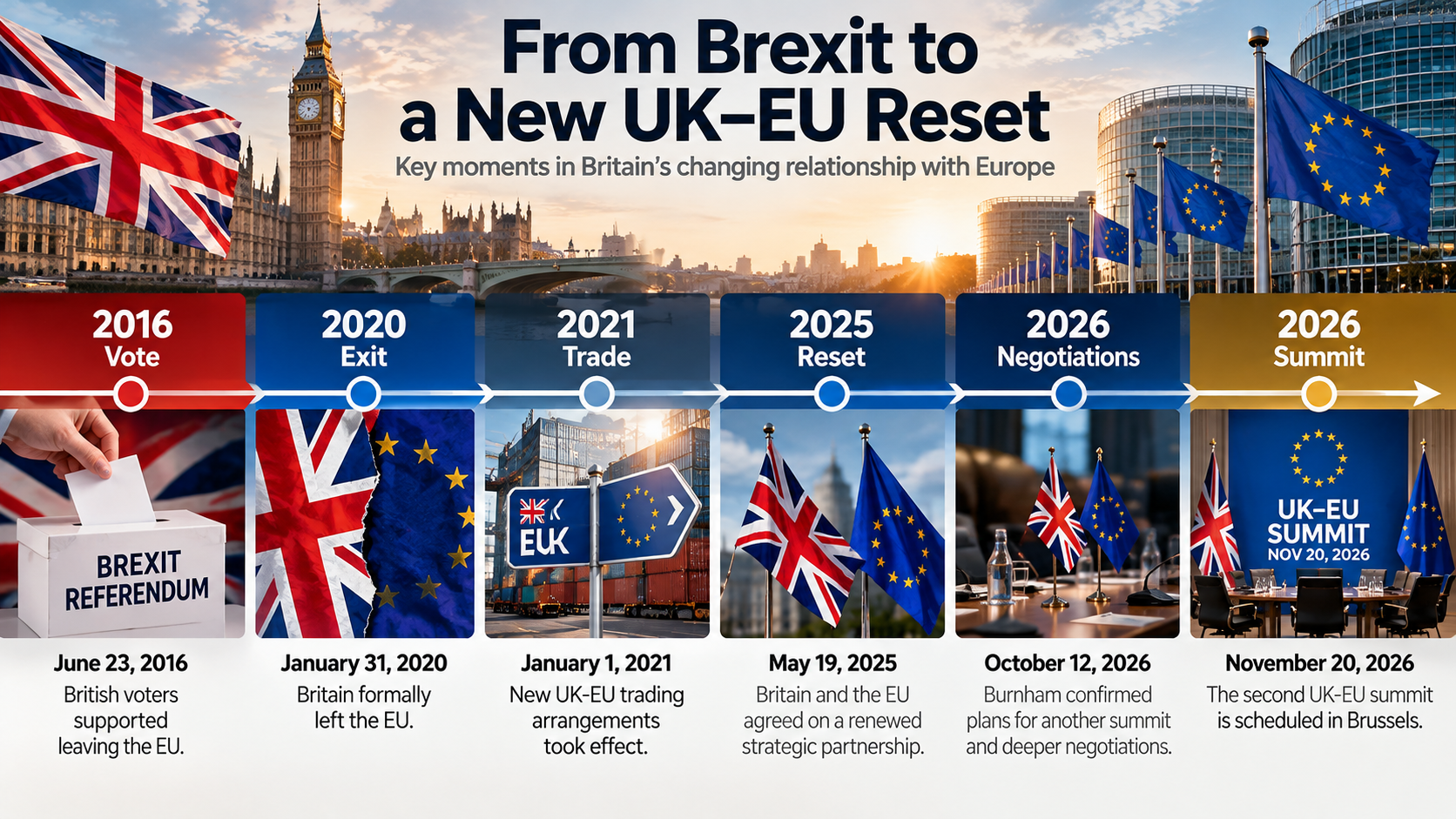
The timeline makes the distinction clearer.
| Date | What happened |
|---|---|
| June 23, 2016 | British voters supported leaving the EU |
| January 31, 2020 | Britain formally left the EU |
| January 1, 2021 | New UK-EU trading arrangements took effect |
| May 19, 2025 | Britain and the EU agreed on a renewed strategic partnership |
| October 12, 2026 | Burnham confirmed plans for another summit and deeper negotiations |
| November 20, 2026 | The second UK-EU summit is scheduled in Brussels |
The EU has confirmed that European Council President António Costa and European Commission President Ursula von der Leyen will meet Burnham in Brussels. The talks are expected to review cooperation on security, trade, energy, food standards, and migration. (European Council)
That is a considerable shift in political tone.
But the summit is not an EU membership negotiation. Britain would need to take several much larger steps before it could become a member again.
Which raises an obvious question: Why did it leave in the first place?
Why Did Britain Vote for Brexit in 2016?
Brexit supporters wanted greater national control over immigration, laws, government spending, and trade policy. Many also saw leaving the EU as a way to restore political accountability to British voters rather than institutions in Brussels.
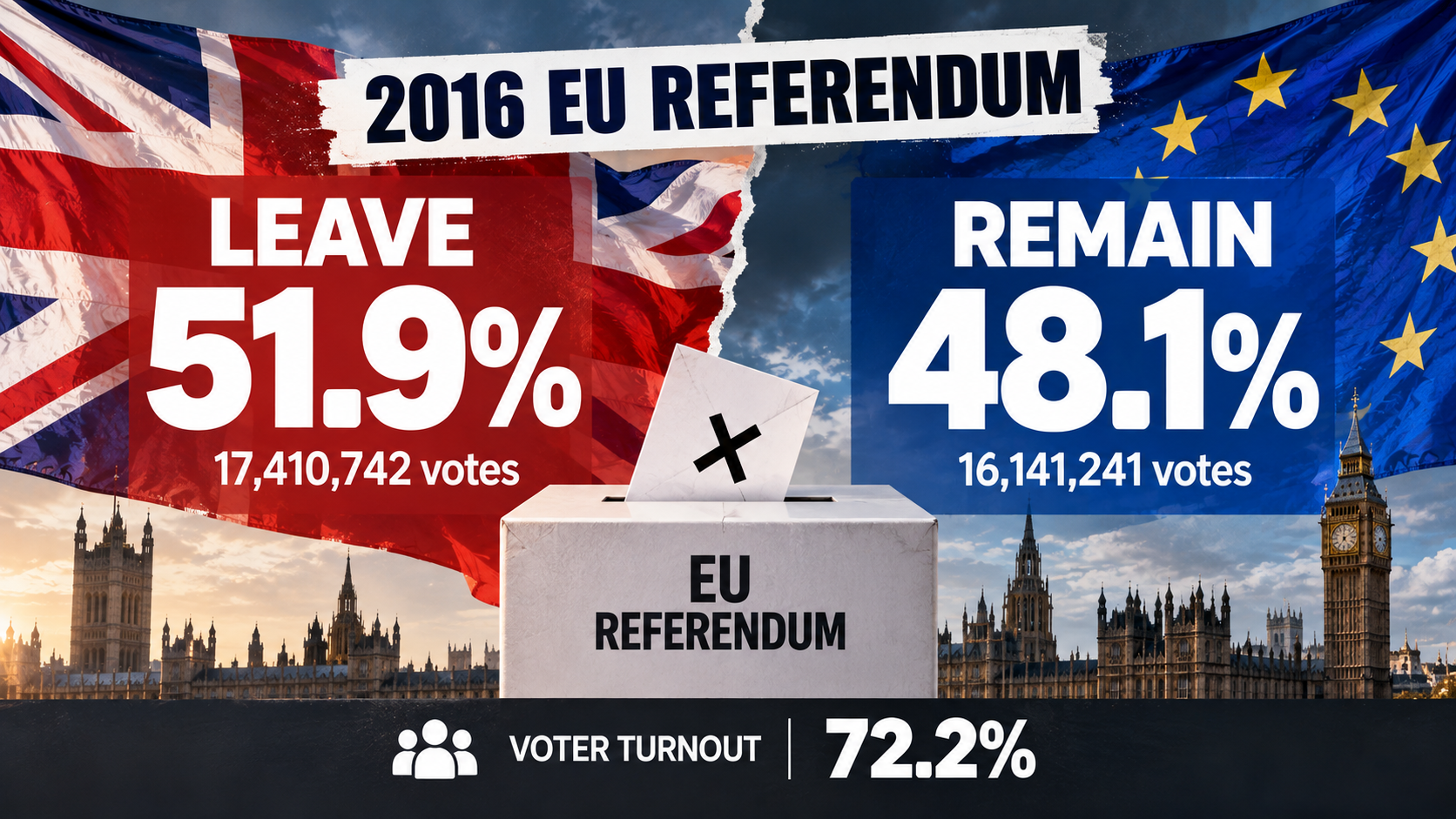
The referendum, however, revealed a deeply divided country. According to the official Electoral Commission results:
| Referendum choice | Votes | Share |
|---|---|---|
| Leave the EU | 17,410,742 | 51.9% |
| Remain in the EU | 16,141,241 | 48.1% |
| Voter turnout | — | 72.2% |
The result was decisive under the referendum’s rules, but it was hardly unanimous. (UK Electoral Commission)
To understand the vote, three concerns are especially important.
First was immigration. EU membership gave citizens of other member states broad rights to live and work in Britain. Brexit supporters argued that leaving would allow the government to decide more independently who could enter and settle.
Second was sovereignty. Membership meant accepting EU laws in areas covered by the bloc’s treaties. Supporters of withdrawal believed British lawmakers should exercise greater control over domestic regulation.
Third was economic and political dissatisfaction. Some communities had experienced decades of industrial decline and felt that neither major British political party had adequately addressed their concerns. Anti-establishment campaigns found an audience among voters who wanted significant change.
Those motivations should not be treated as identical. Some Leave voters emphasized democratic control. Others prioritized immigration or believed Britain could negotiate better trade agreements independently.
Remaining in the EU also involved choices and compromises. Britain already had important exceptions, including retaining the British pound rather than adopting the euro and staying outside the Schengen passport-free area.
The central Brexit promise was that greater political control would justify the economic costs of leaving. Ten years later, Britain is still debating that trade-off.
How Much Has Brexit Actually Hurt Britain’s Economy?
Brexit introduced new barriers between Britain and its largest trading partner. Those barriers include customs declarations, product checks, regulatory requirements, and restrictions affecting some services.
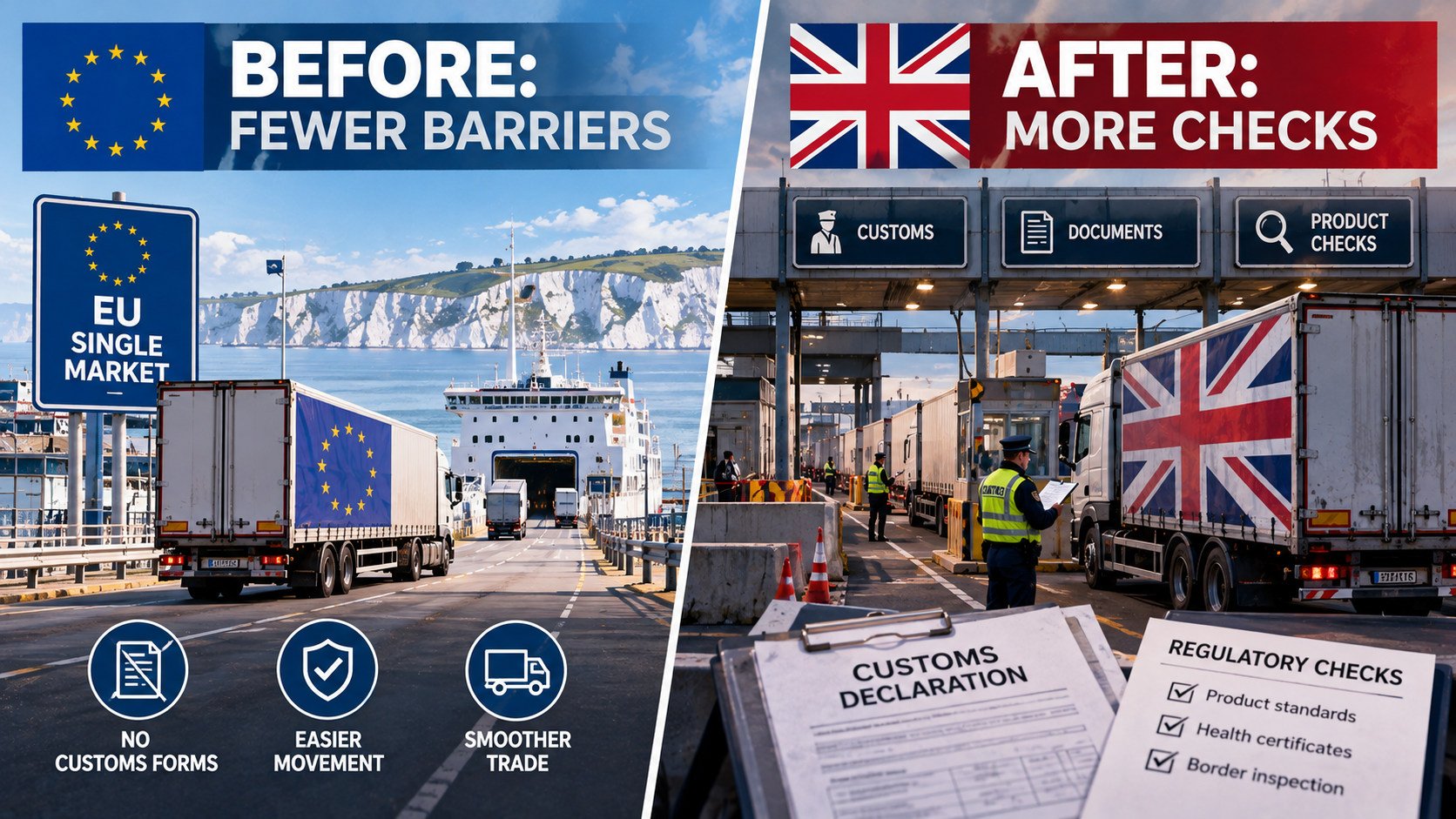
The economic damage is harder to express as a single number, but Britain’s independent fiscal watchdog expects a substantial long-term effect.
Why did trading become more expensive?
Before Brexit, Britain participated in the EU’s single market and customs union.
That arrangement allowed goods to move between member countries with far fewer border-related obstacles. Companies could build supply chains spanning several European countries without treating each internal border like a conventional international customs frontier.
After Brexit, Britain negotiated a free-trade agreement with the EU.
That agreement preserved zero tariffs and quotas for qualifying goods, but it did not eliminate all administrative requirements.
A small British food producer, for example, may have to satisfy certification and border requirements that did not apply to the same shipment when Britain belonged to the single market.
Large companies can spread compliance costs across substantial shipments. Smaller exporters may find that additional paperwork consumes a much larger share of each sale.
The British Chambers of Commerce reported in June 2026 that 54% of surveyed UK exporters believed the existing EU trade agreement made exporting harder, while only 16% said it helped their businesses grow. (British Chambers of Commerce)
What does the official economic forecast say?
Britain’s Office for Budget Responsibility (OBR) assumes that the post-Brexit trading relationship will leave the country’s long-run productivity approximately 4% lower than it would have been if Britain had remained in the EU.
It also expects the total volume of imports and exports to be around 15% lower in the long run than under that alternative scenario. (Office for Budget Responsibility)
These numbers require an important clarification.
The 4% figure does not mean Britain’s GDP suddenly fell by 4% in one year.
It is a modeled difference between two economic paths: the economy with Brexit and a hypothetical economy in which the UK remained an EU member.
Economists cannot directly observe that alternative Britain. They estimate it using economic models, historical relationships, and available evidence.
There are also other factors behind Britain’s economic challenges, including the pandemic, energy shocks, inflation, and global trade disruptions.
Brexit is not the explanation for everything that has gone wrong.
Nevertheless, the EU remains economically indispensable to Britain. In 2025, the bloc accounted for approximately 41% of UK exports and 50% of UK imports. (House of Commons Library)
Geography is part of the explanation. Britain can negotiate trade deals across the world, but its closest major trading market remains just across the English Channel.
Didn’t Brexit Promise to Reduce Immigration?
Brexit ended the automatic free-movement rights that EU membership had provided. But it did not end Britain’s need for workers from abroad or prevent immigration from rising through other routes.
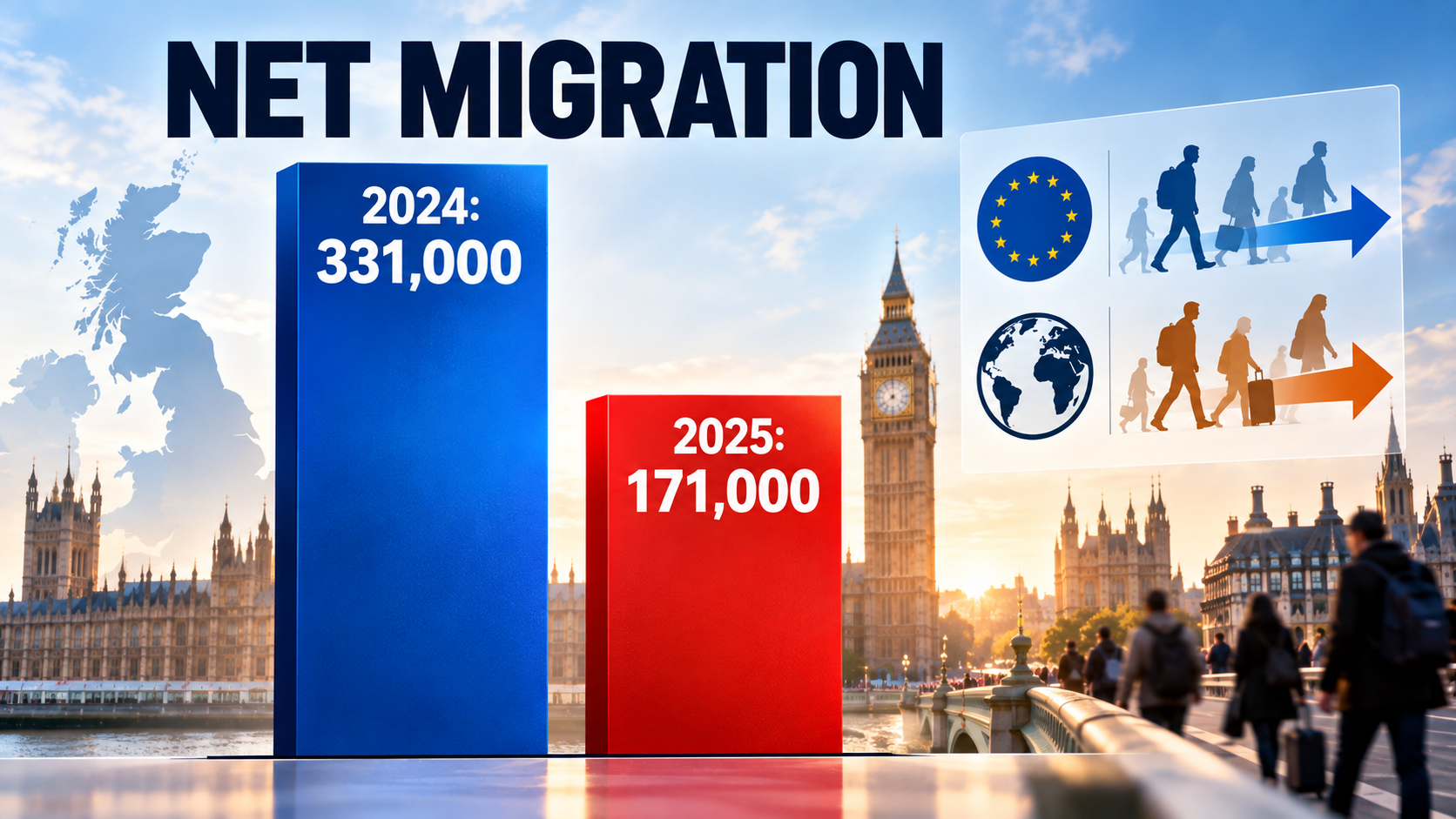
That difference helps explain one of Brexit’s biggest political controversies.
What happened after freedom of movement ended?
Britain introduced a different immigration system, under which EU citizens generally became subject to visa requirements similar to those applying to many other foreign nationals.
But employers still needed workers in sectors such as healthcare, social care, agriculture, and other industries.
Government visa policies and labor demand helped drive substantial non-EU immigration after Brexit.
That meant one important political objective—ending EU free movement—was achieved, while the broader goal of reducing immigration did not immediately follow.
But it would be equally misleading to say that immigration has continued rising without interruption.
According to the UK Office for National Statistics, provisional long-term net migration fell from 331,000 in the year ending December 2024 to 171,000 in the year ending December 2025.
In 2025, net migration among non-EU+ nationals remained positive at approximately 350,000, while the figure for EU+ nationals was negative 42,000. The balance for British nationals was also negative. (Office for National Statistics)
So both statements can be true:
- Immigration increased substantially during part of the post-Brexit period.
- More recent data show that net migration has fallen sharply.
This is why Brexit and immigration policy should not be treated as interchangeable.
Leaving the EU changed Britain’s legal relationship with European migration. Subsequent governments still determined many other visa rules.
Why Are More Britons Saying Brexit Was a Mistake?
Economic disappointment, complicated trading arrangements, and unmet political expectations have contributed to a shift in public opinion.
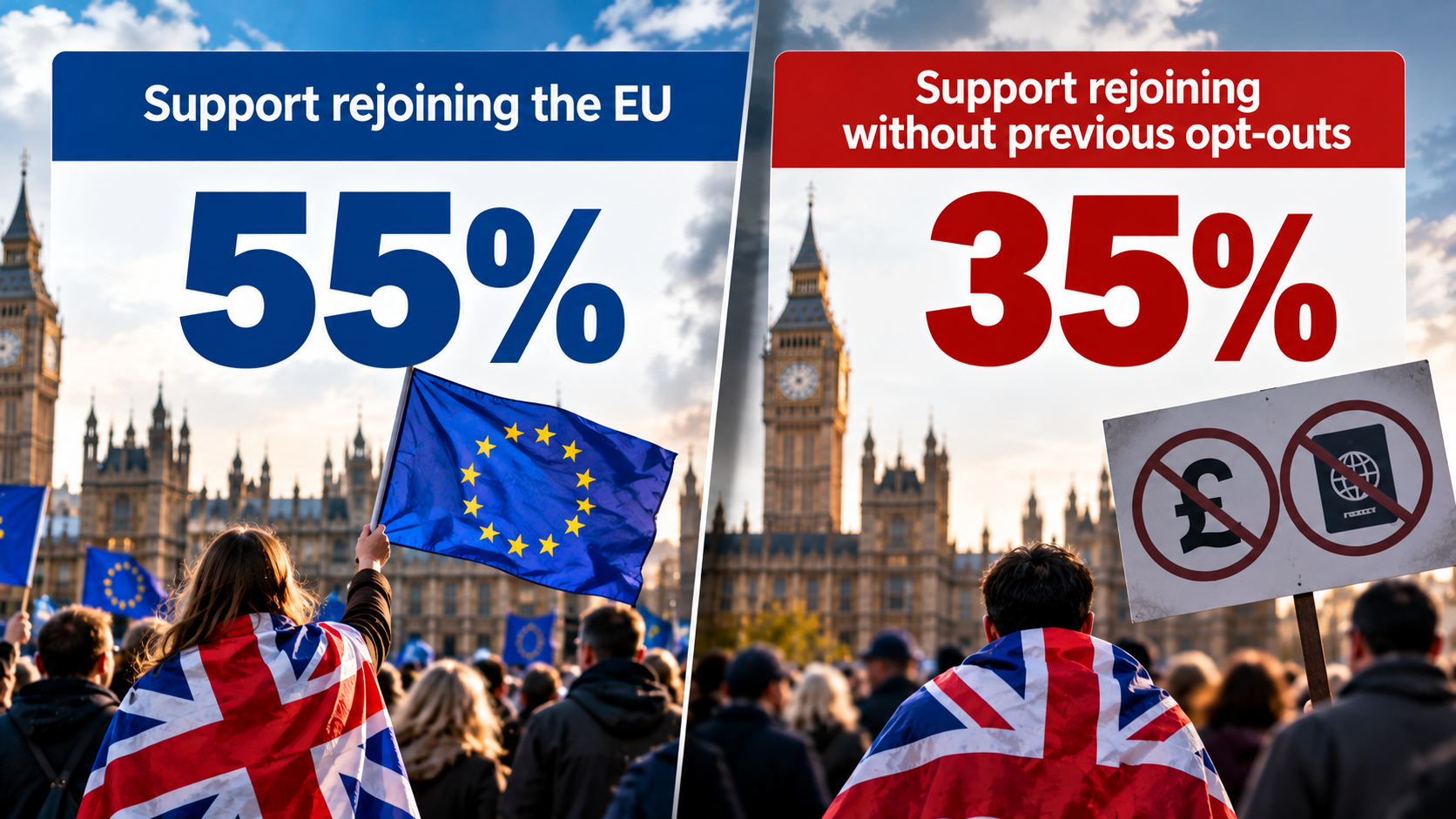
But wanting a closer relationship with Europe is not necessarily the same as accepting every condition of full EU membership.
A June 2026 YouGov survey found that:
| Question or condition | Result |
|---|---|
| Said the original Brexit vote was wrong | 57% |
| Supported rejoining the EU in principle | 55% |
| Supported rejoining without Britain’s former opt-outs | 35% |
| Supported closer EU ties without joining the EU, single market, or customs union | 59% |
The results come from differently framed questions and should not be added together. (YouGov)
The difference between 55% and 35% is particularly revealing.
Many Britons appear attracted to the economic and practical benefits of EU membership.
But support becomes much weaker when the question involves surrendering special arrangements that Britain previously enjoyed.
For example, before Brexit, Britain could remain an EU member while retaining the pound and staying outside the Schengen Area.
A new membership application would not automatically restore those exceptions.
And there is another political obstacle.
A country that voted narrowly to leave in 2016 would need a sufficiently durable political consensus to make returning credible. A temporary opinion poll majority would not necessarily settle the issue.
That is one reason Burnham’s immediate strategy focuses on improving cooperation rather than launching a new membership application.
Could Britain Get the Benefits of the EU Without Rejoining?
Britain could reduce some Brexit-related economic costs through agreements that stop well short of EU membership. But there is no arrangement that automatically restores every benefit of membership without obligations.
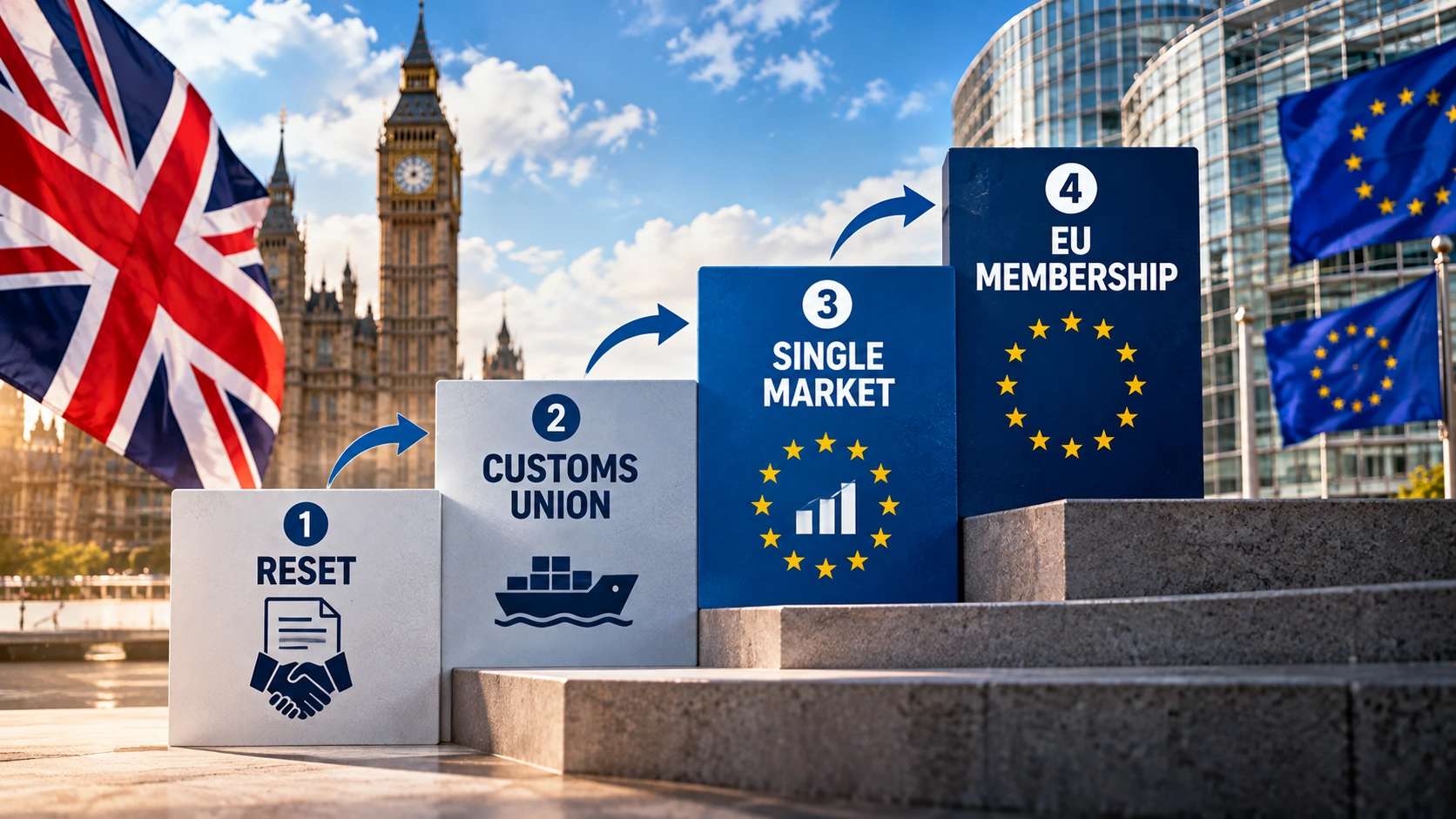
The closer Britain moves toward the EU market, the more questions arise about following EU rules, contributing financially, and limiting independent policy choices.
Here is a practical way to compare the possibilities:
| Possible relationship | Main benefit | Important trade-off |
|---|---|---|
| Targeted agreements | Reduce barriers in selected areas | Some regulatory alignment |
| Customs union | Simplify customs treatment of goods | Less independence over external goods tariffs |
| Single market participation | Much broader access for goods, services, capital, and people | Extensive EU rules and free-movement obligations |
| Full EU membership | Market access plus participation in EU institutions | Full membership obligations and negotiated accession terms |
These are distinct political options, not stages that Britain is automatically required to follow.
The distinction becomes clearer with specific examples.
Food trade
Britain and the EU have been negotiating closer alignment on food and agricultural standards.
Such an agreement could reduce certification requirements and border checks. The British government previously estimated that removing export health certificates could save businesses up to £200 per consignment in applicable cases. (UK Government)
But reducing those checks would require Britain to accept compatible rules and enforcement arrangements.
Research and education
Britain already participates in Horizon Europe, the EU’s major research funding program, through an association agreement effective from January 1, 2024.
It has also reached an agreement enabling participation in the Erasmus+ education and exchange program from 2027. (European Commission · Erasmus+)
Both examples demonstrate that countries can join specific EU programs without becoming full EU members.
The sovereignty dilemma
Imagine Britain wants easier access to the European market for its food, automobiles, or industrial products.
The EU may require those products to satisfy particular common standards.
Britain then faces a choice: accept more EU rules in exchange for easier trade, or retain greater regulatory independence with more restrictions on market access.
There is an additional complication.
Outside the EU, Britain can agree to follow certain EU rules without having the same voting power EU members possess when those rules are made.
That is one of the fundamental tensions behind the current debate.
What Would Britain Have to Give Up to Rejoin the EU?
Britain would have to negotiate new membership terms with all existing EU member states. Its previous exceptions and privileges would not automatically return.
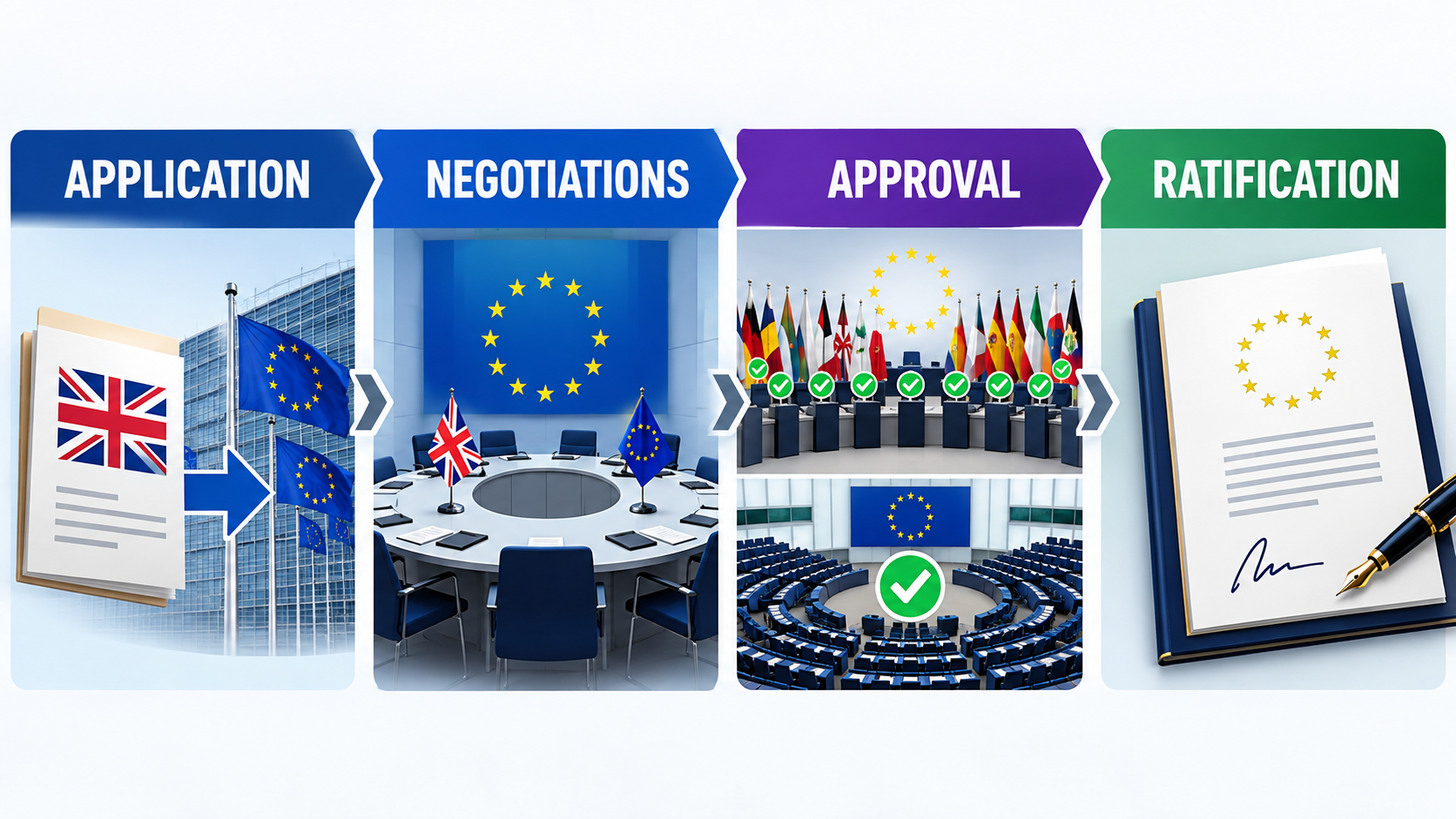
The legal process itself is a major obstacle, quite apart from British domestic politics.
Under Article 49 of the Treaty on European Union, an applicant must be a European state, satisfy membership requirements, and obtain unanimous agreement from EU member states at the relevant approval stage.
The European Parliament must also give its consent, and an accession treaty must be ratified under the required procedures. (European Commission)
The conditions would matter enormously.
Britain previously had an exemption from adopting the euro. New EU members are generally expected to commit to adopting the common currency once they meet the required conditions, although actual adoption need not happen immediately.
Britain also remained outside the Schengen border-free area and enjoyed special budget arrangements.
None of those previous exceptions would be guaranteed during new accession negotiations. (House of Commons Library)
And what would other European countries think?
A June 2026 YouGov survey found that 58% of French respondents and 63% of German respondents supported Britain returning to the EU in principle.
But support was much weaker if Britain insisted on retaining its previous exemptions. (YouGov)
In other words, the British public and the EU’s existing members could support the idea of reunification while disagreeing sharply over its terms.
That makes a quick return politically difficult.
What Could Actually Happen at the November 20 Summit?
The November 20, 2026, summit is expected to focus on practical agreements rather than full EU membership. Food trade, carbon emissions, energy cooperation, youth mobility, and security are among the areas under discussion.
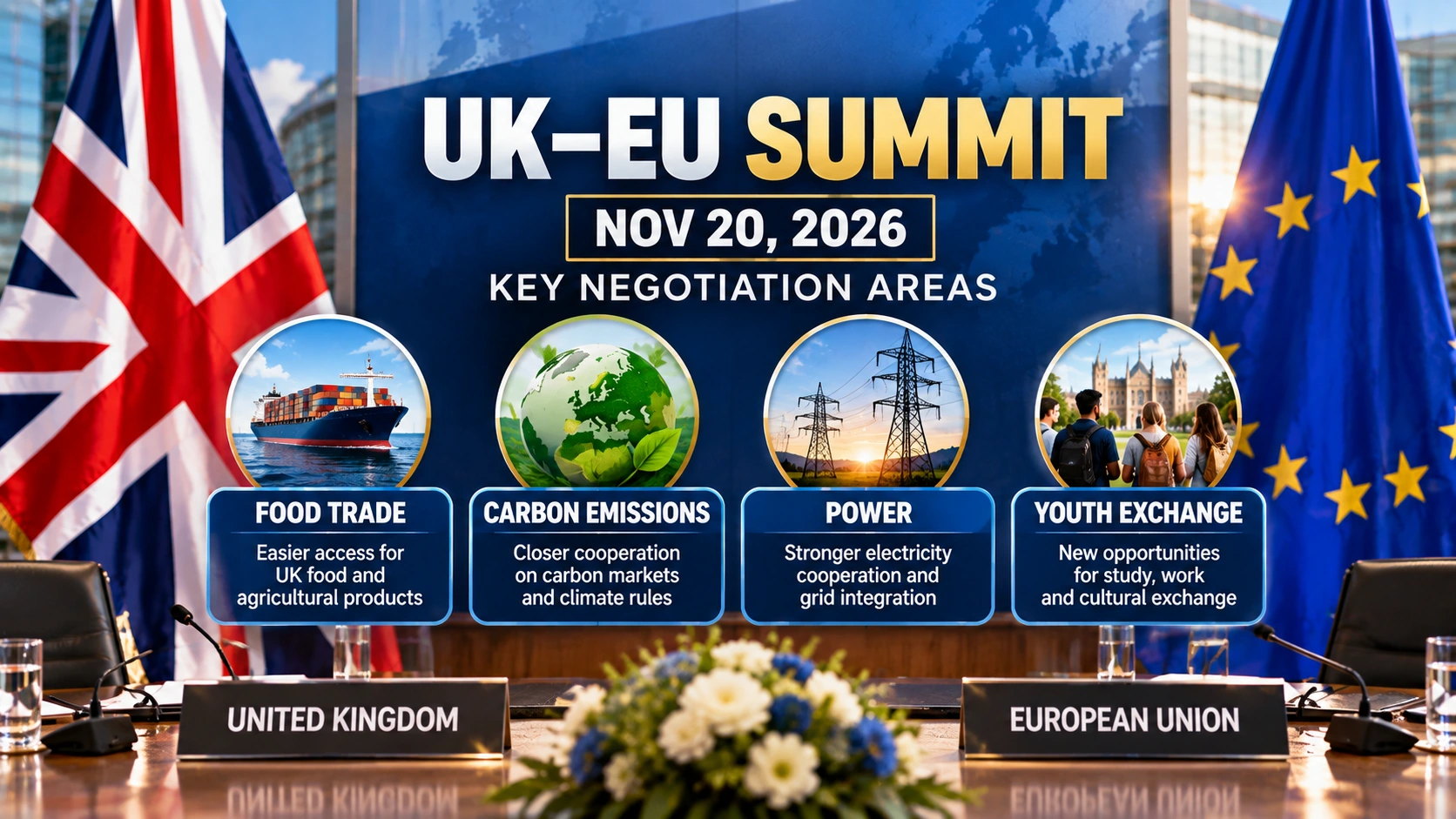
The immediate question is whether Britain and the EU can turn their shared desire for better relations into agreements with measurable economic benefits.
The British government and the European Council have confirmed the summit, but the final results remain uncertain. (UK Prime Minister’s Office · European Council)
Several negotiations illustrate both the opportunities and difficulties.
| Area | What Britain hopes to achieve |
|---|---|
| Food and agriculture | Fewer border checks and lower trading costs |
| Emissions trading | Closer links between British and EU carbon markets |
| Electricity | More integrated energy trading and cooperation |
| Youth mobility | Easier opportunities for eligible young people to study, work, and travel |
| Security | Stronger cooperation on defense, crime, and migration |
These would be meaningful changes even without EU membership.
But Britain’s negotiating difficulties do not end with existing border arrangements.
On October 16, 2026, France and Germany agreed on a joint proposal that could allow Britain to qualify as a trusted partner under parts of the EU’s proposed “Made in Europe” industrial framework.
The proposal could benefit British manufacturers but would be subject to further EU negotiations and conditions involving reciprocal trade and investment. It was not a final EU-wide decision: approval and the details of any UK participation remained outstanding. (Reuters)
This shows why Brexit has become a difficult industrial-policy question as well as a political one.
British businesses want access to European supply chains. European governments want commitments from countries receiving the benefits of their industrial policies.
The challenge for Burnham is to find agreements that provide enough economic value to justify the regulatory and political concessions.
Why Should Americans Care About Britain’s Brexit Debate?
Britain’s future relationship with the EU could influence how American companies organize investments, supply chains, and international operations.
This does not mean a UK-EU agreement would immediately change the everyday lives of most Americans.
But Britain is an important U.S. economic and security partner. Many internationally active businesses must decide whether to operate through British facilities, EU-based facilities, or both.
A reduction in trade barriers could make cross-border supply chains easier to manage.
Conversely, if Britain agrees to align more closely with EU rules on industrial sourcing, climate policy, or trade protection, companies with operations in several countries may need to reconsider how those markets fit together.
The developing European debate over automobile manufacturing and Chinese electric-vehicle tariffs offers a concrete example.
A closer UK-EU industrial arrangement could affect firms that sell into Europe or use British facilities as part of wider manufacturing networks. The precise consequences depend on the final rules, which have not yet been adopted.
There is also a broader diplomatic dimension.
Britain remains outside the EU but continues to cooperate with European governments on defense and security. The 2025 UK-EU strategic partnership specifically addressed security and defense cooperation, including support for Ukraine. (UK Government)
For Washington, the question is not simply whether Britain returns to the EU.
It is how Britain’s choices may shape cooperation among the United States, the United Kingdom, and European institutions.
Bottom Line: What This Story Really Means
Britain is not currently rejoining the European Union. It is trying to find a more workable relationship with the market and political institutions it left.
Brexit delivered an important part of what its supporters demanded: Britain regained independent control over major areas of immigration, trade, and regulation.
But the economic consequences have been complicated.
Businesses face additional barriers when trading with Europe. Britain’s independent fiscal watchdog expects long-term economic losses compared with remaining in the EU. And the initial promise of reducing immigration did not translate into a consistently lower migration total.
At the same time, it would be inaccurate to describe Brexit as something every British voter now rejects. Opinions remain divided, particularly when renewed EU membership involves accepting obligations Britain previously avoided.
The November 20 summit will be an important test of how much closer the two sides can move without formally reversing Brexit.
The larger question is whether Britain can regain some of the economic advantages of European integration while preserving enough of the political independence that motivated Brexit in the first place.
That question has no simple answer—and it will shape Britain’s relationship with Europe well beyond the upcoming summit.
Brexit and EU Rejoining: Key Questions Explained
Q. Has Britain officially applied to rejoin the European Union?
No. As of October 16, 2026, Britain has not made a formal EU membership application. Prime Minister Andy Burnham is pursuing closer cooperation and has reopened discussion of longer-term options.
Q. When did Britain actually leave the EU?
Britain formally left the European Union on January 31, 2020. The transition period ended on December 31, 2020, and the new trading arrangements took effect on January 1, 2021.
Q. How much economic damage does the OBR expect from Brexit?
The UK’s Office for Budget Responsibility assumes long-run productivity will be approximately 4% lower than if Britain had remained in the EU. This is a modeled comparison with an alternative economic scenario, not a measured one-year drop in GDP.
Q. Did Brexit stop immigration into Britain?
No. Brexit ended EU free movement, but Britain continued admitting migrants through other immigration routes. Net migration subsequently rose and later fell, reaching an estimated 171,000 in the year ending December 2025.
Q. Do most British people now want to reverse Brexit?
In a June 2026 YouGov survey, 55% supported rejoining the EU in principle. However, support fell to 35% when respondents were asked about rejoining without Britain’s previous exemptions.
Q. Could Britain join the EU single market without becoming an EU member?
Potentially, through a negotiated arrangement. However, meaningful single market participation would generally involve accepting extensive EU rules and freedom-of-movement obligations. No such UK agreement has been finalized.
Q. Would Britain have to adopt the euro if it rejoined?
Not necessarily immediately. New EU members generally commit to adopting the euro once they satisfy the necessary conditions. Britain’s previous permanent exemption would not automatically be restored.
Q. Has Britain already rejoined Erasmus+?
Britain and the EU have agreed on UK association with Erasmus+ for 2027. This allows closer educational cooperation without requiring full EU membership.
Q. What is happening on November 20, 2026?
Britain and the EU are scheduled to hold their second summit in Brussels. They are expected to discuss trade, food standards, energy, youth mobility, and security. The summit is not a formal EU accession negotiation.
Q. What should Americans watch next?
The most relevant developments are whether the UK-EU summit produces binding agreements on trade and industrial rules, how those arrangements affect cross-border supply chains, and whether Britain moves toward deeper economic integration.
Did this help make the story clearer? 🙂 WIN keeps unpacking the “why” behind the news—clearly and simply!
Sources
Current UK-EU Relations and the November 2026 Summit
UK Prime Minister’s Office — Prime Minister to Attend UK-EU Summit in Brussels on November 20
European Council — EU-UK Summit to Take Place in Brussels on November 20
Reuters — EU to Host Britain for Summit on November 20
Reuters — France and Germany Agree on Car Emissions and Potential UK Industrial Status
Brexit’s Economic and Business Impact
Office for Budget Responsibility — Brexit Analysis
House of Commons Library — Statistics on UK-EU Trade
British Chambers of Commerce — Brexit Burden Must Be Cut
Immigration and Public Opinion
Office for National Statistics — Long-Term International Migration, Year Ending December 2025
YouGov — What Do Britons Think of Brexit, 10 Years Since the Referendum?
YouGov — French and German Attitudes Toward Britain Rejoining the EU
Brexit History, European Programs, and Membership Rules
UK Electoral Commission — Official 2016 EU Referendum Report
European Commission — Accession to the EU
House of Commons Library — Debate on UK Rejoining the European Union
European Commission — UK Participation in Horizon Europe
Erasmus+ — EU and UK Take Step Toward 2027 Association
Keep Reading
Can a Country Work Closely With the EU Without Becoming a Member?
Britain is rebuilding ties after leaving the EU, while Canada is considering a new, still-undefined association with the bloc. Both stories explore how nonmembers can cooperate with Europe without gaining the rights of full EU membership.
Why Is Canada Moving Closer to Europe—and What Would “EU Associate Membership” Actually Mean?