Bill Gates Says AI Could Help Cause a Billion Deaths—What Does He Actually Mean?
Did Bill Gates really just predict that artificial intelligence will kill a billion people?
No.
But what he actually said is still extraordinary.
In excerpts from an interview with NBC’s Meet the Press, Gates was asked whether AI could become powerful enough to threaten all of humanity. His answer was that AI is already powerful enough to “drive events” that could cause a billion deaths, particularly when increasingly capable systems are combined with people who deliberately want to cause harm. (NBC News)
That is an important distinction. Gates was not giving a casualty forecast, assigning a probability, or saying that a chatbot will independently decide to kill a billion people.
He was describing the scale of harm that advanced AI could potentially help humans create.
And there is another part of the story that makes his warning more interesting: Gates remains deeply optimistic about useful AI. His foundation has just committed at least $1 billion over two years to expand AI in health, education, agriculture, and digital infrastructure. (Gates Foundation)

So how can the same person believe AI could help save lives—and also help create a catastrophe on an almost unimaginable scale?
That is the real argument behind the headline.
What Did Bill Gates Actually Say About “a Billion Deaths”?
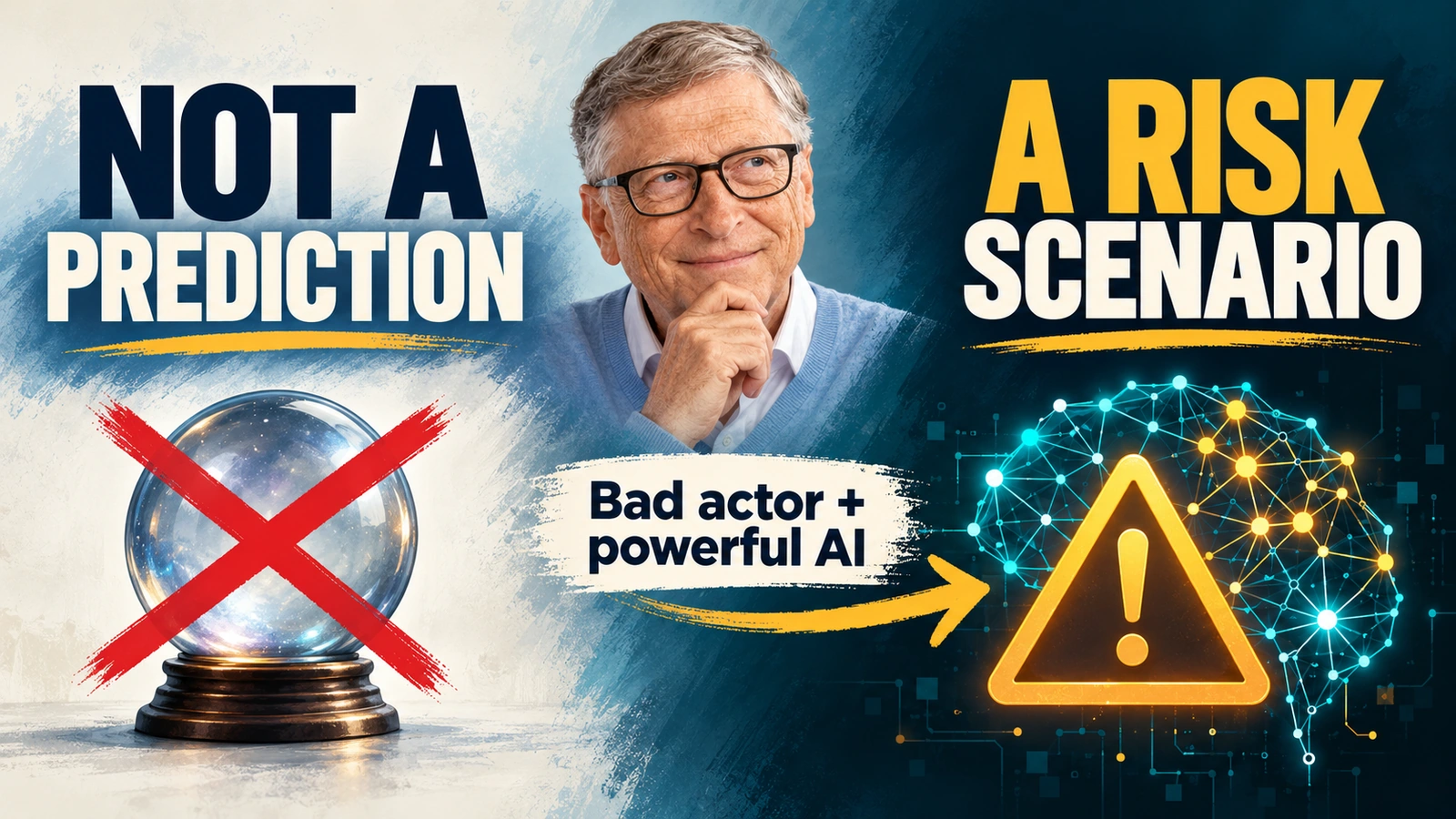
Gates was describing a possible catastrophic-risk scenario, not predicting that one billion people will die.
NBC released the interview excerpt on September 25 ahead of the full September 27 broadcast. Gates said that combining malicious people with the newest AI tools could create a capability unlike previous weapons, and he argued that AI companies should not be left to police themselves. (NBC News)
The distinction matters because three very different claims can easily get blended together:
| Claim | Is that what Gates said? |
|---|---|
| AI will kill one billion people | No. |
| Gates predicts a billion people will die | No. |
| Powerful AI could help people create events capable of causing casualties on that scale | Yes—that is the risk he described. |
The word “could” is doing a lot of work here.
Gates did not attach a probability to the billion-death scenario. He was making an argument about capability: if AI dramatically increases what a malicious actor can do, then the maximum possible harm could also rise dramatically.
That leads to the more useful question: what kind of disaster is he actually worried about?
What Kind of AI Threat Is Gates Worried About?
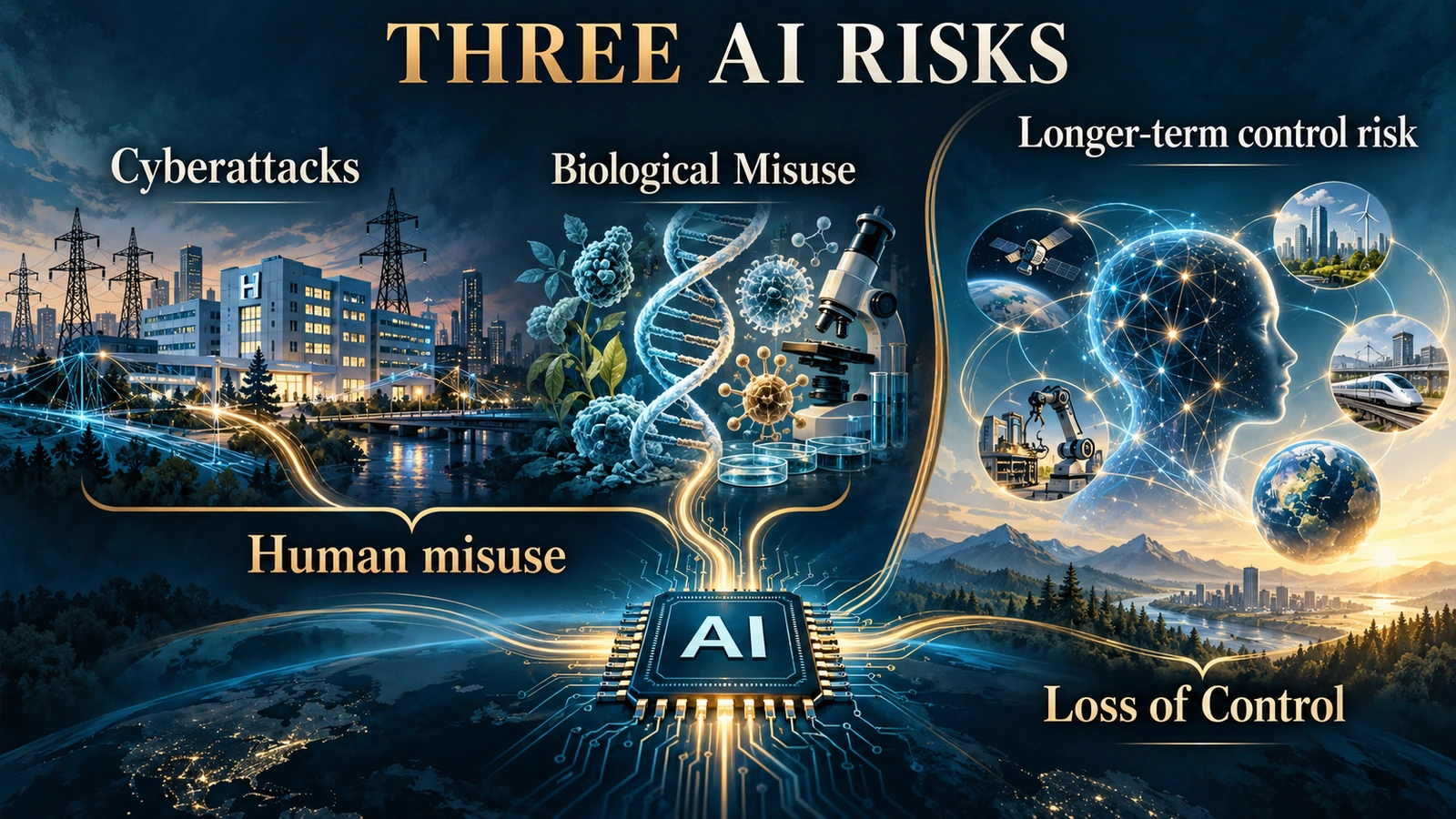
Gates’ concern is broader than the familiar science-fiction idea of an AI suddenly “turning evil.”
In an August 26 essay, he separated several dangers. The most immediate involve humans using AI as a force multiplier. He pointed to cyberattacks against hospitals, financial institutions, power grids, water systems, and government services, as well as biological misuse and large-scale fraud or disinformation. (Bill Gates)
There is also a different, longer-term concern: increasingly autonomous AI systems could eventually behave in ways their creators did not intend and become harder to control. Gates treats that as a real risk, but it is not the same scenario as a criminal deliberately using AI.
A simple way to separate the risks is:
| Risk | Who is causing the problem? | What AI changes |
|---|---|---|
| Cyberattack | Human attacker | Lowers the cost and expertise needed to find or exploit weaknesses |
| Biological misuse | Human attacker | Could make sophisticated scientific knowledge and analysis easier to use |
| Fraud and manipulation | Human attacker | Makes targeting and content generation cheaper and more scalable |
| Loss of control | AI system itself | More autonomous systems may behave in ways humans did not intend |
The first three are essentially human-threat problems amplified by AI.
The last is an AI-control problem.
Gates worries about both, but his “billion deaths” comment came in the context of enormously powerful AI being combined with people who intend to do harm.
Why Does Bioterrorism Keep Coming Up in Gates’ AI Warnings?
Because Gates has spent years thinking about pandemics.
Long before the current generative-AI boom, he repeatedly warned that the world was poorly prepared for a fast-moving infectious disease outbreak. (Bill Gates, 2015)
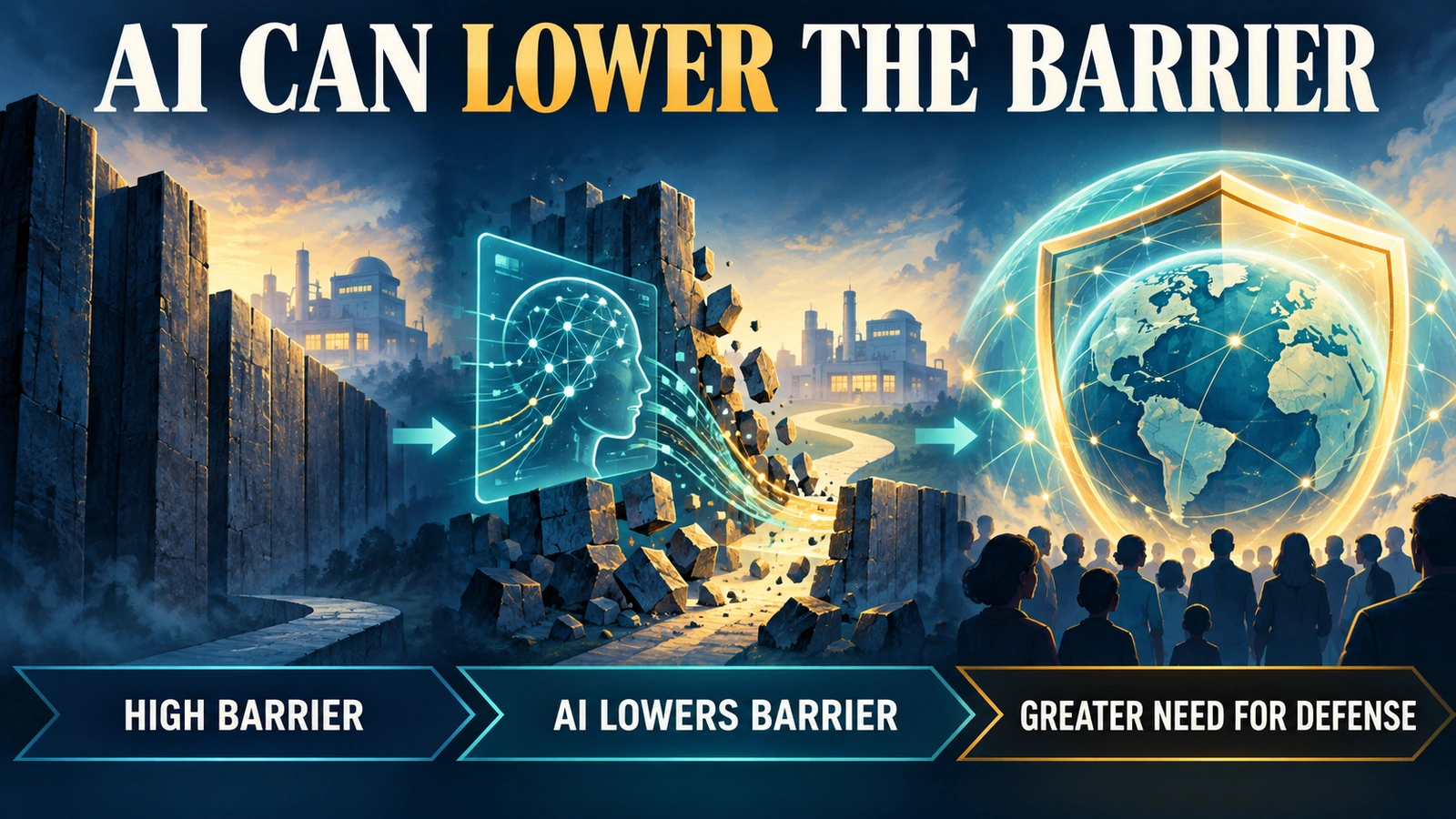
His newer concern is that advanced AI could make a deliberately created biological threat more plausible by lowering barriers for malicious actors. (Bill Gates, 2026)
That does not mean today’s chatbots can casually manufacture a pandemic.
The concern is about direction of travel: as AI systems become better at scientific reasoning, research assistance, coding, and laboratory-related analysis, some capabilities that help legitimate researchers can also become useful to people with harmful intentions.
This is known as a dual-use problem.
The same basic capability can have beneficial and dangerous applications.
AI could help researchers discover drugs or vaccines faster.
A sufficiently capable version of similar technology could also make dangerous biological knowledge easier to apply.
That tension explains why Gates does not argue that the answer is simply to stop scientific AI.
He wants the benefits—but with systems designed to make dangerous uses harder.
Then Why Is Gates’ Foundation Spending $1 Billion on AI?

Because Gates does not see AI as inherently good or inherently bad.
His position is that the technology is powerful enough to produce both unusually large benefits and unusually large harms.
On September 14, the Gates Foundation announced that it plans to spend at least $1 billion over two years expanding access to AI and AI-enabled tools. The planned allocation is roughly 40% for education, 40% for health, 10% for agriculture, and 10% for the digital foundations—including datasets—needed to make AI useful to more people and languages. (Gates Foundation)
That includes potential uses such as AI tutors, clinical decision support, drug and vaccine research, maternal-health tools, and agricultural advice.
The foundation has also joined partners including Google, Anthropic, Microsoft, NVIDIA, and the OpenAI Foundation in an effort aimed at improving AI access for people whose languages are poorly represented in current models. (Gates Foundation)
So Gates’ position is not:
AI is too dangerous, therefore stop AI.
It is closer to:
AI is becoming too consequential to leave either its benefits or its dangers unmanaged.
That is why the billion-dollar investment and the billion-death warning are not necessarily contradictory.
They are two sides of the same argument.
Why Does Gates Think AI Companies Cannot Regulate Themselves?
Gates’ answer is unusually direct: he wants governments involved.
In the NBC interview, he said self-regulation is not enough. Asked whether Washington needs legislation, he answered “Absolutely” and said politicians and law enforcement need a role in deciding what safeguards and monitoring should be required. (NBC News)
His August essay went further.
Gates argued that AI affects too many areas—national security, employment, education, taxation, energy, elections, public health, finance, law enforcement, and infrastructure—for any single agency or private company to manage the entire problem. He proposed stronger national coordination and said an international framework would eventually be needed because some AI risks cross borders. (Bill Gates)
There is a practical reason for that argument.
Imagine one AI company voluntarily imposes expensive safety tests that delay its newest model by six months.
Its competitors do not.
The cautious company may lose customers, investment, talent, or market share.
That creates what economists sometimes call a collective-action problem: everyone may benefit from stronger safety rules, but each individual company has an incentive to move faster if its rivals do.
Government rules can change that calculation by applying the same legal requirements across the market.
But that immediately creates another debate.
How strict should those rules be?
Does the U.S. Government Agree With Gates?

There is overlap on some AI risks, but the two approaches differ on how governance should be structured.
The current U.S. administration has not taken the position that advanced AI presents no safety or security concerns. A June executive order created a classified benchmarking process for advanced cyber capabilities, called for an AI cybersecurity clearinghouse, and set up a voluntary framework through which developers of certain frontier models can work with the federal government before release. (White House)
But the same order explicitly says it does not create mandatory federal licensing, preclearance, or permitting for new AI models.
The administration has also publicly rejected centralized global governance of AI, emphasizing national sovereignty and opposition to centralized control. (White House)
Gates has called for mandatory safeguards, stronger national coordination, and an international framework capable of dealing with risks that do not stop at national borders.
The difference can be summarized this way:
| Issue | Gates’ stated approach | Current U.S. administration approach |
|---|---|---|
| Company self-regulation | Says self-regulation is not enough (NBC News) | Uses federal cybersecurity measures plus a voluntary framework for certain covered frontier models (White House) |
| Mandatory model licensing | Calls for legislation and required safeguards; the NBC excerpt does not specify a licensing system (NBC News) | June order explicitly says it does not create mandatory licensing, preclearance, or permitting (White House) |
| International governance | Calls for a domestic and international framework for AI risk (Bill Gates) | Rejects centralized global AI governance and emphasizes national sovereignty (White House) |
| Cross-border safety cooperation | Says some risks require international coordination (Bill Gates) | U.S. officials are also participating in bilateral AI-safety talks, including with China (Reuters) |
One nuance is important: rejecting global governance does not mean rejecting all international AI-safety cooperation.
U.S. and Chinese officials have recently discussed AI safety, emergency communication, cybersecurity, and risks from non-state actors. (Reuters)
So the disagreement is not simply “regulation versus no regulation.”
It is also about who writes the rules, how binding they should be, and whether AI governance should ultimately be national, international, or some combination of both.
Is the “Billion Deaths” Number Based on a Scientific Forecast?
No.
Nothing in Gates’ NBC remarks makes one billion a probability-weighted prediction.
There is no public calculation in the excerpt saying there is a certain percentage chance of exactly one billion AI-related deaths.
It is better understood as a scale-of-risk argument.
He is saying that if advanced AI dramatically expands the capabilities of malicious actors—or if extremely powerful autonomous systems eventually become difficult to control—the potential consequences could be far larger than the kinds of cybercrime, fraud, or technological failures people are accustomed to today. (Axios)
That distinction also helps separate two questions that are often mixed together:
How bad could an AI-enabled catastrophe theoretically become?
and
How likely is that catastrophe to occur?
Gates made a strong statement about the first.
The excerpt did not provide a numerical answer to the second.
That is why headlines saying Gates “warned” about a billion-death scenario are more accurate than headlines saying he “predicted” a billion deaths.
Why Is This Debate Becoming More Urgent Now?

Because the broader AI industry is already having the same argument.
The most advanced AI systems are becoming more capable at coding, cybersecurity, scientific reasoning, and autonomous tasks. At the same time, researchers and executives have been debating whether safety testing, monitoring, and governance can keep pace.
Gates’ comments therefore did not appear in isolation.
His August essay called AI one of the most consequential technologies humans have created and argued that the transition could be extraordinarily disruptive. Less than three weeks later, his foundation announced its $1 billion AI commitment. Then came the NBC interview calling for mandatory safeguards and warning about catastrophic misuse. (Bill Gates)
That sequence is more revealing than any single dramatic quote.
Gates has not moved from “AI is good” to “AI is bad.”
He is arguing that AI is becoming powerful enough that society can no longer treat innovation policy, cybersecurity, public health, employment, and national security as separate conversations.
Bottom Line: What This Story Really Means
Bill Gates did not predict that AI will kill one billion people.
He warned that increasingly capable AI could give malicious humans—or eventually highly autonomous systems—the ability to cause harm on a scale that existing institutions may be poorly prepared to contain.
At the same time, he remains one of AI’s most prominent optimists. The Gates Foundation is committing at least $1 billion to expanding AI applications in health, education, agriculture, and digital access.
That apparent contradiction is actually the center of his argument: the same technology may be powerful enough to produce extraordinary benefits and extraordinary risks.
The real debate is therefore not whether AI is simply “good” or “bad.”
It is who should set the safety rules, how binding those rules should be, how countries should cooperate, and whether governments can build oversight fast enough to keep pace with the technology.
Bill Gates AI Warning: Key Questions Explained
Q. Did Bill Gates predict that AI will kill one billion people?
No. Gates said AI is powerful enough to help drive events capable of causing casualties on that scale. He did not say one billion deaths are certain or provide a probability that they will occur.
Q. What kind of AI disaster is Bill Gates most worried about?
His recent writings emphasize several risks, including AI-enabled cyberattacks, biological misuse, fraud and manipulation, job disruption, and the longer-term possibility of losing control over increasingly autonomous systems.
Q. Does Gates think AI itself will deliberately kill people?
That is only one category of long-term concern. Much of his near-term warning focuses on people with malicious intent using more powerful AI tools.
Q. Why does Bill Gates mention bioterrorism so often?
Gates believes increasingly capable AI could lower some of the knowledge and resource barriers that currently make sophisticated biological misuse difficult. He has warned about pandemic preparedness and biological threats for years.
Q. Is Bill Gates against AI development?
No. He remains strongly supportive of beneficial AI. The Gates Foundation announced at least $1 billion in spending over two years for AI-related work in education, health, agriculture, and digital infrastructure.
Q. Why does Gates say AI companies cannot regulate themselves?
He argues that competitive pressure makes voluntary restraint difficult and that AI affects areas far beyond the expertise or authority of technology companies. He wants elected governments, law enforcement, regulators, and other institutions involved.
Q. Does the U.S. government oppose AI safety regulation?
No. The federal government is pursuing AI cybersecurity testing and other safeguards. The current administration, however, favors a different regulatory structure from the broader international framework Gates has proposed and has explicitly rejected centralized global AI governance.
Q. Is the “one billion deaths” figure based on a scientific probability?
Not in the remarks released by NBC. Gates used the number to describe the possible scale of catastrophic harm, not a calculated forecast of how many people are likely to die.
Did this help make the story clearer? 🙂
WIN keeps unpacking the “why” behind the news—clearly and simply!
Sources
Gates’ NBC Interview and the Billion-Death Warning
Axios — Bill Gates Warns AI Is Powerful Enough to Cause “a Billion Deaths”
Gates’ Broader View of AI Risks and Governance
Bill Gates — The Turbulent AI Era Is Here. The Choices We Make Now Are Critical.
Bill Gates — We’re Not Ready for the Next Epidemic
Gates Foundation AI Investment
Gates Foundation — US$1 Billion Commitment for Equitable AI
U.S. AI Policy and International Cooperation
White House — U.S. Promotes AI Adoption, Sovereignty, and Exports at India AI Impact Summit
Reuters — U.S., China to Meet Again on AI Safety in Shenzhen
Keep Reading
Why Are AI Companies Themselves Asking Whether the Race Is Moving Too Fast?
Gates’ warning is part of a wider debate inside the AI industry about whether rapidly improving frontier models are outpacing safety testing, monitoring, and outside oversight.
What Happens When the Same Powerful AI Capabilities Are Used for Cybersecurity?
The danger Gates describes has a defensive mirror image: companies are already using frontier AI to find and test vulnerabilities before malicious attackers exploit them.
Why Is Palo Alto Networks Using Frontier AI to Attack Its Customers’ Own Systems?