Does the World Really Have Just Three Years Before 1.5°C—and What Happens After That?
Three years until what, exactly?
If the world has already experienced a calendar year above 1.5°C, why are scientists still warning that the 1.5°C threshold lies ahead?
And if that threshold is crossed, does something suddenly “collapse”?
The answer is less cinematic—and more important—than a doomsday countdown.
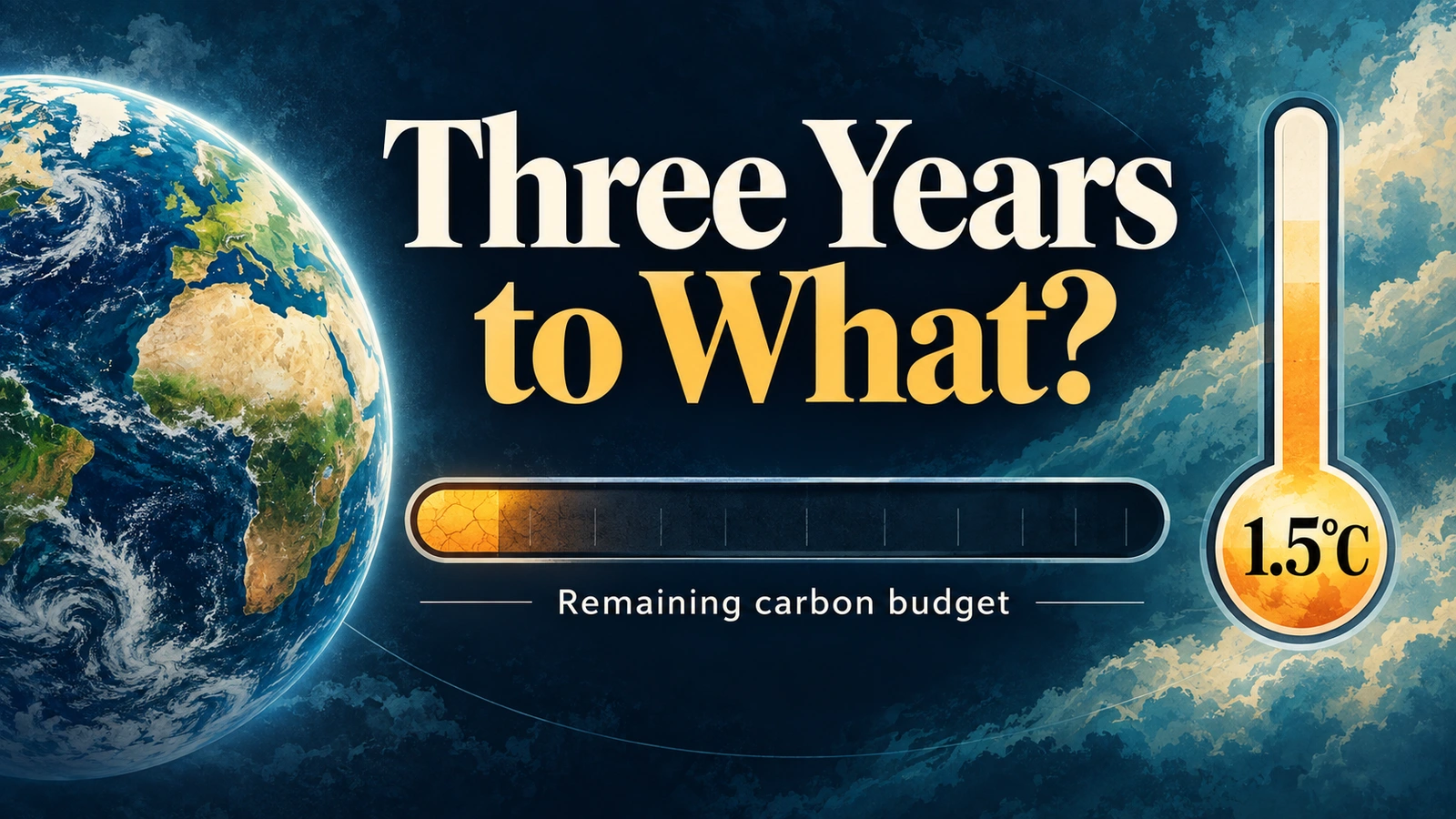
A major 2026 update using methods assessed in the IPCC’s Sixth Assessment Report estimated that, from the start of 2026, the world had about 130 billion metric tons of CO₂ left in the remaining carbon budget for a 50% chance of limiting warming to 1.5°C. At 2025 emissions levels, that estimate would be used up in a little more than three years. But the researchers explicitly warned that this does not mean the planet will hit exactly 1.5°C three years later. (Indicators of Global Climate Change 2025)
The same study estimated human-caused warming at about 1.37°C in 2025 and said the recent warming rate would put long-term human-induced warming near 1.5°C around 2030 if current trends continue. Meanwhile, the UN Environment Programme says an exceedance of 1.5°C is now widely assessed as unavoidable under current policies and near-term trajectories, with the threshold likely to be crossed within the next few years. (Indicators of Global Climate Change 2025 · UNEP Limiting Overshoot)
So the useful question is not “Does the world end in three years?”
It is: What exactly is running out, what does 1.5°C measure, and why does every fraction of a degree after that still matter?
What Does “Three Years Left” Actually Mean?

It refers to a carbon budget.
Scientists have found that long-term warming is closely related to the total amount of carbon dioxide humanity releases. That makes it possible to estimate how much more CO₂ can be emitted before a given temperature target becomes increasingly difficult to stay below.
The 2026 Indicators of Global Climate Change update put the remaining budget for 1.5°C at 130 GtCO₂ from the beginning of 2026 for a 50% probability of limiting warming to that level. Global CO₂ emissions in 2025 were about 42 GtCO₂ a year on the accounting basis used in that calculation. Divide the remaining budget by the current annual flow, and the result is a little more than three years. (Indicators of Global Climate Change 2025)
That 130 GtCO₂ figure is not the only current estimate. The separate Global Carbon Budget 2025 update estimated about 170 GtCO₂ from the start of 2026 for the same 50% likelihood, equivalent to roughly four years at 2025 emissions. The studies use different update methods and explicitly emphasize substantial uncertainty near the 1.5°C limit. The useful takeaway is therefore not that one exact number is certain, but that multiple current estimates put the remaining 1.5°C budget at only a few years of emissions at today’s rate. (Global Carbon Budget 2025)
But there are two qualifications that matter.
First, 50% probability is not a guarantee. Carbon budgets depend on uncertainties in the climate response, non-CO₂ greenhouse gases, future methane reductions, Earth-system feedbacks and the way warming is measured.
Second, the 130 GtCO₂ figure is not a universal rule saying “every 130 GtCO₂ raises temperature by 0.1°C.” A separate 2026 Global Carbon Budget update estimated that roughly 180 GtCO₂ of additional cumulative emissions corresponds to about 0.1°C of warming. The two numbers answer different questions. (Global Carbon Budget 2025)
| Number | What it actually means |
|---|---|
| 130 GtCO₂ | Indicators of Global Climate Change 2025 estimate from the start of 2026 for a 50% chance of limiting warming to 1.5°C |
| 170 GtCO₂ | Global Carbon Budget 2025 estimate from the start of 2026 for the same 50% likelihood |
| ~42 GtCO₂ per year | Approximate 2025 annual CO₂ emissions used in the 130 GtCO₂ estimate |
| ~3–4 years | Approximate time those two budget estimates represent at 2025 emissions levels |
| ~180 GtCO₂ per 0.1°C | Approximate cumulative-emissions relationship reported in the 2026 Global Carbon Budget |
That is why “three years left” is best understood as a warning about the speed at which the remaining room for emissions is disappearing—not a stopwatch counting down to one specific day.
Didn’t the World Already Cross 1.5°C in 2024?
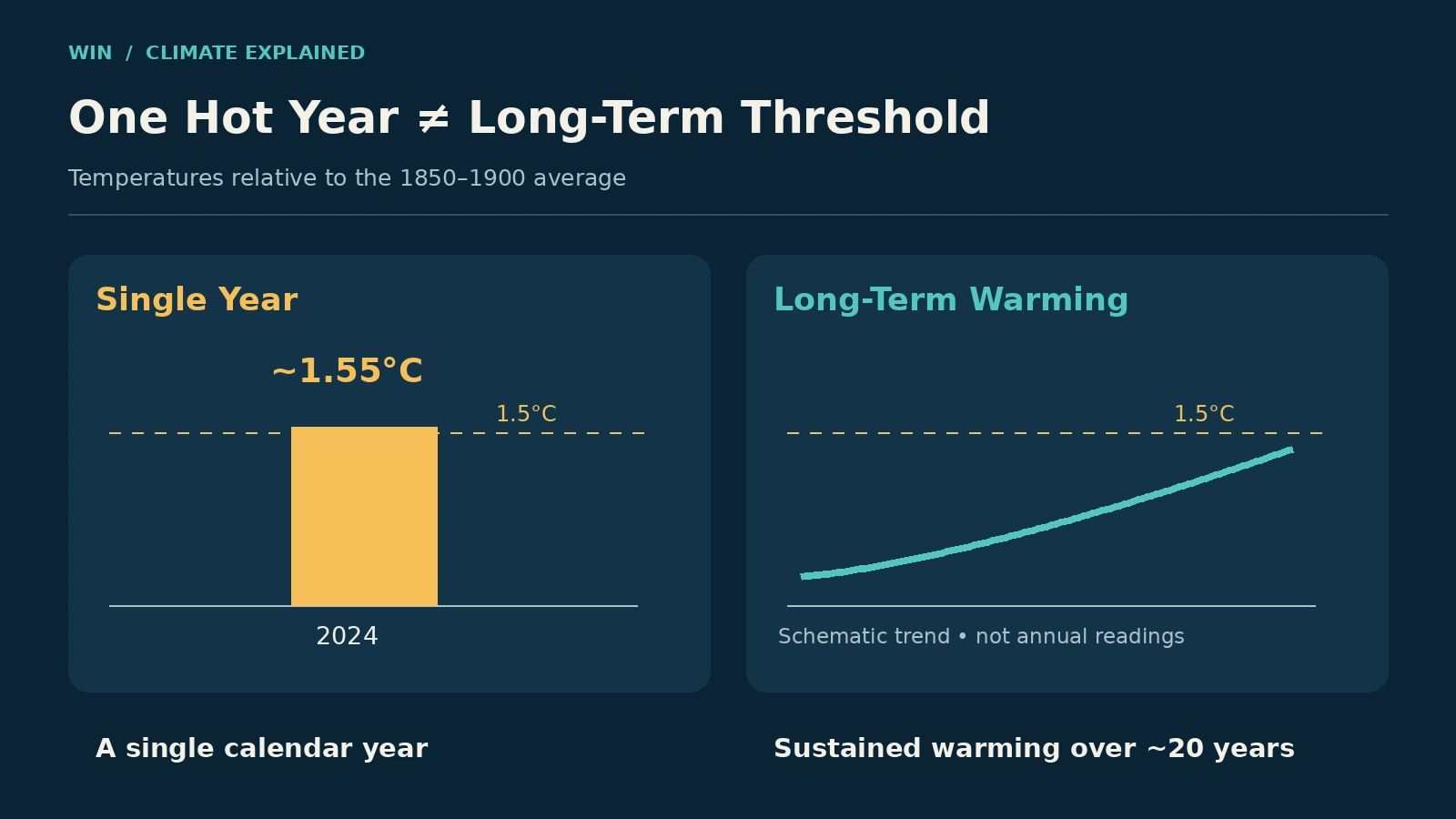
Yes—but only in the annual-average sense.
The World Meteorological Organization calculated that 2024 was about 1.55°C above the 1850–1900 average, making it the first calendar year likely to exceed 1.5°C. WMO’s State of the Global Climate 2025 report put 2025 at about 1.43°C above the same baseline, still among the warmest years on record. (WMO 2024 temperature assessment · State of the Global Climate 2025)
That does not mean the Paris Agreement’s long-term temperature threshold was permanently crossed in 2024.
Climate scientists distinguish between the temperature of an individual year and the longer-term warming level. Weather patterns such as El Niño and La Niña can push a particular year above or below the underlying trend. The Paris temperature goal is about sustained warming over a longer period, commonly assessed over roughly 20 years rather than one unusually hot calendar year. (WMO Global Annual to Decadal Climate Update 2026–2035)
That distinction is becoming harder to ignore because temporary exceedances are becoming more common.
WMO now estimates a 91% chance that at least one year from 2026 through 2030 will temporarily exceed 1.5°C above the 1850–1900 average. It also expects annual temperatures over that period to fall somewhere between about 1.3°C and 1.9°C above the preindustrial baseline. (WMO Global Annual to Decadal Climate Update 2026–2035)
So the world is not waiting for its first hot year above 1.5°C.
It is moving toward a climate in which 1.5°C becomes the underlying long-term condition rather than a temporary annual spike.
Is 1.5°C a Climate Cliff?
No. There is no scientific switch that flips at exactly 1.5°C.
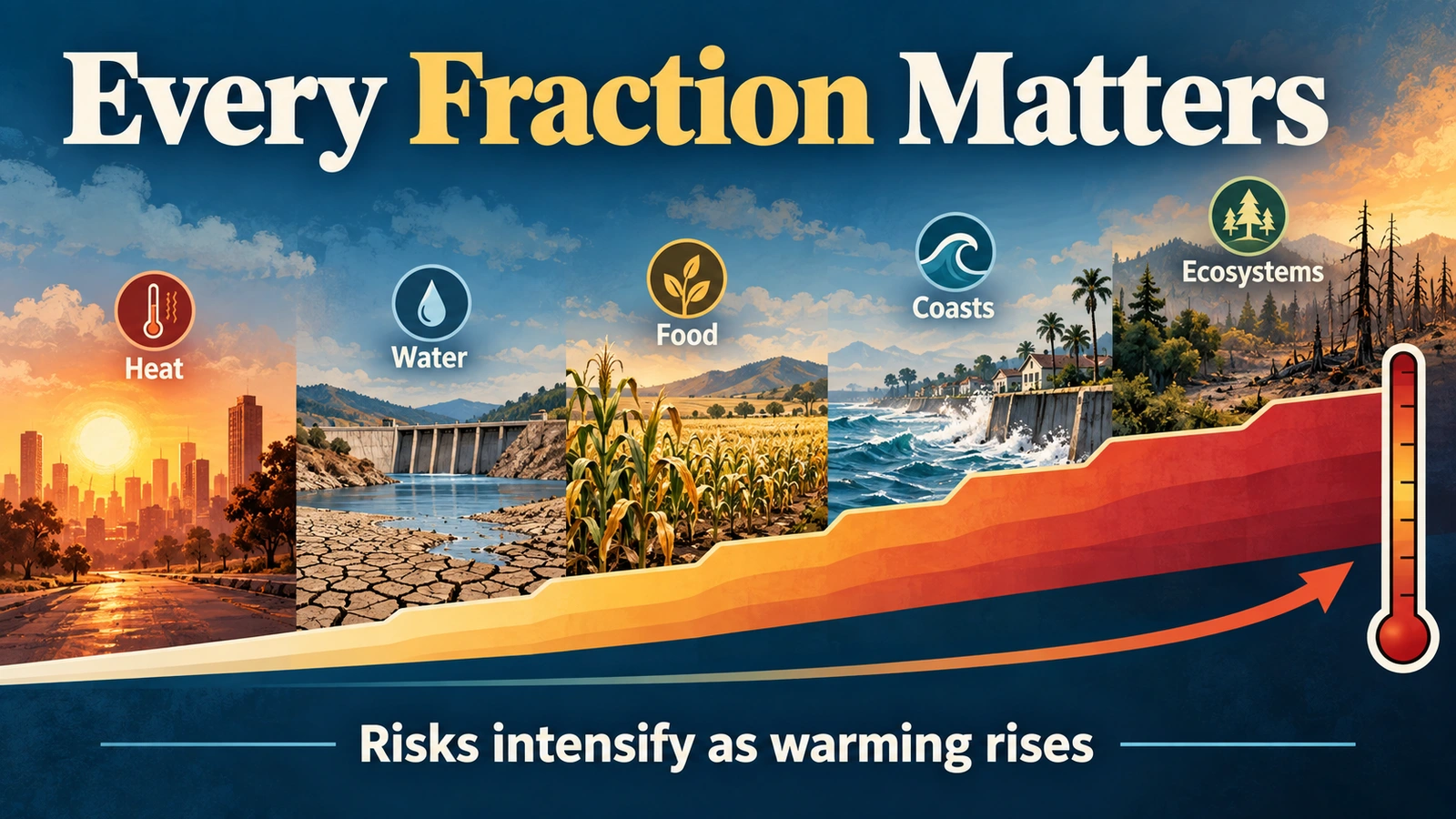
The importance of 1.5°C is that risks become progressively worse as warming rises, and some risks grow sharply enough that every additional fraction of a degree matters.
The IPCC has found that climate-related risks to health, livelihoods, food security, water supplies and economic growth increase at 1.5°C and rise further at 2°C. It also found that crop-yield losses, heat-related illness and water stress are generally lower at 1.5°C than at 2°C. (IPCC Special Report on Global Warming of 1.5°C)
UNEP’s September 2026 Limiting Overshoot report goes one step further: it says exceeding 1.5°C is now widely assessed as unavoidable under current trajectories, and that higher peak warming and longer time spent above the threshold increase the danger. The report highlights intensified extreme weather, ecosystem loss, glacier and ice-sheet risks, sea-level rise, food and water insecurity, and greater strain on cities and infrastructure. (UNEP Limiting Overshoot · UNEP press release)
That makes 1.5°C less like the edge of a cliff and more like a risk marker on a road that keeps getting more dangerous.
Crossing it is serious.
A world at 1.6°C of warming generally carries less climate risk than one at 1.7°C, and 1.7°C generally carries less risk than 1.8°C. The length of time the world stays above the threshold matters too.
That is why scientists continue to say “every fraction of a degree matters” even as the chance of overshooting 1.5°C rises.
What Do the Coral-Reef and Arctic-Ice Numbers Actually Show?
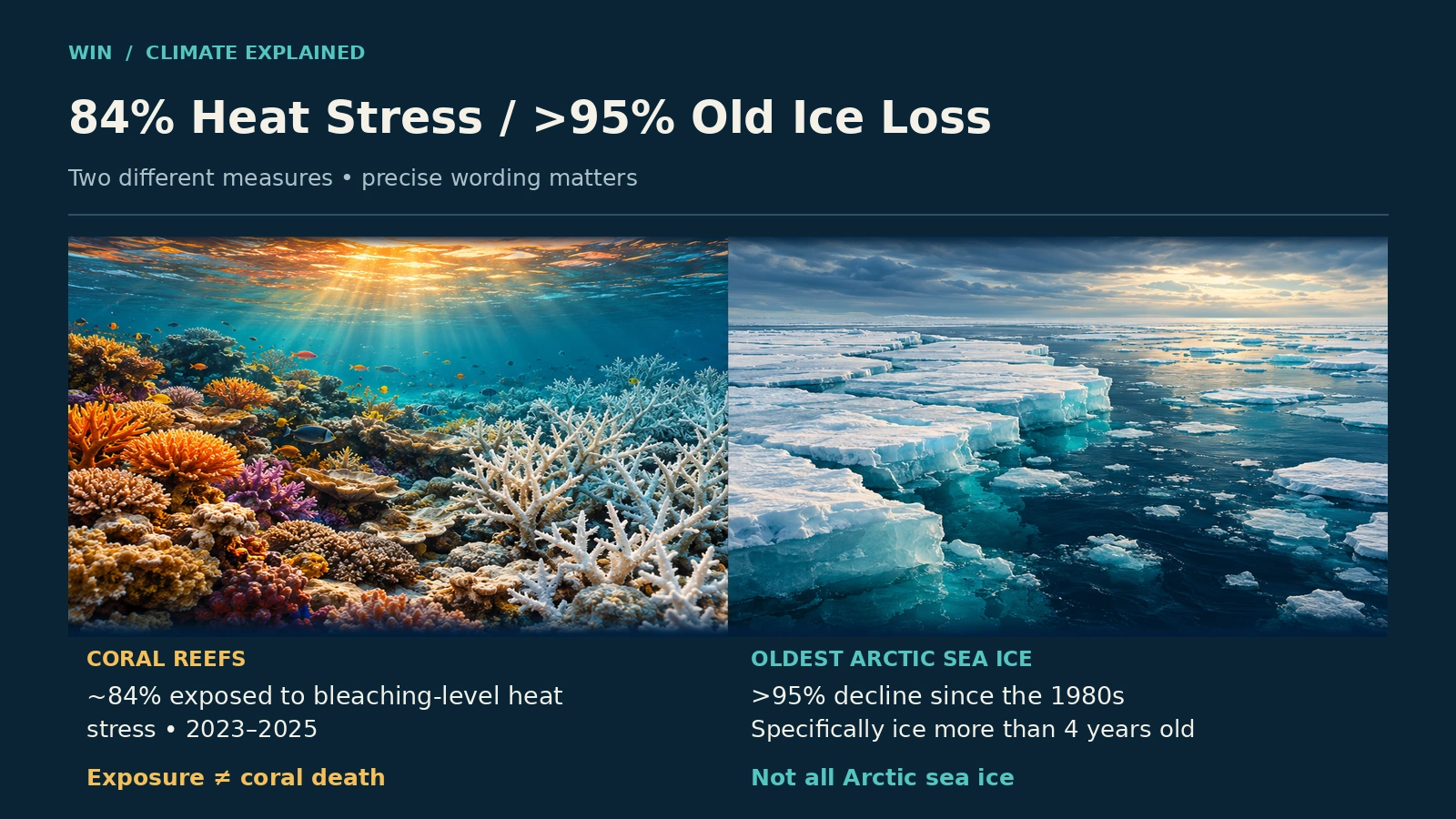
Two dramatic climate numbers are often repeated together, but they do not mean the same thing.
NOAA reports that from January 2023 through September 2025, about 84.4% of the world’s coral-reef area experienced bleaching-level heat stress during the fourth global coral bleaching event. That was the largest such event on record. (NOAA Coral Reef Watch)
But “84% exposed to bleaching-level heat stress” does not mean “84% of all coral reefs died.”
Coral bleaching occurs when heat stress causes corals to expel the algae that help sustain them. Bleached coral is under severe stress and can die if the stress persists, but bleaching itself is not automatically death. (NOAA explanation of coral bleaching)
The Arctic statistic is different—and the wording matters there too.
NOAA’s 2025 Arctic Report Card says the oldest and thickest Arctic sea ice, more than four years old, has declined by more than 95% since the 1980s. That does not mean 95% of all Arctic sea ice has vanished. It means the durable, multi-year ice that once formed the Arctic’s thickest core has been largely replaced by younger, thinner ice that is more vulnerable to summer melting. (NOAA Arctic Report Card 2025)
| Claim you may hear | More accurate reading |
|---|---|
| “80% of coral reefs are dead” | About 84% of global reef area experienced bleaching-level heat stress during the 2023–2025 event; bleaching does not automatically mean death |
| “95% of Arctic ice is gone” | More than 95% of the oldest, thickest Arctic sea ice has declined since the 1980s |
| “The planet is already at permanent 1.5°C warming” | One calendar year has exceeded 1.5°C, but the Paris target refers to sustained long-term warming |
| “Three years until climate collapse” | Roughly three years of 2025-level emissions would exhaust one central estimate of the remaining 1.5°C carbon budget |
The corrected versions are still alarming.
They are also much more useful than the exaggerated versions because they tell us what is actually changing.
Can Carbon-Removal Technology Simply Bring the Temperature Back Down?

Not quickly, and not at anything close to today’s scale.
UNEP says carbon dioxide removal will likely be necessary if the world is to move from overshoot → peak → decline and eventually return below 1.5°C. Carbon removal includes approaches such as restoring forests and technologies that capture CO₂ from the air and store it. (UNEP Limiting Overshoot)
But the same report is explicit that carbon removal is not a substitute for cutting emissions now.
Why?
Because putting CO₂ into the atmosphere is still far easier than removing and storing enormous quantities of it for long periods. Large-scale removal also faces constraints involving land, energy, cost, storage permanence, governance and competition with other land uses. (UNEP Limiting Overshoot)
That means a claim such as “new technology can lower global temperature by exactly 0.1°C in 50 years” is too precise to be treated as a general law.
The real message is broader: if the world overshoots 1.5°C, bringing temperatures back down would require deep emissions cuts first, net-negative CO₂ emissions later, and carbon removal operating at a scale far beyond today’s limited deployment.
And even if average temperature later falls, not every impact automatically reverses. Some ecosystem losses, sea-level changes and tipping-point risks can persist for very long periods. (UNEP overshoot explainer)
If Overshoot Is Likely, What Does “Success” Mean Now?

It means the job is no longer just to avoid every temporary exceedance. The practical challenge is to keep peak warming as low as possible, shorten the overshoot and drive temperatures back down.
UNEP’s current framework is overshoot, peak and decline.
The goal is to make the overshoot as small as possible, keep the peak temperature as low as possible, spend as little time above 1.5°C as possible, and then bring temperatures back down while societies adapt to impacts that can no longer be avoided. (UNEP Limiting Overshoot press release)
That requires three things at the same time:
- Rapid emissions cuts — especially CO₂ and methane — to stop adding warming as quickly as possible.
- Adaptation — preparing cities, health systems, farms, water supplies, coastlines and infrastructure for a warmer climate.
- Carefully governed carbon removal — eventually drawing more CO₂ out of the air than is being emitted if temperatures are to decline after an overshoot.
This is why the “three years” warning is not an argument that action is pointless after three years.
It says the opposite.
If the remaining carbon budget is nearly gone, then the difference between a small overshoot and a much larger one increasingly depends on what happens after that budget is exhausted.
Bottom Line: What This Story Really Means
The world does not have a scientifically defined “three years until collapse.”
What it has is a rapidly shrinking carbon budget.
A leading 2026 climate-indicator update estimates that about 130 GtCO₂ remained at the start of 2026 for a 50% chance of limiting warming to 1.5°C, while the separate Global Carbon Budget 2025 update puts the comparable figure at about 170 GtCO₂. At roughly 2025 emissions, those estimates represent only about three to four years of emissions. Neither is an exact timer for the date when long-term warming reaches 1.5°C.
The threshold itself is not a cliff where the climate suddenly fails. It is a marker on a rising risk curve.
The more temperatures rise, and the longer they remain elevated, the greater the pressure on heat exposure, food, water, ecosystems, coastlines and infrastructure.
And if 1.5°C is overshot, the next question is not whether the target should be abandoned.
It is how high the world allows warming to peak, how long the overshoot lasts, and how quickly emissions, adaptation and carbon removal can push the trajectory back down.
1.5°C Warming: Key Questions Explained
Q. Does the world really have only three years before climate collapse?
No. The “three years” figure refers to how long one estimate of the remaining 1.5°C carbon budget would last if global CO₂ emissions stayed near 2025 levels. It is not a scientific countdown to a single collapse date.
Q. What is the remaining carbon budget for 1.5°C?
Current estimates differ. The 2026 Indicators of Global Climate Change update estimated about 130 GtCO₂ from the start of 2026 for a 50% chance of limiting warming to 1.5°C, while Global Carbon Budget 2025 estimated about 170 GtCO₂ for the same likelihood. Both imply only a few years of emissions at roughly 2025 levels.
Q. Why is the 130 GtCO₂ figure only a 50% chance?
Because the climate response is not perfectly certain. Future non-CO₂ emissions, methane reductions, Earth-system feedbacks and other factors affect how much warming follows a given amount of CO₂.
Q. Didn’t Earth already exceed 1.5°C in 2024?
Yes, for a single calendar year. WMO estimated 2024 at about 1.55°C above the 1850–1900 average, but the Paris Agreement temperature goal refers to sustained long-term warming rather than one unusually warm year.
Q. When could long-term human-caused warming reach 1.5°C?
The 2026 climate-indicator update estimated human-caused warming at about 1.37°C in 2025 and said the recent warming rate would put it near 1.5°C around 2030 if the trend continues.
Q. Does crossing 1.5°C trigger an instant global tipping point?
No. Risks increase with every increment of warming, and some tipping-point risks become more likely as temperatures rise and remain elevated. There is no single instant at exactly 1.5°C when all systems suddenly fail.
Q. Are more than 80% of the world’s coral reefs already dead?
No. NOAA found that about 84.4% of global coral-reef area experienced bleaching-level heat stress during the 2023–2025 global bleaching event. Bleaching can lead to mortality, but bleaching and death are not the same thing.
Q. Has 95% of Arctic sea ice disappeared?
Not all Arctic sea ice. NOAA reports that the oldest and thickest Arctic sea ice—more than four years old—has declined by more than 95% since the 1980s.
Q. Can carbon-removal technology solve an overshoot by itself?
No. UNEP treats carbon dioxide removal as part of a return-from-overshoot strategy, but only alongside rapid emissions cuts and adaptation. Removal at the scale needed for significant cooling would be a major long-term undertaking.
Q. What should people watch next?
Watch whether global CO₂ emissions begin a sustained decline, how quickly methane emissions fall, how governments prepare for adaptation, and whether the world can keep the eventual temperature peak as low and short as possible.
Did this help make the story clearer? 🙂
WIN keeps unpacking the “why” behind the news—clearly and simply!
Sources
Current Warming and the Remaining Carbon Budget
Indicators of Global Climate Change 2025
WMO State of the Global Climate 2025
WMO Global Annual to Decadal Climate Update 2026–2035
Overshoot, Climate Risks and What Happens Next
IPCC — Global Warming of 1.5°C, Summary for Policymakers