Micron’s Revenue More Than Quadrupled. Why Is AI Suddenly So Hungry for Memory?

AI hardware stories usually begin with Nvidia and GPUs.
So why did a company known for memory chips just report one of the most dramatic quarters in the technology industry?
On September 30, Micron reported fiscal fourth-quarter revenue of $54.23 billion, up from $11.32 billion a year earlier. GAAP net income climbed to $37.70 billion, and Micron projected about $61.5 billion in revenue for the following quarter. (Micron · Reuters)
There is an even more revealing number. Reuters reported that customer commitments tied to Micron’s long-term supply agreements had risen to $32 billion, up from $22 billion in June.
Why would technology companies commit that much money just to make sure they can get memory?
Because the AI boom is exposing a limitation that is easy to miss when all the attention goes to processors.
A GPU can calculate only as fast as data can be delivered to it.
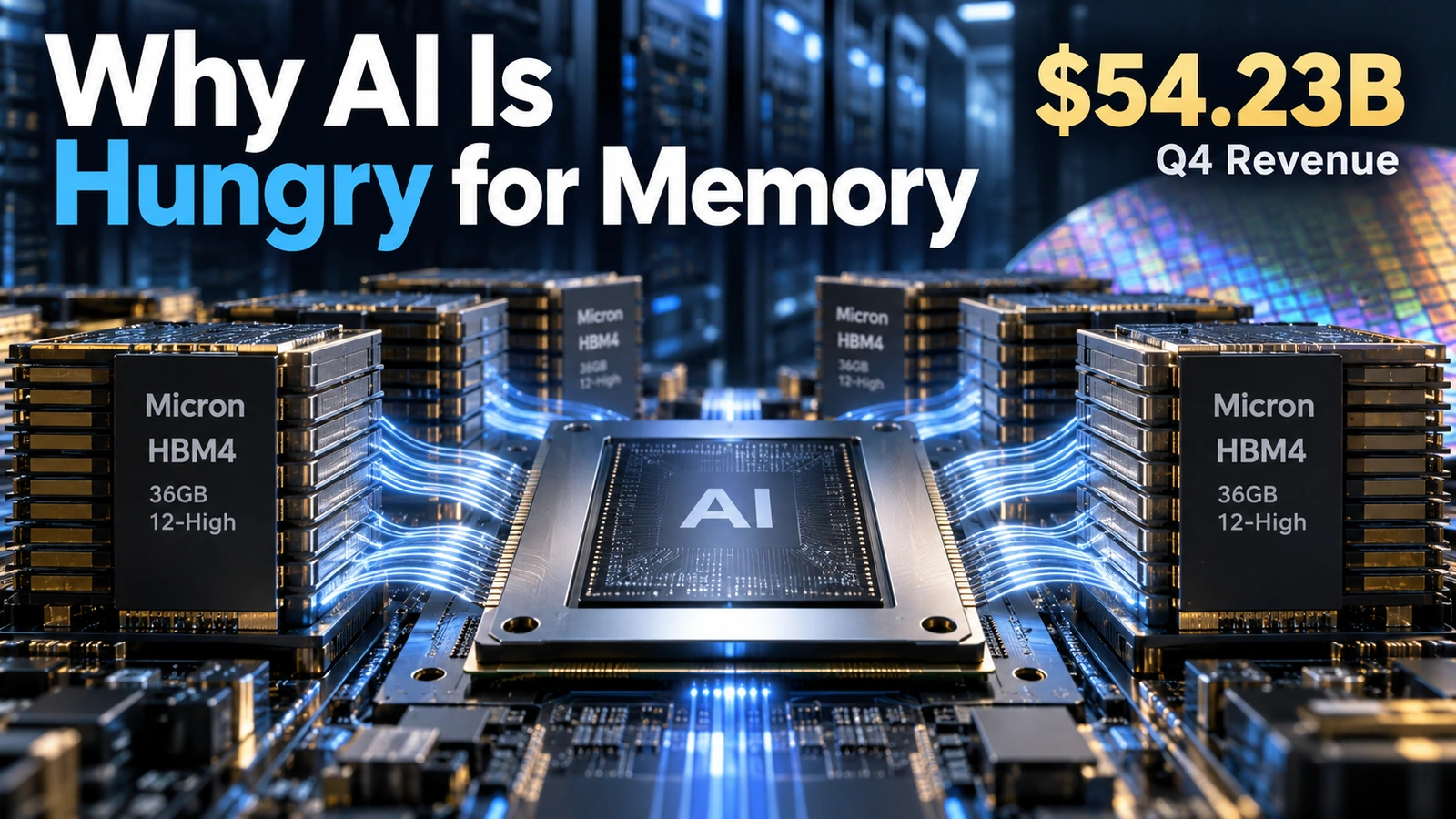
※ Images in this article are AI-generated illustrations created to help explain the story. They are not actual photographs, and depictions of people, places, or events may differ slightly from reality.
That is where high-bandwidth memory, or HBM, enters the story.
And it helps explain why the AI infrastructure race is no longer only about making faster processors.
Why Did Micron’s Numbers Jump So Fast?
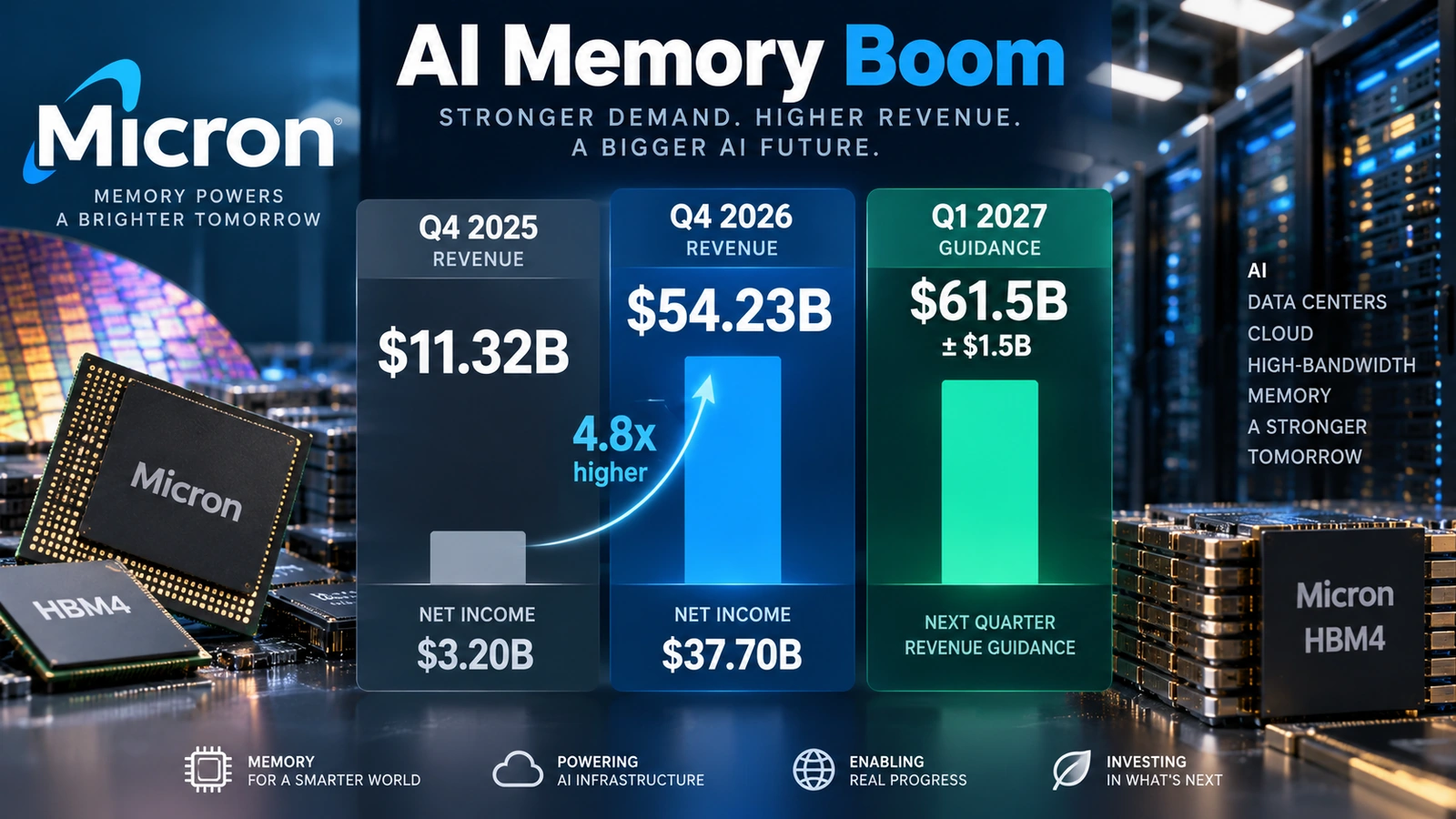
Micron is benefiting from two forces at the same time: AI systems are consuming far more high-performance memory, and memory supply has not expanded nearly as quickly as demand.
The change is visible in the numbers.
| Metric | Fiscal Q4 2026 | Fiscal Q4 2025 |
|---|---|---|
| Revenue | $54.23 billion | $11.32 billion |
| GAAP net income | $37.70 billion | $3.20 billion |
| GAAP gross margin | 86.8% | 44.7% |
Micron’s Core Data Center Business Unit alone generated about $18.0 billion in quarterly revenue, compared with about $1.58 billion a year earlier. (Micron)
That does not mean every extra dollar came from HBM.
Micron also sells conventional DRAM, NAND flash, server memory modules and storage products. AI data centers are increasing demand across several of those categories.
But HBM illustrates the change better than almost anything else.
Memory used to be treated as the supporting cast in many discussions about computing performance.
AI has pushed it much closer to center stage.
What Is HBM—and Why Can’t a Fast GPU Just Use Ordinary Memory?
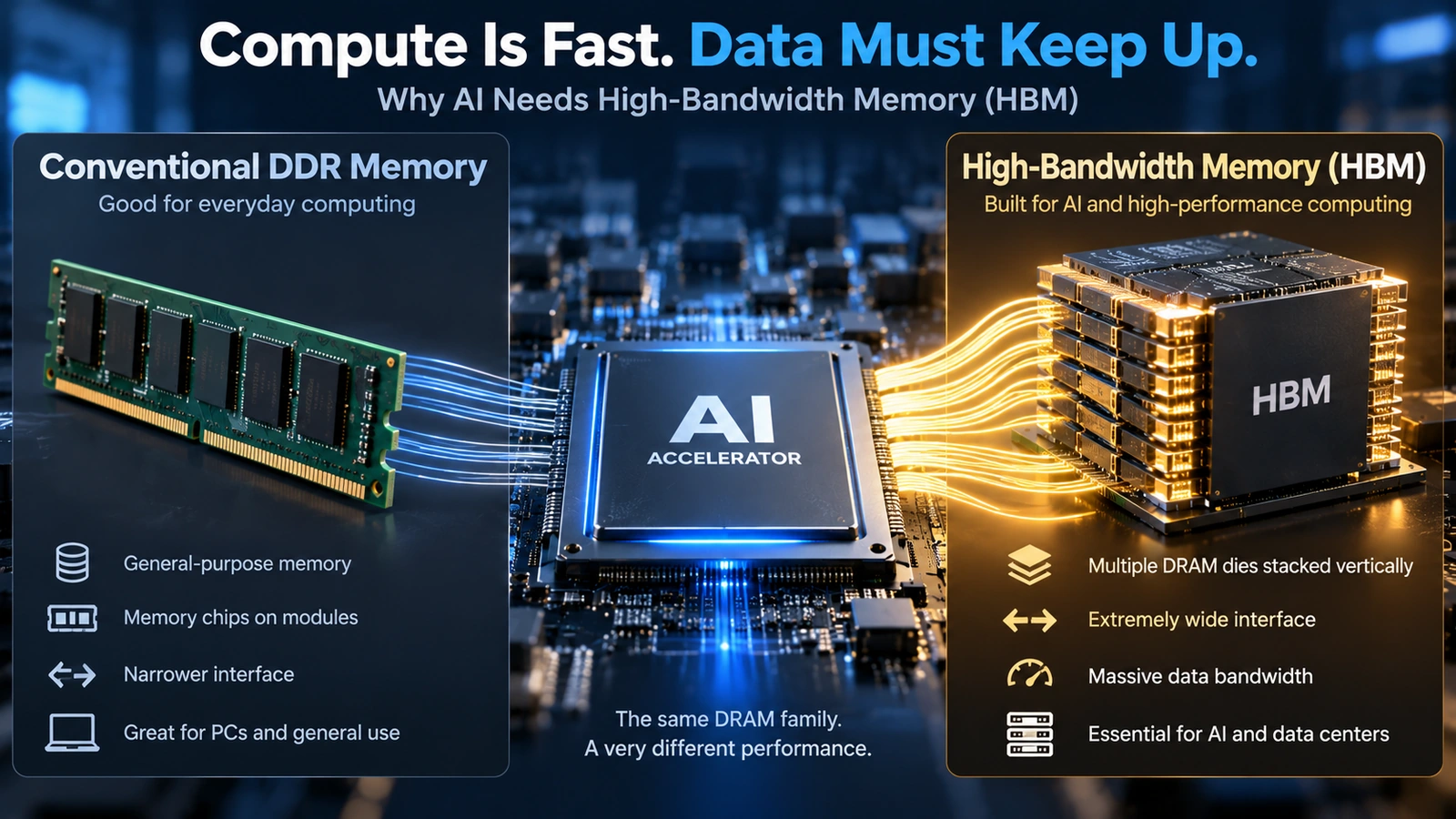
HBM is still DRAM—the same broad family of volatile memory used throughout modern computing—but it is arranged very differently.
Instead of putting memory chips mainly on conventional modules farther away on the motherboard, HBM stacks multiple memory dies vertically and connects them to an accelerator through an extremely wide interface.
That allows enormous amounts of data to move between memory and the processor every second.
Micron says its 36GB 12-high HBM4 can deliver more than 2.8 terabytes per second of bandwidth per stack, more than twice the bandwidth of its comparable previous-generation HBM3E design. (Micron HBM4 · Micron)
A simple way to picture the difference is a warehouse.
The GPU is a giant factory capable of processing enormous amounts of material.
Ordinary memory may offer plenty of storage space, but if the loading dock has only a few lanes, the factory can end up waiting.
HBM adds many more lanes and places the loading dock much closer to the machinery.
| Conventional DDR memory | HBM |
|---|---|
| General-purpose system memory | Optimized for enormous bandwidth near accelerators |
| Memory chips commonly mounted on modules | Multiple DRAM dies stacked vertically |
| Narrower connection to processors | Extremely wide memory interface |
| Excellent for large parts of ordinary computing | Especially valuable for AI and high-performance computing |
S&P Global has described memory bandwidth and capacity as increasingly important constraints as AI accelerator clusters grow. The problem is no longer simply whether enough arithmetic units exist. The system also has to keep those units supplied with data. (S&P Global)
That is why a faster GPU does not automatically solve the whole problem.
If data movement cannot keep up, some of that expensive computing capacity can spend time waiting.
Why Is HBM So Difficult to Produce More of?
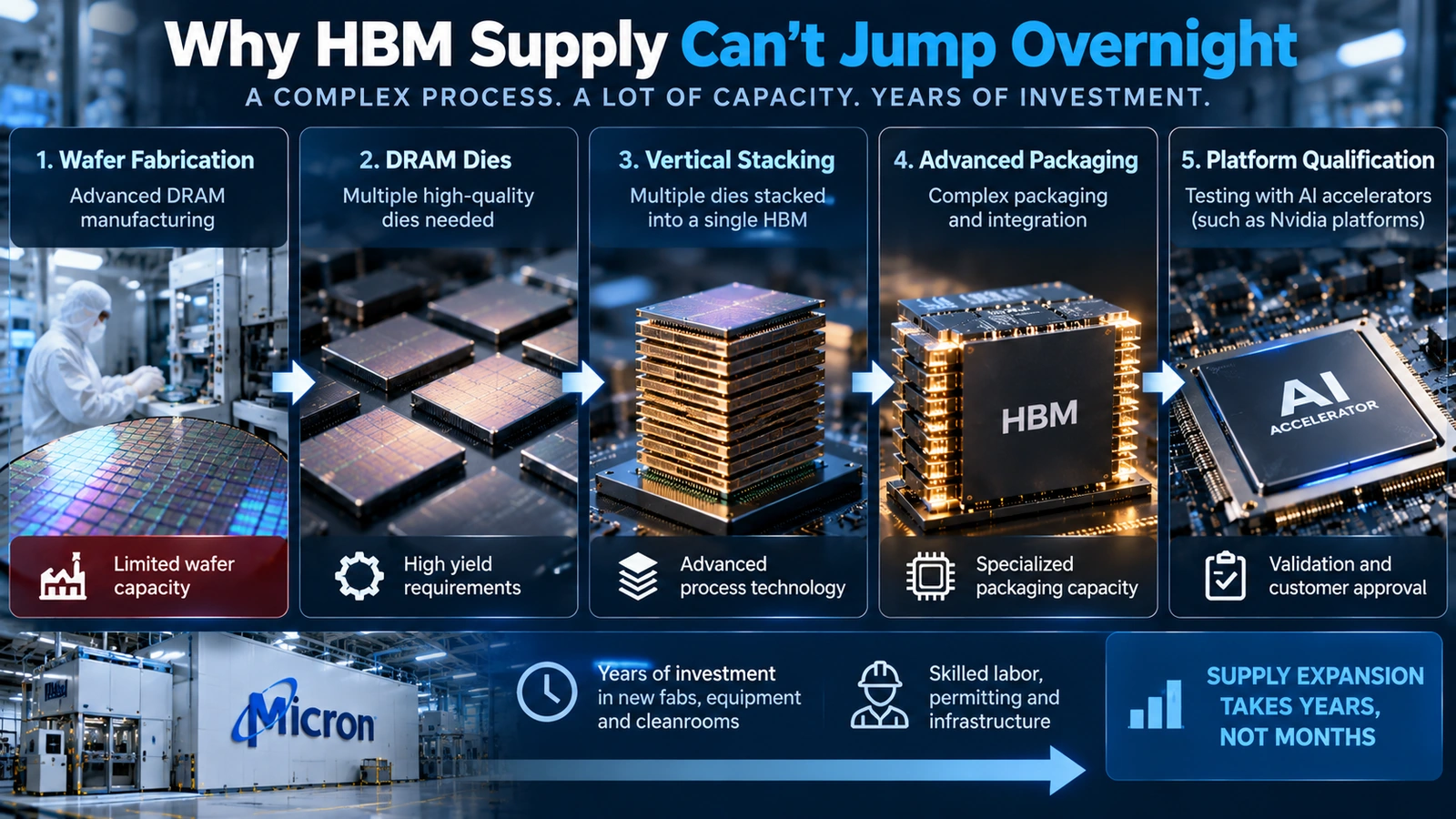
Because HBM is not simply ordinary memory placed in a different box.
It requires advanced DRAM manufacturing, multiple good memory dies, vertical stacking, sophisticated packaging and qualification with the accelerator platforms that will use it.
And there is another important constraint: HBM consumes much more manufacturing capacity for the same amount of memory.
S&P Global reported, citing Micron management, that HBM required more than three times the wafer capacity per bit of conventional DRAM, with the ratio increasing across newer generations. (S&P Global)
That changes the economics of a memory factory.
If a manufacturer shifts more wafers and cleanroom capacity toward HBM, it cannot necessarily produce the same quantity of conventional memory from those resources.
Micron has also said that expanding supply requires major new fabrication plants, cleanroom space, specialized equipment, advanced packaging capacity, skilled labor, permitting and additional energy infrastructure. Those projects take years rather than months. (Micron)
This is the unusual part of the AI memory story.
Demand can jump after a new AI platform is announced. Semiconductor manufacturing capacity cannot.
Why Are Customers Reserving Memory Years in Advance?
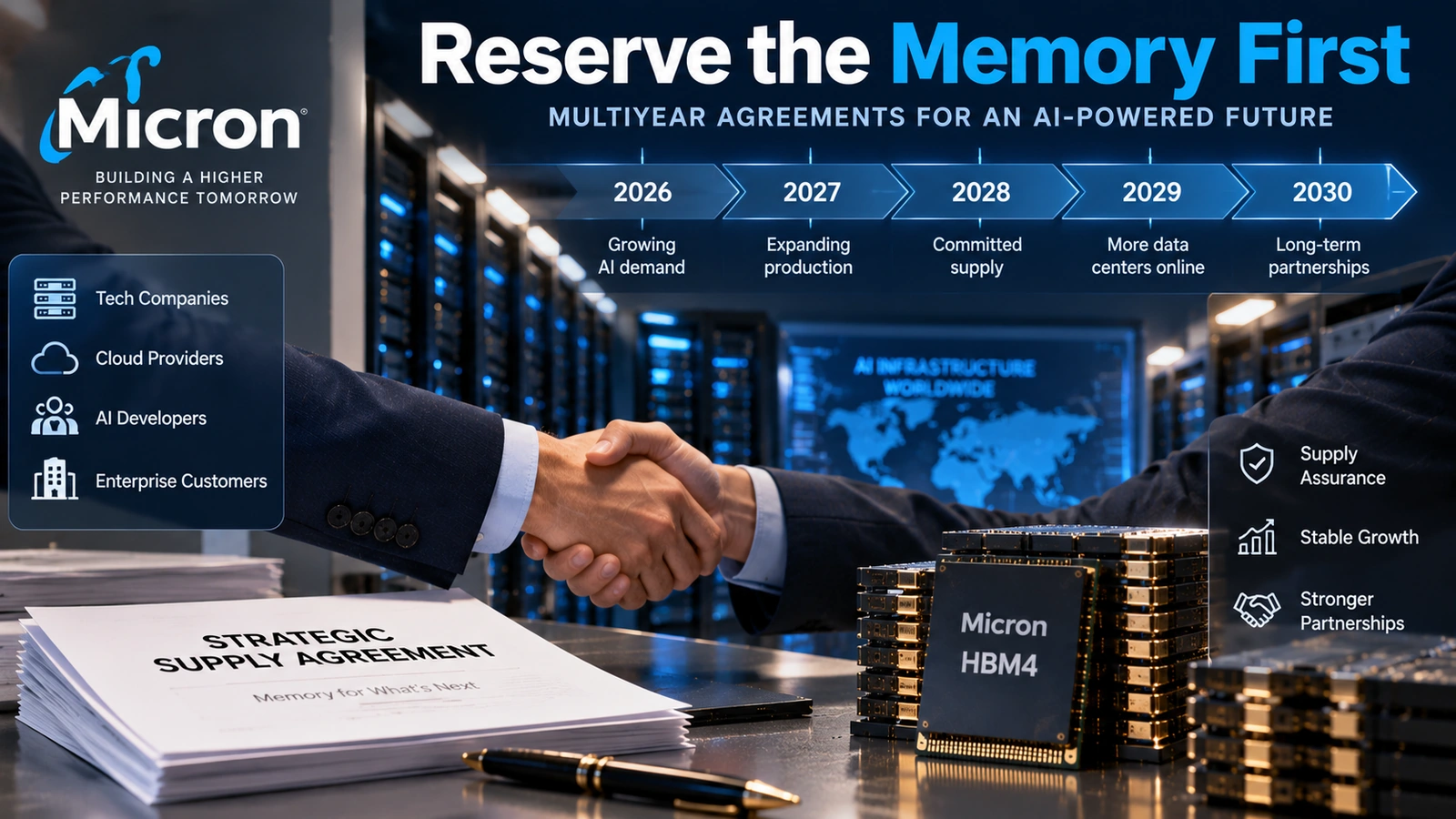
Because for a company building a multibillion-dollar AI data center, an unavailable memory component can make other expensive hardware far less useful.
Micron has been responding with what it calls Strategic Customer Agreements.
In June, the company said it had signed 16 such agreements across data-center, consumer and automotive customers. Many were structured as multiyear, take-or-pay arrangements running through 2030, covering committed volumes of DRAM—including HBM where appropriate—and NAND. (Micron)
At that point, Micron projected $22 billion in cash deposits and related financial commitments from the agreements.
By September 30, Reuters reported that the figure had climbed to $32 billion. (Reuters)
That is a major shift from the way many people think about memory chips.
Historically, memory has been famous for its commodity-like cycles: too little supply pushes prices sharply higher, manufacturers expand, too much supply eventually appears, and prices fall again.
Long-term contracts attempt to reduce some of that uncertainty.
For buyers, the attraction is supply assurance.
For Micron, the attraction is more visibility into future demand.
And when customers are willing to commit money years before they need every chip, it suggests that access to memory itself has become strategically important.
Does More HBM Mean Less Ordinary DRAM?
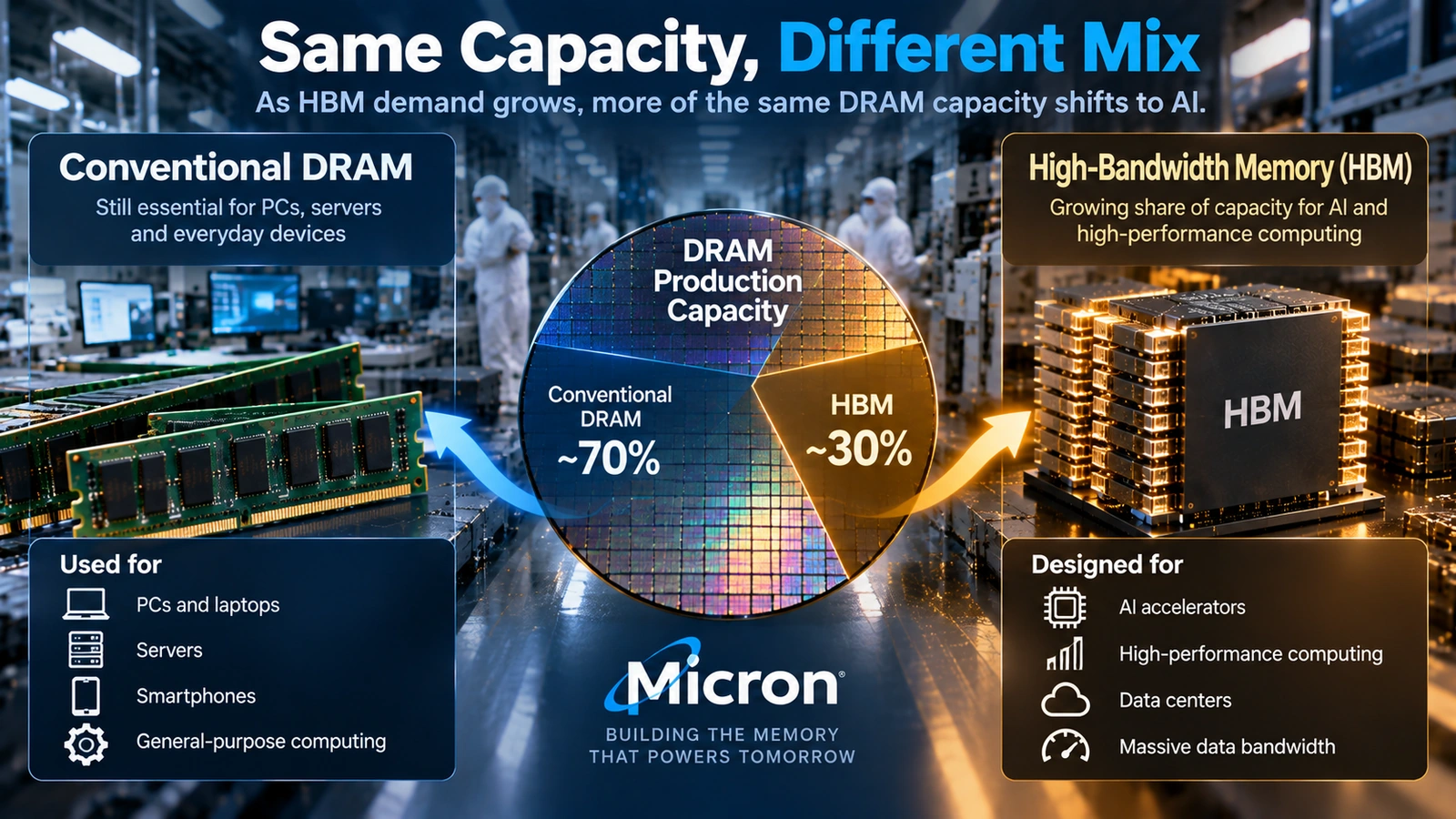
Potentially, yes—and this is one reason the AI boom can affect parts of the technology market that do not look like AI at first.
HBM and conventional DRAM rely on overlapping manufacturing capacity.
Samsung Electronics said on September 29 that HBM could account for nearly 30% of industry DRAM wafer capacity next year, up from roughly 20%, according to Reuters. The company specifically noted that increasing HBM production can constrain standard DRAM because they share wafer capacity. (Reuters)
S&P Global has described the same broader shift: memory producers are reallocating capacity toward high-bandwidth memory while demand remains strong for conventional memory used in servers, PCs and other electronics. (S&P Global)
That does not mean AI automatically makes your next laptop or smartphone more expensive.
Retail device prices depend on many other factors, including contracts, inventories, competition, device demand and how much of a component-cost increase manufacturers absorb.
But it does mean that the AI boom can tighten the same industrial base that supplies ordinary computing.
That is how an AI data-center bottleneck can eventually become a broader electronics supply issue.
Could This Memory Bottleneck Eventually Reverse?
Yes.
That may sound strange after a year in which memory supply has looked exceptionally tight, but the memory business has a long history of swinging between shortage and oversupply.
The current shortage encourages Micron, Samsung, SK hynix and their suppliers to invest in new fabrication and packaging capacity.
If that capacity arrives at the same time AI infrastructure spending slows, memory efficiency improves sharply, or new architectures reduce the amount of HBM needed for a given workload, today’s shortage could eventually become tomorrow’s excess supply.
S&P Global has warned that this remains a real risk. Its supply-chain analysis notes that memory downturns have historically reappeared as investment catches up with—or passes—demand, and that technologies such as better compression or alternative computing architectures could change future memory requirements. (S&P Global)
For now, however, the immediate signal is still tightness.
Micron CEO Sanjay Mehrotra said the company expects supply-demand conditions to become even tighter in fiscal 2027 and 2028, Reuters reported after the September 30 earnings release. (Reuters)
So the debate is not really about whether memory is tight today.
It is about how long this unusually strong cycle can last before new supply, new technology or weaker demand changes the balance again.
What Should You Watch in 2027 and 2028?
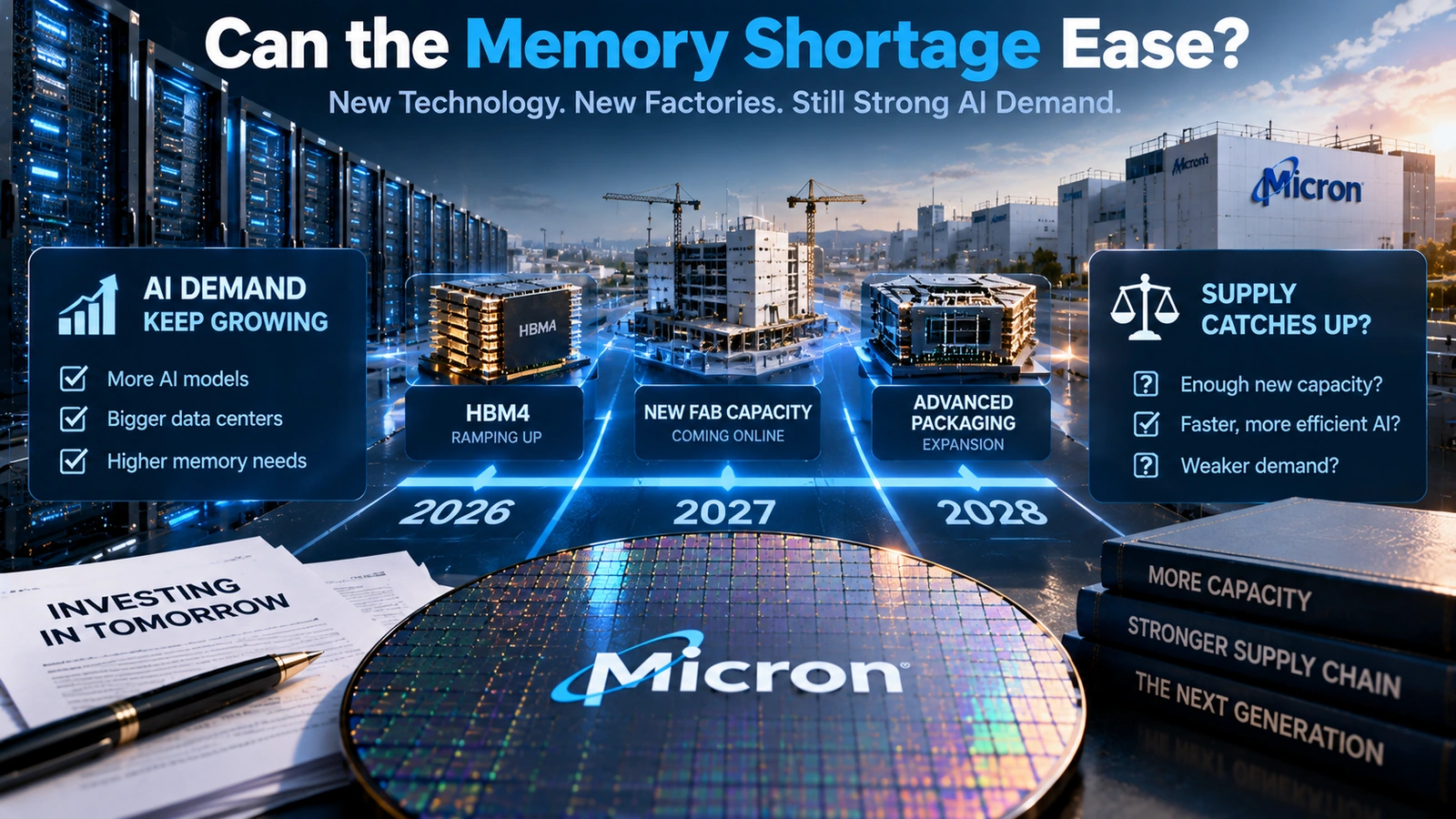
Five signals will tell us whether the shortage is becoming structural or merely another very large memory cycle.
| Signal | Why It Matters |
|---|---|
| HBM4 and HBM4E ramps | New generations increase performance but also add manufacturing complexity |
| Advanced packaging capacity | Finished HBM needs more than DRAM wafers alone |
| New fabrication capacity | More wafers can eventually relieve supply pressure |
| AI data-center spending | Continued accelerator deployment keeps memory demand high |
| Conventional DRAM pricing | Rising prices can reveal how strongly HBM demand is affecting the broader market |
Micron began high-volume shipments of HBM4 designed for Nvidia’s Vera Rubin platform in 2026 and has said development of the next HBM4E generation is underway. (Micron)
The company is also increasing investment in manufacturing as customers seek more supply. Reuters reported after the latest earnings release that Micron plans higher capital spending in fiscal 2027. (Reuters)
The key question is whether those supply additions can arrive faster than AI systems become more memory-hungry.
That race may matter almost as much as the next generation of GPUs.
Bottom Line: What This Story Really Means
Micron’s record results are not simply another story about investors getting excited over anything connected to AI.
They reveal a deeper change in how AI computers are built.
GPUs and other accelerators can perform enormous numbers of calculations, but those processors constantly need model weights, activations, context and other data delivered to them at extremely high speed.
When data cannot move fast enough, compute power alone cannot solve the problem.
HBM addresses that problem by putting very high-bandwidth stacked memory close to the accelerator.
But HBM is difficult to manufacture, consumes substantial wafer and packaging capacity and takes years of investment to expand at scale.
That combination explains why memory companies are reporting extraordinary results, why customers are reserving future supply through multiyear agreements, and why AI demand can tighten conventional memory markets as well.
The AI hardware race is still about computing power.
It is just becoming increasingly clear that the fastest processor in the world is far less useful if its memory cannot keep up.
High-Bandwidth Memory: Key Questions Explained
Q. What is HBM?
HBM stands for high-bandwidth memory. It is a form of DRAM that stacks multiple memory dies vertically and uses an unusually wide connection to move large amounts of data between memory and processors.
Q. Why does AI need HBM?
AI accelerators constantly move enormous amounts of model and working data. HBM provides the bandwidth needed to keep powerful GPUs and other accelerators supplied with that data instead of leaving computing resources waiting.
Q. Is HBM completely different from DRAM?
No. HBM is a specialized form of DRAM. The key differences are its stacked design, very wide interface, advanced packaging and emphasis on extremely high data-transfer bandwidth.
Q. Does Nvidia make the HBM used with its GPUs?
Nvidia designs AI accelerators and computing platforms, while HBM is supplied by specialized memory manufacturers including Micron, SK hynix and Samsung. The memory and accelerator must then be integrated into advanced computing packages and systems.
Q. Why is Micron benefiting so much from the AI boom?
Micron sells HBM along with other DRAM and storage products used throughout AI data centers. Strong demand combined with constrained memory supply has sharply increased both sales and profitability.
Q. Why is HBM harder to manufacture than ordinary DRAM?
HBM requires high-quality DRAM dies, vertical stacking, advanced packaging and extensive qualification. It also uses substantially more wafer capacity per bit than conventional DRAM.
Q. Can making more HBM reduce the supply of ordinary memory?
Yes, to a degree. HBM and conventional DRAM share parts of the same manufacturing base, so allocating more wafer and cleanroom capacity to HBM can limit how quickly standard DRAM supply grows.
Q. Why are customers signing multiyear memory agreements?
Large technology companies want more certainty that memory will be available when future AI systems are deployed. Long-term agreements can reserve supply that might otherwise be difficult to obtain during a shortage.
Q. When will the AI memory shortage end?
There is no confirmed date. New wafer fabrication and advanced packaging capacity is coming, but Micron has said demand may remain extremely tight through 2027 and 2028.
Q. Does the HBM boom guarantee that memory prices will keep rising?
No. Semiconductor memory has historically been cyclical. New capacity, weaker AI spending, more efficient software or new computing architectures could eventually reduce the imbalance.
Did this help make the story clearer? 🙂
WIN keeps unpacking the “why” behind the news—clearly and simply!
Sources
Micron Results and Customer Demand
Micron Technology — Fiscal Fourth-Quarter and Full-Year 2026 Results
Reuters — Micron’s AI-Fueled Revenue Forecast Blows Past Estimates, Backlog Swells
HBM Technology and Manufacturing Constraints
Micron — HBM4 Technical Overview
Micron — HBM4 in High-Volume Production for Nvidia Vera Rubin
Micron — Fiscal Q3 2026 Earnings Call Prepared Remarks
S&P Global — Micron: A Look at Memory Ahead of Earnings
Broader Memory Supply and Capacity
S&P Global — Behind the AI Boom: The Electronics Supply-Side Constraints
Reuters — Samsung Says HBM Could Account for Nearly 30% of Industry DRAM Capacity Next Year
Keep Reading
Why does memory also matter when AI runs locally?
Micron’s HBM story is centered on data centers, but the same basic constraint appears in local AI: models need enough high-speed memory close to the processor. This WIN explainer looks at why unified memory and memory bandwidth matter when AI runs on hardware sitting beside a desk.
Why Would a Company Buy a $20,000 Mac Instead of Paying for AI in the Cloud?