Didn’t the U.S. Leave Iraq in 2011? Why Did American Troops Leave Again in 2026?

Didn’t the United States already leave Iraq?
Yes.
The large U.S. military mission that followed the 2003 invasion ended in December 2011, when the last major troop convoy crossed into Kuwait; a small number of military personnel remained under embassy arrangements.
So why were American troops still leaving an air base in Iraq almost 15 years later?
Because the troops who left on September 30, 2026 belonged to a different U.S. mission—one created after ISIS swept across Iraq in 2014 and the Iraqi government asked for international military help.
U.S. Central Command said the departure of American forces and equipment from Erbil Air Base completed the Operation Inherent Resolve mission inside Iraq. AP and Reuters also reported the U.S. troop withdrawal as complete. (U.S. Central Command · AP · Reuters)
But “the U.S. left Iraq” does not mean Washington has ended its security relationship with Iraq—or stopped fighting ISIS elsewhere in the region.
That is the distinction that makes this withdrawal much easier to understand.
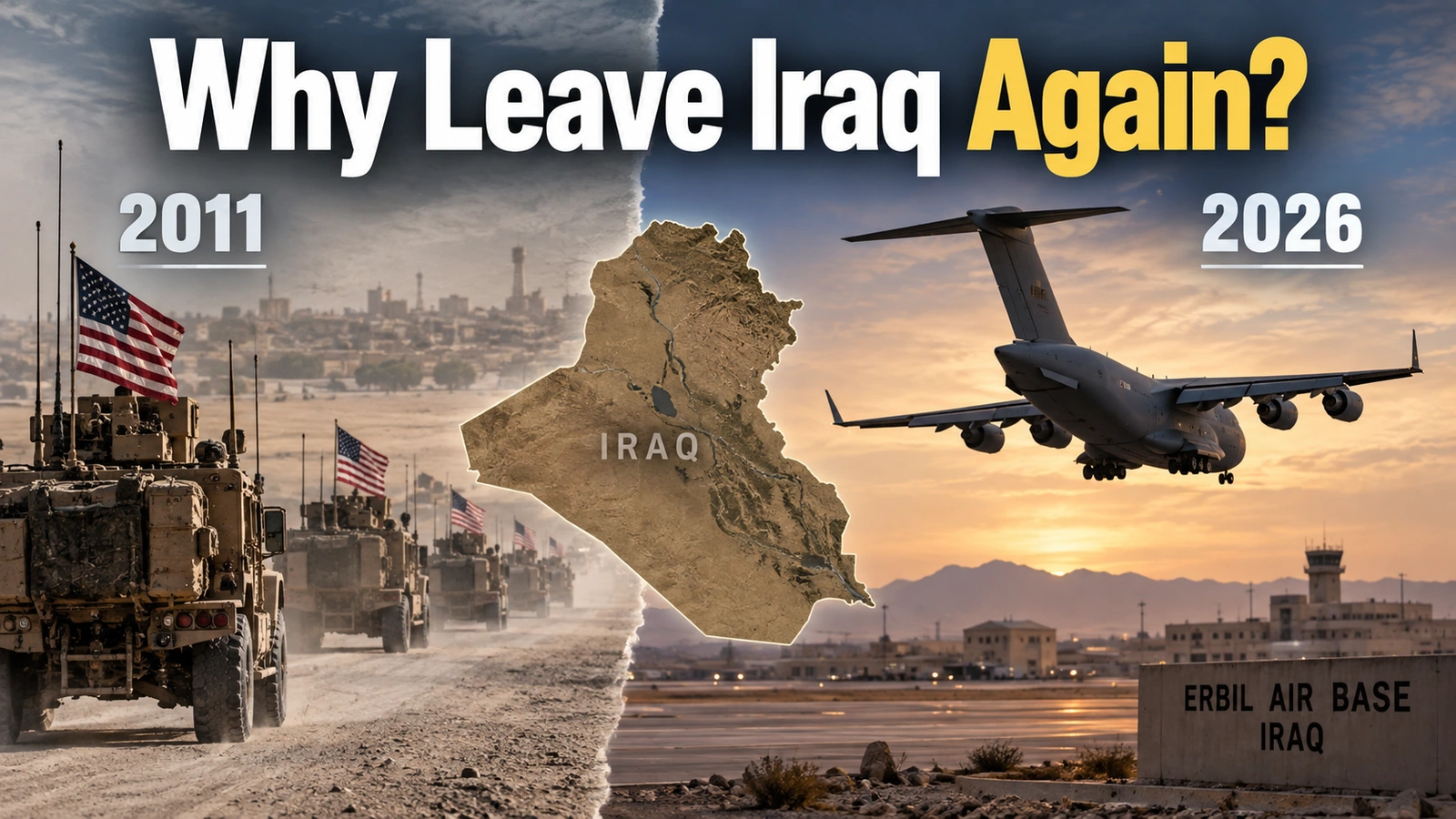
※ Images in this article are AI-generated illustrations created to help explain the story. They are not actual photographs, and depictions of people, places, or events may differ slightly from reality.
What Actually Ended on September 30?
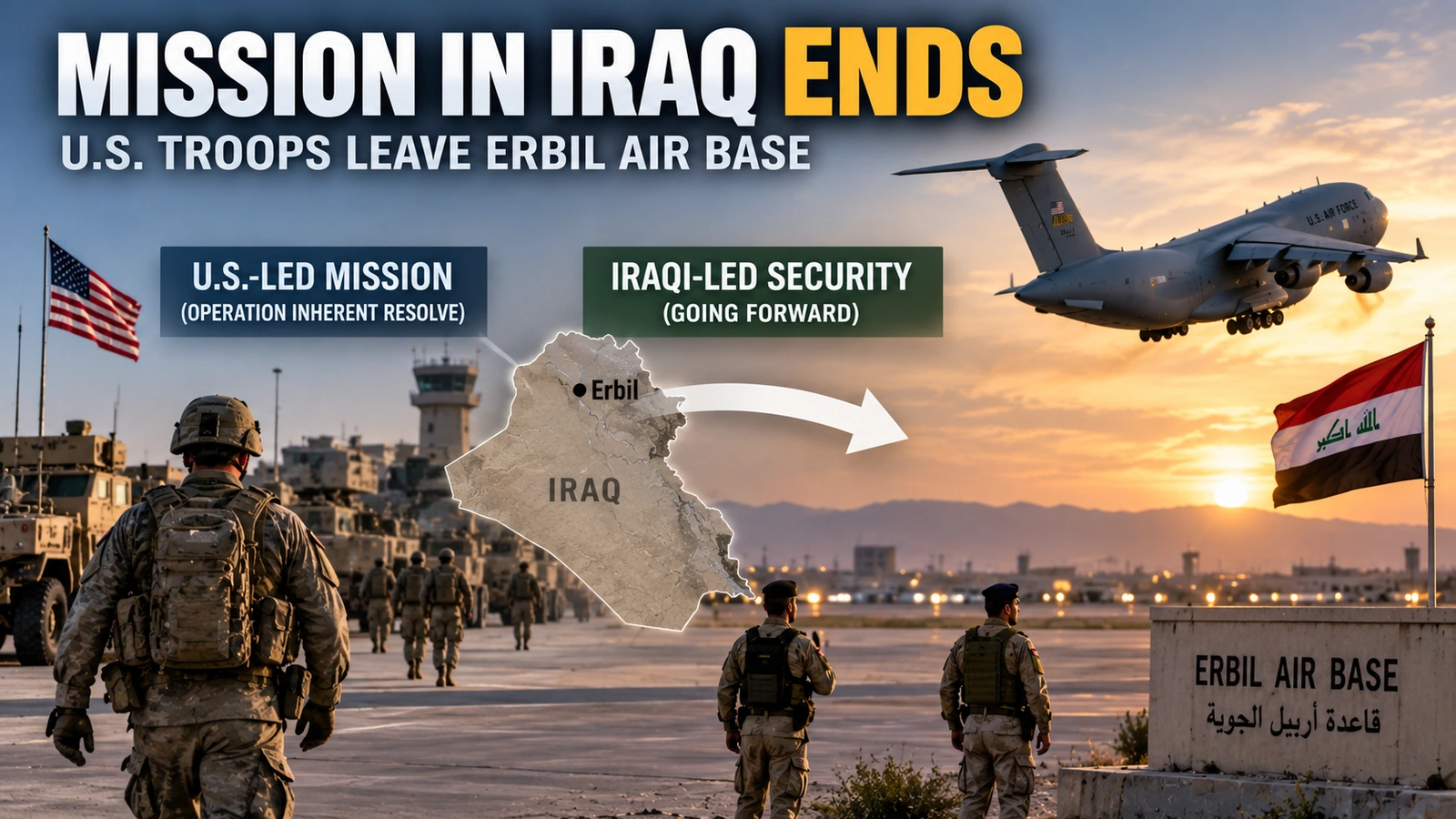
The United States ended Operation Inherent Resolve’s military mission inside Iraq and removed its remaining forces and equipment from Erbil Air Base.
Erbil had become the main remaining hub for the coalition mission. CENTCOM said it had hosted most of roughly 1,500 American and coalition personnel supporting counter-ISIS operations. (U.S. Central Command)
The Pentagon described September 30 as a transition from a wartime coalition mission to an Iraqi-led security effort. (AP)
That means Iraqi forces—including federal security forces and Kurdish Peshmerga—now carry primary responsibility for security inside Iraq, including suppressing remaining ISIS cells.
The United States, however, says it will continue targeted training and intelligence support under a more conventional bilateral defense relationship with Iraq. (U.S. Central Command · AP)
So there are really two separate ideas:
| What ended | What did not end |
|---|---|
| U.S. troops stationed in Iraq under Operation Inherent Resolve | The U.S.-Iraq defense relationship |
| The coalition’s Iraq-based military mission | Targeted U.S. training and intelligence support |
| Erbil’s role as the coalition’s Iraq operational hub | U.S. counter-ISIS activity elsewhere in the region |
| Iraq’s reliance on coalition troops for the mission | U.S. forces remaining available elsewhere in the region |
That distinction matters because headlines saying “U.S. troops leave Iraq” can sound much broader than what the military actually announced.
Didn’t the U.S. Already Leave Iraq in 2011?
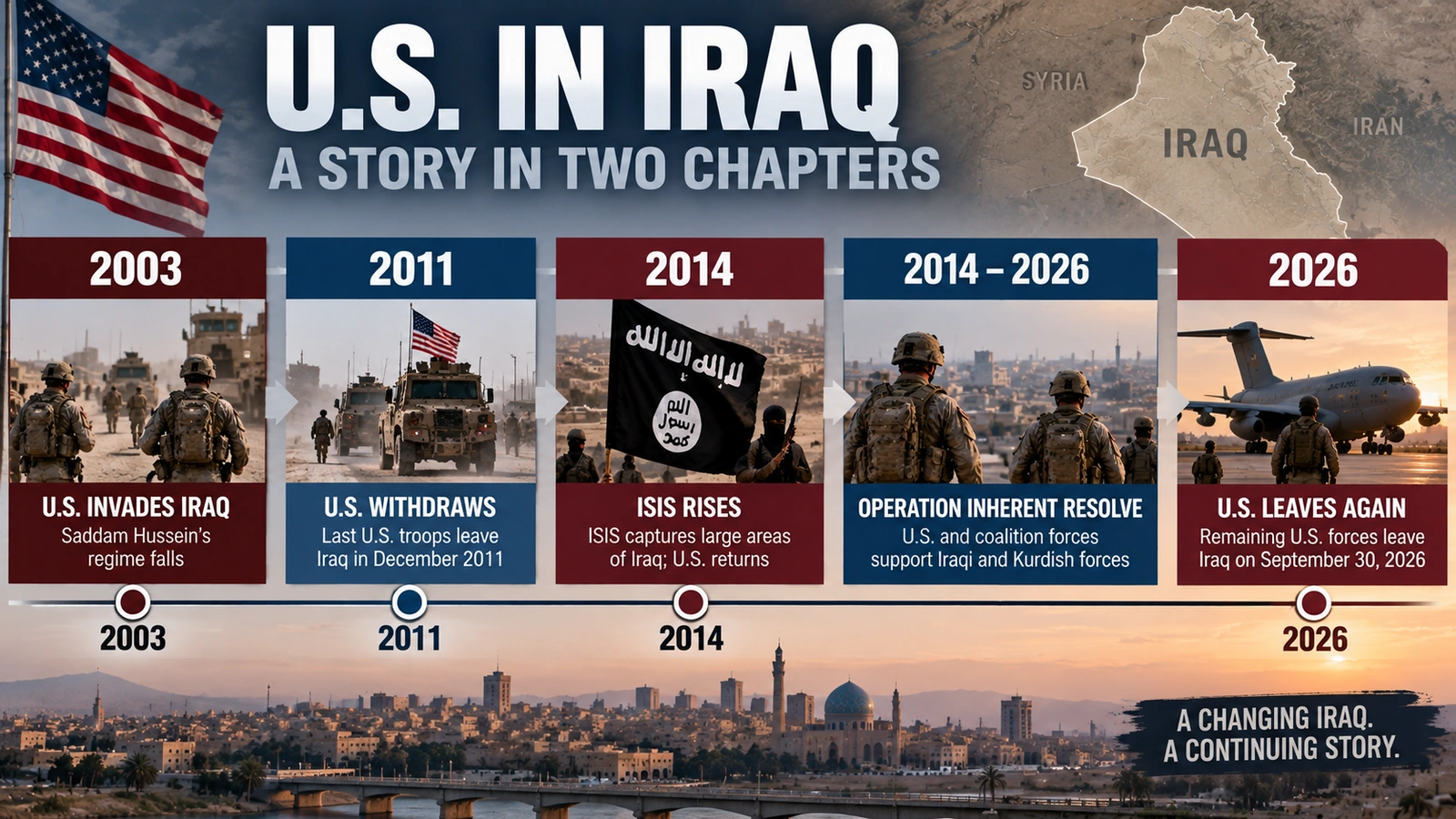
Yes—and that is why the current headline can feel so strange.
U.S. forces invaded Iraq in 2003 and overthrew Saddam Hussein’s government. Under a U.S.-Iraq security agreement, American forces were required to leave Iraqi territory by the end of 2011.
The final large U.S. troop convoy crossed from Iraq into Kuwait on December 18, 2011. (U.S. Army)
For a while, that really was the end of the large U.S. military mission created by the 2003 war.
Then Iraq’s security situation deteriorated.
ISIS grew out of an earlier insurgent organization, exploited sectarian tensions in Iraq and the civil war in neighboring Syria, and by 2014 had seized large areas of northern and western Iraq. (Congressional Research Service)
The Iraqi government then requested international military assistance.
American forces returned.
So the simplest way to understand the timeline is this:
| Period | U.S. role in Iraq |
|---|---|
| 2003–2011 | War, occupation and subsequent security mission following the U.S.-led invasion |
| December 2011 | Large post-2003 U.S. military mission ends; last major troop convoy withdraws |
| 2014 | U.S. forces return after ISIS captures large areas of Iraq |
| 2014–2026 | Operation Inherent Resolve supports Iraqi and Kurdish forces against ISIS |
| September 30, 2026 | Remaining U.S. forces leave Iraq and the Iraq-based mission ends |
The 2026 withdrawal is therefore not a delayed completion of the 2011 withdrawal. It is the end of the separate mission that began after U.S. troops returned in 2014.
Why Did U.S. Troops Have to Return in 2014?
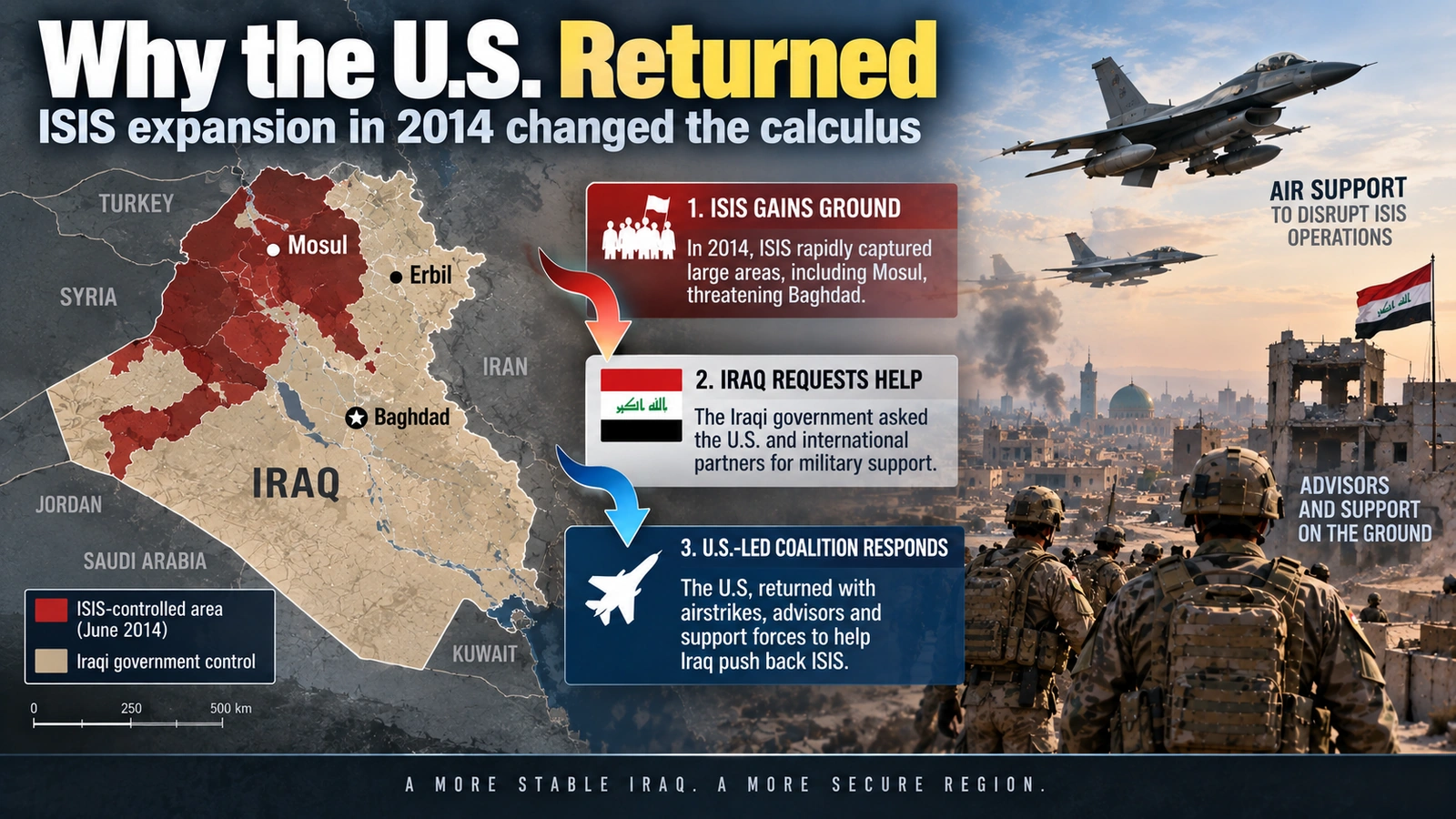
The return happened because Iraq in 2014 looked radically different from Iraq at the end of 2011.
ISIS fighters captured Mosul, Iraq’s second-largest city, and seized large areas of the country. Iraqi military units collapsed or withdrew from some areas as the organization declared a self-styled caliphate spanning territory in Iraq and Syria.
The Iraqi government formally sought outside military support, and the United States began airstrikes before helping organize the multinational campaign that became Operation Inherent Resolve. (Congressional Research Service · U.S. Department of Defense)
That campaign eventually stripped ISIS of its territorial control in Iraq.
The Pentagon said in 2024 that ISIS’s territorial defeat in Iraq had been achieved in 2017 and in Syria in 2019.
But territorial defeat was not the same thing as the disappearance of ISIS.
The organization survived as a smaller insurgent and terrorist network, which is one reason U.S. and coalition forces remained after the major battles were over. (U.S. Department of Defense)
Why Was 2026 the Exit Point?
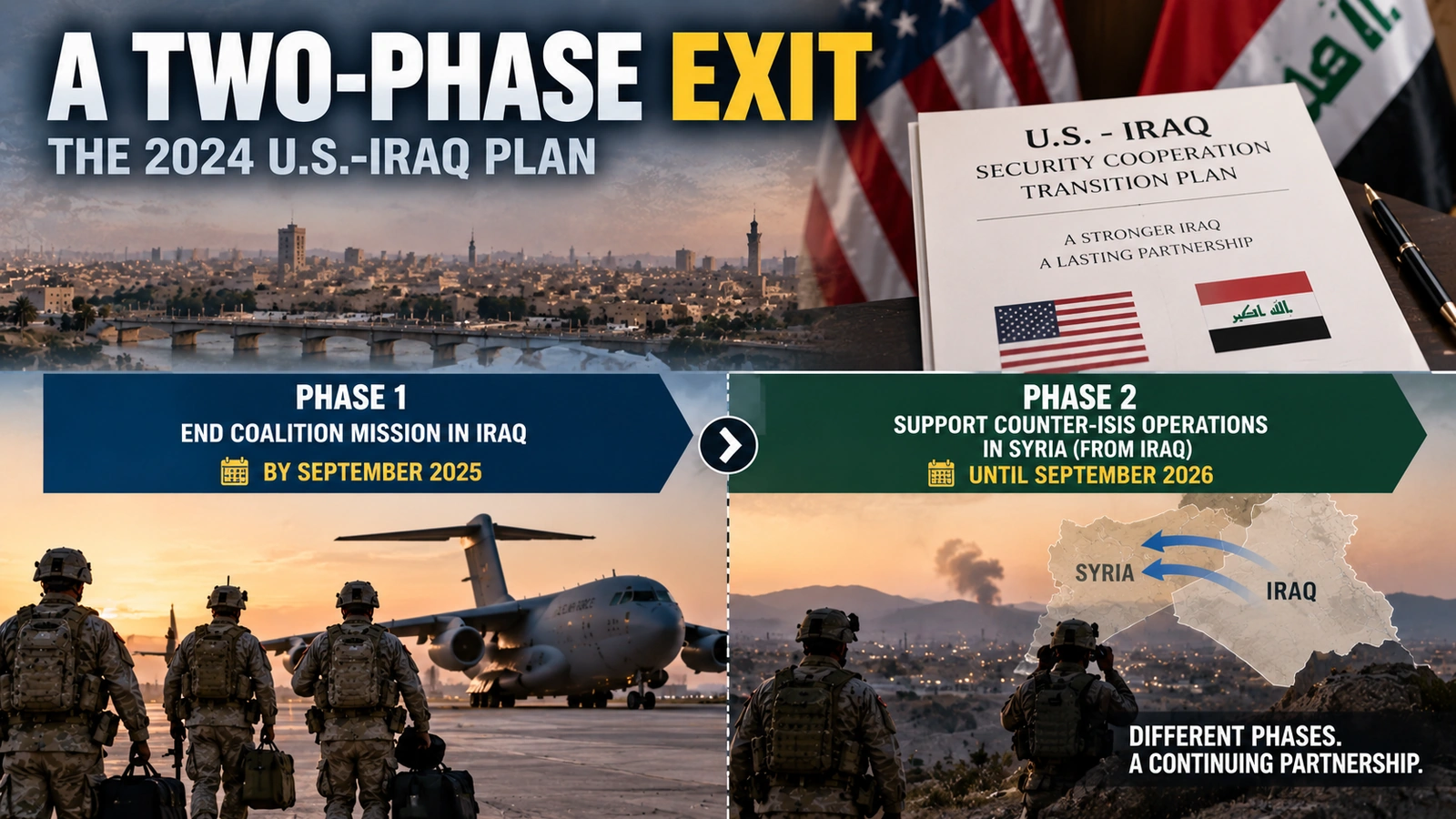
The September 2026 withdrawal was not a sudden decision made this week.
Washington and Baghdad announced a transition plan in September 2024.
The first phase called for the coalition’s military mission inside Iraq to end by the end of September 2025. A second phase allowed Iraq to continue supporting coalition operations against ISIS in Syria until at least September 2026, subject to conditions and consultations. (U.S. Department of Defense)
That explains why some U.S. and coalition personnel remained in northern Iraq after the main drawdown.
Their presence in Erbil helped support the wider counter-ISIS mission during the second phase.
CENTCOM said American and coalition forces began leaving federal Iraq in 2025, with the process culminating in the removal of the remaining personnel and equipment from Erbil Air Base in September 2026. (U.S. Central Command)
There is also an important wording issue.
When U.S. officials announced the transition in 2024, they stressed that America was not ending its relationship with Iraq. The intention was to replace the coalition combat framework with a more conventional country-to-country security partnership. (U.S. Department of Defense)
That is what is happening now.
Is America Really “Done” With Iraq?
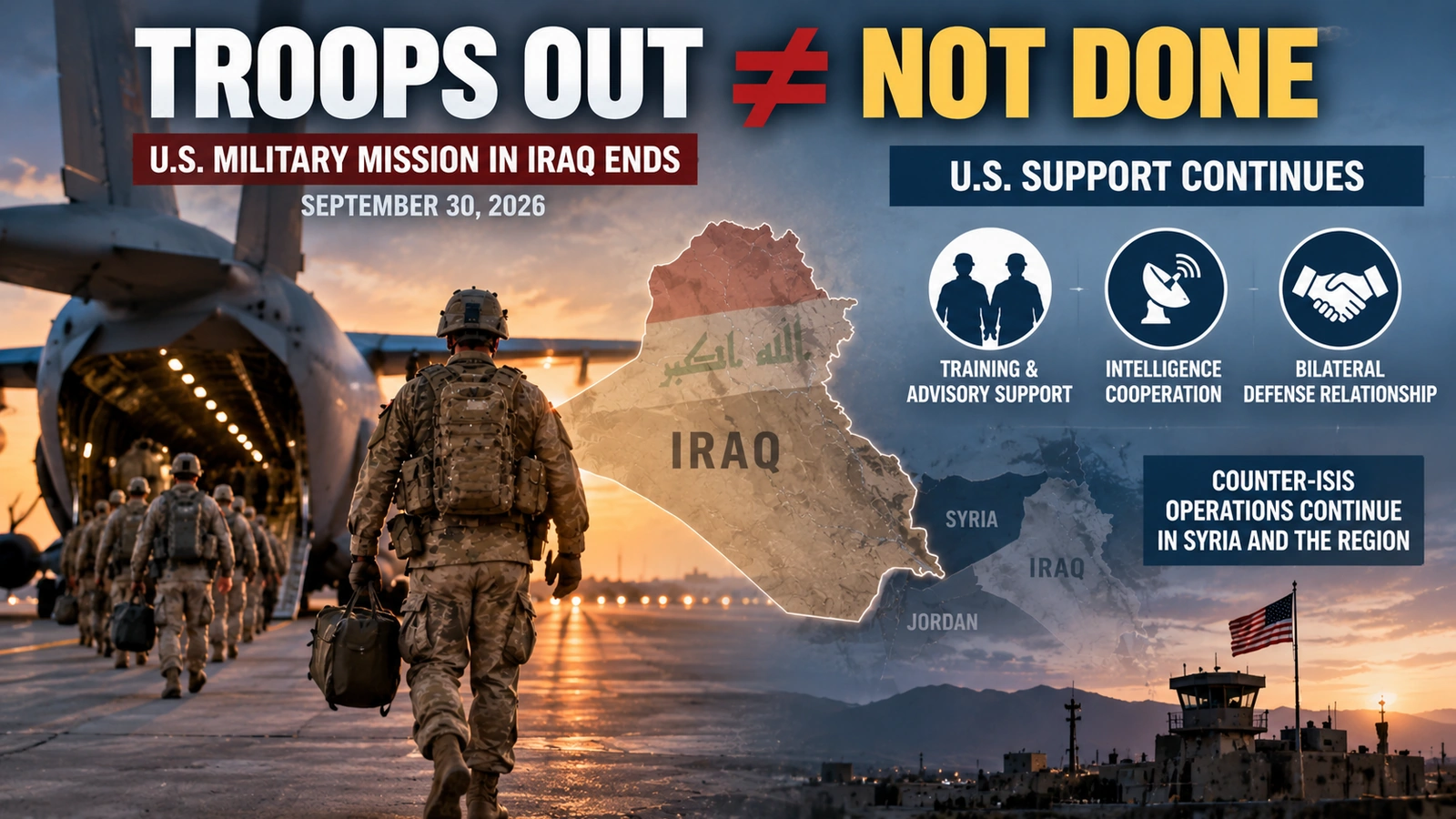
Not in the broader sense.
The Iraq-based U.S. troop mission is over, according to the military.
But the United States is not abandoning every form of defense cooperation with Iraq.
The Pentagon says targeted training and intelligence support will continue. CENTCOM describes the next phase as a bilateral U.S.-Iraq defense relationship. (U.S. Central Command · AP)
There is another major piece that can disappear in the headline: Operation Inherent Resolve itself still exists.
Its combined task force is now headquartered in Jordan, and U.S. forces continue counter-ISIS operations in Syria alongside regional and coalition partners. (U.S. Central Command)
A useful way to think about it is:
The United States has ended its military stationing for this mission inside Iraq, not its entire military role in the surrounding region.
That makes the 2026 withdrawal much narrower than saying “America has left the Middle East.”
What Happens to ISIS Now?
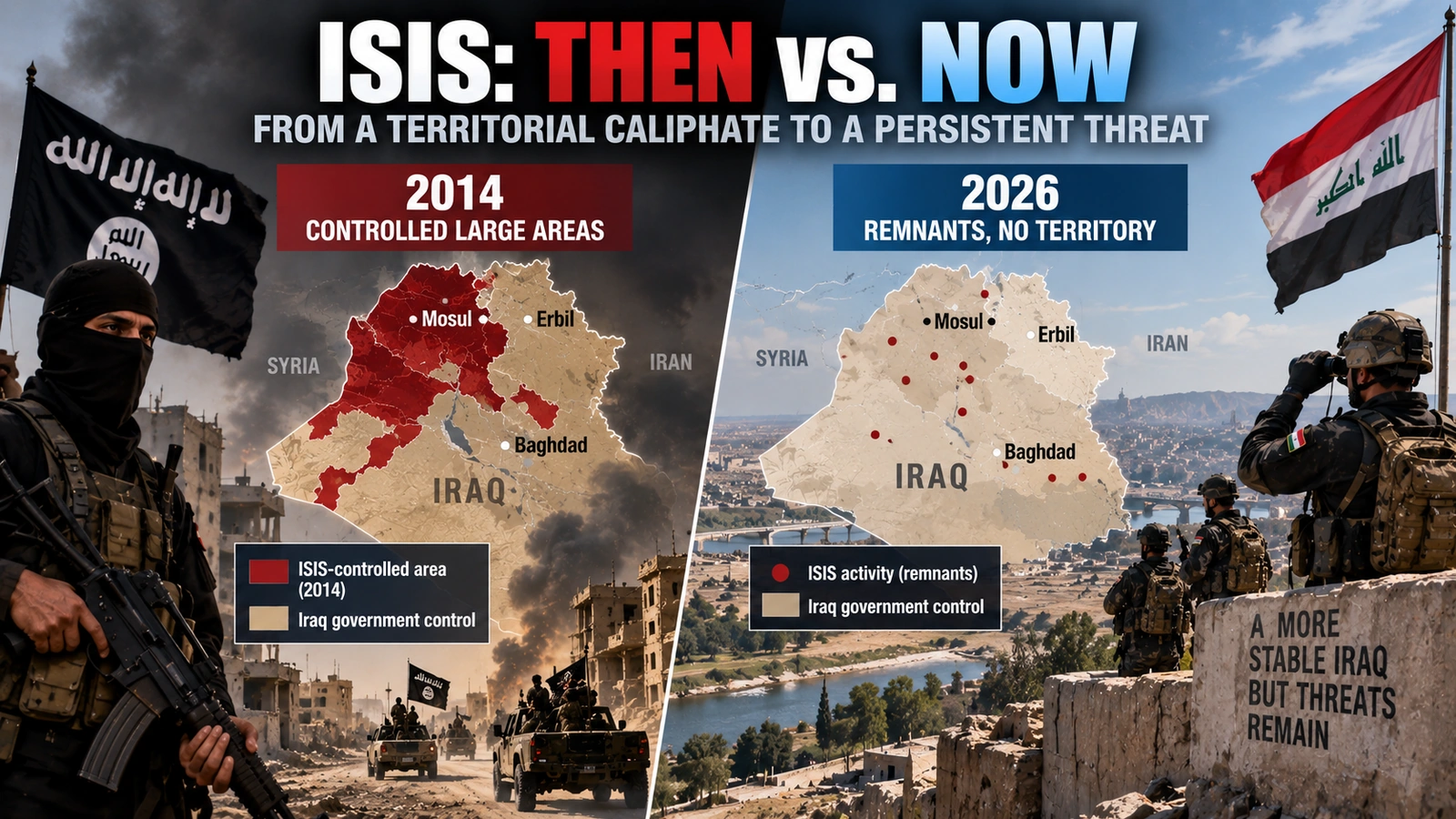
The Iraqi government now has primary responsibility for keeping ISIS suppressed.
CENTCOM’s assessment is that ISIS no longer poses a systemic threat to Iraq’s national security and that Iraqi federal and Kurdish forces have developed the capacity to manage remaining threats. (U.S. Central Command)
That is a much different threat from 2014.
Then, ISIS controlled cities and territory, operated heavy weapons and tried to function like a state.
Today, the concern is primarily remnants, sleeper cells and the possibility that instability could give the organization room to rebuild.
That last part explains why the United States is not treating the September 30 departure as the end of counter-ISIS policy.
U.S. forces stationed elsewhere in the region remain positioned to respond to ISIS threats, and the coalition command continues operating from Jordan. (U.S. Central Command)
So “ISIS was defeated” needs a qualifier.
Its territorial military project in Iraq was defeated. The organization itself was not erased.
What About Iran-Backed Militias?
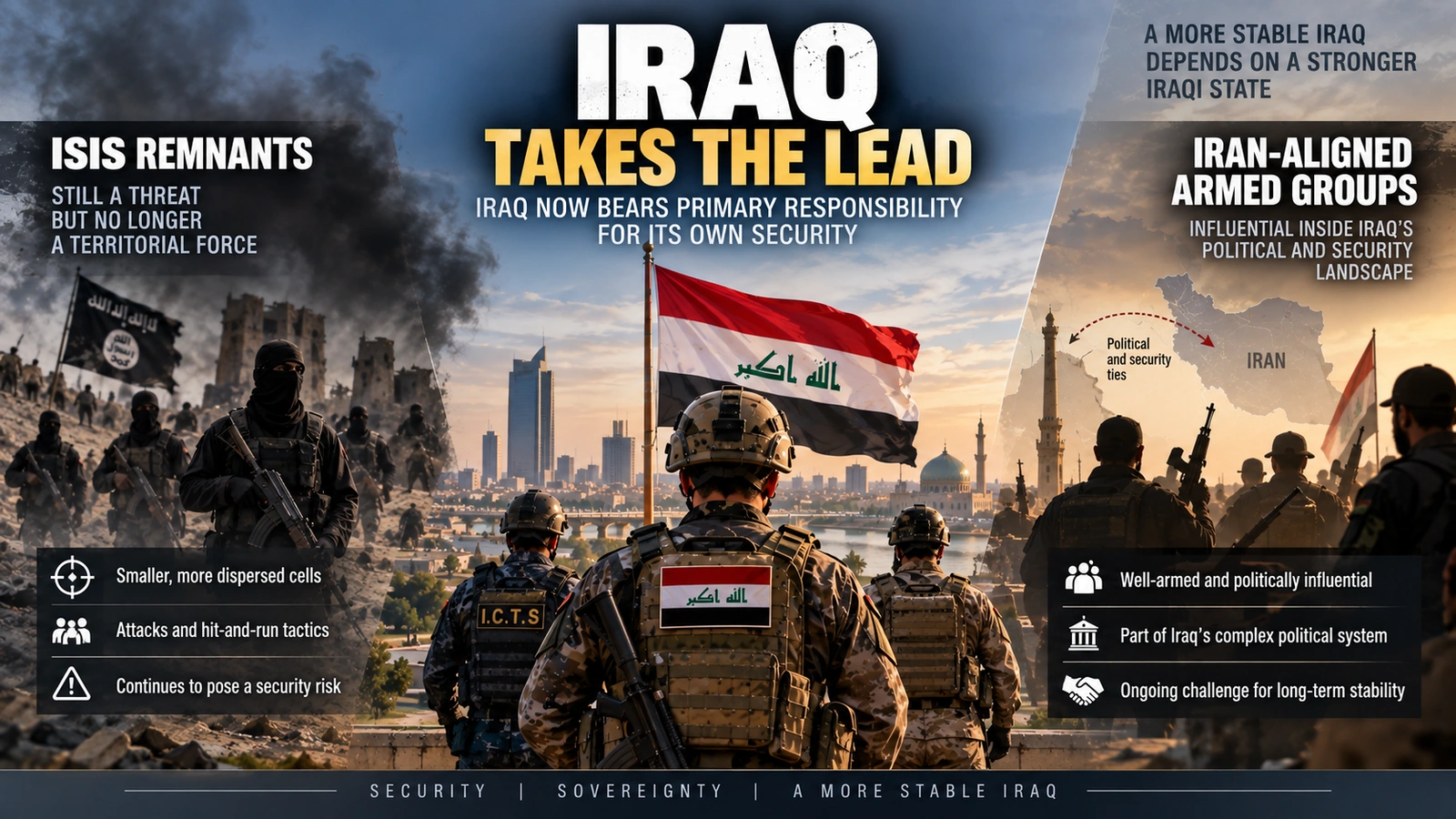
ISIS is only one part of the security problem Baghdad inherits.
Iraq also has powerful armed groups with varying relationships to the state and to Iran. Some Iran-aligned factions have fought U.S. forces or U.S.-linked targets, while militia influence also reaches into Iraqi politics and security institutions.
The issue has become more urgent during the wider confrontation involving the United States and Iran.
AP reported that some powerful Iran-backed factions resisted or placed conditions on Iraqi government efforts to disarm armed groups, even as some smaller groups agreed to give up weapons. (AP)
The Pentagon explicitly included Iran-aligned militias among the security challenges for which Baghdad now carries primary responsibility. (U.S. Central Command)
That does not mean every armed faction in Iraq is the same or that every Iran-aligned group takes direct orders from Tehran.
But it does mean the withdrawal removes one of the major foreign military forces that had been operating inside a country where U.S.-Iran competition has repeatedly played out through local armed groups.
For Baghdad, the problem is therefore bigger than preventing an ISIS comeback.
It also has to demonstrate that the Iraqi state—not an outside country or an independent armed organization—ultimately controls the use of force inside Iraq.
Why Is This Withdrawal Different From 2011?
The obvious fear is: if U.S. troops left once and ISIS later became powerful enough to force them back, why should the second withdrawal be different?
There is no guarantee that the future will repeat—or avoid—the past.
But the starting conditions are different.
In 2011, the U.S. military withdrawal ended the post-2003 mission while Iraq still faced deep political and institutional weaknesses. Over the following years, sectarian conflict, the Syrian civil war and the deterioration of Iraqi security forces created an environment ISIS was able to exploit. Congressional Research Service assessments describe both political deterioration and serious security weaknesses during that period. (Congressional Research Service)
In 2026, the U.S. military says Iraqi federal forces and the Peshmerga are capable of independently handling the remaining ISIS threat.
The withdrawal is also occurring after a gradual two-year transition rather than following the sudden appearance of a new battlefield threat. (U.S. Central Command)
Still, one lesson from 2011 remains relevant:
The absence of a large terrorist-controlled territory today does not mean the political and security conditions that could allow one to re-emerge can be ignored.
That is why ISIS cells, militia power and the ability of Iraqi institutions to maintain control will matter more than the symbolism of the last U.S. aircraft leaving Erbil.
What Should Americans Watch Next?
The most useful signals are not whether another withdrawal ceremony takes place.
The important questions are what happens after the ceremony.
First, watch whether Iraqi forces continue suppressing ISIS without regular U.S. forces based in the country.
Second, watch Baghdad’s attempts to control or disarm armed groups operating outside normal state command structures.
Third, watch how the new bilateral U.S.-Iraq security relationship actually works. Training, intelligence cooperation and military assistance can continue even without an American troop mission stationed inside Iraq.
Fourth, watch the regional mission. Operation Inherent Resolve has shifted its headquarters to Jordan, while counter-ISIS activity continues outside Iraq. (U.S. Central Command)
And finally, watch the wider U.S.-Iran confrontation.
The timing of this withdrawal is unusual because American troops are leaving Iraq while U.S.-Iran tensions elsewhere in the region remain high. Iran and allied groups have portrayed the U.S. departure as a strategic gain, while some Iraqis—particularly in the Kurdish region—have expressed concern about what the loss of the American military presence could mean for local security. (AP · Reuters)
That combination is what makes September 30 more than another troop-movement announcement.
The military presence ended.
The security questions did not.
Bottom Line: What This Story Really Means
Yes, the United States already withdrew its troops from Iraq in 2011.
The reason American troops had to “leave Iraq” again in 2026 is that Iraq invited a new U.S.-led mission back in 2014 after ISIS captured large parts of the country.
That second mission is what ended on September 30.
The remaining U.S. forces and equipment left Erbil Air Base, and Iraq now carries primary responsibility for suppressing ISIS remnants and dealing with other armed groups inside the country. (U.S. Central Command)
But America is not disappearing from Iraq’s security picture or from the region.
Training and intelligence cooperation with Iraq will continue, Operation Inherent Resolve has moved its headquarters to Jordan, and the U.S. counter-ISIS mission continues elsewhere in the region.
So the most accurate way to describe the moment is:
U.S. troops have left Iraq again. The U.S. security relationship with Iraq—and the fight against ISIS—has not simply ended.
Iraq Withdrawal: Key Questions Explained
Q. Didn’t the United States already withdraw from Iraq in 2011?
Yes. The large post-2003 U.S. military mission ended in December 2011, when the last major troop convoy crossed into Kuwait; a small embassy-support military presence remained. A new U.S.-led force returned in 2014 after ISIS seized large areas of Iraq and the Iraqi government requested international assistance. (U.S. Army · U.S. Department of Defense)
Q. What exactly happened on September 30, 2026?
U.S. Central Command said American forces and equipment completed their departure from Erbil Air Base, ending the Operation Inherent Resolve military mission inside Iraq. (U.S. Central Command)
Q. Are there still U.S. troops stationed in Iraq?
The U.S. military says the withdrawal of its forces from Iraq is complete. The relationship is shifting to bilateral security cooperation that includes targeted training and intelligence support rather than the Operation Inherent Resolve troop mission based there. (AP)
Q. Why did U.S. troops return to Iraq in 2014?
ISIS captured major Iraqi cities and large areas of territory, and the Iraqi government asked for international military assistance. The United States then helped build the coalition campaign that became Operation Inherent Resolve. (Congressional Research Service · U.S. Department of Defense)
Q. Has ISIS been completely eliminated?
No. ISIS lost the territorial caliphate it once controlled, but remnants of the organization remain. U.S. officials currently assess that ISIS no longer poses the systemic military threat to Iraq that it did in 2014. (U.S. Central Command)
Q. Who is responsible for fighting ISIS inside Iraq now?
Iraqi security forces, including federal forces and Kurdish Peshmerga, have primary responsibility. U.S. officials say training, intelligence support and regional counterterrorism cooperation will continue. (U.S. Central Command · AP)
Q. Did Operation Inherent Resolve end completely?
No. Its military mission inside Iraq ended, but the Combined Joint Task Force remains operational and is now headquartered in Jordan while counter-ISIS activity continues elsewhere in the region. (U.S. Central Command)
Q. Why do Iran-backed militias matter after the withdrawal?
They represent a separate security and sovereignty challenge for Baghdad. Some powerful Iran-aligned factions have resisted Iraqi government efforts to bring weapons fully under state control, and U.S. officials say responsibility for dealing with such groups now rests primarily with Iraq. (AP · U.S. Central Command)
Q. Does the withdrawal mean the United States has left the Middle East?
No. The announcement concerns the U.S. military mission and troop presence inside Iraq. American forces and counterterrorism missions remain elsewhere in the region. (U.S. Central Command)
Did this help make the story clearer? 🙂
WIN keeps unpacking the “why” behind the news—clearly and simply!
Sources
September 30 Withdrawal and the New Security Arrangement
U.S. Central Command — U.S. Forces End Operation Inherent Resolve Mission in Iraq
Associated Press — The U.S. Military Says Its Withdrawal of Troops From Iraq Is Complete
Reuters — U.S. Forces Exit Iraq, Emboldening Iran’s Proxies and Islamic State
The 2024 Transition Plan
U.S. Department of Defense — Inherent Resolve Mission in Iraq and Syria Transitioning
Why the U.S. Left in 2011 and Returned in 2014
U.S. Army — Last Brigade Leaves Iraq
Congressional Research Service — Iraq: Background and U.S. Policy
Keep Reading
Why Do Armed Groups in Iraq Matter Beyond Iraq’s Borders?
The withdrawal puts more responsibility on Baghdad to control Iran-aligned armed groups. A recent attack attributed by Saudi Arabia to an Iraq-based militia shows why those groups can also affect energy security far beyond Iraq.
Saudi Arabia Built a Pipeline to Bypass Hormuz—So Why Is Its Oil Route Still at Risk?