Why Are Trump’s New “Forced Labor” Tariffs Back in Court—and How Is Section 301 Different?

Didn’t the Supreme Court already strike down President Donald Trump’s sweeping tariffs?
So why are U.S. importers still paying another broad set of duties on goods arriving from dozens of major trading partners?
The answer is that the Supreme Court did not rule that presidents can never impose tariffs under authority delegated by Congress. It ruled that the International Emergency Economic Powers Act, or IEEPA, did not authorize the president to impose the challenged tariffs. (U.S. Supreme Court)
The administration then turned to other trade statutes.
The latest fight centers on Section 301 of the Trade Act of 1974, a law that expressly authorizes the U.S. Trade Representative to impose duties in certain circumstances. The question now before the courts is whether the administration satisfied the legal requirements for using that authority so broadly against 60 economies. (U.S. Code)
※ Images in this article are AI-generated illustrations created to help explain the story. They are not actual photographs, and depictions of people, places, or events may differ slightly from reality.
That distinction explains why a tariff policy that suffered a major Supreme Court defeat in February is once again before federal judges.
What Happened in Court on September 30?
On September 30, a three-judge panel of the U.S. Court of International Trade heard arguments challenging the administration’s new forced-labor-related tariffs.
The challengers include four small businesses and a coalition of 25 Democratic-led states. The administration, represented by the Justice Department, defended the tariffs and the investigations that preceded them. The judges did not issue a final ruling at the hearing. (Reuters)
The consolidated litigation is being heard as In Re: Section 301 Forced Labor Cases. The September 30 oral argument was scheduled in the U.S. Court of International Trade in New York. (Liberty Justice Center)
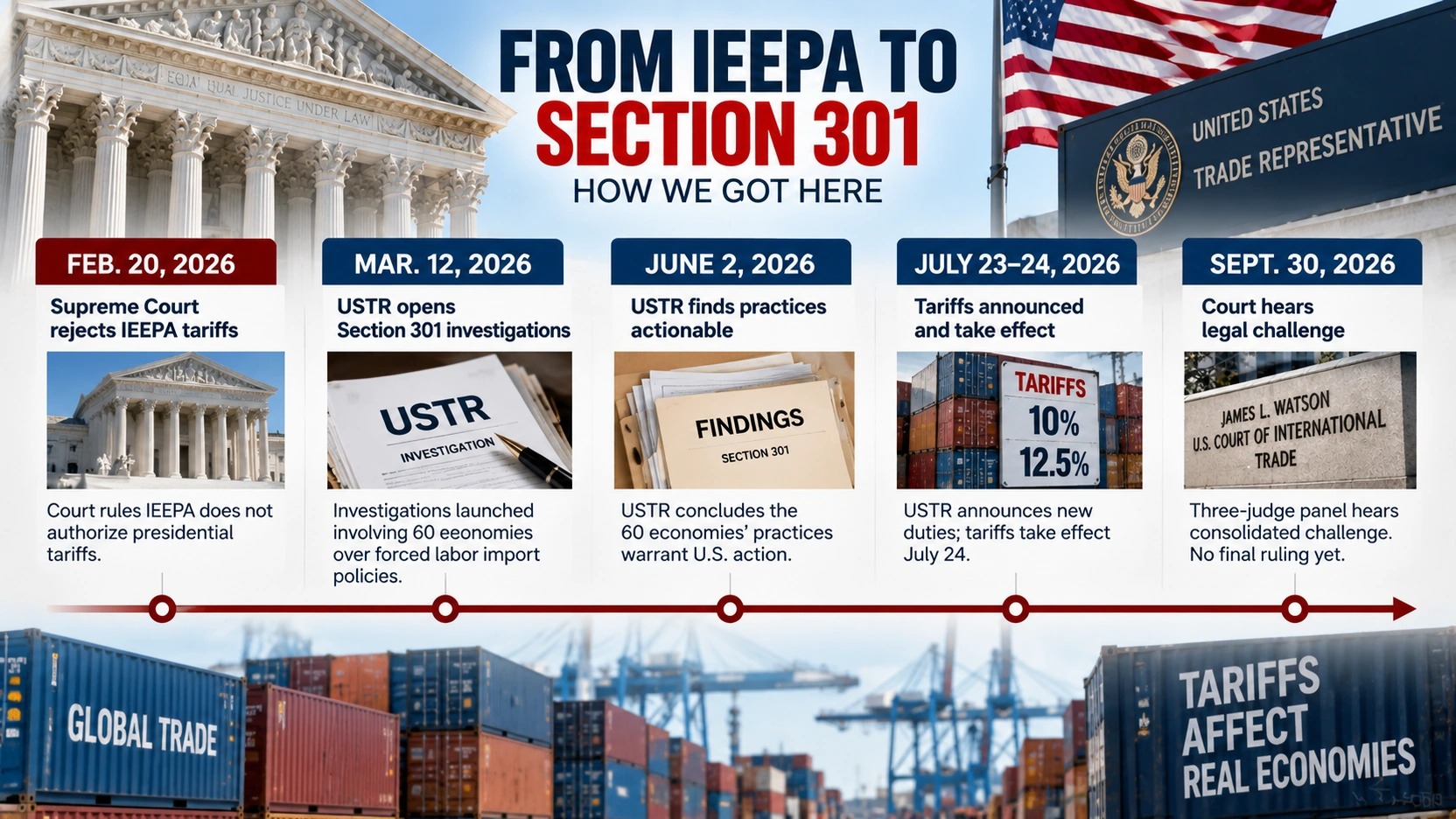
The timeline helps explain why the case matters:
| Date | What happened | Why it matters |
|---|---|---|
| February 20, 2026 | Supreme Court rejected Trump’s use of IEEPA for tariffs | Forced the administration to rely on other trade laws |
| March 12 | USTR opened Section 301 investigations involving 60 economies | Began the process behind the current tariffs |
| June 2 | USTR found the 60 economies’ practices actionable | Supplied the formal findings used to justify trade action |
| July 23–24 | USTR announced the tariffs; duties took effect July 24 | New duties of generally 10% or 12.5% began |
| September 30 | Court of International Trade heard the consolidated challenge | Judges are now testing whether Section 301 was lawfully used |
The September hearing therefore was not another review of the old emergency tariffs.
It was a test of the administration’s replacement legal strategy. After the February Supreme Court decision, USTR said the administration would immediately use Section 122 temporarily and initiate or continue Section 301 investigations as alternative trade-law tools. (USTR)
Didn’t the Supreme Court Already Strike Down Trump’s Tariffs?
Yes—but it struck down tariffs imposed under one specific statute.
In Learning Resources, Inc. v. Trump, decided February 20, the Supreme Court held that IEEPA did not authorize the president to impose tariffs. The Court emphasized that Congress had not expressly granted tariff or duty authority in IEEPA. (U.S. Supreme Court)
That was a major ruling, but it was not a declaration that every presidential tariff is unlawful.
Congress has enacted other laws that expressly provide tariff authority.
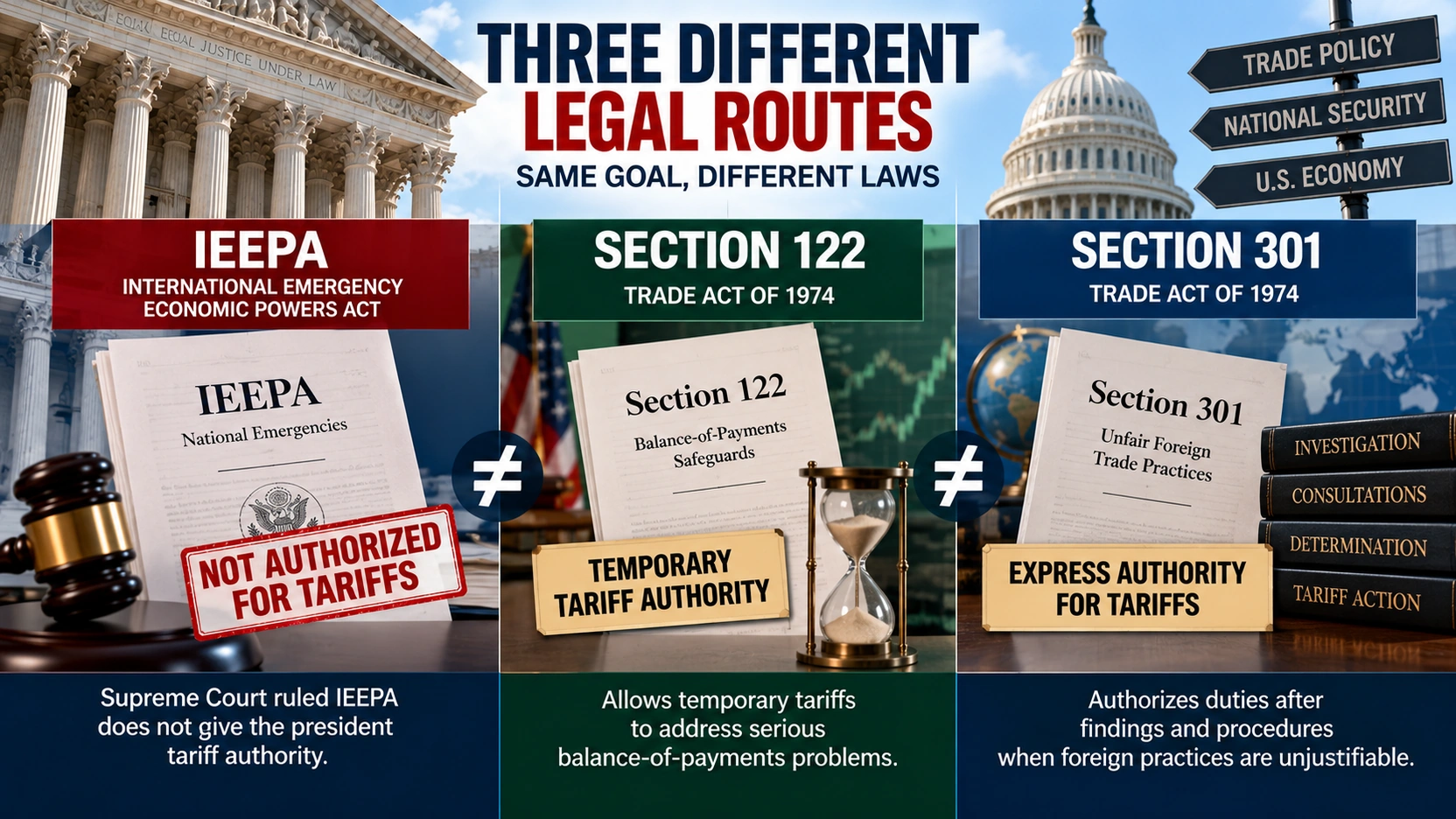
The easiest way to see the difference is this:
| Legal authority | Basic purpose | Tariff authority |
|---|---|---|
| IEEPA | Economic powers during declared national emergencies | Supreme Court held that it does not authorize tariffs |
| Section 122 | Temporary action related to serious balance-of-payments problems | Express but time-limited tariff authority |
| Section 301 | Response to certain unfair or burdensome foreign trade practices | Expressly authorizes duties after statutory findings and procedures |
After the February ruling, the administration announced temporary action under Section 122 and new investigations under Section 301 and other trade laws. (USTR)
So the September 30 case is legally different.
The current question is not whether Section 301 contains tariff authority. It does. The fight is over whether the administration met the conditions Congress attached to that authority.
What Exactly Is Section 301?
Section 301 is a trade-enforcement law.
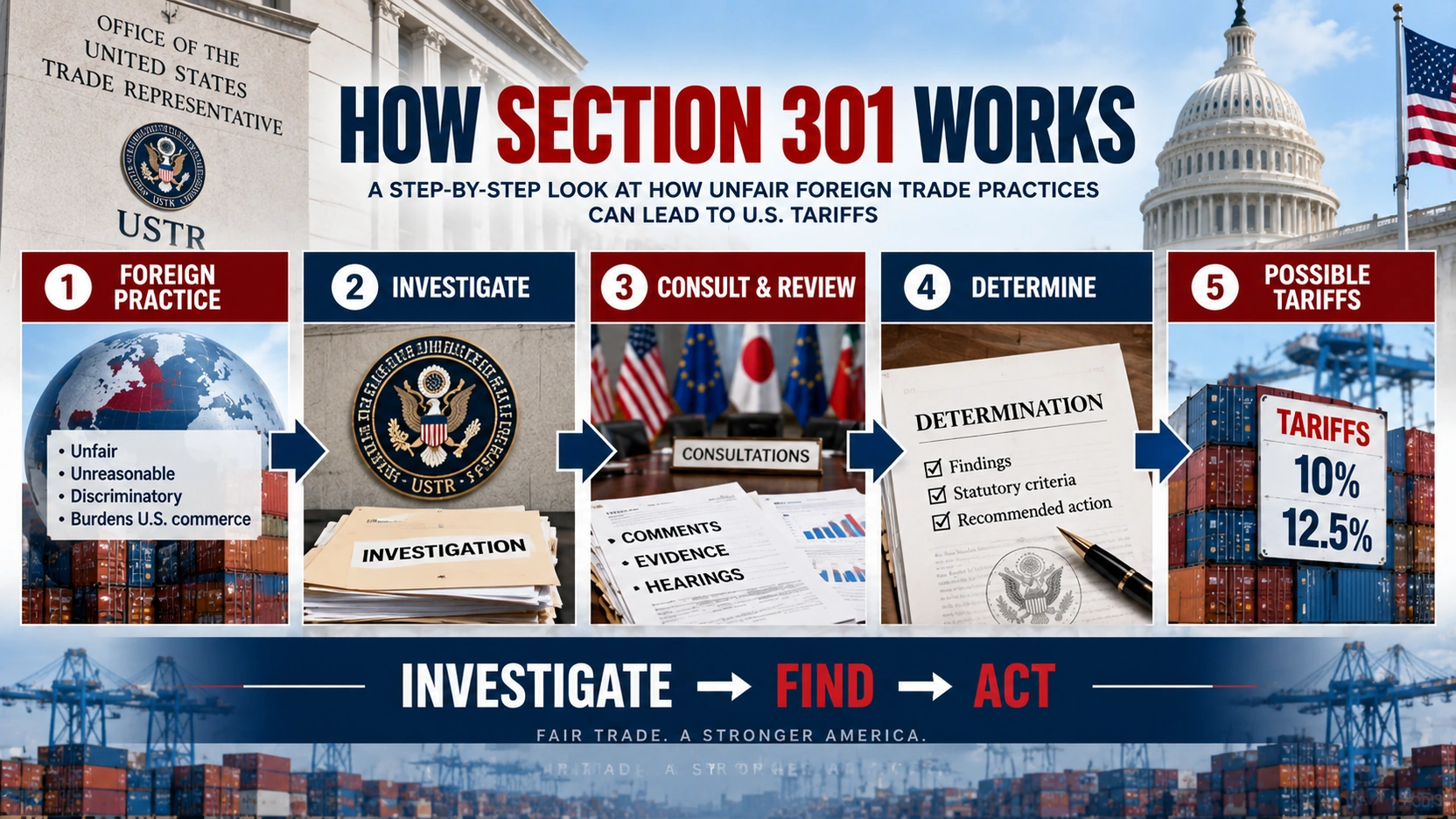
Under 19 U.S.C. §2411, the U.S. Trade Representative can act when it determines that a foreign government’s act, policy or practice is unreasonable or discriminatory, burdens or restricts U.S. commerce, and warrants U.S. action.
The law expressly allows the Trade Representative to “impose duties or other import restrictions” when the statutory requirements are satisfied. (U.S. Code)
But Section 301 is not simply a blank authorization saying, “The president may impose whatever tariff he wants.”
Other parts of the statute establish an investigation and determination process. Section 304, for example, requires the Trade Representative to make determinations based on the investigation, consultations and applicable proceedings. (U.S. Code)
That is why the current case is more complicated than the earlier IEEPA dispute.
With IEEPA, the Supreme Court’s threshold question was whether the law authorized tariffs at all.
With Section 301, tariff authority is written into the statute.
The harder question is whether the government identified the kind of foreign conduct Congress authorized Section 301 to address—and whether its findings and process were sufficient for tariffs this broad.
Why Are These Called “Forced Labor” Tariffs?
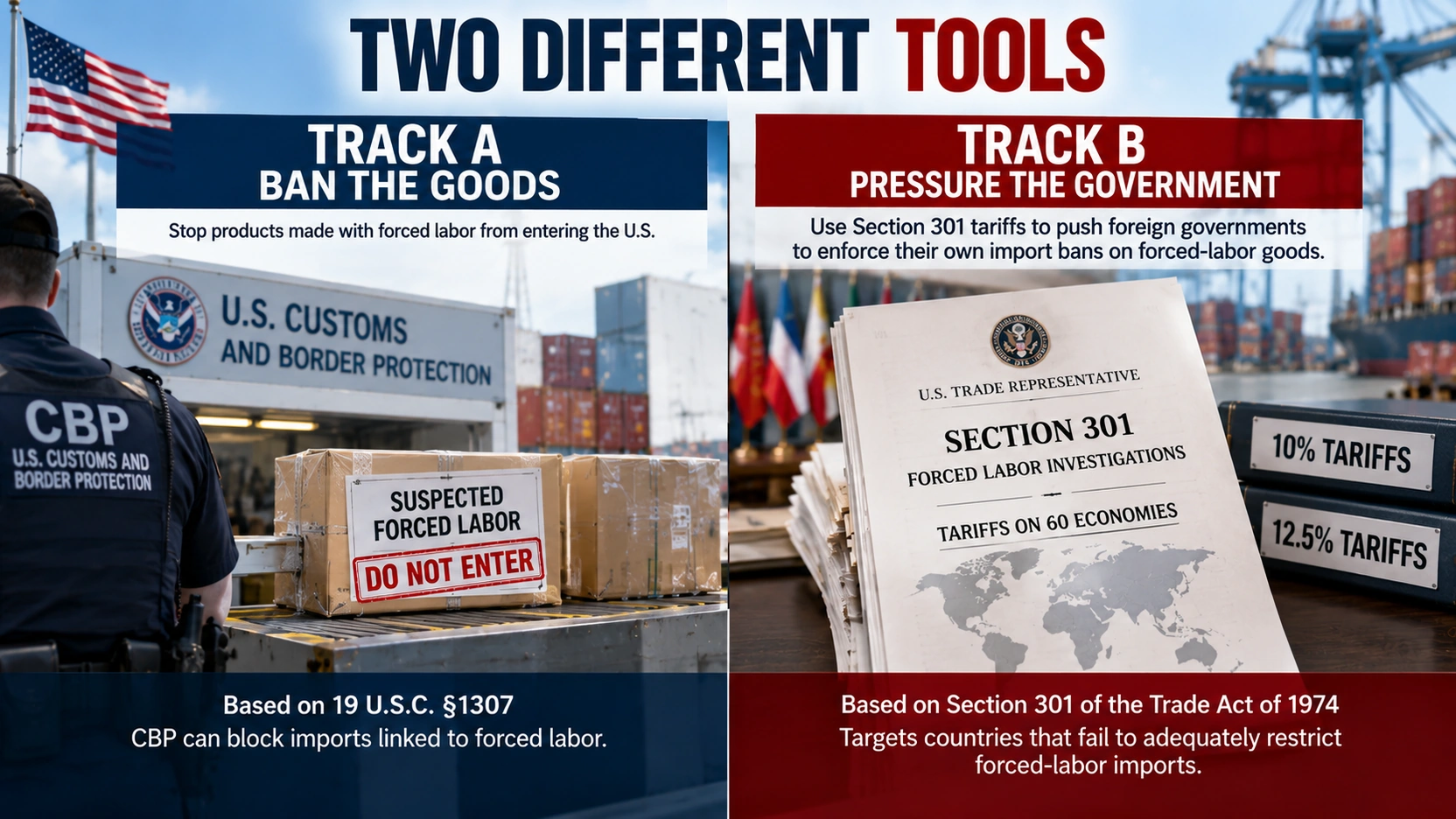
This is one of the easiest parts of the story to misunderstand.
The United States already has a separate law that prohibits imports made wholly or partly with forced labor. Section 307 of the Tariff Act of 1930, codified at 19 U.S.C. §1307, gives U.S. Customs and Border Protection tools to stop goods linked to forced labor from entering the country. (19 U.S.C. §1307)
The new Section 301 tariffs do something different.
They are based on the Trump administration’s conclusion that 60 trading economies failed to impose or effectively enforce adequate bans on their own imports of forced-labor goods, which USTR said creates an unfair trade problem that burdens U.S. commerce. (USTR)
That distinction matters.
These tariffs are not limited to individual shipments that U.S. authorities have proven were made with forced labor.
USTR instead imposed additional duties broadly on products originating in the economies covered by the investigations, subject to exemptions and special rate structures. (Federal Register)
USTR says its process included consultations with foreign governments, two rounds of hearings and more than 2,100 public comments across the investigation and proposed-action stages. The agency announced final action on July 23, with duties applying to covered imports beginning at 12:01 a.m. Eastern on July 24. (USTR · Federal Register)
The basic rate structure looks like this:
| Group | Section 301 treatment |
|---|---|
| Certain economies that have a prohibition, relevant commitment or partial regime | Generally 10% |
| EU and Taiwan | Combined MFN and Section 301 rate generally capped at 10% under the specified formula |
| Japan, South Korea and Switzerland | Combined MFN and Section 301 rate generally capped at 12.5% under the specified formula |
| Other covered economies | Generally 12.5% |
| Certain products | Exempt under the USTR action |
That is why calling these simply “tariffs on forced-labor goods” would be misleading.
They are better understood as country-based trade penalties designed to pressure governments over forced-labor import enforcement.
What Are the Challengers and the Administration Arguing?
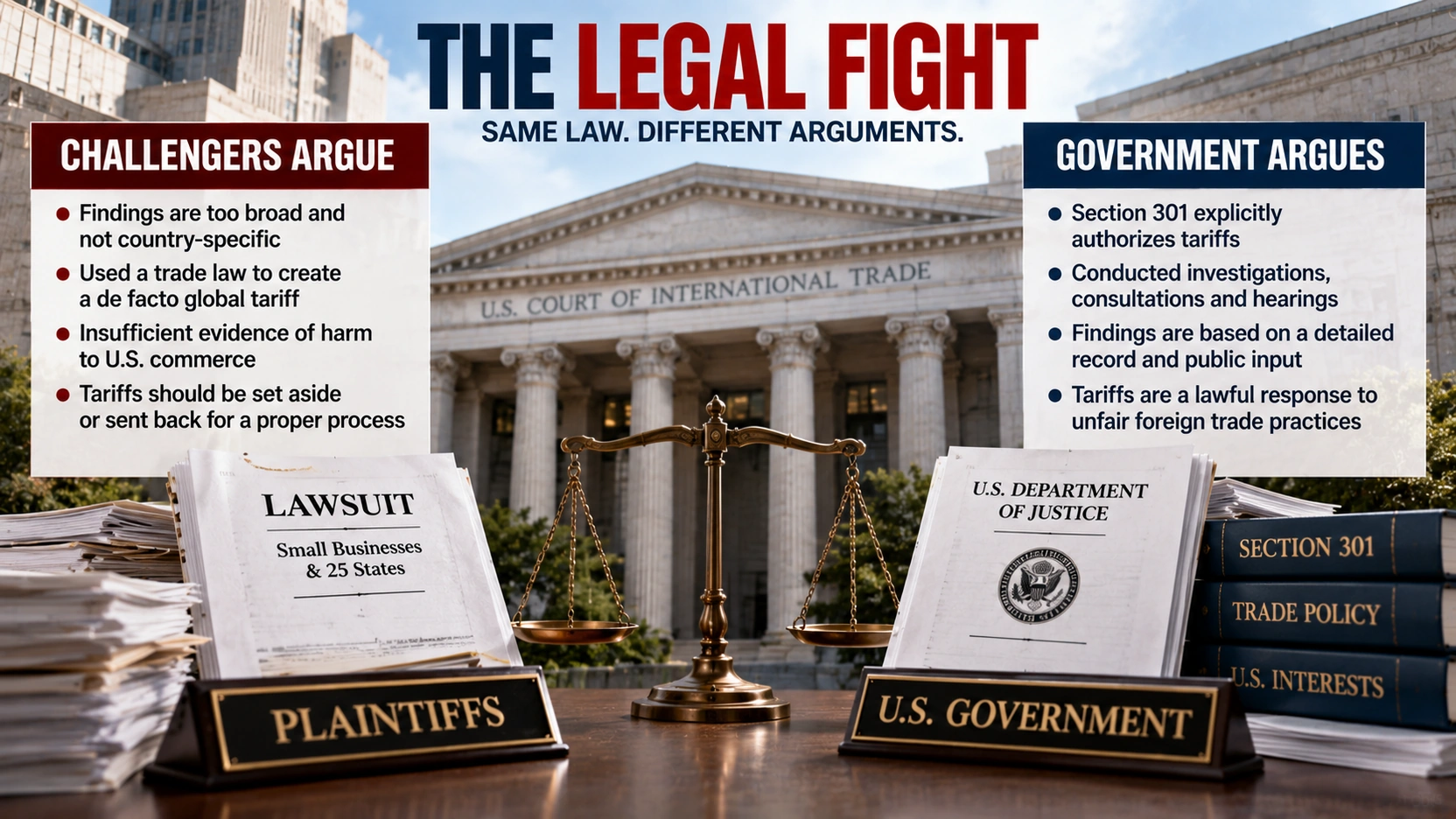
The two sides agree on one important point: Section 301 can authorize tariffs.
They disagree over whether these particular tariffs satisfy the law.
| Challengers argue | Administration argues |
|---|---|
| The government did not sufficiently establish, economy by economy, how the challenged policies burden U.S. commerce | USTR conducted investigations, consultations, hearings and comment processes sufficient under the statute |
| The administration used a trade-enforcement statute to recreate something resembling a broad global tariff | Section 301 expressly authorizes duties as a response to actionable foreign practices |
| The findings and proposed remedies were too generalized or insufficiently connected to the tariffs imposed | The law does not require the government to quantify with absolute precision the economic harm caused by forced-labor-related practices |
| The action should be set aside or sent back for a lawful process | The tariffs are a permissible means of obtaining changes in the foreign practices USTR identified |
The challengers’ arguments have been presented by small-business plaintiffs and state attorneys general. The Justice Department has defended the adequacy of USTR’s findings and the connection between the identified trade practices and the tariff response. (Reuters)
That leaves the judges with a narrower question than the political debate over whether tariffs are a good idea.
The court has to decide what Section 301 legally requires, and whether the administrative record in these 60 investigations meets those requirements.
Does a 10% Tariff Mean Store Prices Automatically Rise 10%?
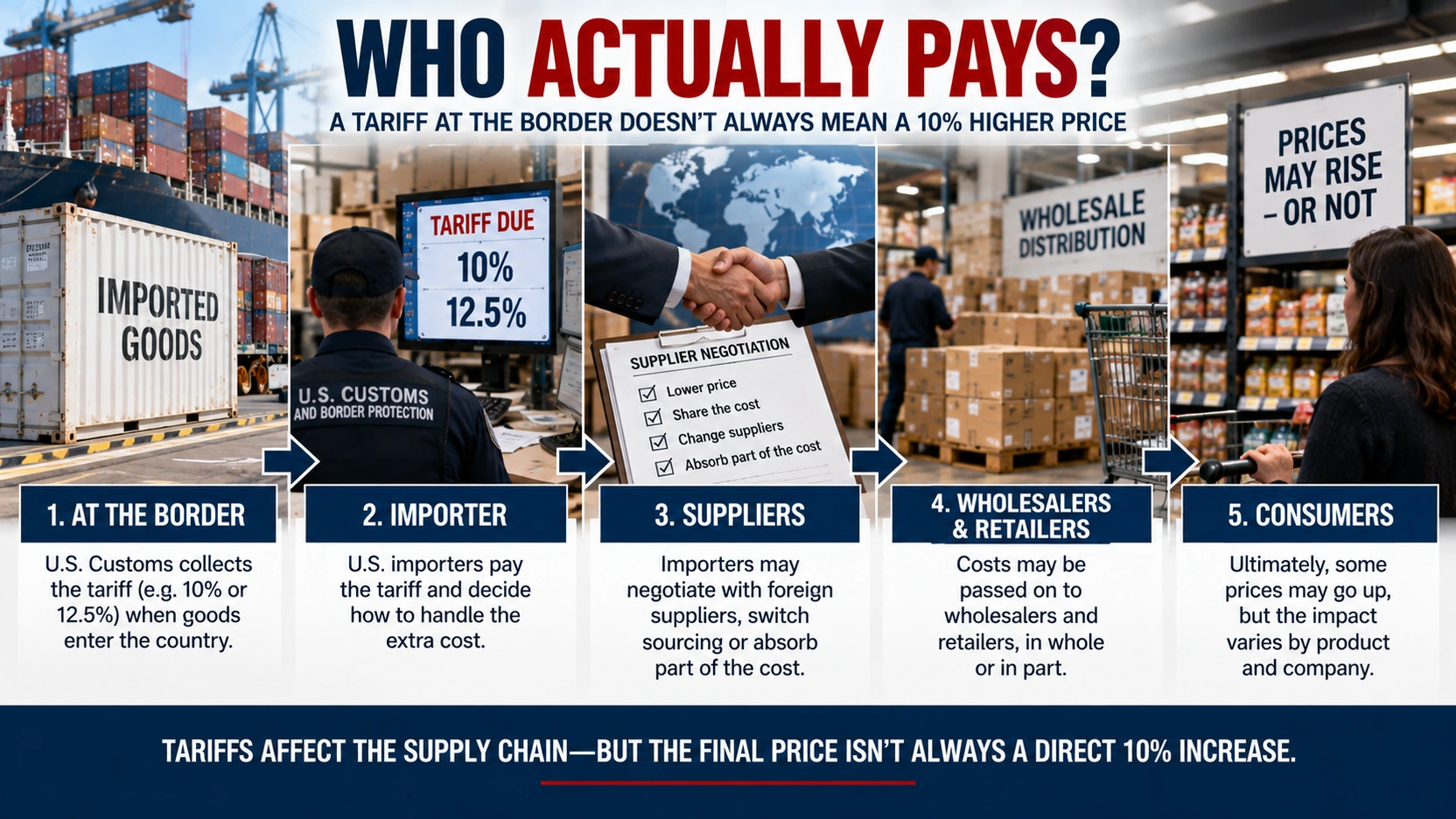
No.
A tariff is collected when merchandise enters the United States. CBP’s implementation guidance tells importers and customs filers how the additional Section 301 duties are assessed on covered entries. (U.S. Customs and Border Protection)
But what happens after that can vary.
A U.S. importer might:
- absorb part of the additional cost,
- negotiate a lower price with a foreign supplier,
- switch sourcing,
- reduce another expense,
- pass some or all of the cost to wholesalers or retailers,
- or eventually raise the price charged to customers.
So a 10% duty does not mechanically mean the price of every affected product rises by exactly 10%.
There is another complication: exemptions, existing most-favored-nation duties and the special rate formulas for several major trading partners mean the additional tariff actually paid can depend on the product’s origin and tariff classification. (White House · CBP)
That is why the court case matters beyond lawyers and trade specialists.
A ruling that changes the tariffs could affect importers’ costs, sourcing decisions and, eventually, some consumer prices—but the effect would differ by product and business.
Are the Tariffs Still in Effect While the Court Decides?
Yes.
The September 30 argument itself did not cancel the duties. The tariffs have been collected on covered imports since July 24, and the Court of International Trade has not yet issued a final ruling in the consolidated challenge. (Federal Register · Reuters)
Reuters reported that the judges closely questioned both sides about the statutory basis and the evidence supporting the tariffs. Possible outcomes include leaving the policy in place or setting aside the action or requiring additional agency work, depending on how the court resolves the legal claims. (Reuters)
For importers, that means the current rule is still the current rule.
Litigation does not by itself erase a tariff.
What Happens Next?
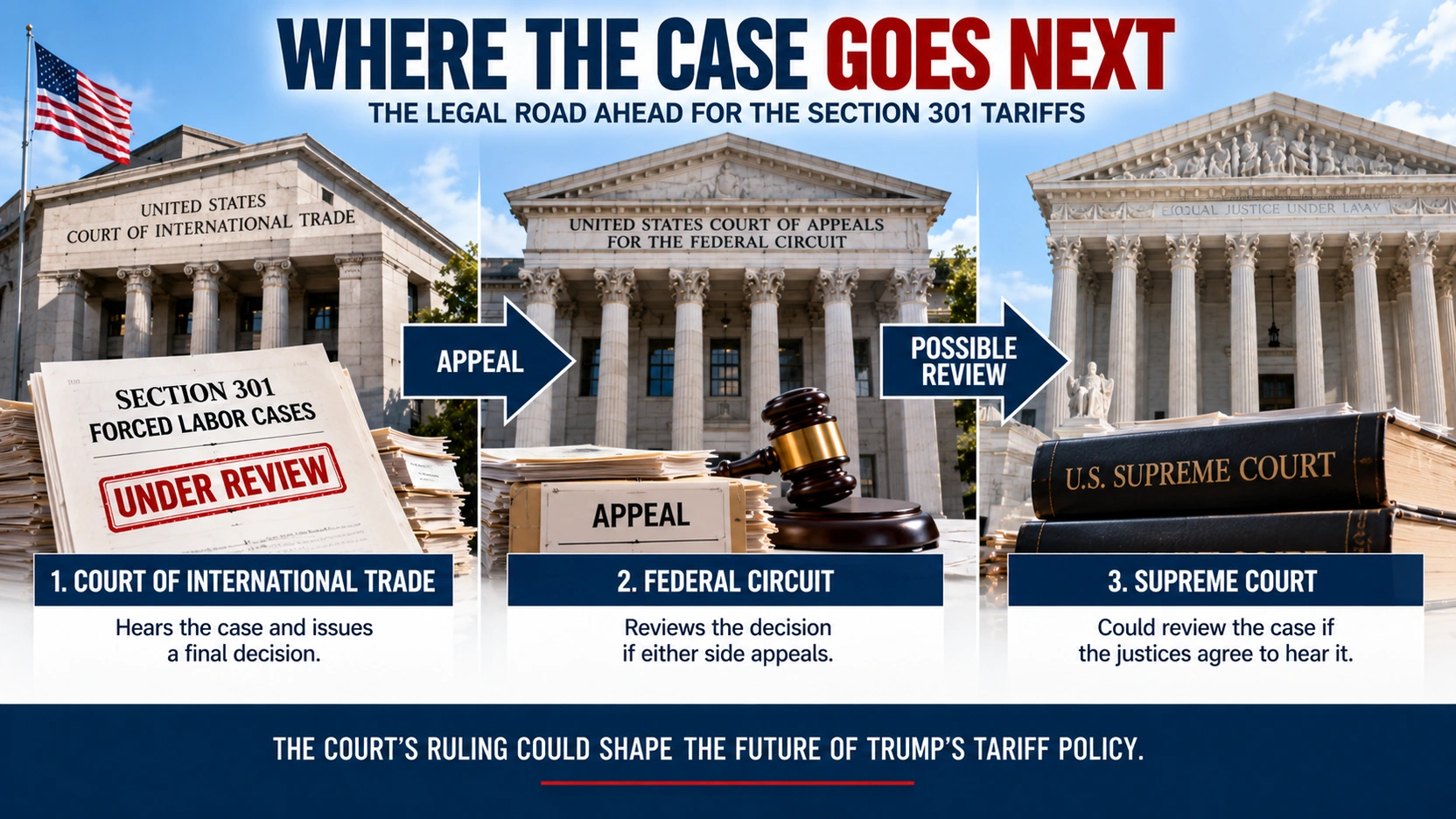
First comes a decision from the Court of International Trade.
A final decision from that court can be appealed to the U.S. Court of Appeals for the Federal Circuit. A case can ultimately reach the Supreme Court if the justices agree to review it. (U.S. Court of International Trade)
That creates several questions worth watching separately:
Does the court say USTR’s factual findings were detailed enough?
Does Section 301 permit a remedy this broad when the underlying practice differs from country to country?
If the judges find a defect, do they invalidate the tariffs outright or send the matter back to USTR?
Would any ruling take effect immediately, or would the tariffs remain in place during an appeal?
Those questions matter because the February Supreme Court ruling did not end the broader legal struggle over presidential tariff policy.
It changed the statute at the center of that struggle.
Bottom Line: What This Story Really Means
The Supreme Court’s February decision did not prohibit the United States from imposing tariffs whenever Congress has actually delegated tariff authority.
It held that IEEPA was not such a law.
Section 301 is different because Congress expressly authorized the U.S. Trade Representative to impose duties in response to certain foreign trade practices.
But that authority comes with legal conditions.
The September 30 case asks whether the Trump administration properly used those conditions to justify broad tariffs covering goods from 60 economies over the way those governments handle imports connected to forced labor.
That is the central distinction:
The first tariff case asked, “Does this law authorize tariffs at all?”
The new case asks, “The law authorizes tariffs—but did the government use that authority the way Congress required?”
Section 301 Tariffs: Key Questions Explained
Q. Did the Supreme Court ban Trump from imposing tariffs?
No. The Supreme Court held that IEEPA did not authorize the tariffs imposed under that emergency statute. Congress has enacted other laws, including Section 301, that expressly authorize tariffs under defined circumstances. (U.S. Supreme Court)
Q. What is Section 301 of the Trade Act?
Section 301 is a U.S. trade-enforcement mechanism that allows the U.S. Trade Representative to respond to certain foreign acts, policies or practices that are unjustifiable, unreasonable or discriminatory and burden or restrict U.S. commerce. Its authorized responses can include tariffs. (U.S. Code)
Q. Are the new tariffs only imposed on products proven to be made with forced labor?
No. The tariffs generally apply according to the origin of covered merchandise from the economies included in the Section 301 action, subject to exemptions and special rate rules. Separate U.S. law already allows CBP to stop individual imports linked to forced labor. (Federal Register · 19 U.S.C. §1307)
Q. How high are the forced-labor Section 301 tariffs?
The general structure uses 10% and 12.5% rates, with special net-of-MFN formulas for the European Union, Taiwan, Japan, South Korea and Switzerland, plus exemptions for certain products. (Federal Register)
Q. Why are businesses and states challenging the tariffs?
The challengers argue that USTR did not adequately establish the required country-specific legal and economic basis for tariffs of this breadth. The administration argues that its investigations, consultations, hearings and findings satisfied Section 301. (Reuters)
Q. Are the Section 301 tariffs still being collected?
Yes. The September 30 hearing did not itself invalidate the duties, which took effect on July 24, 2026. (Federal Register)
Q. Where would an appeal go after the Court of International Trade?
Appeals from final decisions of the U.S. Court of International Trade go to the U.S. Court of Appeals for the Federal Circuit. A case may later reach the U.S. Supreme Court if the Court agrees to hear it. (U.S. Court of International Trade)
Did this help make the story clearer? 🙂
WIN keeps unpacking the “why” behind the news—clearly and simply!
Sources
September 30 Court Challenge and Litigation
Reuters — U.S. trade court weighs challenge to Trump’s forced-labor tariffs
Section 301 Tariffs and Forced-Labor Policy
USTR — Final action in the forced-labor Section 301 investigations
Federal Register — Notice of actions in the 60 forced-labor Section 301 investigations
U.S. Customs and Border Protection — Section 301 forced-labor import duty guidance
Supreme Court and Statutory Authority
U.S. Supreme Court — Learning Resources, Inc. v. Trump, February 20, 2026
U.S. Code — 19 U.S.C. §2411, actions by the U.S. Trade Representative
U.S. Code — 19 U.S.C. §2414, determinations by the U.S. Trade Representative
Keep Reading
How Can the U.S. Lower Some Chinese Tariffs While Keeping Other Tariffs in Place?
Different tariff programs can operate under different statutes, products and policy objectives. The recent U.S.-China arrangement helps show why tariff relief for selected goods does not automatically erase other trade measures.
U.S.-China Deal: What the $30 Billion Tariff Plan and New AI Incident Channel Actually Change